
Life, 1908-03-19 · page 10 of 24
Life — March 19, 1908 — page 10: what you’re looking at
What you’re looking at
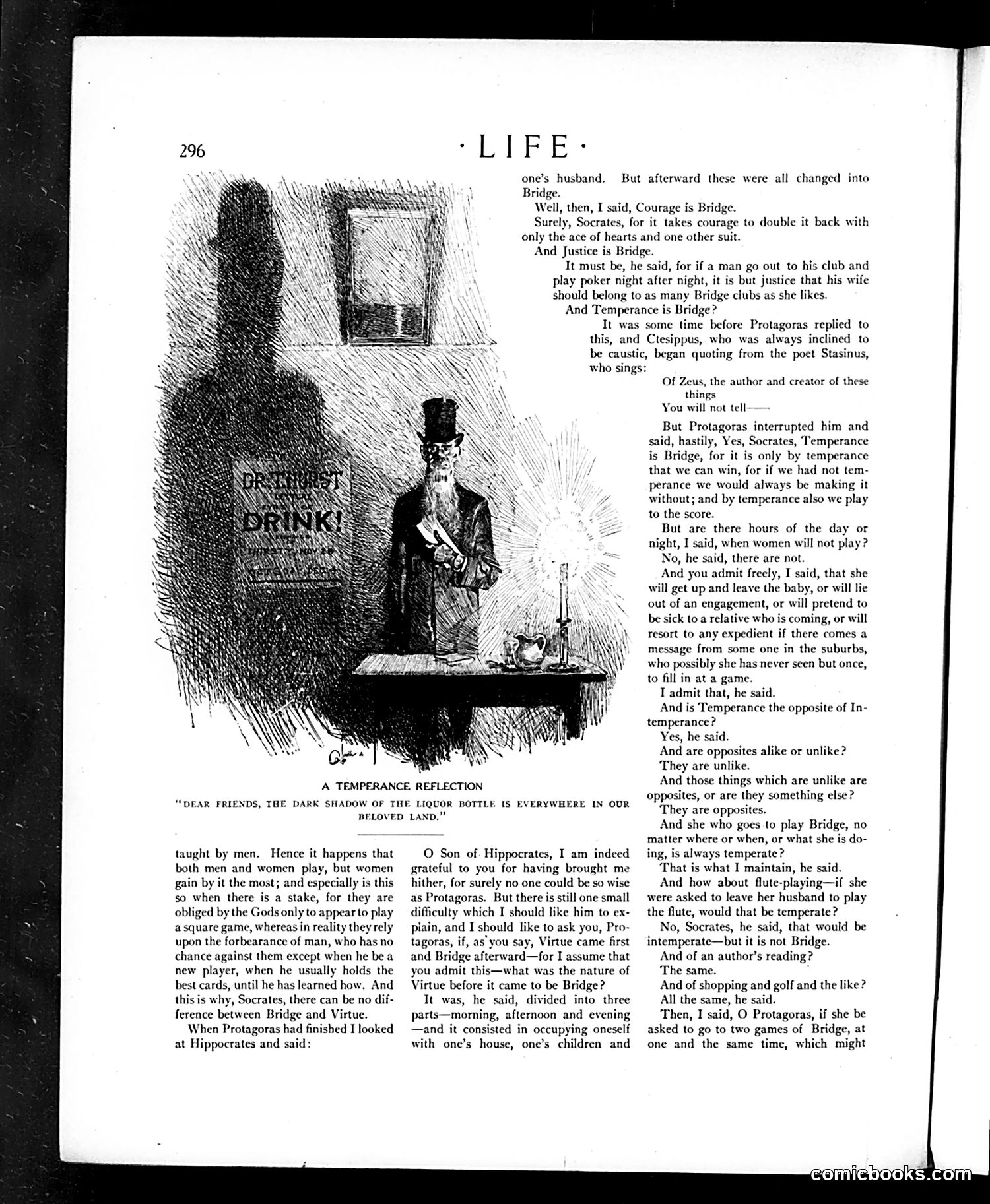
This cartoon satirizes the temperance movement's hypocrisy regarding gender and social rules. The illustration shows a man at a window labeled "DRINK!" — suggesting he frequents bars despite temperance advocacy. The accompanying dialogue presents Socrates debating whether women should play Bridge (a card game). The satire argues that temperance advocates claim virtue requires women to avoid Bridge entirely, yet these same men frequent drinking establishments without similar restrictions. The caption quote — "the dark shadow of the bottle is everywhere in our beloved land" — mocks temperance rhetoric while the cartoon exposes the double standard: men lecture women about moral discipline while exempting themselves from equivalent restraint. The satire criticizes both temperance extremism and gender hypocrisy.
📄 Transcribed text from this page (OCR, searchable)
Machine-transcribed from the original scan — historical spelling and the odd misread are preserved.
‘LIPE- one’s husband. Bridge. A TEMPERANCE REFLECTION “DEAR FRIENDS, THE DARK SHADOW OF THE LIQUOR BOTTLE IS EVERYWHERE IN OUR BELOVED LAND.” taught by men. Hence it happens that both men and women play, but women gain by it the most; and especially is this so when there is a stake, for they are obliged by the Gods only to appear to play a square game, whereas in reality they rely upon the forbearance of man, who has no chance against them except when he be a new player, when he usually holds the best cards, until he has learned how. And this is why, Socrates, there can be no dif- ference between Bridge and Virtue. When Protagoras had finished I looked at Hippocrates and said: O Son of. Hippocrates, I am indeed grateful to you for having brought me hither, for surely no one could be so wise as Protagoras. But there is still one small difficulty which I should like him to ex- plain, and I should like to ask you, Pro- tagoras, if, as you say, Virtue came first and Bridge afterward—for I assume that you admit this—what was the nature of Virtue before it came to be Bridge? It was, he said, divided into three parts—morning, afternoon and evening —and it consisted in occupying oneself h one’s house, one’s children and But afterward these were all changed into Well, then, I said, Courage is Bridge. \ Surely, Socrates, for it takes courage to double it back with only the ace of hearts and one other suit. And Justice is Bridge. It must be, he said, for if a man go out to his club and play poker night after night, it is but justice that his wife should belong to as many Bridge clubs as she likes. And Temperance is Bridge? It was some time before Protagoras replied to this, and Ctesippus, who was always inclined to be caustic, began quoting from the poet Stasinus, who sings: Of Zeus, the author and creator of these things You will not tell—— But Protagoras interrupted him and said, hastily, Yes, Socrates, Temperance is Bridge, for it is only by temperance that we can win, for if we had not tem- perance we would always be making it without; and by temperance also we play to the score. But are there hours of the day or night, I said, when women will not play? No, he said, there are not. And you admit freely, I said, that she will get up and leave the baby, or will lie out of an engagement, or will pretend to be sick toa relative who is coming, or will resort to any expedient if there comes a message from some one in the suburbs, who possibly she has never seen but once, to fill in at a game. I admit that, he said. And is Temperance the opposite of In- temperance? Yes, he said. And are opposites alike or unlike? They are unlike. And those things which are unlike are opposites, or are they something else? ‘They are opposites. And she who goes to play Bridge, no matter where or when, or what she is do- ing, is always temperate? That is what I maintain, he said. And how about flute-playing—if she were asked to leave her husband to play the flute, would that be temperate? No, Socrates, he said, that would be intemperate—but it is not Bridge. And of an author’s reading? The same. . And of shopping and golf and the like? All the same, he said. ‘Then, I said, O Protagoras, if she be asked to go to two games of Bridge, at one and the same time, which might