
Life, 1908-03-19 · page 16 of 24
Life — March 19, 1908 — page 16: what you’re looking at
What you’re looking at
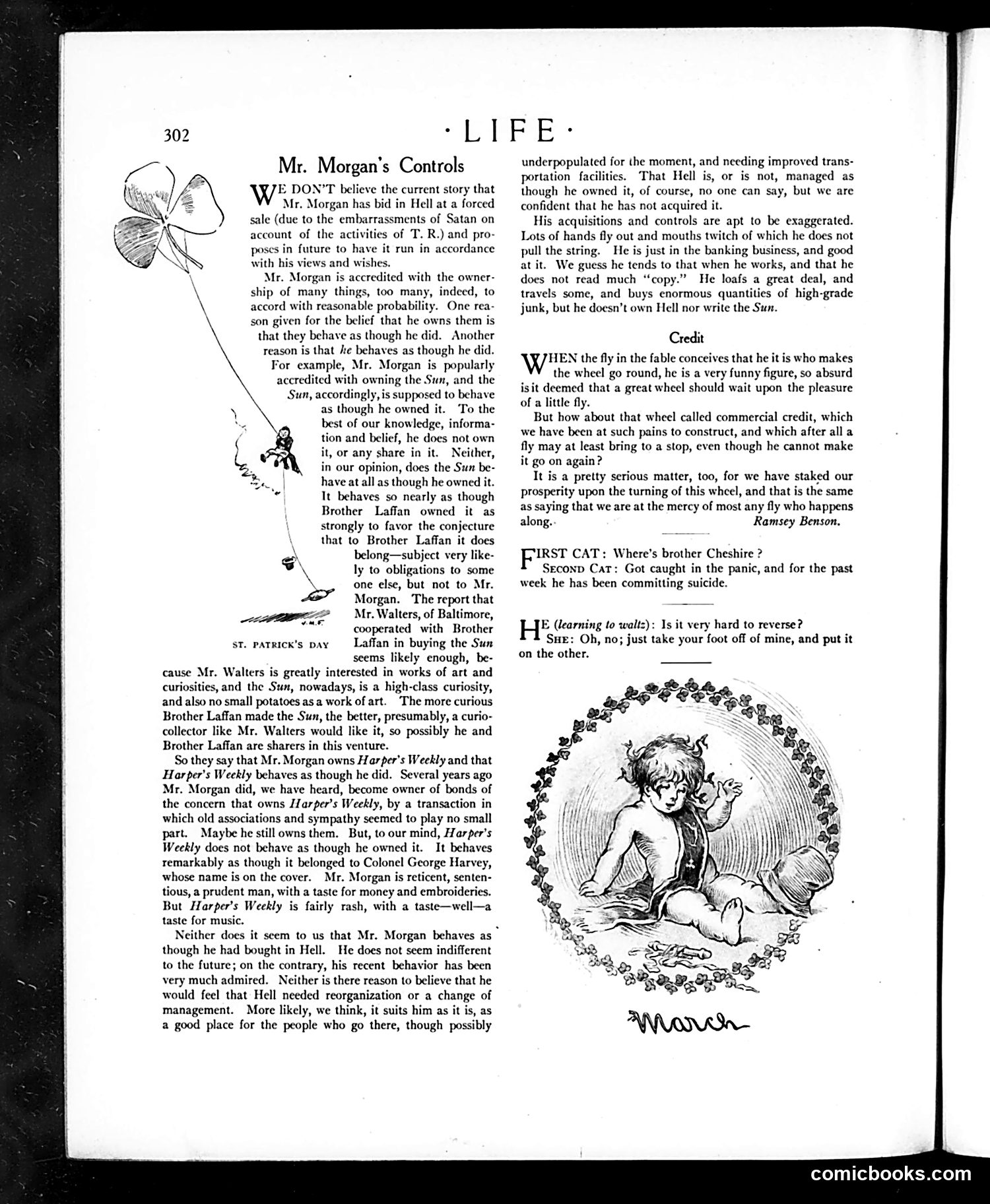
This page mocks the widespread belief that banker J.P. Morgan controls numerous major institutions—the Sun newspaper, Harper's Weekly magazine, and even (jokingly) "Hell" itself. The satire appears to reference Theodore Roosevelt ("T.R."), suggesting Morgan's influence extends into political spheres. The article argues Morgan doesn't actually own or control these entities as directly as rumors suggest. It compares exaggerating his power to Aesop's fable where a fly believes it propels a wagon wheel—absurdly inflating minor influence into total control. Real figures mentioned include Colonel George Harvey (Harper's Weekly editor) and Baltimore art collector Mr. Walters, who the piece credits with actual influence over publications Morgan only partially owns through bonds. The accompanying illustrations (St. Patrick's Day imagery and cherub) appear decorative rather than directly satirical. The piece's central point: Morgan is "just in the banking business"—powerful but not the omnipotent puppet-master popular imagination has created.
📄 Transcribed text from this page (OCR, searchable)
Machine-transcribed from the original scan — historical spelling and the odd misread are preserved.
“(i PRE « Mr. Morgan’s Controls E DON’T believe the current story that Mr. Morgan has bid in Hell at a forced sale (due to the embarrassments of Satan on account of the acti of T. R.) and pro- poses in future to have it run in accordance with his vi and wishes, Mr. Morgan is accredited with the owner- ship of many things, too many, indeed, to accord with reasonable probability. One rea- son given for the belief that he owns them is that they behave as though he did. Another reason is that /te behaves as though he did. For example, Mr. Morgan is popularly accredited with owning the Sun, and the Sun, accordingly, is supposed to behave as though he owned it. To the best of our knowledge, informa- tion and belief, he does not own it, or any share in it. Neither, in our opinion, does the Sun be- have at all as though he owned it. Tt behaves so nearly as though Brother Lafian owned it as strongly to favor the conjecture that to Brother Laffan it does belong—subject very like- ly to obligations to some one else, but not to Mr. Morgan. The report that Mr. Walters, of Baltimore, cooperated with Brother Laffan in buying the Sun seems likely enough, be- cause Mr. Walters is greatly interested in works of art and curiosities, and the Sun, nowadays, is a high-class curiosity, and also no small potatoes as a work of art. The more curious Brother Laffan made the Sun, the better, presumably, a curio- collector like Mr. Walters would like it, so possibly he and Brother Laffan are sharers in this venture. So they say that Mr. Morgan owns Harper's Weekly and that Harper's Weekly behaves as though he did. Several years ago Mr. Morgan did, we have heard, become owner of bonds of the concern that owns Harper's Weekly, by a transaction in which old associations and sympathy seemed to play no small part. Maybe he still owns them. But, to our mind, Harper's Weekly does not behave as though he owned it. It behaves remarkably as though it belonged to Colonel George Harvey, whose name is on the cover. Mr. Morgan is reticent, senten- tious, a prudent man, with a taste for money and embroideries. But Harper’s Weekly is fairly rash, with a taste—well—a taste for music. ST. PATRICK'S DAY Neither does it seem to us that Mr. Morgan behaves as though he had bought in Hell. He does not seem indifferent to the future; on the contrary, his recent behavior has been very much admired. Neither is there reason to believe that he would feel that Hell needed reorganization or a change of management. More likely, we think, it suits him as it is, as a good place for the people who go there, though possibly underpopulated for the moment, and needing improved trans- portation facilities. That Hell is, or is not, managed as though he owned it, of course, no one can say, but we are confident that he has not acquired it. His acquisitions and controls are apt to be exaggerated. Lots of hands fly out and mouths twitch of which he does not pull the string. He is just in the banking business, and good at it. We guess he tends to that when he works, and that he does not read much “copy.” He loafs a great deal, and travels some, and buys enormous quantities of high-grade junk, but he doesn’t own Hell nor write the Sun. Credit HEN the fly in the fable conceives that he it is who makes the wheel go round, he is a very funny figure, so absurd isit deemed that a great wheel should wait upon the pleasure of a little fly. But how about that wheel called commercial credit, which we have been at such pains to construct, and which after all a fly may at least bring to a stop, even though he cannot make it go on again? It is a pretty serious matter, too, for we have staked our prosperity upon the turning of this whcel, and that is the same as saying that we are at the mercy of most any fly who happens along. Ramsey Benson. IRST CAT: Where's brother Cheshire ? Seconp Cat: Got caught in the panic, and for the past week he has been committing suicide. E (learning to waltz): Is it very hard to reverse? SHE: Oh, no; just take your foot off of mine, and put it on the other. comicbooks.com