
Life, 1908-03-19 · page 9 of 24
Life — March 19, 1908 — page 9: what you’re looking at
What you’re looking at
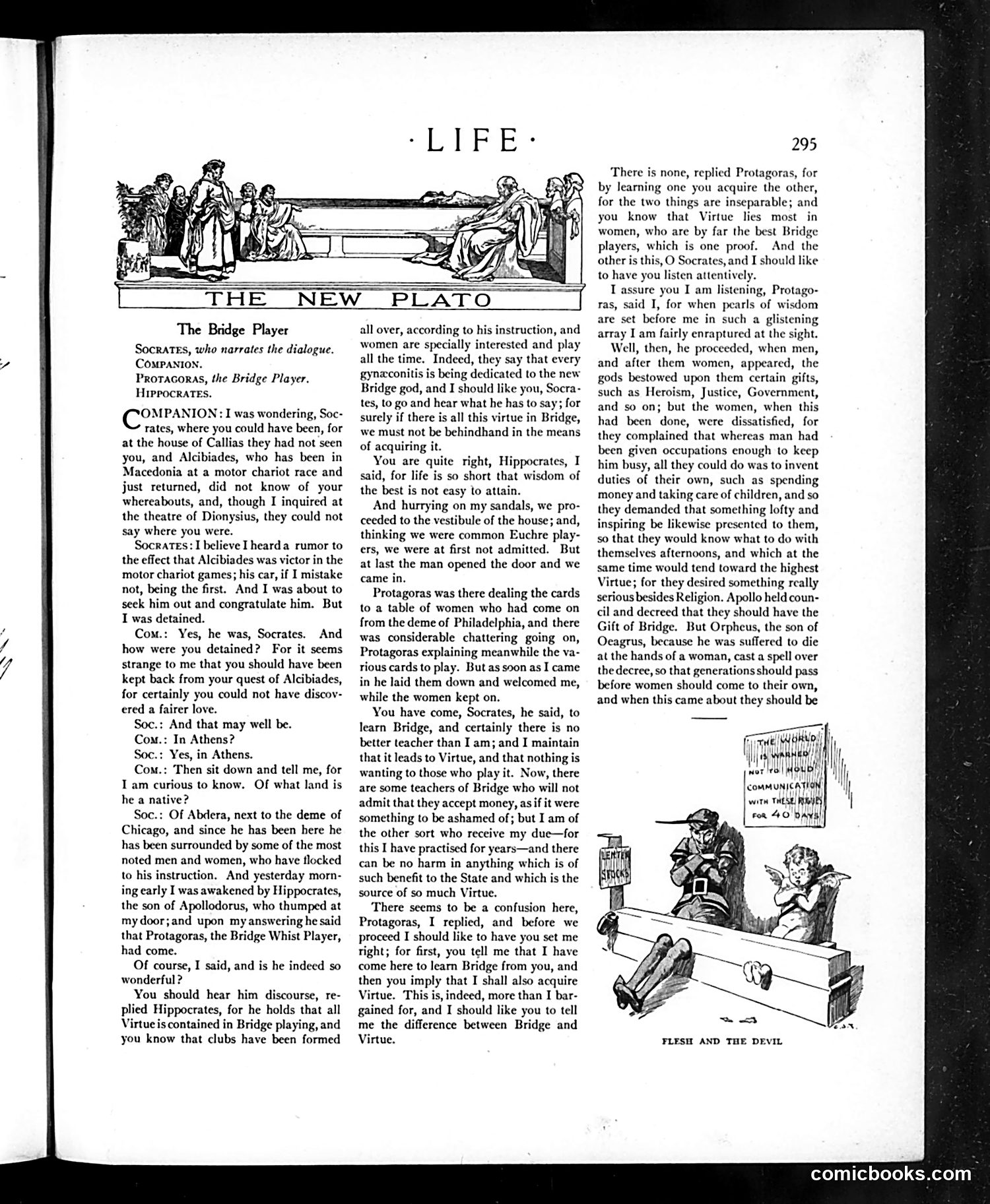
This page presents "The Bridge Player," a Platonic dialogue where Socrates questions Protagoras and Hippocrates about Bridge—a card game that was apparently becoming culturally significant enough to merit philosophical treatment. The satire mocks the pretension of treating a parlor game with serious philosophical weight. The dialogue humorously debates whether Bridge teaching requires payment, whether it leads to Virtue, and the distinction between Bridge skill and actual Virtue itself. The bottom cartoon, "Flesh and the Devil," appears unrelated—a separate satirical illustration about temptation. The overall joke: elevating a mere card game to the status of ancient Greek philosophical inquiry, poking fun at both Bridge's cultural importance and contemporary intellectual pretension.
📄 Transcribed text from this page (OCR, searchable)
Machine-transcribed from the original scan — historical spelling and the odd misread are preserved.
THE NEW PLAT The Bridge Player Socrates, who narrates the dialogue. CoMPANION. Proracoras, the Bridge Player. Hippocrates. OMPANION: I was wondering, Soc- rates, where you could have been, for at the house of Callias they had not seen you, and Alcibiades, who has been in Macedonia at a motor chariot race and just returned, did not know of your whereabouts, and, though I inquired at the theatre of Dionysius, they could not say where you were. Socrates: I believe Ihearda rumor to the effect that Alcibiades was victor in the motor chariot games; his car, if I mistake not, being the first. And I was about to seek him out and congratulate him. But I was detained. Com.: Yes, he was, Socrates. And how were you detained? For it seems strange to me that you should have been kept back from your quest of Alcibiades, for certainly you could not have discov- ered a fairer love. Soc.: And that may well be. Com.: In Athens? Soc.: Yes, in Athens. Com.: Then sit down and tell me, for I am curious to know. Of what land is he a native? Soc.: Of Abdera, next to the deme of Chicago, and since he has been here he has been surrounded by some of the most noted men and women, who have flocked to his instruction. And yesterday morn- ing early I was awakened by Hippocrates, the son of Apollodorus, who thumped at my door;and upon my answering he said that Protagoras, the Bridge Whist Player, had come. Of course, I said, and is he indeed so wonderful? You should hear him discourse, re- plied Hippocrates, for he holds that all Virtucis contained in Bridge playing, and you know that clubs have been formed all over, according to his instruction, and women are specially interested and play all the time. Indeed, they say that every gynaconitis is being dedicated to the new Bridge god, and I should like you, Socra- tes, to go and hear what he has to say; for surely if there is all this virtue in Bridge, we must not be behindhand in the means of acquiring it. You are quite right, Hippocrates, I said, for life is so short that wisdom of the best is not easy to attain. And hurrying on my sandals, we pro- ceeded to the vestibule of the house; and, thinking we were common Euchre play- ers, we were at first not admitted. But at last the man opened the door and we came in, Protagoras was there dealing the cards to a table of women who had come on from the deme of Philadelphia, and there was considerable chattering going on, Protagoras explaining meanwhile the va- rious cards to play. But as soon as I came in he laid them down and welcomed me, while the women kept on. You have come, Socrates, he said, to learn Bridge, and certainly there is no better teacher than I am; and I maintait that it leads to Virtue, and that nothing is wanting to those who play it. Now, there are some teachers of Bridge who will not admit that they accept money, as if it were something to be ashamed of; but I am of the other sort who receive my due—for this I have practised for years—and there can be no harm in anything which is of such benefit to the State and which is the source of so much Virtue. There seems to be a confusion here, Protagoras, I replied, and before we proceed I should like to have you set me right; for first, you tell me that I have come here to learn Bridge from you, and then you imply that I shall also acquire Virtue. This is, indeed, more than I bar- gained for, and I should like you to tell me the difference between Bridge and Virtue. 295 There is none, replied Protagoras, for by learning one you acquire the other, for the two things are inseparable; and you know that Virtue lies most in women, who are by far the best Bridge players, which is one proof. And the other is this, O Socrates, and I should like to have you listen attentively. T assure you I am listening, Protago- ras, said I, for when pearls of wisdom are set before me in such a glistening array I am fairly enraptured at the sight. Well, then, he proceeded, when men, and after them women, appeared, the gods bestowed upon them certain gifts, such as Heroism, Justice, Government, and so on; but the women, when this had been done, were dissatisfied, for they complained that whereas man had been given occupations enough to keep him busy, all they could do was to invent duties of their own, such as spending money and taking care of children, and so they demanded that something lofty and inspiring be likewise presented to them, so that they would know what to do with themselves afternoons, and which at the same time would tend toward the highest Virtue; for they desired something really serious besides Religion. Apollo held coun- cil and decreed that they should have the Gift of Bridge. But Orpheus, the son of Ocagrus, because he was suffered to die at the hands of a woman, cast a spell over the decree, so that generations should pass before women should come to their own, and when this came about they should be |coumunjcn ti wit THESE, Ry Fon 40 DAYS! FLESH AND THE DEVIL comicbooks.com