
Life, 1908-03-19 · page 14 of 24
Life — March 19, 1908 — page 14: what you’re looking at
What you’re looking at
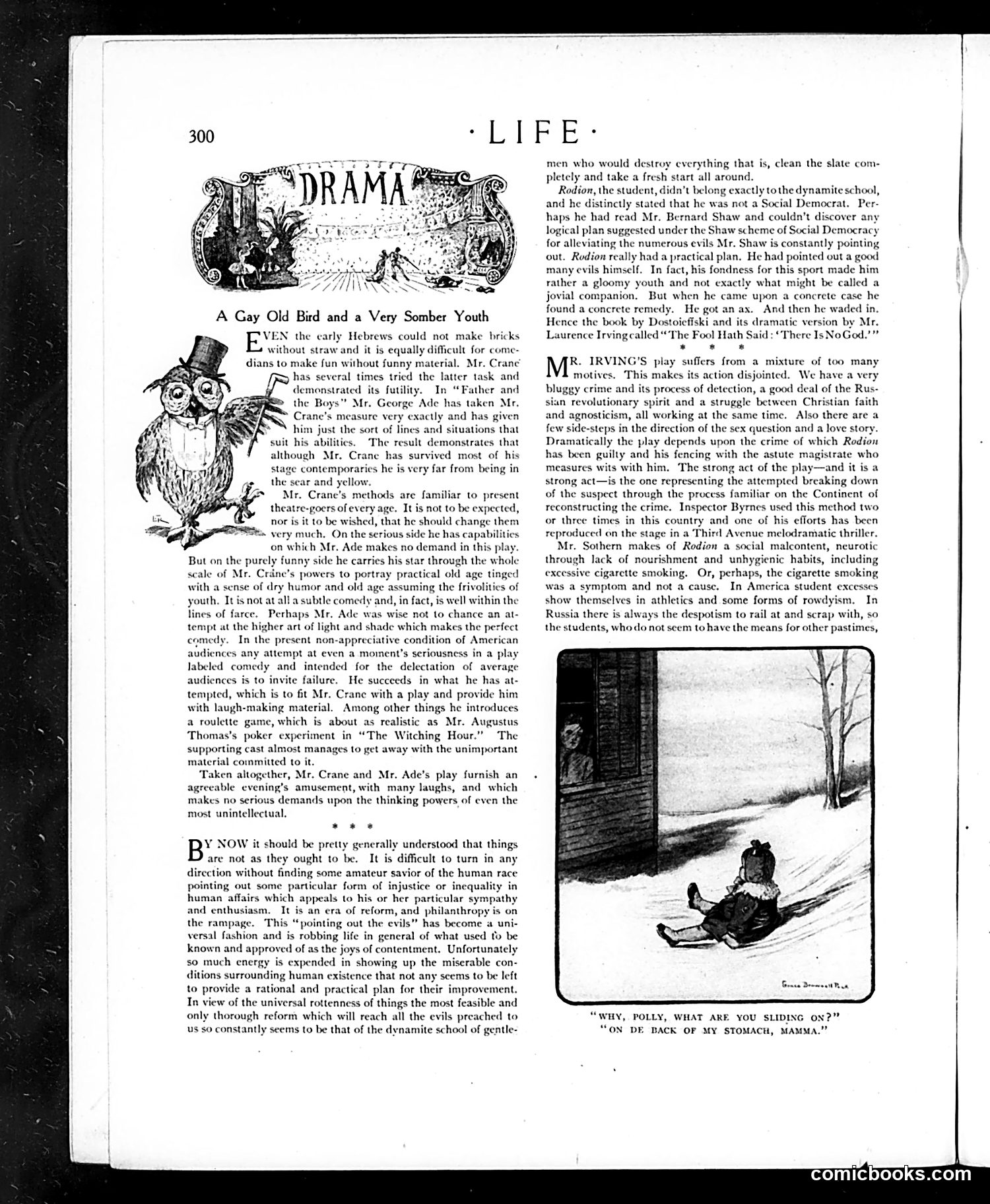
This page reviews a stage play starring **William Crane** (the owl caricature), paired with playwright **George Ade**. The critic praises their lightweight farce as appropriate entertainment—acknowledging Crane's comedic talents while noting the play makes no intellectual demands on audiences. The second article satirizes the era's reform movements and radical politics. It references **Rodion**, apparently a character from Dostoevsky's *Crime and Punishment*, critiquing "dynamite school" anarchists and Social Democrats who spend energy denouncing societal evils without proposing practical solutions. The satirist suggests these reformers are more interested in destruction than actual improvement. The accompanying illustration (captioned "Why, Polly, what are you sliding on? / On de back of my stomach, Mamma") appears to be unrelated comedic filler—a child sledding on an adult's belly. The satire targets both impractical radical philosophy and the era's obsession with "pointing out evils" without constructive remedies.
📄 Transcribed text from this page (OCR, searchable)
Machine-transcribed from the original scan — historical spelling and the odd misread are preserved.
A Gay Old Bird and a Very Somber Youth VEN the carly Hebrews could not make bricks without straw and it is equally difficult for come- dians to make fun without funny material. Mr. Crane has several times tried the latter task and demonstrated its futility. In “Father and the Boys" Mr. George Ade has taken Mr. Crane’s measure very exactly and has given him just the sort of lines and situations that suit his abilities. ‘The result demonstrates that although Mr, Crane has survived most of his stage contemporaries he is very far from being in the sear and yellow. Mr. Crane's methods are familiar to present theatre-goers of every age. It is not to be expected, nor is it to be wished, that he should change them very much, On the serious side he has capabilities on which Mr. Ade makes no demand in this play. But on the purely funny side he carries his star through the whole scale of Mr. Crine’s powers to portray practical old age tinged with a sense of dry humor and old age assuming the frivolitics of youth. It isnot at all a subtle comedy and, in fact, is well within the lines of farce. Perhaps Mr. Ade was wise not to chance an at- tempt at the higher art of light and shade which makes the perfect comedy. In the present non-appreciative condition of American audiences any attempt at even a moment’s seriousness in a play labeled comedy and intended for the delectation of average audiences is to invite failure. He succeeds in what he has at- tempted, which is to fit Mr. Crane with a play and provide him with laugh-making material. Among other things he introduces a roulette game, which is about as realistic as Mr. Augustus Thomas's poker experiment in “The Witching Hour.” The supporting cast almost manages to get away with the unimportant material committed to it. ‘Taken altogether, Mr. Crane and Mr. Ade’s play furnish an agreeable cvening’s amusement, with many laughs, and which makes no serious demands upon the thinking powers of even the most unintellectual. Y NOW it should be pretty generally understood that things are not as they ought to be. It is difficult to turn in any direction without finding some amateur savior of the human race pointing out some particular form of injustice or inequality in human affairs which appeals to his or her particular sympathy and enthusiasm. It is an era of reform, and philanthroy the rampage. ‘This “pointing out the evils” has become a uni- versal fashion and is robbing life in general of what used to be known and approved of as the joys of contentment. Unfortunately so much cnergy is expended in showing up the miserable con- ditions surrounding human existence that not any seems to be left to provide a rational and practical plan for their improvement. In view of the universal rottenness of things the most feasible and only thorough reform which will reach all the evils preached to us so constantly seems to be that of the dynamite school of gentle- = LIVE ¢ men who would destroy everything that is, clean the slate com- pletely and take a fresh start all around, Rodion, the student, didn’t belong exactly tothe dynamite school, and he distinctly stated that he was not a Social Democrat. Per- haps he had read Mr. Bernard Shaw and couldn't discover any logical plan suggested under the Shaw scheme of Social Democracy for alleviating the numerous evils Mr. Shaw is constantly pointing out. Rodion really had a practical plan, He had pointed out a good many evils himself, In fact, his fondness for this sport made him rather a gloomy youth and not exactly what might be called a jovial companion. But when he came upon a concrete case he found a concrete remedy. He got an ax. And then he waded in. Hence the book by Dostoiefiski and its dramatic version by Mr. Laurence Irving called “The Fool Hath Said : ‘There Is No God. * * # R. IRVING'S play suffers from a mixture of too many This makes its action disjointed. We have a very bluggy crime and its process of detection, a good deal of the Rus- sian revolutionary spirit and a struggle between Christian faith and agnosticism, all working at the same time. Also there are a few side-steps in the direction of the sex question and a love story Dramatically the play depends upon the crime of which Rodion has been guilty and his fencing with the astute magistrate who measures wits with him, The strong act of the play—and it is a strong act—is the one representing the attempted breaking down of the suspect through the process familiar on the Continent of reconstructing the crime. Inspector Byrnes used this method two or three times in this country and one of his efforts has been reproduced on the stage in a Third Avenue melodramatic thriller. Mr. Sothern makes of Redion a social malcontent, neurotic through lack of nourishment and unhygicnic habits, including excessive cigarette smoking. Or, perhaps, the cigarette smoking was a symptom and not a cause. In America student excesses show themselves in athletics and some forms of rowdyism. In Russia there is always the despotism to rail at and scrap with, so the students, who do not scem to have the means for other pastimes, motives “WHY, POLLY, WHAT ARE YOU SLIDING oN?” “ON DE BACK OF MY STOMACH, MAMMA.”” comicbooks.com