
A complete issue · 36 pages · 1908
Life — February 6, 1908
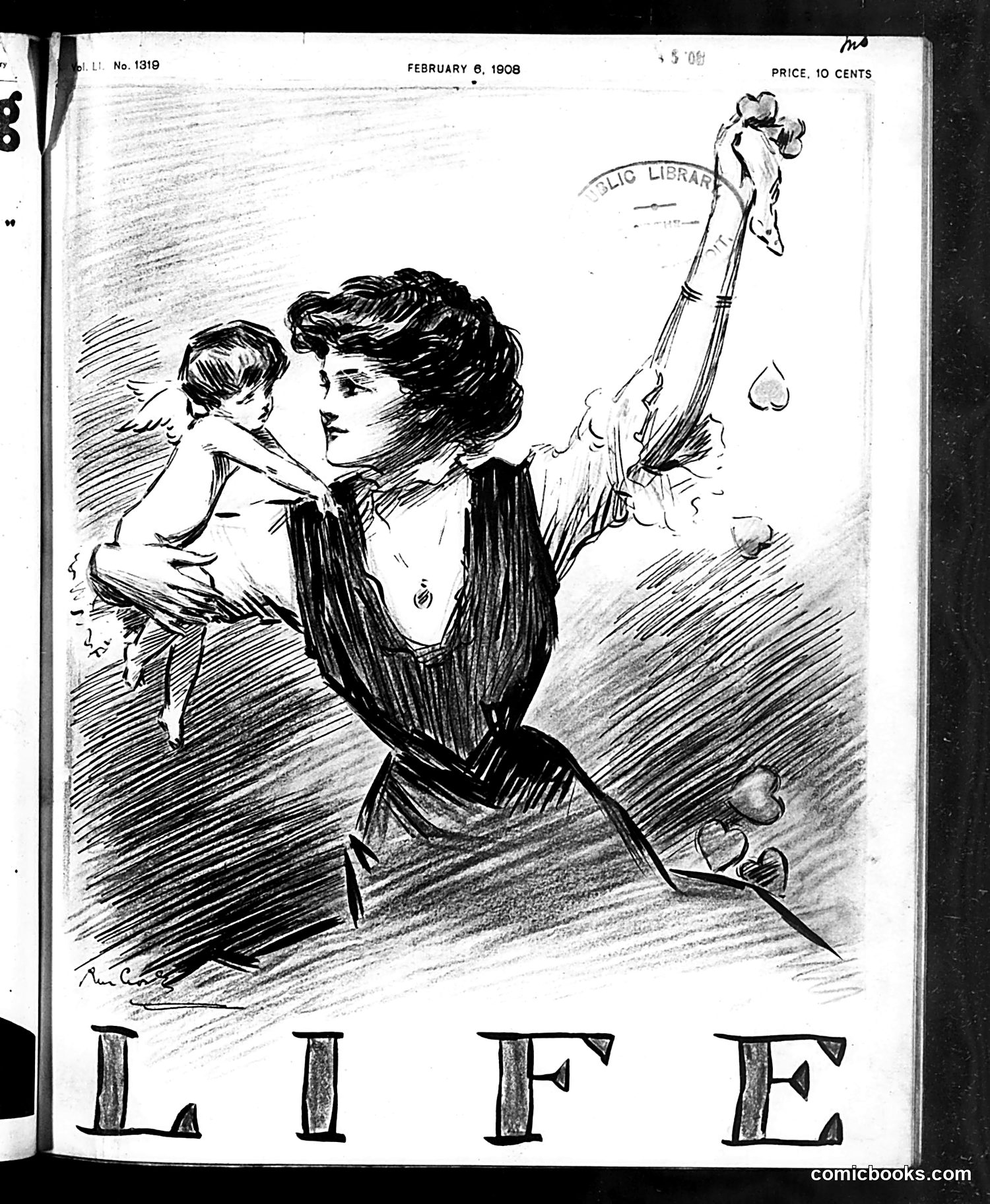
This is a cover illustration titled "LIFE" depicting a woman holding a cherub or cupid figure aloft like a trophy or prize. She cradles a small child in her other arm. The woman appears elegantly dressed in early 1900s fashion, and hearts are scattered around the composition. The satire likely comments on **motherhood, marriage, or romantic aspiration** as cultural ideals for women in the Edwardian era. The triumphant pose—holding the cupid/love symbol victoriously—may mock women's limited social roles being reduced to romantic pursuits and childbearing, or conversely celebrate maternal pride. Without accompanying article text, the precise satirical target remains somewhat unclear, though it clearly engages with contemporary expectations about women's identity and fulfillment.
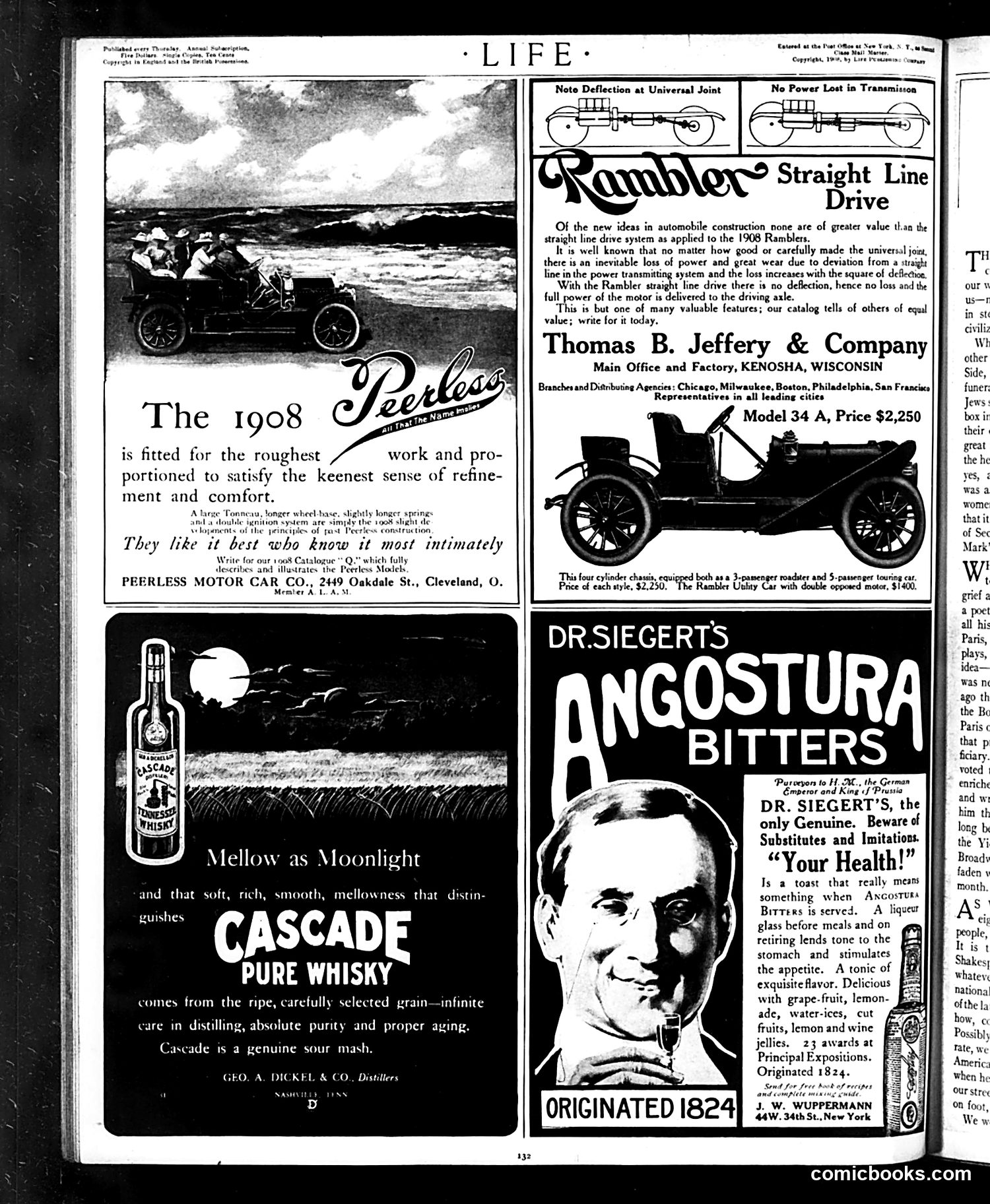
This page is **primarily advertising** rather than satire or political commentary. It contains four product advertisements from circa 1908: 1. **Peerless Motor Car** (1908 model) — emphasizes durability for rough work 2. **Rambler automobile** — highlights their "straight line drive" transmission system as superior to competing designs 3. **Cascade Pure Whisky** — describes its smooth, mellow quality 4. **Dr. Siegert's Angostura Bitters** — a medicinal tonic claiming health benefits, noted as "originated 1824" There are no political cartoons or satirical commentary visible. The page represents typical early 20th-century magazine advertising, mixing automobiles with alcohol and patent medicines—products that would later face regulatory restrictions.
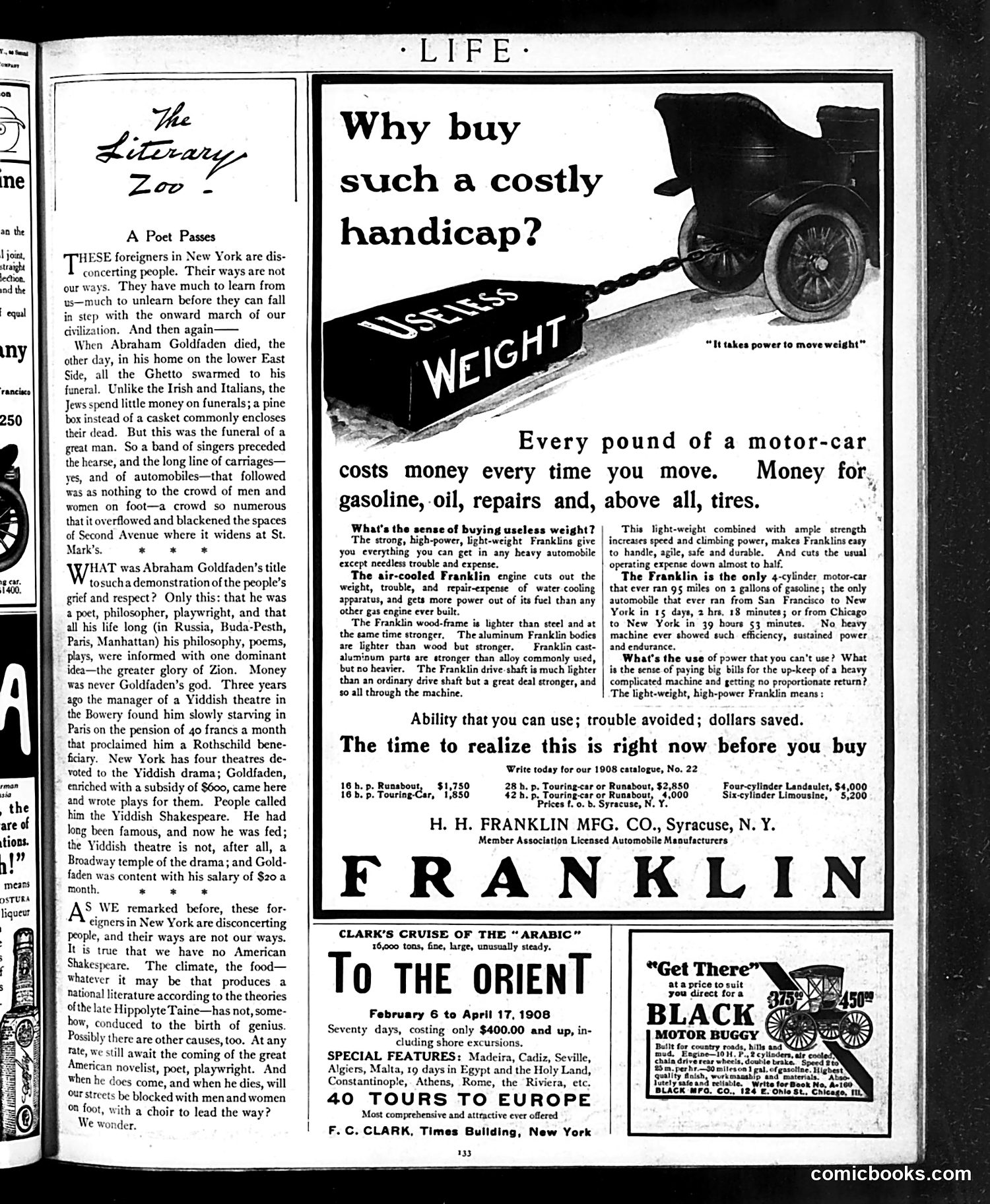
This page is primarily **advertising**, not satire. The dominant content is a Franklin automobile advertisement featuring a detailed pitch about why buyers should choose a Franklin car based on weight efficiency and engineering superiority. The left column contains "The Literary Zoo," a brief essay about Abraham Goldfaden, a Yiddish theater pioneer in New York. The author discusses how foreign immigrants like Goldfaden enriched American culture despite modest means, using his funeral as an example of community support. The advertisements promote Franklin automobiles, a cruise to the Orient, and a Black Motor Buggy. There is no political cartoon or satirical commentary on this page—it's a straightforward magazine layout mixing cultural commentary with period advertising.
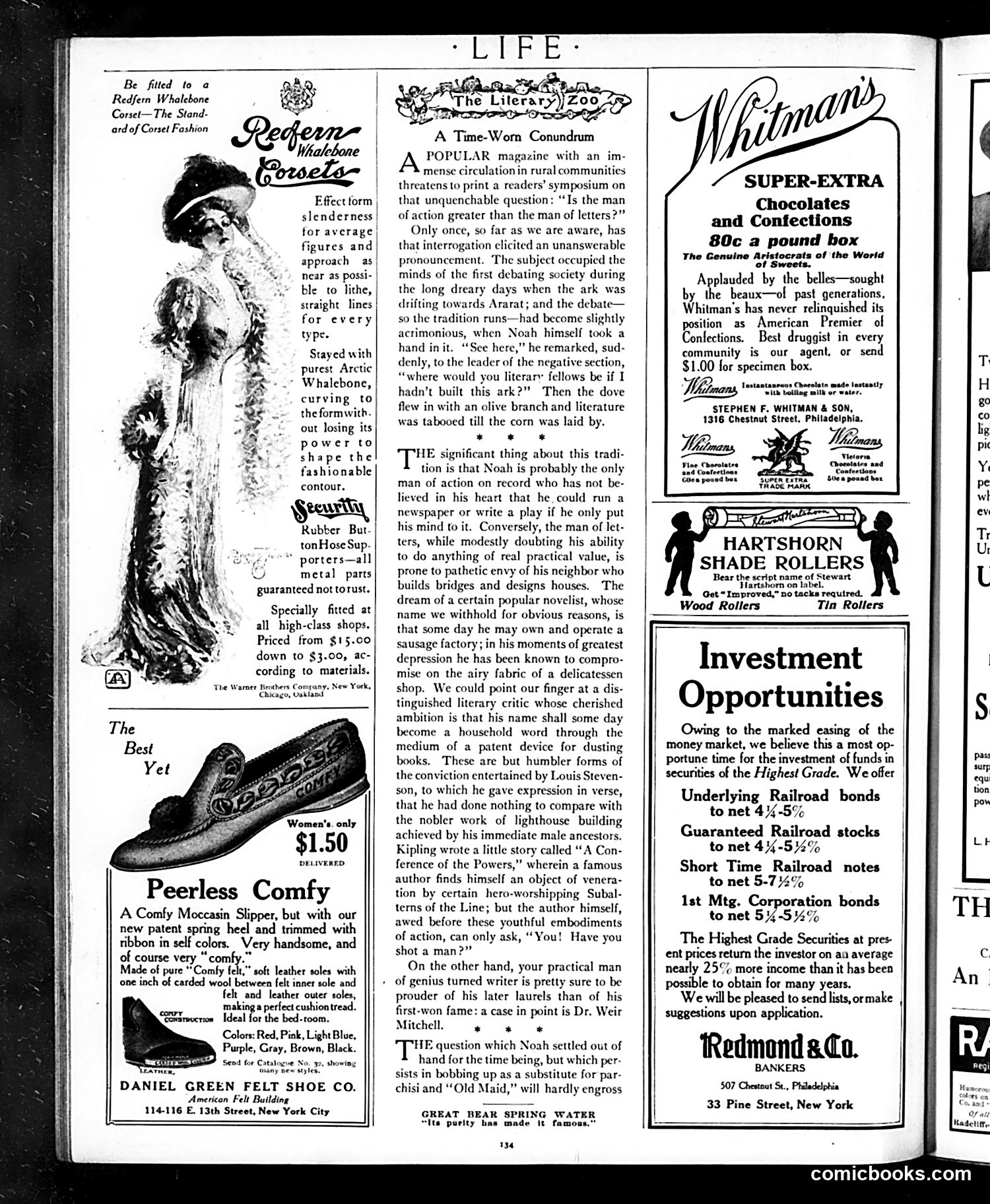
This page is primarily **advertisements and commercial content** with minimal satirical editorial material. The main feature is "A Time-Worn Conundrum," a brief essay debating whether "the man of action" is greater than "the man of letters"—using Noah (man of action) as an example. The piece humorously suggests that practical men like Noah rarely gain literary recognition, while writers earn fame despite doing less tangible work. The bulk of the page contains product ads: Redern corsets, Whitman's chocolates, Peerless Comfy shoes, Hartshorn shade rollers, and investment opportunities from Redmond & Co. **No political cartoons are present.** This appears to be a typical Life magazine page from the early 20th century mixing light social commentary with commercial advertising.
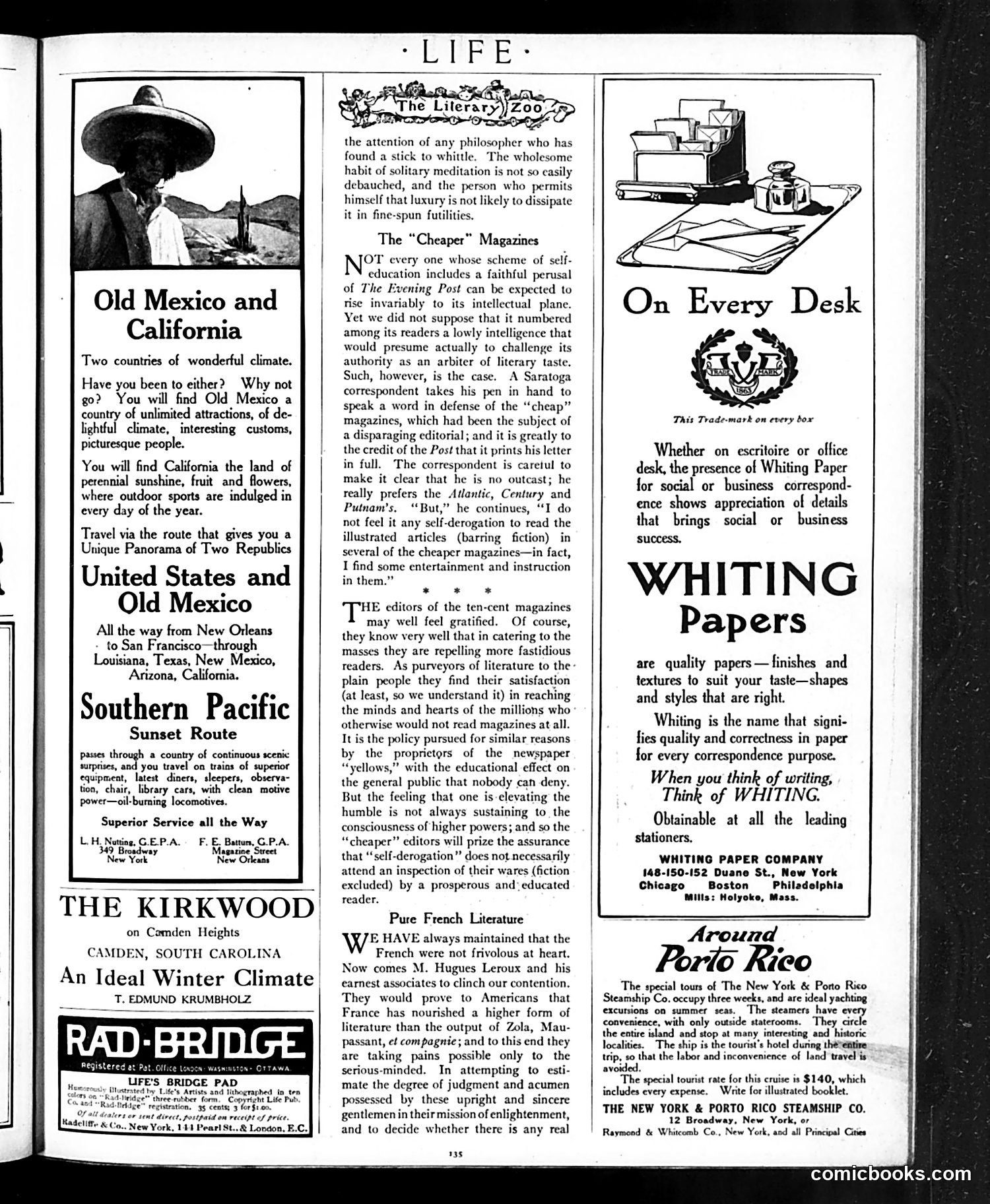
This page is **primarily advertising** rather than satirical content. The ads promote travel destinations (Mexico, California, Southern Pacific railroad), stationery products (Whiting Papers), and a resort (The Kirkwood in Camden, South Carolina). The one substantive article—"The 'Cheaper' Magazines"—defends *The Evening Post* against criticism that inexpensive ten-cent magazines like *Century* and *Putnam's* represent lowbrow entertainment. The piece argues these magazines actually serve the masses respectably, offering both entertainment and instruction. It's a meta-commentary on magazine culture and class anxieties about popular versus elite reading materials—but this is editorial content, not satirical cartooning.
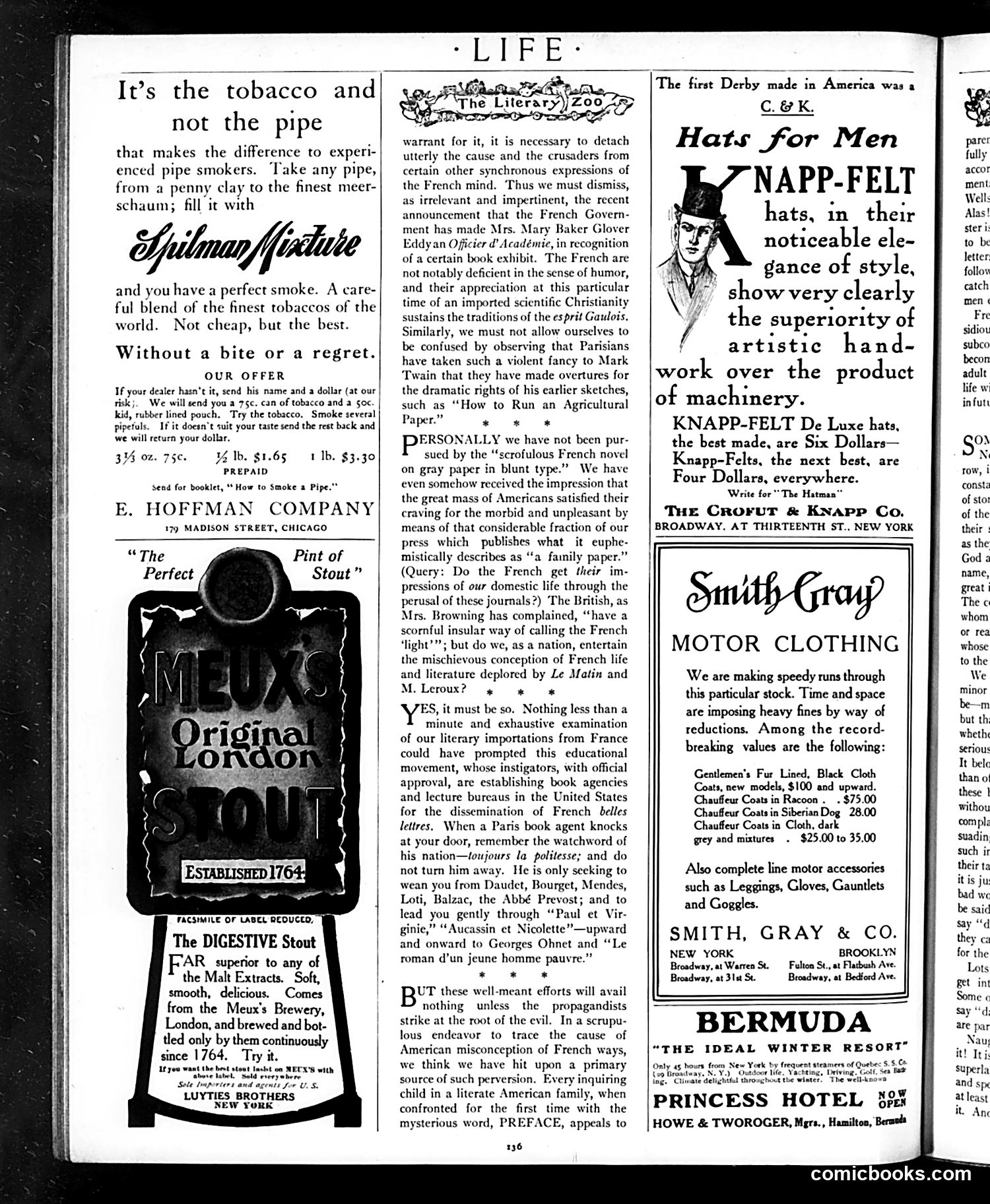
This page is **primarily advertising** with one brief satirical article. The main content includes ads for Spulman Mixture tobacco, Knapp-Felt hats, Smith-Gray motor clothing, and resort destinations—typical of Life magazine's commercial content. The only editorial text is a short piece mocking French cultural pretensions in America. It satirizes how Americans have absorbed misleading impressions of French life through literature (referencing *Le Malin* and *Le Matin* newspapers). The author suggests that French novels promoting romantic notions of Parisian life have created false expectations among educated Americans, and criticizes this as cultural influence worth examining. The satire is gentle social commentary rather than pointed political critique.
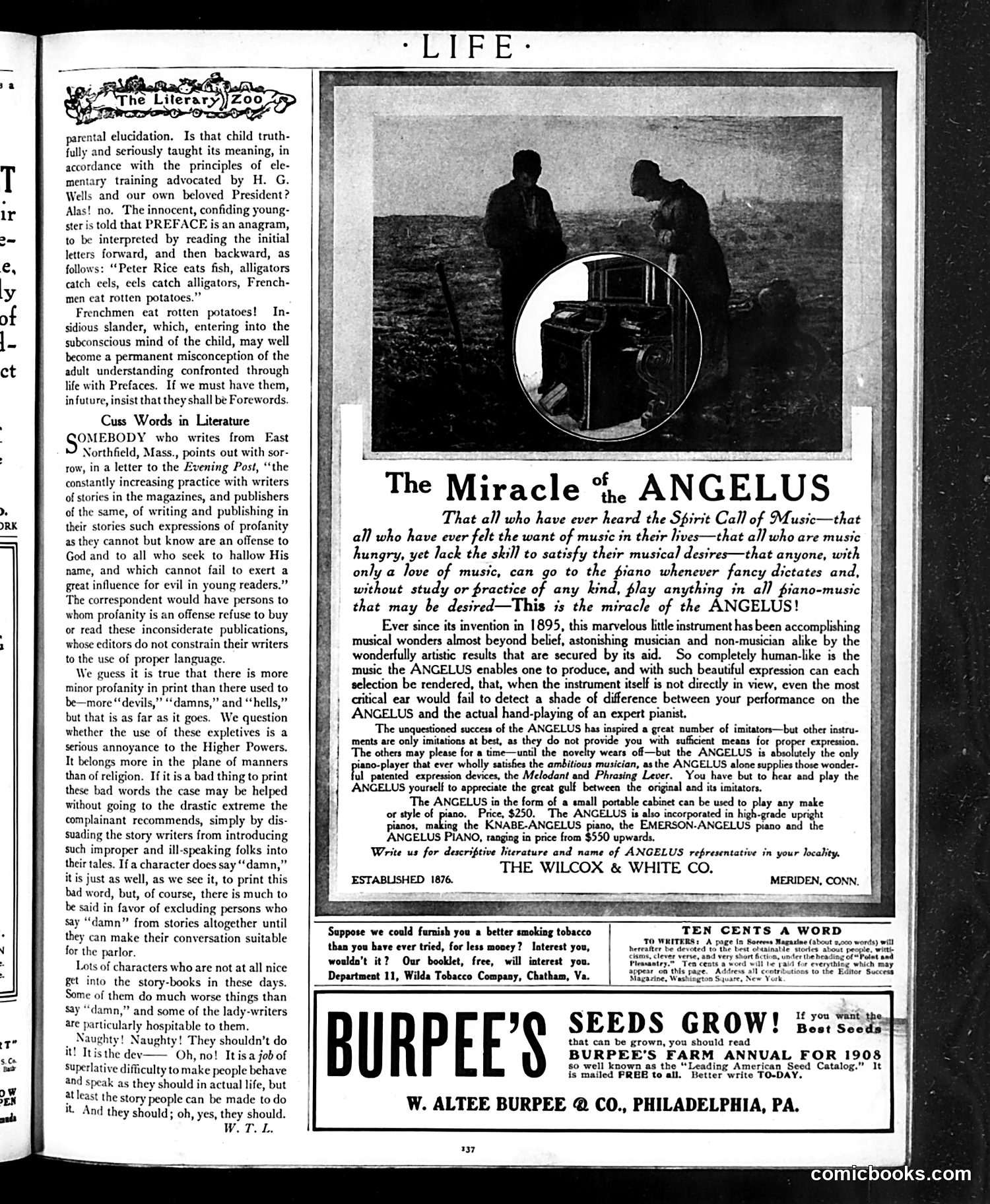
This page is primarily **advertising and articles**, not political satire or cartoons. The main content includes: 1. **"The Literary Zoo"** — a column discussing parental education and prefacing ("Preface" as an anagram), with commentary on language standards in children's literature. 2. **"Cuss Words in Literature"** — an article defending mild profanity in writing, arguing that excluding words like "damn" and "hell" from stories is overly prudish censorship. 3. **Three advertisements**: the "Angelus" piano (claiming musical ability without practice), a tobacco company ad, and Burpee's Seeds. There are no political cartoons or caricatures on this page. The content focuses on literary standards, propriety in language, and product marketing typical of early 20th-century magazine publishing.
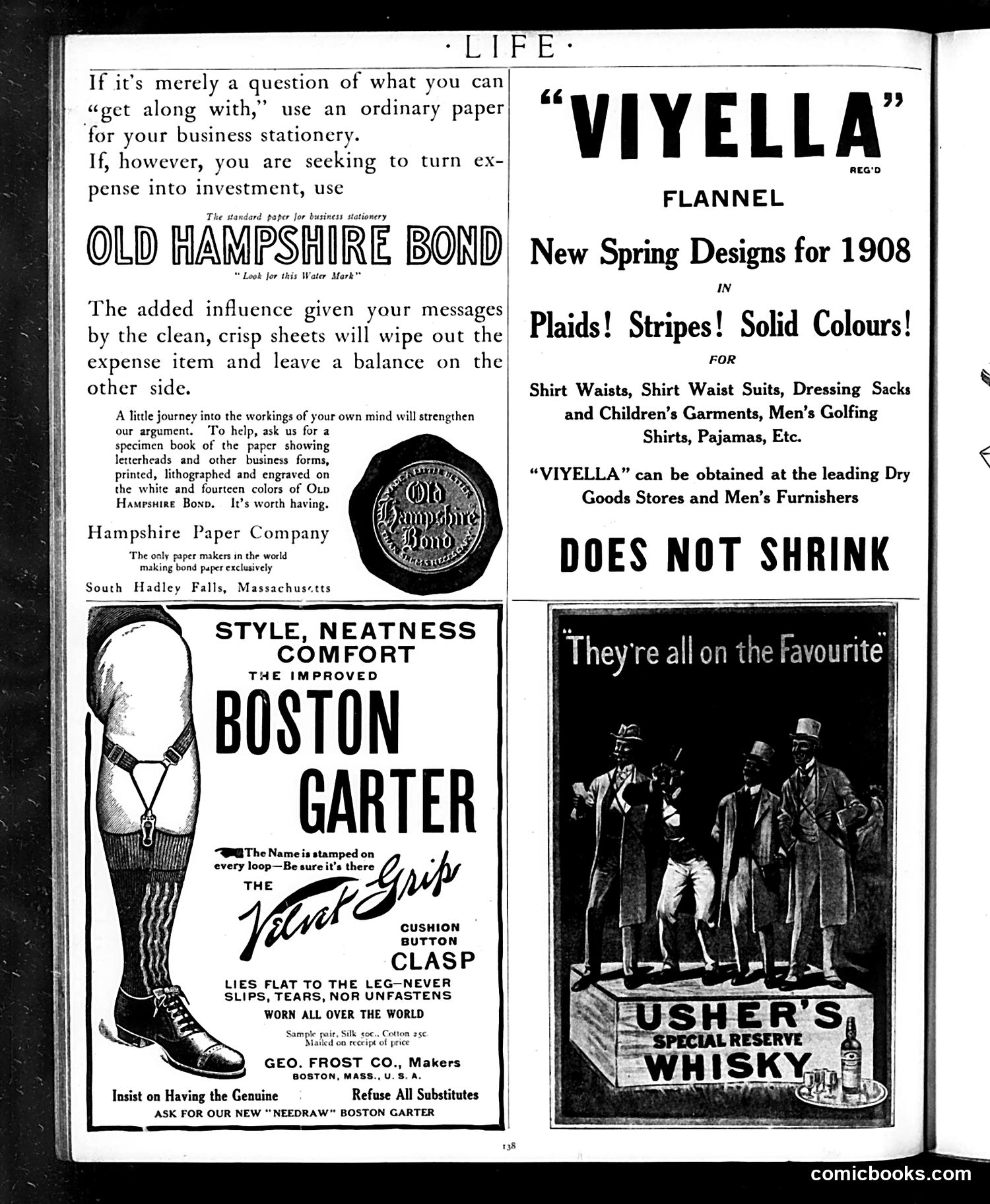
This page is primarily **advertising content** from Life magazine, circa 1908 (based on "New Spring Designs for 1908"). There are no political cartoons present. The advertisements feature: 1. **Hampshire Paper Company** - promoting "Old Hampshire Bond" business stationery 2. **Viyella Flannel** - fabric for shirts and garments that "does not shrink" 3. **Boston Garter** - an improved leg garter with cushion button clasp, marketed as worn "all over the world" 4. **Usher's Special Reserve Whisky** - showing well-dressed men, captioned "They're all on the Favourite" The only image approaching narrative is the whisky ad, which appears to depict fashionably dressed gentlemen endorsing the product through their apparent popularity or status. The page reflects early 1900s consumer culture and product marketing strategies.
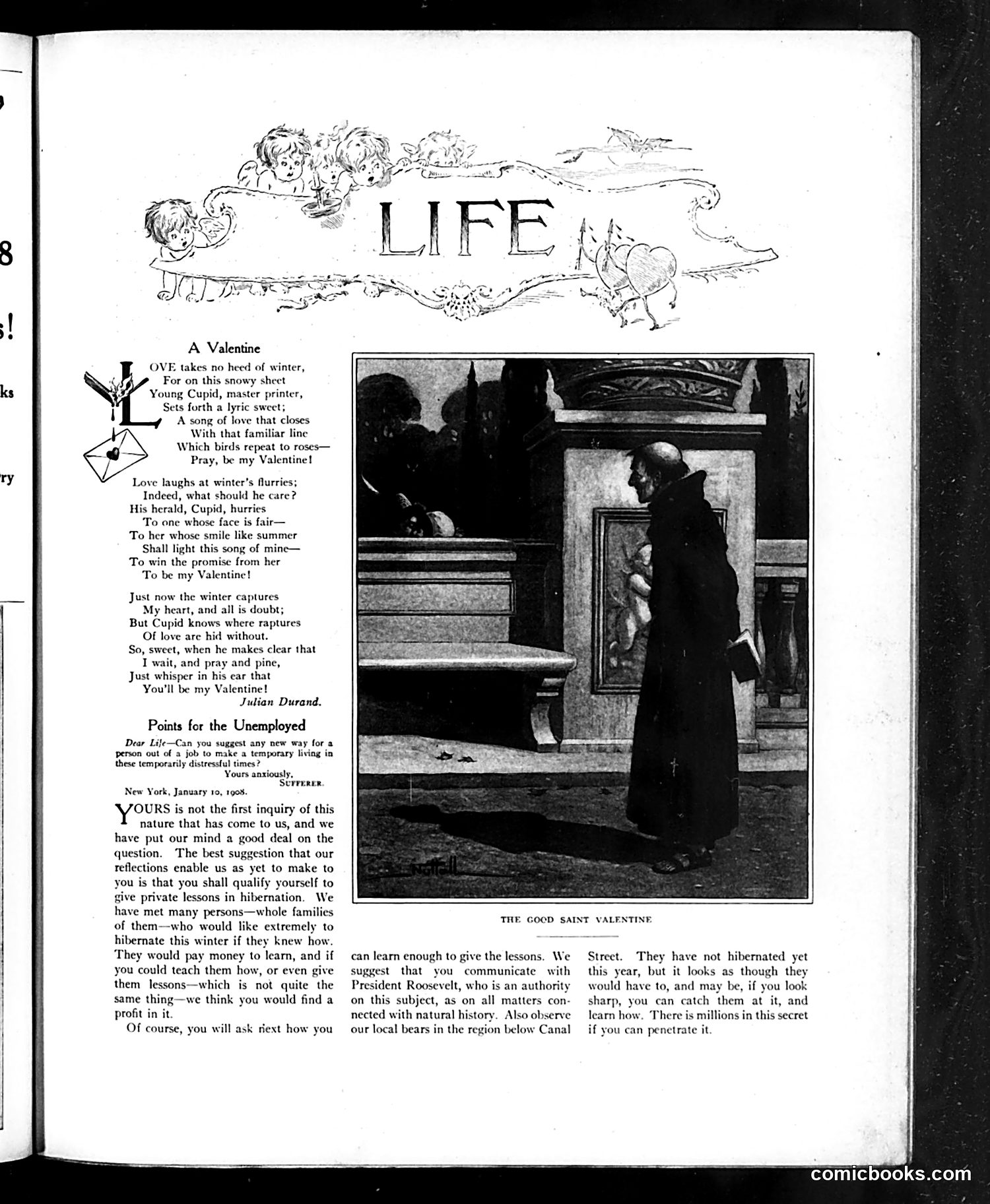
This page combines Valentine's Day poetry with social commentary. "A Valentine" by Julian Durand is romantic verse about love conquering winter's doubt. Below it, "Points for the Unemployed" addresses a serious 1908 economic crisis (dated New York, January 12, 1908). The author suggests unemployed workers could earn money teaching others—specifically hibernation techniques for survival during winter hardship. The accompanying photograph titled "The Good Saint Valentine" shows a silhouetted figure at a doorway, likely illustrating the practical hardship being discussed. The satire is dark: while offering romantic sentiments about love, the magazine simultaneously addresses desperate poverty, suggesting the unemployed must literally learn to survive like hibernating animals. This juxtaposes sentimental Valentine's Day idealism against grim economic reality.
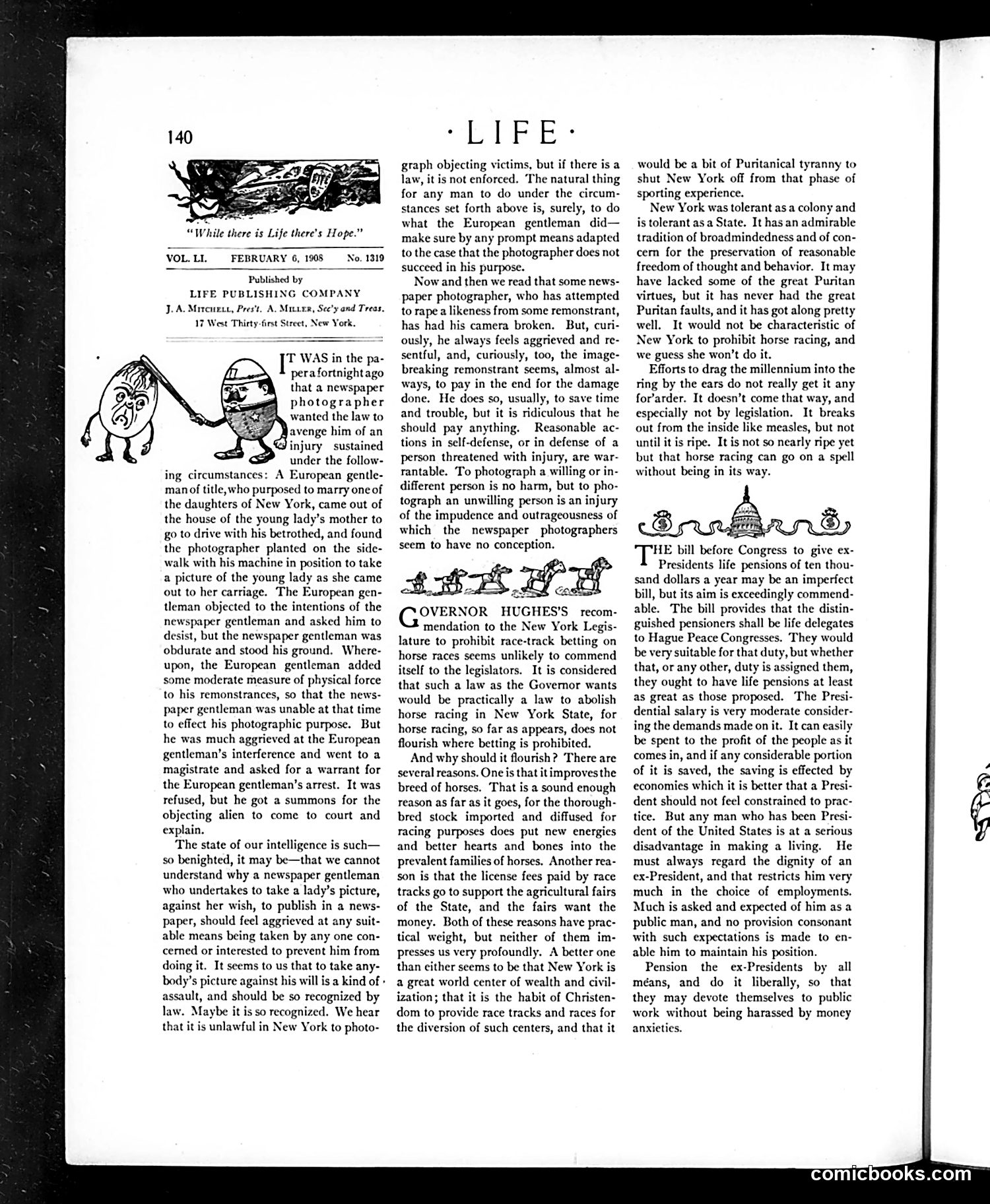
This page contains two satirical articles with accompanying illustrations, rather than traditional political cartoons. The main illustrated piece depicts a confrontation between a European gentleman and a newspaper photographer over taking a picture without consent. The cartoon shows the European objecting to the photographer's intrusion, reflecting a real legal dispute described in the text: a European aristocrat sued a newspaper photographer for taking his photograph without permission and publishing it. The second illustration shows Governor Hughes's recommendation regarding horse racing in New York State. The text discusses debates over whether New York should prohibit horse racing, with arguments about breeding stock, agricultural fairs, and the tax revenue from racing licenses. Both pieces use humor to critique American attitudes toward privacy rights and commercial interests in early 1908.
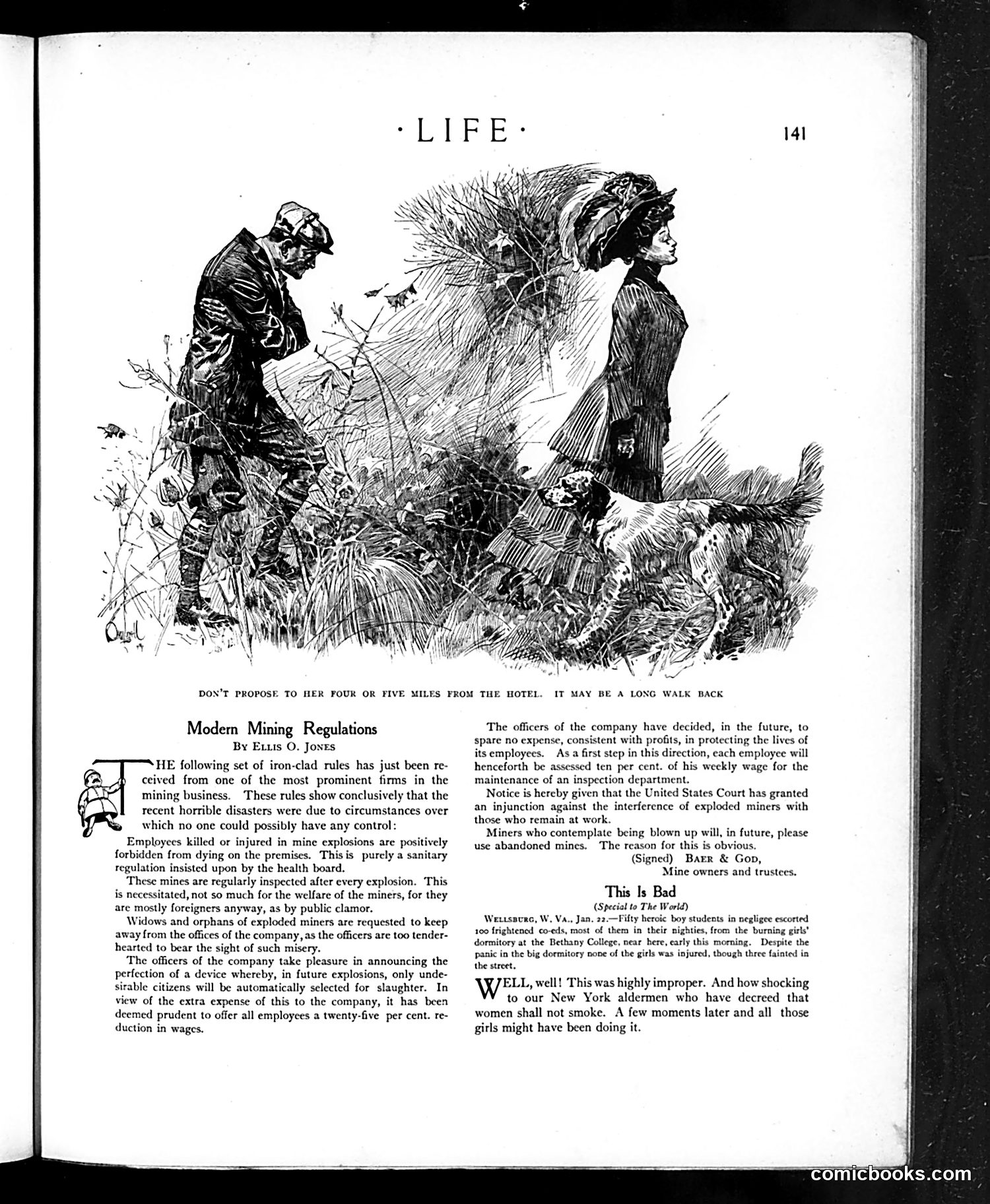
This page from *Life* magazine satirizes mining industry safety practices through both illustration and text. **The Cartoon:** Shows a couple on a countryside walk. The caption warns against proposing marriage "four or five miles from the hotel," suggesting a long walk back—a light romantic joke unrelated to the mining content below. **The Main Article:** "Modern Mining Regulations" by Ralph D. Jones mocks mining companies' pretense of safety reform. The text sarcastically describes a company "perfecting a device whereby, in future explosions, only undesirable citizens will be automatically selected for slaughter" and offering workers a "twenty-five per cent reduction in wages" to cover inspection costs. The satire targets the mining industry's cynical approach to worker safety—offering wage cuts while claiming to implement protections, rather than genuinely improving dangerous conditions that caused "horrible disasters."
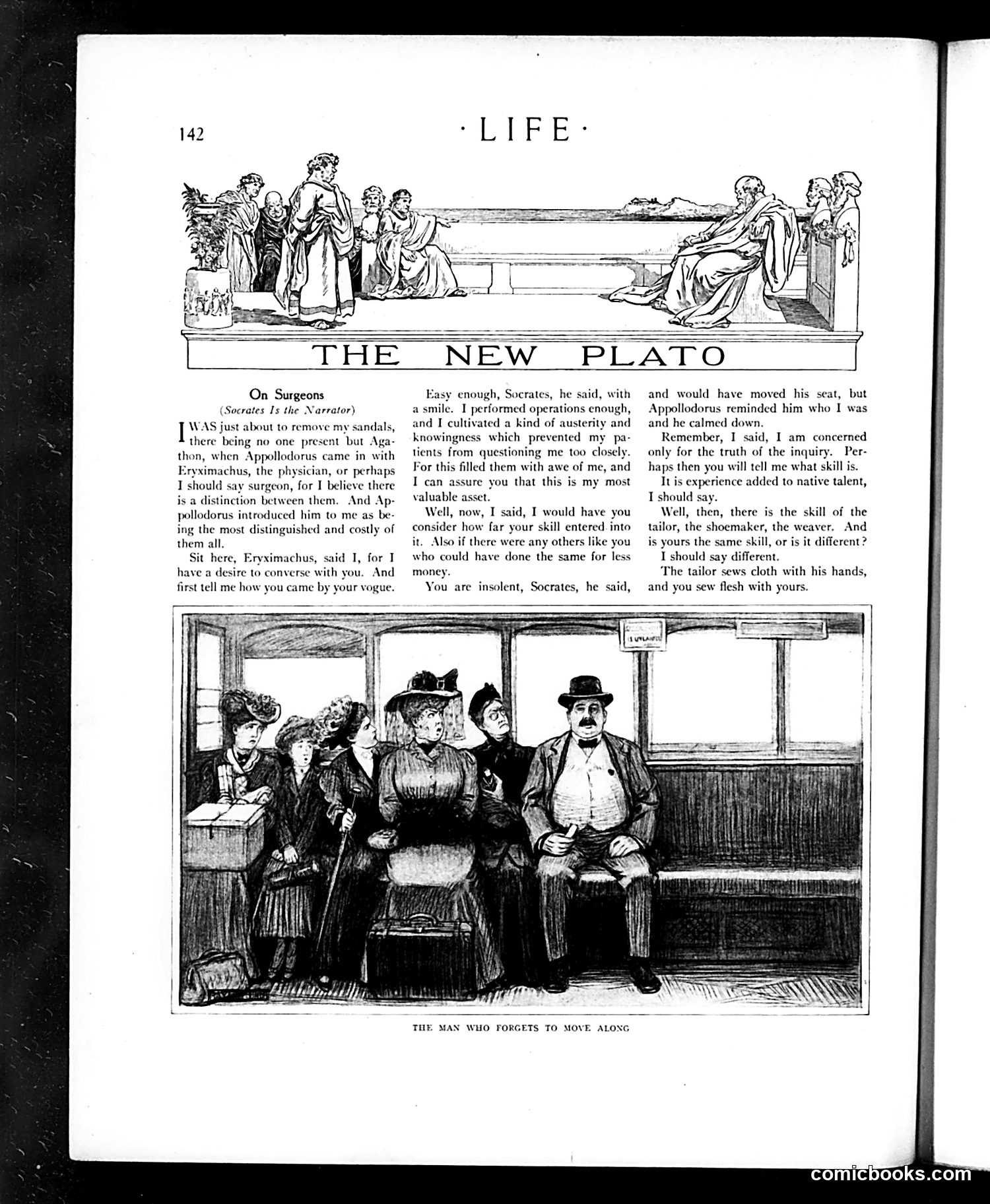
This page satirizes pretentious intellectualism through a dialogue mimicking Plato's philosophical method. The top illustration shows a classical philosophical discussion, while the bottom cartoon depicts modern reality: ordinary people crowded on what appears to be public transportation (a streetcar or train). The text mockingly uses Socratic dialogue to debate whether a surgeon's skill differs from a tailor's skill—a deliberately mundane topic elevated to philosophical importance. The satire's point: modern people fancy themselves philosophers while discussing trivial matters in unglamorous settings. The caption "THE MAN WHO FORGETS TO MOVE ALONG" suggests social commentary on commuter behavior—someone blocking the train's efficiency. The contrast between classical ideals and crowded, mundane modern life is the core joke.
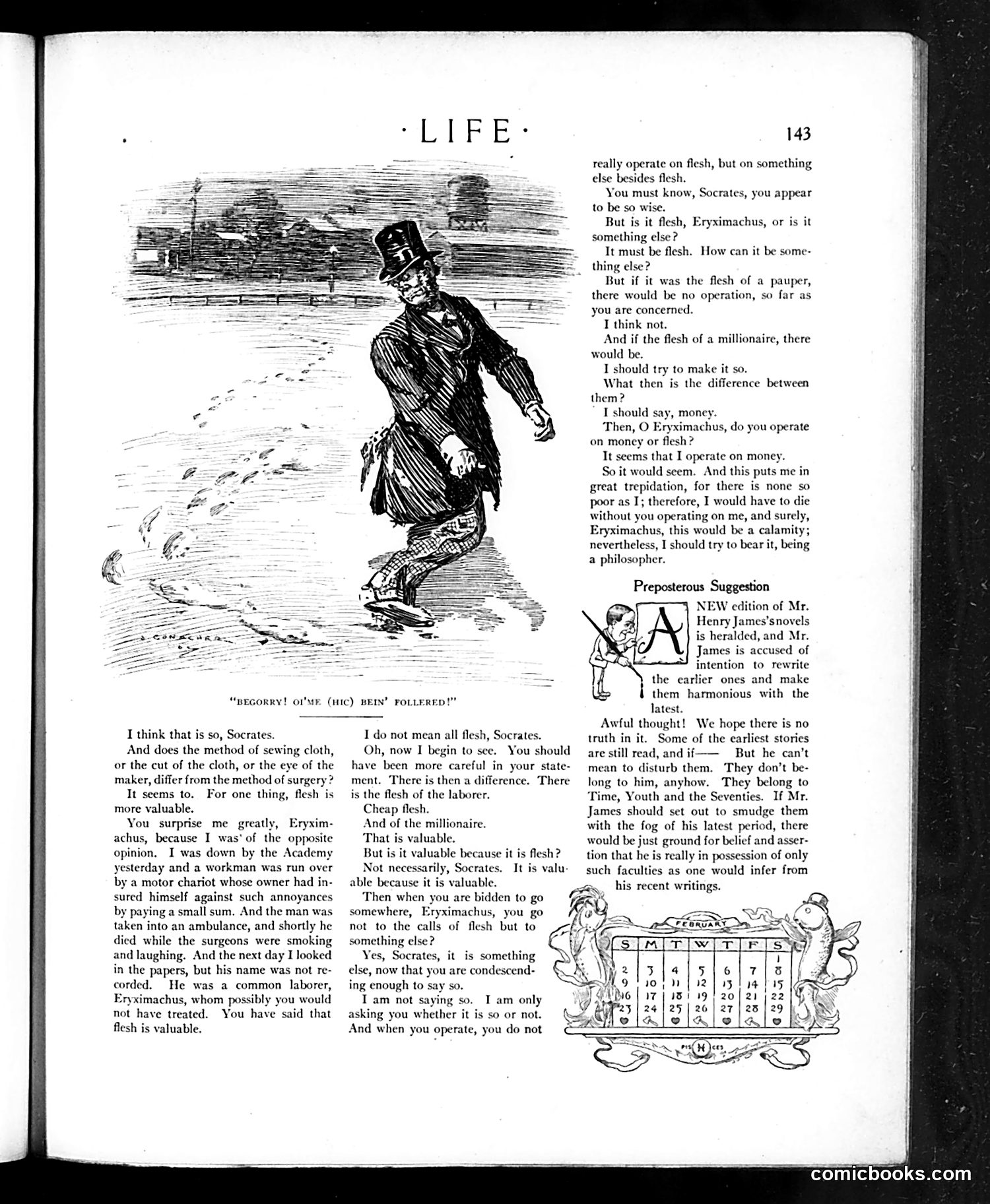
The main illustration depicts a disheveled man in a top hat walking through snow, captioned "BEGORY! OI'VE (HIC) BEIN' FOLLERED!" This appears to be a satirical commentary on Irish immigrants or Irish-American stereotypes—the phonetic spelling "Begory" and "Bein' follered" (being followed) suggest drunkenness and Irish dialect. The accompanying dialogue between "Socrates" and "Erysmachus" debates whether surgery operates on flesh or something else—likely a metaphorical discussion about class and wealth. References to "pauper" versus "millionaire" suggest social satire about medical treatment differences based on economic status. The "Preposterous Suggestion" section critiques Henry James's novels as derivative rewrites of earlier works, dismissing them as unoriginal.
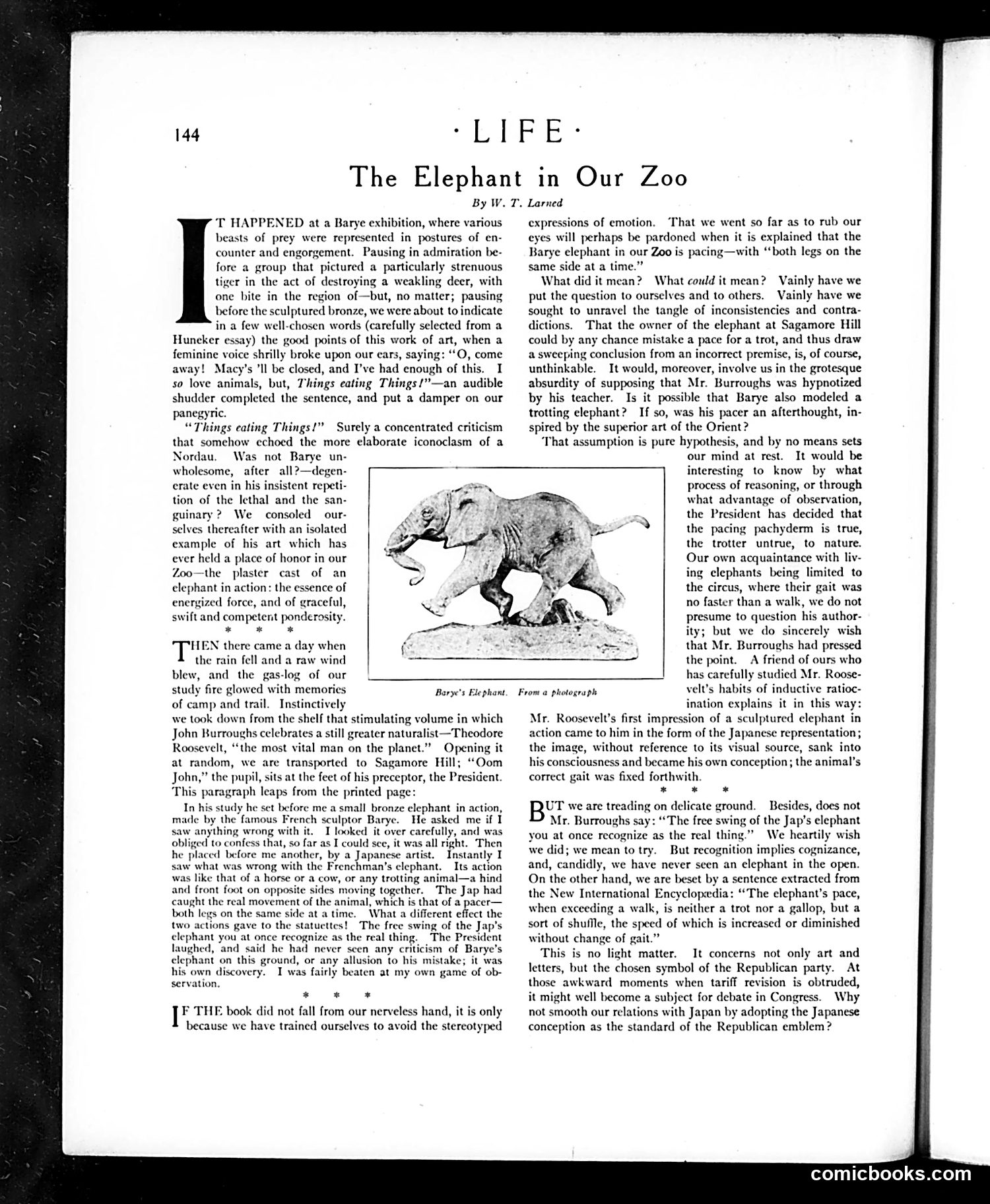
This article mocks President Theodore Roosevelt's self-proclaimed expertise in natural history. The satire centers on Roosevelt's criticism of a famous French sculptor Barye's bronze elephant, claiming its gait is anatomically incorrect. The humor lies in Roosevelt's supposed superiority: he confidently "corrected" Barye's work by preferring a Japanese artist's version, yet the author notes the Barye elephant paces "with both legs on the same side at a time"—an obvious anatomical impossibility that Roosevelt apparently endorsed. The piece suggests Roosevelt, despite his reputation as a great naturalist (celebrated by John Burroughs), made embarrassingly poor observations. By accepting an impossible pose as "true to nature," Roosevelt becomes a figure of ridicule—a know-it-all authority figure confidently wrong about observable facts. The opening anecdote about "Things eating Things" establishes the article's tone: mocking overwrought artistic pretension and those who pontificate about nature.
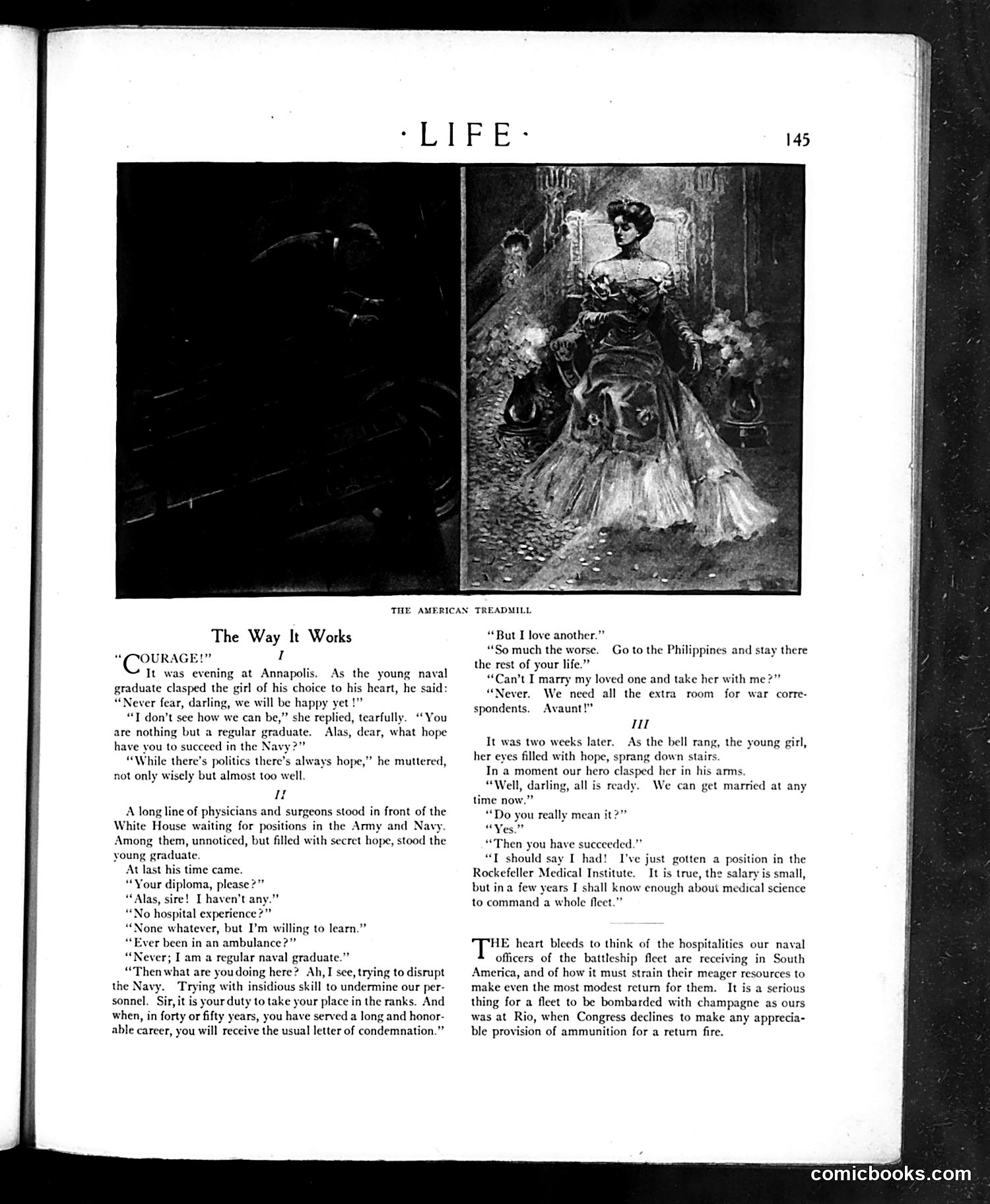
This satirical story mocks the U.S. Navy's reliance on **political connections** over merit. A young Naval Academy graduate seeking advancement discovers that without "politics," he has no future in the Navy—despite his credentials. When he approaches the White House for a position, officials reject him as a "regular graduate," accusing him of trying to "disrupt the Navy" by wanting to advance through proper channels rather than patronage. The joke's bitter edge: he only succeeds by abandoning the Navy entirely for the **Rockefeller Medical Institute**, where he ironically boasts he'll eventually "command a whole fleet"—highlighting how talent leaves the Navy due to its dysfunction. The final paragraph shifts tone, sarcastically complaining that naval officers in South America receive lavish hospitality (champagne) while Congress refuses adequate **ammunition appropriations**—suggesting misplaced priorities and wasteful spending on social niceties rather than military readiness. The satire targets early 1900s **military bureaucracy, political favoritism, and congressional negligence**.
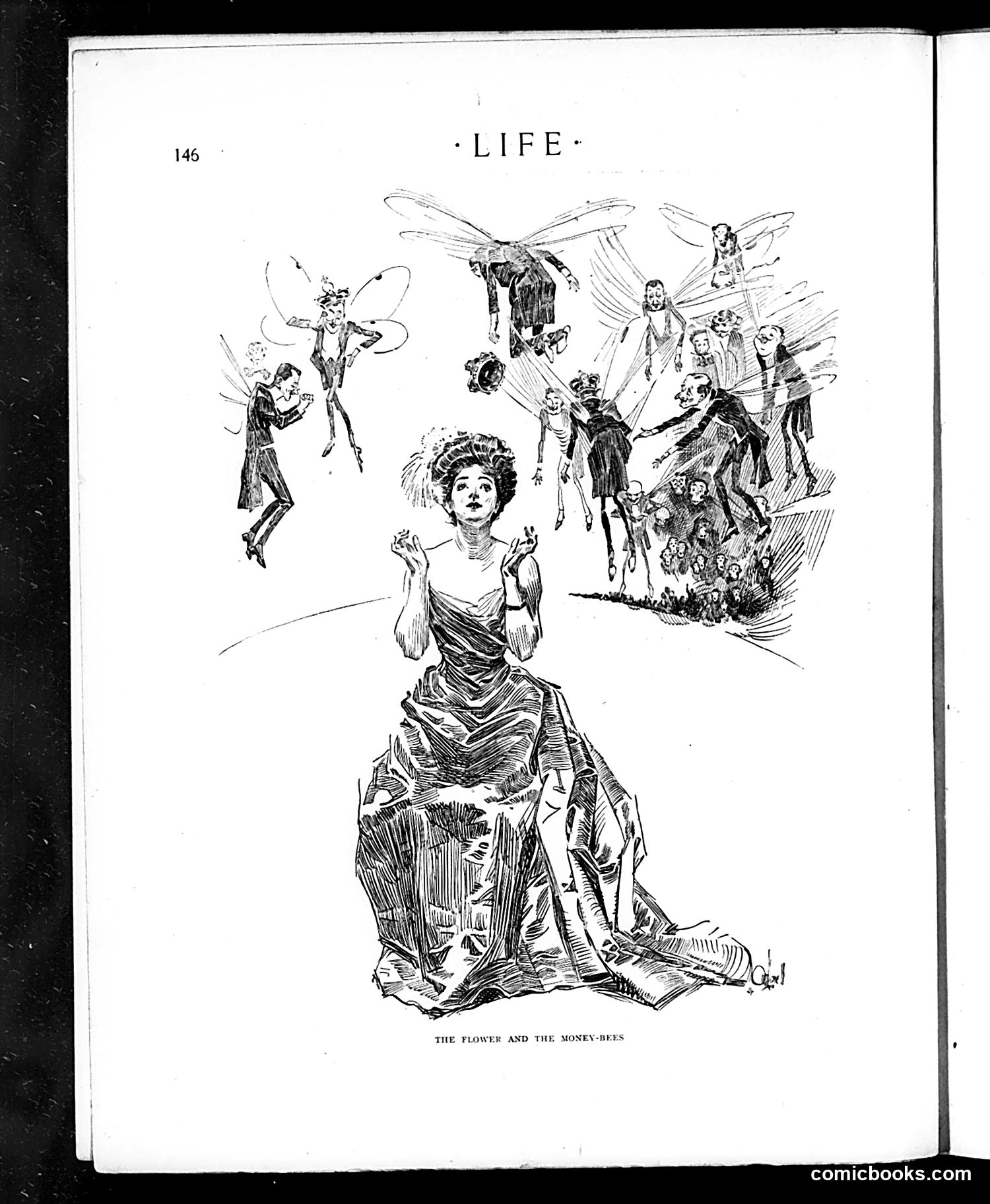
This satirical illustration depicts a woman in an elegant dress as a flower, surrounded by winged figures labeled "money-bees." The woman gazes upward with an expression of wonder or vulnerability as the bee-like creatures swarm around her. The satire likely critiques the relationship between wealthy men (represented as "money-bees") and society women of the era. The flower metaphor suggests the woman is beautiful but passive, while the money-bees are depicted as predatory or parasitic—drawn to her wealth or status rather than genuine affection. This reflects early 20th-century anxieties about marriage, materialism, and transactional relationships among the upper classes. The visual pun plays on both the natural attraction of bees to flowers and the mercenary nature of romantic pursuit.
This editorial defends *Life* magazine against accusations of antisemitic humor. The text reveals that Jewish readers and organizations boycotted the publication and pressured advertisers to withdraw, citing offensive caricatures and stereotypes. *Life* claims it satirized all ethnic groups equally—Irish, German, Black Americans—without complaint, but Jews uniquely objected. The magazine argues it voluntarily stopped such humor out of kindness, not principle, and resents being "silently boycotted" and having advertisers intimidated. The piece reflects early 20th-century attitudes where ethnic mockery was normalized as "impartial" satire. *Life* presents itself as victimized by Jewish activism rather than acknowledging that caricatures perpetuated harmful stereotypes. The defensive tone suggests the boycott was effective enough to provoke this lengthy rebuttal.

This page from *Life* magazine appears to be mostly blank or heavily darkened, making it impossible to discern specific cartoon imagery, figures, or caricatures. The only legible text at the bottom reads: "BUT THERE'S NOTHING HALF SO SWEET AS LIFE AS I" followed by a partially visible caption crediting "Miss Ida Rentschler" as the artist and referencing "Life's court jester." Without being able to see the actual illustration clearly, I cannot identify the specific political or social references, the figures depicted, or the satirical point being made. The page quality and reproduction make meaningful analysis impossible.
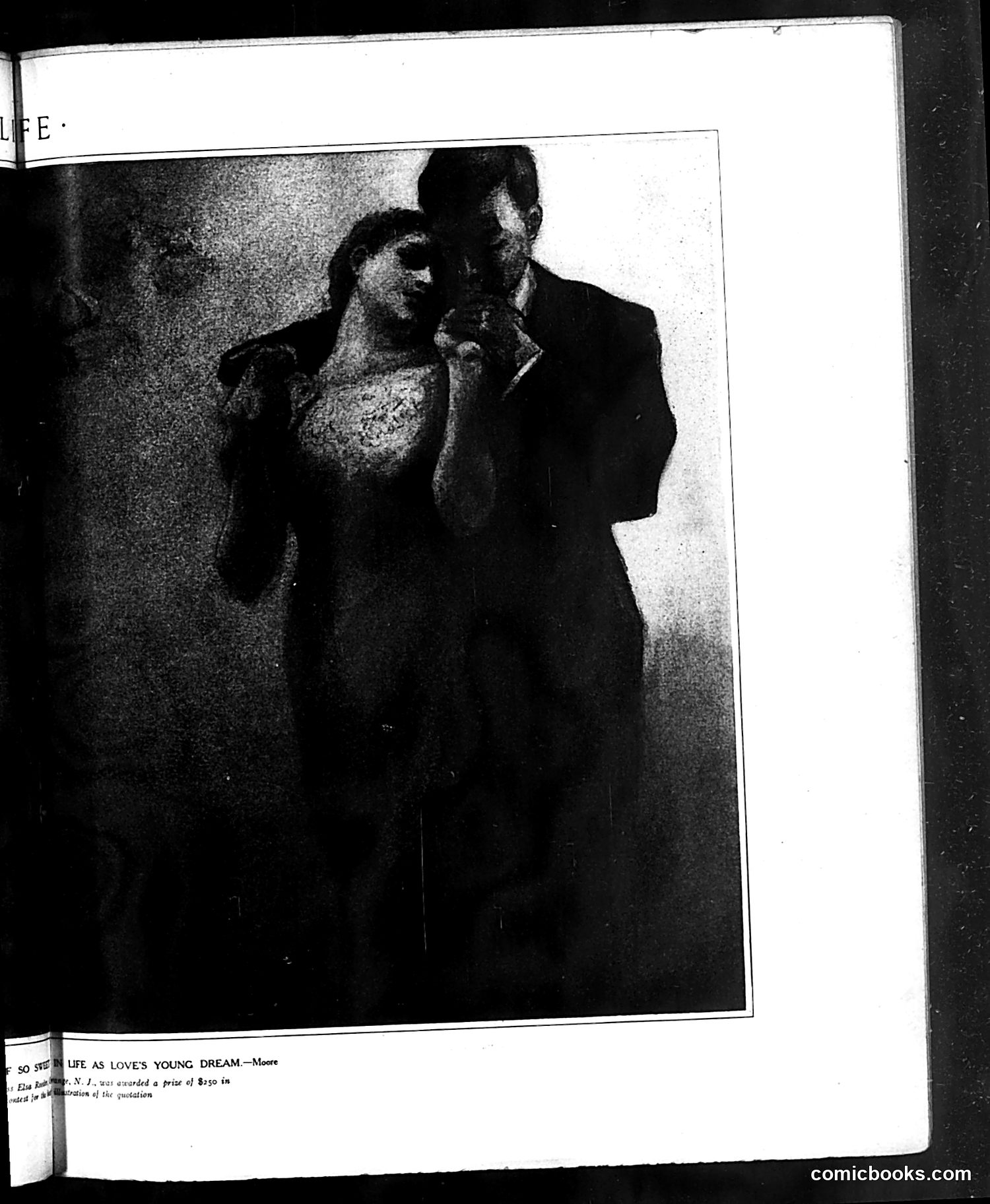
This page appears to be from *Life* magazine and shows a romantic scene of a couple in silhouette—a man and woman in formal dress, positioned close together in an intimate moment. The caption references Thomas Moore's famous poem "Love's Young Dream," which romanticizes youthful romance. The satirical intent likely mocks the gap between sentimental literary ideals of love and real-life relationships. The grainy, shadowy silhouette treatment may suggest the obscurity or illusion of such romantic fantasies. The reference to Moore's 19th-century poetry juxtaposed with what appears to be a contemporary scene creates ironic commentary on how people perpetually chase timeless romantic ideals that may not match reality. The visible text mentions a $250 prize, suggesting this may be part of a contest or feature in the magazine.
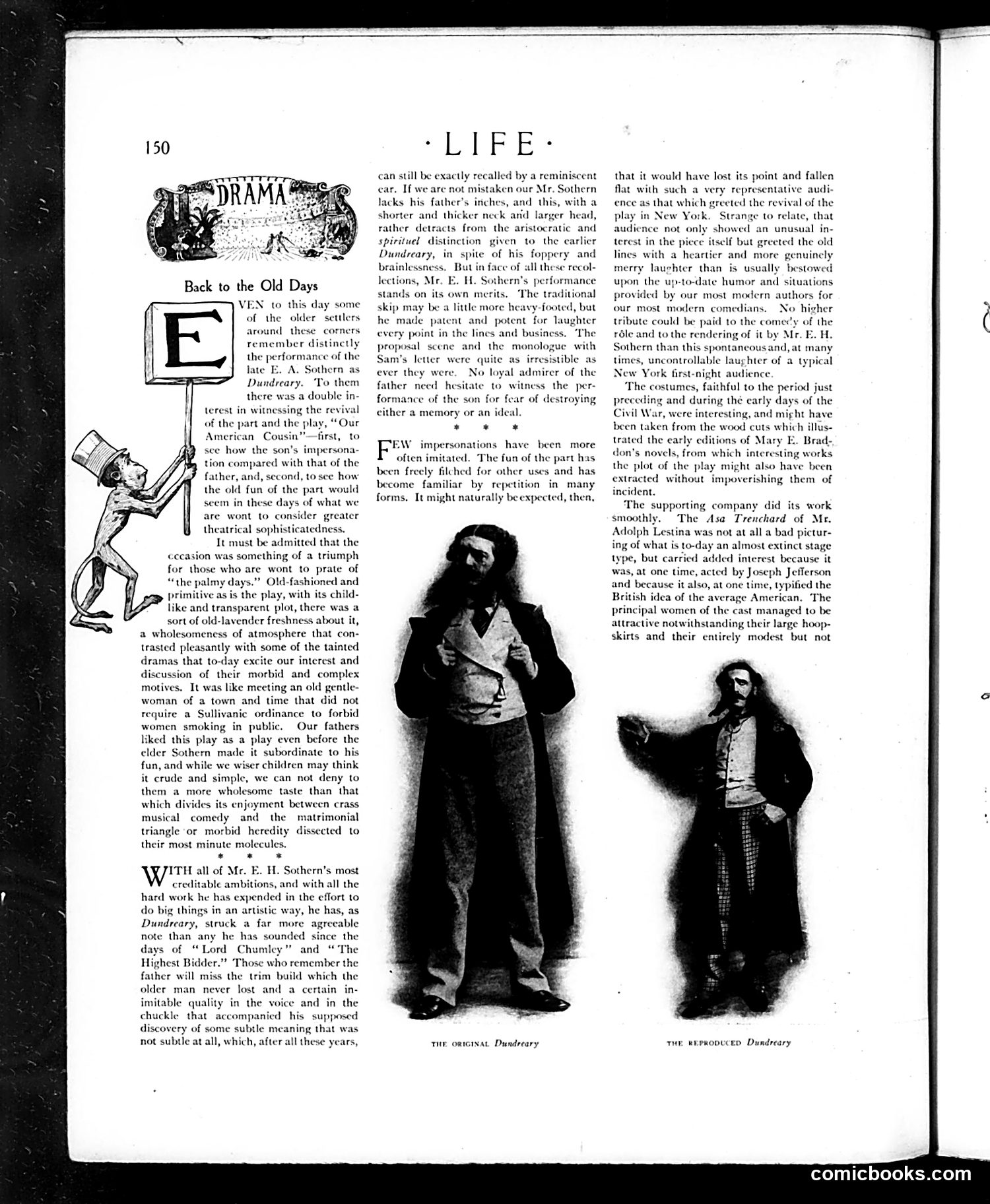
This page reviews a Broadway revival of "Our American Cousin," comparing E.H. Sothern Jr.'s performance as Lord Dundreary to his famous father's original portrayal. The two photographs show the character in the original production (left) and the contemporary revival (right). The text discusses how the younger Sothern physically differs from his father—shorter, thicker-necked—which slightly diminishes the character's aristocratic quality. However, the reviewer credits the son with successfully reviving the role on its own merits. The broader point contrasts this "old-fashioned" play's "wholesome" humor favorably against contemporary theater's focus on "morbid" themes and "matrimonial triangles." The satire celebrates how audiences responded more enthusiastically to traditional comedy and character work than to modern psychological dramas, suggesting nostalgia for simpler theatrical fare.
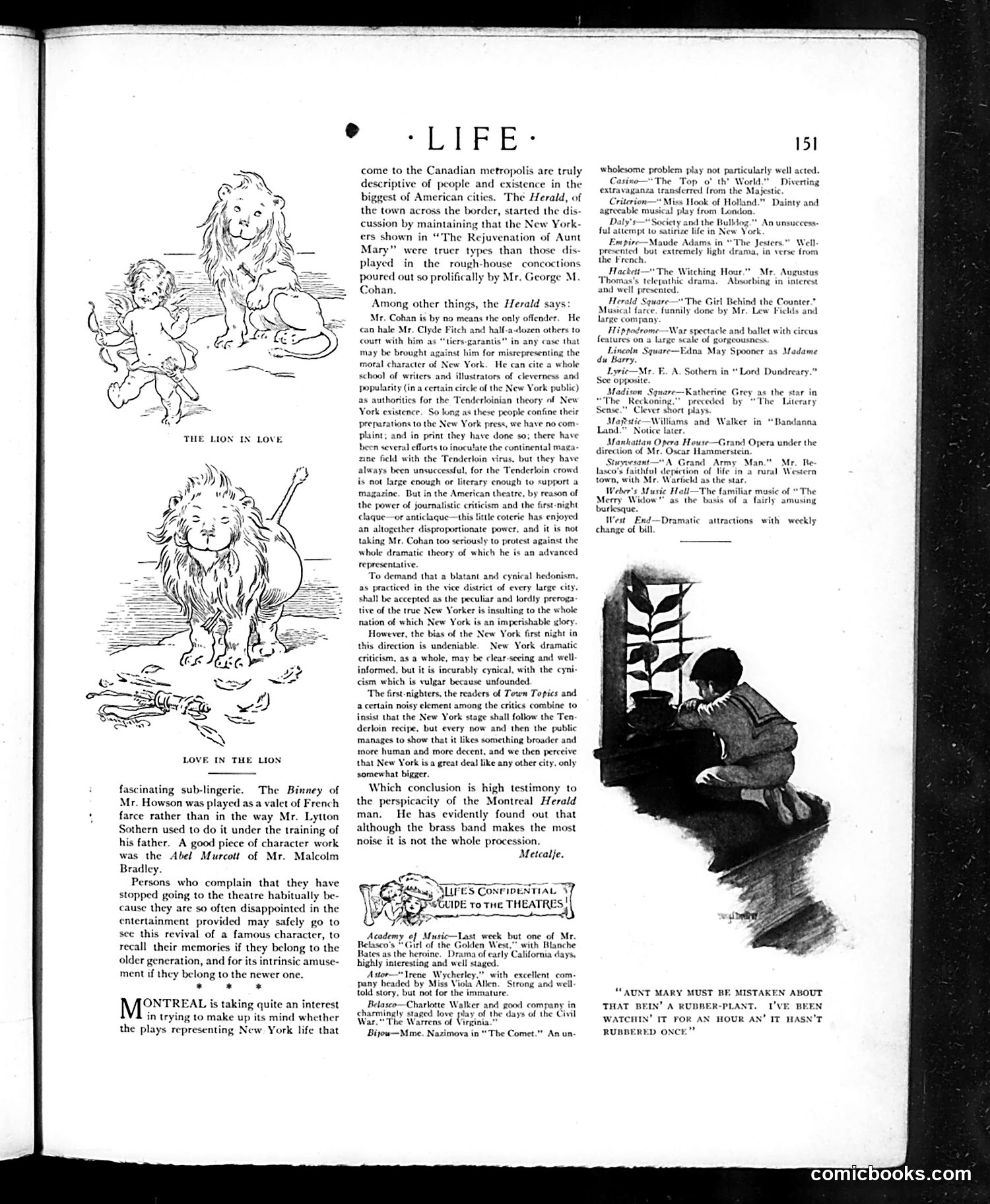
This page critiques how Broadway theater portrays New York City life, specifically attacking George M. Cohan and similar playwrights for sensationalizing the "Tenderloin" district—the city's notorious red-light/vice area—as representative of authentic New York existence. The Montreal *Herald* argues these dramatists misrepresent New York to audiences by treating the demimonde's "blatant and cynical hedonism" as the city's defining character. The article defends New Yorkers against this insulting caricature, noting that while such lowlife characters generate noise and critical attention through first-night cliques, the general public prefers "broader and more decent" entertainment. The cartoons labeled "The Lion in Love" and "Love in the Lion" appear to illustrate this theme of romanticizing base behavior—using animal imagery to satirize human pretension. The critique essentially argues New York theater had become too fixated on vice-district sensationalism rather than authentic middle-class life.
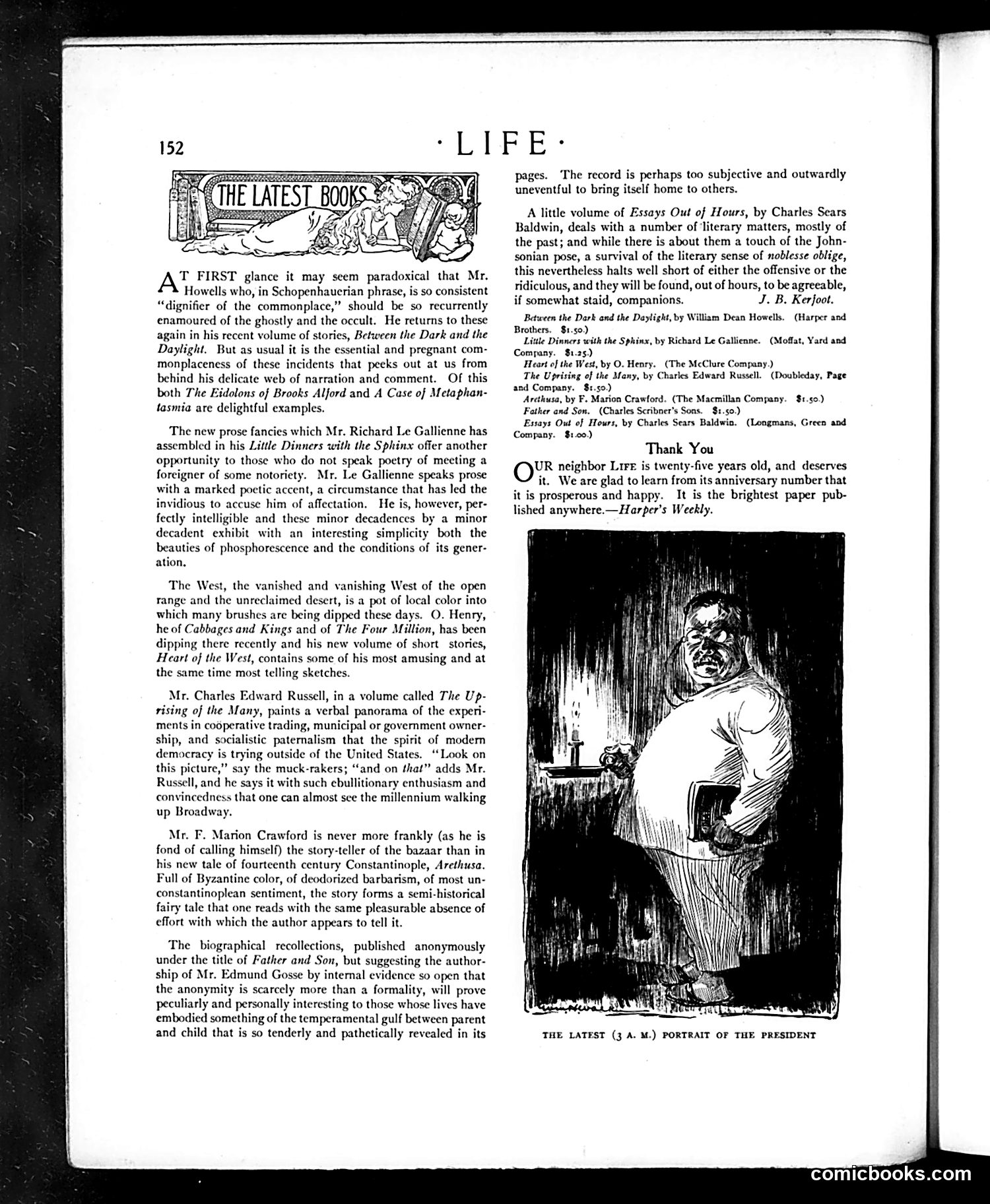
This page reviews recent literary works rather than presenting political satire. The accompanying illustration—labeled "The Latest (3 A.M.) Portrait of the President"—appears to be a sketch of a figure at a desk, likely meant as humor about presidential work habits or appearance, though the specific president and joke are unclear without additional dating context. The text discusses books by William Dean Howells, Richard Le Gallienne, O. Henry, Charles Edward Russell, F. Marion Crawford, Edmund Gosse, and Charles Sears Baldwin. The reviews employ period literary criticism language, praising Howells's treatment of the commonplace and mocking Le Gallienne's "poetic accent" as affected "decadence." Russell's socialist-themed work receives cautious, somewhat patronizing coverage. The tone reflects early-1900s literary gatekeeping—simultaneously celebrating American letters while maintaining skepticism toward experimental or progressive themes.
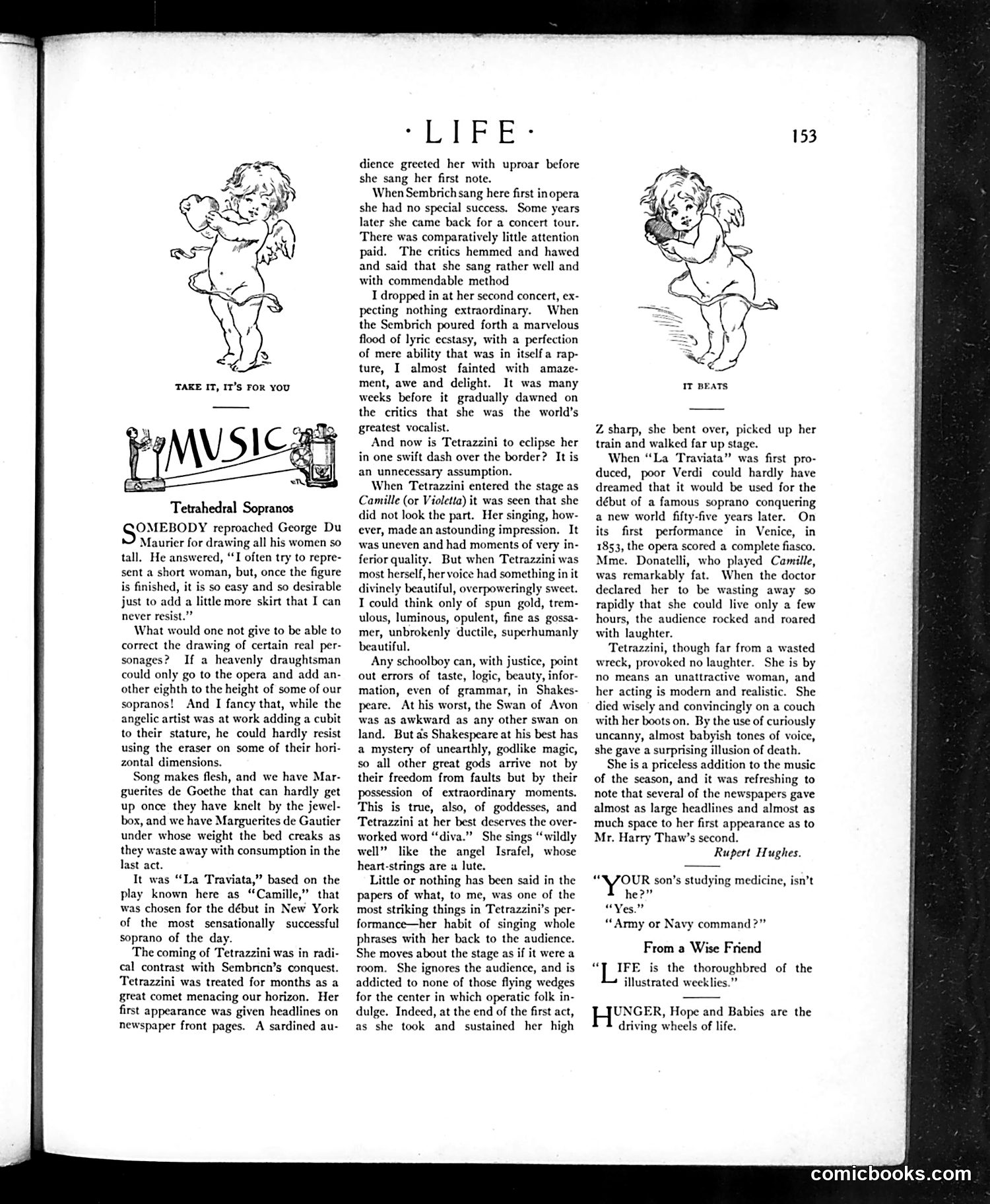
This page satirizes operatic sopranos, particularly contrasting two famous singers: Luisa Tetrazzini (then newly debuted in New York) and Marcella Sembrich. The cartoon illustrations show cherubic figures labeled "TAKE IT, IT'S FOR YOU" and "IT BEATS," likely mocking the physical proportions of opera singers—the accompanying text humorously references Du Maurier's tendency to draw women unrealistically tall, then jokes that a "heavenly draughtsman" adding height to sopranos would need an eraser for their "horizontal dimensions" (waistlines). The article contrasts Tetrazzini's sensational, heavily-promoted debut with Sembrich's initially overlooked performances that gradually revealed her as the superior vocalist. The satire suggests that hype and appearance matter more than genuine talent in opera. The critic praises Tetrazzini's extraordinary voice while noting she lacked the physical appearance for her role, yet defends great artists as transcending such flaws through exceptional moments—comparing her to Shakespeare's occasional genius.
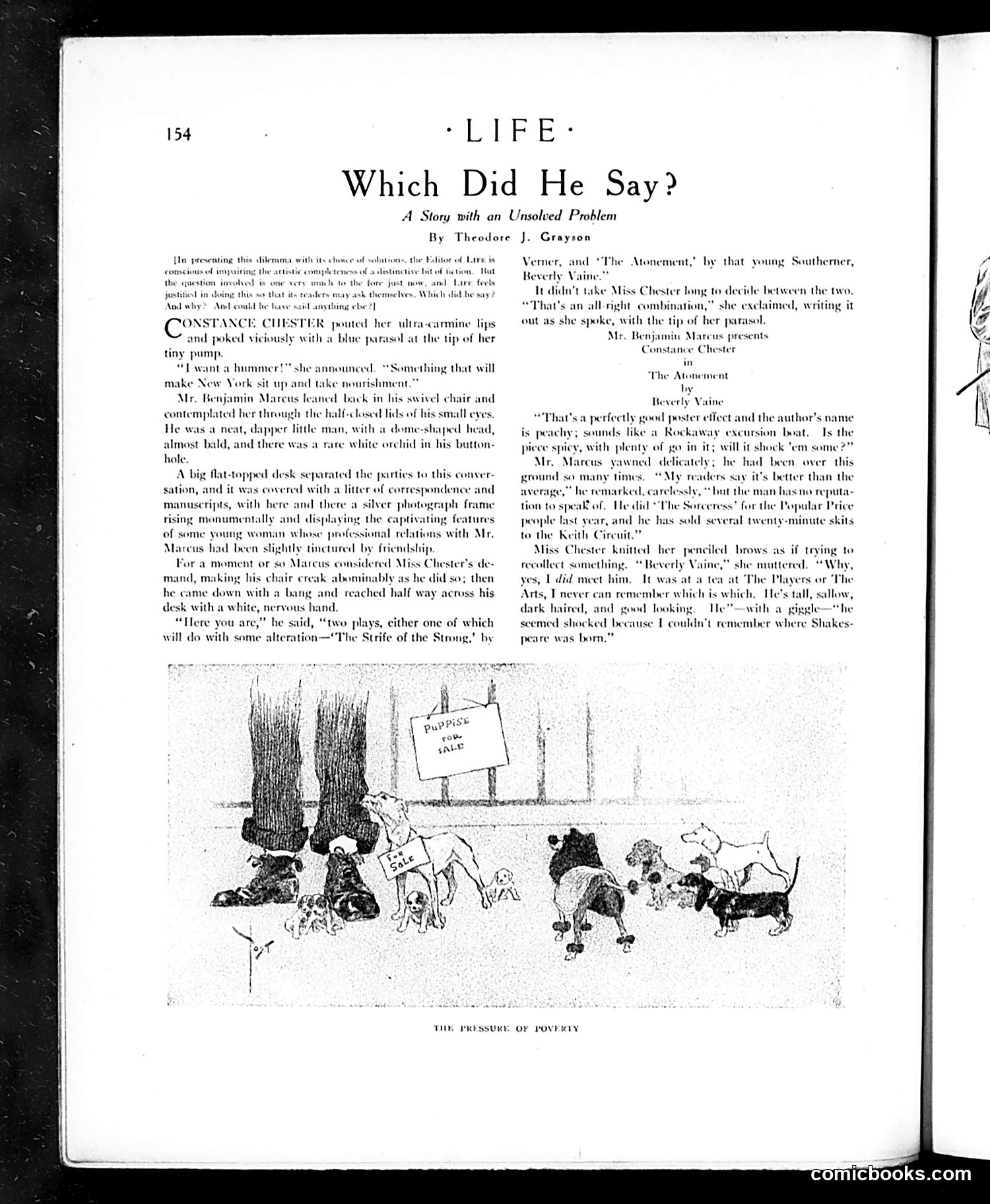
This page presents a story rather than a political cartoon. The small illustration at bottom—labeled "The Pressure of Poverty"—depicts a person in formal dress surrounded by small dogs or animals with signs, likely satirizing how the poor are forced into undignified situations for survival. The main narrative concerns theatrical producer Benjamin Marcus and actress Constance Chester negotiating over plays. Marcus offers her two scripts: "The Strife of the Strong" and "The Atonement" by a Southern playwright named Beverly Vaine. Chester chooses the combination and notes that Vaine's name "sounds like a Rockaway excursion boat"—a dismissive jab suggesting it sounds cheap or common. The satire targets theatrical pretension: Chester worries whether the play is "spicy" enough to shock audiences, while Marcus admits readers prefer mediocre work. When Chester recalls meeting Vaine at "The Players or The Arts" (prestigious New York clubs), she jokes that he was shocked she didn't know where Shakespeare was born—mocking both his snobbery and her own indifference to literary culture.
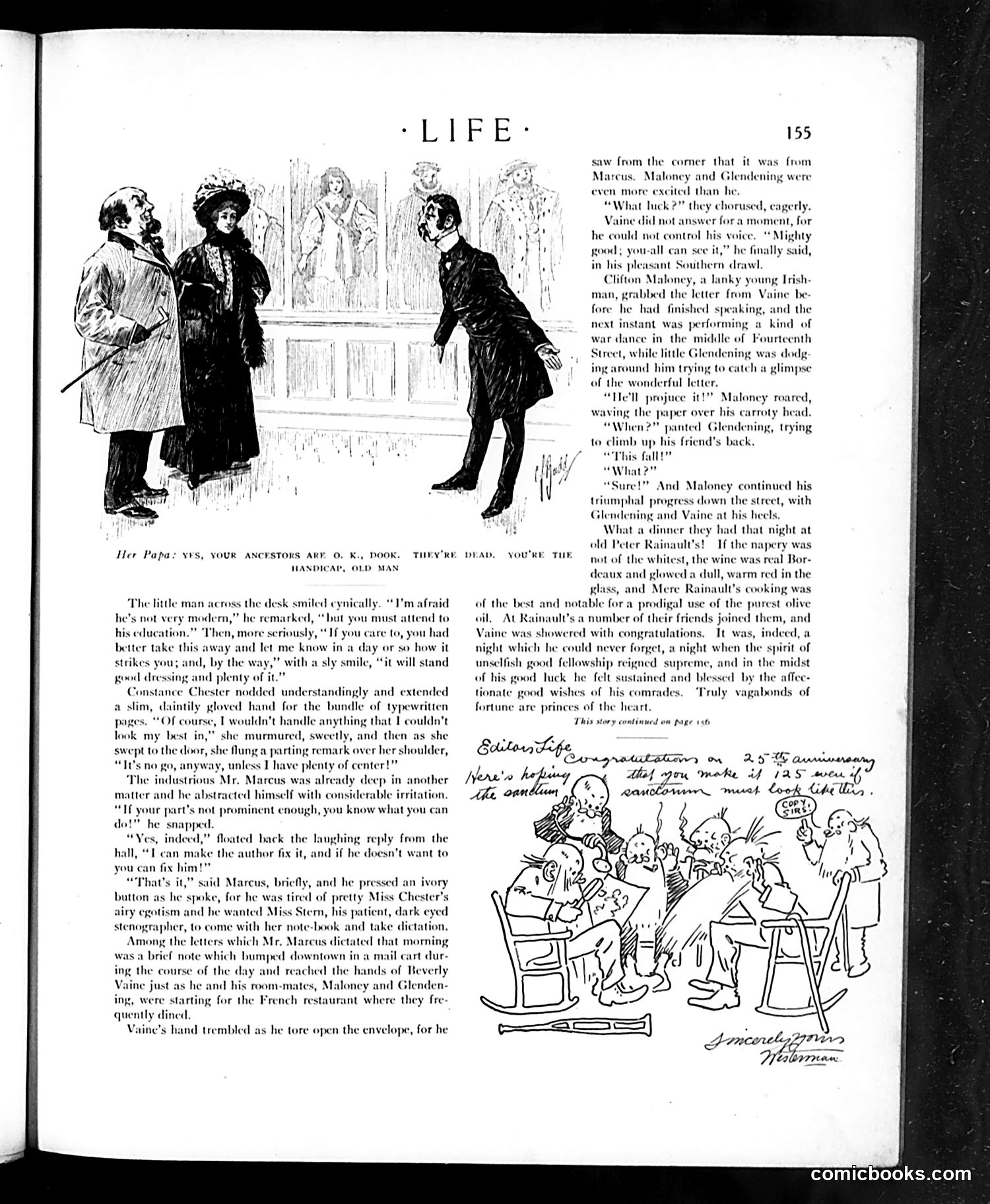
This page from *Life* satirizes social climbing and class pretension through a narrative about young artist Beverly Vaine receiving acceptance from a publisher (Mr. Marcus). **The main cartoon** (top) shows a condescending older man speaking to a younger one, with the caption mocking ancestral pedigree: "Your ancestors are O.K., book. They're dead—you're the handicap, old man." This is a jab at those who rely on family lineage rather than personal merit. **The story** follows Vaine and his working-class roommates (Maloney and Glendening) celebrating at a modest French restaurant. The satire targets their naive elation over a publishing opportunity—they're portrayed as unsophisticated young men (note the "Southern drawl," the boisterous street dancing) celebrating at a second-rate establishment where "napery" isn't pristine and the wine is ordinary. **The lower sketch** shows their celebratory dinner scene, highlighting their earnest but humble circumstances. The overall point: the page mocks both snobbish class consciousness and the aspirational pretensions of working-class youth, suggesting genuine merit matters less than social position.
This page contains **no political cartoons**—it is a **serialized fiction story** titled "The Atonement" (continued on page 198). The narrative depicts early 20th-century **theatrical production dynamics**. A playwright named Beverly Vaine negotiates with Mr. Marcus, a theater manager, to produce his play starring actress Constance Chester. The satire targets the **vanity and impracticality of stage stars**: Miss Chester demands her costume from a Paris fashion show ("Longchamps") be incorporated regardless of plot logic, and objects to the male lead having substantial dialogue that might overshadow her role. The humor mocks the **commercial theater world's prioritization of star appeal over artistic integrity**—the actress's ego and fashion concerns override the script's dramatic coherence. Mr. Marcus emerges as a shrewd, dismissive businessman indifferent to the playwright's artistic vision. This reflects genuine early-theater tensions between artistic merit and star-driven box office appeal.
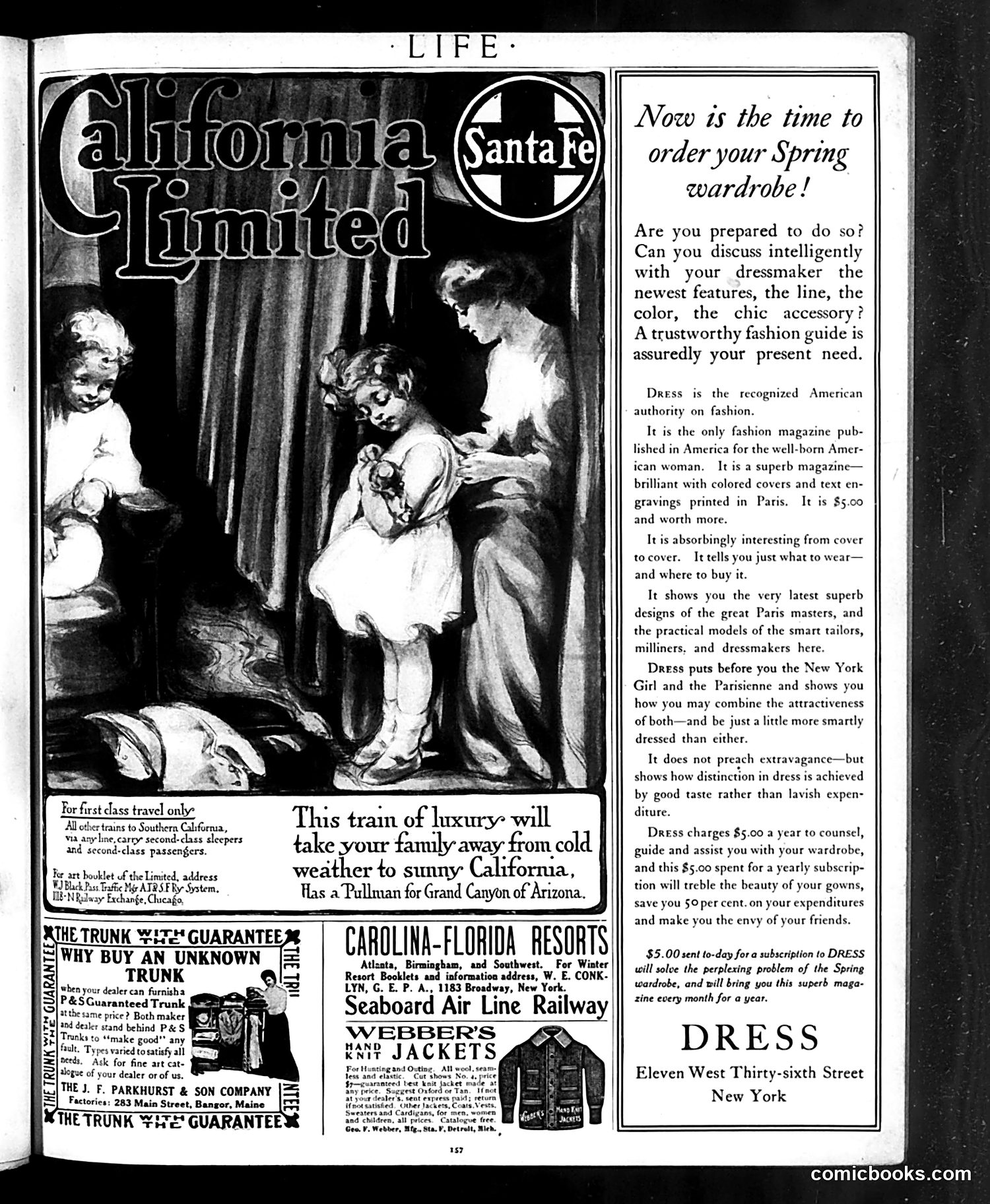
This page is primarily **advertising**, not satire or political commentary. The left side features a Santa Fe Railway advertisement with an allegorical illustration—likely representing luxury travel or prosperity—promoting train service to California and Arizona resorts during winter months. The right side advertises *Dress* magazine, positioning it as essential for upper-class women planning spring wardrobes. The copy emphasizes *Dress* as "the recognized American authority on fashion," claiming it features Paris designs and helps wealthy women ("well-born American women") achieve sophistication while economizing—a notable pitch given the era's class consciousness. Additional ads promote luggage ("P&S Guaranteed Trunk"), train travel to Florida resorts, and work jackets. The illustration style and typeface suggest this is from the early 20th century. The overall page reflects aspirational advertising targeting affluent readers interested in travel, fashion, and consumption—typical Life magazine content of its era.
This page contains serialized fiction rather than political cartoons. It depicts a confrontation between Beverly Vaine, a struggling playwright, and Marcus, a theater producer/manager, over artistic control of Vaine's play. The satire targets **commercial theater's corruption of art**. Marcus represents the profit-driven impresario who demands Vaine compromise his artistic vision to please audiences and avoid controversy. Marcus explicitly states he wants entertainment that won't make people "think too much or feel that any of their little faults have been ridiculed." Vaine, the principled but powerless artist, refuses—only to discover a contract clause that leaves him helpless. The story critiques how **financial leverage allows commercial interests to destroy artistic integrity**, a common Progressive-era concern about capitalism corrupting culture. Miss Chester, the star actress, silently supports the producer, suggesting even performers prioritize commercial success over art.
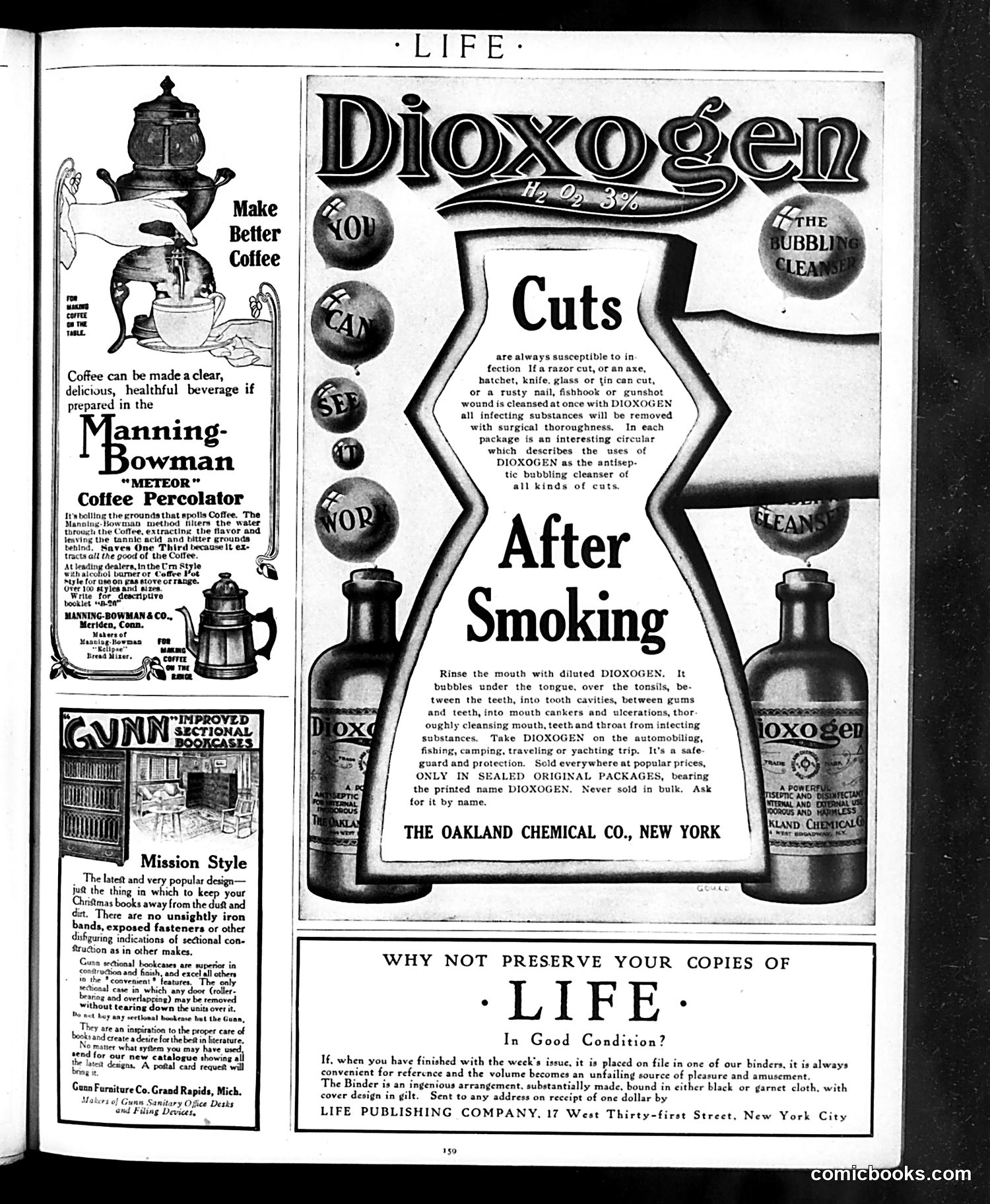
This page is primarily **advertising**, not satire or political commentary. It contains three product advertisements typical of early 20th-century magazines: 1. **Manning-Bowman Coffee Percolator** — promotes a coffee maker that filters grounds, emphasizing health benefits by removing "tannic acid and bitter grounds." 2. **Gunn Sectional Bookcases** — advertises modular furniture "Mission Style," marketed as ideal for storing Christmas books safely from dust. 3. **Dioxogen** — the largest ad, promoting an antiseptic solution for wound cleaning and post-smoking mouth rinse. The bottle imagery and claims of "surgical thoroughness" reflect period medical advertising (before modern FDA regulations). A footer offers **Life magazine binders** for preserving weekly issues in bound volumes. The page reflects **turn-of-the-century consumer culture**: emphasis on cleanliness, modern conveniences, and home organization. No political figures or satirical targets are visible—this is straightforward product marketing from the advertising-heavy era of American magazines.
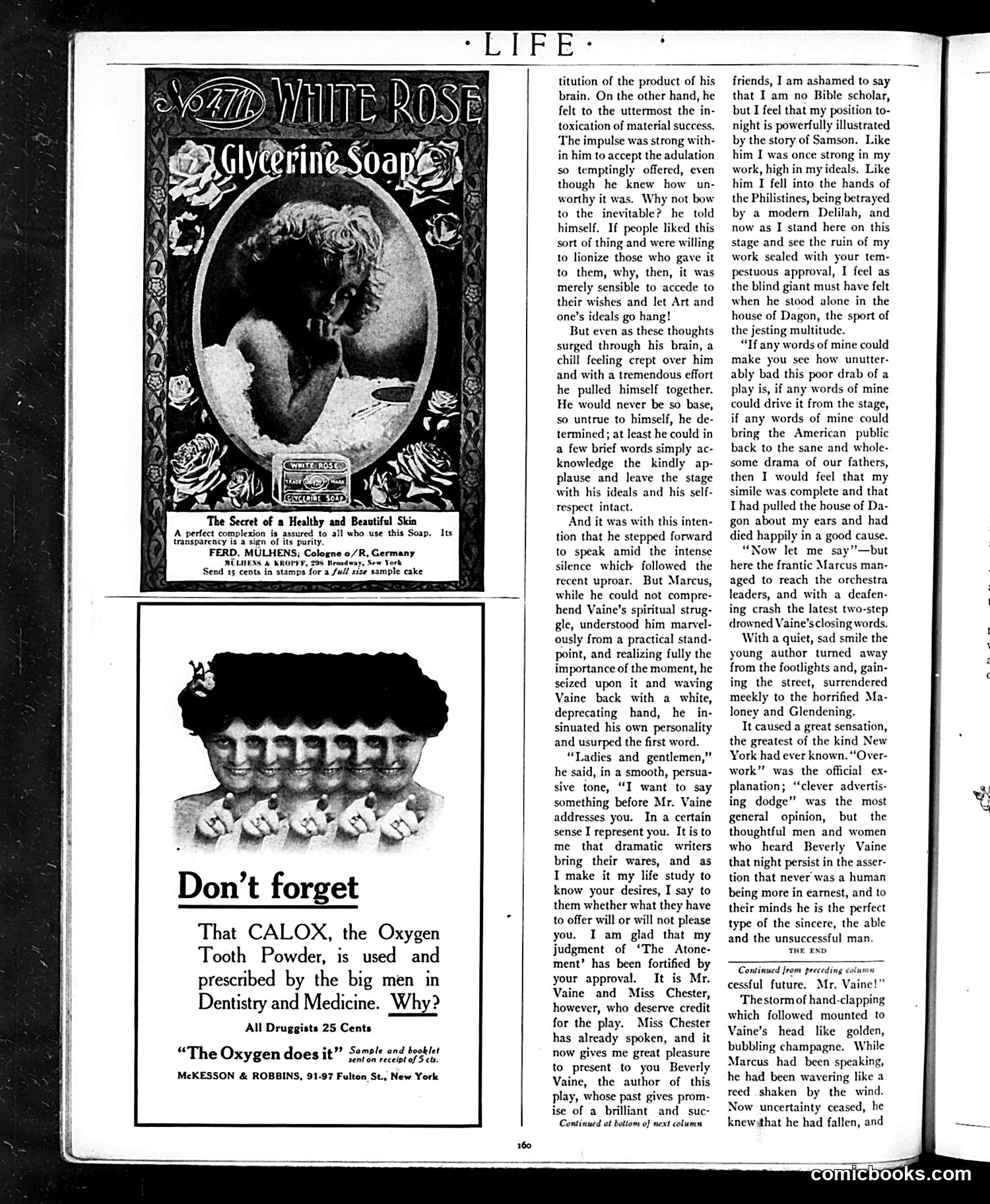
This page contains **primarily advertisements** rather than political satire or comics. The main content includes: 1. **White Rose Glycerin Soap ad** (top): A beauty product advertisement claiming to provide "a perfect complexion" through transparency, marketed by a German manufacturer. 2. **Calox Tooth Powder ad** (bottom): Endorses an "oxygen" tooth powder supposedly used by dental professionals, priced at 25 cents. 3. **Serialized story text** (right column): Appears to be a dramatic narrative about a character named Vaine, an author experiencing moral conflict after his play receives acclaim. The passage references Samson and Delilah, with Vaine lamenting that material success has compromised his artistic ideals. The page reflects early 20th-century magazine advertising conventions, with elaborate typography and claims about scientific benefits (the "oxygen" claims are typical period marketing). The story represents the magazine's serialized fiction content—not satire but melodramatic narrative about artistic integrity versus commercial success.
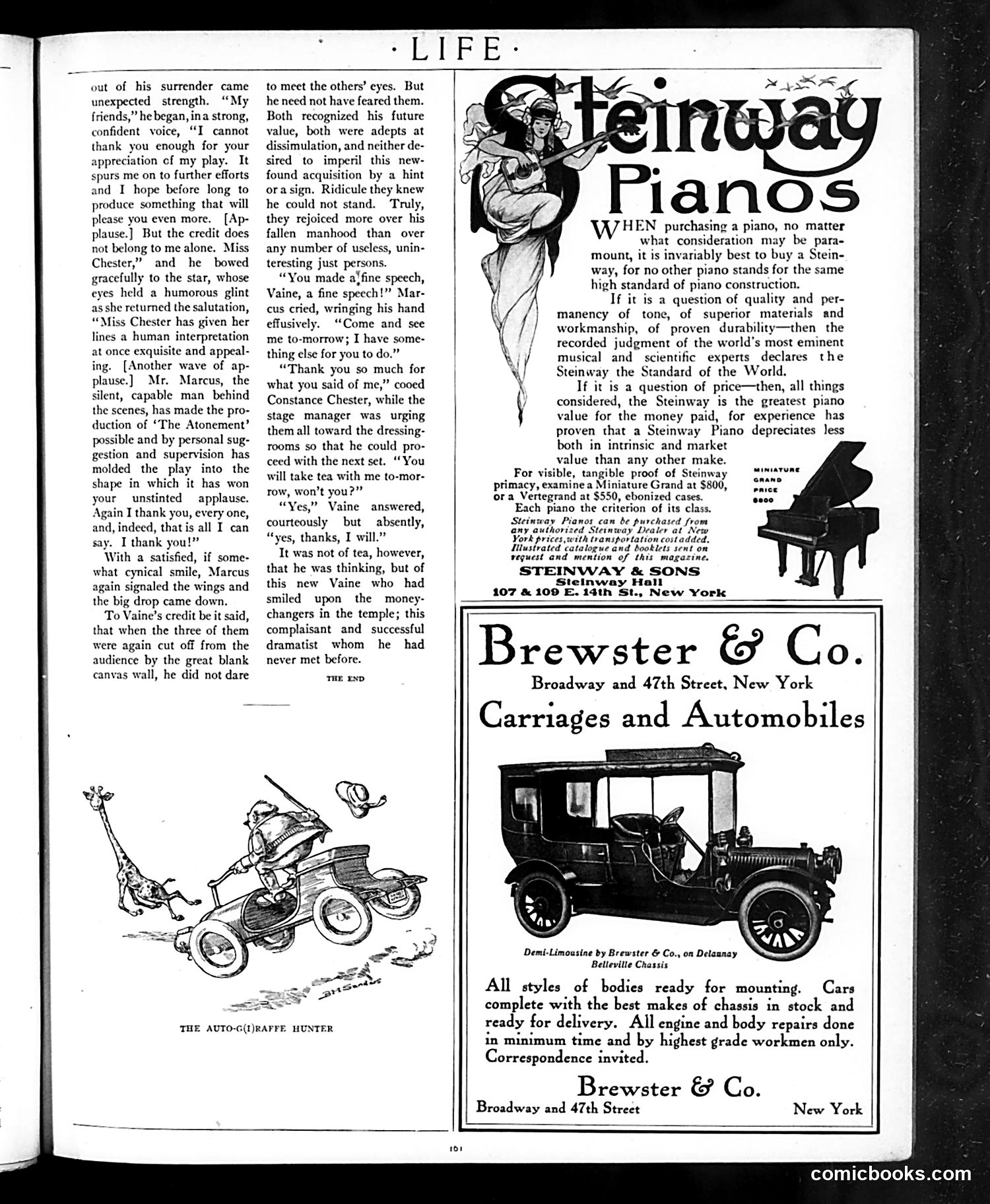
This page contains a story conclusion on the left and period advertisements on the right. **The Story (left):** A theatrical narrative where protagonist Vaine delivers a gracious curtain speech thanking his collaborators—Miss Chester and stage manager Marcus—for the play's success. The text reveals this is performative humility masking Vaine's actual contempt for himself and others. He's become a "successful dramatist" willing to compromise his principles ("smiled upon the money-changers in the temple"), recognizing his newfound commercial value while internally despising this transformation. **The Cartoon:** "The Auto-Giraffe Hunter" depicts a whimsical figure in an early automobile chasing a giraffe—satirizing the nascent automobile industry's wild, unpredictable nature. **The Advertisements:** Steinway Pianos and Brewster & Co. (carriages/automobiles) represent luxury goods for wealthy readers—typical of Life magazine's upscale audience. The page juxtaposes theatrical compromise with consumer aspiration.
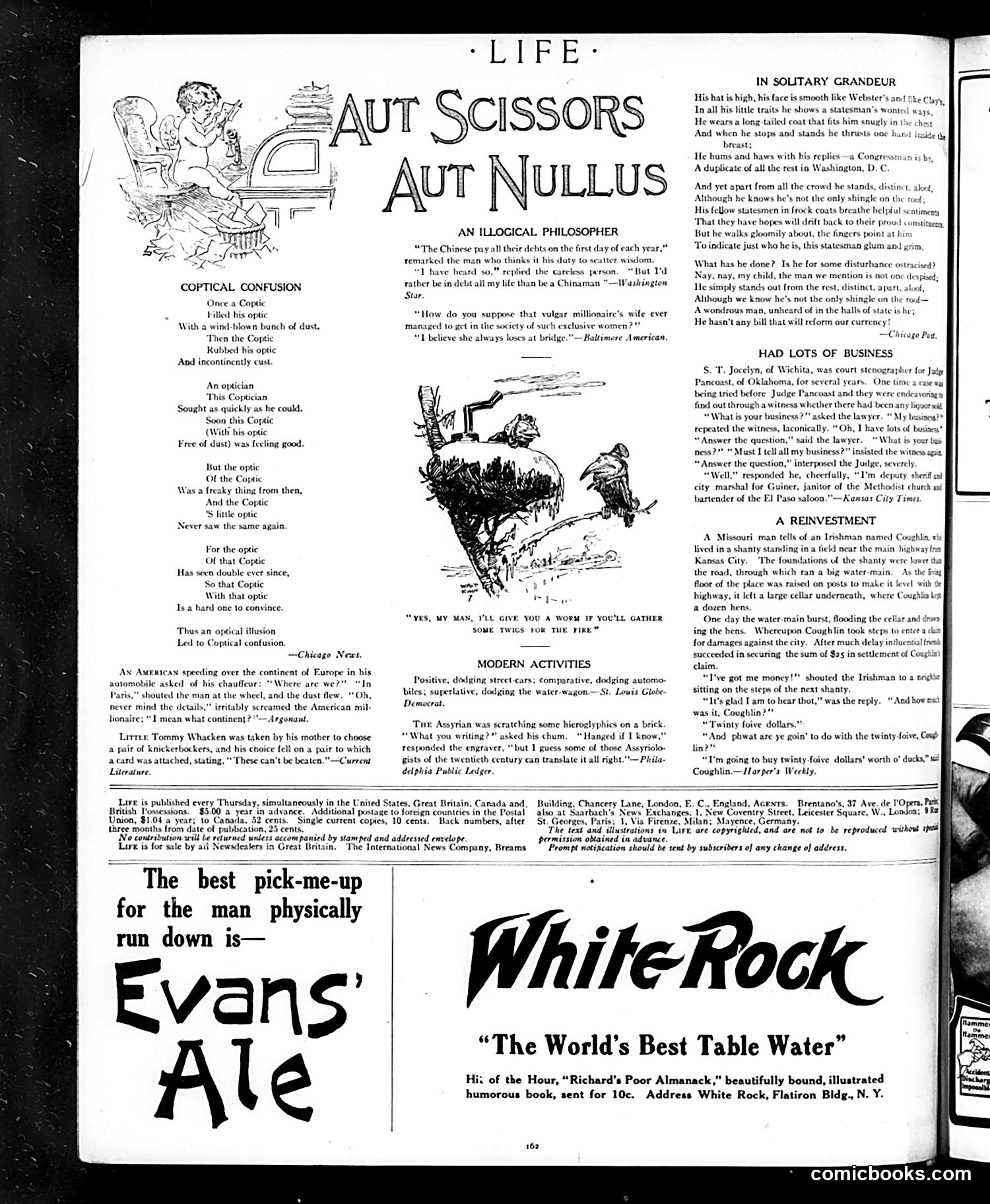
This page contains several humorous short pieces and verses typical of Life's satirical format. The main items are: **"Coptical Confusion"** — A nonsense poem playing on words ("Coptic"/ophthalmology puns) about a man who gets dust in his eye, seeks an optician, but afterward sees everything doubled. The joke relies entirely on wordplay rather than social commentary. **"Aut Scissors Aut Nullus"** — Labeled "An Illogical Philosopher," this section collects brief anecdotes mocking foolish reasoning: a man refusing to be Chinese despite debt, a millionaire's wife gaining high-society access through card-playing, etc. These target pretension and illogical class attitudes. **"Modern Activities"** — A brief joke progressively defining American urban life as "dodging" (street-cars, automobiles, water-wagons)—satirizing the hazards and chaos of modern city living. **"In Solitary Grandeur"** — A poem about a Washington D.C. congressman notable only for *not* accomplishing anything—satirizing political mediocrity and uselessness. The page exemplifies Life's humor: wordplay, brief satirical vignettes, and gentle mockery of American pretension and political incompetence.
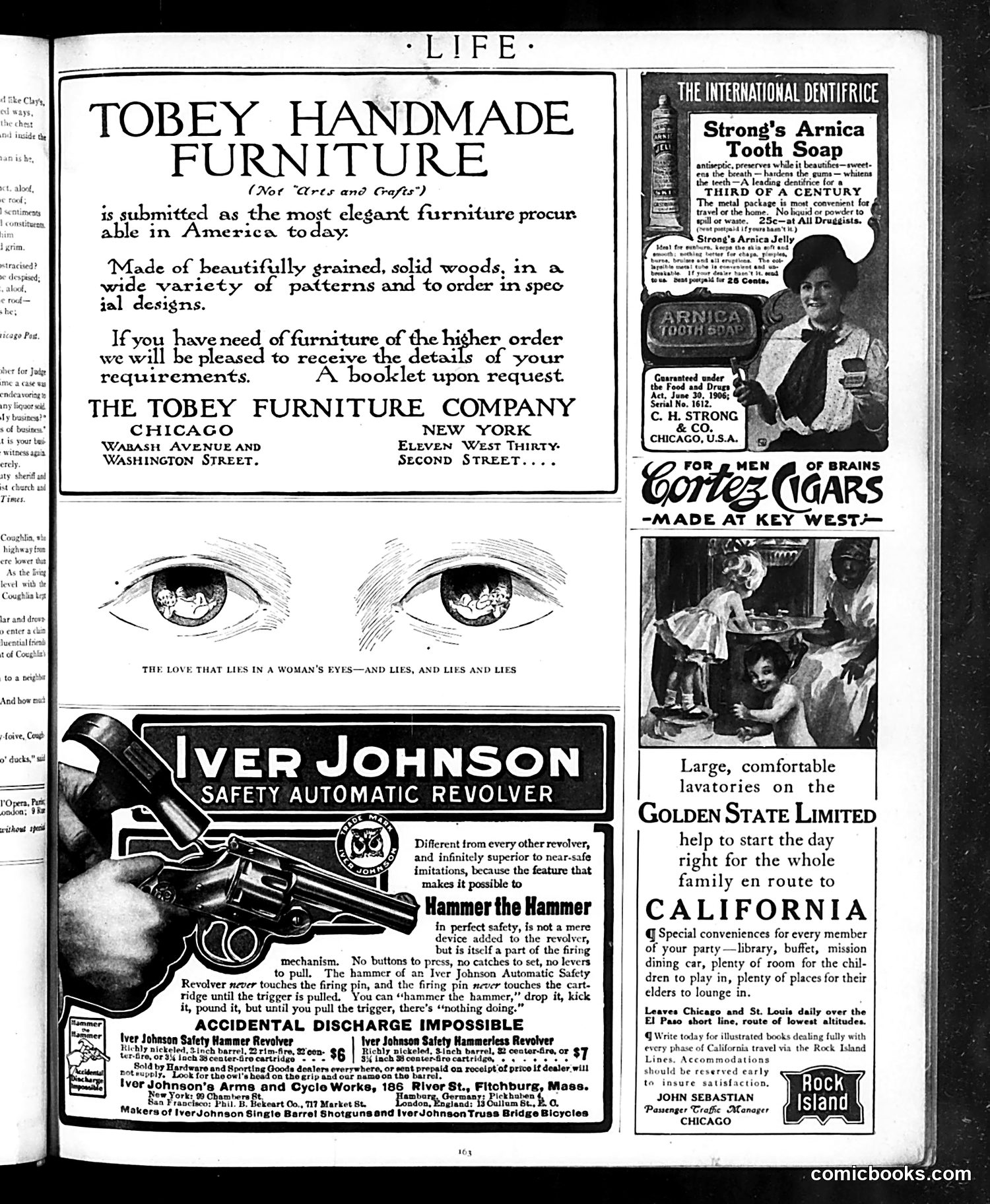
This page is primarily **advertising**, not political satire or editorial content. It contains four distinct product advertisements from the early 20th century: 1. **Tobey Handmade Furniture** — luxury furniture company claiming to offer "the most elegant furniture procurable in America" 2. **Iver Johnson Safety Revolver** — emphasizes the gun's safety mechanisms, claiming "accidental discharge impossible" through its hammer design 3. **Strong's Arnica Tooth Soap** — dental hygiene product 4. **Golden State Limited Train** — California rail service advertising comfortable lavatories and amenities for family travel The page's only illustration with potential symbolic meaning is the **pair of eyes** with the caption "The Love That Lies in a Woman's Eyes — and Lies, and Lies and Lies," which appears to be cynical commentary on female deception, reflecting period gender attitudes. No identifiable political cartoons or satirical figures appear on this page.
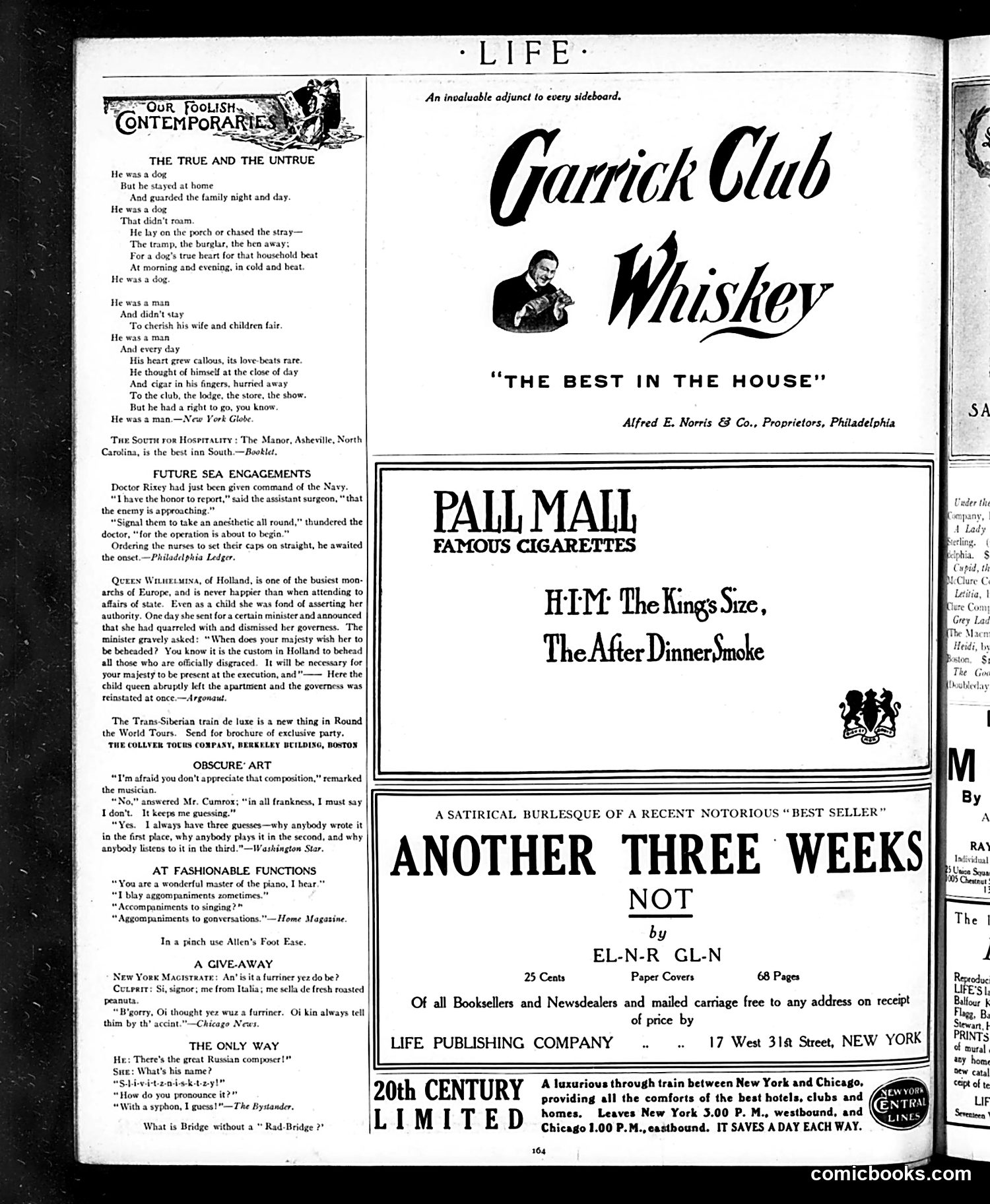
This page is primarily **advertising and filler content** rather than political satire. The main elements are: **"The True and the Untrue"** is a morality poem contrasting a faithful dog with an unfaithful husband who abandons his family for clubs and entertainment—a critique of male selfishness dressed in sentimental verse. It reflects early 20th-century anxieties about masculinity and domestic responsibility. The remaining content consists of **humorous anecdotes** (about a doctor commanding the Navy, Queen Wilhelmina of Holland, obscure music composition) and several **full-page advertisements** for Garrick Club Whiskey, Pall Mall Cigarettes, a book titled "Another Three Weeks," and the 20th Century Limited train. The humor is gentle and domestic rather than politically charged. The page represents Life's mixed format: satirical commentary adjacent to commercial advertising, with the magazine's audience being affluent, urban readers of leisure goods and services.
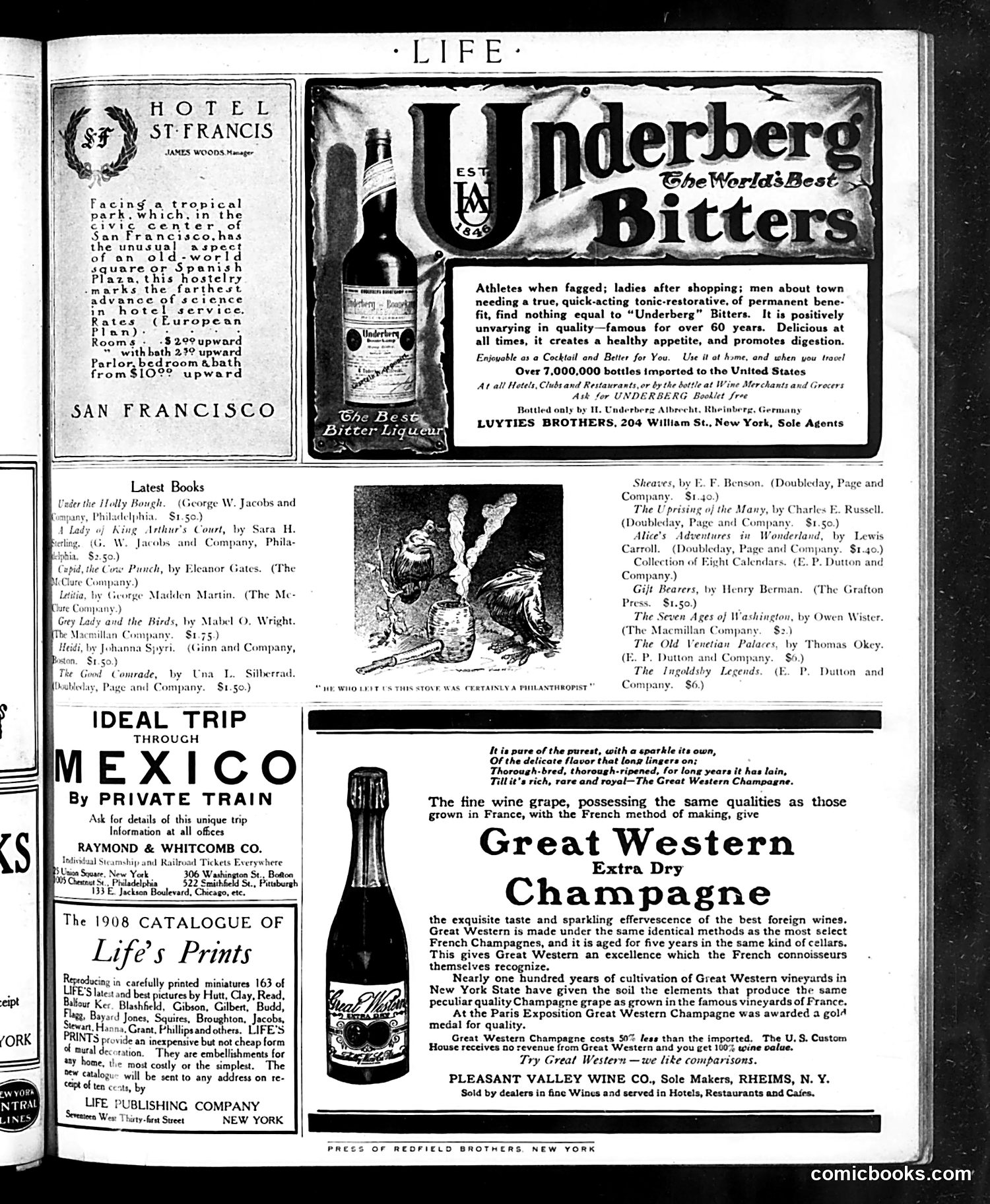
This page is **primarily advertising** with minimal editorial content. The main satirical element is absent or unclear from this particular spread. **Visible advertisements include:** - Hotel St. Francis (San Francisco luxury hotel) - Underberg Bitters (digestive tonic marketed to "athletes when fagged" and shoppers) - Raymond & Whitcomb travel company (Mexico trips) - Great Western Champagne (New York State product competing with French imports) - Life's Prints (decorative reproductions of magazine illustrations) **Book reviews** list contemporary titles by popular authors. **Notable context**: The Underberg ad's language ("tonic-restorative") reflects the era's common use of alcohol-based patent medicines. The Great Western Champagne ad defensively emphasizes American production quality to compete with imported French champagne—reflecting early 20th-century American commercial aspirations. No clear political satire or caricature is visible on this page; it functions primarily as a revenue-generating advertising section.
This page is **not a cartoon or satire**—it's a full-page advertisement for "Old Bleach" linens, placed in *Life* magazine (dated February 6, 1919). The ad promotes linen products manufactured by Geo. Riggs & Co., a New York wholesale distributor. The marketing pitch emphasizes that "Old Bleach" linens are superior because they're bleached naturally by sunlight on grass rather than through chemical processing. This natural method allegedly preserves fabric quality, softness, durability, and elasticity. The opening poetic epigraph establishes a nostalgic, traditional manufacturing image. The ad lists various linen products (tablecloths, napkins, diapers, etc.) and promises superior lustre and draping qualities. For modern readers: this reflects early 20th-century consumer marketing emphasizing "natural" versus "chemical" processes—a sales strategy that remains familiar today.