
Life, 1908-02-06 · page 10 of 36
Life — February 6, 1908 — page 10: what you’re looking at
What you’re looking at
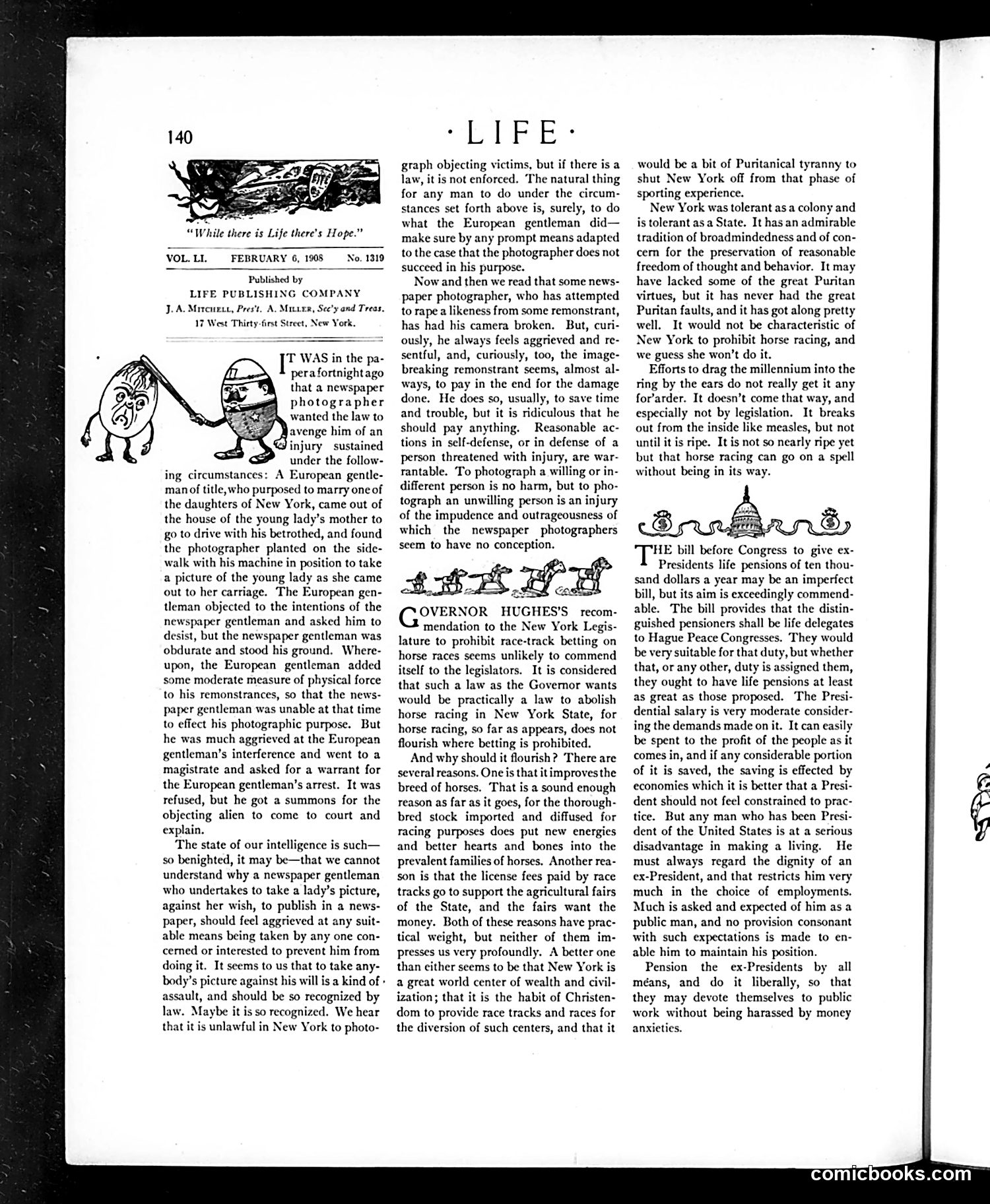
This page contains two satirical articles with accompanying illustrations, rather than traditional political cartoons. The main illustrated piece depicts a confrontation between a European gentleman and a newspaper photographer over taking a picture without consent. The cartoon shows the European objecting to the photographer's intrusion, reflecting a real legal dispute described in the text: a European aristocrat sued a newspaper photographer for taking his photograph without permission and publishing it. The second illustration shows Governor Hughes's recommendation regarding horse racing in New York State. The text discusses debates over whether New York should prohibit horse racing, with arguments about breeding stock, agricultural fairs, and the tax revenue from racing licenses. Both pieces use humor to critique American attitudes toward privacy rights and commercial interests in early 1908.
📄 Transcribed text from this page (OCR, searchable)
Machine-transcribed from the original scan — historical spelling and the odd misread are preserved.
“While there is Life there's Hope.” VOL. LI. No. 1319 FEBRUARY 6, 1908 Published by LIFE PUBLISHING COMPANY J.A. Mireur, Pres't. A. Miture, See’y and Treas, 17 West Thirty-first Street, New York. T WAS in the pa- perafortnightago that a newspaper photographer wanted the law to enge him of an jury sustained under the follow- ing circumstances: A European gentle- man of title, who purposed to marry oneof the daughters of New York, came out of the house of the young lady’s mother to go to drive with his betrothed, and found the photographer planted on the side- walk with his machine in position to take a picture of the young lady as she came out to her carriage. The European gen- tleman objected to the intentions of the newspaper gentleman and asked him to desist, but the newspaper gentleman was obdurate and stood his ground. Where- upon, the European gentleman added some moderate measure of physical force to his remonstrances, so that the news- paper gentleman was unable at that time to effect his photographic purpose. But he was much aggrieved at the European gentleman’s interference and went to a magistrate and asked for a warrant for the European gentleman’s arrest. It was refused, but he got a summons for the objecting alien to come to court and explain. The state of our intelligence is such— so benighted, it may be—that we cannot understand why a newspaper gentleman who undertakes to take a lady’s picture, against her wish, to publish in a news- paper, should feel aggrieved at any suit- able means being taken by any one con- cerned or interested to prevent him from doing it. It seems to us that to take any- body’s picture against his will isa kind of assault, and should be so recognized by law. Maybe it is so recognized. We hear that it is unlawful in New York to photo- ‘LIFE: graph objecting victims, but if there is a law, it is not enforced. The natural thing for any man to do under the circum- stances set forth above is, surely, to do what the European gentleman did— make sure by any prompt means adapted to the case that the photographer does not succeed in his purpose. Now and then we read that some news- paper photographer, who has attempted to rape a likeness from some remonstrant, has had his camera broken. But, curi- ously, he always feels aggrieved and re- sentful, and, curiously, too, the image- breaking remonstrant seems, almost al- ways, to pay in the end for the damage done. He does so, usually, to save time and trouble, but it is ridiculous that he should pay anything. Reasonable ac- tions in self-defense, or in defense of a person threatened with injury, are war- rantable. To photograph a willing or in- different person is no harm, but to pho- tograph an unwilling person is an injury of the impudence and outrageousness of which the newspaper photographers scem to have no conception. Att PT OVERNOR HUGHES'S recom- mendation to the New York Legis- lature to prohibit race-track betting on horse races seems unlikely to commend itself to the legislators. It is considered that such a law as the Governor wants would be practically a law to abolish horse racing in New York State, for horse racing, so far as appears, does not flourish where betting is prohibited. And why should it flourish? There are several reasons. One is that itimprovesthe breed of horses. That is a sound enough reason as far as it goes, for the thorough- bred stock imported and diffused for racing purposes does put new energies and better hearts and bones into the prevalent families of horses. Another rea- son is that the license fees paid by race tracks go to support the agricultural fairs of the State, and the fairs want the money. Both of these reasons have prac- tical weight, but neither of them im- presses us very profoundly. A better one than cither seems to be that New York is a great world center of wealth and civil- ization; that it is the habit of Christen- dom to provide race tracks and races for the diversion of such centers, and that it would be a bit of Puritanical tyranny to shut New York off from that phase of sporting experience. New York was tolerant asa colony and is tolerant as a State. It has an admirable tradition of broadmindedness and of con- cem for the preservation of reasonable freedom of thought and behavior. It may have lacked some of the great Puritan virtues, but it has never had the great Puritan faults, and it has got along pretty well. It would not be characteristic of New York to prohibit horse racing, and we guess she won't do it. Efforts to drag the millennium into the ring by the ears do not really get it any forarder. It doesn’t come that way, and especially not by legislation. It breaks out from the inside like measles, but not until it is ripe. It is not so nearly ripe yet but that horse racing can go on a spell without being in its way. Tie bill before Congress to give ex- Presidents life pensions of ten thou- sand dollars a year may be an imperfect bill, but its aim is exceedingly commend- able. The bill provides that the distin- guished pensioners shall be life delegates to Hague Peace Congresses. They would be very suitable for that duty, but whether that, or any other, duty is assigned them, they ought to have life pensions at least as great as those proposed. The Presi- dential salary is very moderate conside ing the demands made on it. It can e: be spent to the profit of the people as it comes in, and if any considerable portion of it is saved, the saving is effected by economies which it is better that a Presi- dent should not feel constrained to prac- tice. But any man who has been Presi- dent of the United States is at a serious disadvantage in making a living. He must always regard the dignity of an ex-President, and that restricts him very much in the choice of employments. Much is asked and expected of him as a public man, and no provision consonant with such expectations is made to en- able him to maintain his position. Pension the ex-Presidents by all méans, and do it liberally, so that they may devote themselves to public work without being harassed by money anxieties. comicbooks.com