
Life, 1908-02-06 · page 21 of 36
Life — February 6, 1908 — page 21: what you’re looking at
What you’re looking at
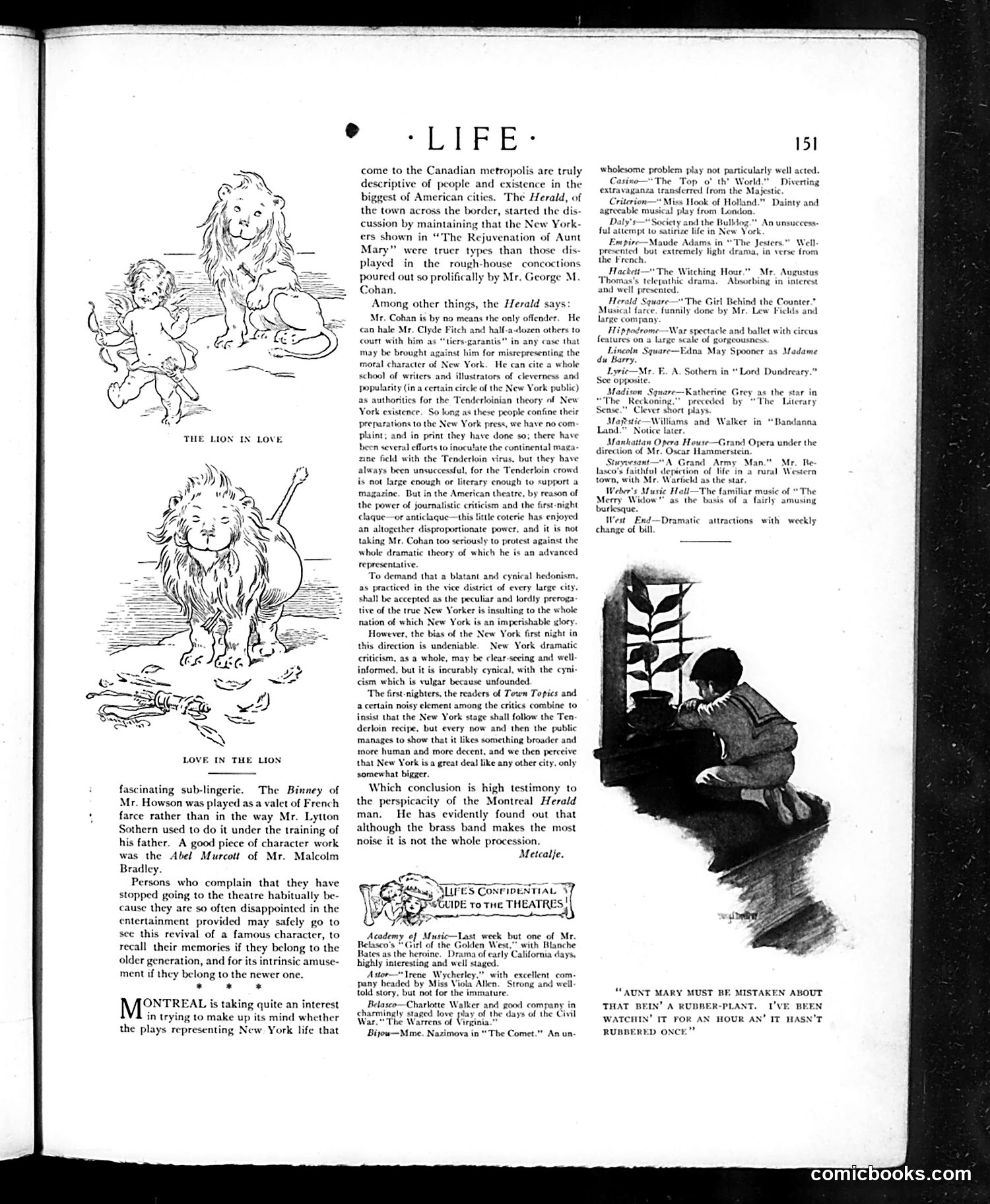
This page critiques how Broadway theater portrays New York City life, specifically attacking George M. Cohan and similar playwrights for sensationalizing the "Tenderloin" district—the city's notorious red-light/vice area—as representative of authentic New York existence. The Montreal *Herald* argues these dramatists misrepresent New York to audiences by treating the demimonde's "blatant and cynical hedonism" as the city's defining character. The article defends New Yorkers against this insulting caricature, noting that while such lowlife characters generate noise and critical attention through first-night cliques, the general public prefers "broader and more decent" entertainment. The cartoons labeled "The Lion in Love" and "Love in the Lion" appear to illustrate this theme of romanticizing base behavior—using animal imagery to satirize human pretension. The critique essentially argues New York theater had become too fixated on vice-district sensationalism rather than authentic middle-class life.
📄 Transcribed text from this page (OCR, searchable)
Machine-transcribed from the original scan — historical spelling and the odd misread are preserved.
THE LION IN LOVE LOVE IN THE LION fascinating sub-lingerie. The Binney of Mr. Howson was played asa valet of French farce rather than in the way Mr. Lytton Sothern used to do it under the training of his father. A good piece of character work was the Abel Murcott of Mr. Malcolm Bradley. Persons who complain that they have stopped going to the theatre habitually be- cause they are so often disappointed in the entertainment provided may safely go to ¢ this revival of a famous character, to recall their memories if they belong to the older generation, and for its intrinsic amuse- ment if they belong to the newer one. . © & ONTREAL is taking quite an interest in trying to make up its mind whether the plays representing New York life that * LUPE come to the Canadian metropolis are truly descriptive of people and existence in the biggest of American cities. The Herald, of the town across the border, started the dis- cussion by maintaining that the New York- ers shown in “The Rejuvenation of Aunt Mary” were truer types than those dis- played in the rough-house concoctions poured out so prolifically by Mr. George M. Cohan. Among other things, the Herald says ‘Mr. Cohan is by no means the only offender. He can hale Mr. Clyde Fitch and half-a-dozen others to garantis” in any case that im for misrepresenting the cite a whole court with him as “tie may be brought against moral character of New Y school of writers and illustrators of cleverness and. popularity (ina certain circle of the New Vork public) as authoritics for the Tenderloinian theory af New York existence. So lung as these people confine their preparations to the New York press, we have no com: plaint; and in print they have done so; there have been several efforts to inoculate the continental maga zine field with the Tenderloin virus, but they have always been unsuccessful, for the Tenderloin crowd is not large enough of literary enough to support a magazine. But in the American theatre, by reason of the power of journalistic criticism and the first-night claque—or anticlaque—this little coterie has enjoyed an altogether disproportionate power, and it is not taking Mr. Cohan too seriously to protest against the whole dramatic theory of which he is an advanced representative. To demand that a blatant and cynical hedonism, as practiced in the vice district of every large city shall be accepted as the peculiar and lordly preroga tive of the true New Yorker is insulting to the whole nation of which New York is an imperishable xlory However, the bias of the New York first night in this direction is undeniable. New York dramatic criticism, as a whole, may be clear-seeing and well informed. but it is incurably cynical, with the cyni- cism which is vulgar because unfounded. ¢ first-nighters, the readers of Town Topics and a certain noisy element among the critics combine to insist that the New York stage shall follow the Ten. derloin recipe. but every now and then the public manages to show that it likes something broader and more human and more decent, and we then perceive that New York is a great deal like any other city. only somewhat bigger. Which conclusion is high testimony to the perspicacity of the Montreal Herald man. He has evidently found out that although the brass band makes the most noise it is not the whole procession. Metcalfe. LIFES CONFIDENTIAL % SSGUIDE ro THe THEATRES! a! Academy of Music—Last week but one of Mr. Relasco’s “Girl of the Golden West,” with Blanche Bates as the heroine. Drama of early California days, highly interesting and well staged Astor—"Irene Wychetley,” with excellent com: pany beaded by Miss Viola Allen. Strong and well told story, but not for the immature Belasco—Charlotte Walker and good company in charmingly staged love play of the days of War." The Warrens of Virginia.” Bijou—Mme. Nazimova in “The Comet.” An un- 151 not particularly well acted. Cas The Top o' th’ World.” Diverting extravaganza tranderred [rom the Majestic. Criterion—" Miss Hook of Holland.” Dainty and agreeable musical play from London. Daly's—"‘Society and the Bulhtog."* ful attermpt to satirize life in New York Empire—Mavde Adams in “The Jesters.” Well presented but extremely light drama, in verse from the French Hackett—"The Witching Hour.” Mr. Augustus Thomas's telepathic drama. Absorbing in interest and well presented. Herald Square funnily do wholesome problem An unsuccess- “The Girl Behind the Counter” by Mr. Lew Fields and Hippodrome—War spectacle and ballet with circus features on a large scale of gorgcousness Lincoln —Edlna May Spooner as Madame dus Barry, Lyric—Mr. F. Soe opposit Madison Sq Reckoning,” preceded by Clever short plays. ie—Williams and Walker in “Bandana otice later. an Opera House—Grand Opera under the direction of Mr. Oscar Hammerstein, Stw A Grand Army Man.” Mr. Re. lasco’s faithful depiction of life ina rural Western town, with Mr. Warfield as the star Weber's Music Hell—Th Merry Widow" as the basis of burlesque. West Exd—Dramatic change of bill. A. Sothern in “Lord Dundreary cy_as the star in “The Literary f music of “The fairly amusing attractions with weekly “AUNT MARY MUST B THAT BEIN’ A RUBRER-PLANT. I'VE BEE WATCHIN’ IT FOR AN HOUR AN’ IT IAS: RUBBERED ONCE. MISTAKEN ABOUT N 'T comicbooks.com