
Life, 1908-02-06 · page 23 of 36
Life — February 6, 1908 — page 23: what you’re looking at
What you’re looking at
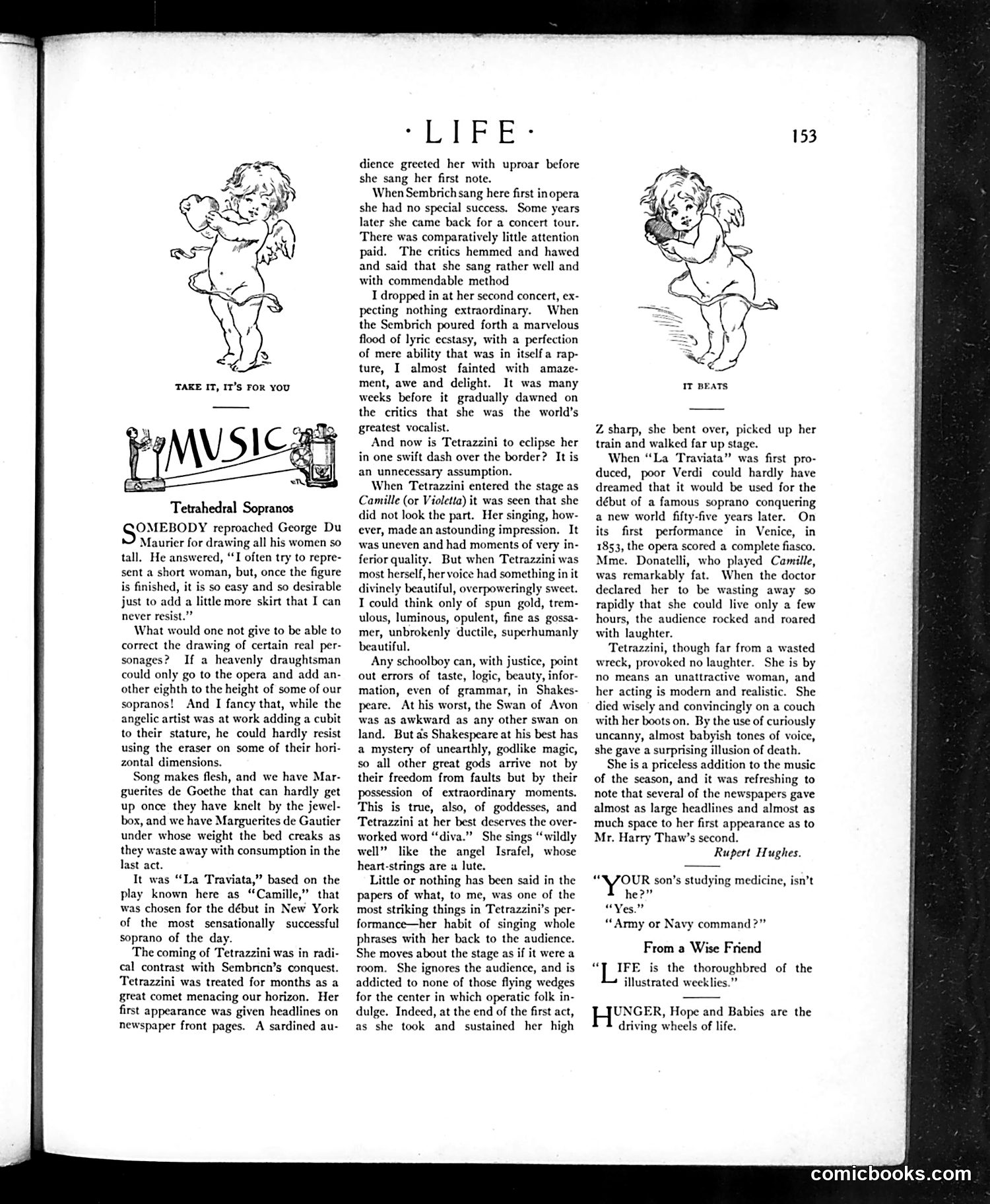
This page satirizes operatic sopranos, particularly contrasting two famous singers: Luisa Tetrazzini (then newly debuted in New York) and Marcella Sembrich. The cartoon illustrations show cherubic figures labeled "TAKE IT, IT'S FOR YOU" and "IT BEATS," likely mocking the physical proportions of opera singers—the accompanying text humorously references Du Maurier's tendency to draw women unrealistically tall, then jokes that a "heavenly draughtsman" adding height to sopranos would need an eraser for their "horizontal dimensions" (waistlines). The article contrasts Tetrazzini's sensational, heavily-promoted debut with Sembrich's initially overlooked performances that gradually revealed her as the superior vocalist. The satire suggests that hype and appearance matter more than genuine talent in opera. The critic praises Tetrazzini's extraordinary voice while noting she lacked the physical appearance for her role, yet defends great artists as transcending such flaws through exceptional moments—comparing her to Shakespeare's occasional genius.
📄 Transcribed text from this page (OCR, searchable)
Machine-transcribed from the original scan — historical spelling and the odd misread are preserved.
Tetrahedral Sopranos SOMEBODY reproached George Du Maurier for drawing all his women so tall. He answered, “I often try to repre- sent a short woman, but, once the figure is finished, it is so easy and so desirable just to add a little more skirt that I can never resist.” What would one not give to be able to correct the drawing of certain real per- sonages? If a heavenly draughtsman could only go to the opera and add an- other eighth to the height of some of our sopranos! And I fancy that, while the angelic artist was at work adding a cubit to their stature, he could hardly resist using the eraser on some of their hori- zontal dimensions. Song makes flesh, and we have Mar- guerites de Goethe that can hardly get up once they have knelt by the jewel- box, and we have Marguerites de Gautier under whose weight the bed creaks as they waste away with consumption in the last act. It was “La Traviata,” based on the play known here as “Camille,” that was chosen for the début in New York of the most sensationally successful soprano of the day. ‘The coming of Tetrazzini was in radi- cal contrast with Sembncn’s conquest. Tetrazzini was treated for months as a great comet menacing our horizon. Her first appearance was given headlines on newspaper front pages. A sardined au- ‘LIFE: dience greeted her with uproar before she sang her first note. When Sembrich sang here first inopera she had no special success. Some years later she came back for a concert tour. There was comparatively little attention paid. The critics hemmed and hawed and said that she sang rather well and with commendable method I dropped in at her second concert, ex- pecting nothing extraordinary. When the Sembrich poured forth a marvelous flood of lyric ecstasy, with a perfection of mere ability that was in itselfa rap- ture, I almost fainted with amaze- ment, awe and delight. It was many weeks before it gradually dawned on the critics that she was the world’s greatest vocalist. And now is Tetrazzini to eclipse her in one swift dash over the border? It is an unnecessary assumption. When Tetrazzini entered the stage as Camille (or Violetta) it was seen that she did not look the part. Her singing, how- ever, made an astounding impression, It was uneven and had moments of very in- ferior quality. But when Tetrazzini was most herself, her voice had something in it divinely beautiful, overpoweringly sweet. I could think only of spun gold, trem- ulous, luminous, opulent, fine as gossa- mer, unbrokenly ductile, superhumanly beautiful. Any schoolboy can, with justice, point out errors of taste, logic, beauty, infor- mation, even of grammar, in Shakes: peare. At his worst, the Swan of Avon was as awkward as any other swan on land. But ds Shakespeare at his best has a mystery of unearthly, godlike magic, so all other great gods arrive not by their freedom from faults but by their possession of extraordinary moments. This is true, also, of goddesses, and Tetrazzini at her best deserves the over- worked word “diva.” She sings “wildly well” like the angel Israfel, whose heart-strings are uw lute. Little or nothing has been said in the papers of what, to me, was one of the most striking things in Tetrazzini’s per- formance—her habit of singing whole phrases with her back to the audience. She moves about the stage as if it were a room. She ignores the audience, and is addicted to none of those flying wedges for the center in which operatic folk in- dulge. Indeed, at the end of the first act, as she took and sustained her high Z sharp, she bent over, picked up her train and walked far up stage. When “La Traviata” was first pro- duced, poor Verdi could hardly have dreamed that it would be used for the début of a famous soprano conquering a new world fifty-five years later. On its first performance in Venice, in 1853, the opera scored a complete fiasco. Mme. Donatelli, who played Camille, was remarkably fat. When the doctor declared her to be wasting away so rapidly that she could live only a few hours, the audience rocked and roared with laughter. Tetra: i, though far from a wasted wreck, provoked no laughter. She is by no means an unattractive woman, and her acting is modem and realistic. She died wisely and convincingly on a couch with her boots on, By the use of curiously uncanny, almost babyish tones of voice, she gave a surprising illusion of death. She is a priceless addition to the music of the season, and it was refreshing to note that several of the newspapers gave almost as large headlines and almost as much space to her first appearance as to Mr. Harry Thaw’s second. Rupert Hughes. “OUR son’s studying medicine, isn't he?” “Yes.” “Army or Navy command?” From a Wise Friend “T IFE is the thoroughbred of the illustrated weeklies.” HENGER, Hope and Babies are the driving wheels of life. comicbooks.com