
Life, 1908-02-06 · page 22 of 36
Life — February 6, 1908 — page 22: what you’re looking at
What you’re looking at
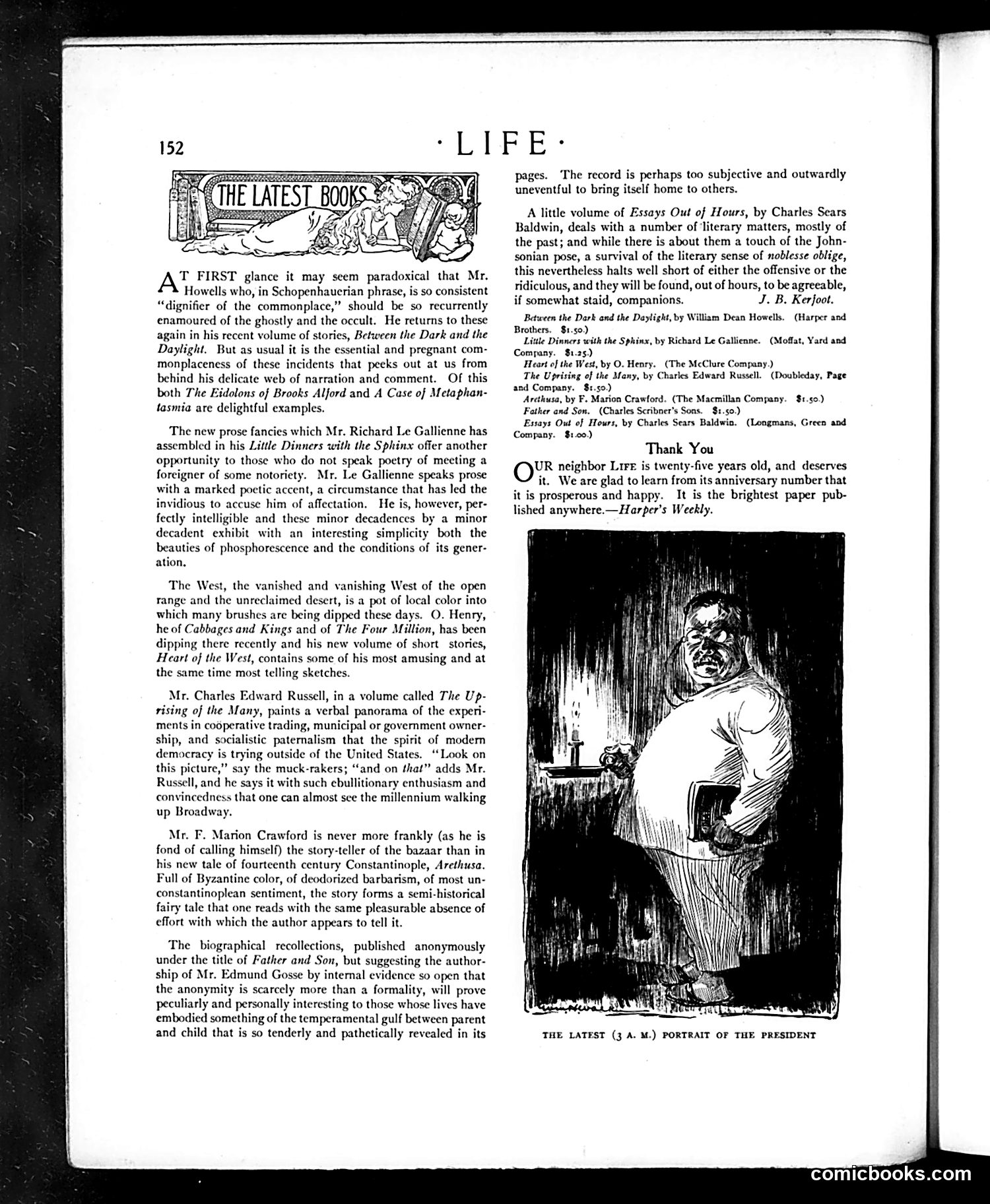
This page reviews recent literary works rather than presenting political satire. The accompanying illustration—labeled "The Latest (3 A.M.) Portrait of the President"—appears to be a sketch of a figure at a desk, likely meant as humor about presidential work habits or appearance, though the specific president and joke are unclear without additional dating context. The text discusses books by William Dean Howells, Richard Le Gallienne, O. Henry, Charles Edward Russell, F. Marion Crawford, Edmund Gosse, and Charles Sears Baldwin. The reviews employ period literary criticism language, praising Howells's treatment of the commonplace and mocking Le Gallienne's "poetic accent" as affected "decadence." Russell's socialist-themed work receives cautious, somewhat patronizing coverage. The tone reflects early-1900s literary gatekeeping—simultaneously celebrating American letters while maintaining skepticism toward experimental or progressive themes.
📄 Transcribed text from this page (OCR, searchable)
Machine-transcribed from the original scan — historical spelling and the odd misread are preserved.
*“LIFE* AXT, FIRST glance it may seem paradoxical that Mr. Howells who, in Schopenhaucrian phrase, is so consistent “‘dignifier of the commonplace,” should be so recurrently enamoured of the ghostly and the occult. He returns to these again in his recent volume of stories, Between the Dark and the Daylight. But as usual it is the essential and pregnant com- monplaceness of these incidents that peeks out at us from behind his delicate web of narration and comment. Of this both The Eidolons of Brooks Alford and A Case of Metaphan- tasmia are delightful examples. The new prose fancies which Mr. Richard Le Gallienne has assembled in his Little Dinners with the Sphinx offer another opportunity to those who do not speak poetry of mecting a foreigner of some notoriety. Mr. Le Gallienne speaks prose with a marked poctic accent, a circumstance that has led the invidious to accuse him of affectation. He is, however, per- fectly intelligible and these minor decadences by a minor decadent exhibit with an interesting simplicity both the beauties of phosphorescence and the conditions of its gener- ation, The West, the vanished and vanishing West of the open range and the unreclaimed desert, is a pot of local color into which many brushes are being dipped these days. O. Henry, he of Cabbages and Kings and of The Four Million, has been dipping there recently and his new volume of short stories, Heart of the West, contains some of his most amusing and at the same time most telling sketches. Mr. Charles Edward Russell, in a volume called The Up- rising of the Many, paints a verbal panorama of the experi- ments in cooperative trading, municipal or government owner- ship, and socialistic paternalism that the spirit of modem democracy is trying outside of the United States. ‘Look on this picture,” say the muck-rakers; ‘“‘and on that” adds Mr. Russell, and he says it with such ebullitionary enthusiasm and convincedness that one can almost see the millennium walking up Broadway. Mr. F. Marion Crawford is never more frankly (as he is fond of calling himself) the story-teller of the bazaar than in his new tale of fourteenth century Constantinople, Arethusa. Full of Byzantine color, of deodorized barbarism, of most un- constantinoplean sentiment, the story forms a semi-historical fairy tale that one reads with the same pleasurable absence of effort with which the author appears to tell it. The biographical recollections, published anonymously under the title of Father and Son, but suggesting the author- ship of Mr. Edmund Gosse by internal evidence so open that the anonymity is scarcely more than a formality, will prove peculiarly and personally interesting to those whose lives have embodied something of the temperamental gulf between parent and child that is so tenderly and pathetically revealed in its pages. The record is perhaps too subjective and outwardly uneventful to bring itself home to others. A little volume of Essays Out of Hours, by Charles Sears Baldwin, deals with a number of ‘literary matters, mostly of the past; and while there is about them a touch of the John- sonian pose, a survival of the literary sense of noblesse oblige, this nevertheless halts well short of either the offensive or the ridiculous, and they will be found, out of hours, to be agreeable, if somewhat staid, companions. J. B. Kerjoot. Between the Dark and the Daylight, by William Dean Howells. (Harper and Brothers. $1.50.) Little Dinners with the Sphinx, by Richard Le Gallienne. (Moffat, Yard and Company. $1.25.) Heart of the West, by O. Henry. (The McClure Company.) The Uprising of the Many, by Charles Edward Russell. (Doubleday, Page and Company. $1.50.) Arcthusa, by F. Marion Crawford. (The Macmillan Company. Father and Son, (Charles Scribner's Sons. $1.50.) Essays Out of Hours, by Charles Sears Baldwin. (Longmans, Green and Company. $1.00.) Thank You UR neighbor Lire is twenty-five years old, and deserves it, We are glad to learn from its anniversary number that it is prosperous and happy. It is the brightest paper pub- lished anywhere.—Harper’s Weekly. $1.50.) THE LATEST (3 A. M.) PORTRAIT OF THE PRESIDENT Comicbooks.com