
Life, 1908-02-06 · page 28 of 36
Life — February 6, 1908 — page 28: what you’re looking at
What you’re looking at
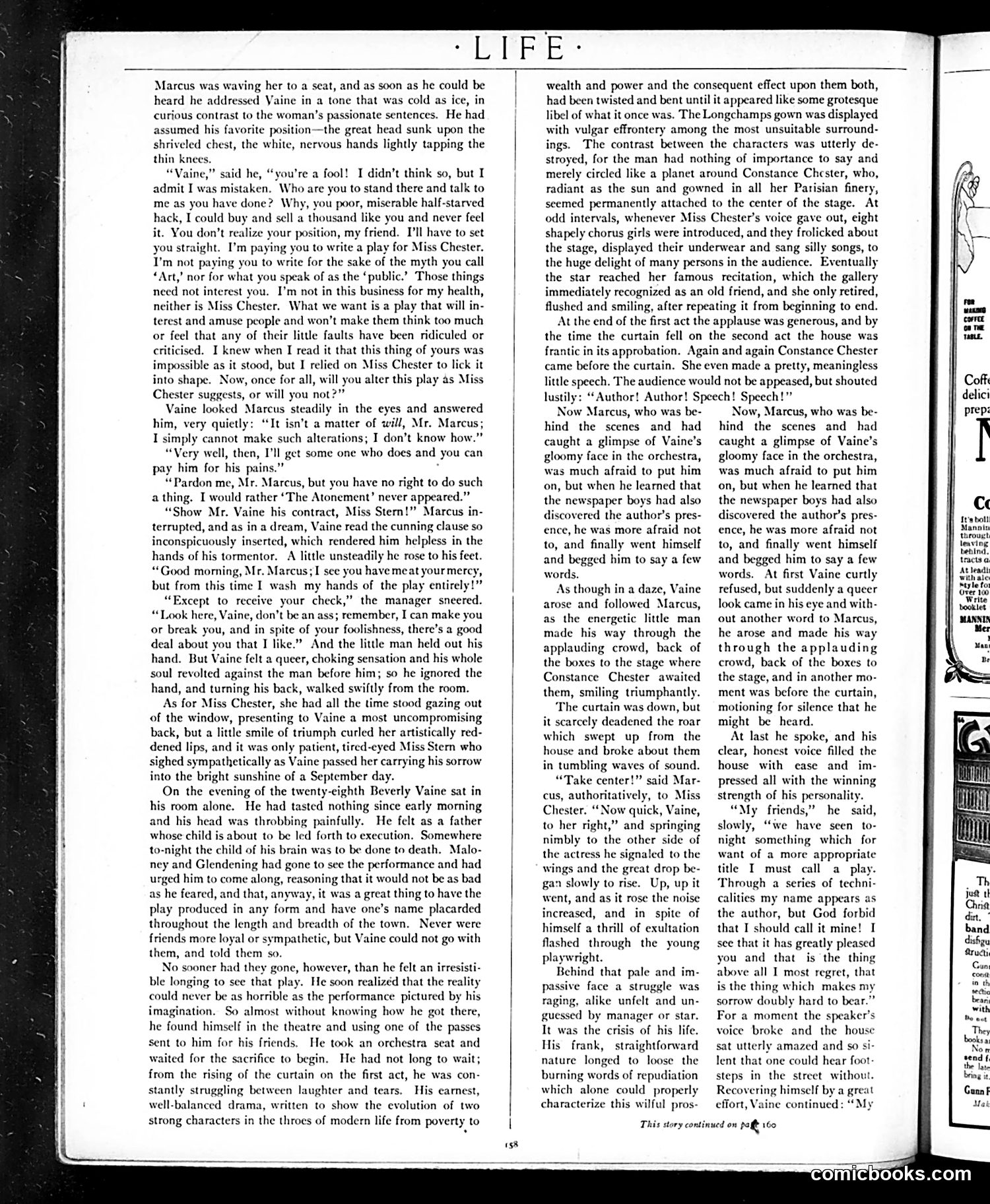
This page contains serialized fiction rather than political cartoons. It depicts a confrontation between Beverly Vaine, a struggling playwright, and Marcus, a theater producer/manager, over artistic control of Vaine's play. The satire targets **commercial theater's corruption of art**. Marcus represents the profit-driven impresario who demands Vaine compromise his artistic vision to please audiences and avoid controversy. Marcus explicitly states he wants entertainment that won't make people "think too much or feel that any of their little faults have been ridiculed." Vaine, the principled but powerless artist, refuses—only to discover a contract clause that leaves him helpless. The story critiques how **financial leverage allows commercial interests to destroy artistic integrity**, a common Progressive-era concern about capitalism corrupting culture. Miss Chester, the star actress, silently supports the producer, suggesting even performers prioritize commercial success over art.
📄 Transcribed text from this page (OCR, searchable)
Machine-transcribed from the original scan — historical spelling and the odd misread are preserved.
luli Jee yg Marcus was waving her to a seat, and as soon as he could be heard he addressed Vaine in a tone that was cold as ice, in curious contrast to the woman’s passionate sentences. He had assumed his favorite position—the great head sunk upon the shriveled chest, the white, nervous hands lightly tapping the thin knee ine,” said he, “you're a fool! I didn’t think so, but I admit I was mistaken. Who are you to stand there and talk to me as you have done? Why, you poor, miserable half-starved hack, I could buy and sell a thousand like you and never feel it. You don’t realize your position, my friend. I’ll have to set you straight. I’m paying you to write a play for Miss Chester. I’m not paying you to write for the sake of the myth you call “Art,’ nor for what you speak of as the ‘public.’ Those things necd not interest you. I’m not in this business for my health, neither is Miss Chester. What we want is a play that w terest and amuse people and won't make them think too much or feel that any of their litle faults have been ridiculed or iticised. I knew when I read it that this thing of yours was impossible as it stood, but I relied on Miss Chester to lick it into shape. Now, once for all, will you alter this play as Mi Chester suggests, or will you not?” Vaine looked Marcus steadily in the eyes and answered him, very quietly: “It isn’t a matter of will, Mr. Marcus; I simply cannot make such alterations; I don’t know how.” “Very well, then, I'll get some one who does and you can pay him for his pains.” : “Pardon me, Mr. Marcus, but you have no right to do such a thing. I would rather ‘The Atonement’ never appeared.” “Show Mr. Vaine his contract, Miss Stern!” Marcus in- terrupted, and as in a dream, Vaine read the cunning clause so inconspicuously inserted, which rendered him helpless in the hands of his tormentor. A little unsteadily he rose to his feet. “Good morning, Mr. Marcus; I see you have meat yourmercy, but from this time I wash my hands of the play entirely!” “Except to receive your check,” the manager sneered. “Look here, Vaine, don’t be an ass; remember, I can make you or break you, and in spite of your foolishness, there’s a good deal about you that I like.” And the little man held out his hand. But Vaine felt a queer, choking sensation and his whole soul revolted against the man before him; so he ignored the hand, and turning his back, walked swiftly from the room. As for Miss Chester, she had all the time stood gazing out of the window, presenting to Vaine a most uncompromising back, but a little smile of triumph curled her artistically red- dened lips, and it was only patient, tired-eyed Miss Stern who sighed sympathetically as Vaine passed her carrying his sorrow into the bright sunshine of a September day. On the evening of the twenty-eighth Beverly Vaine sat in his room alone. He had tasted nothing since early morning and his head was throbbing painfully. He felt as a father whose child is about to be led forth to execution. Somewhere to-night the child of his brain was to be done to death. Malo- ney and Glendening had gone to see the performance and had urged him to come along, reasoning that it would not be as bad as he feared, and that, anyway, it was a great thing to have the play produced in any form and have one’s name placarded throughout the length and breadth of the town. Never were friends more loyal or sympathetic, but Vaine could not go with them, and told them so. No sooner had they gone, however, than he felt an irresisti ble longing to sce that play. He soon realizéd that the reality could never be as horrible as the performance pictured by his imagination. So almost without knowing how he got there, he found himself in the theatre and using one of the passes sent to him for his friends, He took an orchestra seat and waited for the sacrifice to begin. He had not long to wait; from the rising of the curtain on the first act, he was con- stantly struggling between laughter and tears. His earnest, well-balanced drama, written to show the evolution of two strong characters in the throes of modern life from poverty to wealth and power and the consequent effect upon them both, had been twisted and bent until it appeared like some grotesque libel of what it once was. The Longchamps gown was displayed with vulgar effrontery among the most unsuitable surround- ings. The contrast between the characters was utterly de- stroyed, for the man had nothing of importance to say and merely circled like a planet around Constance Chester, who, radiant as the sun and gowned in all her Parisian finery, seemed permanently attached to the center of the stage. At odd intervals, whenever Miss Chester’s voice gave out, eight shapely chorus girls were introduced, and they frolicked about the stage, displayed their underwear and sang silly songs, to the huge delight of many persons in the audience. Eventually the star reached her famous recitation, which the gallery immediately recognized as an old friend, and she only retired, flushed and smiling, after repeating it from beginning to end. At the end of the first act the applause was generous, and by the time the curtain fell on the second act the house was frantic in its approbation. Again and again Constance Chester came before the curtain. She even made a pretty, meaningle: little speech. The audience would not be appeased, but shouted lustily: “Author! Author! Speech! Speech!” Now Marcus, who was be- hind the scenes and had caught a glimpse of Vaine’s gloomy face in the orchestra, was much afraid to put him on, but when he learned that the newspaper boys had also discovered the author’s pres- ence, he was more afraid not to, and finally went himself and begged him to say a few words. As though in a daze, Vaine arose and followed Marcus, as the energetic lithe man made his way through the applauding crowd, back of the boxes to the stage where Constance Chester awaited them, smiling triumphantly. ‘The curtain was down, but it scarcely deadened the roar which swept up from the house and broke about them in tumbling waves of sound. “Take center!” said Mar- cus, authoritatively, to Miss Chester. “Now quick, Vaine, to her right,” and springing nimbly to the other side of the actress he signaled to the wings and the great drop be- gan slowly to rise. Up, up it went, and as it rose the noise increased, and in spite of himself a thrill of exultation flashed through the young playwright. Behind that pale and im- passive face a struggle was raging, alike unfelt and un- guessed by manager or star. It was the crisis of his life. His frank, straightforward nature longed to loose the burning words of repudiation which alone could properly characterize this wilful pros- Now, Marcus, who was be- hind the scenes and had caught a glimpse of Vaine’s gloomy face in the orchestra, was much afraid to put him on, but when he learned that the newspaper boys had also discovered the author's pres- ence, he was more afraid not to, and finally went himself and begged him to say a few words. At first Vaine curtly refused, but suddenly a queer look came in his eye and with- out another word to Marcus, he arose and made his way through the applauding crowd, back of the boxes to the stage, and in another mo- ment was before the curtain, motioning for silence that he might be heard. At last he spoke, and his clear, honest voice filled the house with case and im- pressed all with the winning strength of his personality. “My friends,” he said, slowly, “we have seen to- night something which for want of a more appropriate title I must call a_ play. Through a series of techni- calities my name appears as the author, but God forbid that I should call it mine! I see that it has greatly pleased you and that is the thing above all I most regret, that is the thing which makes my sorrow doubly hard to bea For a moment the speaker’: voice broke and the house sat utterly amazed and so si- lent that one could hear foot- steps in the street without. Recovering himself by a great effort, Vaine continued: “My This story continued on poe 160 Irsbolt Manoin throug acts At leadi