
Life, 1908-02-06 · page 20 of 36
Life — February 6, 1908 — page 20: what you’re looking at
What you’re looking at
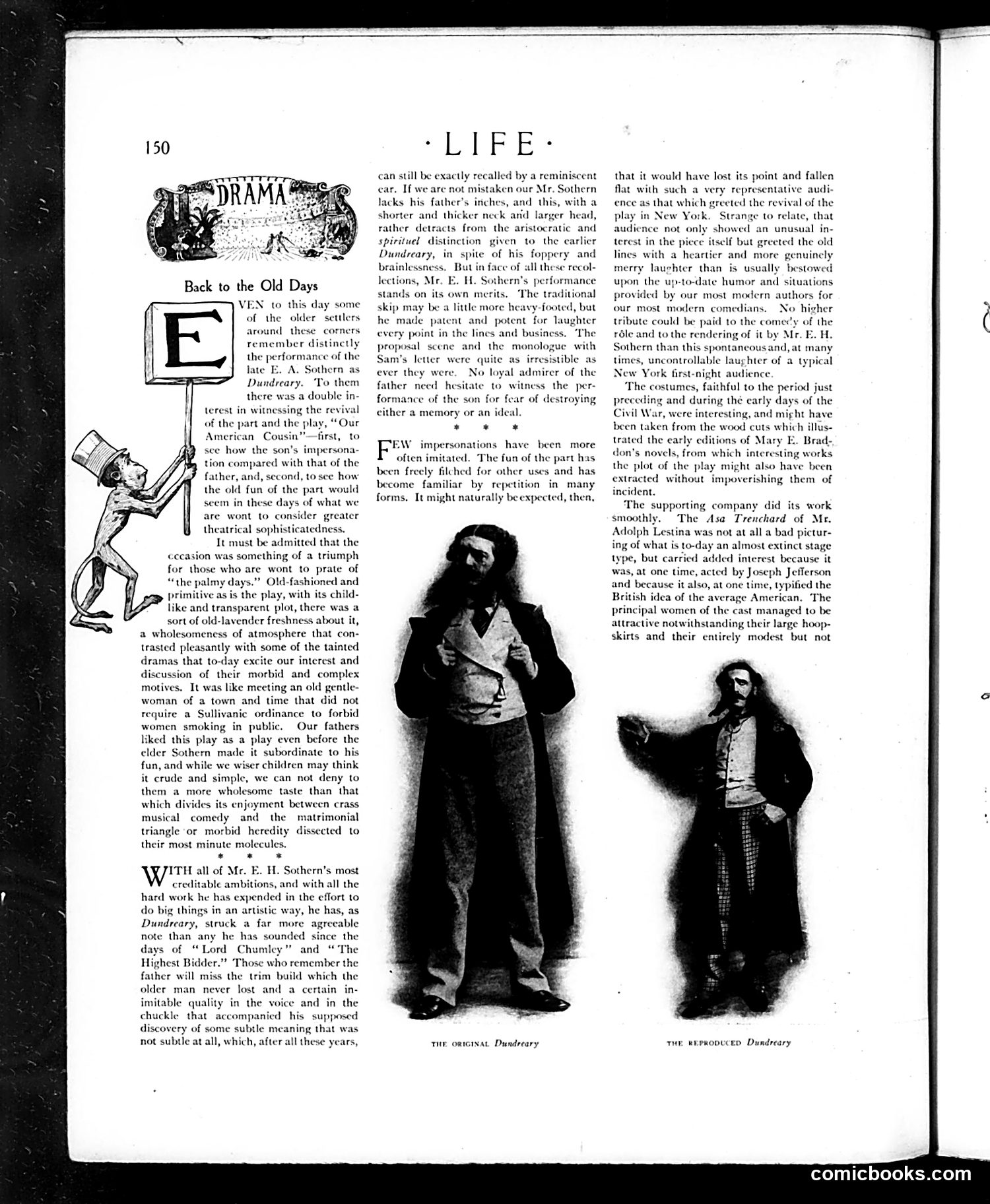
This page reviews a Broadway revival of "Our American Cousin," comparing E.H. Sothern Jr.'s performance as Lord Dundreary to his famous father's original portrayal. The two photographs show the character in the original production (left) and the contemporary revival (right). The text discusses how the younger Sothern physically differs from his father—shorter, thicker-necked—which slightly diminishes the character's aristocratic quality. However, the reviewer credits the son with successfully reviving the role on its own merits. The broader point contrasts this "old-fashioned" play's "wholesome" humor favorably against contemporary theater's focus on "morbid" themes and "matrimonial triangles." The satire celebrates how audiences responded more enthusiastically to traditional comedy and character work than to modern psychological dramas, suggesting nostalgia for simpler theatrical fare.
📄 Transcribed text from this page (OCR, searchable)
Machine-transcribed from the original scan — historical spelling and the odd misread are preserved.
Back to the Old Days ven of the around to this day some older settlers these corners remember distinctly the performance of the late A. Sothern as Dundreary. ‘To them there was a double in- terest in witnessing the revival of the part and the play, “Our American Cousin" —first, to sce how the son’s impersona- tion compared with that of the father, and, second, to see how the old fun of the part would seem in these days of what we are wont to consider greater theatrical sophisticatedness. It must be admitted that the sion was something of a triumph for those who are wont to prate of “the palmy days.” Old-fashioned and primitive as is the play, with its child- like and transparent plot, there was a sort of old-lavender freshness about it, a wholesomeness of atmosphere that con- trasted pleasantly with some of the tainted dramas that to~ excite our interest and discussion of their morbid and complex motives. It was like meeting an old gentle- woman of a town and time that did not require a Sullivanic ordinance to forbid women smoking in public. Our fathers liked this play as a play even before the elder Sothern made it subordinate to his fun, and while we wiser children may think it crude and simple, we can not deny to them a more wholesome te than that h divides its enjoyment between crass musical comedy and the matrimonial triangle ‘or morbid heredity dissected to their most minute molecules. 8 & ITH all of Mr. E. H. Sothern’s most creditable ambitions, and with all the hard work he has expended in the effort to do big things in an artistic way, he has, as Dundreary, struck a far more agreeable note than any he has sounded since the days of “Lord Chumley” and “ ‘The Highest Bidder.” ‘Those who remember the father will miss the trim build which the older man never lost and a certain in- imitable quality in the voice and in. the chuckle that accompanied his supposed discovery of some subtle meaning that was not subtle at all, which, after all these years, ‘LIP E ® can still be exactly recalled by a reminiscent car. If we are not mistaken our Mr. Sothern lacks his father’s inches, and this, with a shorter and thicker neck anid larger head, rather detracts from the aristocratic and spirituel distinction given to the earlier Dundreary, in spite of his foppery and But in face of all these recol- lections, Mr. E. H. Sothern’s performance stands on its own merits. ‘The traditional skip may be a little more heavy-footed, but he made patent and potent for laughter every point in the lines and business. ‘The proposal and the monologue with Sam’s letter were quite as irresistible as ever they were. No loyal admirer of the father need hesitate to. witness the per- formance of the son for fear of destroying cither a memory or an ideal. + * * brainlessness. scene FFEW impersonations have been more often imitated. The fun of the part has been frecly filched for other uses and has become familiar by repetition in many forms, It might naturally beexpected, then, Tur onIcINAL. Dundreary it would have lost its point and fallen flat with such a very representative auc ceted the revival of the Strange to relate, that ence as that which g play in New York audience not only showed an unusual in- terest in the piece itself but greeted the old lines with a hearticr and more genuine merry laughter than is usually bestowed upon the up-to-date humor and situations 1f most modern authors for No higher tribute could be paid to the come:y of the réle and to the rendering of it by Mr. E. H. Sothern than this spontancous and, at many times, uncontrollable laughter of a typical New York first-night audience ‘The costumes, faithful to the period just preceding and during thé early days of the Civil War, were interesting, and might have been taken from the wood cuts which illus- trated the early editions of Mary E. Brad: don’s novels, from which interesting works the plot of the play might also have been extracted without impoverishing them of incident. The supporting company did its work smoothly, The Asa Trenchard of Mr. Adolph Lestina was not at all a bad pictur ing of what is to-day an almost extinct stage type, but carried added interest because it was, at one time, acted by Joseph Jefferson and because it also, at one time, typified the British idea of the average American. ‘The principal women of the cast managed to be attractive notwithstanding their large hoop- skirts and their entirely modest but not provided by our most modern comedians. run eneKoDUCED Dundreary comicbooks.com