
Life, 1908-02-06 · page 14 of 36
Life — February 6, 1908 — page 14: what you’re looking at
What you’re looking at
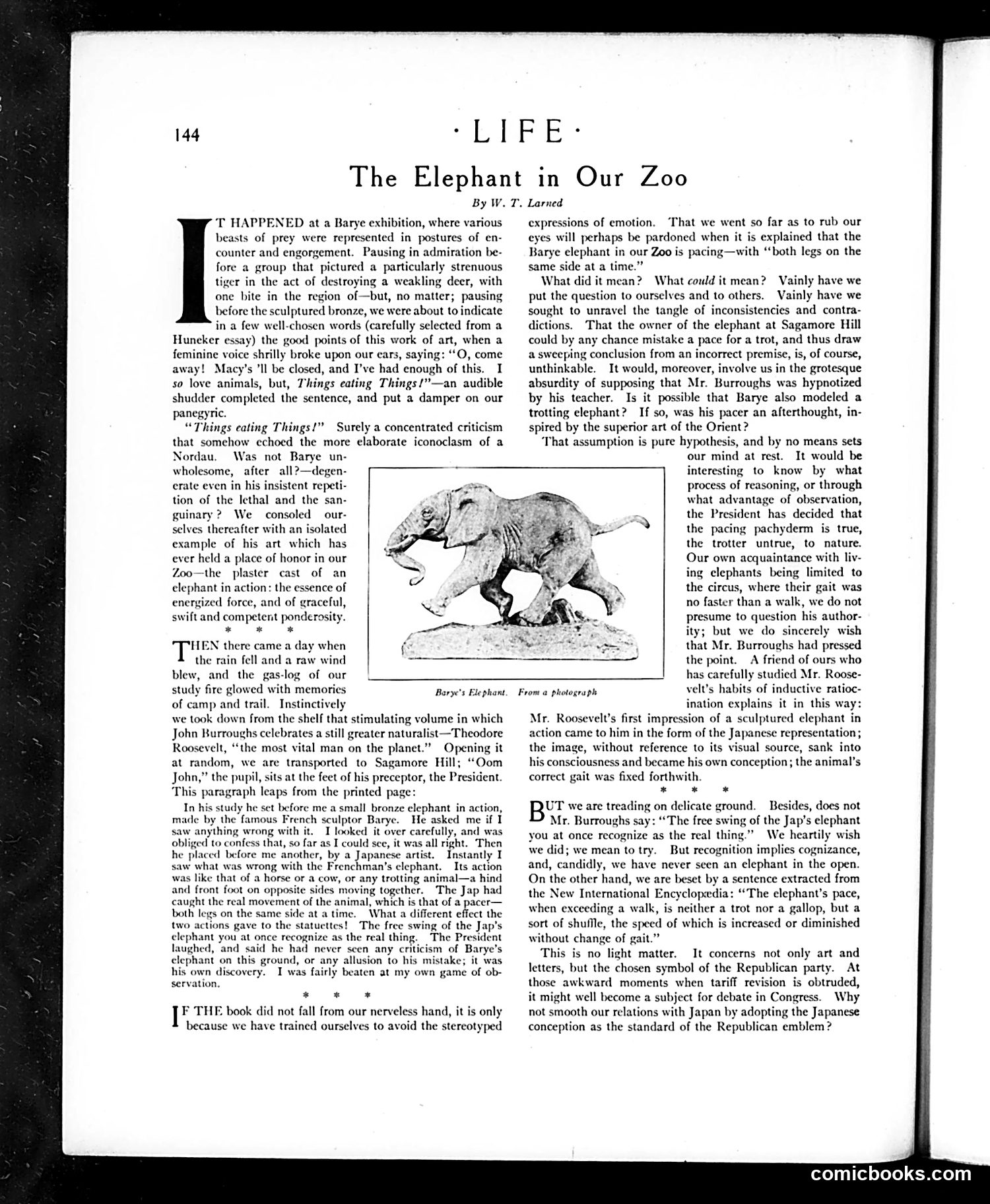
This article mocks President Theodore Roosevelt's self-proclaimed expertise in natural history. The satire centers on Roosevelt's criticism of a famous French sculptor Barye's bronze elephant, claiming its gait is anatomically incorrect. The humor lies in Roosevelt's supposed superiority: he confidently "corrected" Barye's work by preferring a Japanese artist's version, yet the author notes the Barye elephant paces "with both legs on the same side at a time"—an obvious anatomical impossibility that Roosevelt apparently endorsed. The piece suggests Roosevelt, despite his reputation as a great naturalist (celebrated by John Burroughs), made embarrassingly poor observations. By accepting an impossible pose as "true to nature," Roosevelt becomes a figure of ridicule—a know-it-all authority figure confidently wrong about observable facts. The opening anecdote about "Things eating Things" establishes the article's tone: mocking overwrought artistic pretension and those who pontificate about nature.
📄 Transcribed text from this page (OCR, searchable)
Machine-transcribed from the original scan — historical spelling and the odd misread are preserved.
LI PE The Elephant in Our Zoo By W. T HAPPENED at a Barye exhibition, where various beasts of prey were represented in postures of en- counter and engorgement. Pausing in admiration be- fore a group that pictured a particularly strenuous tiger in the act of destroying a weakling deer, with one bite in the region of—but, no matter; pausing before the sculptured bronze, we were about to indicate in a few well-chosen words (carefully selected from a Huneker essay) the good points of this work of art, when a feminine voice shrilly broke upon our cars, saying: “O, come Macy’s 'll be closed, and I’ve had enough of this. I so love animals, but, Things eating Things!”—an audible shudder completed the sentence, and put a damper on our panegyric. “Things eating Things!” Surely a concentrated criticism that somehow echoed the more elaborate iconoclasm of a Nordau. Was not Barye un- ", Larned expressions of emotion. ‘That we went so far as to rub our eyes will perhaps be pardoned when it is explained that the Barye elephant in our Zoo is pacing—with “both legs on the same side at a time.” What did it mean? What could it mean? Vainly have we put the question to ourselves and to others. Vainly have we sought to unravel the tangle of inconsistencies and contra- dictions. That the owner of the elephant at Sagamore Hill could by any chance mistake a pace for a trot, and thus draw a sweeping conclusion from an incorrect premise, is, of course, unthinkable. It would, moreover, involve us in the grotesque absurdity of supposing that Mr. Burroughs was hypnotized by his teacher. Is it possible that Barye also modeled a trotting elephant? If so, was his pacer an afterthought, in- spired by the superior art of the Orient? ‘That assumption is pure hypothesis, and by no means sets our mind at rest. It would be wholesome, after all?—degen- erate even in his insistent repeti- tion of the lethal and the san- guinary ? We consoled our- selves thereafter with an isolated example of his art which has ever held a place of honor in our Zoo—the plaster cast of an elephant in action: the essence of energized force, and of graceful, and competent ponderosity. » * * HEN there came a day when interesting to know by what process of reasoning, or through what advantage of observation, the President has decided that the pacing pachyderm is true, the trotter untrue, to nature. Our own acquaintance with ing elephants being limited to the circus, where their gait was no faster than a walk, we do not presume to question his author- ity; but we do sincerely wish that Mr. Burroughs had pressed the rain fell and a raw wind blew, and the gas-log of our the point. A friend of ours who has carefully studied Mr. Roose- study fire glowed with memories of camp and trail. Instinctively we took down from the shelf that stimulating volume in which John Burroughs celebrates a still greater naturalist—Theodore Roosevelt, ‘‘the most vital man on the planet.” Opening it at random, we are transported to Sagamore Hill; “Oom John,” the pupil, sits at the feet of his preceptor, the President. This paragraph leaps from the printed page: In his study he set before me a small bronze elephant in action, made by the famous French sculptor Barye. He asked me if I saw anything wrong with it. I looked it over carefully, and w obliged to confess that, so far as I could sce, it was all right. Then he placed before me another, by a Japanese artist. Instantly I saw what was wrong with the Frenchman’s clephant. Its action was like that of a horse or a cow, or any trotting animal—a hind and front foot on opposite sides moving together. ‘The Jap had caught the real movement of the animal, which is that of a pacer— both legs on the same side ata time. What a different effect the two actions gave to the statuettes! The free swing of the Jap’s elephant you at once recognize as the real thing. The President laughed, and said he had never scen any criticism of Barye’s elephant on this ground, or any allusion to his mistake; it was his own discovery. I was fairly beaten at my own game of ob- servation, Barye’s Elephant. * * * F THE book did not fall from our nerveless hand, it is only because we have trained ourselves to avoid the stereotyped velt’s habits of inductive ratioc- ination explains it in this way: Mr. Roosevelt's first impression of a sculptured elephant in action came to him in the form of the Japanese representation ; the image, without reference to its visual source, sank into his consciousness and became his own conception ; the animal’s correct gait was fixed forthwith. * * Bur we are treading on delicate ground. Besides, does not Mr. Burroughs say: “The free swing of the Jap’s elephant you at once recognize as the real thing.” We heartily wish we did; we mean to t But recognition implies cognizance, and, candidly, we have never seen an clephant in the open. On the other hand, we are beset by a sentence extracted from the New International Encyclopedia: “The elephant’s pace, when exceeding a walk, is neither a trot nor a gallop, but a sort of shufile, the speed of which is increased or diminished without change of gait.” This is no light matter. It concerns not only art and letters, but the chosen symbol of the Republican party. At those awkward moments when tariff revision is obtruded, it might well become a subject for debate in Congress. Why not smooth our relations with Japan by adopting the Japanese conception as the standard of the Republican emblem? From a photograph comicbooks.com