
A complete issue · 24 pages · 1908
Life — January 16, 1908
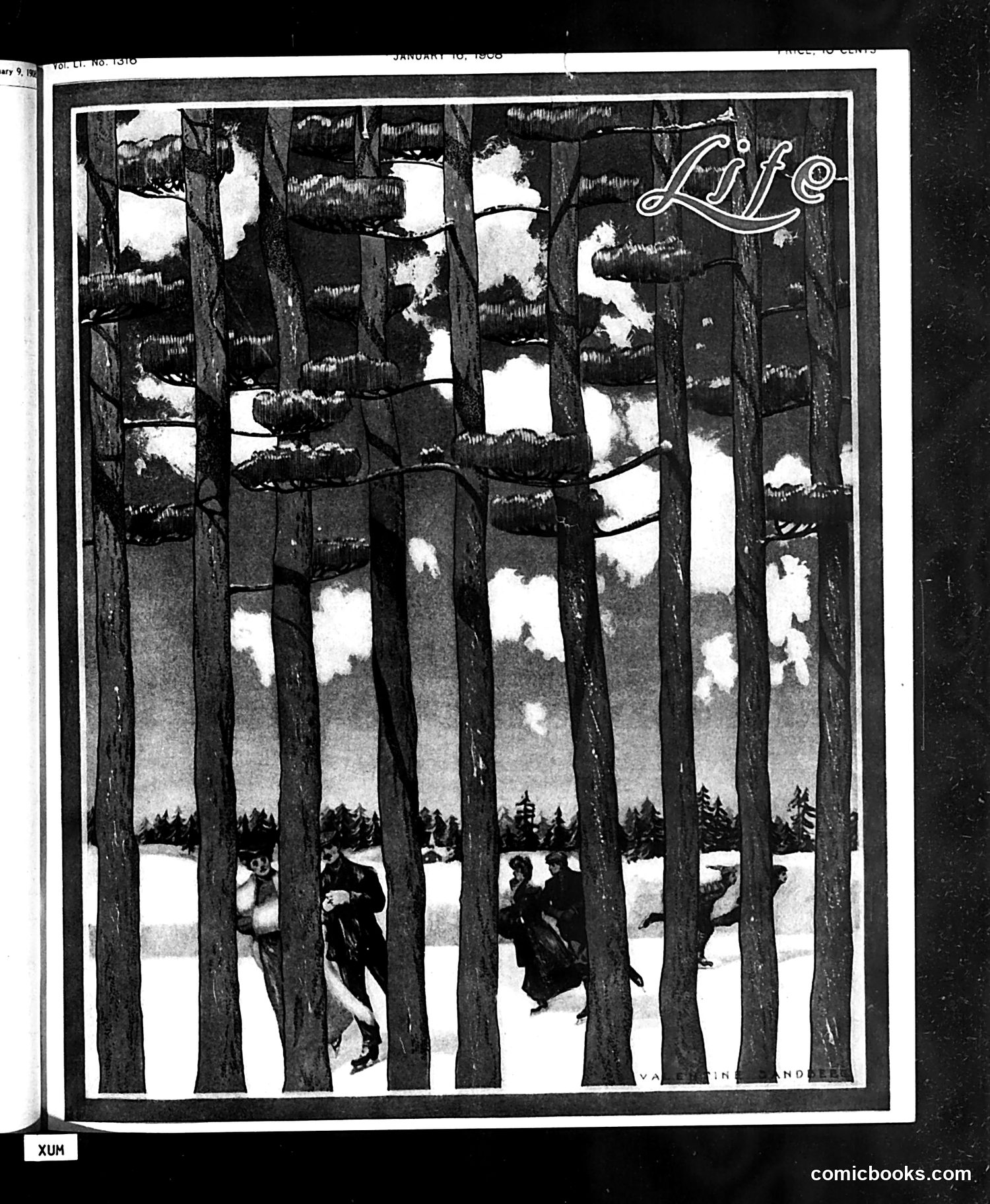
This appears to be a cover or full-page illustration from *Life* magazine (January 10, 1920, based on the header). The artwork depicts several figures in dark clothing walking or running through deep snow between tall, stark pine trees. The scene is winter landscape art in a woodcut or high-contrast illustration style typical of early 20th-century magazine covers. Without clearer OCR text or visible captions identifying the figures, I cannot definitively state who they represent or what political/social event this satirizes. The composition suggests narrative drama—perhaps depicting escape, migration, or hardship—but the specific historical reference remains unclear from the image alone. The artistic style is striking but the satirical point is not evident without additional context.
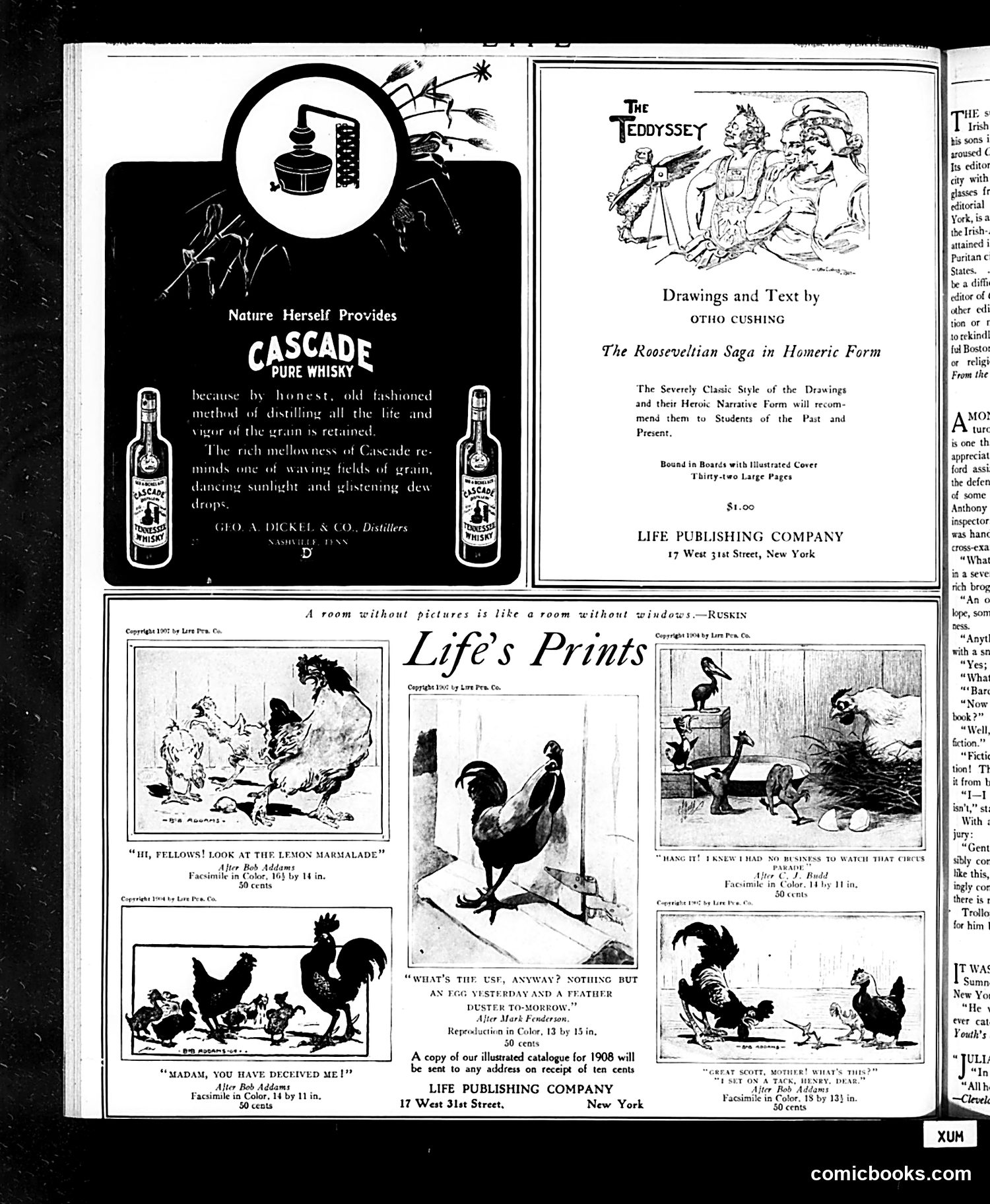
This page contains two distinct sections: **Top Half:** A Cascade Pure Whisky advertisement emphasizing traditional distilling methods that preserve grain vigor and the whisky's "rich mellowness." **Bottom Half:** "Life's Prints"—humorous animal cartoons by artists including Otho Cushing and others. The comics feature roosters and chickens in comedic situations with captions like "Hi, Fellows! Look at the Lemon Marmalade," "Madam, You Have Deceived Me!," and "What's the Use, Anyway? Nothing but an Egg Yesterday and a Feather Dull." These animal comics appear to be gentle domestic humor rather than political satire—typical early 20th-century magazine filler featuring anthropomorphized animals in silly domestic scenarios. The page is primarily commercial and entertainment-focused rather than satirical commentary.
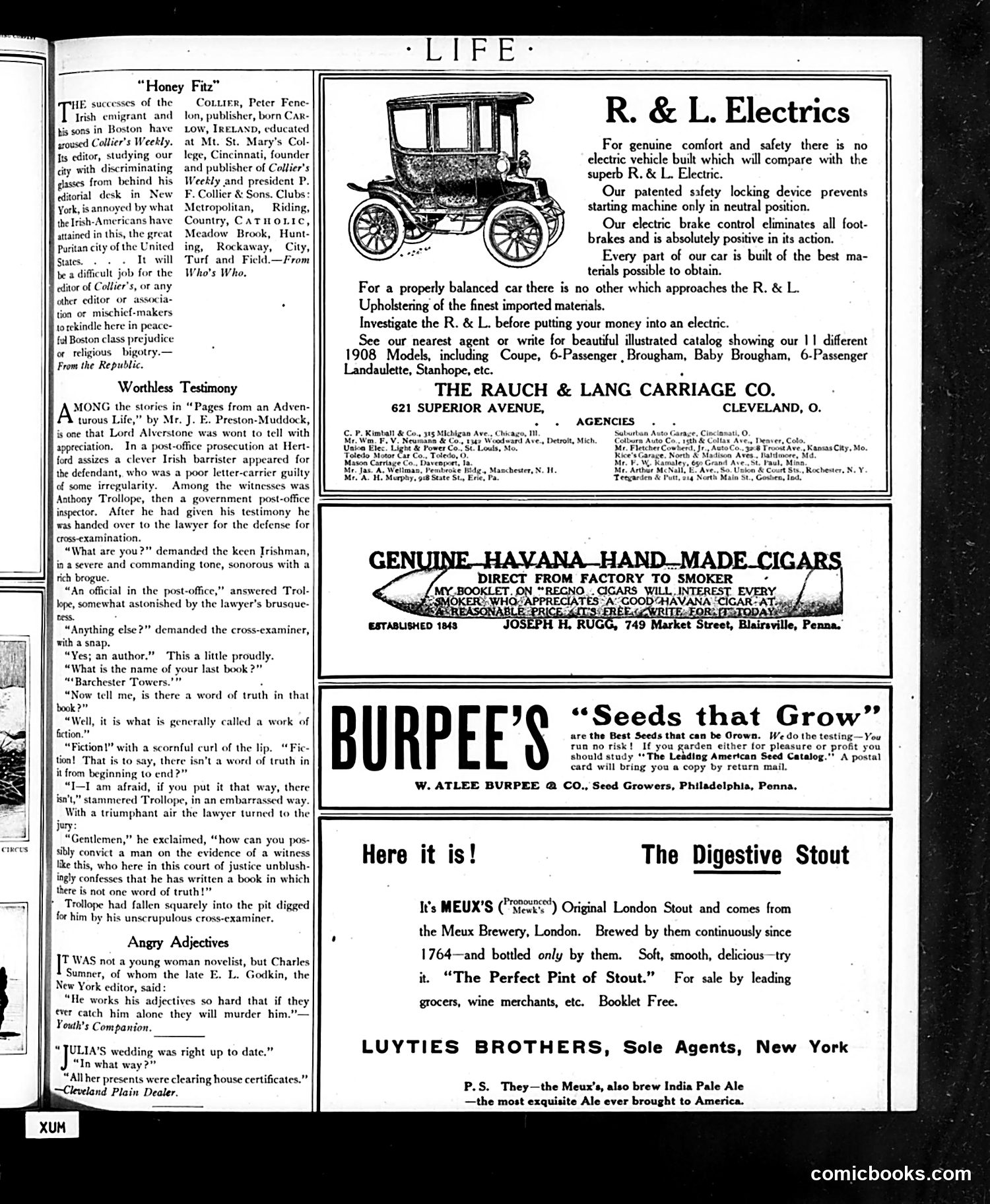
This page is primarily **advertising with minimal editorial content**. The ads include R. & L. Electrics (early automobiles), Havana cigars, Burpee's seeds, and Meux's stout beer. The left column contains brief literary commentary, including: - A note on "Honey Fitz" (appears to reference Irish-American Boston political circles) - A section titled "Worthless Testimony" discussing witness credibility in legal proceedings - "Angry Adjectives," a short piece on Charles Sumner's use of inflammatory language These are light satirical pieces typical of *Life* magazine's era, but lack clear political cartoons. The page primarily functioned as a revenue-generating advertising vehicle rather than substantive social commentary.
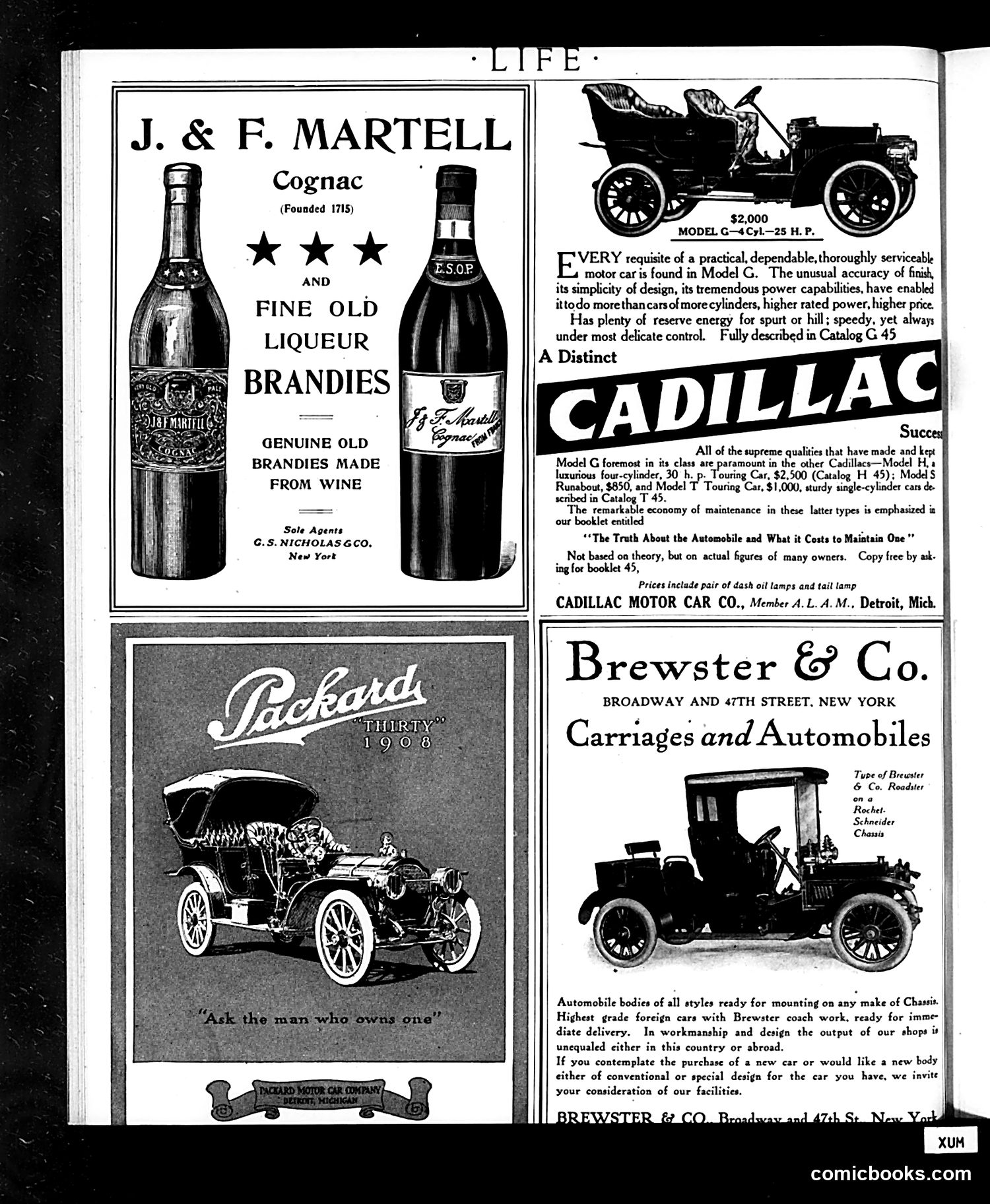
This page contains **no political cartoons or satire**—it is primarily **advertising from circa 1908-1910**. The ads feature: - **J. & F. Martell Cognac** (French brandy, founded 1715) - **Packard automobile** ("Ask the man who owns one") - **Cadillac Model G** ($2,000, emphasizing reliability and power) - **Brewster & Co.** (carriages and automobiles, New York) The content reflects the **early automobile era**, when cars were luxury goods marketed alongside premium spirits. The ads appeal to wealthy consumers and emphasize engineering quality and status. There is no political commentary or satirical content visible on this page—it functions as standard commercial advertisement space in *Life* magazine.
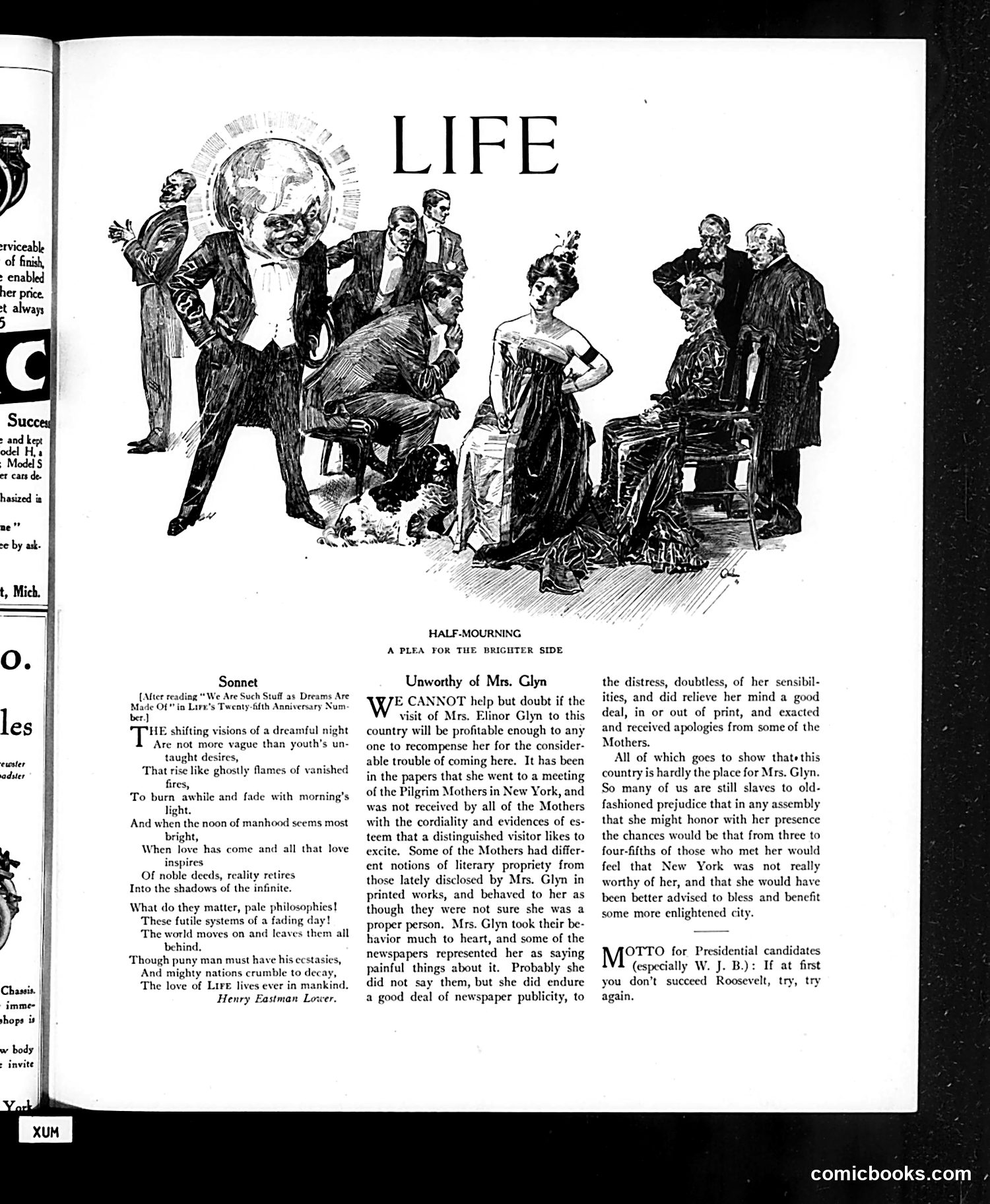
This satirical piece critiques the visit of **Mrs. Elinor Glyn** to America. The illustration depicts society figures in formal dress gathered around a globe, suggesting Mrs. Glyn's international celebrity status. The accompanying article and sonnet mock the excessive public reaction to her visit. Mrs. Glyn, apparently a controversial British author, visited the Pilgrim Mothers organization in New York, causing considerable social fuss. The satire suggests American society was overly fixated on her presence while overlooking substantive issues. The phrase "half-mourning" implies the country should move past its obsession with this foreign literary figure and focus on more important matters—likely including the presidential election referenced in the "MOTTO" section below.
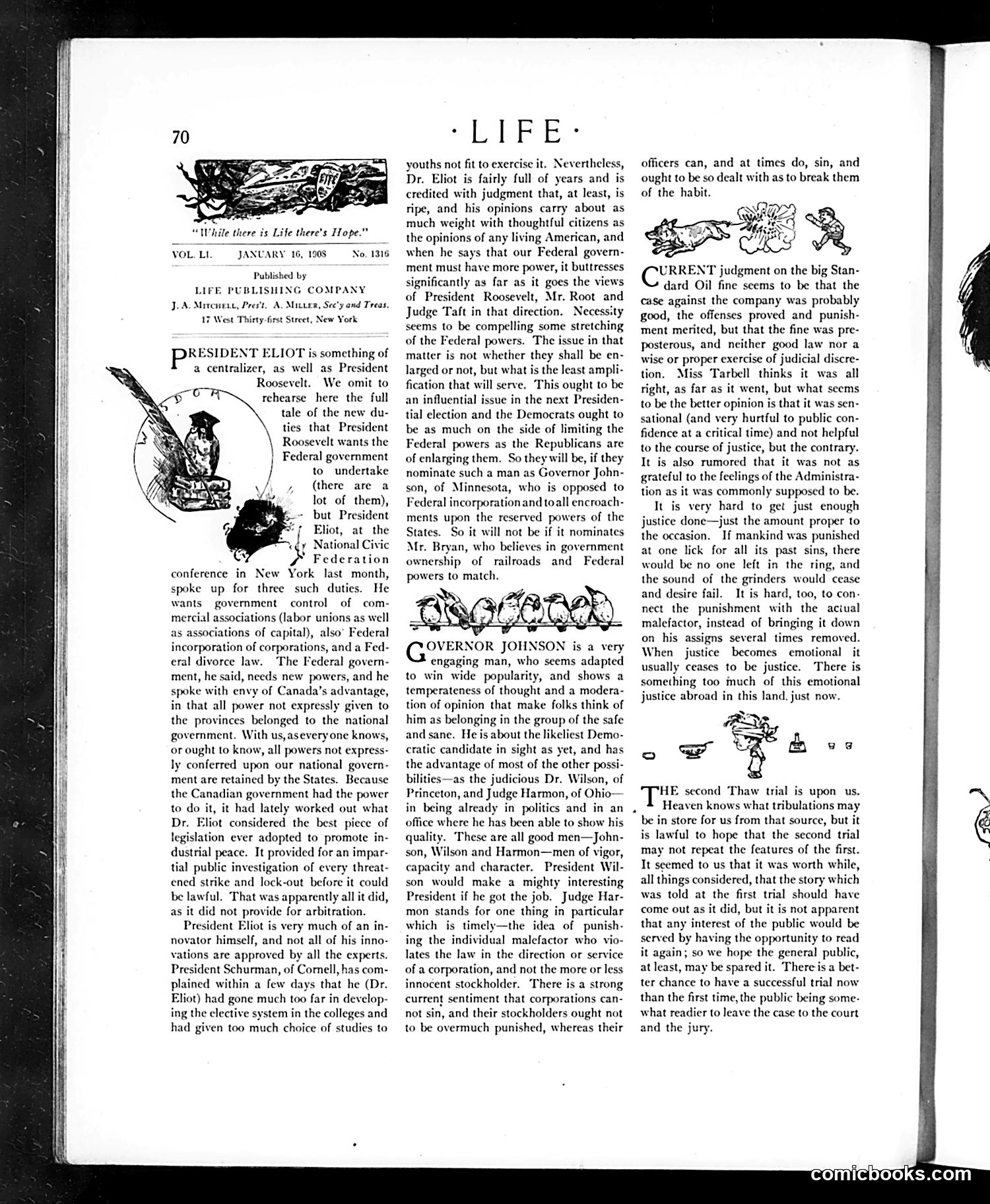
This page contains political commentary rather than traditional cartoons. The text discusses President Theodore Roosevelt's centralizing power and federal government expansion. The illustrated figures appear to be political caricatures, though specific identities aren't entirely clear from image quality. The article criticizes Roosevelt's approach to Federal powers while discussing potential Democratic candidates including what appears to be references to Governor Johnson and Judge Taft. The commentary debates whether Federal power should be limited versus expanded—a central Progressive-era political controversy. The piece suggests Roosevelt may have overreached in centralizing authority, while defending his general competence. The small decorative illustrations appear to be humorous vignettes typical of Life's satirical style, though their specific content is difficult to discern clearly in this reproduction.
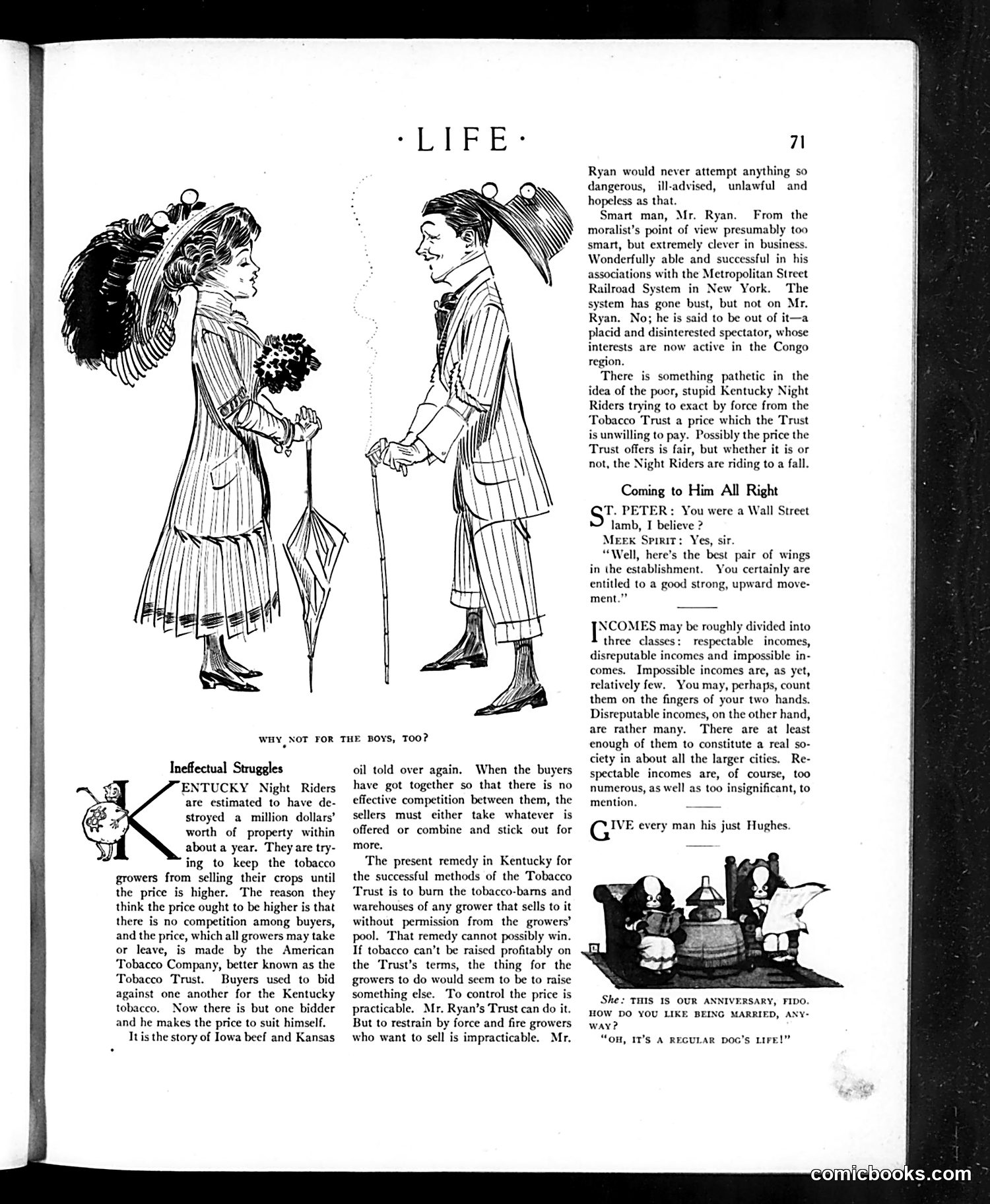
**Main Cartoon ("Why Not for the Boys, Too?"):** A stylized illustration shows a woman with elaborate feathered hat offering flowers to a man in a suit. The caption's question suggests ironic commentary on gender expectations—possibly critiquing unequal social courtesies or romantic customs of the era. **"Ineffectual Struggles" Section:** This article discusses the Kentucky Night Riders, a group attempting to control tobacco prices by preventing growers from selling crops until prices rose. The satire targets their ineffective monopoly scheme, contrasting their failed approach with the successful "Tobacco Trust's" ability to control markets through consolidation. The text implies the Trust's methods were more pragmatically powerful than the Night Riders' coercive tactics. **Bottom Panel:** A domestic humor scene about marriage anniversary celebrations.
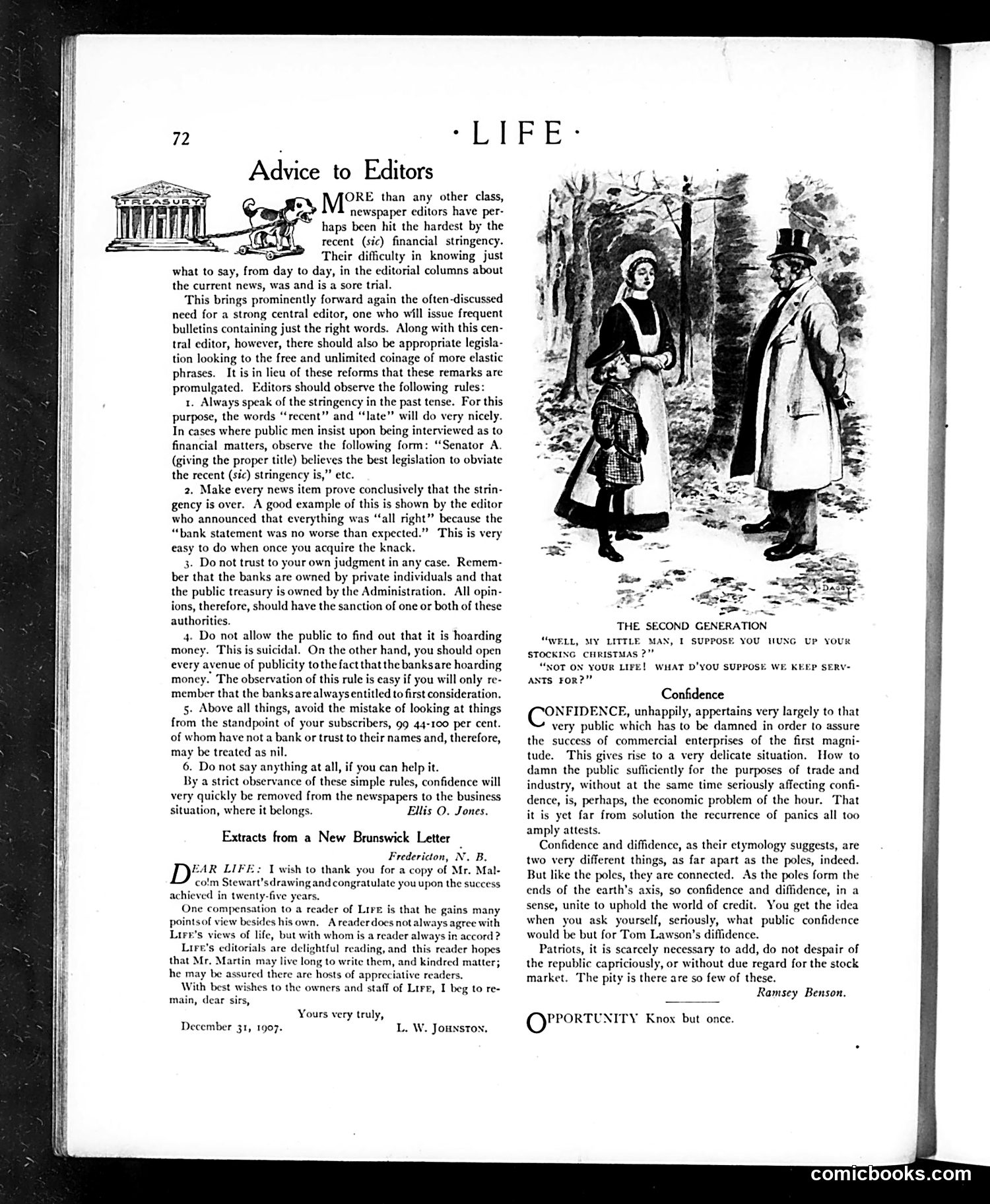
The illustration shows three figures—two adults and a child—in what appears to be a poor urban setting. The caption reads: "Well, my little man, using up your stocking Christmas?" / "Not on your life! What d'you suppose we keep servants for?" **The satire**: A working-class child is depicted parroting the dismissive attitudes of wealthy employers toward servants. The joke criticizes how economic inequality teaches even poor children to adopt the callous class prejudices of their "betters"—perpetuating a cycle of social contempt across generations. The child's shocking entitlement, despite obvious poverty, highlights the absurdity of lower classes imitating aristocratic disdain for service workers.
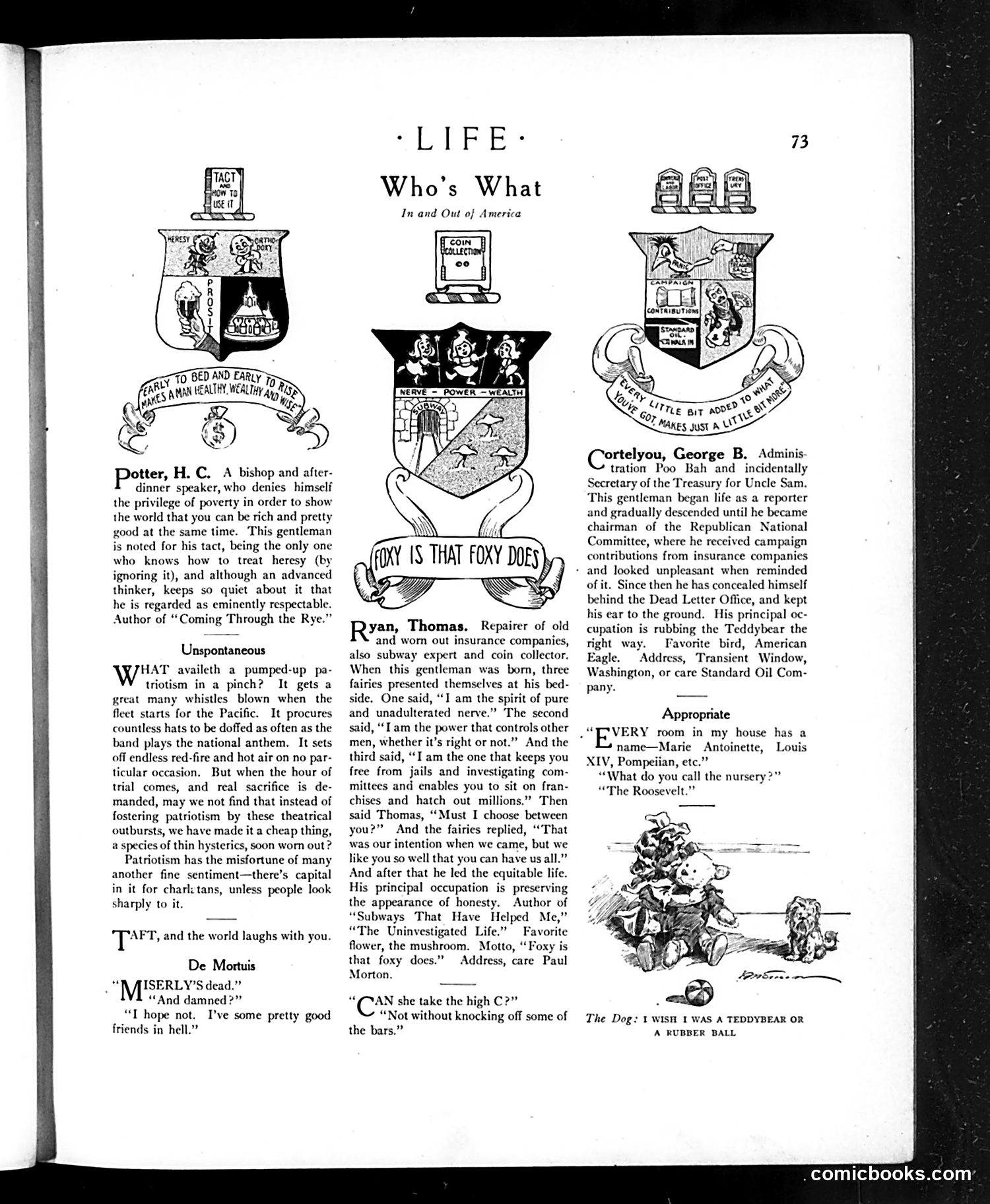
This page satirizes American political and social figures through heraldic-style coats of arms and biographical sketches. **Potter, H.C.** is mocked as a bishop who publicly champions poverty while privately enjoying wealth—a hypocrite preaching what he doesn't practice. **Ryan, Thomas** is caricatured as a subway expert and coin collector; the three fairies at his bedside represent competing claims (pure nerve, controlling power, keeping people docile). The satire suggests his real occupation is exploiting these traits for personal gain. **Cortelyou, George B.** is lampooned for his Republican National Committee campaign work and insurance company involvement, hiding behind the Treasury Secretary position before retreating to the Dead Letter Office. The page uses genealogical mockery to expose hypocrisy among prominent Americans.
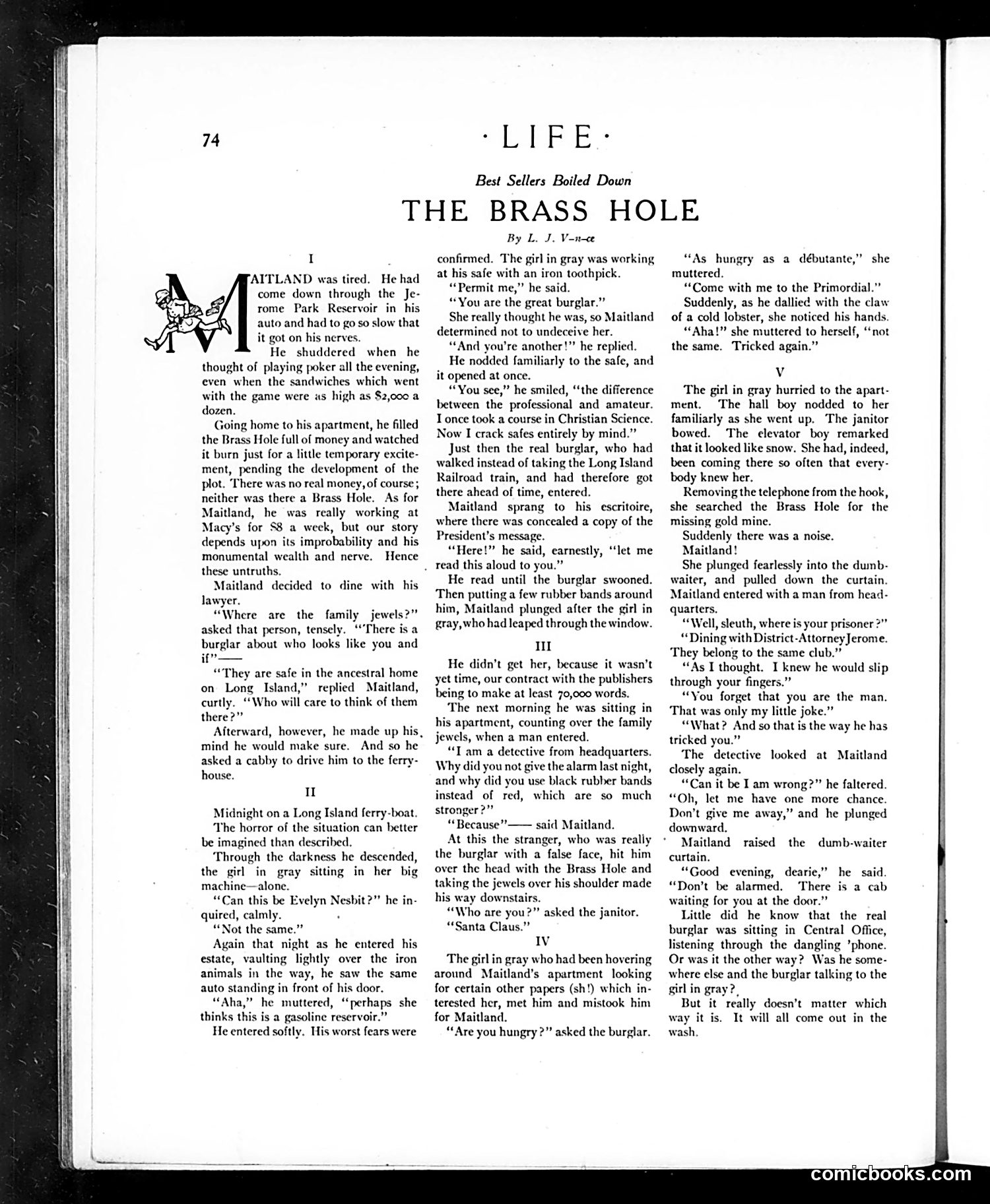
This page contains the opening of a short story, not a political cartoon. The narrative follows Maitland, a tired man returning home to his apartment after an evening of poker, who decides to investigate a brass hole he finds filled with money and valuables. The story involves a burglary plot: Maitland becomes entangled with an actual burglar and a girl in gray, leading to complications with a detective claiming to be from headquarters. The tale appears to be a comedic crime story playing on mistaken identities and confusion about who the "real" burglar is. Without additional context about the author or publication date visible here, the specific satirical targets remain unclear, though it's clearly meant as humorous fiction rather than political commentary.
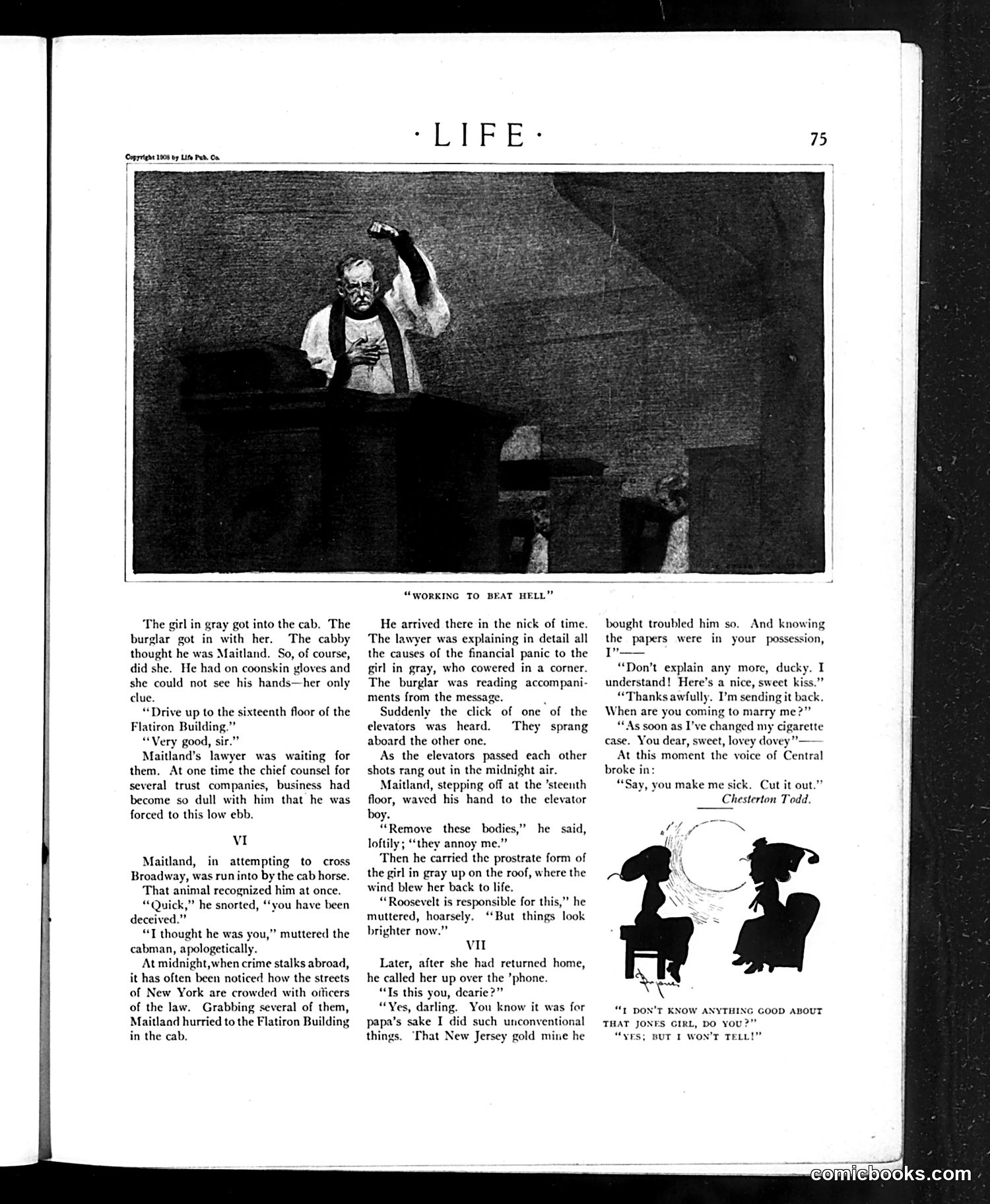
This page contains a serialized story titled "Working to Beat Hell" with accompanying illustrations. The narrative follows a character named Maitland, a lawyer involved in financial panic litigation, who encounters a cab driver and becomes entangled in criminal activity. The small cartoon at the bottom depicts two silhouetted figures in conversation, with dialogue about a "Jones girl" and gold mining in New Jersey. This appears to be a humorous aside unrelated to the main story. The page represents typical early 20th-century LIFE magazine content: serialized satirical fiction mocking urban professionals, corrupt business dealings, and contemporary social foibles. The cartoon's mention of "New Jersey gold" suggests mocking small-town financial schemes or get-rich-quick ventures popular among unsophisticated investors of the era.
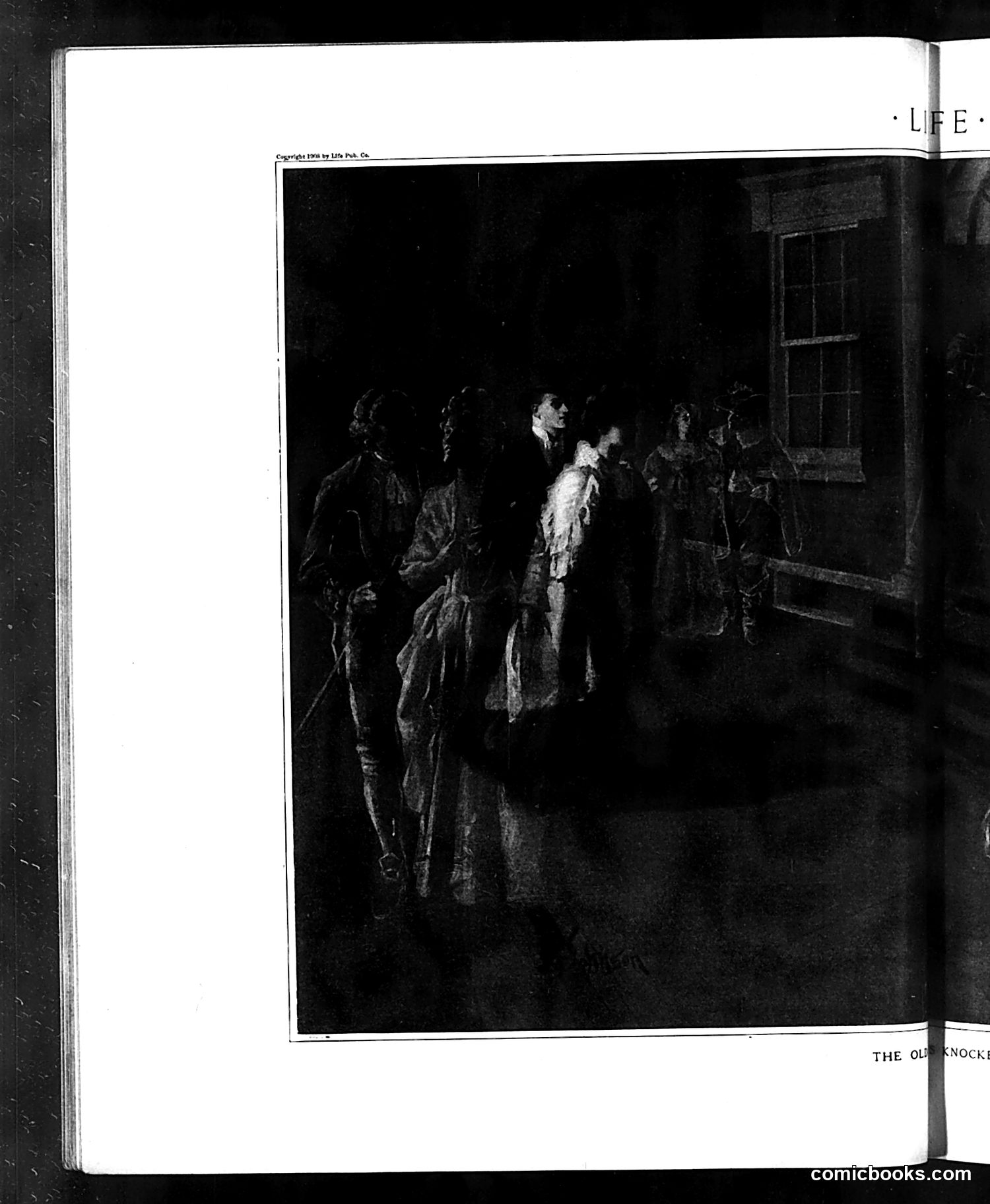
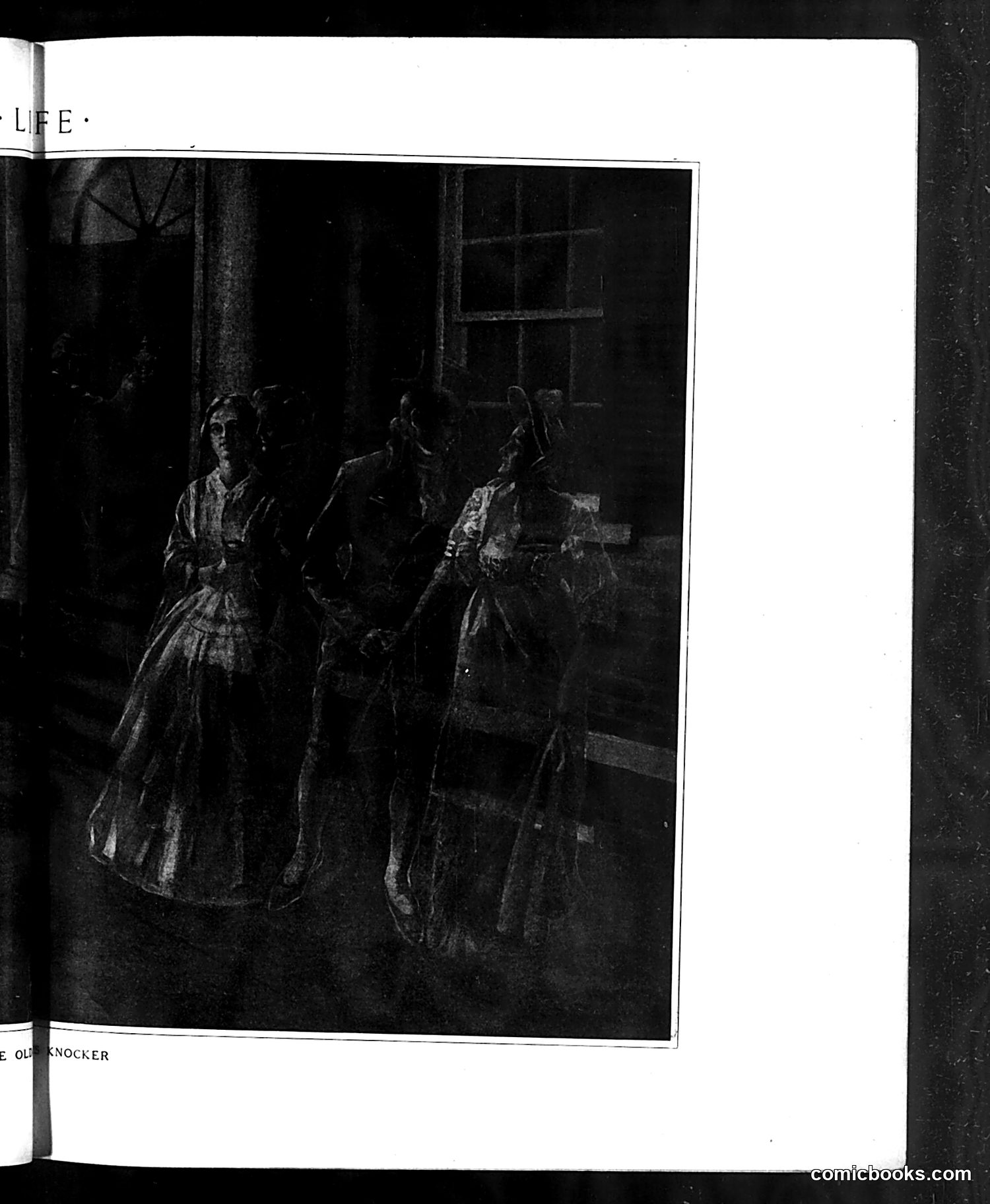
This appears to be a dramatic illustration from *Life* magazine titled "The Old Knocki[ng]" (caption partially visible at bottom). The image depicts a nighttime scene with multiple figures gathered at what appears to be a doorway or entrance. The composition is dark and shadowy, suggesting either a scene of suspense or social commentary. Without the complete caption or accompanying article text, I cannot definitively identify the specific political or social reference this illustration satirizes. The gathering of figures in formal dress at a threshold could reference various historical events—possibly related to law enforcement, social calls, or political meetings—but I cannot assert which without risking inaccuracy. The dramatic lighting and composition suggest the content carried significance for contemporary 1920s-era readers.
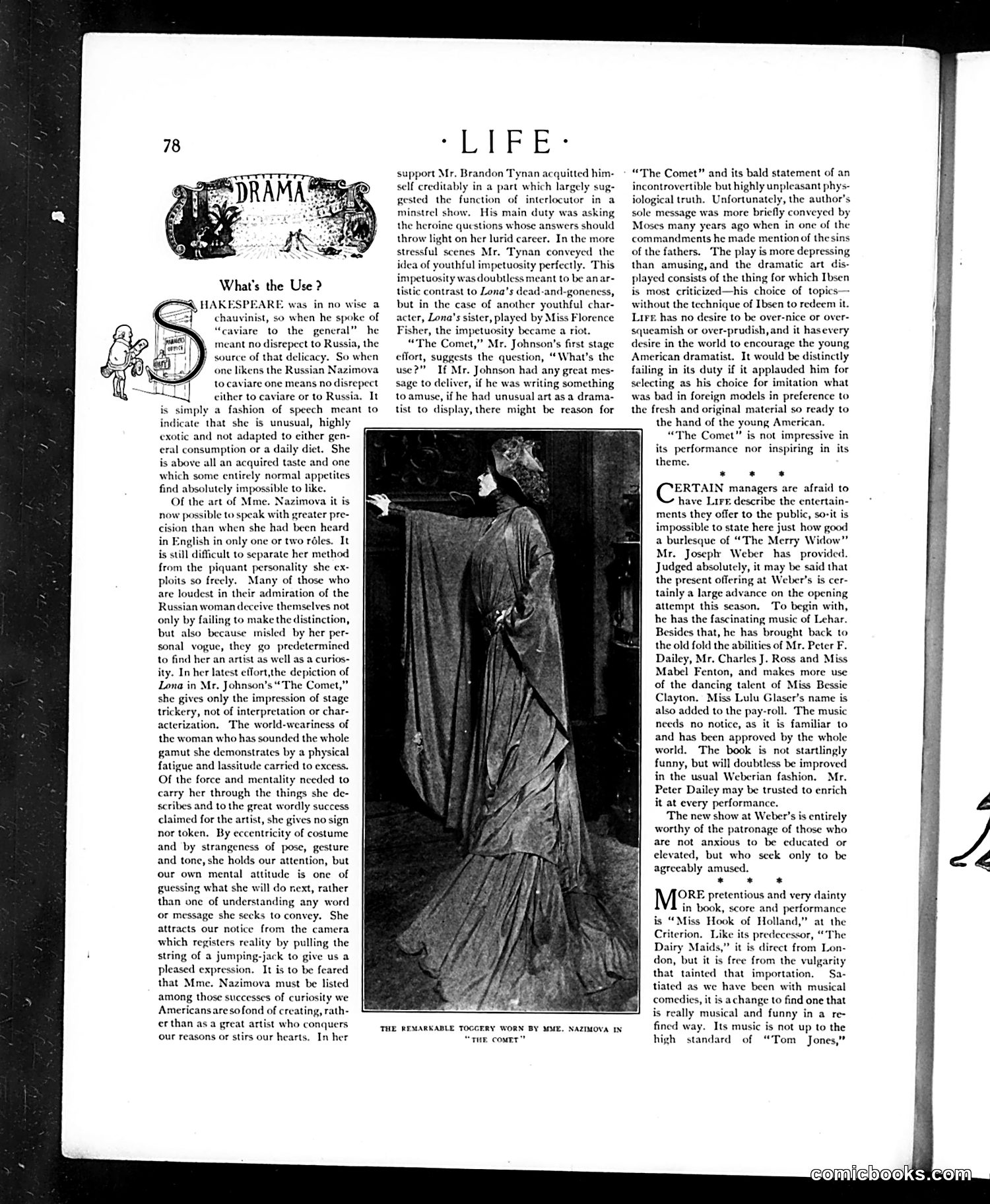
This page reviews theatrical performances, focusing heavily on Russian actress **Mme. Nazimova**. The small cartoon at top left illustrates a joke about the phrase "caviare to the general" (from Shakespeare's *Hamlet*), comparing Nazimova herself to caviar—refined and exotic, but an "acquired taste" unsuitable for mass audiences. The main critique attacks Nazimova's performance in "The Comet," dismissing her acting as mere "stage trickery" and physical posturing rather than genuine artistry. The reviewer argues she succeeds through curiosity and eccentricity of costume/gesture rather than real talent or conveying meaningful messages. The accompanying photograph shows her in elaborate theatrical costume. The review also mentions other shows: "The Merry Widows" and performances featuring Mr. Peter F. Dailey and others. The satire suggests American audiences are too easily impressed by exotic foreigners and novelty rather than genuine artistic merit—a common early 20th-century criticism of popular theater tastes.
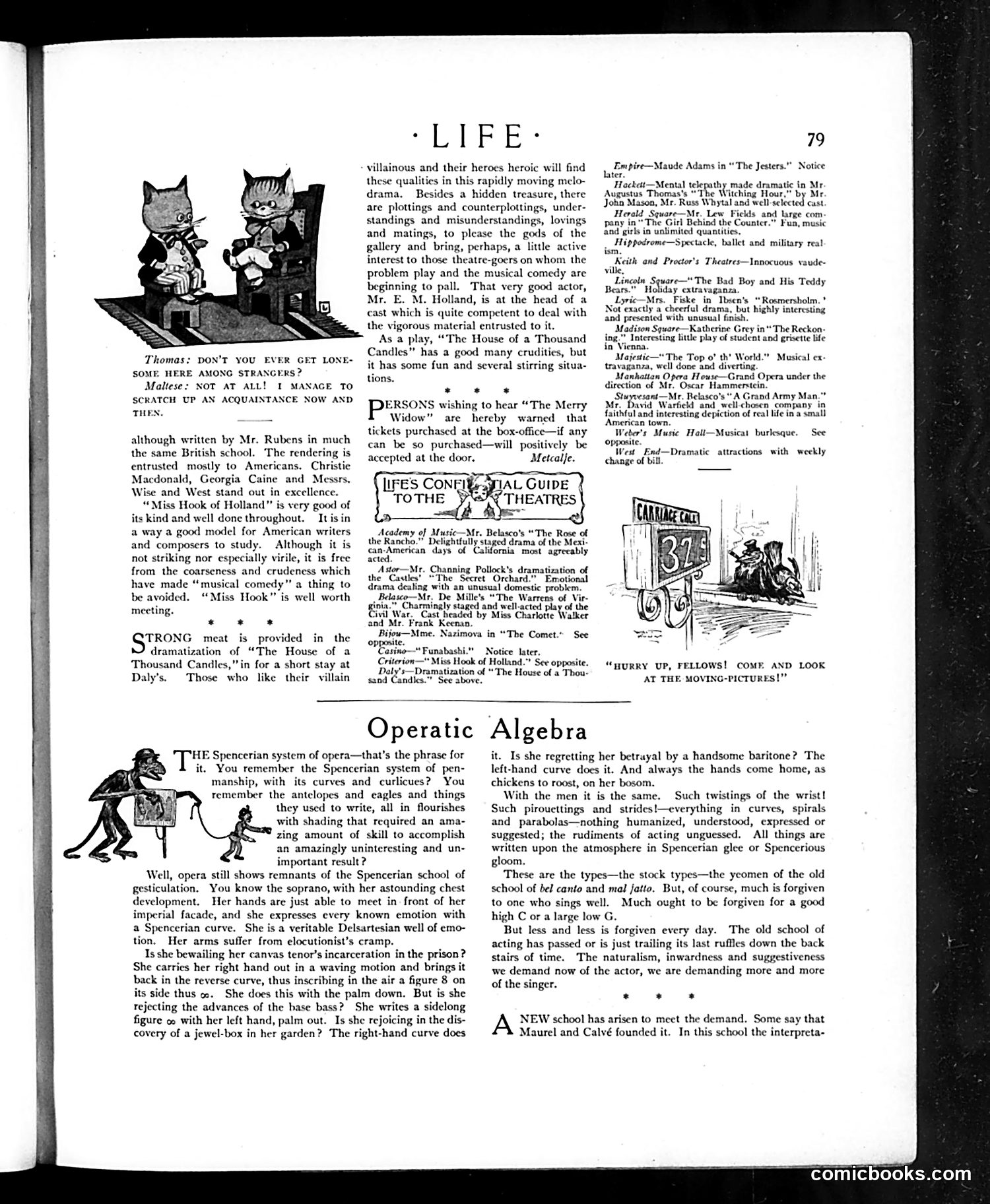
This page from *Life* magazine contains theatre reviews and advertisements rather than political cartoons. The small cartoon at top left shows two characters in conversation—one appears to be a cat-like figure (labeled "Thomas") asking another character (labeled "Maltese") if he gets lonely among strangers. The joke is a pun: "Maltese" responds he manages to "scratch up an acquaintance," with "scratch" being a cat reference, playing on the character's feline appearance. The bulk of the page comprises theatrical reviews of current Broadway productions (including "The Merry Widow," "Miss Hook of Holland," and "The House of a Thousand Candles"), with a separate illustrated section titled "Operatic Algebra" discussing operatic performance techniques. The only other illustration shows a figure at a moving picture theatre advertising, with text reading "Hurry up, fellows! Come and look at the moving pictures!"—reflecting early cinema's growing popularity as entertainment competition to live theatre.
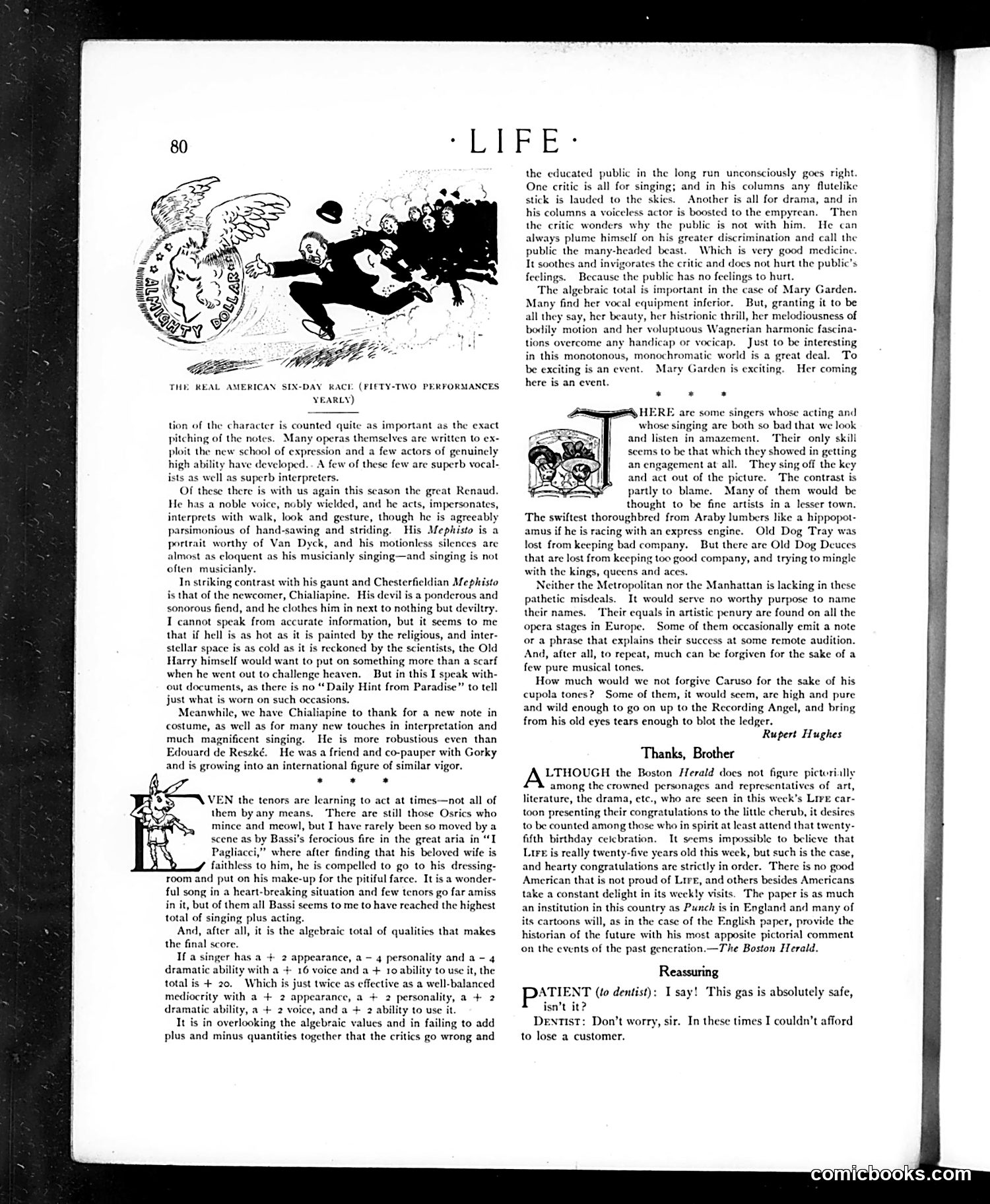
The main cartoon, titled "The Real American Six-Day Race (Fifty-Two Performances Yearly)," depicts a winged figure (appearing to be an angel or allegorical character) being chased or pursued by a group of men in formal dress. The image satirizes the grueling schedule of opera singers, particularly comparing their demanding performance schedule to the exhausting endurance races that were popular spectacles of the era. The accompanying text by what appears to be a theater critic discusses opera performances and singers, including commentary on performers like Renaud, Chaliapin, and Mary Garden. The critic uses a mathematical metaphor ("algebraic total") to argue that great performance requires balance—combining voice, dramatic ability, appearance, and technique rather than excelling in only one area. The satire criticizes both overly specialized critics (who focus exclusively on singing or drama) and the myth of the "many-headed beast" public, suggesting educated audiences instinctively recognize balanced talent better than narrow-minded critics do.
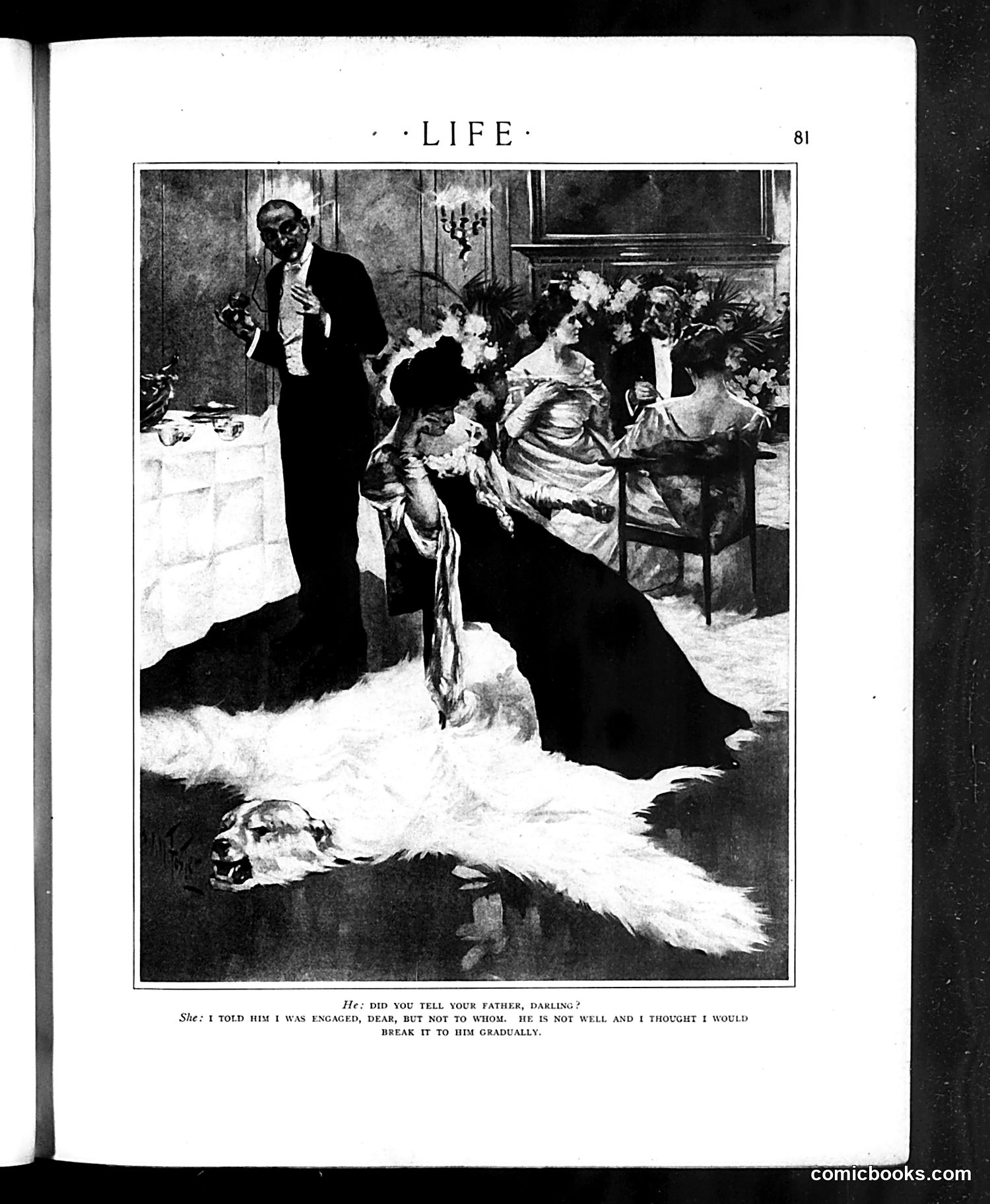
This is a single-panel cartoon satirizing upper-class courtship conventions. A woman in an elegant black gown kneels before a man in formal attire at what appears to be a wealthy social gathering (note the elaborate floral arrangements and well-dressed guests in the background). The joke hinges on the woman's deceptive strategy: she's told her father she's engaged, but deliberately withheld the fiancé's identity to ease him into the news "gradually." This implies her chosen partner is so unsuitable or objectionable that a full disclosure would shock her father's delicate health. The humor mocks both the pretense of high society (where such deceptions occur) and the exaggerated concern for an older gentleman's fragile constitution. The woman's casual dishonesty is presented as a refined approach to difficult family news.
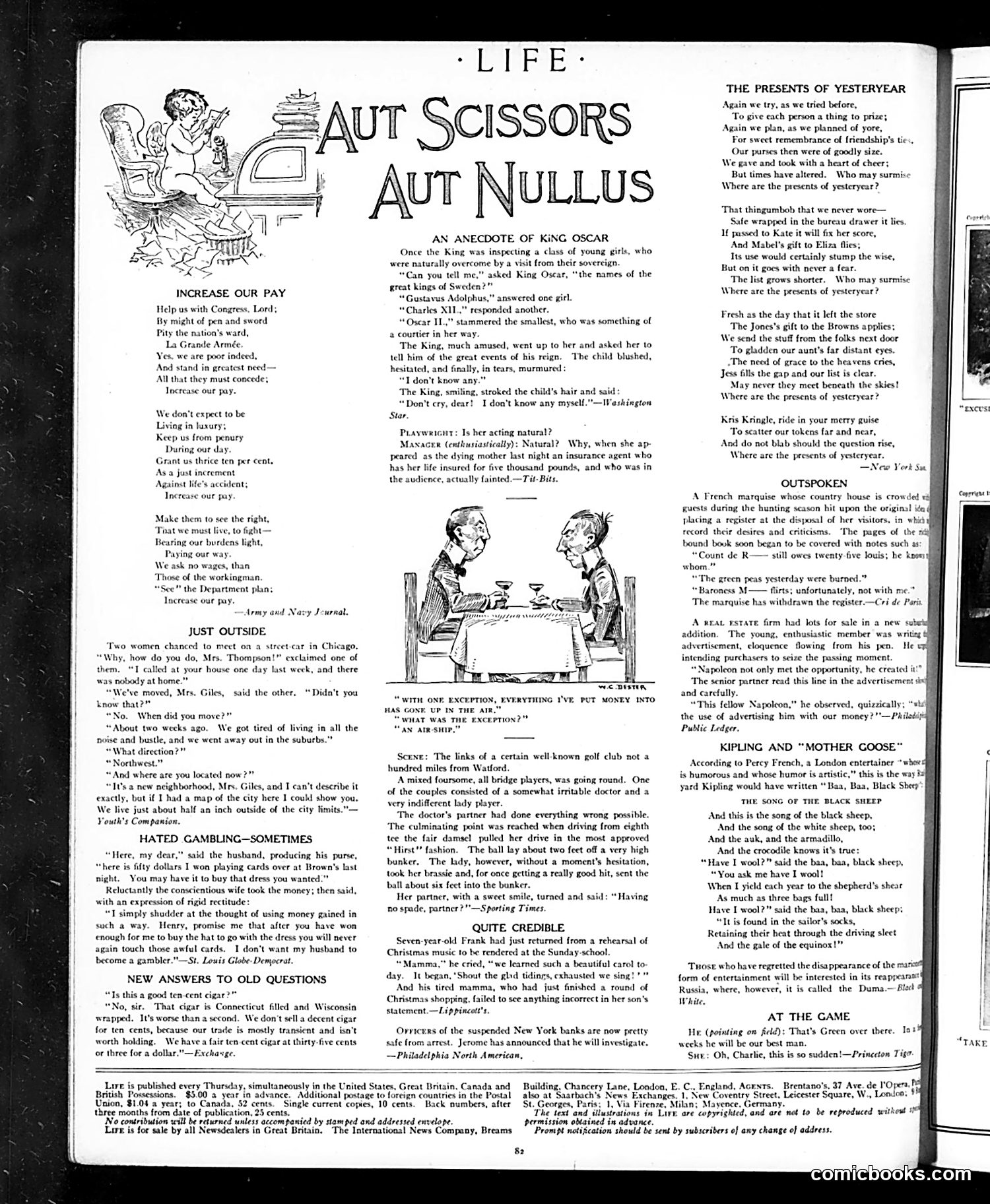
This page from *Life* magazine contains several satirical pieces typical of early 20th-century American humor: **"Aut Scissors Aut Nullus"** (main feature): A humorous anecdote about King Oscar of Sweden, playing on the Latin phrase meaning "either scissors or nothing." When the King asks a nervous schoolgirl about great Swedish events during his reign, she cannot answer. The King good-naturedly admits he doesn't know either—satirizing the gap between royal authority and actual knowledge. **Other pieces** mock everyday absurdities: military pay complaints, suburban relocation boasting, wives condemning gambling while accepting its proceeds, cigar fraud, and theatrical exaggeration. The cartoons accompanying these pieces use simple line drawings to illustrate social pretension and hypocrisy. The humor relies on exposing contradictions in human behavior—people's self-serving logic and class anxieties were recognizable targets for *Life*'s satirical readership.
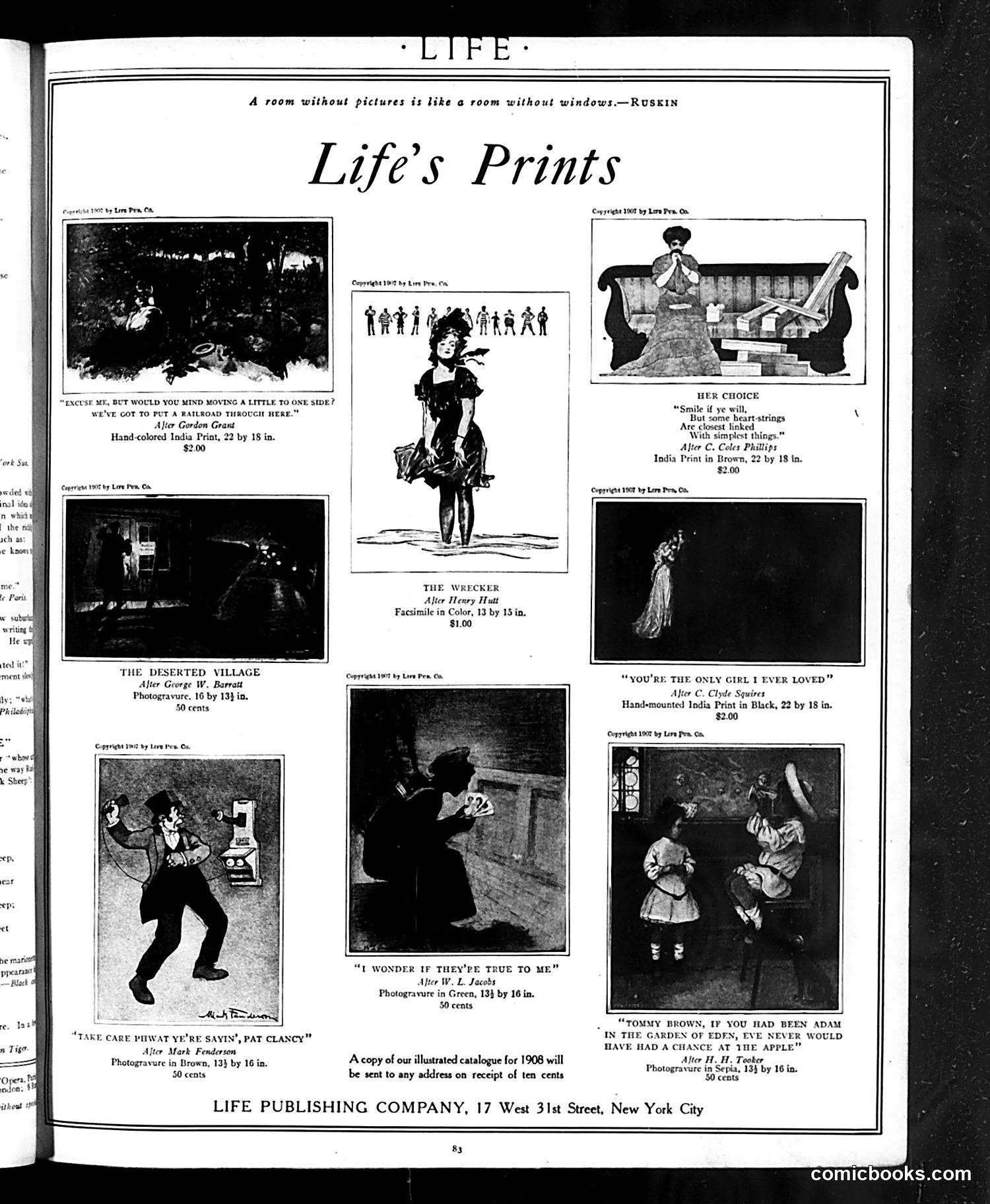
This is primarily an **advertising catalog page** from Life Publishing Company (circa 1907–1908), showcasing art prints available for purchase. Rather than political satire, it displays sentimental and comedic genre scenes popular in early 20th-century home decoration. The prints depict everyday American scenarios: railroad workers displacing rural residents ("Excuse Me, but Would You Mind Moving"), Irish workmen bickering, romantic couples, and domestic humor. One image references the Biblical Adam and Eve story as a joking comparison to modern courtship. **Key context for modern readers:** These hand-colored prints and photogravures were mass-market decorative items sold through magazines. The titles and quotations emphasize sentiment and gentle comedy rather than sharp satire. Prices ranged from 50 cents to $2.00—affordable for middle-class homes. The Ruskin epigraph at top frames pictures as essential domestic elements, legitimizing their cultural value during an era when home decoration reflected taste and refinement.
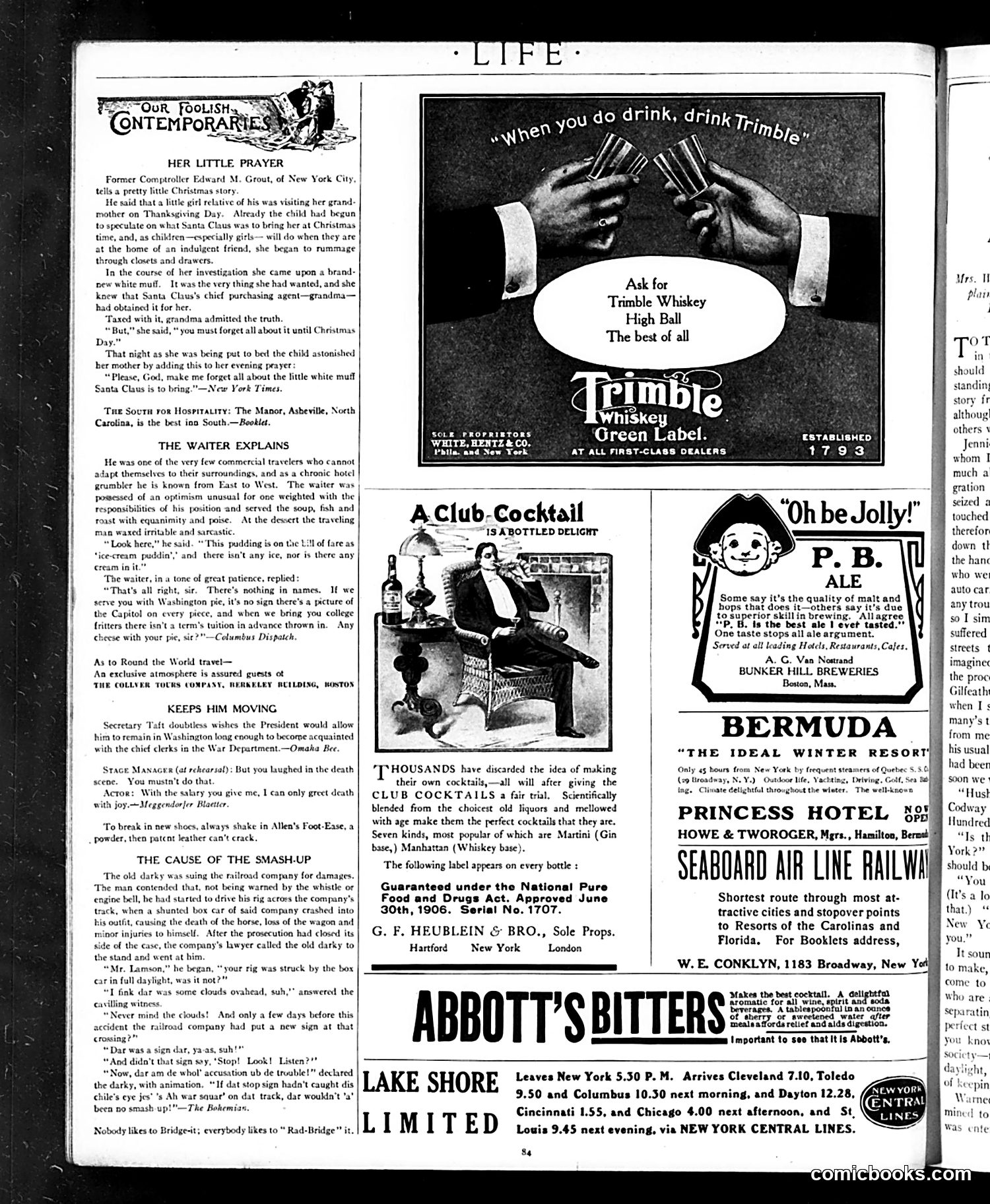
This page contains **primarily advertisements and humorous anecdotes**, not political cartoons. The main content includes: **Advertising**: Prominent ads for Trimble Whiskey, P.B. beer, Abbott's Bitters, and railroad services dominate the page—typical of early 20th-century magazines where alcohol promotion was legal and normalized. **Humorous Stories**: Several short anecdotes appear, including: - "Her Little Prayer": A sentimental Christmas story about a child discovering her grandmother's gift - "The Waiter Explains": A joke about restaurant terminology and class assumptions - "The Cause of the Smash-Up": A dialect-heavy story featuring a Black man in a legal dispute, reflecting period stereotypes and racist humor conventions **Context for Modern Readers**: This reflects an era when magazines freely advertised alcohol (pre-Prohibition or early Prohibition era), when racist dialect humor was considered acceptable entertainment, and when advertising occupied equal weight with editorial content. The page lacks explicit political satire—it's primarily commercial and entertainment-focused.
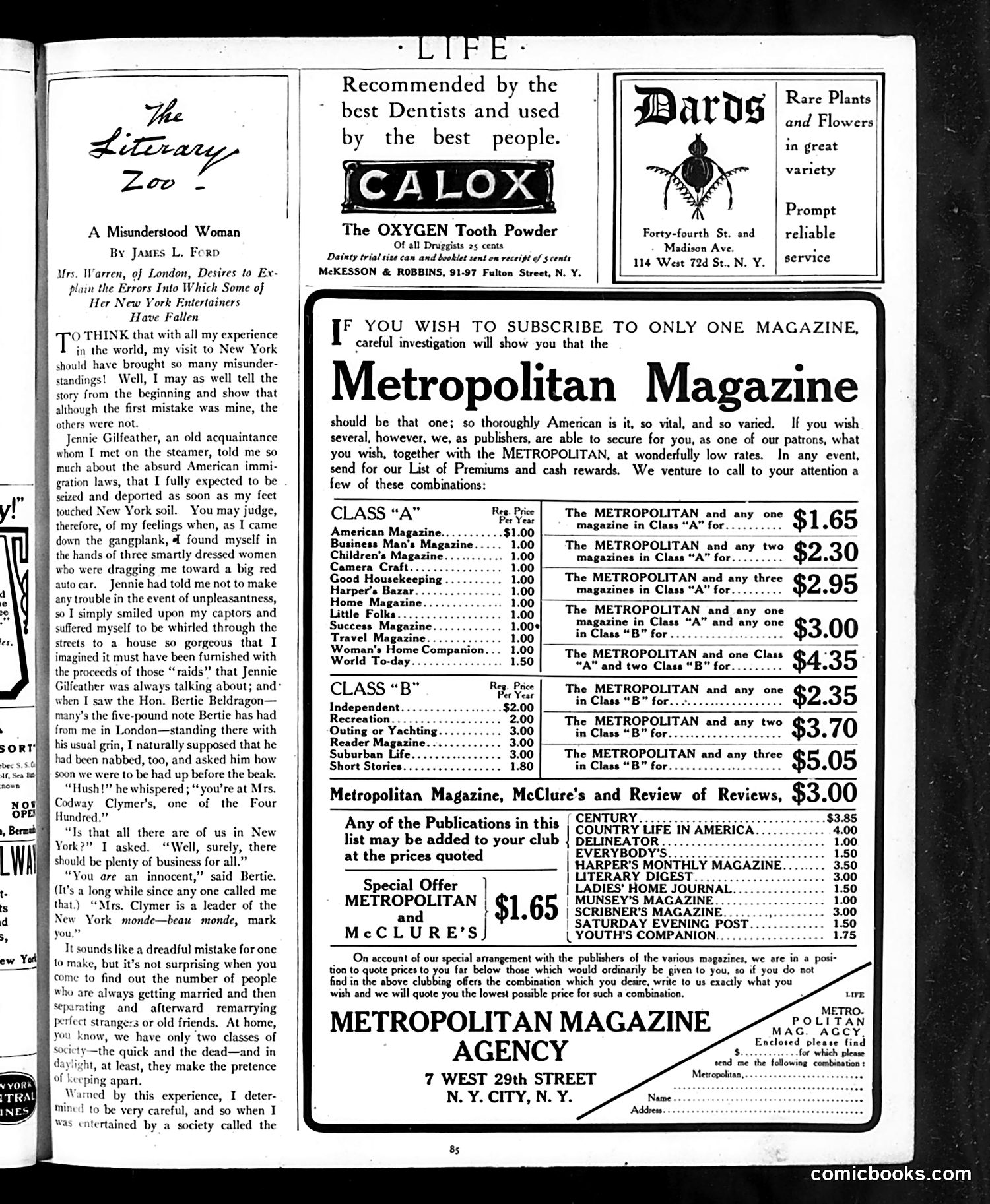
This page is primarily **advertising and magazine subscription offers**, not a political cartoon. It contains the beginning of a serialized short story titled "A Misunderstood Woman" by James L. Ford. The story's opening describes a British visitor (Mrs. Warren) arriving in New York and being mistakenly seized by three women who drag her to an automobile—she initially fears this is related to "absurd American immigration laws." The humor relies on her confusion about American society customs and the "Four Hundred" (New York's wealthy elite social circle). The bulk of the page is dominated by subscription offers for *Metropolitan Magazine* and other periodicals from the Metropolitan Magazine Agency at 7 West 29th Street, NYC. There are also period advertisements for Calox tooth powder and Dard's rare plants and flowers. The satirical content is light social commentary on American vs. British customs and class structures, embedded in the story rather than presented as a cartoon.
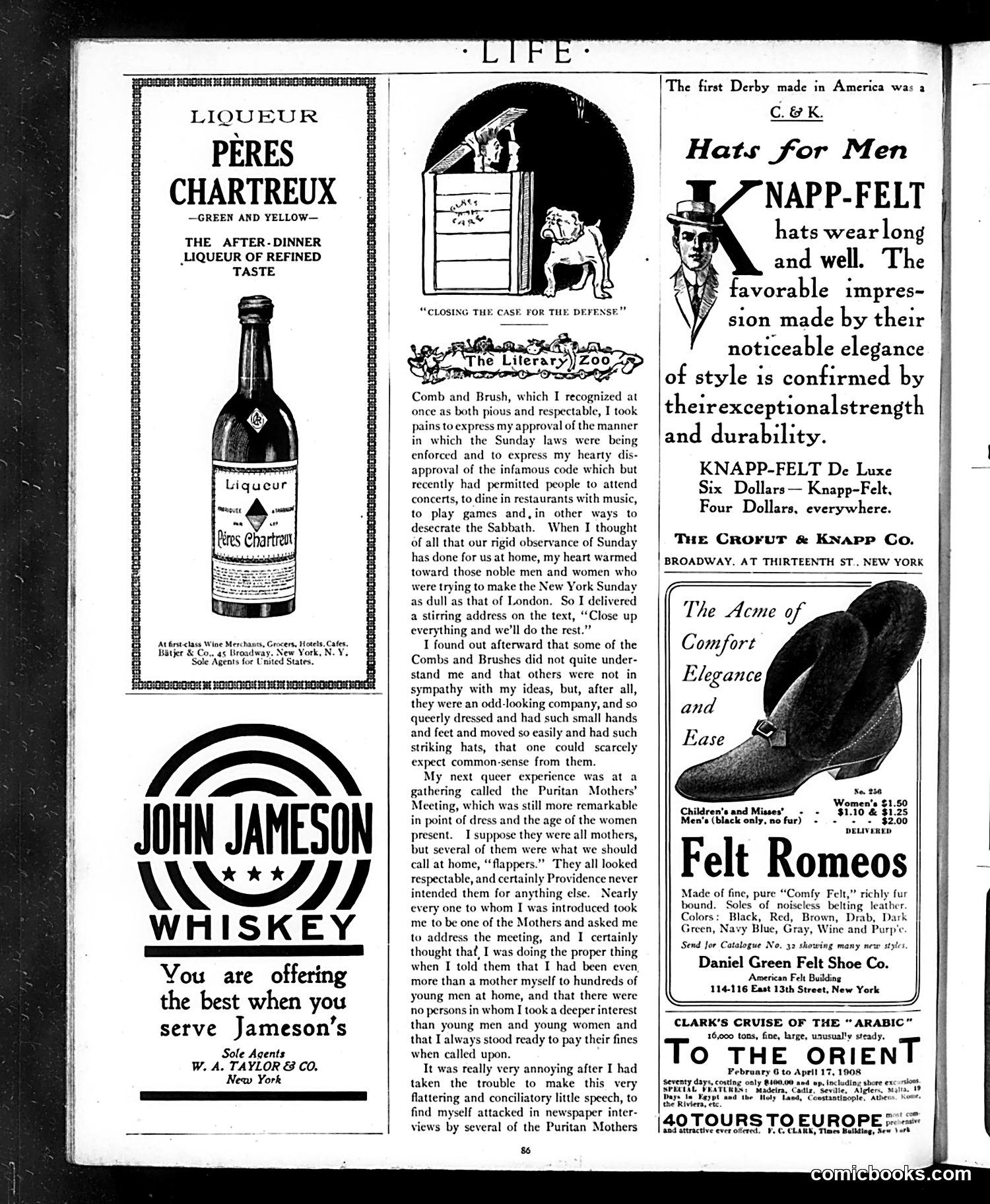
This page is primarily **advertisements** with an embedded satirical essay about the author's experiences visiting America. The central text describes a visitor (likely British, given references to "at home") attending two American gatherings: a "Comb and Brush" meeting and a "Puritan Mothers' Meeting." The satire targets **American religious hypocrisy and puritanical enforcement of Sunday laws**. The author initially praised strict Sabbath observance to his hosts, thinking this would please them. However, he later discovered the "Puritan Mothers" were actually young women ("flappers") dressed fashionably—contradicting their supposed pious restraint. He also offered to pay fines for young men's transgressions, an offer that backfired when reported in newspapers. The joke: **American "Puritans" don't actually live according to their strict moral codes**—they're hypocritical, fashionable, and easily offended when their inconsistency is exposed. The surrounding ads (whiskey, liqueur, hats, shoes) ironically coexist with this critique of American moral pretension.
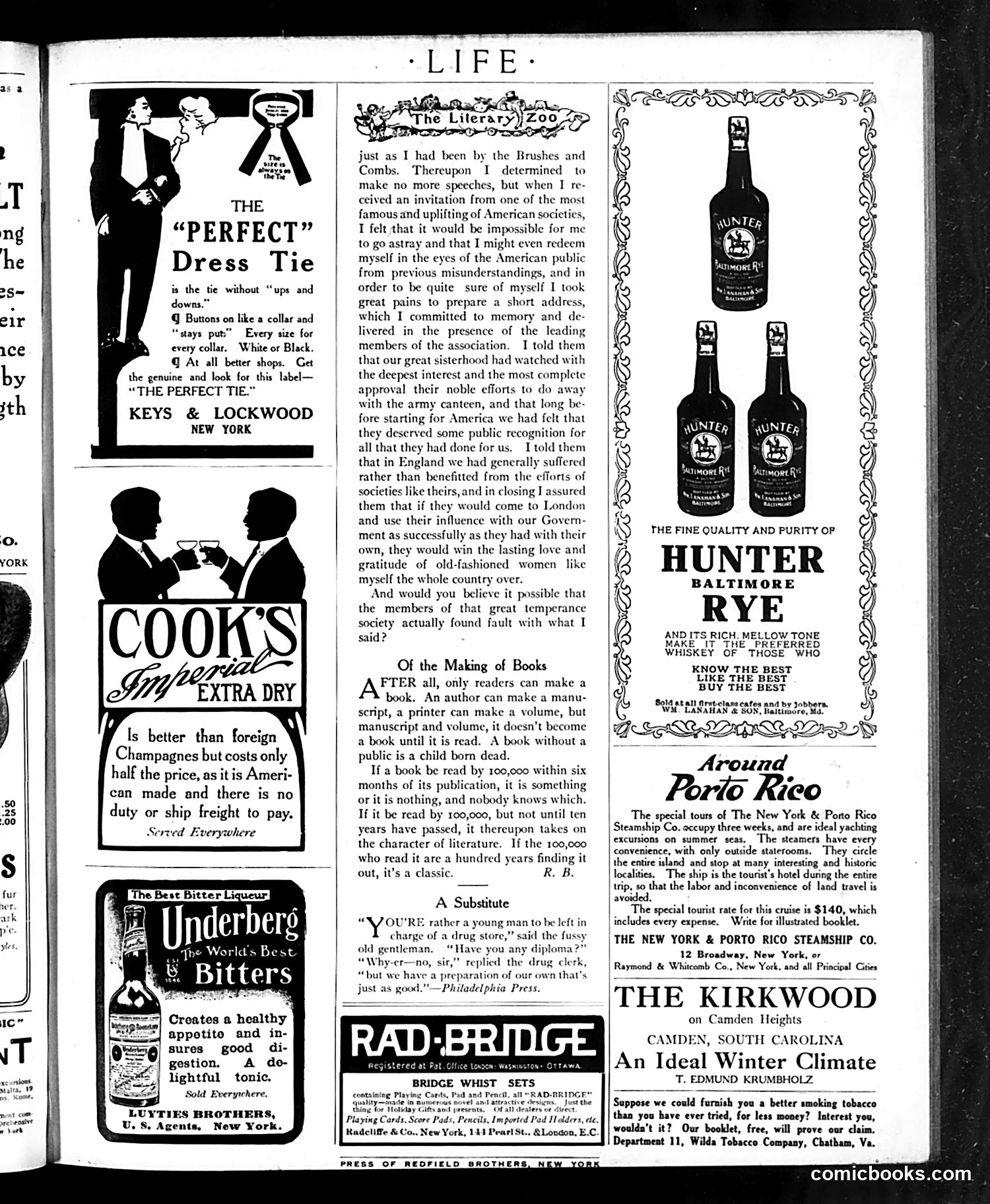
This is primarily an **advertising page** from Life magazine, featuring various product advertisements interspersed with editorial content. The notable editorial pieces include: 1. **"The Literary Zoo"** - A first-person account (apparently by a female British visitor) describing her experience addressing an American temperance society. She mentions preparing remarks about supporting their anti-army canteen efforts, only to have them criticize her speech—a humorous commentary on the unpredictability of reform-minded organizations. 2. **"Of the Making of Books"** - A brief essay arguing that readers, not authors or printers, truly "make" books by reading them; a book becomes literature only through readership over time. 3. **"A Substitute"** - A short joke about a young pharmacist lacking credentials but claiming his store's homemade preparation is adequate. The advertisements promote dress ties, champagne, bitters, playing cards, whiskey, steamship tours, and tobacco—typical early 20th-century luxury goods marketed to affluent readers. The page reflects Life's satirical voice combined with commercial appeals to its middle-to-upper-class audience.
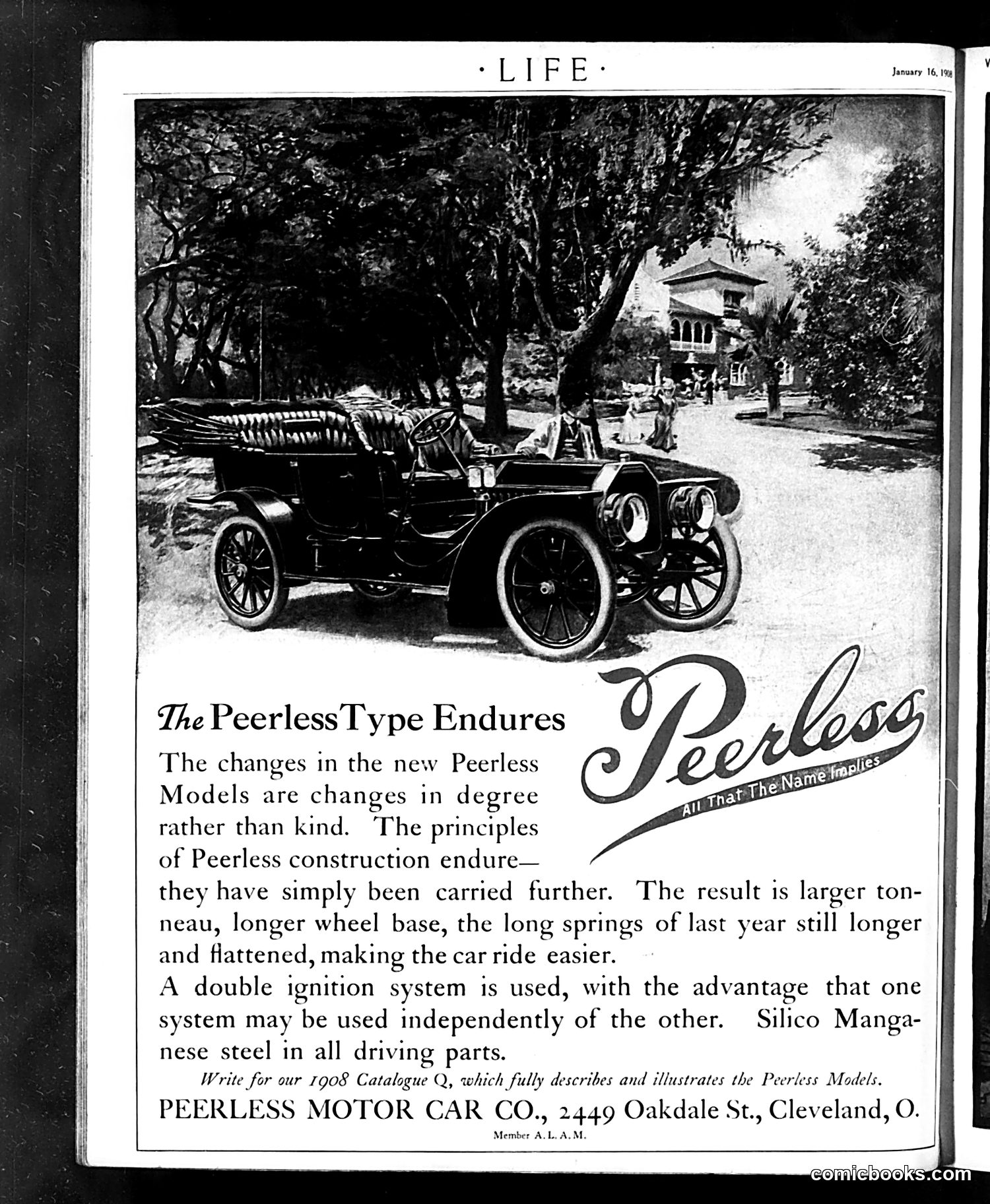
This page is **not a cartoon or satire**—it's a straightforward advertisement. The image shows an early automobile (a Peerless touring car) parked on a tree-lined street with a building visible in the background. The ad promotes the 1908 Peerless automobile, emphasizing engineering improvements: larger tonneau (passenger compartment), extended wheelbase, improved springs for smoother riding, dual ignition systems, and steel components. The slogan "All That The Name Implies" suggests reliability and quality. For modern readers: this represents early automotive advertising from the era when cars were luxury goods. The emphasis on technical specifications reflects consumer interest in mechanical innovation during the automobile industry's formative years. The Cleveland manufacturer was competing in a growing market by highlighting incremental improvements to proven designs.