
Life, 1908-01-16 · page 6 of 24
Life — January 16, 1908 — page 6: what you’re looking at
What you’re looking at
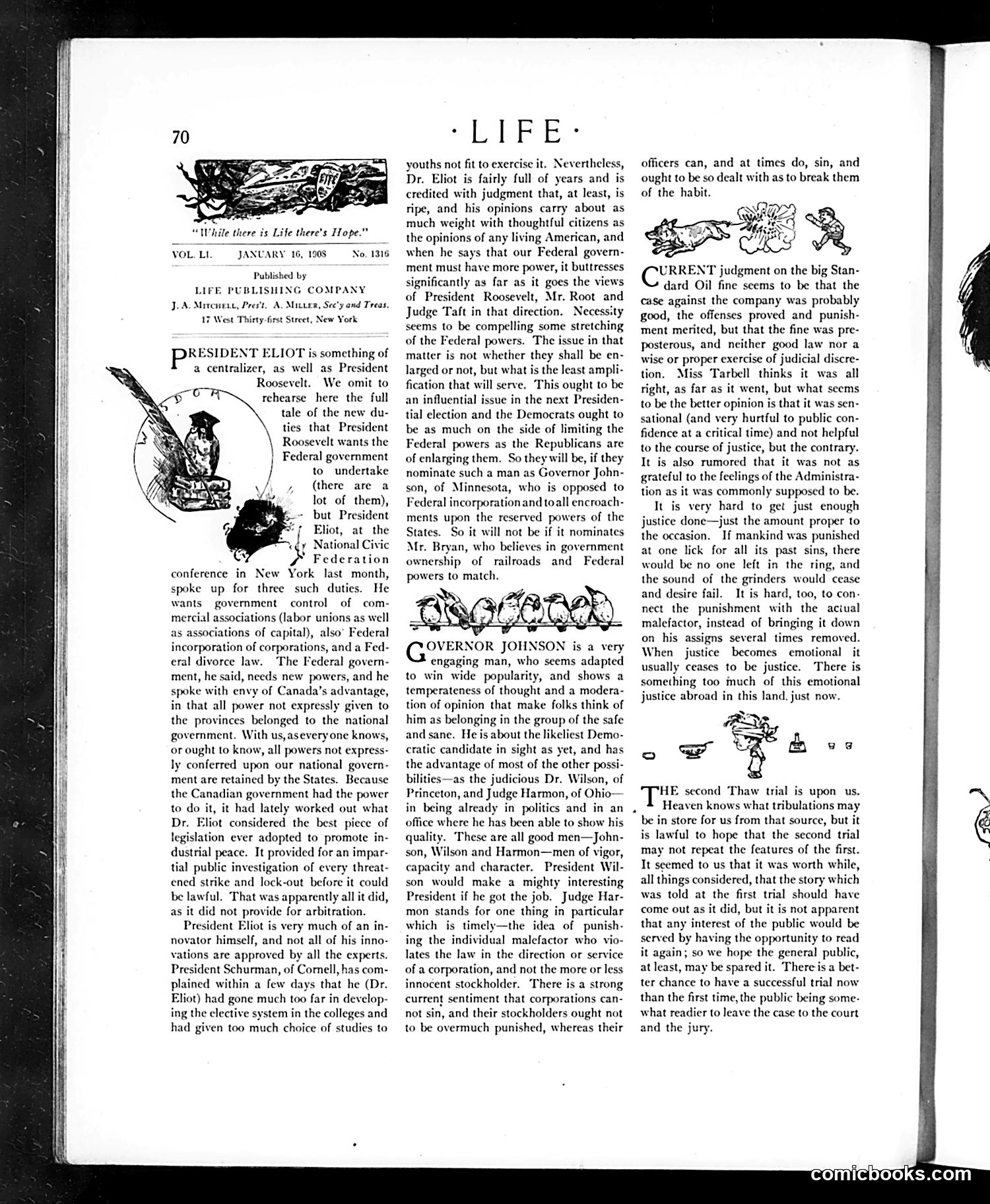
This page contains political commentary rather than traditional cartoons. The text discusses President Theodore Roosevelt's centralizing power and federal government expansion. The illustrated figures appear to be political caricatures, though specific identities aren't entirely clear from image quality. The article criticizes Roosevelt's approach to Federal powers while discussing potential Democratic candidates including what appears to be references to Governor Johnson and Judge Taft. The commentary debates whether Federal power should be limited versus expanded—a central Progressive-era political controversy. The piece suggests Roosevelt may have overreached in centralizing authority, while defending his general competence. The small decorative illustrations appear to be humorous vignettes typical of Life's satirical style, though their specific content is difficult to discern clearly in this reproduction.
📄 Transcribed text from this page (OCR, searchable)
Machine-transcribed from the original scan — historical spelling and the odd misread are preserved.
“While there is Life there's Hope.” VOL. LI. JANUARY 16, 1908 No. 1315 Published by LIFE PUBLISHING COMPANY JA. Marcnnat, Pres't, A. Minter, Sec'y ond Treas, 17 West Thirty-first Street, New York RESIDENT ELIOT is something of a centralizer, as well as President Roosevelt. We omit to rehearse here the full tale of the new du- ties that President Roosevelt wants the to undertake (there are a lot of them), but President Eliot, at the a National Ci pu Federation conference in New York last month, spoke up for three such duties. He wants government control of com- mercial associations (labor unions as well as associations of capital), also’ Federal incorporation of corporations, and a Fed- eral divorce law. The Federal govern- ment, he said, needs new powers, and he spoke wi of Canada’s advantage, in that all power not expressly given to the provinces belonged to the national government. With us, asevery one know: or ought to know, all powers not express: ly conferred upon our national govern- ment are retained by the States. Because the Canadian government had the power to do it, it had lately worked out what dered the best piece of legislation ever adopted to promote in- dustrial peace. It provided for an impar- tial public investigation of every threat- ened strike and lock-out before it could be lawful. ‘That was apparently all it did, as it did not provide for arbitration. President Eliot is very much of an in- novator himself, and not all of his inno- vations are approved by all the experts, President Schurman, of Cornell, has com- plained within a few days that he (Dr. Eliot) had gone much too far in develop- ing the elective system in the colleges and had given too much choice of studies to «LF. youths not fit to exercise it. Nevertheless, Dr. Eliot is fairly full of years and is credited with judgment that, at least, is ripe, and his opinions carry about as much weight with thoughtful citizens as the opinions of any living American, and when he says that our Federal govern- ment must have more power, it buttresses significantly as far as it goes the views of President Roosevelt, Mr. Root and Judge Taft in that direction. Necessity seems to be compelling some stretching of the Federal powers. The issue in that matter is not whether they shall be en- larged or not, but what is the least ampli- fication that will serve. This ought to be an influential issue in the next Presiden- tial election and the Democrats ought to be as much on the side of limiting the Federal powers as the Republicans are of enlarging them. So they'will be, if they nominate such a man as Governor John- son, of Minnesota, who is opposed to Federal incorporation and toall encroach- ments upon the reserved powers of the States. So it will not be if it nominates an, who believes in government ownership of railroads and Federal powers to match, OVERNOR JOHNSON is a very engaging man, who seems adapted to win wide popularity, and shows a temperateness of thought and a modera- tion of opinion that make folks think of him as belonging in the group of the safe ane. He is about the likeliest Demo- candidate in sight as yet, and has the advantage of most of the other possi- bilities—as the judicious Dr. Wilson, of Princeton, and Judge Harmon, of Ohio- in being already in politics and in an office where he has been able to show his quality. ‘These are all good men—John- son, Wilson and Harmon—men of vigor, capacity and character. President Wil- son would make a mighty interesting President if he got the job. Judge Har- mon stands for one thing in particular which is timely—the idea of punish- ing the individual malefactor who vio- lates the law in the direction or service of a corporation, and not the more or less innocent stockholder. ‘There is a strong current sentiment that corporations can- not sin, and their stockholders ought not to be overmuch punished, whereas their officers can, and at times do, sin, and ought to be so dealt with as to break them of the habit. CURRENT judgment on the big Stan- dard Oil fine seems to be that the case against the company was probably good, the offenses proved and punish- ment merited, but that the fine was pre- posterous, and neither good law nor a wise or proper exercise of judicial discre- tion. Miss Tarbell thinks it was all right, as far as it went, but what seems to be the better opinion is that it was sen- sational (and very hurtful to public con- fidence at a critical time) and not helpful to the course of justice, but the contrary. It is also rumored that it was not as grateful to the feelings of the Administra- tion as it was commonly supposed to be. It is very hard to get just enough justice done—just the amount proper to the occasion. If mankind was punished at one lick for all its past sins, there would be no one left in the ring, and the sound of the grinders would cease and desire fail. It is hard, too, to con- nect the punishment with the aciual malefactor, instead of bringing it down on his assigns several times removed When justice becomes emotional it usually ceases to be justice. There is something too much of this emotional justice abroad in this land, just now. 'HE second Thaw trial is upon us. Heaven knows what tribulations may be in store for us from that source, but it is lawful to hope that the second trial may not repeat the features of the first. It seemed to us that it was worth while, all things considered, that the story which was told at the first trial should have come out as it did, but it is not apparent that any interest of the public would be served by having the opportunity to read it again; so we hope the general public, at least, may be spared it. Theres a bet- ter chance to have a successful trial now than the first time, the public being some- what readier to leave the case to the court and the jury. Comicbooks.com