
Life, 1908-01-16 · page 8 of 24
Life — January 16, 1908 — page 8: what you’re looking at
What you’re looking at
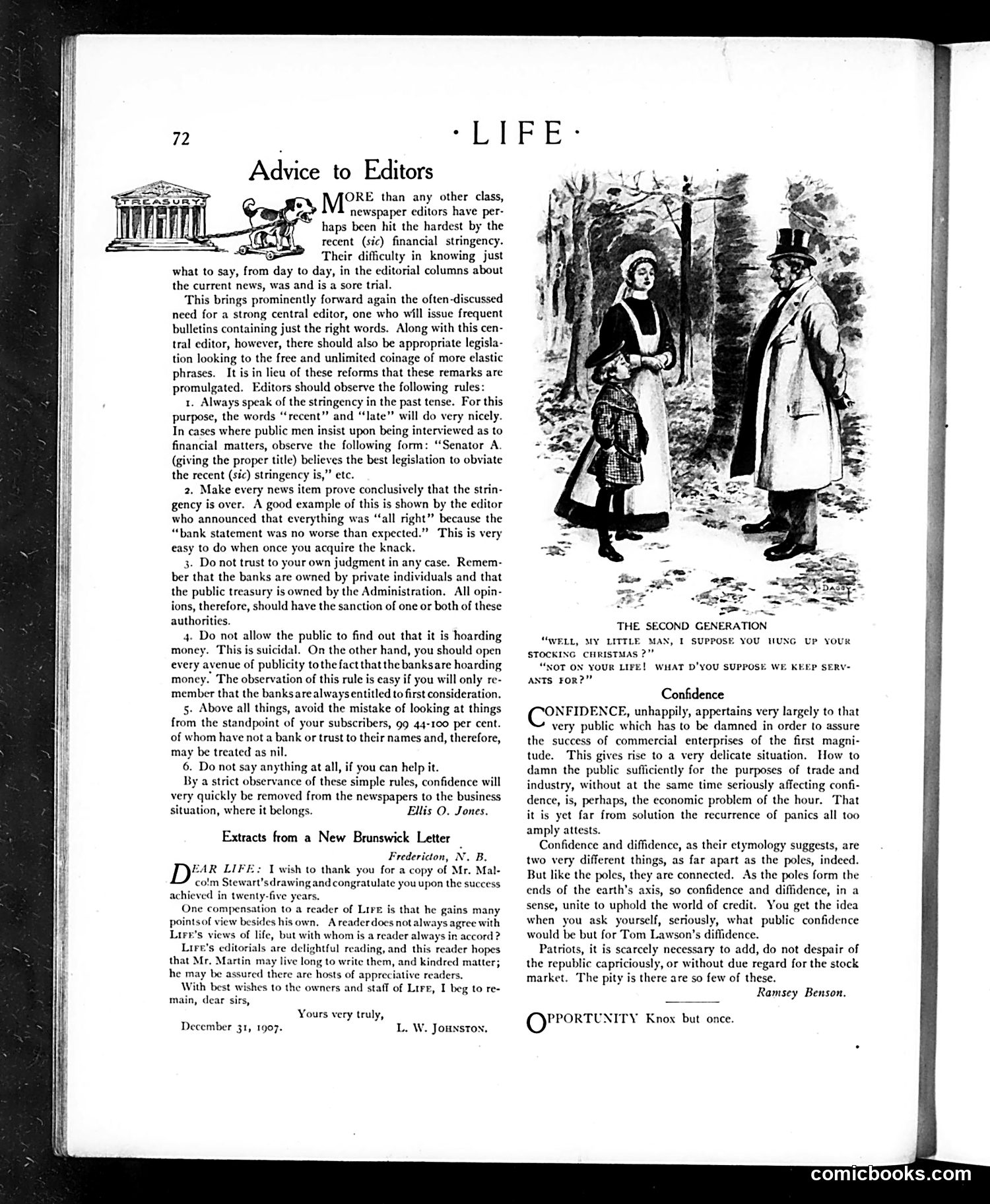
The illustration shows three figures—two adults and a child—in what appears to be a poor urban setting. The caption reads: "Well, my little man, using up your stocking Christmas?" / "Not on your life! What d'you suppose we keep servants for?" **The satire**: A working-class child is depicted parroting the dismissive attitudes of wealthy employers toward servants. The joke criticizes how economic inequality teaches even poor children to adopt the callous class prejudices of their "betters"—perpetuating a cycle of social contempt across generations. The child's shocking entitlement, despite obvious poverty, highlights the absurdity of lower classes imitating aristocratic disdain for service workers.
📄 Transcribed text from this page (OCR, searchable)
Machine-transcribed from the original scan — historical spelling and the odd misread are preserved.
*LIPE* Advice to Editors Moke than any other class, , newspaper editors have per- haps been hit the hardest by the recent (sic) financial stringency. Their difficulty in knowing just what to say, from day to day, in the editorial columns about the current news, was and is a sore trial. This brings prominently forward again the often-discussed need for a strong central editor, one who will issue frequent bulletins containing just the right words. Along with this cen- tral editor, however, there should also be appropriate legisla- tion looking to the free and unlimited coinage of more elastic phrases. It is in lieu of these reforms that these remarks are promulgated. Editors should observe the following rules: 1. Always speak of the stringency in the past tense. For this purpose, the words “recent” and “late” will do very nicely. In cases where public men insist upon being interviewed as to financial matters, observe the following form: “Senator A (giving the proper title) believes the best legislation to obviate the recent (sic) stringency is,” ete. 2. Make every news item prove conclusively that the strin- gency is over. A good example of this is shown by the editor who announced that everything was ‘“‘all right”? because the “bank statement was no worse than expected.” This is very easy to do when once you acquire the knack. Do not trust to your own judgment in any case. Remem- ber that the banks are owned by private individuals and that the public treasury is owned by the Administration. All opin- ions, therefore, should have the sanction of one or both of these authorities. 4- Do not allow the public to find out that it is hoarding money. ‘This is suicidal. On the other hand, you should open every avenue of publicity tothe fact that the banksare hoarding money. The observation of this rule is easy if you will only re- member that the banks are alwaysentitled to first consideration. 5. Above all things, avoid the mistake of looking at things from the standpoint of your subscribers, 99 44-100 per cent. of whom have nota bank or trust to their names and, therefore, may be treated as nil. 6. Do not say anything at all, if you can help it. By a strict observance of these simple rules, confidence will very quickly be removed from the newspapers to the business situation, where it belongs. Ellis O. Jones. Extracts from a New Brunswick Letter Fredericton, N. B. I wish to thank you for a copy of Mr. Mal- ing and congratulate you upon the success ved in twenty-five years. One compensation to a reader of Lire is that he gains many pointsof view besides his own. A reader does not always agree with Lirr’s views of life, but with whom is a reader always in accord ? Lire’s cditorials are delightful ing, and this reader hopes that Mr. Martin may live long to write them, and kindred matter; he may be assured there are hosts of appreciative readers. With best wishes to the owners and staff of Lire, I beg to re- main, dear sirs, Yours very truly, December 31, 1907. L. W. Jouxstos. THE SECOND GENERATION “WELL, MY LITTLE MAN, I SUPPOSE YOU HUNG UP YOUR STOCKING CHRISTMA “NOT ON YOUR LIFE! WHAT D'YOU SUPPOSE WE KEEP SERV- ANTS FOR?” Confidence ONFIDENCE, unhappily, appertains very largely to that very public which has to be damned in order to assure the success of commercial enterprises of the first magni- tude. This gives rise to a very delicate situation. How to damn the public sufficiently for the purposes of trade and industry, without at the same time seriously affecting confi- dence, is, perhaps, the economic problem of the hour. That it is yet far from solution the recurrence of panics all too amply attests. Confidence and diffidence, as their etymology suggests, are two very different things, as far apart as the poles, indeed. But like the poles, they are connected. As the poles form the ends of the earth’s axis, so confidence and diffidence, in a sense, unite to uphold the world of credit. You get the idea when you ask yourself, seriously, what public confidence would be but for Tom Lawson's diffidence. Patriots, it is scarcely necessary to add, do not despair of the republic capriciously, or without due regard for the stock market. The pity is there are so few of these. Ramsey Benson. OPPorTUNITY Knox but once. comicbooks.com