
Life, 1908-01-16 · page 14 of 24
Life — January 16, 1908 — page 14: what you’re looking at
What you’re looking at
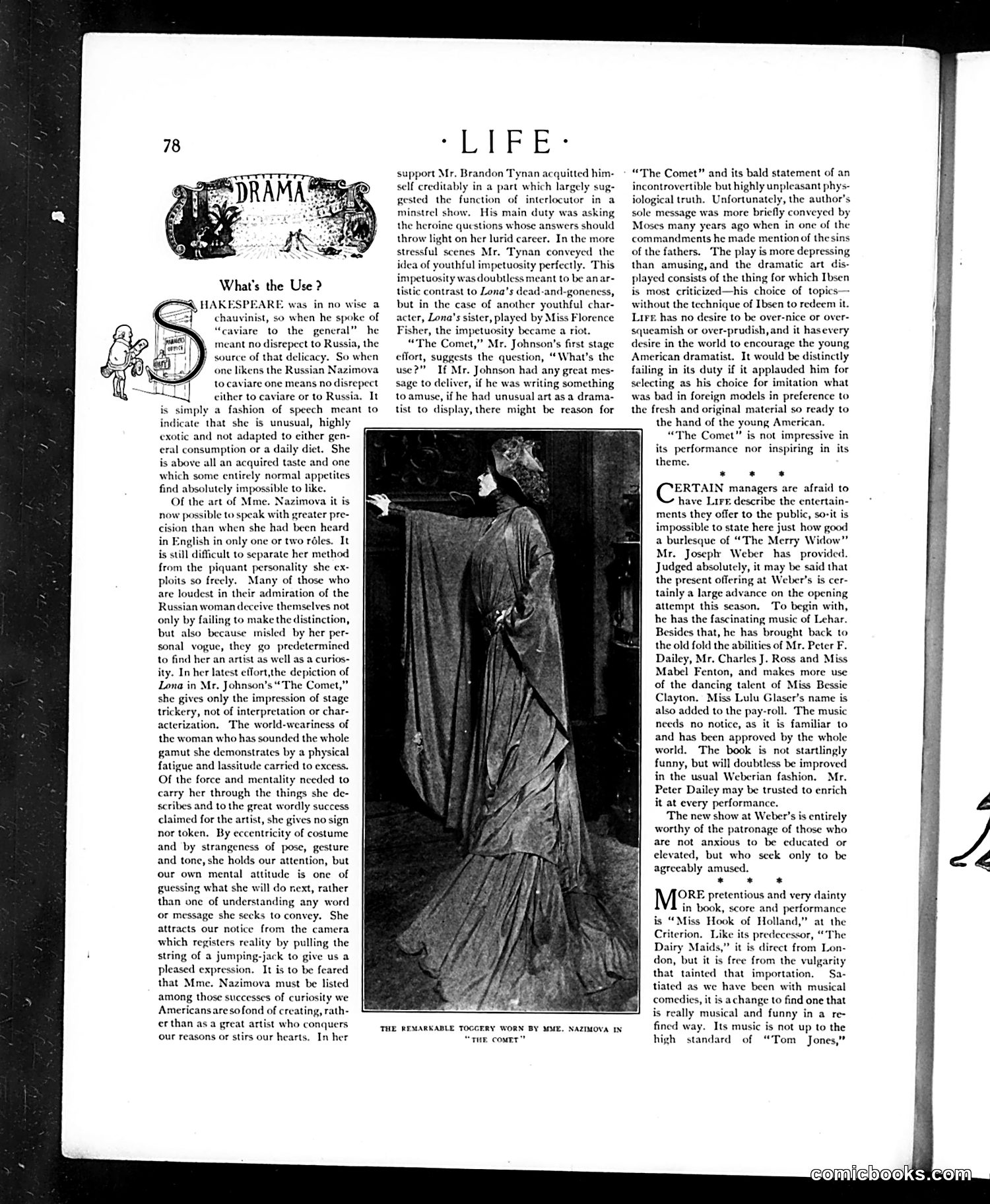
This page reviews theatrical performances, focusing heavily on Russian actress **Mme. Nazimova**. The small cartoon at top left illustrates a joke about the phrase "caviare to the general" (from Shakespeare's *Hamlet*), comparing Nazimova herself to caviar—refined and exotic, but an "acquired taste" unsuitable for mass audiences. The main critique attacks Nazimova's performance in "The Comet," dismissing her acting as mere "stage trickery" and physical posturing rather than genuine artistry. The reviewer argues she succeeds through curiosity and eccentricity of costume/gesture rather than real talent or conveying meaningful messages. The accompanying photograph shows her in elaborate theatrical costume. The review also mentions other shows: "The Merry Widows" and performances featuring Mr. Peter F. Dailey and others. The satire suggests American audiences are too easily impressed by exotic foreigners and novelty rather than genuine artistic merit—a common early 20th-century criticism of popular theater tastes.
📄 Transcribed text from this page (OCR, searchable)
Machine-transcribed from the original scan — historical spelling and the odd misread are preserved.
What's the Use > HAKESPEARE was in no wise a chauvinist, so when he spoke of caviare to the general” he meant no disrepect to Russia, the source of that delicacy. So when one likens the Russian Nazimova tocaviare one means no disrepect cither to caviare or to Russia. It is simply a fashion of speech meant to indicate that she is unusual, highly *LIPE: support Mr. Brandon Tynan acquitted him- self creditably in a part which largely sug- gested the function of interlocutor in a minstrel show. His main duty was asking the heroine questions whose answers should throw light on her lurid career. In the more stressful scenes Mr. Tynan conveyed the idea of youthful impetudsity perfectly. This impetuosity was doubtless meant to be an ar- tistic contrast to Lona’s dead -and-goneness, but in the case of another youthful char- acter, Lona’s sister, played by Miss Florence Fisher, the impetuosity became a riot. “The Comet,” Mr. Johnson's first stage effort, suggests the question, “What's the use?” If Mr. Johnson had any great mes- sage to deliver, if he was writing something toamuse, if he had unusual art as a drama- tist to display, there might be reason for exotic and not adapted to either gen- eral consumption or a daily diet. She is above all an acquired taste and one which some entirely normal appetites find absolutely impossible to like. Of the art of Mme. Nazimova it is now possible to speak with greater pre- cision than when she had been heard in English in only one or two réles. It is still difficult to separate her method from the piquant personality she ex- ploits so freely. Many of those who are loudest in their admiration of the Russian woman deccive themselves not only by failing to make the distinction, but also because misled by her per- sonal vogue, they go predetermined to find her an artist as well as a curios- ity. In her latest effort,the depiction of Lona in Mr. Johnson’s “The Comet,’ she gives only the impression of stage trickery, not of interpretation or char- acterization, The world-weariness of the woman who has sounded the whole gamut she demonstrates by a physical fatigue and lassitude carried to excess. Of the force and mentality needed to carry her through the things she de- scribes and to the great wordly success claimed for the artist, she gives no sign nor token. By eccentricity of costume and by strangeness of pose, gesture and tone, she holds our attention, but our own mental attitude is one of guessing what she will do next, rather than one of understanding any word or message she secks to convey. She attracts our notice from the camera which registers reality by pulling the string of a jumping-jac pleased expression. It is to be feared that Mme. Nazimova must be listed among those successes of curiosity we Americansaresofond of creating, rath- er than asa great artist who conquers our reasons or stirs our hearts, In her to give usa THE REMARKABLE TOCCERY WORN BY MME, NAZIMOVA IN “TUR court” “The Comet” and its bald statement of an incontrovertible but highly unpleasant phy: iological truth. Unfortunately, the author's sole message was more briefly conveyed by Moses many years ago when in one of the commandments he made mention of thesins of the fathers. ‘The play is more depressing than amusing, and the dramatic art dis played consists of the thing for which Ibsen is most criticized—his choice of topics without the technique of Ibsen to redeem it. Lire has no desire to be over-nice or over- squeamish or over-prudish, and it hasevery desire in the world to encourage the young American dramatist. It would be distinctly failing in its duty if it applauded him for selecting as his choice for imitation what was bad in foreign models in preference to the fresh and original material so ready to the hand of the young American, “The Comet” is not impressive in its performance nor inspiring in its theme. * 8 8 ERTAIN managers are afraid to have Lire describe the entertain- ments they offer to the public, so-it is impossible to state here just how good a burlesque of “The Merry Widow” Mr. Josephy Weber has provided. Judged absolutely, it may be said that the present offering at Weber's is cer- tainly a large advance on the opening attempt this season. ‘To begin with, he has the fascinating music of Lehar. Besides that, he has brought back to the old fold the abilities of Mr. Peter F. Dailey, Mr. Charles J. Ross and Miss Mabel Fenton, and makes more use of the dancing talent of Miss Bessie Clayton, Miss Lulu Glaser’s name is also added to the pay-roll. ‘The mu: needs no notice, as it is familiar to and has been approved by the whole world. The book is not startlingly funny, but will doubtless be improved in the usual Weberian fashion, Mr. Peter Dailey may be trusted to enrich it at every performance. ‘The new show at Weber's is entirely worthy of the patronage of those who. are not anxious to be educated or elevated, but who seck only to be agreeably amused. * * « ORE pretentious and very dainty in book, score and performance is “Miss Hook of Holland,” at the Criterion. Like its predecessor, “The Dairy Maids,” it is direct from Lon- don, but it is free from the vulgarity that tainted that importation, Sa- tiated as we have been with musical comedies, it is achange to find one that is really musical and funny in a re- fined way. Its music is not up to the high standard of “Tom Jones,”