
Life, 1908-01-16 · page 11 of 24
Life — January 16, 1908 — page 11: what you’re looking at
What you’re looking at
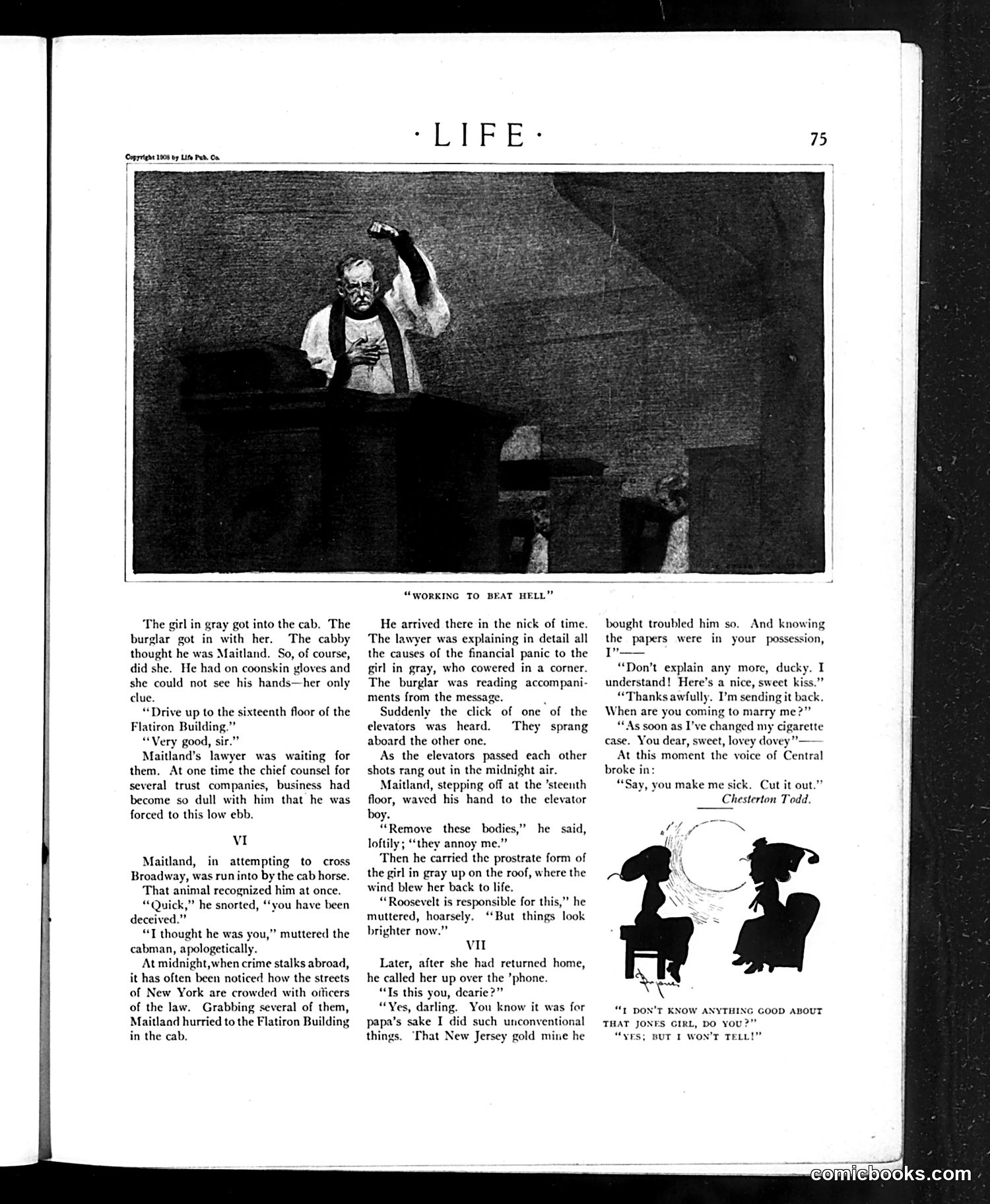
This page contains a serialized story titled "Working to Beat Hell" with accompanying illustrations. The narrative follows a character named Maitland, a lawyer involved in financial panic litigation, who encounters a cab driver and becomes entangled in criminal activity. The small cartoon at the bottom depicts two silhouetted figures in conversation, with dialogue about a "Jones girl" and gold mining in New Jersey. This appears to be a humorous aside unrelated to the main story. The page represents typical early 20th-century LIFE magazine content: serialized satirical fiction mocking urban professionals, corrupt business dealings, and contemporary social foibles. The cartoon's mention of "New Jersey gold" suggests mocking small-town financial schemes or get-rich-quick ventures popular among unsophisticated investors of the era.
📄 Transcribed text from this page (OCR, searchable)
Machine-transcribed from the original scan — historical spelling and the odd misread are preserved.
‘The girl in gray got into the cab. The burglar got in with her. The cabby thought he was Maitland. So, of course, did she. He had on coonskin gloves and she could not see his hands—her only clue. “Drive up to the sixteenth floor of the Flatiron Building.” “Very good, sir.” Maitland’s lawyer was waiting for them. At one time the chief counsel for several trust companies, business had become so dull with him that he was forced to this low ebb. VI Maitland, in attempting to cross Broadway, was run into by the cab horse. ‘That animal recognized him at once. “Quick,” he snorted, ‘you have been deceived.” “T thought he was you,” muttered the cabman, apologetically. At midnight,when crime stalks abroad, it has often been noticed how the streets of New York are crowded with officers of the law. Grabbing several of them, Maitland hurried to the Flatiron Building in the cab. “WORKING TO BEAT HELL He arrived there in the nick of time. The lawyer was explaining in detail all the causes of the financial panic to the girl in gray, who cowered in a corner. The burglar was reading accompani- ments from the message. . Suddenly the click of one of the elevators was heard. They sprang aboard the other one. ‘As the elevators passed each other shots rang out in the midnight air. Maitland, stepping off at the ’steenth floor, waved his hand to the elevator boy. “Remove these bodies,” loftily ; “they annoy me.” Then he carried the prostrate form of the girl in gray up on the roof, where the wind blew her back to life. “Roosevelt is responsible for this,” he muttered, hoarsely, ‘But things look brighter now.” he said, VII Later, after she had returned home, he called her up over the ’phone. “Is this you, dearie?” “Yes, darling. You know it was for papa’s sake I did such unconventional things. That New Jersey gold mine he bought troubled him so. And knowing the papers were in your possession, pi “Don’t explain any more, duck understand! Here’s a nice, sweet kiss. “Thanks awfully. I’m sending it back. When are you coming to marry me?” “ As soon as I’ve changed my cigarette case. You dear, sweet, lovey dovey”— At this moment the voice of Central broke in: “Say, you make me sick, Cut it out.” Chesterton Todd. “1 DON'T KNOW ANYTHING GOOD ABOUT THAT JONES GIRL, DO you?” “YES; BUT I WON'T TELL!”