
Life, 1908-01-16 · page 15 of 24
Life — January 16, 1908 — page 15: what you’re looking at
What you’re looking at
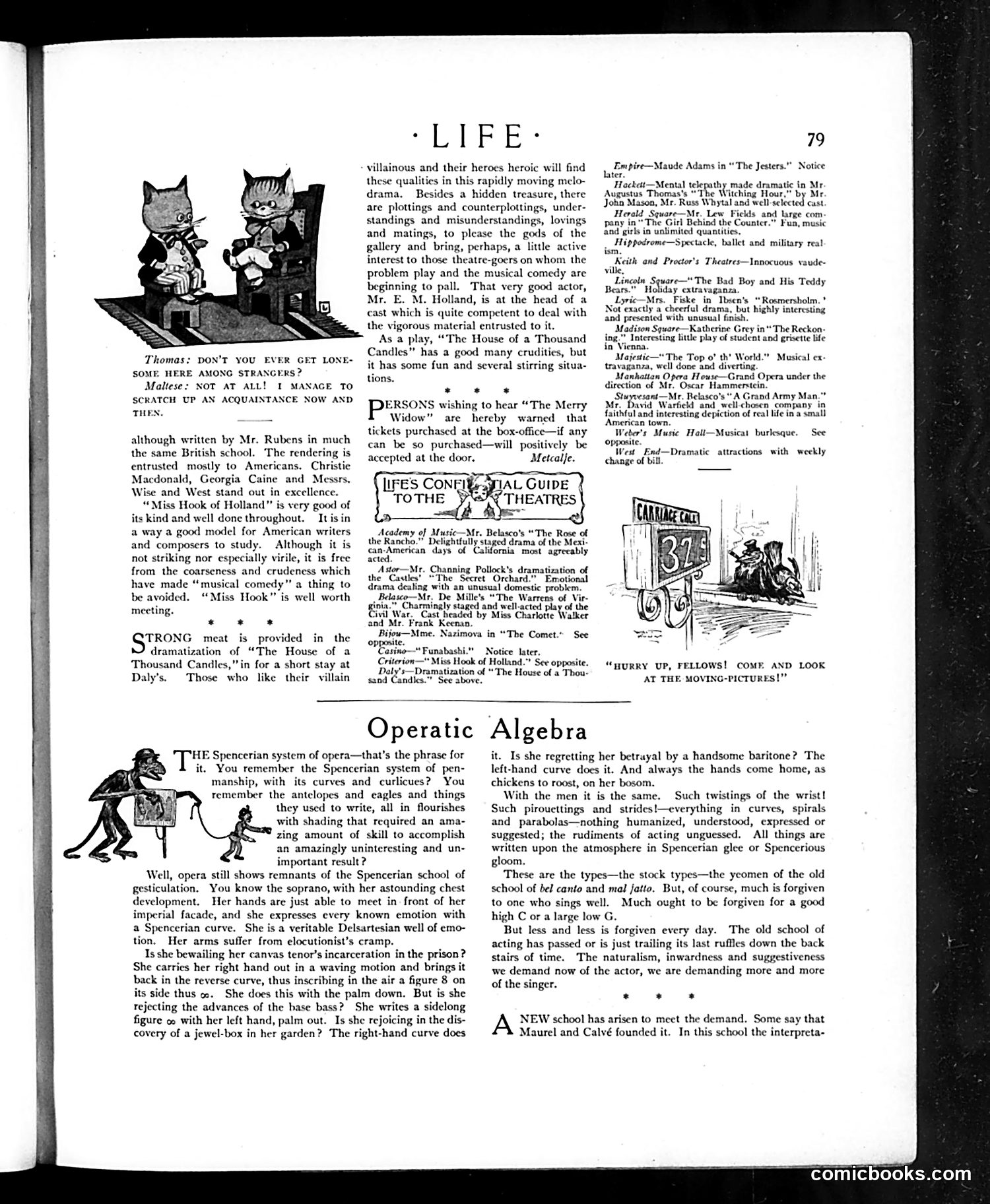
This page from *Life* magazine contains theatre reviews and advertisements rather than political cartoons. The small cartoon at top left shows two characters in conversation—one appears to be a cat-like figure (labeled "Thomas") asking another character (labeled "Maltese") if he gets lonely among strangers. The joke is a pun: "Maltese" responds he manages to "scratch up an acquaintance," with "scratch" being a cat reference, playing on the character's feline appearance. The bulk of the page comprises theatrical reviews of current Broadway productions (including "The Merry Widow," "Miss Hook of Holland," and "The House of a Thousand Candles"), with a separate illustrated section titled "Operatic Algebra" discussing operatic performance techniques. The only other illustration shows a figure at a moving picture theatre advertising, with text reading "Hurry up, fellows! Come and look at the moving pictures!"—reflecting early cinema's growing popularity as entertainment competition to live theatre.
📄 Transcribed text from this page (OCR, searchable)
Machine-transcribed from the original scan — historical spelling and the odd misread are preserved.
Thomas; Don’t you SOME HERE AMONG STRANGERS? Maltese: NOT AT ALL! I MANAGE TO SCRATCH UP AN ACQUAINTANCE NOW AND THEN. EVER GET LONE- although written by Mr. Rubens in much the same British school. The rendering is entrusted mostly to Americans. Christie Macdonald, Georgia Caine and Messrs, Wise and West stand out in excellence. iss Hook of Holland” is very good of its kind and well done throughout. It is in a way a good model for American writers and composers to study. Although it is not striking nor especially virile, it is free from the coarseness and crudeness which have made “musical comedy” a thing to be avoided. ‘Miss Hook” is well worth meeting. * * ‘TRONG meat is provided in the dramatization of “The House of a Thousand Candles,” in for a short stay at Daly's. | Those who like their villain “LIFE: villainous and their heroes heroic will find these qualities in this rapidly moving mclo- drama. Besides a hidden treasure, there are plottings and counterploitings, under- standings and misunderstandings, lovings and matings, to please the gods of the gallery and bring, perhaps, a little active interest to those theatre-goers on whom the problem play and the musical comedy are beginning to pall. That very good actor, Mr. E. M. Holland, is at the head of a cast which is quite competent to deal with the vigorous material entrusted to it. As a play, “The House of a Thousand Candles" has a good many crudities, but it has some fun and several stirring situa- tions. * 8 « wishing to hear “The Merry Widow” are hereby warned that tickets purchased at the box-office—if any can be so purchased—will positively be accepted at the door. Metcalfe. (URES CONTIG PIAL Curve y TOTHE My ReneS b a Academy of Music—Mr. Belasco's “The Rose of the Rancho.” Delightfully staged drama of the Mexi- can-American days of California most agreeably acted. Aster—Mr. Channing Pollock's dramatization of the Castles’ “The Secret Orchard.” Emotional drama dealing with an unusual domestic problem. _ Belasco—Mr. De Mille's “The Warrens of Vir- ginia.” Charmingly staged and well-acted play of the Gril" War. Cast headed by Miss Charlotte Walker and Mr. Frank Keenan. Bijou—Mme. Nazimova in “The Comet.” See opposite. Casino—" Funabashi.” Notice later. Criterion—" Miss Hook of Holland.”* Sce opposite. Daly's—Dramatization of “ The H of = sand Candles.” See above. eHouse of & Thee 79 “i Em pire—Maude Adams in “The Jesters.” Notice ter. Hockat Mental telepathy made dramatic in Mr Augustus Thomas's “The Witching Hour,” by Mr. John Masoa, Mr. Russ Whytal and well selected cast Herald Square—Mt. Lew Fields and large com: pany in“ The Girl Behind the Counter.” Fun, music and gitls in unlimited quantities. _ Hippodrome—Spectacle, ballet and military real ism, aeith and Proder's Theatres—Innocuous vavde- Lincoln Spuare—"The Bad Boy and His Teddy Bears." Holiday extravaganza. Lyric—Mrs. Fiske in Ibsen's “Rosmersholm. * Not exactly a cheerful drama, but highly interesting and presented with unusual finish Madison Square—Katherine Grey in** The Reckon- ing.” Interesting little play of student and grisette life in Vienna. Majestic—* The Top o' th' World.” Musical ex: travaganza, well done and diverting Manhattan Opera House—Grand Opera under the direction of Mr. Oscar Hammerstei Stuyvesant—Mr. Relasco’s “A Grand Army Man.” Mr. David Warfield and. well-chosen company in faithful and interesting depiction of real life ina small American town. Weber's Music Heall—Musicat burlesque, See opposite West End—Dramatic attractions with weekly change of bill. “HURRY UP, FELLOWS! COME AND LOOK AT THE MOVING-PICTURES!” Operatic Algebra HE Spencerian system of opera—that’s the phrase for it. You remember the Spencerian system of pen- manship, with its curves and curlicues? You remember the antclopes and eagles and things they used to write, all in flourishes with shading that required an ama- © zing amount of skill to accomplish an amazingly uninteresting and un- important result? Well, opera still shows remnants of the Spencerian school of gesticulation. You know the soprano, with her astounding chest development. Her hands are just able to meet in front of her imperial facade, and she expresses every known emotion with a Spencerian curve. She is a veritable Delsartesian well of emo- tion, Her arms suffer from elocutionist’s cramp. Is she bewailing her canvas tenor’s incarceration in the prison? She carries her right hand out in a waving motion and brings it back in the reverse curve, thus inscribing in the air a figure 8 on its side thus oo. She does this with the palm down. But is she rejecting the advances of the hase bass? She writes a sidelong figure oo with her left hand, palm out. Is she rejoicing in the dis- covery of a jewel-box in her garden? The right-hand curve docs it, Is she regretting her betrayal by a handsome baritone? The left-hand curve does it. And always the hands come home, as chickens to roost, on her bosom. With the men it is the same. Such twistings of the wrist! Such pirouettings and strides!—everything in curves, spirals and parabolas—nothing humanized, understood, expressed or suggested; the rudiments of acting unguessed. All things are written upon the atmosphere in Spencerian glee or Spencerious gloom. These are the types—the stock types—the yeomen of the old school of bel canto and mal jatto, But, of course, much is forgiven to one who sings well. Much ought to be forgiven for a good high C or a large low G. But less and less is forgiven every day. The old school of acting has passed or is just trailing its last ruffles down the back stairs of time. The naturalism, inwardness and suggestiveness we demand now of the actor, we are demanding more and more of the singer. * 8 « NEW school has arisen to meet the demand. Some say that Maurel and Calvé founded it. In this school the interpreta- ~ comicbooks.com