
Life, 1908-01-16 · page 16 of 24
Life — January 16, 1908 — page 16: what you’re looking at
What you’re looking at
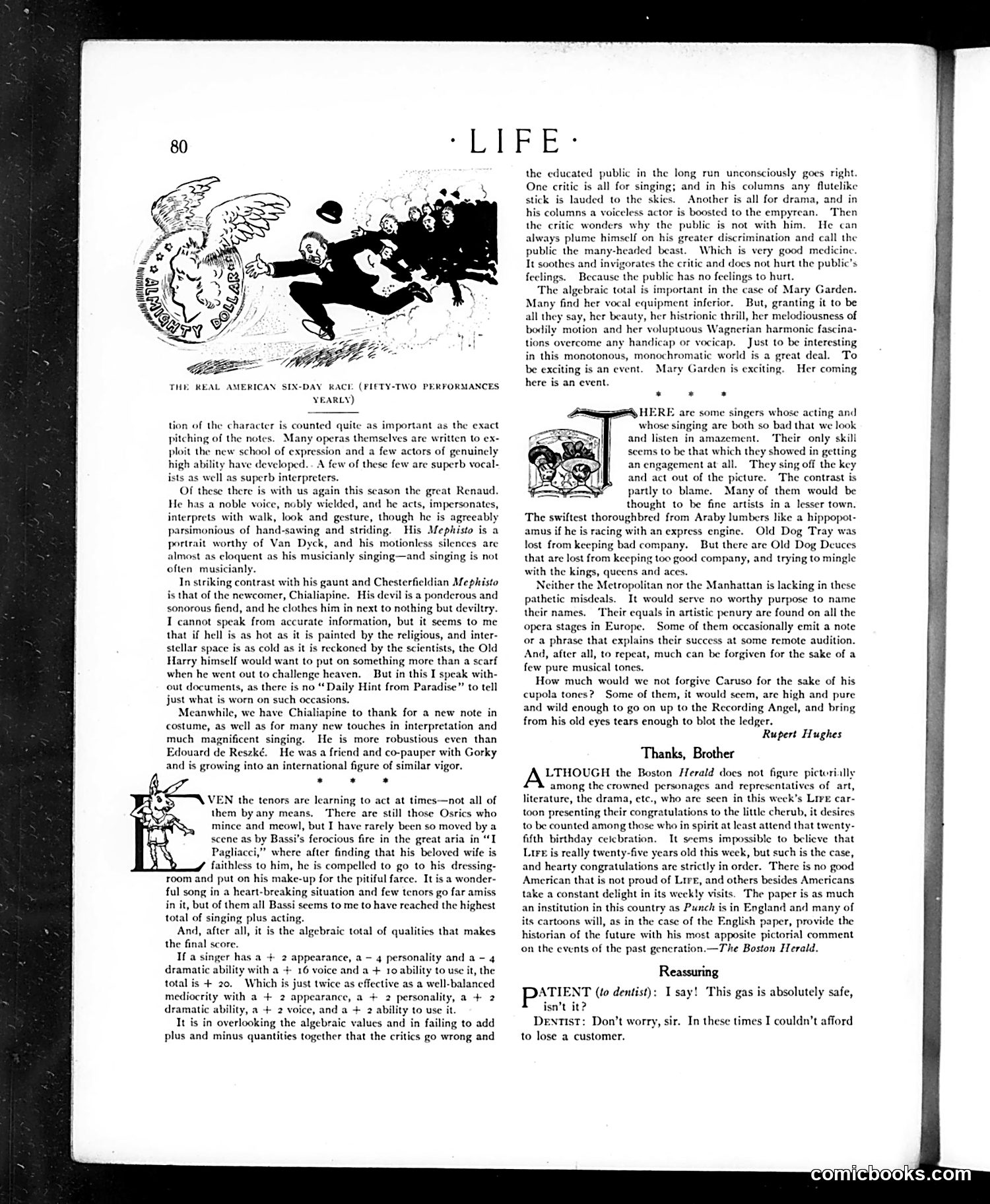
The main cartoon, titled "The Real American Six-Day Race (Fifty-Two Performances Yearly)," depicts a winged figure (appearing to be an angel or allegorical character) being chased or pursued by a group of men in formal dress. The image satirizes the grueling schedule of opera singers, particularly comparing their demanding performance schedule to the exhausting endurance races that were popular spectacles of the era. The accompanying text by what appears to be a theater critic discusses opera performances and singers, including commentary on performers like Renaud, Chaliapin, and Mary Garden. The critic uses a mathematical metaphor ("algebraic total") to argue that great performance requires balance—combining voice, dramatic ability, appearance, and technique rather than excelling in only one area. The satire criticizes both overly specialized critics (who focus exclusively on singing or drama) and the myth of the "many-headed beast" public, suggesting educated audiences instinctively recognize balanced talent better than narrow-minded critics do.
📄 Transcribed text from this page (OCR, searchable)
Machine-transcribed from the original scan — historical spelling and the odd misread are preserved.
uty * LEE THE REAL AMERICAN SIX-DAY RACE (PIETY-TWO PERFORMANCES, YEARLY) tion of the character is counted quite as important as the exact pitching of the notes. Many operas themselves are written to ex- ploit the new school of expression and a few actors of genuine! high ability have developed... A few of these few are superb vocal- ists as well as superb interpreters. Of these there is with us again this season the great Renaud. He has a noble voice, nobly wielded, and he acts, impersonate: interprets with walk, look and gesture, though he is agreeably parsimonious of hand-sawing and striding. His Mephisto is a portrait worthy of Van Dyck, and his motionless silences are almost as eloquent as his musicianly singing—and singing is not often: musicianly. In striking contrast with his gaunt and Chesterfieldian Mephisto is that of the newcomer, Chialiapine. His devil is a ponderous and sonorous fiend, and he clothes him in next to nothing but deviltry. I cannot speak from accurate information, but it seems to me that if hell is as hot as it is painted by the religious, and inter- stellar space is as cold as it is reckoned by the scientists, the Old Harry himself would want to put on something more than a scarf when he went out to challenge heaven. But in this I speak with- out documents, as there is no “ Daily Hint from Paradise” to tell just what is worn on such occasions. Meanwhile, we have Chialiapine to thank for a new note in costume, as well as for many new touches in interpretation and much magnificent singing. He is more robustious even than Edouard de Reszké. He was a friend and co-pauper with Gorky and is growing into an international figure of similar vigor. s 8 8 VEN the tenors are learning to act at times—not all of them by any means, There are still those Osrics who mince and meowl, but I have rarely been so moved by a scene as by Bassi’s ferocious fire in the great aria in “I Pagliacci,” where after finding that his beloved wife is thless to him, he is compelled to go to his dressing- room and put on his make-up for the pitiful farce. It is a wonder ful song in a heart-breaking situation and few tenors go far amiss in it, but of them all Bassi seems to me to have reached the highest total of singing plus acting, And, after all, it is the algebraic total of qualitics that makes the final score. If a singer has a + 2 appearance, a ~ 4 personality and a - 4 dramatic ability with a + 16 voice and a + 10 ability to use it, the total is + 20. Which is just twice as effective as a well-balanced mediocrity with a + 2 appearance, a + 2 personality, a + 2 dramatic ability, a + 2 voice, and a + 2 ability to use it. It is in overlooking the algebraic values and in failing to add plus and minus quantities together that the critics go wrong and the educated public in the long run unconsciously goes right. One critic is all for singing; and in his columns any flutelike stick is lauded to the skies. Another is all for drama, and in his columns a voiceless actor is boosted to the empyrean. ‘Then the critic wonders why the public is not with him. He can always plume himself on his greater discrimination and call the public the many-headed beast. Which is very good medicine It soothes and invigorates the critic and does not hurt the public’s feelings. Because the public has no feelings to hurt. The algebraic total is important in the case of Mary Garden. Many find her vocal equipment inferior. But, granting it to be all they say, her beauty, her histrionic thrill, her melodiousness of bodily motion and her voluptuous Wagnerian harmonic fascina- tions overcome any handicap or vocicap. Just to be interesting in this monotonous, monochromatic world is a great deal. To be exciting is an event. Mary Garden is exciting. Her coming here is an event. + 8 8 HERE are some singers whos whose singing are both so bad that we look and listen in amazement. ‘Their only skill scems to be that which they showed in getting an engagement at all. They sing off the key and act out of the picture. The contrast is partly to blame. Many of them would be thought to be fine artists in a lesser town, The swiftest thoroughbred from Araby lumbers like a hippopot- amus if he is racing with an express engine. Old Dog Tray was lost from keeping bad company. But there are Old Dog Deuces that are lost from keeping too good company, and trying to mingle with the kings, qucens and aces. Neither the Metropolitan nor the Manhattan is lacking in these pathetic misdeals. It would serve no worthy purpose to name their names. ‘Their equals in artistic penury are found on all the opera stages in Europe. Some of them occasionally emit a note or a phrase that exp s their succe: some remote audition. And, after all, to repeat, much can be forgiven for the sake of a few pure musical tones, How much would we not forgive Caruso for the sake of his cupola tones? Some of them, it would seem, are high and pure and wild enough to go on up to the Recording Angel, and bring from his old eyes tears enough to blot the ledger. Rupert Hughes Thanks, Brother LTHOUGH the Boston Herald docs not figure pictorially among the crowned personages and representatives of art, literature, the drama, etc., who are seen in this weck’s Lire car- toon presenting their congratulations to the little cherub, it desire: to be counted among those who in spirit at least attend that twenty- fifth birthday ceicbration. It seems impossible to believe that Lire is really twenty-five years old this week, but such is the case, and hearty congratulations are strictly in order. ‘There is no good American that is not proud of Lire, and others besides Americans take a constant delight in its weekly visits. ‘The paper is as much an institution in this country as Punch is in England and many of its cartoons will, as in the case of the English paper, provide the historian of the future with his most apposite pictorial comment ‘on the events of the past gencration.—The Boston Herald. Reassuring TIENT (to dentist): I say! This gas is absolutely safe, isn’t it? Dentist: Don’t worry, sir. In these times I couldn't afford to lose a customer.