
A complete issue · 50 pages · 1907
Life — November 7, 1907
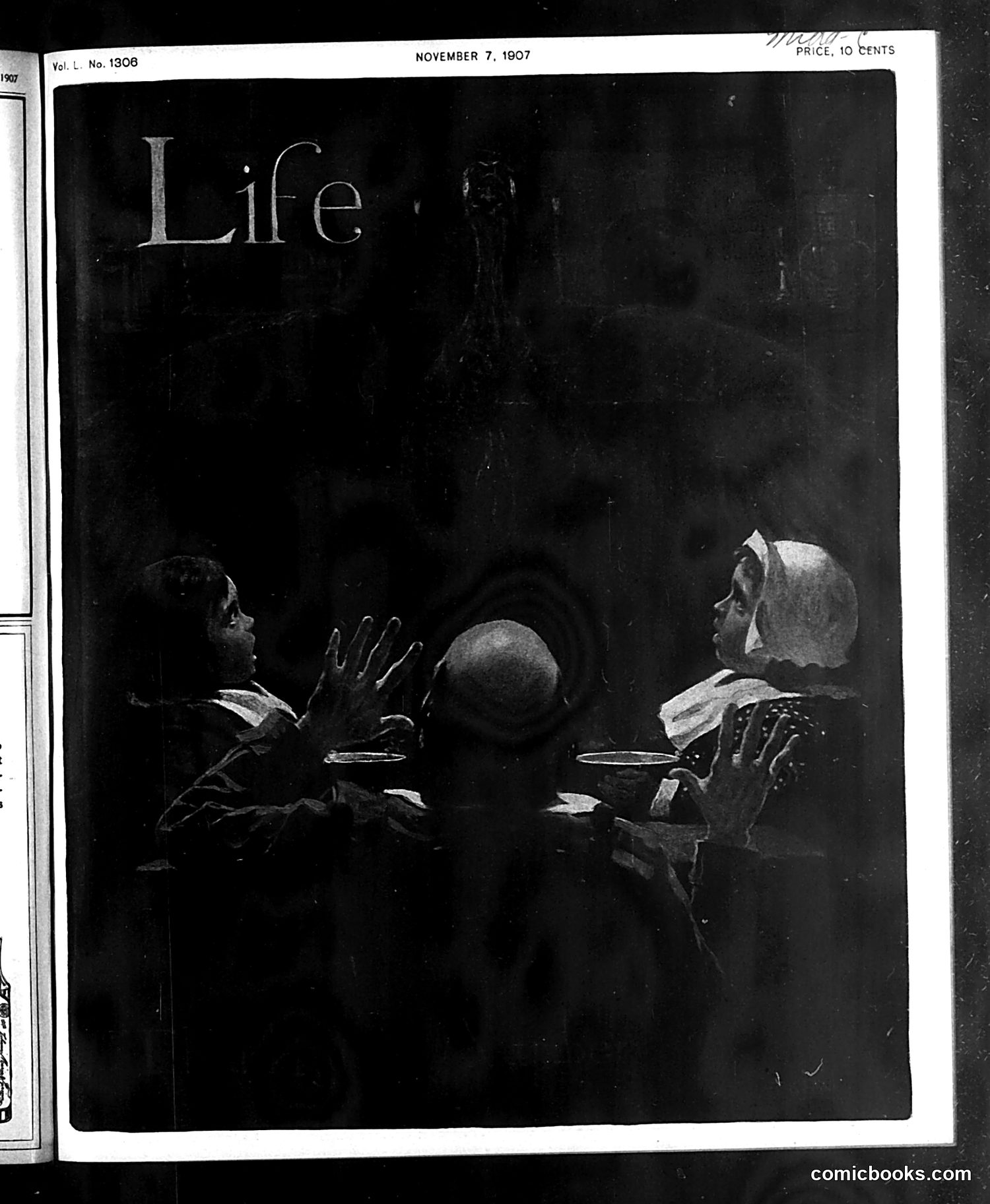
This cover depicts three figures seated at a table in deep shadow, appearing to share a meal. The stark, dramatic lighting and positioning suggest an ominous or supernatural scene. The word "Life" appears prominently at top. Without visible text identifying the specific figures or context, the exact political or social reference remains unclear. However, given Life's satirical nature and the date (1907), this likely comments on contemporary politics or social issues. The theatrical staging—the darkness, the formal seated arrangement—suggests either a commentary on secret dealings, formal negotiations, or possibly a literary/theatrical reference popular at the time. The composition emphasizes tension and secrecy through its chiaroscuro technique rather than explicit caricature or labeling.
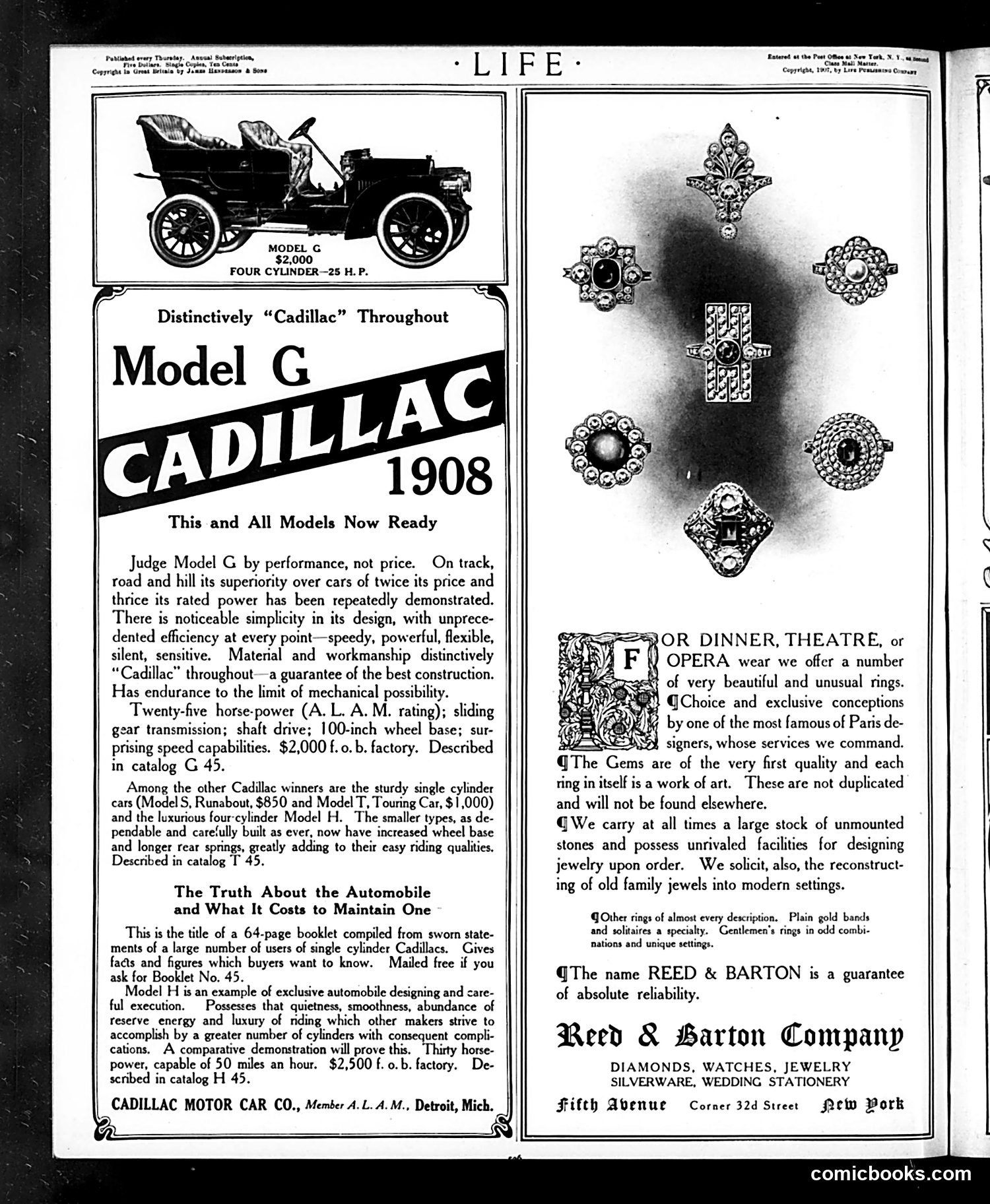
This page contains **no political cartoons or satire**—it's primarily advertising from 1908. The left side advertises the **Cadillac Model G automobile**, priced at $2,000 with a 25 horsepower four-cylinder engine. The ad emphasizes the car's reliability and performance, comparing it favorably to more expensive competitors. The right side advertises **Reed & Barton Company**, a jewelry firm located on Fifth Avenue in New York. They offer custom-designed rings and jewelry for formal occasions (dinner theater, opera), claiming exclusive designs by famous Parisian signers and guaranteeing quality craftsmanship. Both advertisements target affluent early-20th-century consumers. There is no satirical content—this is straightforward commercial promotion typical of Life magazine's revenue model.
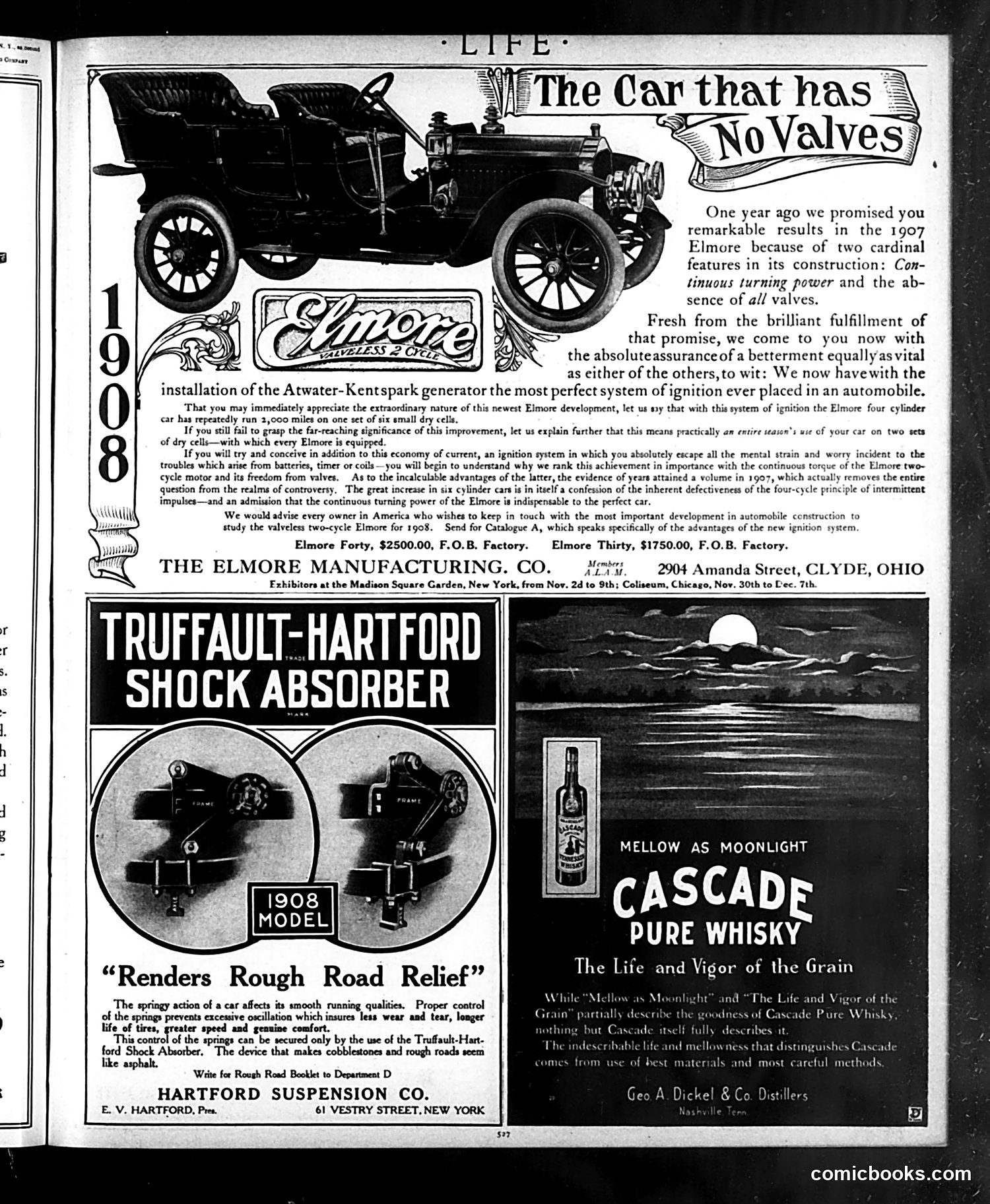
This page consists primarily of **three automobile and product advertisements** rather than satirical cartoons. The top advertisement promotes the **Elmore automobile**, highlighting its "Atwater-Kentspark generator" ignition system and notably its lack of valves—presented as a major selling point for reliability and ease of use. This reflects early 1900s automotive innovation competition. Below are ads for the **Truffault-Hartford Shock Absorber** (emphasizing comfort on rough roads) and **Cascade Pure Whisky** (using poetic language about quality). The page reveals **1908 consumer priorities**: mechanical reliability, comfort in vehicles, and quality spirits. There is **no political satire present**—this appears to be a standard advertising section of the magazine rather than editorial content.
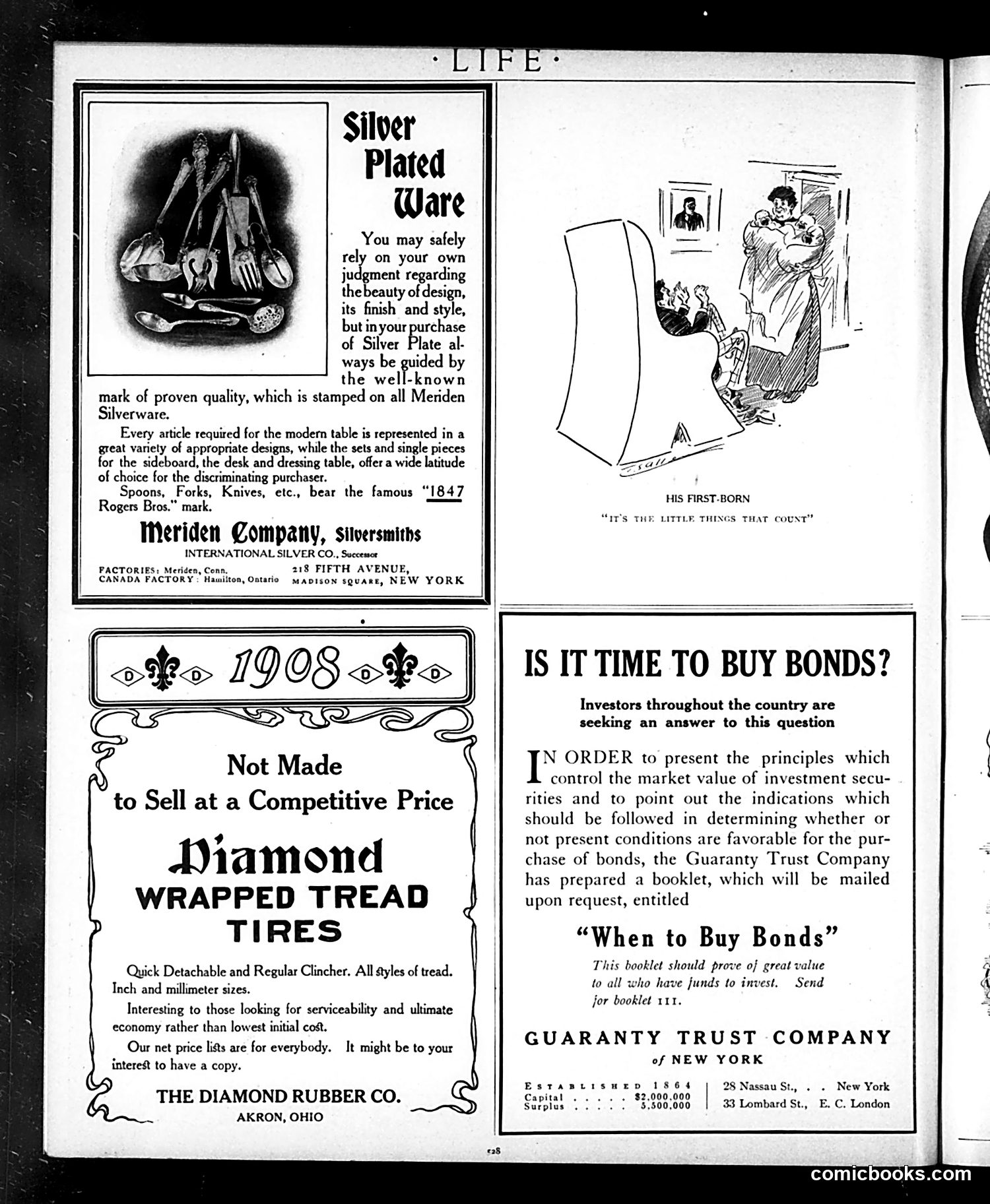
This page is primarily **advertising**, not satirical content. It contains four ads from 1908: 1. **Meriden Silverplate Ware** — promotes "Silver Plate" tableware, emphasizing quality and design variety for discriminating buyers. 2. **Cartoon illustration** (top right) titled "His First Born" with caption "It's the Little Things That Count" — depicts a mother with an infant, likely advertising baby products or services, though the specific advertiser is unclear. 3. **Diamond Wrapped Tread Tires** — promotes economical tire options in multiple sizes, from the Diamond Rubber Company in Akron, Ohio. 4. **Guaranty Trust Company** — offers a free booklet "When to Buy Bonds" to investors considering securities purchases during this pre-WWI economic period. The page reflects early 20th-century consumer advertising and financial services targeting middle-class Americans.
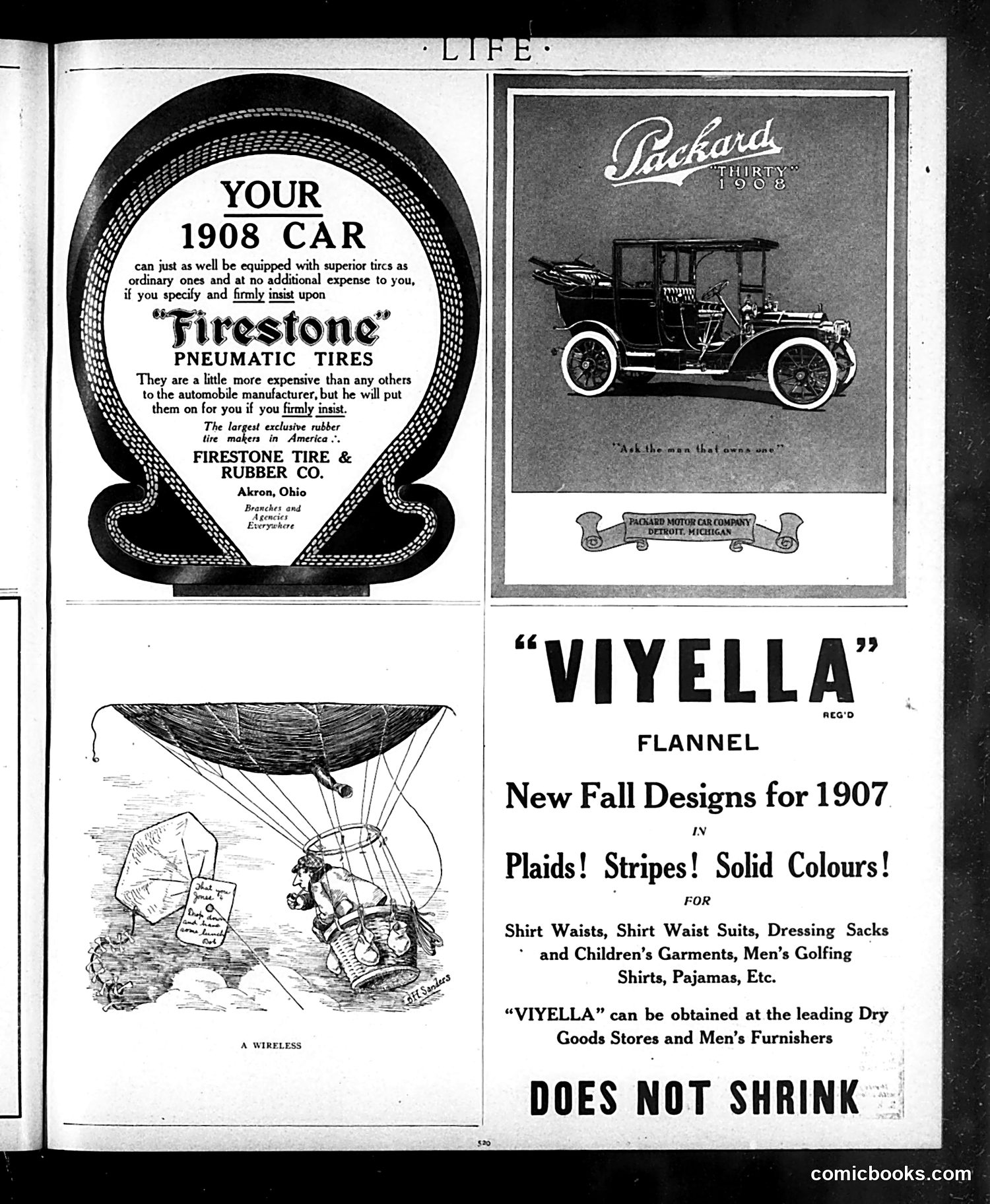
This page is **primarily advertising**, not editorial content or satire. It contains four advertisements from circa 1907-1908: 1. **Firestone Pneumatic Tires** - appeals to 1908 car owners to upgrade their tires 2. **Packard Motor Car Company** - showcases their "Thirty" model automobile 3. **"A Wireless" cartoon** - a whimsical illustration (likely satirical vignette about communication technology) 4. **Viyella Flannel** - promotes new fabric designs for clothing, emphasizing it "does not shrink" The page reflects early 20th-century consumer culture: automobiles, emerging wireless technology, and textile manufacturing. There is no coherent political or social satire connecting these advertisements—they simply represent the commercial products and innovations of the era that Life magazine's readers would have encountered.
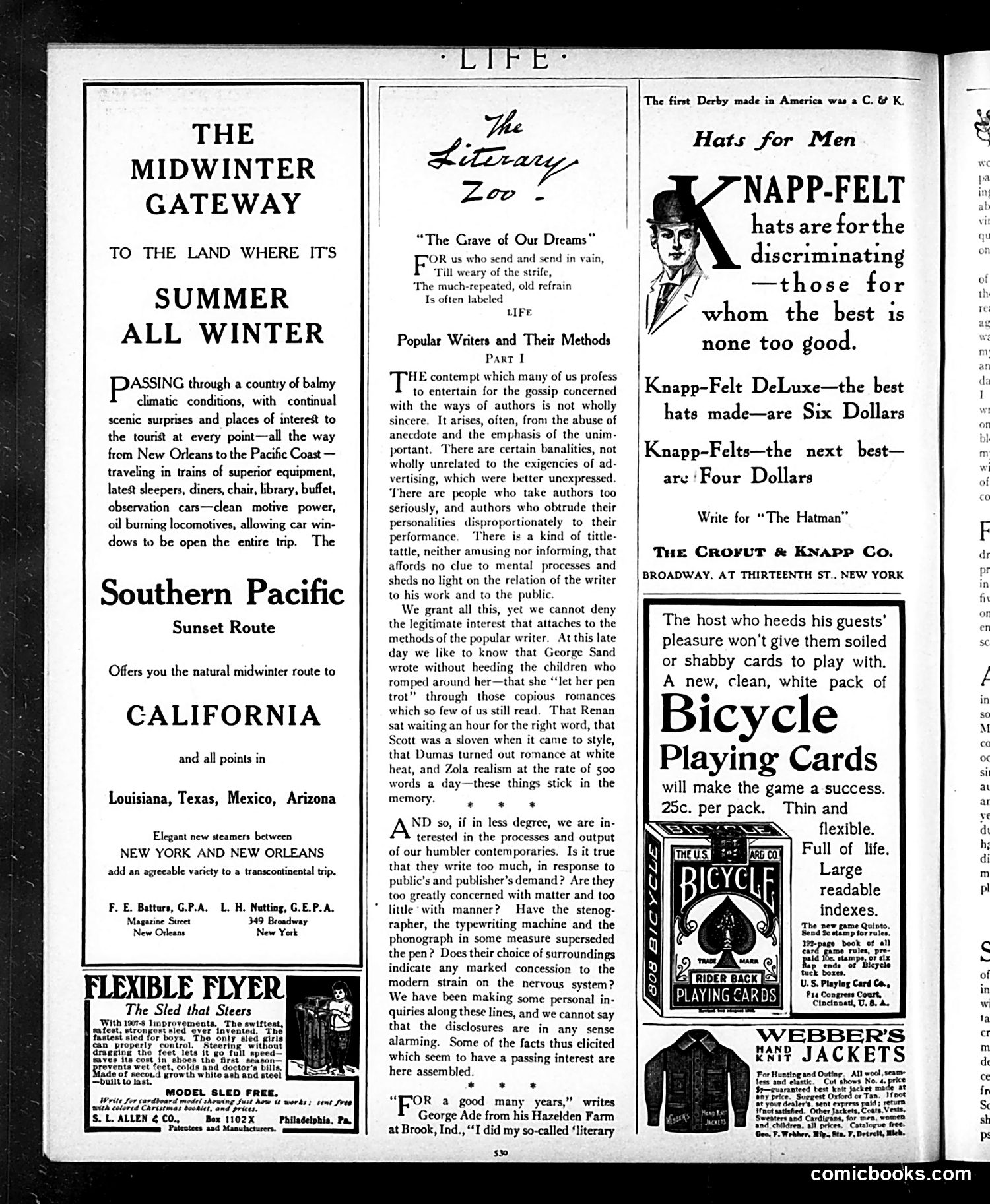
This page is primarily **advertising**, not political satire. It contains four distinct advertisements: 1. **Southern Pacific Railroad** - promoting winter travel to California and southwestern destinations 2. **Flexible Flyer Sled** - a children's toy marketed as steerable and safe 3. **Literary Zoo** - an article about popular writers' working methods and personalities, discussing authors' quirks and eccentricities 4. **Knapp-Felt Hats, Bicycle Playing Cards, and Webber's Rain Jackets** - standard consumer product ads The only editorial content is "Popular Writers and Their Methods," which humorously examines how famous authors work—their habits, superstitions, and personalities—rather than making political commentary. The tone is lighthearted observation about the literary world, not satire. This reflects Life's mid-20th-century mix of advertising and lifestyle content.
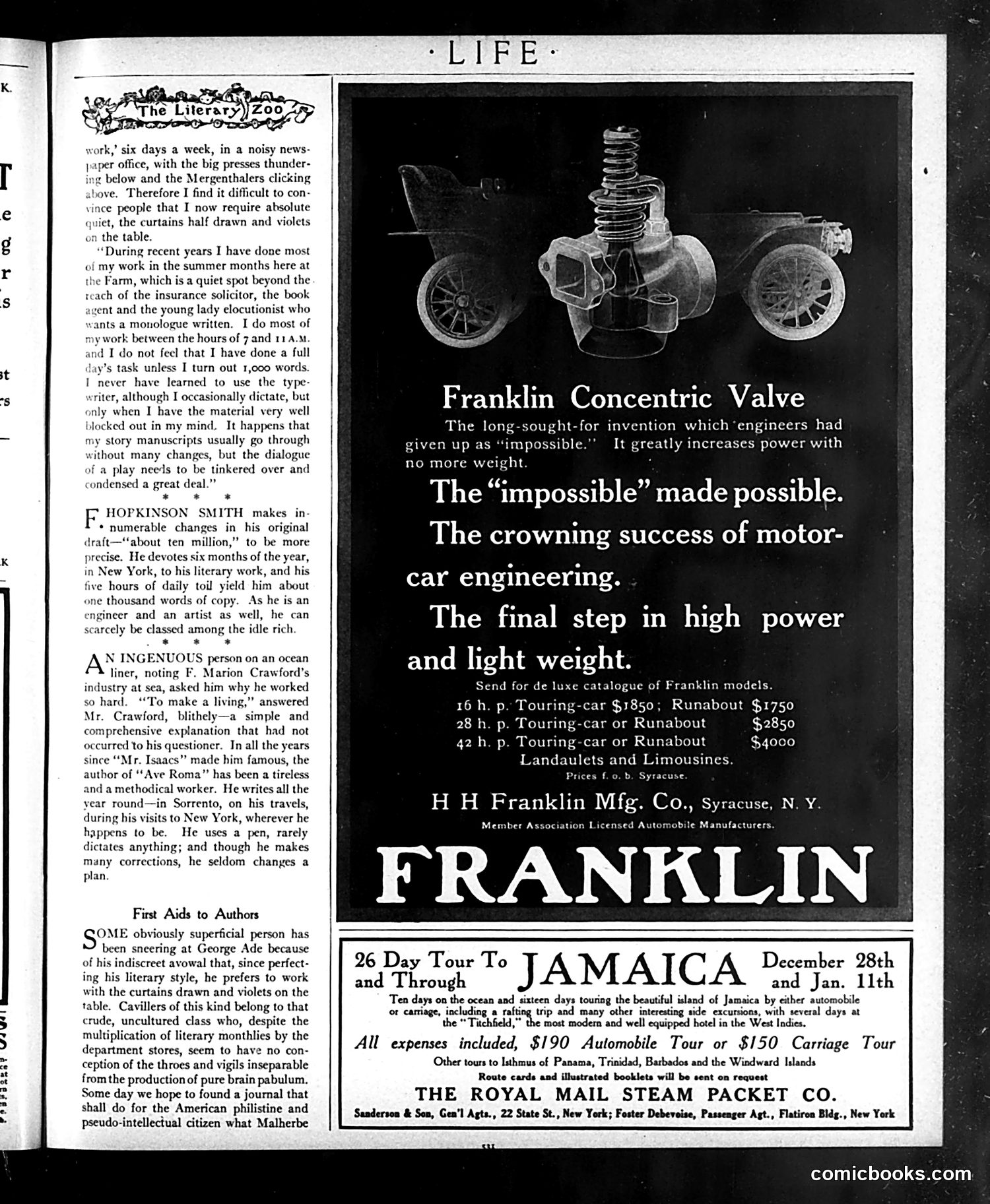
This page is primarily **advertising and author interviews**, not satire or political cartoons. The main content includes: 1. **"The Literary Zoo"** — an interview section featuring F. Hopkinson Smith, a writer discussing his work habits and creative process. 2. **Franklin Concentric Valve advertisement** — a full-page car engine ad promoting the Franklin automobile's innovative valve technology as engineering's breakthrough achievement in "high power and light weight." 3. **Jamaica tour advertisement** — promoting a 26-day tourist package by the Royal Mail Steam Packet Co. The page contains no political cartoons or satire. It's a standard early 20th-century magazine layout mixing editorial content with automotive and travel advertising—common for *Life* during this era.
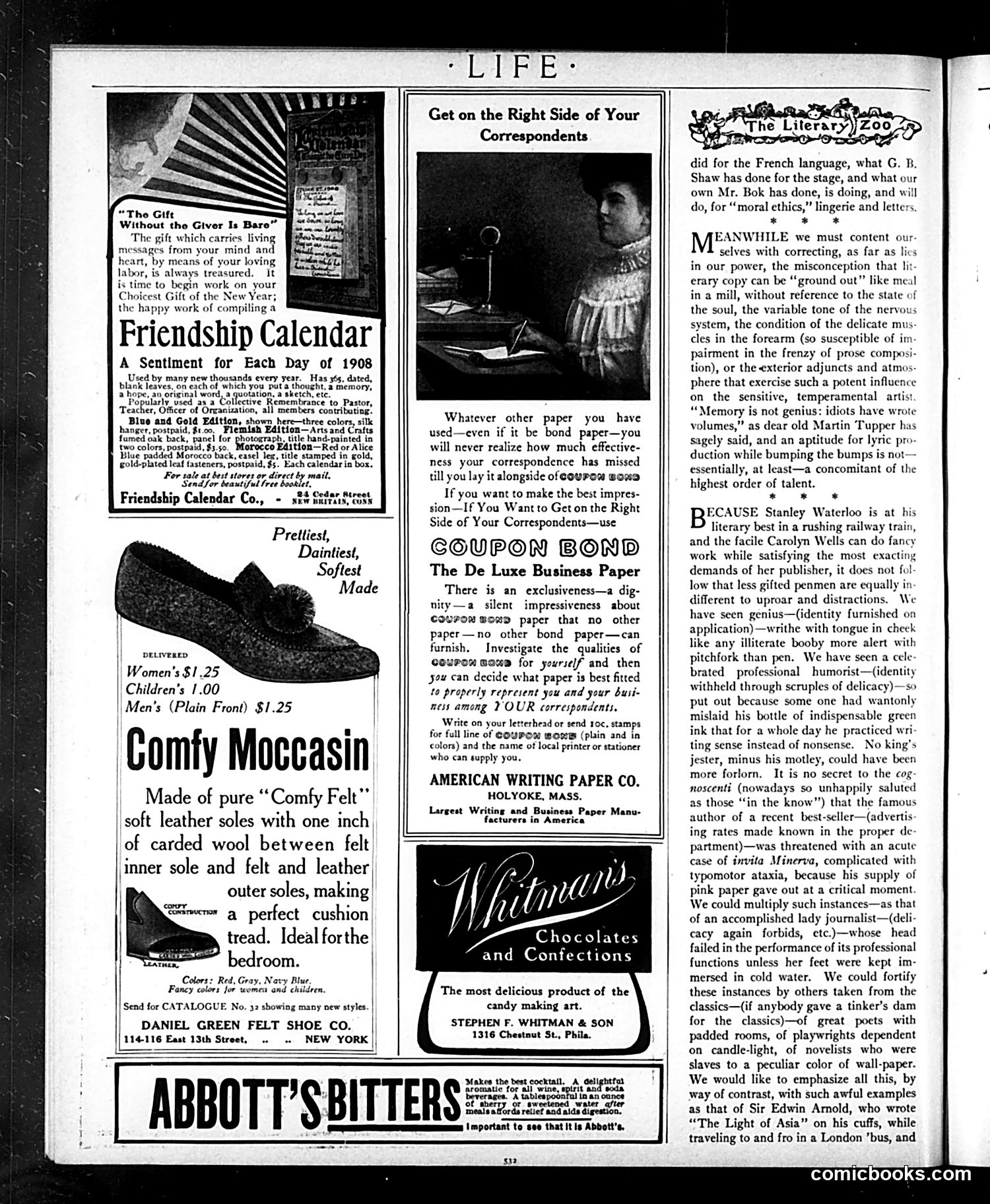
This page is primarily **advertising and literary content** rather than political satire. The main elements include: - **"Friendship Calendar"** advertisement promoting a 1908 calendar compilation of sentimental quotations and writings - **"Comfy Moccasin"** shoe advertisement with pricing - **"Coupon Bond"** business paper advertisement - **"Whitman's Chocolates"** confectionery ad - **"Abbott's Bitters"** beverage advertisement The literary section, "The Life Literary," discusses contemporary authors like Stanley Waterloo and Carolyn Wells, noting their professional competence. There's mild satire about editorial practices and writer idiosyncrasies, but no significant political commentary. The page reflects early 1900s consumer culture and publishing industry standards rather than satirizing current events or public figures.
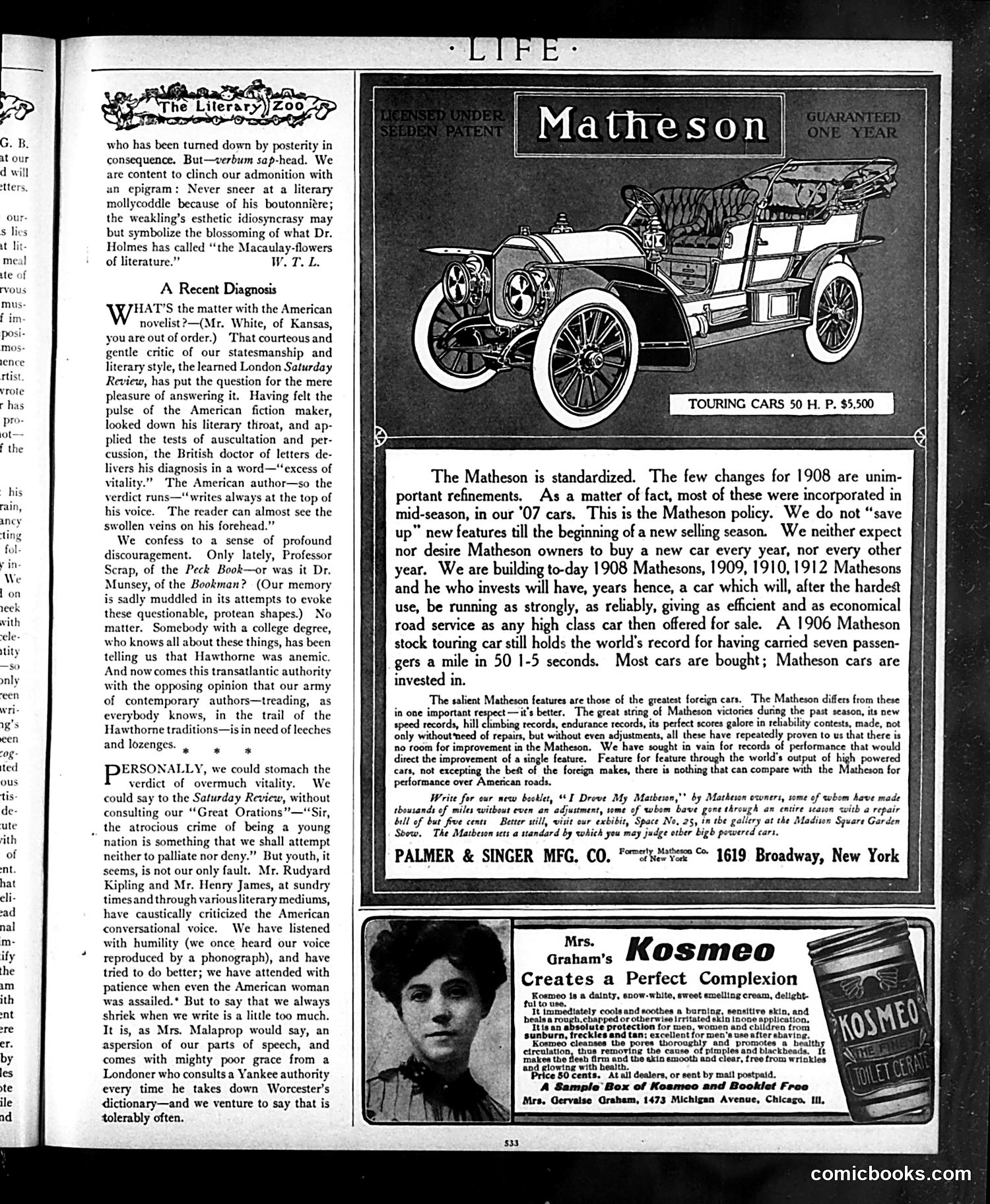
This page is primarily **advertising** rather than satirical content. The dominant feature is a large Matheson automobile advertisement (center-right), promoting their 1908 touring cars at $5,500. The ad emphasizes the car's reliability and standardized design, claiming a Matheson holds the world record for passenger capacity. Below is a Kosmeo beauty product advertisement featuring "Mrs. Graham's" complexion cream. The left side contains literary criticism under "The Literary Zoo" and "A Recent Diagnosis," discussing American novelists' style and vitality. The tone is somewhat satirical about American fiction, but this is cultural commentary rather than political satire. This appears to be a **typical early 1900s Life magazine page**, blending editorial content with commercial advertisements—the primary revenue source for the publication.
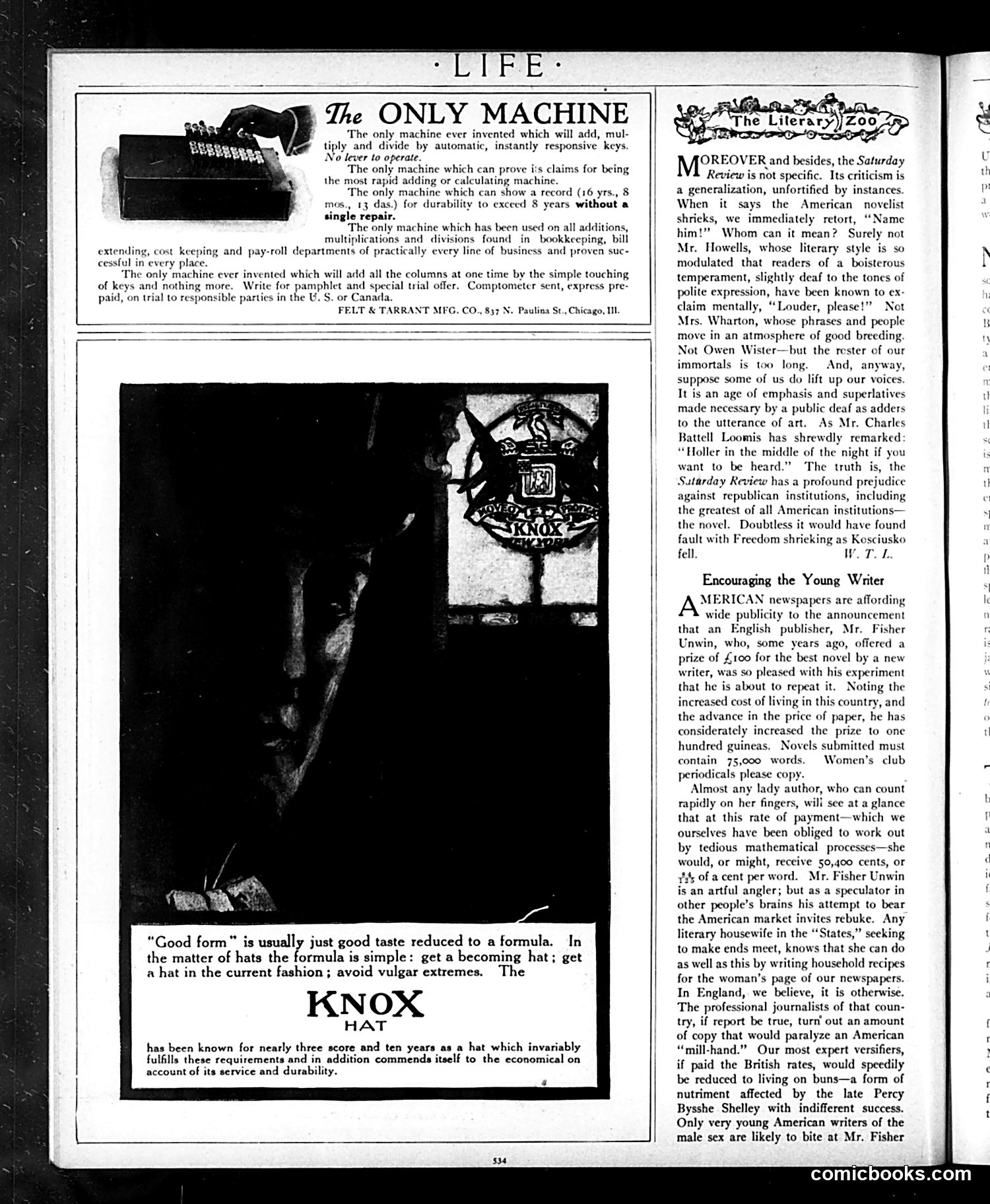
This page contains **advertisements** (for Felt & Tarrant calculating machines and Knox hats) alongside a literary column titled "The Literary Zoo." The visible cartoon/illustration shows a **hat advertisement** with a photograph of someone wearing a Knox hat, captioned with fashion advice about "good form" and hat selection. The right column discusses **American literary culture**, specifically praising a British publisher's prize for novels and critiquing the *Saturday Review* for its harsh treatment of American authors. The author argues that American newspapers are more encouraging to young writers than British publications, and notes increased prize money for fiction writers. **No specific political figures or caricatures are identifiable** in the visible portions. The satire targets **literary institutions and critical prejudices** rather than individual politicians or public figures.
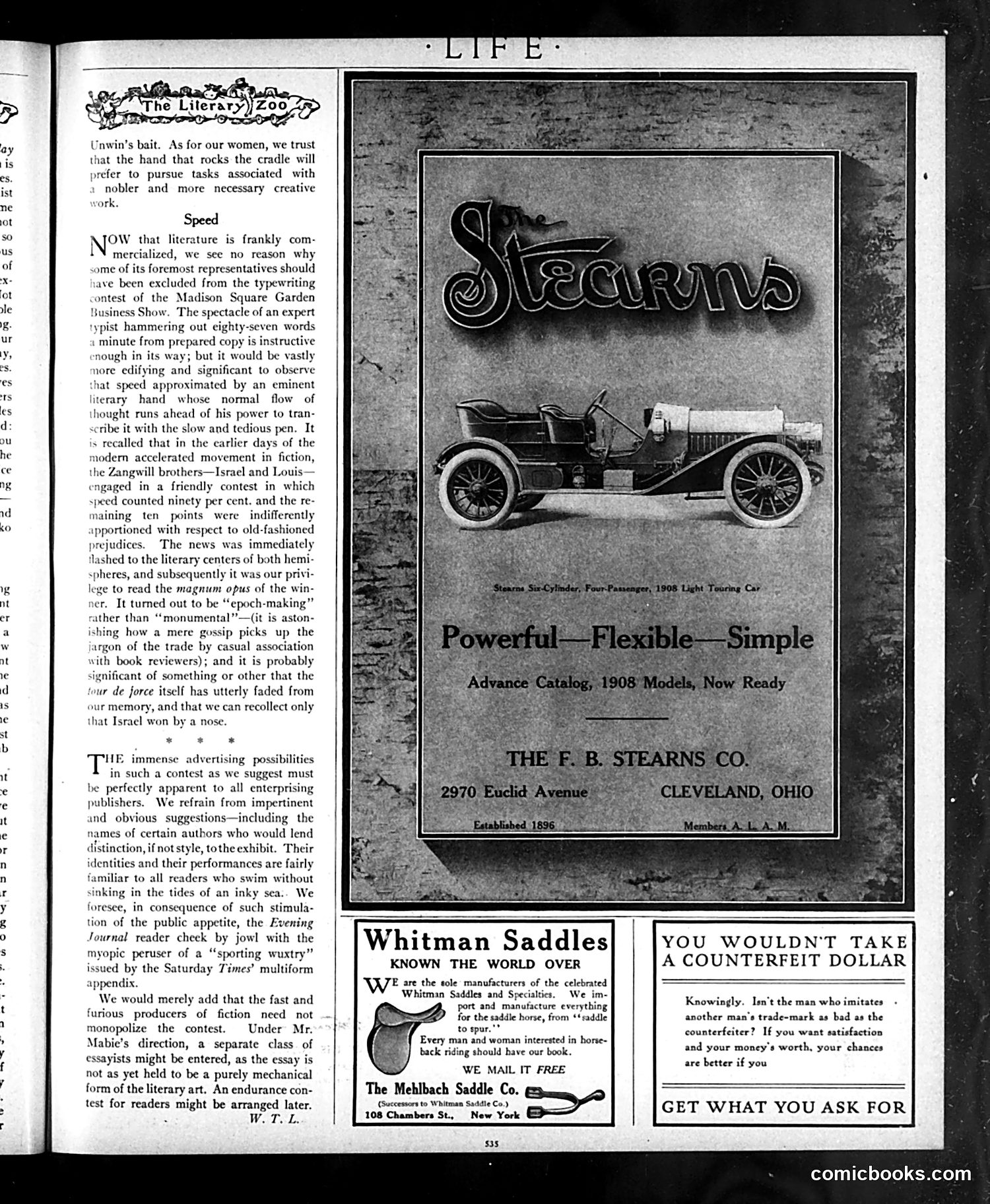
The page is not a political cartoon but rather a collection of advertisements and literary commentary from *Life* magazine. The left column contains "The Literary Zoo," a brief essay discussing the commercialization of literature and the value of observing skilled writers' work. It references a typing speed contest from the "Madison Square Garden Business Show." The advertisements feature: - **F.B. Stearns Co.**: A 1908 automobile advertisement emphasizing the car's "Powerful, Flexible, Simple" design - **Whitman Saddles**: Promoting their products with the phrase "Know the World Over" - **Counterfeit Dollar warning**: A cautionary ad against accepting fake currency The page reflects early 1900s consumer culture and advertising priorities rather than political satire.
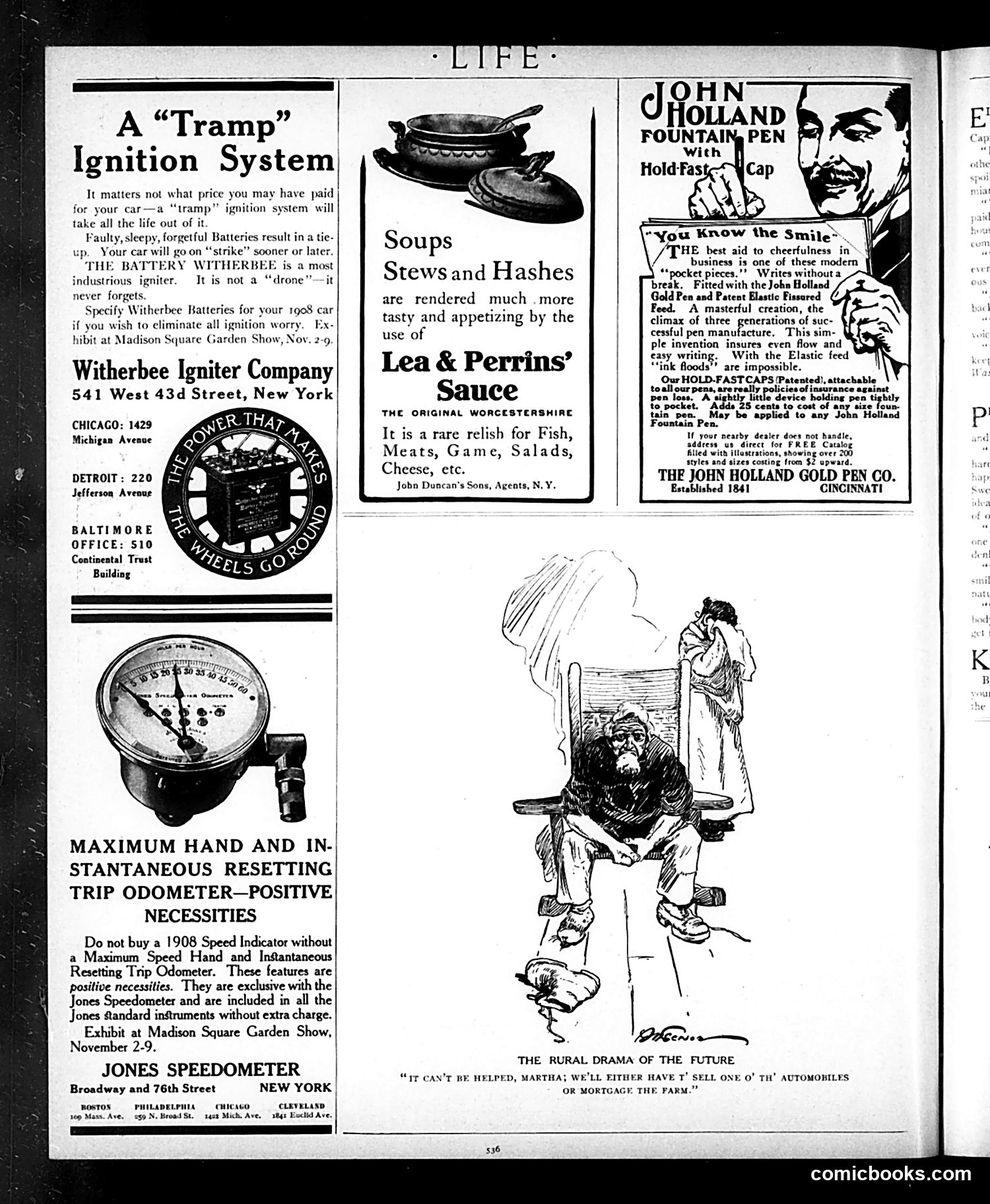
This page is primarily **advertising**, with a large political cartoon at the bottom. The cartoon depicts a rural couple in distress—a man slumped in a chair while a woman gestures dramatically. The caption reads: "IT CAN'T BE HELPED, MARTHA; WE'LL EITHER HAVE T' SELL ONE O' TH' AUTOMOBILES OR MORTGAGE THE FARM." The satire targets **rural economic anxiety during early automotive adoption**. The joke is that farmers have become so dependent on automobiles that they face an impossible choice: sell vehicles or mortgage their land—reversing traditional priorities. It mocks both the conspicuous consumption of rural buyers and the genuine economic pressure farmers faced, suggesting car ownership had become culturally essential even in financially precarious circumstances.
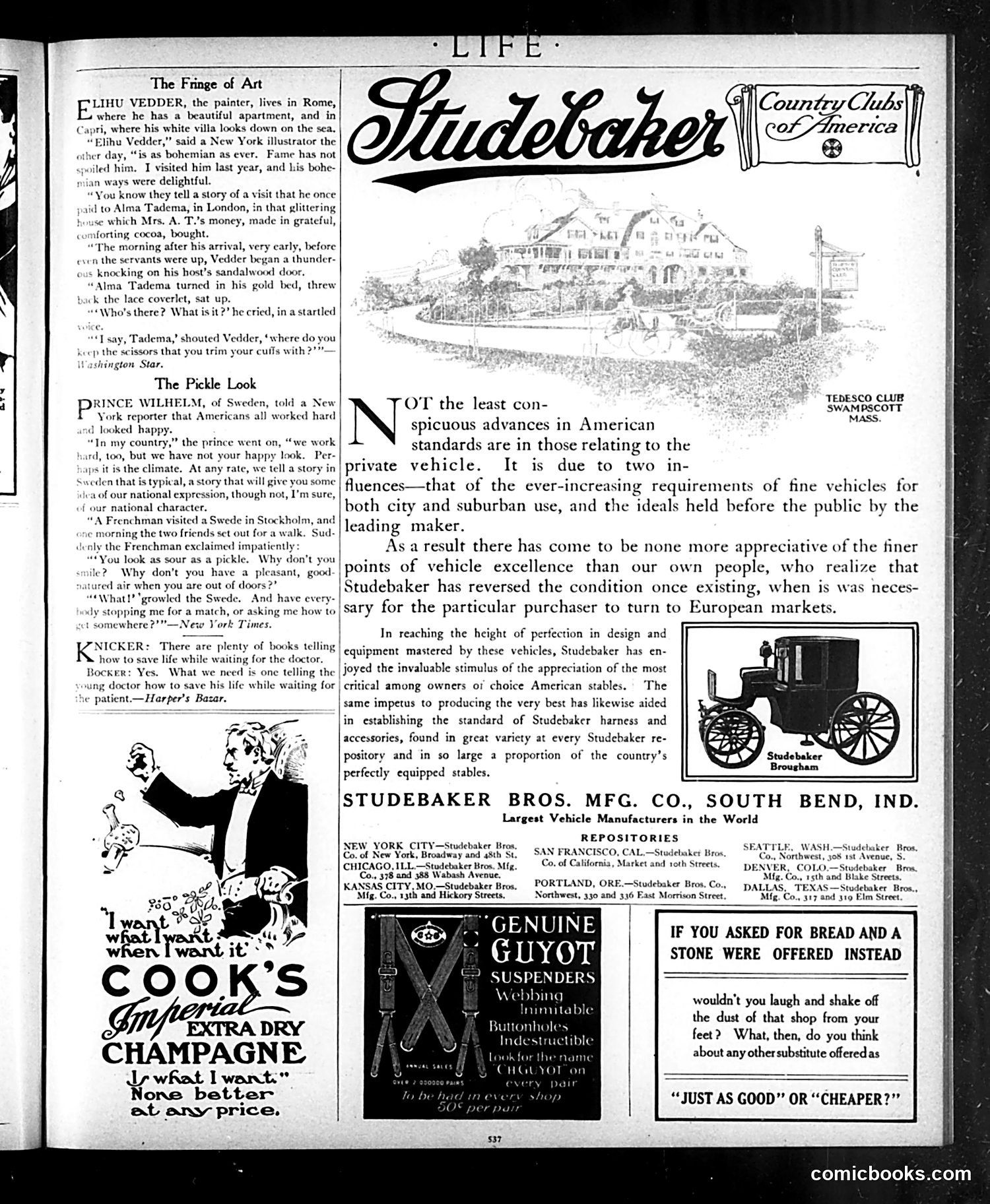
This page is primarily **advertising and light humor** rather than political satire. The main content includes: 1. **"The Fringe of Art"** and **"The Pickle Look"** — two brief anecdotal humor columns featuring socialites and European nobility (Elibu Vedder, Prince Wilhelm of Sweden) in comedic situations. These mock bohemian artists and aristocratic pretension. 2. **Cook's Imperial Extra Dry Champagne ad** — a cartoon showing a man declaring he wants "what I want when I want it" at "none better at any price," satirizing consumer desire and brand loyalty. 3. **Studebaker automobile advertisement** — the dominant ad, praising American vehicles as superior to European standards. 4. Small ads for Guyot Suspenders and a bread/stone substitute comparison (questioning inferior substitutes). The page reflects early 20th-century consumer culture and light social comedy rather than serious political commentary.
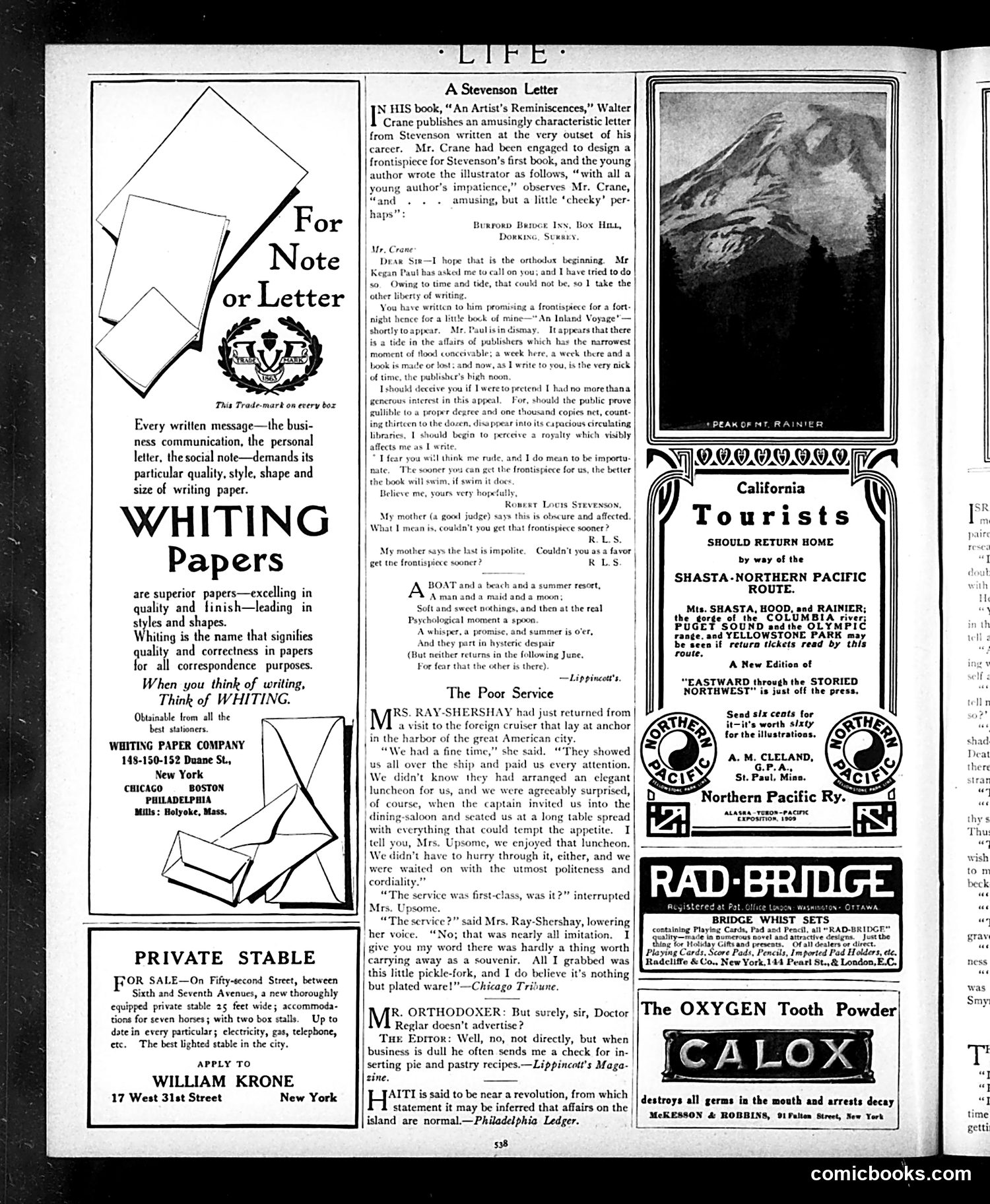
This page is primarily **advertisements and letters to the editor**, not political cartoons. The main content includes: **"A Stevenson Letter"**: A humorous excerpt from Walter Crane's book reproducing a letter from young Robert Louis Stevenson (author of *Treasure Island*) to his illustrator. Stevenson writes impatiently requesting the frontispiece artwork, joking about his mother's criticism of his rudeness—a self-aware, cheeky tone that illustrates his youthful impatience. The satire is gentle autobiography, not political. **"The Poor Service"**: A short satirical anecdote about a woman visiting a Navy ship. The joke's punchline (partly obscured) appears to mock the inadequate quality of the "elegant" luncheon provided—the irony being that despite the Navy's efforts to impress, the food was so poor she could only steal a "plated ware" souvenir. **Other content**: Various period advertisements (Whiting Papers, private stable for sale, tourist routes) and brief editorial Q&As. The page reflects *Life*'s mix of literary humor and commercial advertisements rather than political satire.
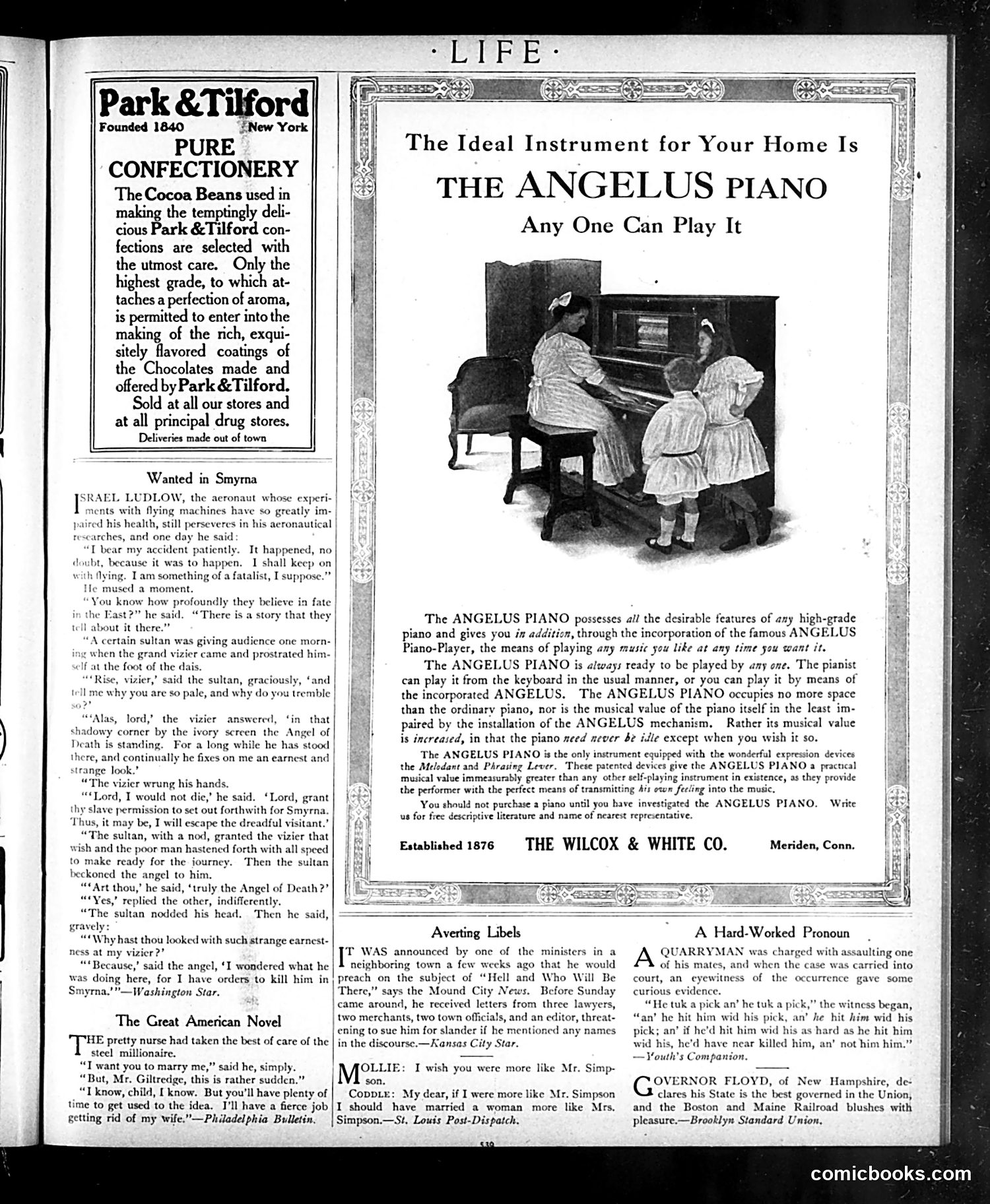
This page is primarily **advertising**, not political satire. It contains three commercial advertisements and three unrelated humorous anecdotes. The main content includes: - A **Park & Tilford chocolate advertisement** (left) - An **Angelus Piano advertisement** (center/right), featuring an illustration of a woman and child at a self-playing piano - Three brief joke pieces: "Wanted in Smyrna" (a Middle Eastern fable about fate), "The Great American Novel" (satirizing wealthy industrialists), and "A Hard-Worked Pronoun" (wordplay humor) The Angelus Piano ad emphasizes that anyone can play music through the piano's mechanical player mechanism—appealing to middle-class homeowners without musical training. The anecdotes mock social pretension and linguistic confusion rather than political figures or events. This represents typical early 20th-century *Life* magazine content: advertising mixed with light satirical humor aimed at educated, urban readers.
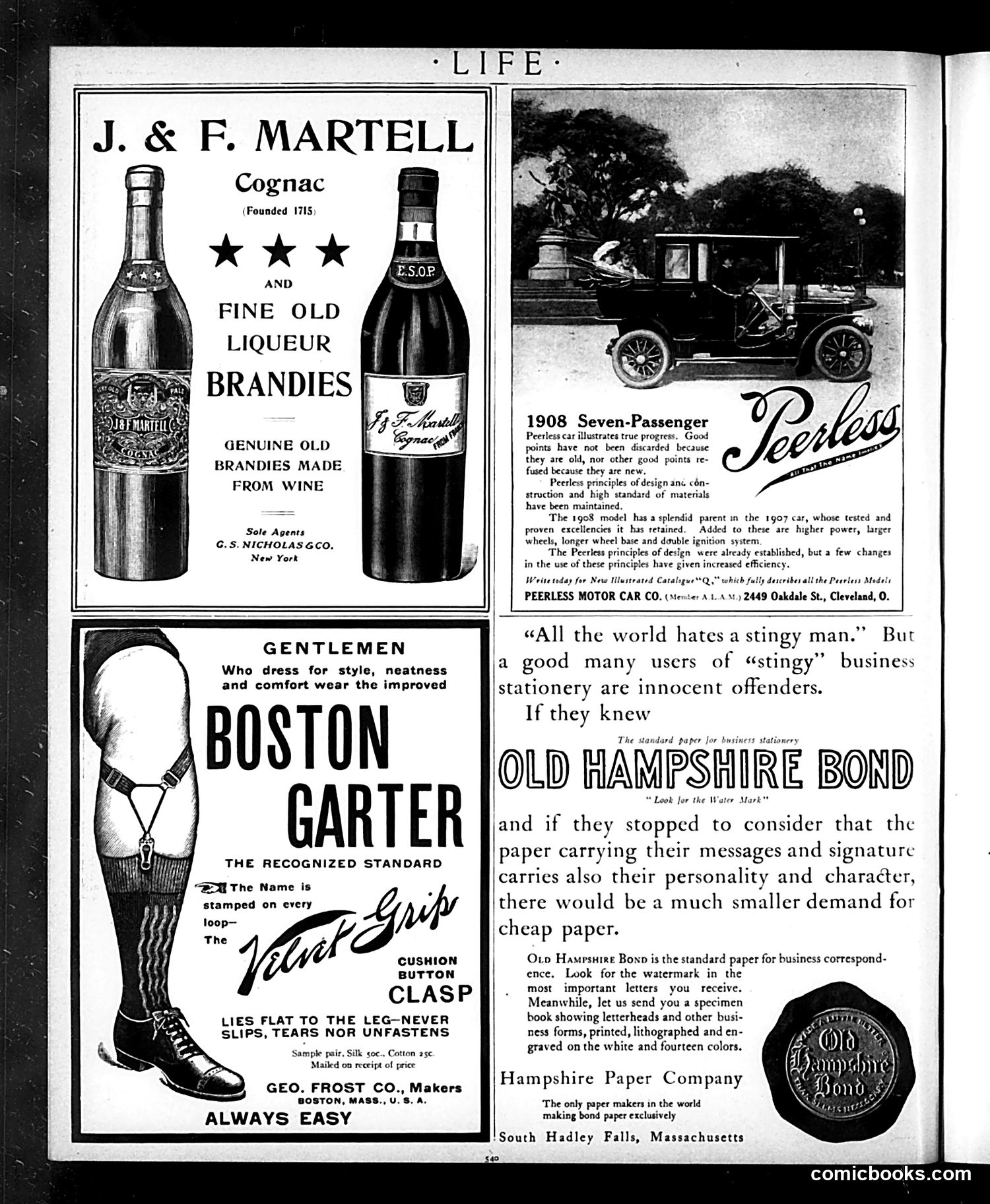
This is primarily an **advertising page** from an early 1900s Life magazine, containing no political cartoons or satire requiring historical context. The advertisements showcase products marketed to affluent gentlemen: - **J. & F. Martell Cognac** — luxury French brandy established 1715 - **Peerless automobiles** — a 1908 seven-passenger car emphasizing improved engineering while retaining proven features - **Boston Garter** — men's hosiery with a cushioned button clasp that "never slips, tears nor unfastens" - **Old Hampshire Bond paper** — business stationery with an accompanying moral lecture: using cheap paper reflects poorly on one's character and personality The only editorial content is a brief **moralizing message** about stationery: the page criticizes businessmen who use inexpensive paper, arguing that quality materials reflect personal integrity. This reflects early 20th-century class anxieties about appearance and social standing. The page illustrates Life's role as both satirical magazine and upscale advertising vehicle for wealthy readers.
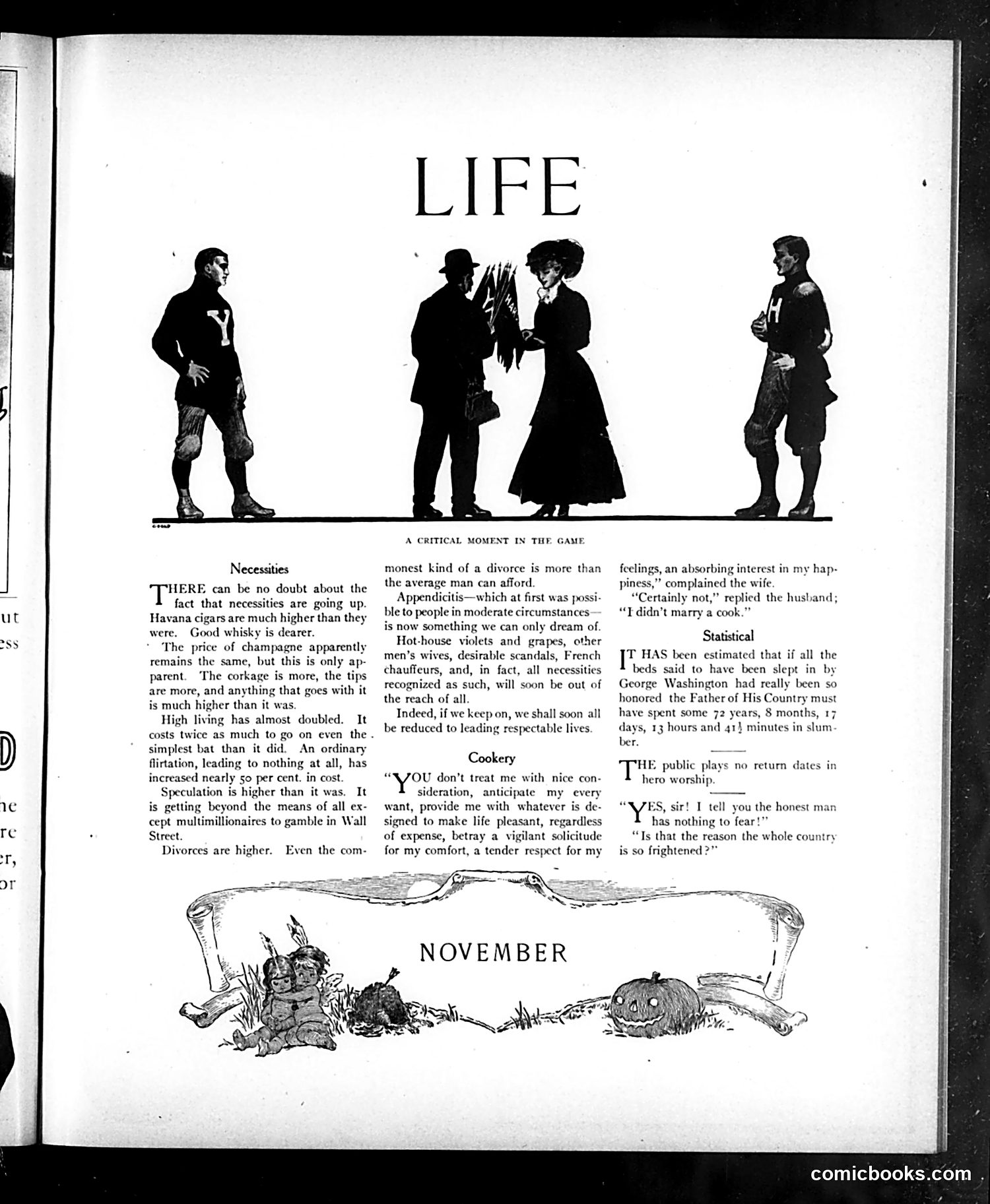
This page from *Life* magazine satirizes early 20th-century American anxieties about rising costs and social change. **"Necessities"** mocks wealthy concerns disguised as hardships: Havana cigars, champagne, and Wall Street speculation are presented as "necessities" now beyond reach. The satire cuts deeper—divorce costs, appendicitis treatments, and "other men's wives" are listed alongside luxuries, conflating moral and economic decline. The punchline warns that continued inflation will force society into "respectable lives," implying that respectability is itself an undesirable luxury. **"Cookery"** jokes about marital tension: a wife demands her husband treat her with constant consideration and expense; he refuses, claiming he "didn't marry a cook"—suggesting she married him for maintenance, not romance. **"Statistical"** ridicules the apocryphal Washington-slept-here tourism phenomenon, calculating the implausible total sleep hours required. The silhouette illustration labeled "A Critical Moment in the Game" depicts a social negotiation among four figures, likely representing the tension between appearance and reality in courtship or business dealings that the text explores throughout.
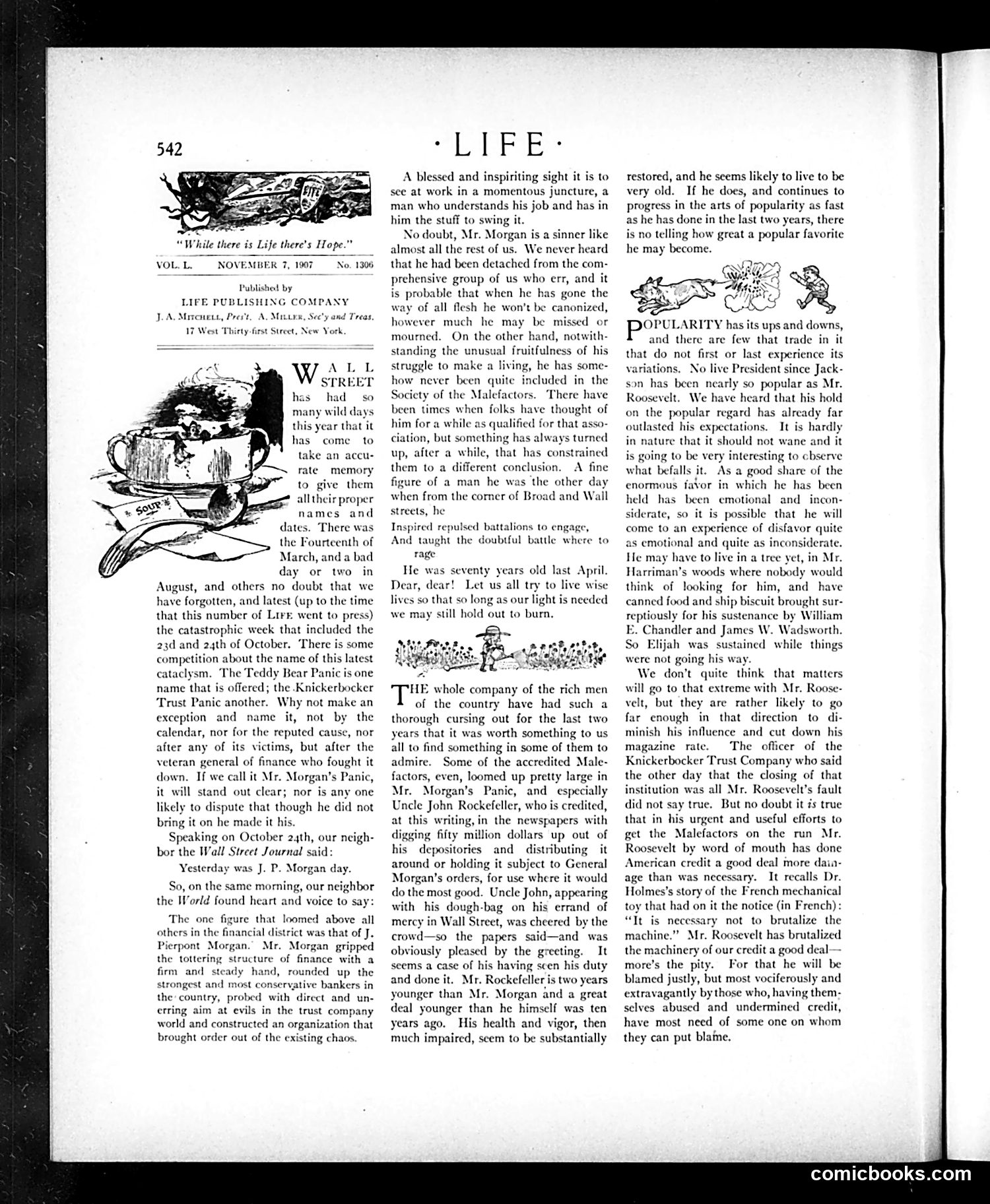
This page celebrates **J.P. Morgan's role in controlling the financial panic of October 1907**. The cartoon shows Morgan as a forceful figure commanding Wall Street during the crisis. **The Context:** The text describes the recent stock market collapse (October 23-24, 1907), proposing it be called "Mr. Morgan's Panic" because Morgan, not the initial cause, dominated the response. He mobilized conservative bankers and "brought order out of the existing chaos." **The Satire:** Life's tone is genuinely admiring yet tongue-in-cheek. While acknowledging Morgan is "a sinner like almost all the rest of us" and joking about his eventual canonization, the magazine praises his competence and steadiness. The piece notes even despised tycoons like Rockefeller gained public approval by contributing to Morgan's stabilization effort. **The Point:** During economic crisis, even America's most-criticized robber barons became heroes through decisive action. Morgan's financial authority was so absolute that he single-handedly restored confidence—a remarkable concentration of power the magazine presents with both admiration and irony.
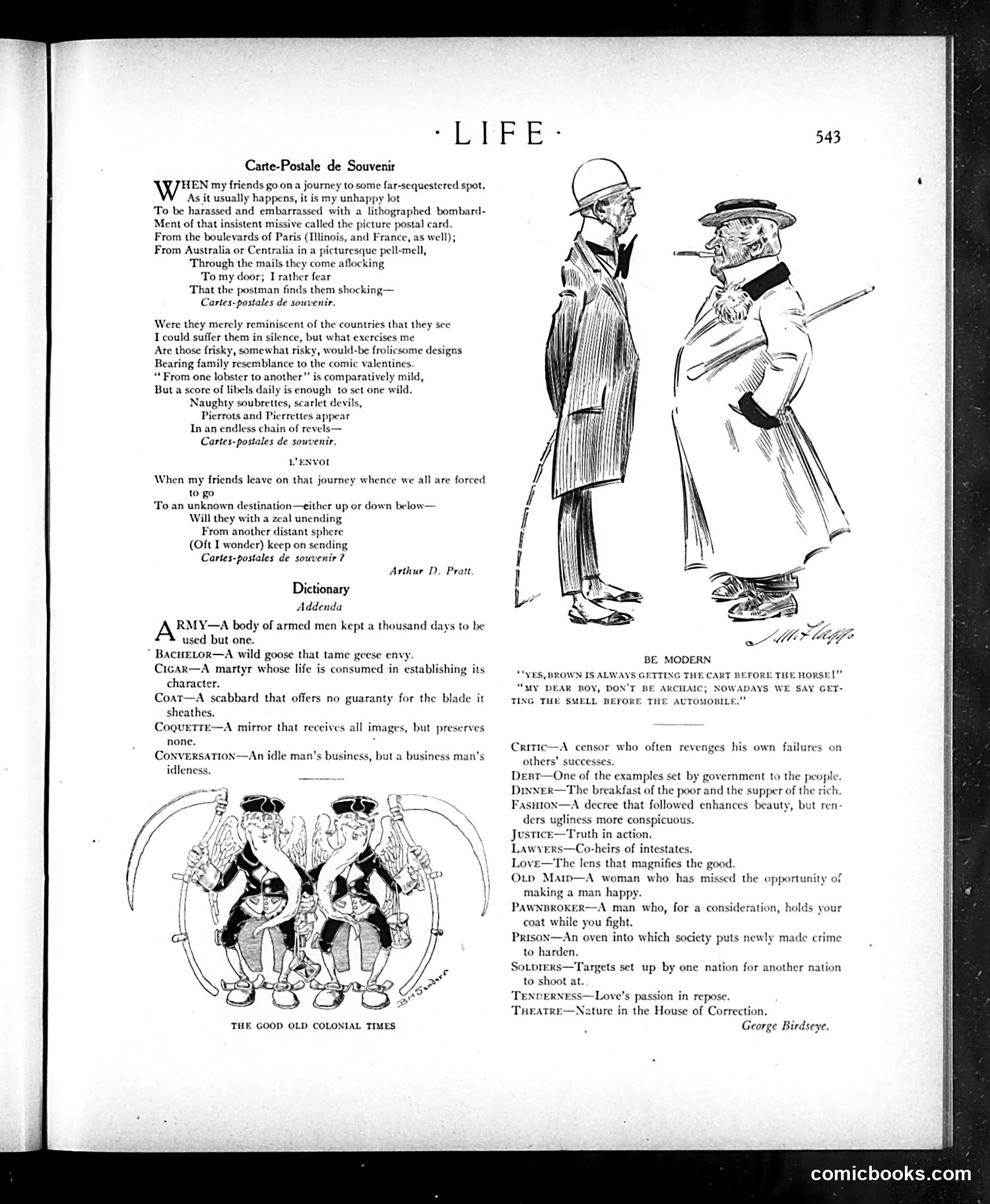
This page satirizes the Victorian-era nuisance of picture postcards. The poem by Arthur D. Pratt complains that friends traveling abroad bombard him with postcards—especially risqué French ones featuring "naughty soubrettes, scarlet devils, Pierrots and Pierrettes" in scandalous poses. The humor targets both the annoying habit of postcard-sending and the mildly salacious continental designs that embarrass the recipient. The cartoon "Be Modern" jokes about changing language and attitudes: two men discuss someone "getting the cart before the horse," but one corrects him that the modern phrasing is "getting the smell before the automobile"—a dated reference to early automobiles being unreliable and smelly compared to horses. Below is a dictionary of humorous definitions mocking social types and institutions (armies, bachelors, critics, lawyers, prisons), typical of Life's satirical style. The colonial-era illustration contrasts old-fashioned propriety with modern irreverence.
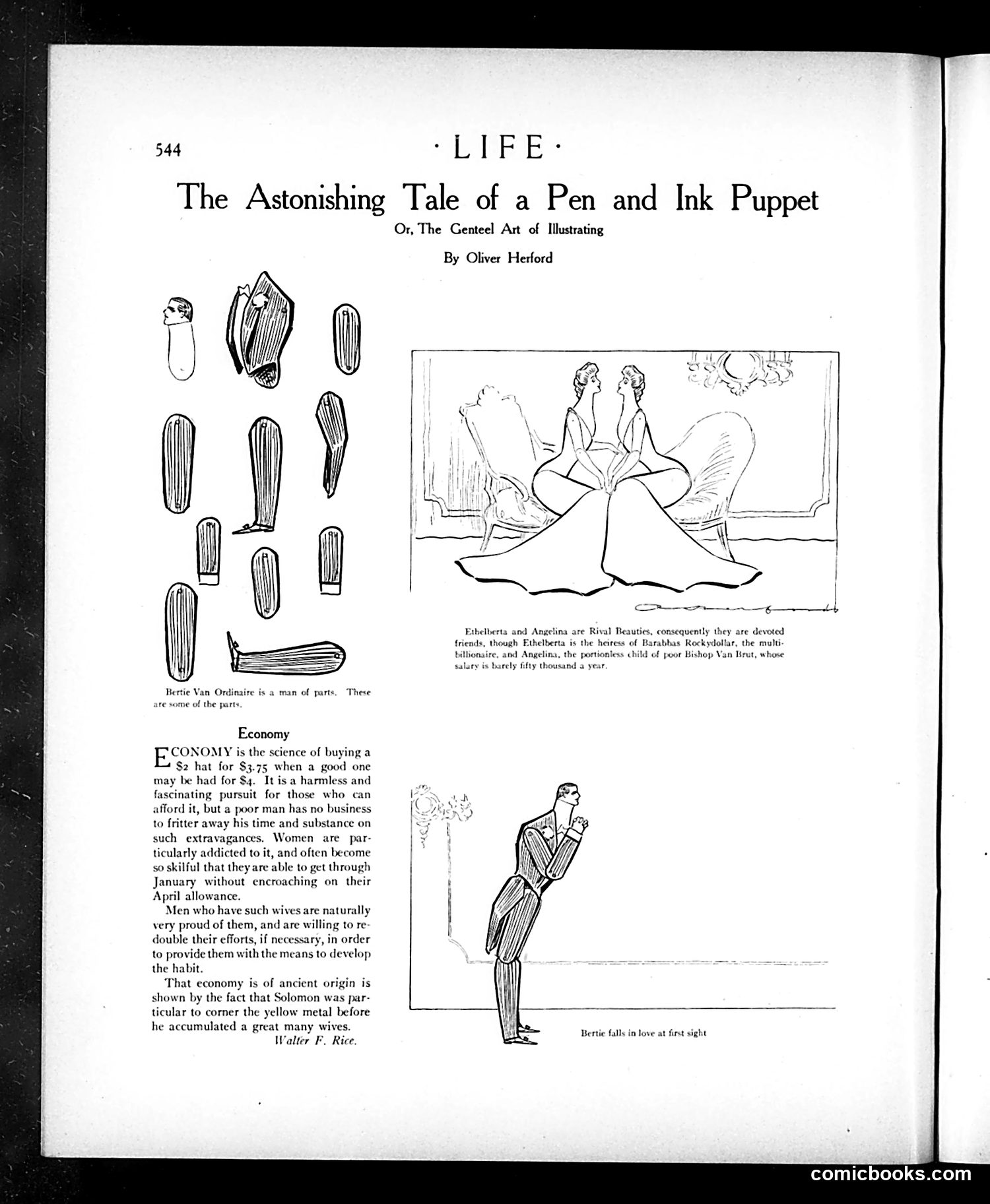
This is a satirical illustrated story by Oliver Herford about courtship and economics. The narrative follows Bertie Van Ordinaire (a "man of parts"—a visual pun showing him literally disassembled as pen-and-ink components) who falls instantly in love with one of two rival beauties: the wealthy Ethelberta or poor Angelina, daughter of Bishop Van Brut. The accompanying essay on "Economy" satirizes women's obsessive shopping habits, suggesting they're skilled at stretching allowances across months. It humorously traces this vice to biblical times, claiming Solomon accumulated gold before marrying many wives—implying women's extravagance is ancient and inevitable. The joke mocks both female spending and the men who indulge it, presenting economics as a "fascinating pursuit" for the wealthy but irresponsible for the poor. The artwork demonstrates Herford's illustrative technique through deliberate artificiality.
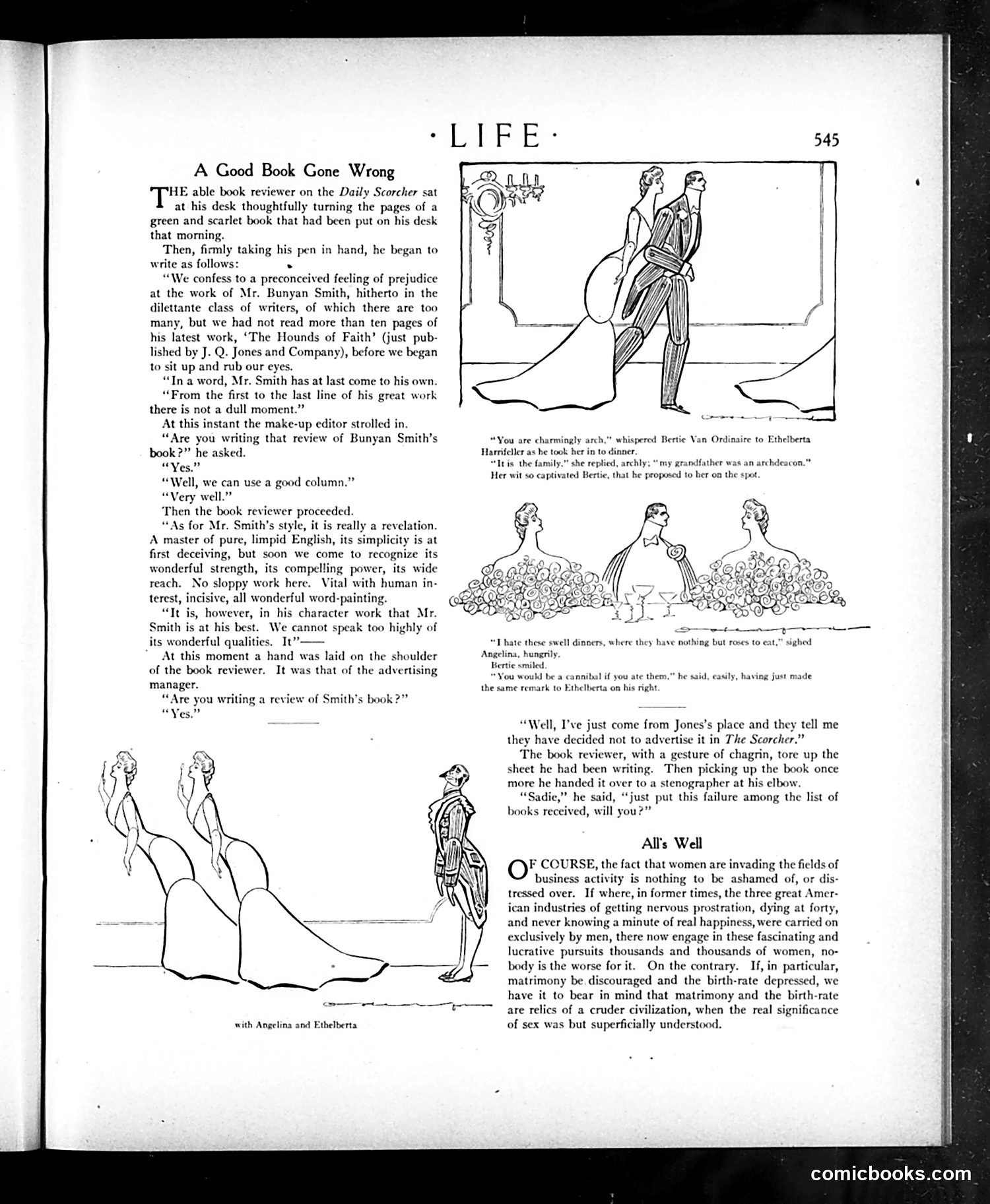
This cartoon satirizes the compromised nature of book reviewing. A reviewer enthusiastically praises a mediocre novel by Bunyan Smith, calling it a masterpiece with "wonderful strength" and "compelling power." However, the moment an advertising manager informs him that the book's publisher won't advertise in *The Scorcher* (the fictional newspaper), the reviewer immediately tears up his review and dismisses the same book as a "failure." The satire targets **pay-to-play book reviewing**—the implication that positive reviews depend on advertising revenue rather than literary merit. The joke exposes how commercial interests corrupt critical judgment: the book's quality hasn't changed, only its advertising budget. The three subsidiary cartoons about "Angelina and Ethelberta" appear unrelated social humor. The piece criticizes the publishing industry's mercenary practices and the lack of editorial independence in early 20th-century American journalism.
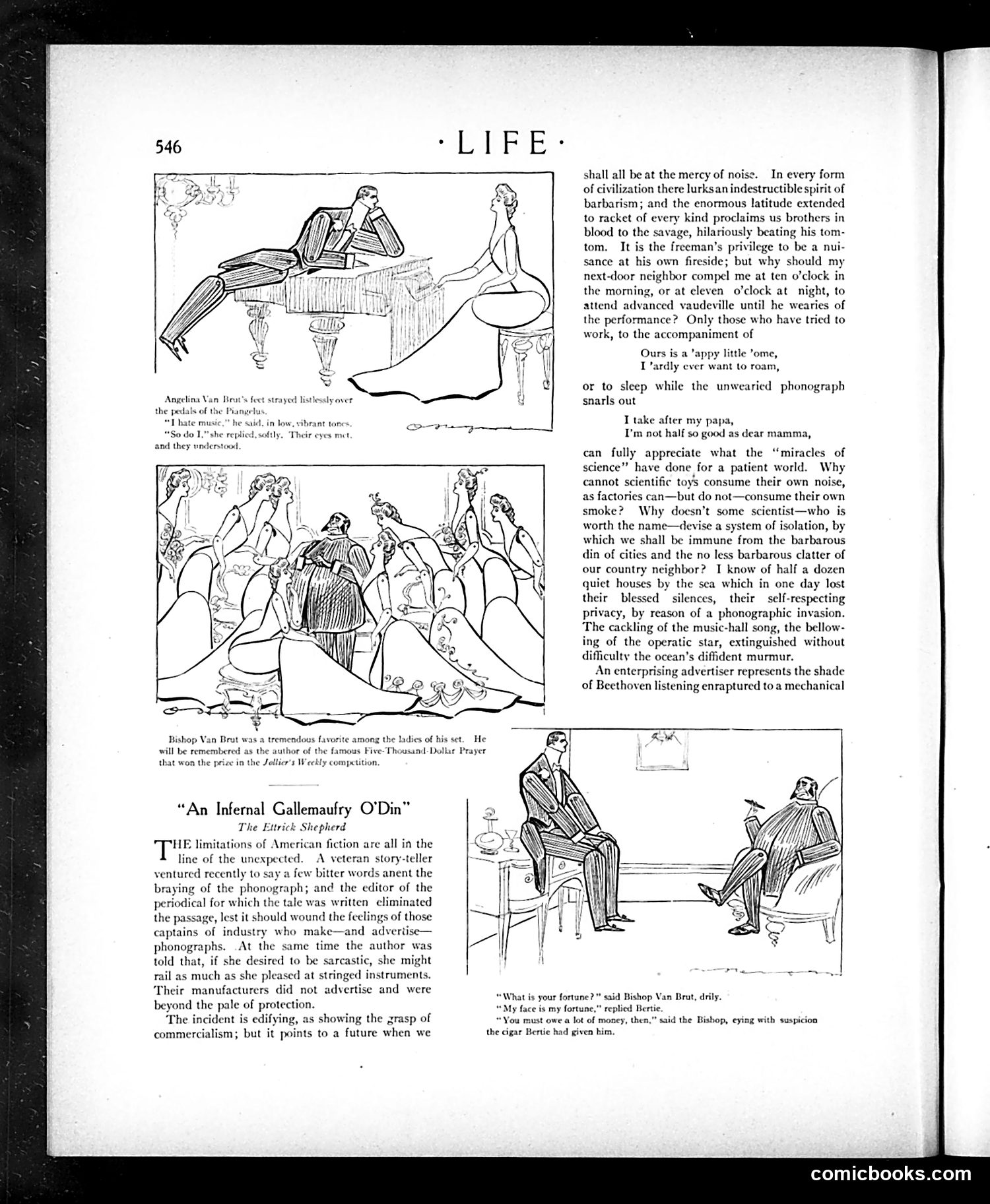
This page critiques two interconnected problems in early 20th-century America: the invasion of mechanical noise (particularly phonographs) into private life, and the censorship of social criticism by commercial interests. The top cartoons illustrate the author's complaint: phonographs and pianos invade homes and public spaces, forcing unwilling audiences to endure noise. The text sarcastically contrasts America's "freedom" with how neighbors can compel attendance at "advanced vaudeville" through phonographic noise. The lower section explains editorial censorship: a story criticizing phonographs was rejected because phonograph manufacturers advertise in the magazine, while criticism of stringed instruments was permitted since their makers don't advertise. The author identifies this as the "grasp of commercialism"—advertisers dictate editorial content. The final cartoon featuring "Bishop Van Brut" appears to illustrate this hypocrisy, though the specific reference is unclear from the visible text. The satire targets how commercial interests suppress legitimate social critique.
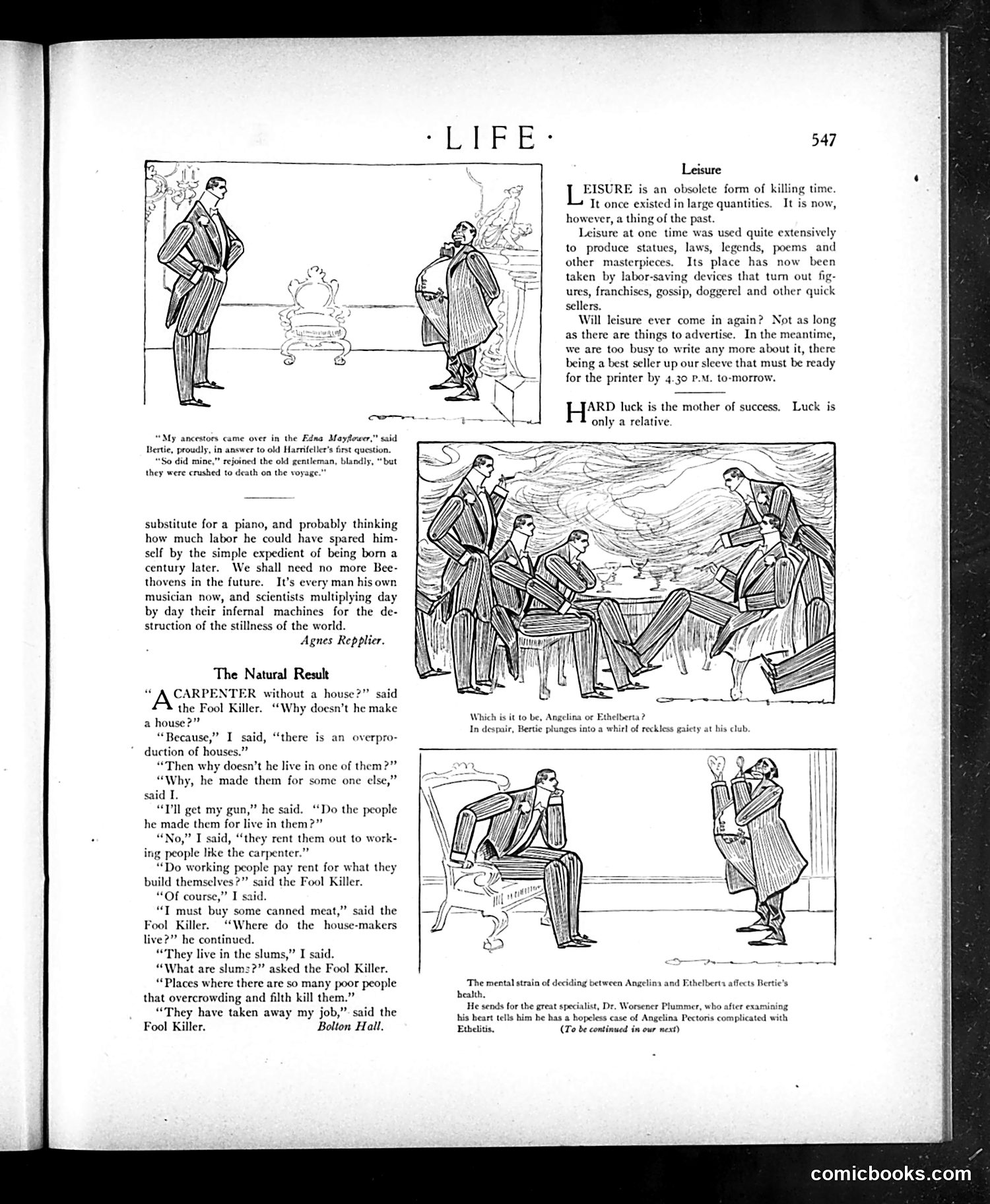
This page contains satirical commentary and comic narratives typical of early-20th-century *Life* magazine. **"Leisure" Essay**: A brief satirical piece lamenting that leisure—once used to create great art and literature—is now obsolete. The irony is that the magazine is too busy advertising products to properly discuss the topic, highlighting modern commercial culture's displacement of contemplative pursuits. **"The Natural Result"**: A dialogue between an unnamed narrator and "the Fool Killer" (a recurring *Life* character representing common sense) exposing economic contradictions: a carpenter who builds houses cannot afford to live in them, instead renting from speculators. Workers pay rent for structures they themselves built—an absurdist critique of economic inequality and the housing market's illogic. **"Which is it to be, Angelica or Ethelberta?"**: A humorous romantic serial depicting a gentleman (Bertie) caught between two women, suffering "Angelina Pectoris complicated with Ethelitis"—a pun on the heart condition "angina pectoris." The illustrations show his social dilemma and distress at his club. The page exemplifies *Life*'s blend of social critique and light comedy.
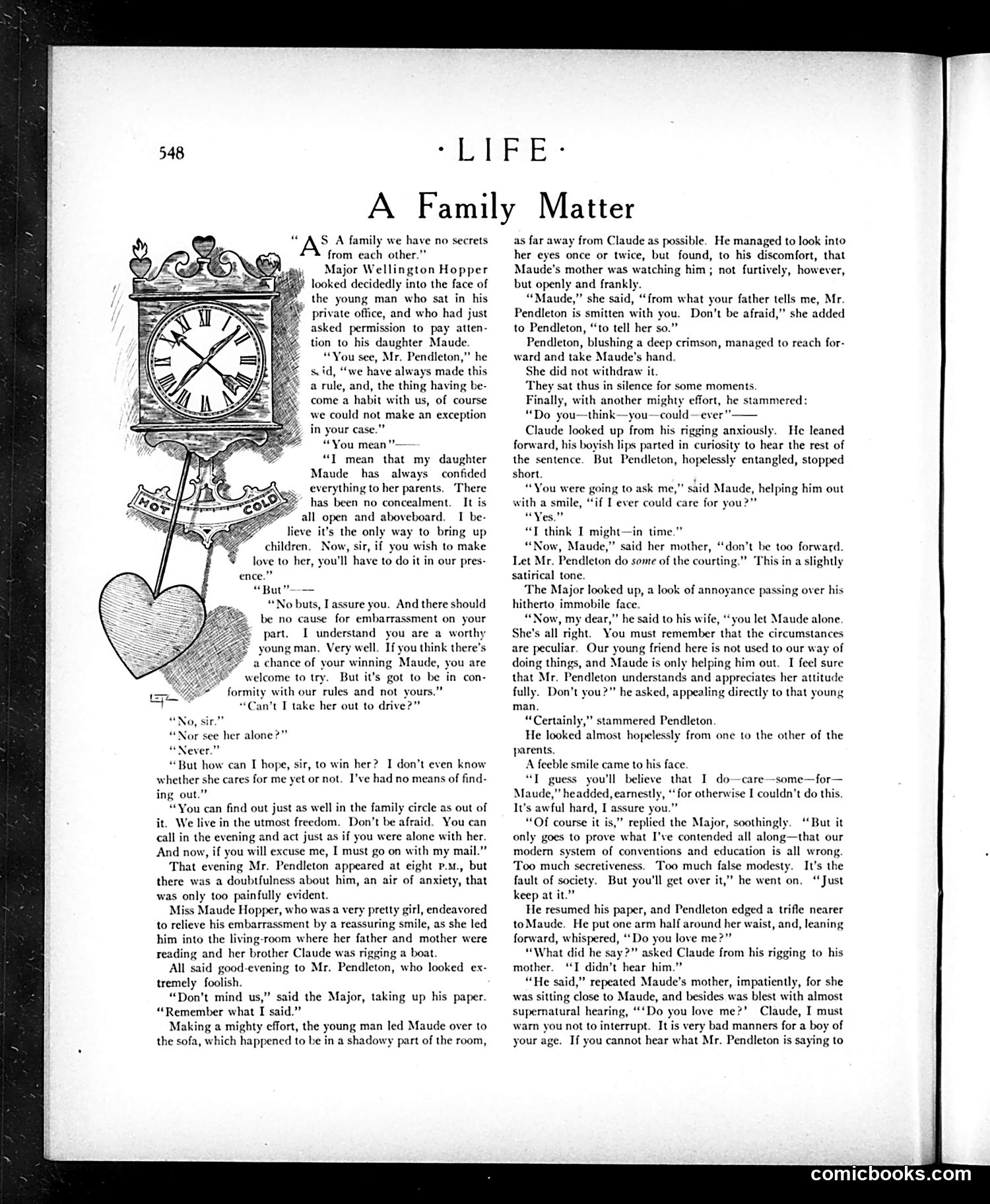
This satirical story mocks the Victorian ideal of complete family transparency and parental control over courtship. Major Hopper insists that suitor Mr. Pendleton must court his daughter Maude *only in the family's presence*, never alone—claiming this represents "utmost freedom" and openness. The humor lies in the contradiction: the family's constant surveillance under the guise of honesty actually prevents genuine courtship. Pendleton cannot speak privately to Maude, her mother openly watches him, and her brother eavesdrops—yet the parents frame this intrusive monitoring as progressive child-rearing. The satire targets late 19th/early 20th-century middle-class pretensions about "modern" parenting that paradoxically enforced stricter control than traditional courtship customs. The decorative clock illustration underscores time's importance—Pendleton literally cannot steal a moment alone.
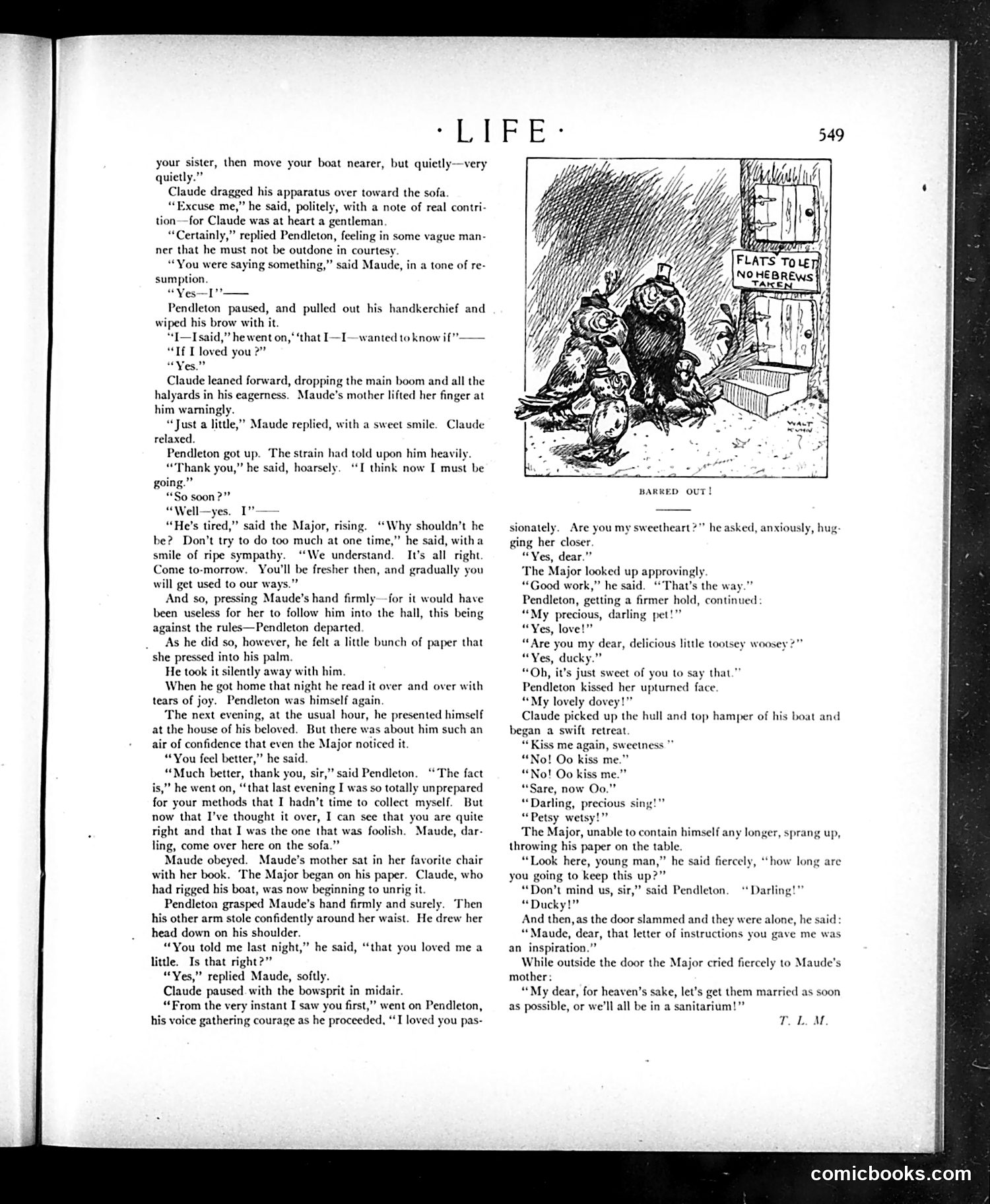
This illustrated story satirizes Victorian courtship customs and parental supervision. The cartoon (titled "BARRED OUT!") shows a suitor attempting to court a young woman while her family enforces strict chaperone rules in the parlor. The humor centers on the **absurdity of rigid social propriety**: Pendleton must navigate elaborate rules of etiquette—he cannot even escort Maude to the hall without breaking protocol. When he finally gains confidence and begins an intimate conversation, he becomes increasingly saccharine with baby-talk endearments ("tootsey woosey," "petsy wetsy"), which exasperates the Major (Maude's father) beyond tolerance. The satire mocks both the **oppressive formality of courtship customs** that force young couples into awkward performance and the **sentimental excess** that results when passion is finally unleashed. The Major's eventual exasperation suggests these rules, while meant to preserve decorum, actually produce ridiculous outcomes. The story appears to be serialized fiction, likely from the early 1900s, typical of Life magazine's blend of romance and social commentary.
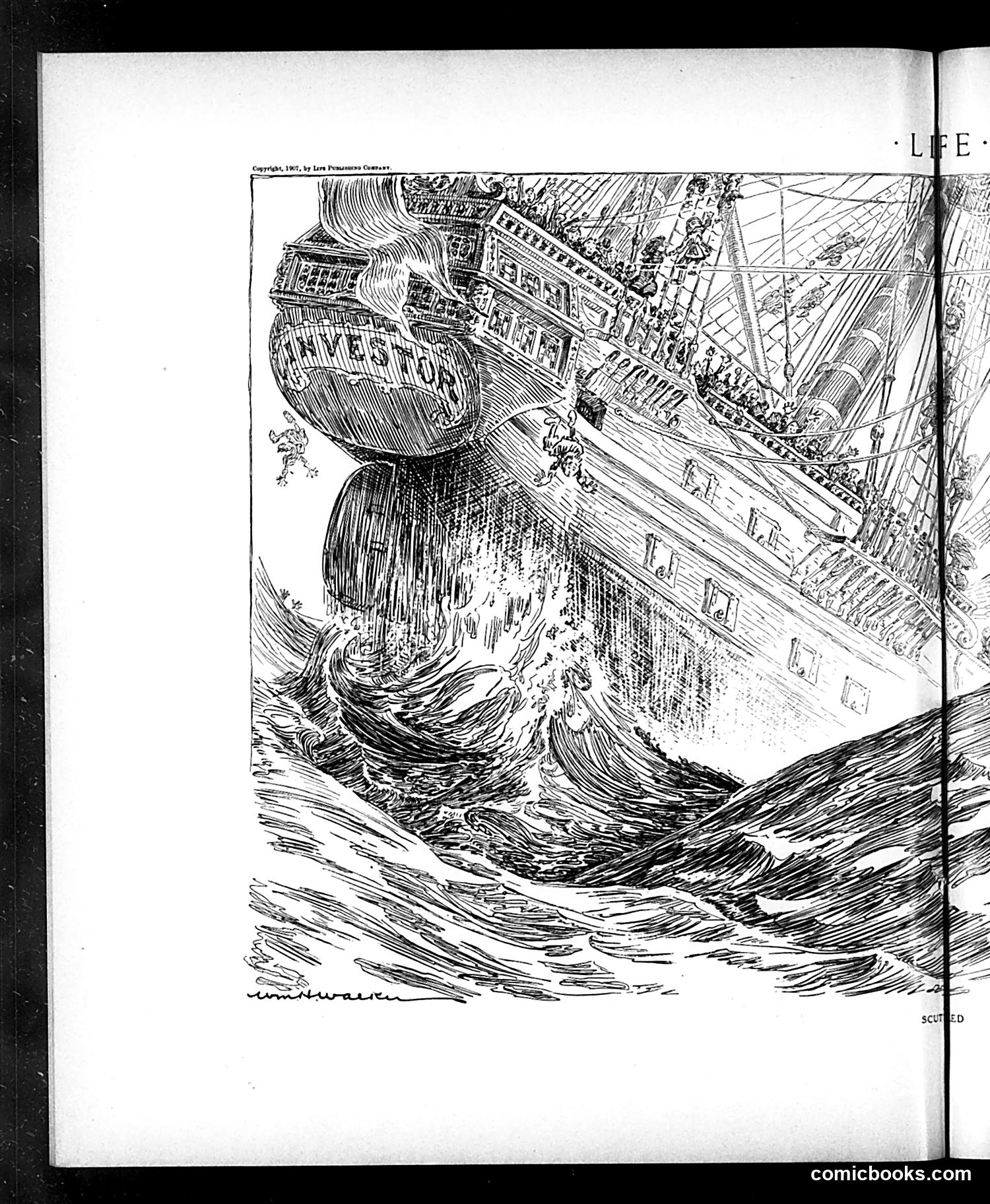
The OCR text is largely illegible, but the image itself is clear: this is a political cartoon showing a large ship labeled "HAMILTON" being swamped by enormous waves. The vessel appears to be in distress, tilting dangerously while crowds of people line the deck and rigging. The cartoon likely satirizes a contemporary maritime disaster or political crisis involving a ship or entity named Hamilton. Without readable text or visible date, I cannot definitively identify which specific event this references—it could relate to a notable shipwreck, naval incident, or use "Hamilton" metaphorically for a political situation or institution under threat. The style and "LIFE" masthead indicate this is early 20th-century American satire, but the specific historical context remains unclear from this page alone.
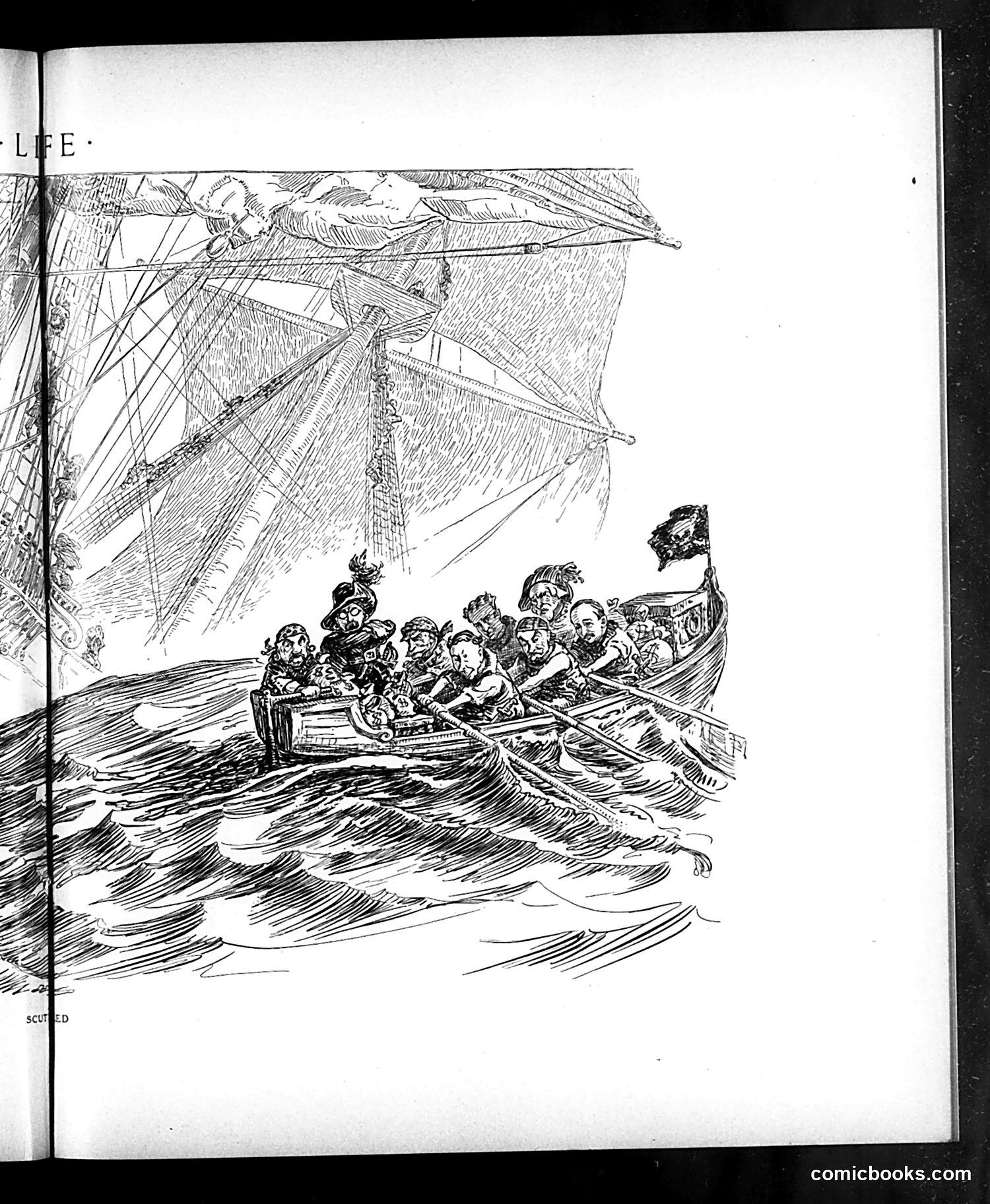
This page is titled "LIFE" and contains a single ink illustration showing a small rowboat with multiple figures rowing frantically away from a large sailing ship in rough seas. The boat flies a flag, and the occupants appear to be in distress or urgent flight. The OCR text appears corrupted and provides no readable content to interpret the specific political or social commentary. **Without legible accompanying text, I cannot reliably identify the specific figures, historical event, or satirical point this cartoon references.** The image suggests escape or fleeing from authority (the larger ship), but determining whether this references a specific 19th or early 20th-century political crisis, scandal, or social issue would require the original caption or article text, which isn't clearly readable here.
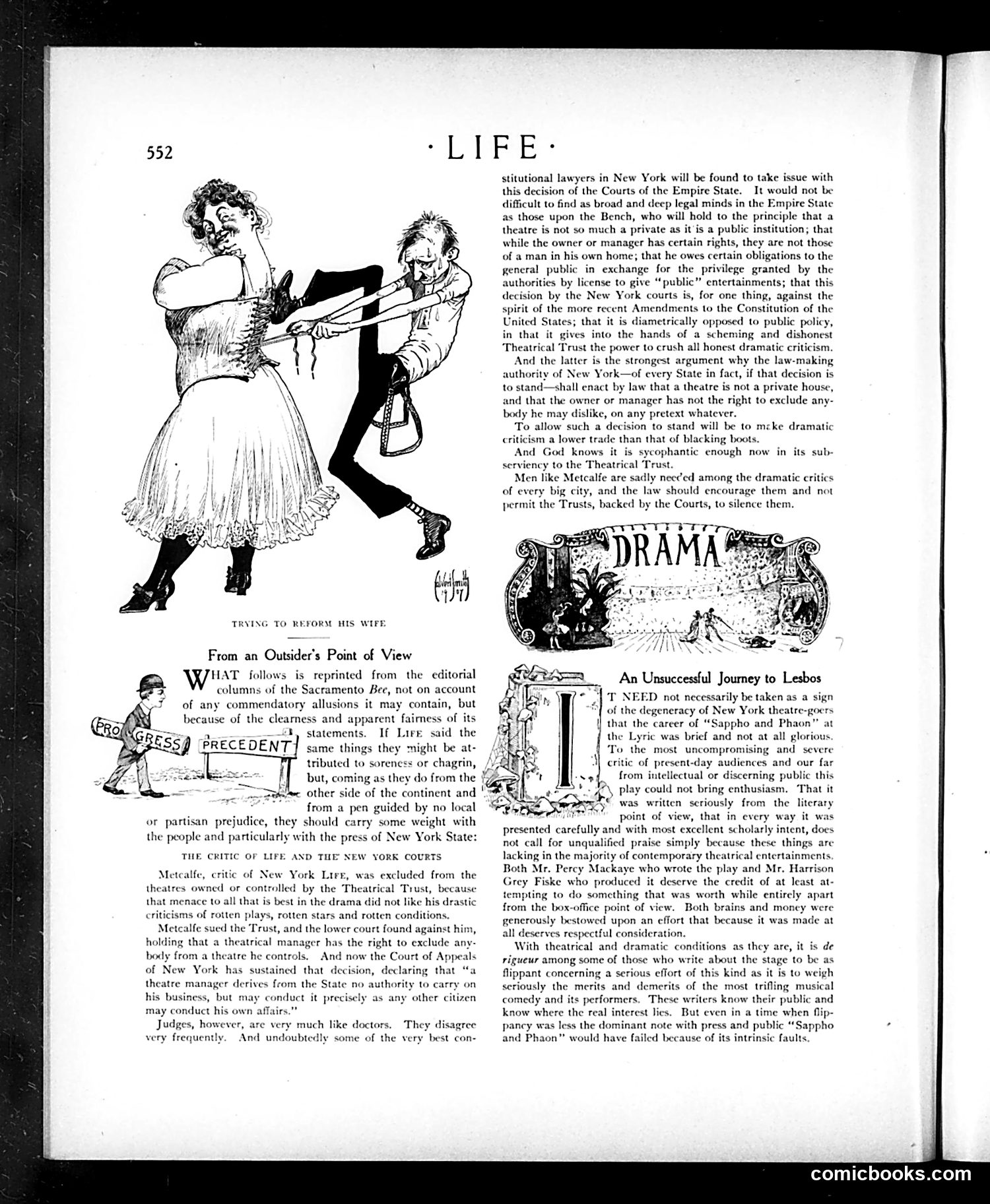
This page discusses a lawsuit by **Metcalfe, a theater critic for Life magazine**, against the **Theatrical Trust**—a powerful monopoly controlling major New York theaters. The Trust excluded Metcalfe because he published "drastic criticisms" of their productions. **The cartoon** (top left, captioned "Trying to Reform His Wife") illustrates the dispute through domestic satire: a man attempts to "reform" a resistant woman, paralleling efforts to control or silence the Theatrical Trust's practices. **The legal issue**: New York's Court of Appeals ruled theater managers could exclude anyone they disliked, treating theaters as private property. The editorial (reprinted from Sacramento's newspaper for credibility) argues this decision is wrong—theaters should be treated as public institutions with obligations to the public, not private houses. The piece contends the ruling unconstitutionally empowers a "scheming and dishonest" monopoly to crush honest dramatic criticism, making theater criticism "a lower trade than blacking boots."
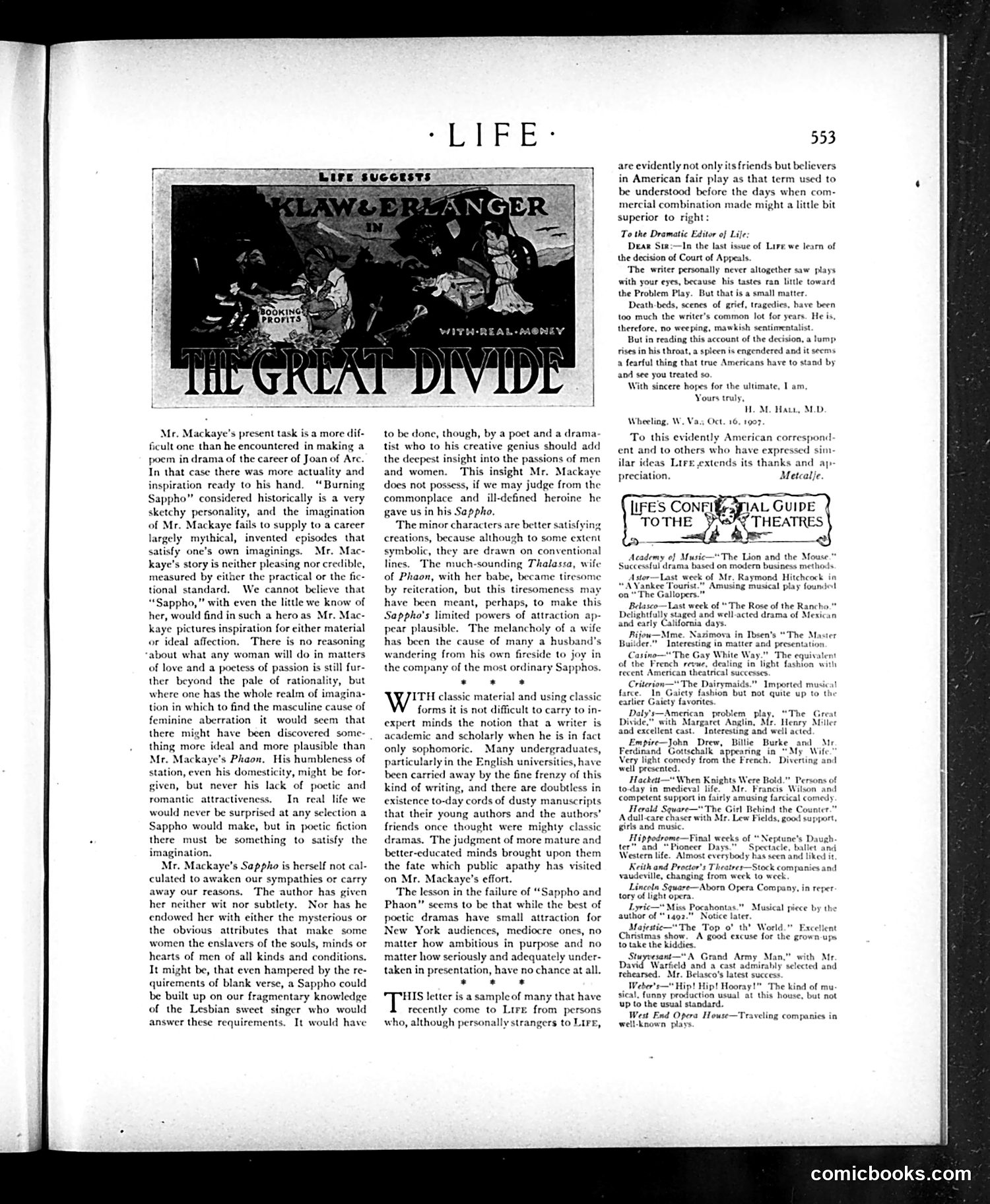
This page reviews a theatrical production of "Sappho and Phaon," a poetic drama by Percy Mackaye based on classical Greek subject matter. The cartoon at top advertises the play itself. The review is scathing. The critic argues that Mackaye's reimagining of the ancient poet Sappho fails because: (1) the male lead character Phaon lacks romantic appeal or poetic merit—he's merely a humble, domestic figure unconvincing as an object of passion; (2) Sappho herself is drawn without wit, subtlety, or the mysterious qualities that would justify her legendary status; and (3) using classical forms and material doesn't make mediocre work "scholarly"—it merely attracts unsophisticated audiences. The underlying point: ambitious but poorly executed "serious" drama cannot succeed with New York theatergoers, regardless of lofty subject matter.
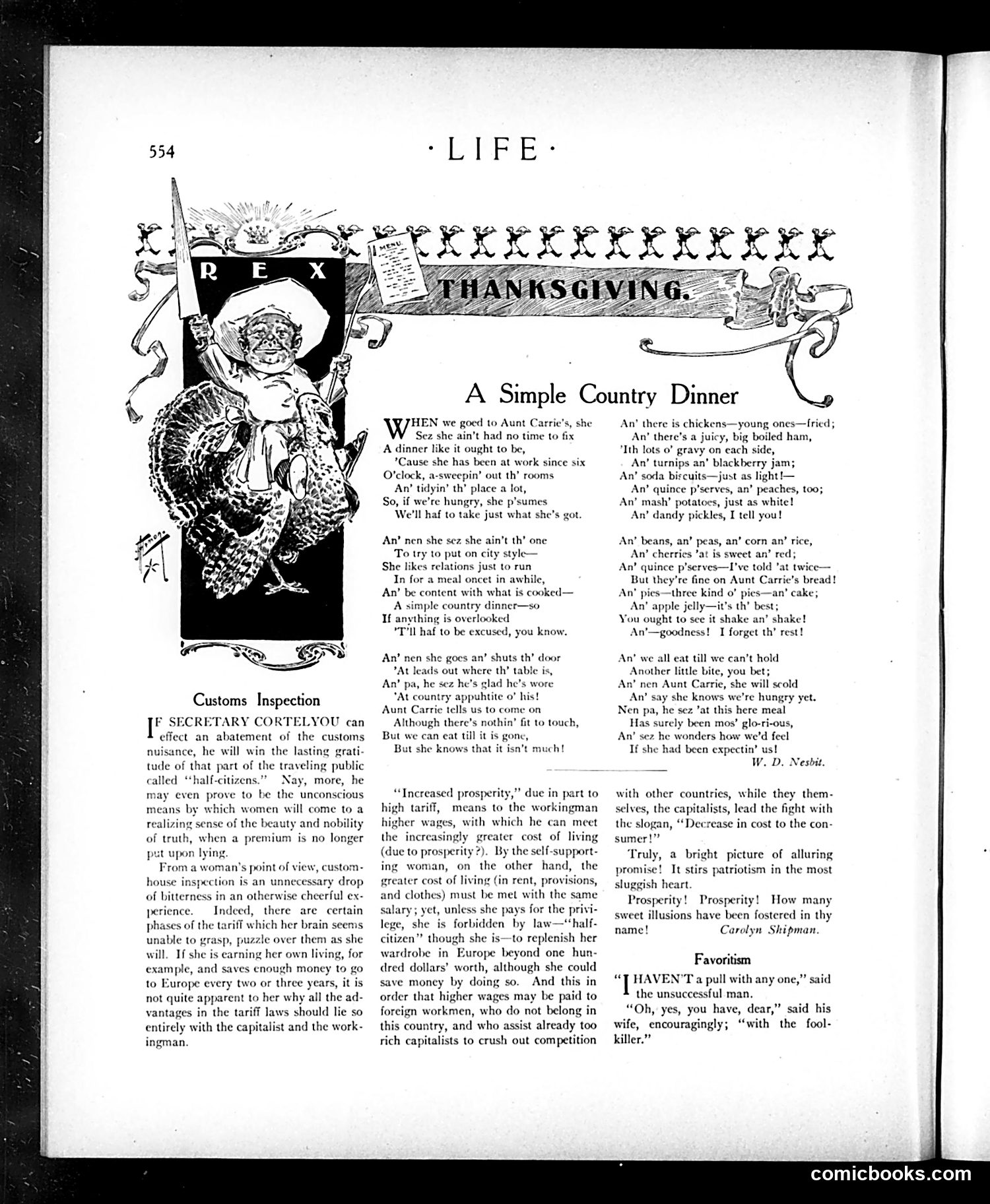
This page contains two distinct pieces of satire: **"Customs Inspection"** critiques Secretary of Commerce Cortelyou's tariff policy. It attacks the hypocrisy of protectionist tariffs claimed to benefit workers—which actually raise living costs for working women who cannot afford European goods. The piece sarcastically notes these "half-citizen" women (likely referencing women's limited legal status pre-suffrage) are forbidden by law from buying cheaper clothing abroad, while tariffs supposedly aid foreign workers more than American consumers. **"A Simple Country Dinner"** (a humorous poem by W.D. Nesbit) depicts a modest but abundant rural meal at "Aunt Carrie's"—a contrast to the preceding economic critique. The accompanying caricature shows a cheerful, generously-proportioned woman with a turkey, embodying idealized country hospitality and abundance. Together, these pieces explore tensions between rural/urban life, tariff policy's real effects on ordinary Americans, and women's economic vulnerability during this progressive-era period.
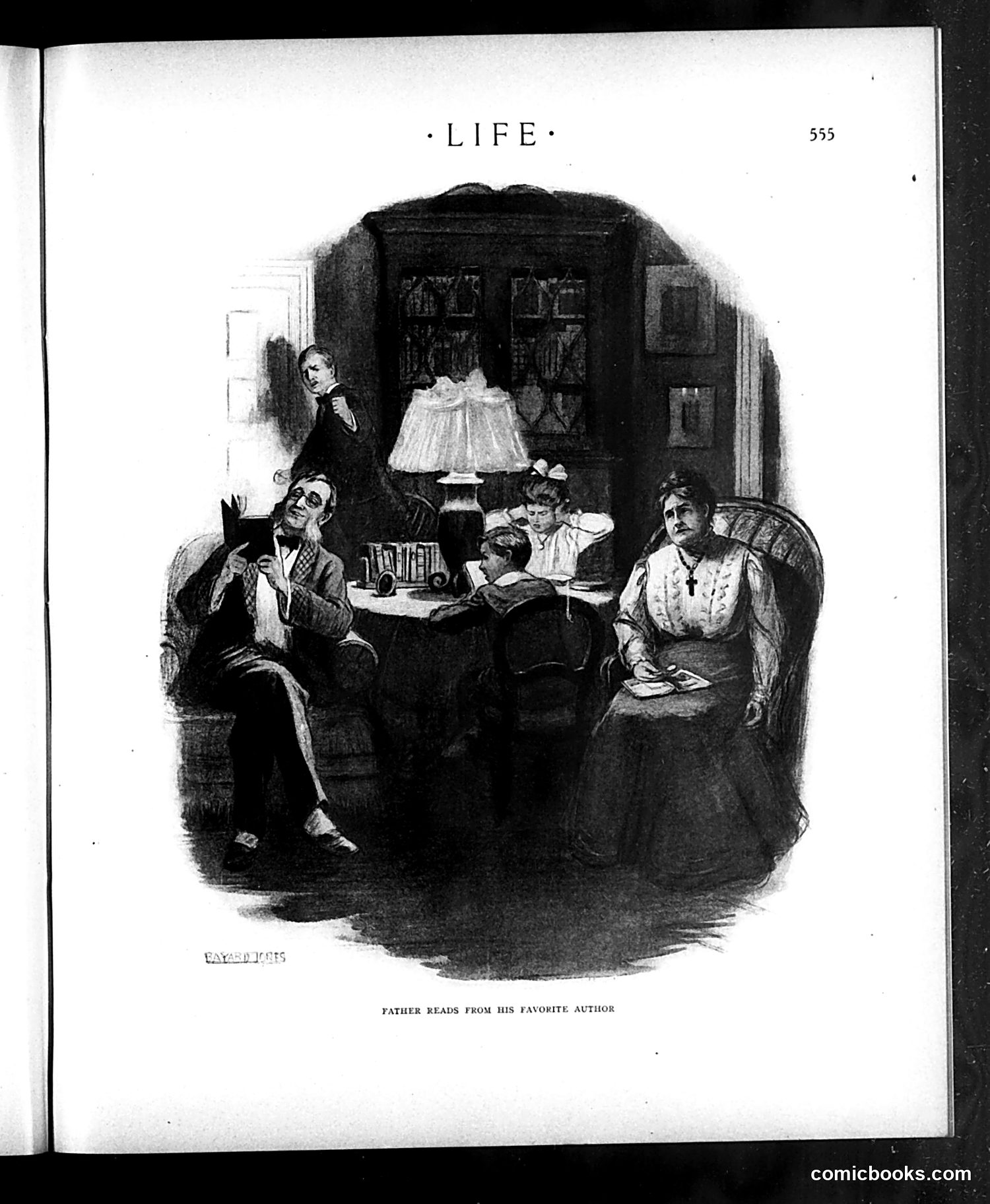
This satirical illustration depicts a domestic scene where a father sits reading aloud to his family gathered in a Victorian-era parlor. The caption suggests humor about paternal literary taste. The satire likely mocks either: - A father's choice of "favorite author" (the specific author is not identified in the visible text) - The gap between what fathers claim to enjoy reading versus what they actually prefer - Gender dynamics around domestic entertainment and intellectual pursuits The formal family gathering, with women in period dress attending to the father's reading, underscores potential commentary on domestic hierarchies or the pretense of cultural refinement in household life. Without identifying the specific author referenced, the precise satirical target remains unclear, though the scene itself parodies Victorian domestic propriety.
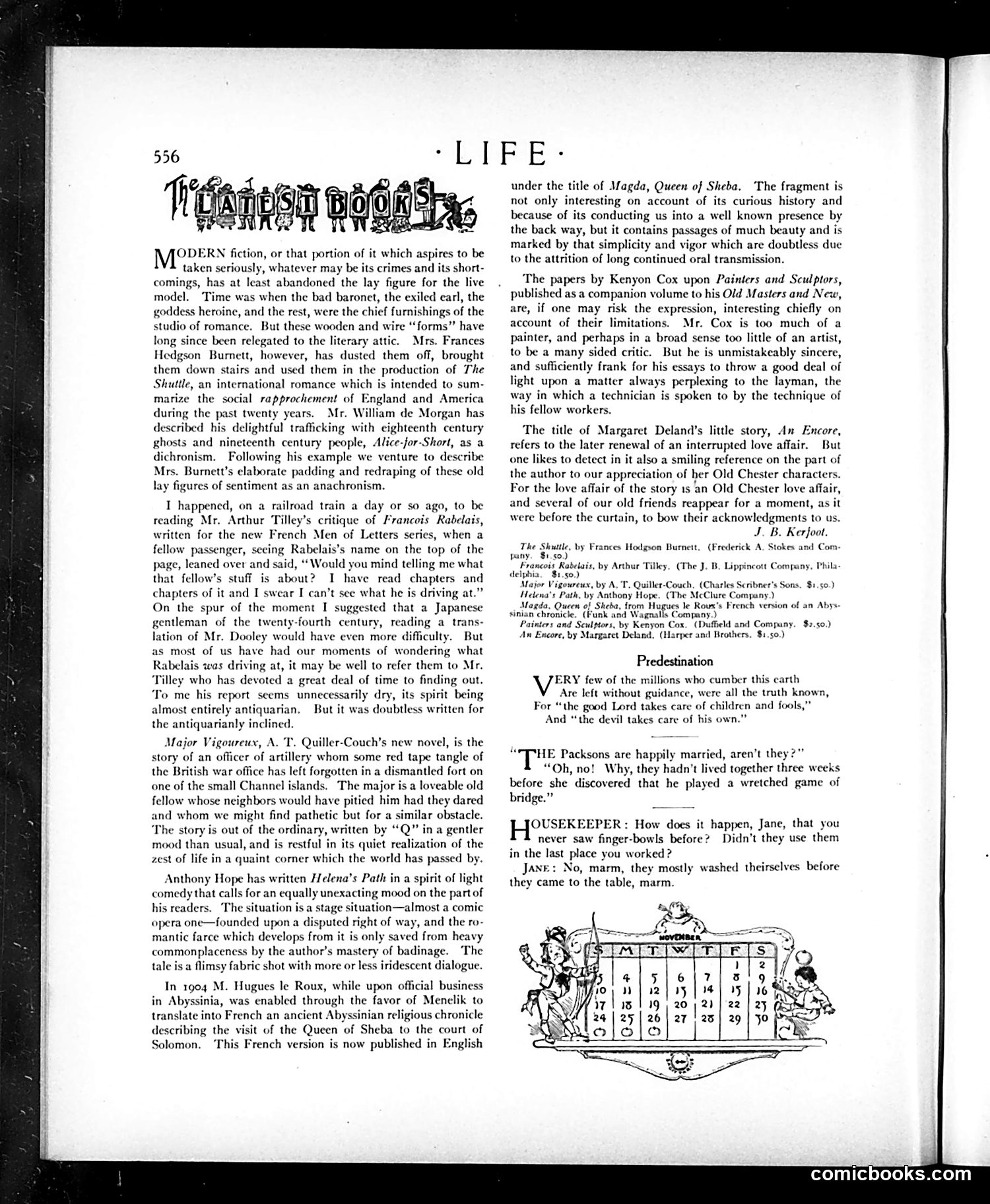
This page contains literary criticism rather than political satire. It reviews contemporary fiction from the early 1900s, discussing works by established authors like Frances Hodgson Burnett (*The Shuttle*), Arthur Quiller-Couch (*Major Vigoureux*), and Anthony Hope (*Helena's Path*). The critic argues that modern fiction has abandoned wooden "lay figures" (stock characters) for realistic portrayals. However, Burnett is criticized for reverting to this outdated practice in her novel about Anglo-American relations. At the bottom is a small decorative calendar illustration labeled "AUGUST," unrelated to the text. The page demonstrates Life magazine's dual function: while primarily known for political cartoons and satire, it also featured serious literary commentary aimed at educated readers interested in contemporary fiction and cultural criticism.
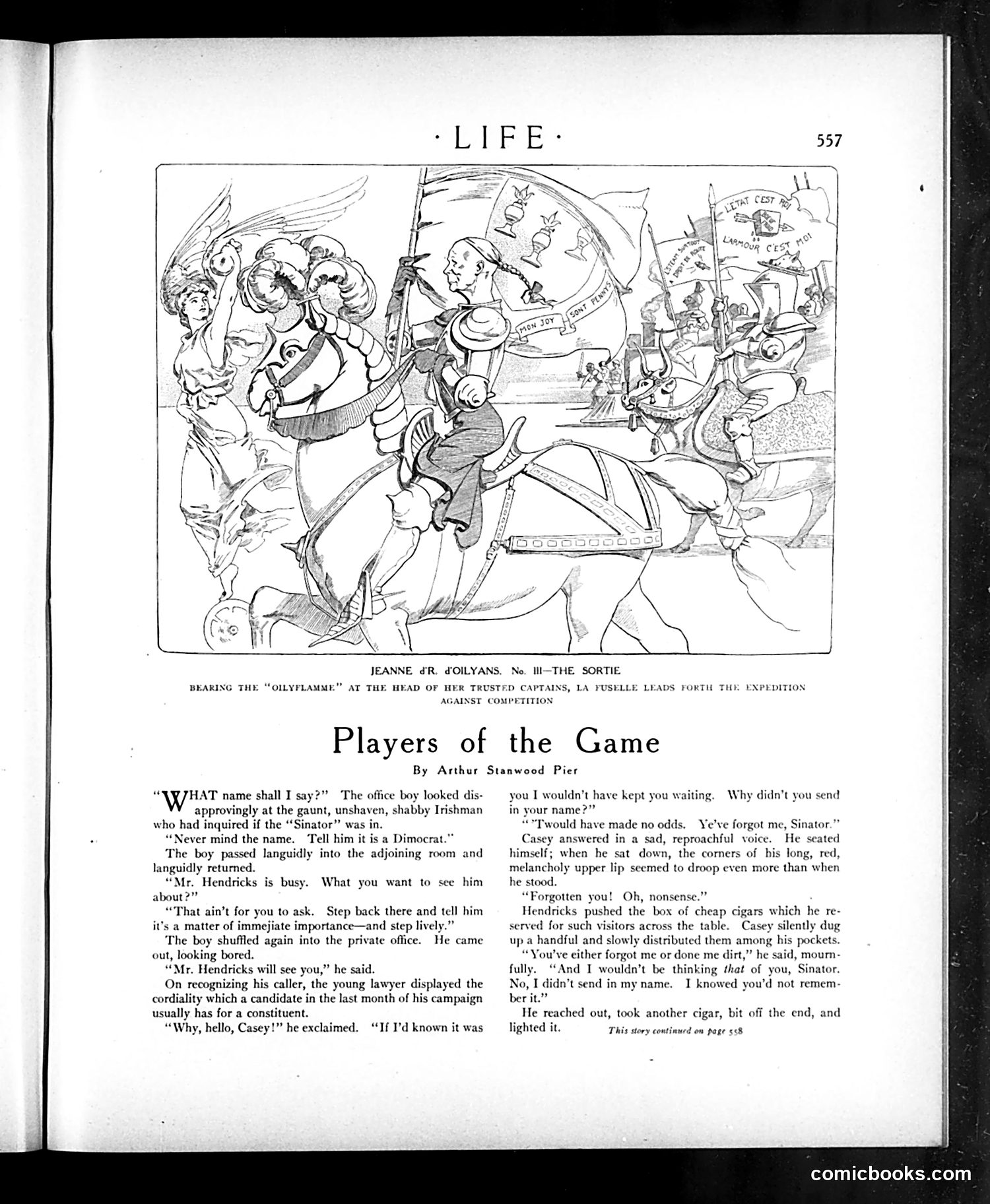
This page contains a satirical illustration and the opening of a short story titled "Players of the Game" by Arthur Stanwood Pier. **The Illustration:** A mock-heroic cartoon depicts "Jeanne d'Oilyans" (a pun on Joan of Arc) leading "La Fuselle" and captains into battle against "Competition," bearing the "Oilyflamme" (likely referencing oil industry or commercial interests). The exaggerated, cartoonish style mocks grandiose business or political campaigns through historical parody. **The Story:** Opens with a shabby Irish man attempting to see "Mr. Hendricks," a politician/candidate. An office boy dismissively calls him a "Dimocrat" [Democrat]. Hendricks, in campaign mode, warmly greets the visitor as "Casey"—a constituent he's apparently forgotten. The satire critiques political hypocrisy: Hendricks' sudden cordiality contrasts with his earlier dismissal, while Casey's hurt suggests politicians exploit working-class supporters only during election season, then abandon them. The humor targets machine politics and Irish-American political relationships in the early 20th century.
This page depicts a conversation between Casey, a working-class Irish-American political operative, and Senator Hendricks, illustrating the mechanics of **urban machine politics** in early 20th-century America. Casey controls thirty-three votes in his district and secured a city job (subforeman in Street Cleaning) through political loyalty. Now he expects advancement to foreman as reward for his continued support, viewing the job as inadequate compensation for his political power. Hendricks claims the Superintendent of Streets operates independently, but Casey insists the "city machine" (the interconnected network of political bosses) controls everything. The satire mocks how **patronage systems worked**: politicians traded government jobs for reliable votes, creating hierarchies of obligation and expectation. The reference to Casey wanting to hire "good men like Murphy and O'Neil" over "Dagoes" (derogatory term for Italian immigrants) reflects period ethnic tensions within working-class politics. The joke targets the hypocrisy of machine politicians who benefit from voter loyalty but claim powerlessness when constituents demand returns on their political investment.
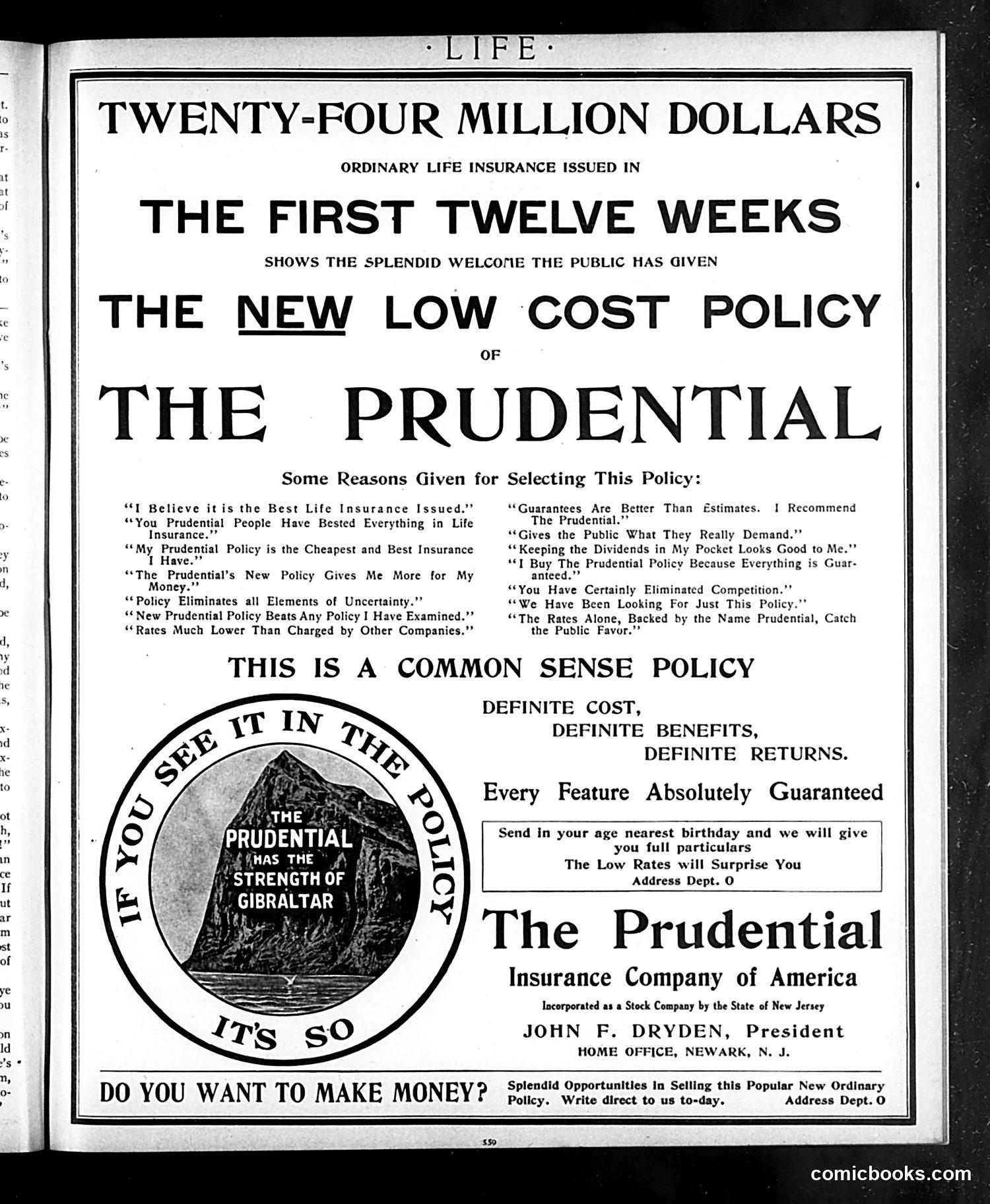
This is **advertisement, not satire**—a full-page promotion for The Prudential Insurance Company's new low-cost life insurance policy. The page claims $24 million in policies sold in twelve weeks, presenting customer testimonials praising the product's affordability and guaranteed benefits. The circular logo showing Gibraltar's Rock reinforces Prudential's stability and strength. There is **no cartoon or political content to interpret**. The only visual element is Prudential's trademark symbol. This represents straightforward early 20th-century insurance marketing, using testimonials and competitive claims (lower rates, better guarantees than competitors) to drive sales. The closing line solicits agents, offering commissions for salespeople. As *Life* magazine content, this likely indicates the publication accepted commercial advertising alongside its satirical editorial content.
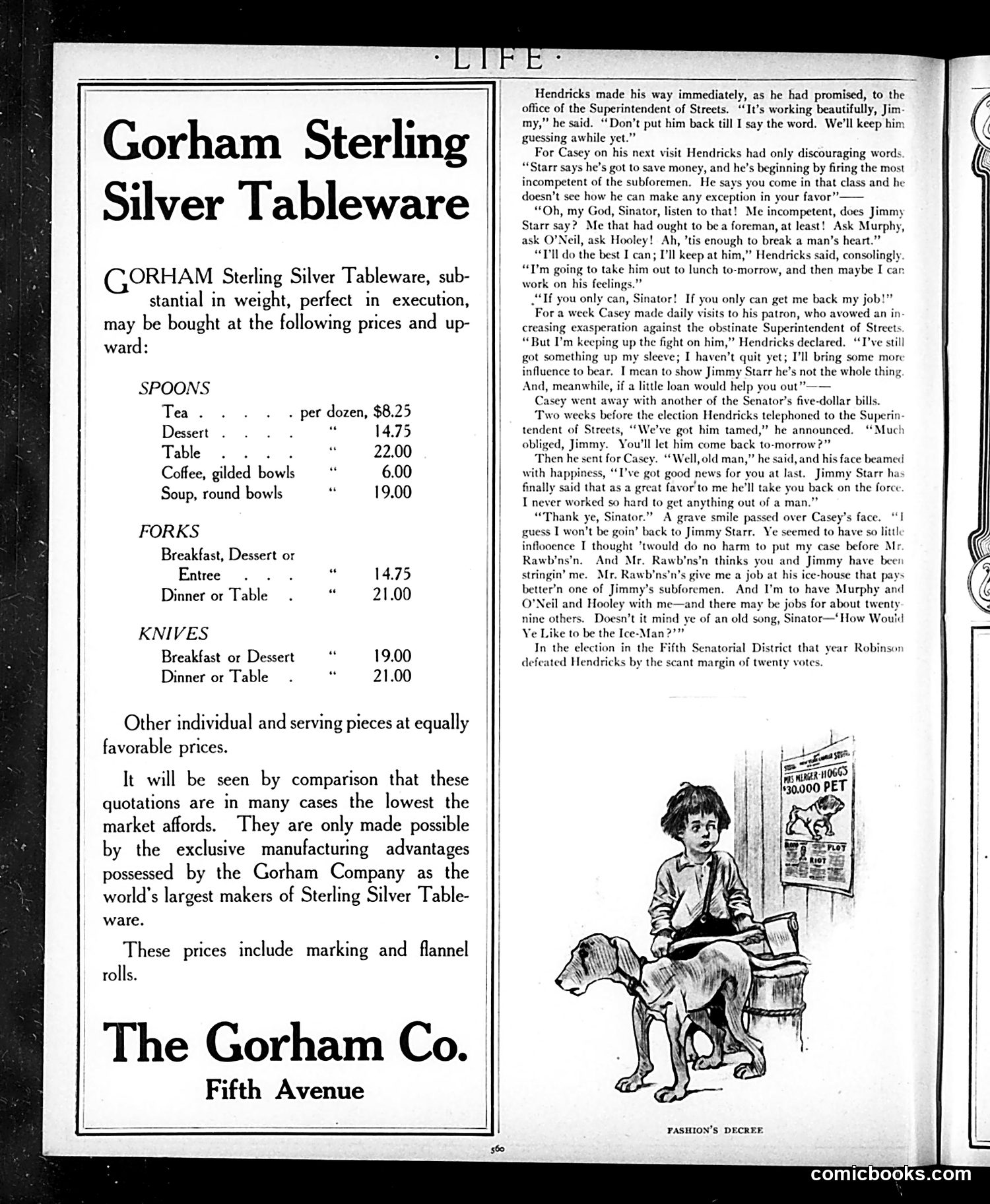
This page combines a Gorham silverware advertisement with a serialized story about political corruption. The cartoon at bottom illustrates the story's climax: a working-class man (Casey) reading a newspaper about a lost dog while standing near a poster, representing his newfound independence. The narrative describes how Senator Hendricks manipulates Casey, a city worker fired by Superintendent Starr. Hendricks promises to help Casey regain his job, extracting five-dollar bribes weekly under false pretenses of "influence." However, Casey discovers Hendricks is merely stringing him along and finds better employment with a rival politician (Rawb'ns'n), who also hires Casey's friends. **The satire's point**: The story exposes machine politics—how corrupt politicians exploit working-class voters with empty promises and hollow influence. Casey's escape through a competing patron satirizes how even corrupt systems can accidentally benefit the common man. The election defeat of Hendricks ("by the scant margin of twenty votes") suggests political comeuppance, though it appears almost accidental rather than principled.
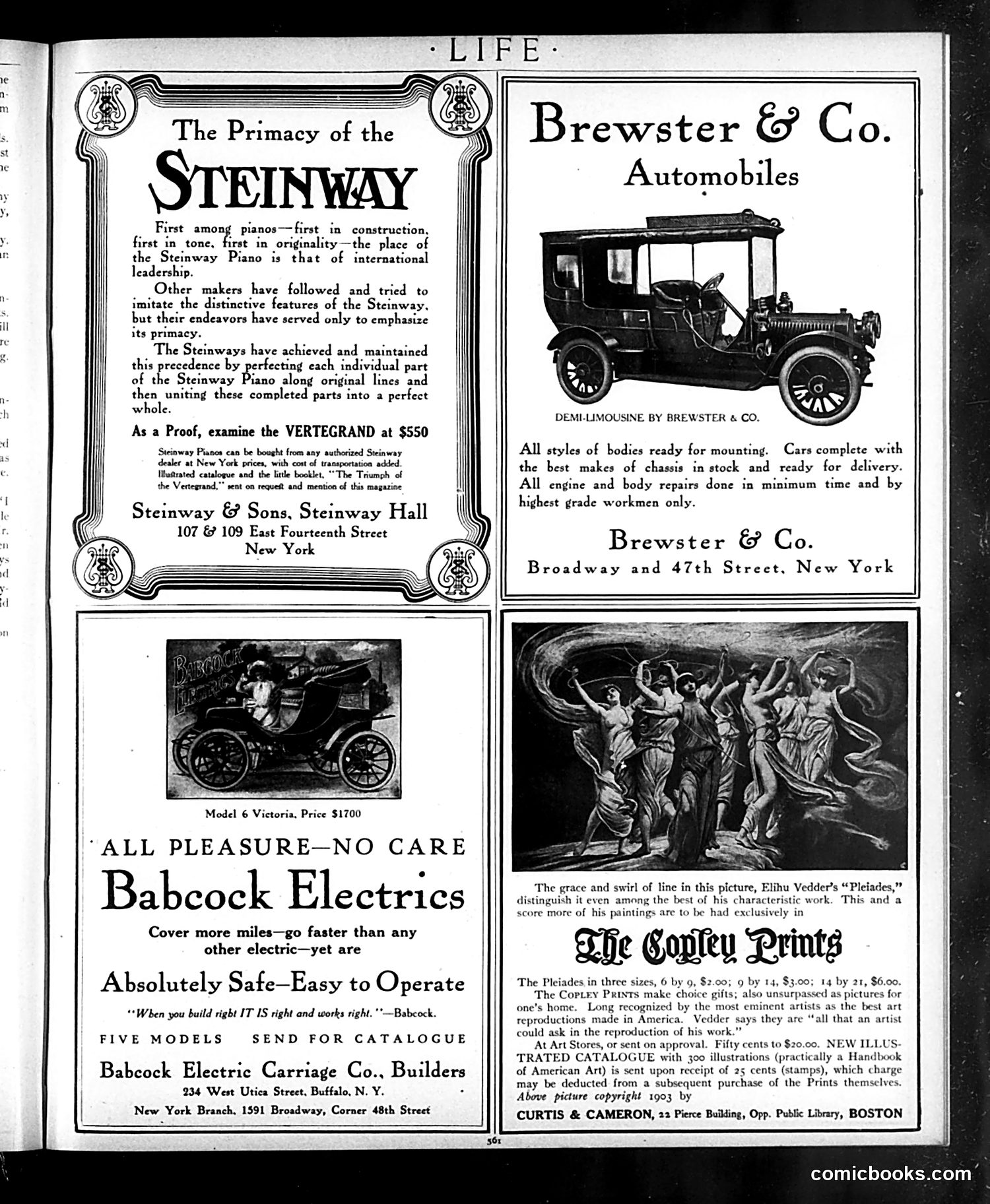
This page from *Life* magazine contains **no political cartoons or satire**—it is almost entirely **commercial advertising** from the early 1900s. The advertisements promote luxury goods: Steinway pianos (emphasizing American manufacturing superiority), Brewster & Co. automobiles, Babcock electric carriages, and Copley Prints (art reproductions featuring Elihu Vedder's "Pleiades"). The only potential satirical element is implicit: the *juxtaposition* of competing technologies. Brewster offers gasoline-powered cars while Babcock simultaneously advertises electric vehicles as safer and easier to operate—reflecting the genuine early-automotive industry competition between electric and internal combustion engines (a debate the electric car ultimately lost). The tone is aspirational marketing to wealthy readers, not political commentary. No identifiable caricatures or satirical figures appear.
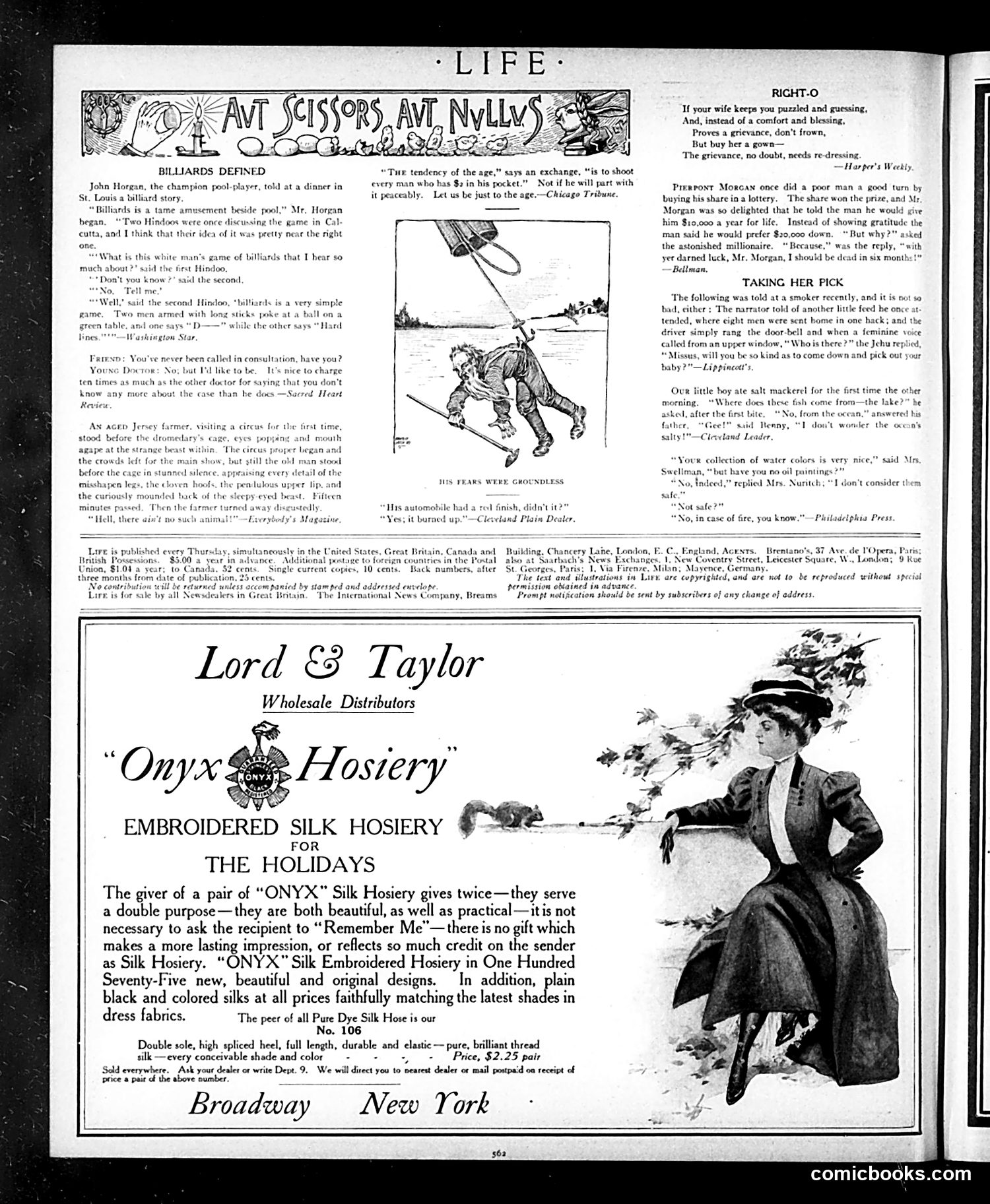
This page from *Life* magazine contains several brief humorous anecdotes typical of the publication's satirical style, plus advertising. The main cartoons/jokes mock social pretension and human nature: - **"Billiards Defined"**: A play on class distinctions—pool is dismissed as crude compared to billiards, the "gentleman's game" - **"His Tears Were Groundless"**: A farmer witnesses a circus elephant's distress, only to learn it's theatrical—mocking sentimental over-reaction - **"Right-O"** and related quips: Gentle satire on marriage, gratitude, and human greed (a poor man rejects a millionaire's gift because he wants lump cash, fearing he'll die anyway) The humor relies on irony and unexpected reversals—situations that appear one way but are revealed differently. The **Onyx Hosiery advertisement** is standard early-20th-century marketing, positioning silk stockings as thoughtful holiday gifts reflecting credit on the giver. The page reflects *Life*'s general tone: witty, middle-class commentary on everyday situations rather than hard political satire.
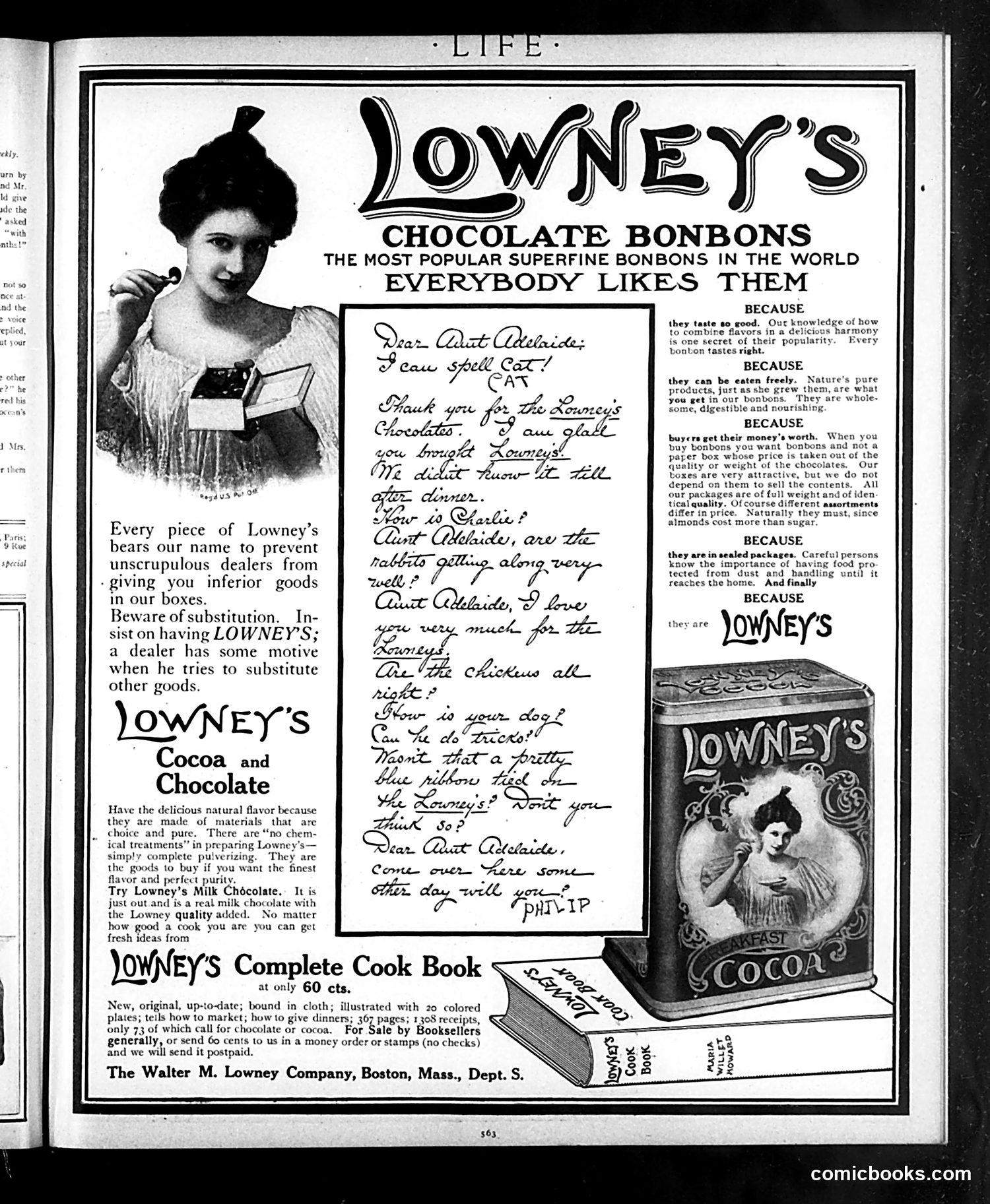
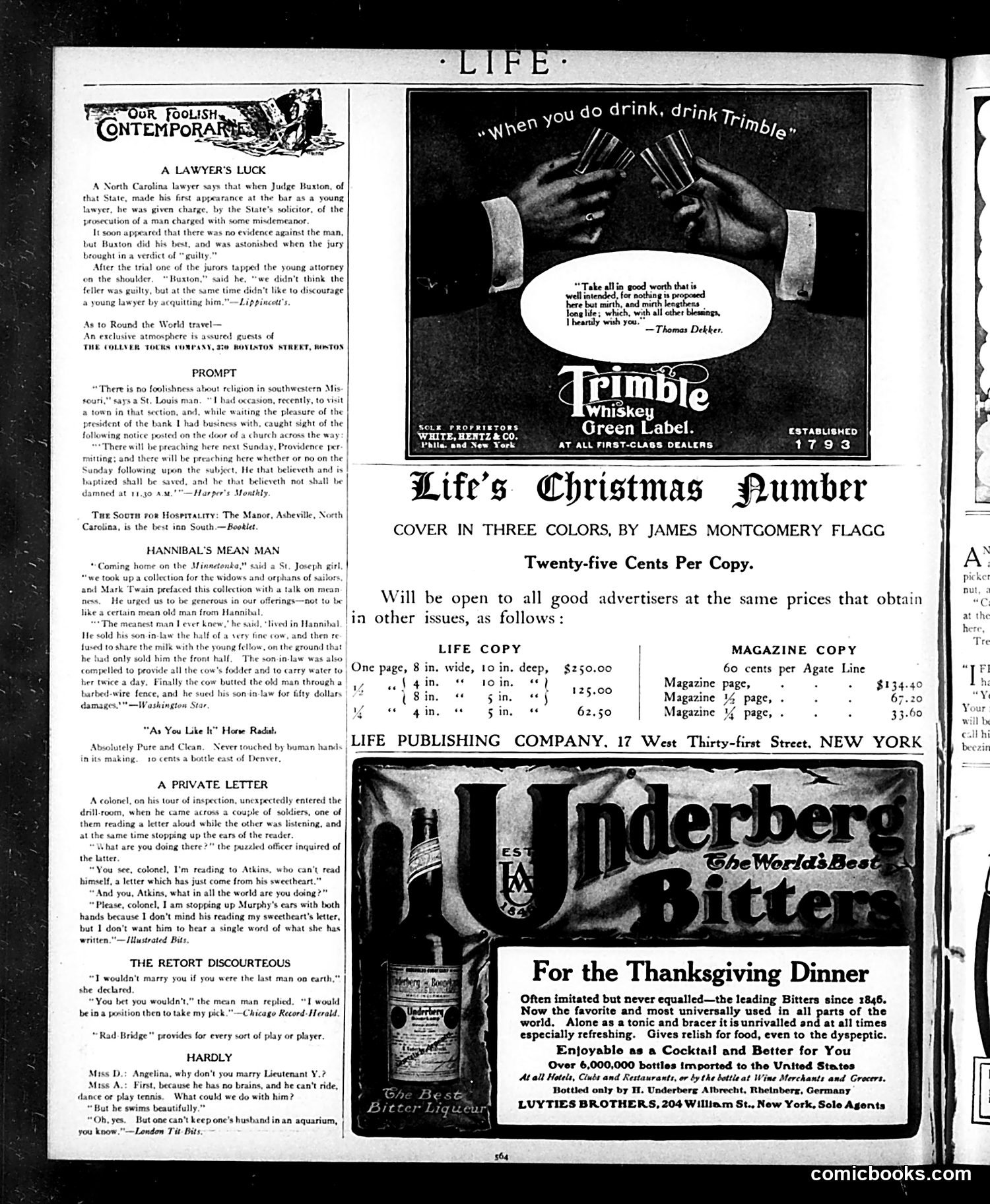
This page from Life magazine (a satirical publication) primarily consists of **humorous anecdotes and advertisements** rather than political cartoons. The main content includes brief jokes about American life: a young lawyer wins a case despite lacking evidence (the jury didn't want to discourage him), a St. Louis man observes that Southwest Missouri religion is pragmatic, and Mark Twain's anecdote about a miserly Hannibal man who forced an orphan boy to labor for minimal pay. **The advertisements** dominate visually—Trimble Whiskey and Underberg Bitters are prominently featured, along with notices about Life's Christmas issue cover by James Montgomery Flagg. The humor is gentle, folksy Americana rather than sharp political satire. The jokes target human nature (greed, laziness, legal absurdity) rather than specific politicians or events. This reflects Life's role as a mainstream humor magazine for middle-class readers, mixing light social observation with commercial content.
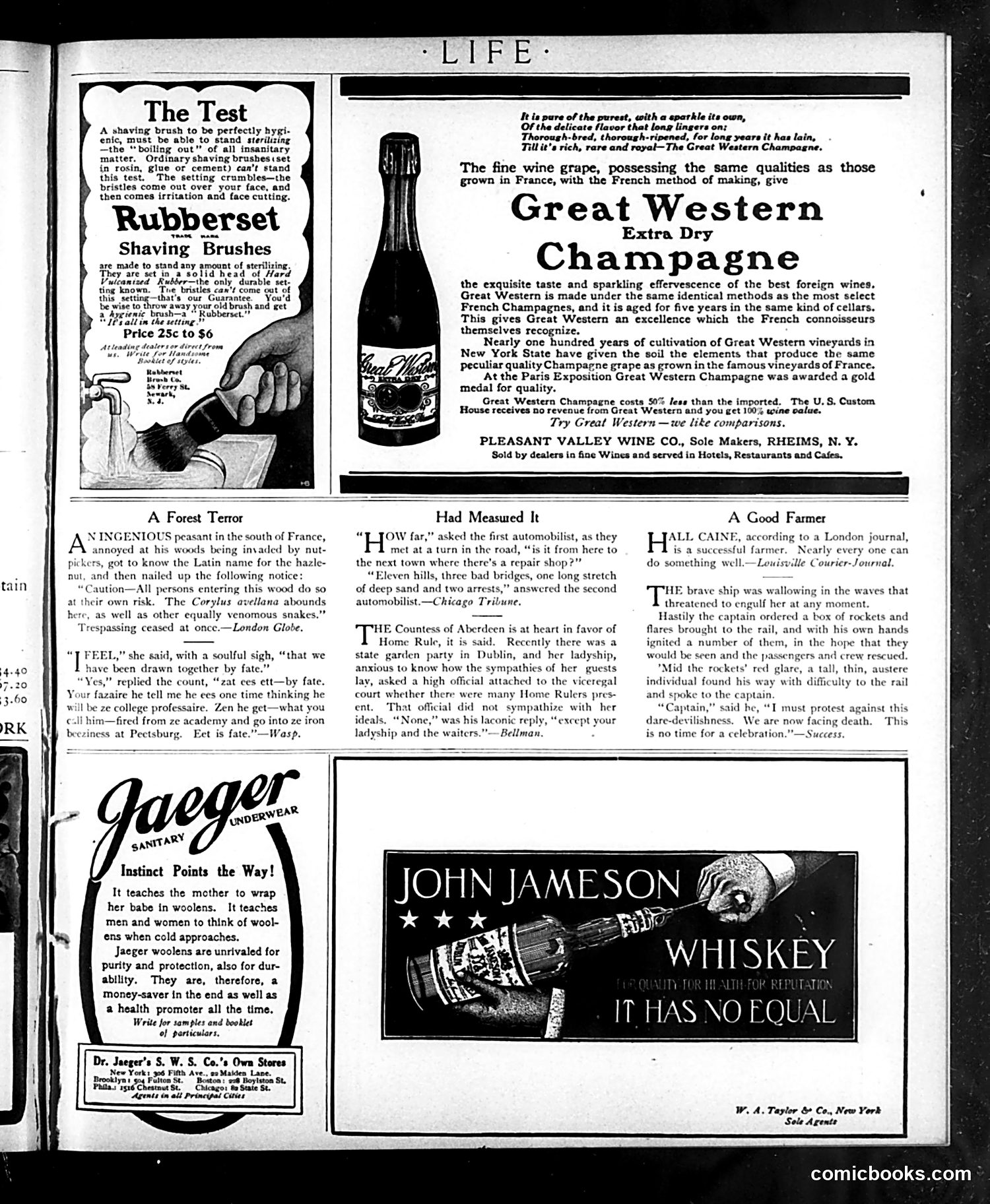
This page is primarily **advertising**, with three short humorous anecdotes interspersed. The ads promote Rubberset shaving brushes, Great Western Champagne (a New York product marketed as equal to French imports), Jaeger woolens, and John Jameson whiskey. The three brief jokes reflect early 20th-century humor: 1. **"A Forest Terror"** plays on a French peasant's use of Latin scientific nomenclature to scare away trespassers—the joke being that "Corylus avellana" (hazelnut) sounds dangerously exotic. 2. **"Had Measured It"** is a motorist joke about early automobile travel—the punchline measures distance not in miles but in physical obstacles (hills, bad bridges, arrests), satirizing the primitive state of roads and the frequency of traffic violations. 3. The unnamed third anecdote appears to involve a European count and a "fate" discussion, likely playing on ethnic/class stereotypes common to the era. These brief comedic pieces were typical filler content in Life magazine between advertisements.
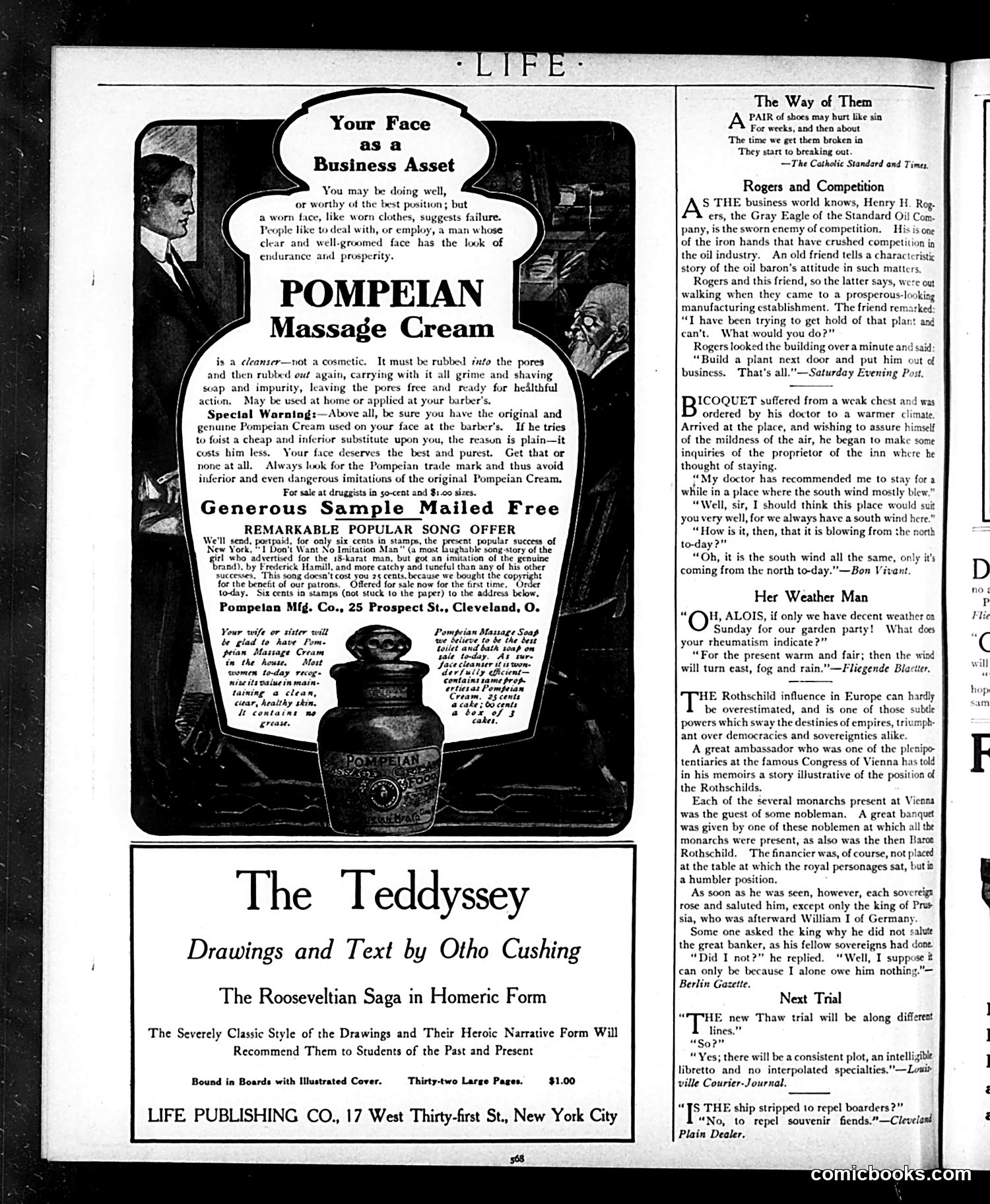
This page mixes advertising with satirical content. The dominant **Pompeian Massage Cream advertisement** uses the era's commonplace assumption that a man's facial appearance directly determines business success—promoting skincare as a professional necessity rather than vanity. This reflects early 20th-century anxieties about self-presentation in capitalist competition. The **"Rogers and Competition"** piece references **Henry H. Rogers**, a Standard Oil executive notorious for crushing competitors. The anecdote illustrates his ruthless philosophy: rather than negotiate, simply build a rival business next door to destroy the target. This satirizes the unchecked monopolistic practices of the Gilded Age oil barons. **"The Teddyssey"** advertises a book by Otho Cushing presenting Theodore Roosevelt's exploits in Homeric epic style—mocking both Roosevelt's aggressive persona and the era's tendency to mythologize powerful figures. The remaining items are brief humor pieces and advertisements typical of Life's satirical magazine format from this period (likely early 1900s).
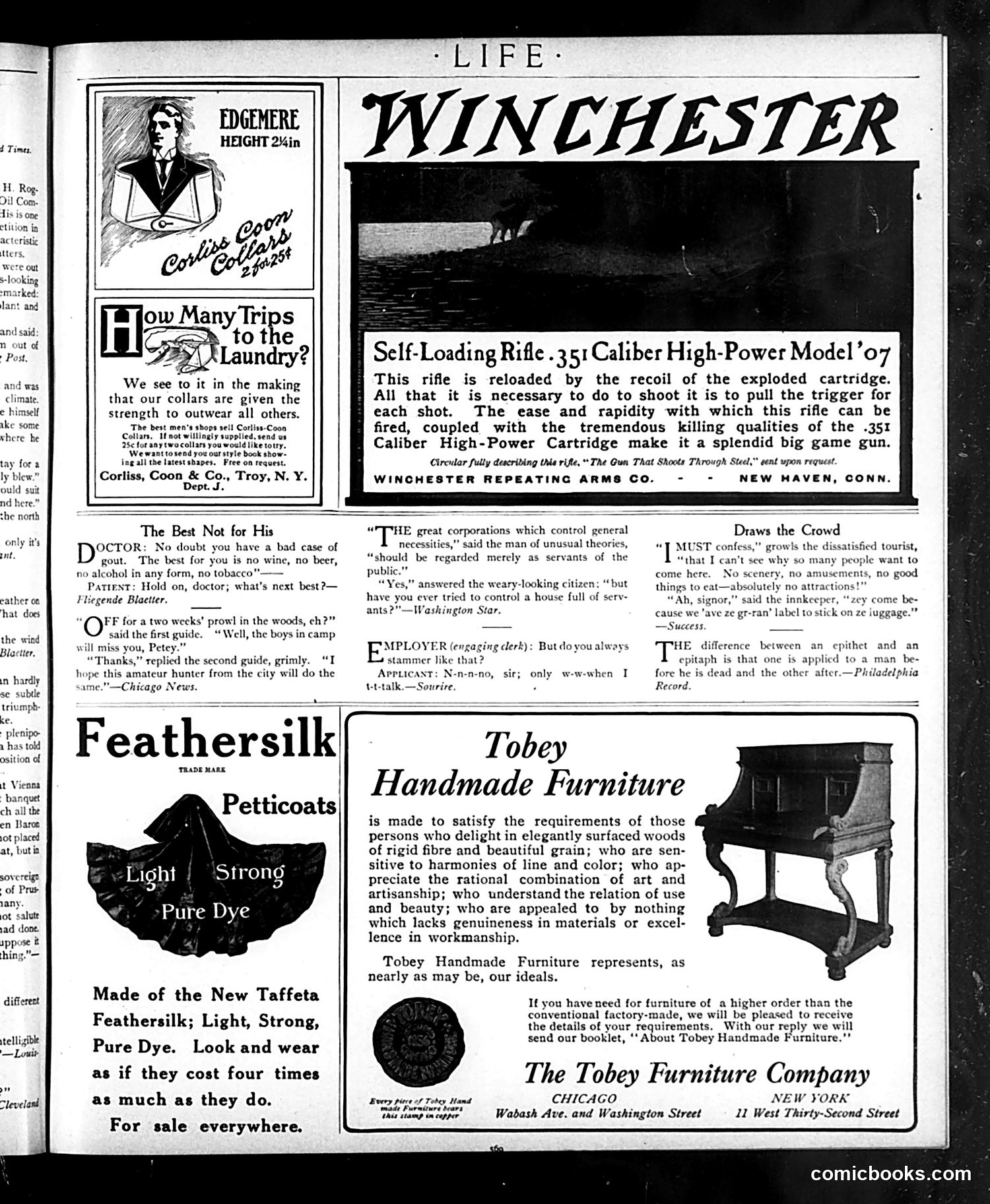
This page is primarily **advertising**, with brief satirical humor pieces interspersed. The main advertisements promote **Winchester rifles** (self-loading, high-power models for big game hunting), **Feathersilk petticoats** (lightweight, durable), and **Tobey Handmade Furniture** (artisanal craftsmanship). The humor sections include: - **"The Best Not for His"**: A doctor-patient joke about gout treatment—the patient rejects medical advice for no alcohol/tobacco, asking what's "next best" - **Workplace/hunting anecdotes**: Brief quips about amateur hunters and guides - **Social commentary**: Snippets about corporate control, tourism complaints, stammering employees, and semantic differences (epithet vs. epitaph) These are generic, light satirical observations typical of early-20th-century *Life* magazine—no specific political figures or dated events are referenced. The page reflects period advertising interests (hunting equipment, fashion, furniture) and offers mild social humor rather than sharp political commentary.
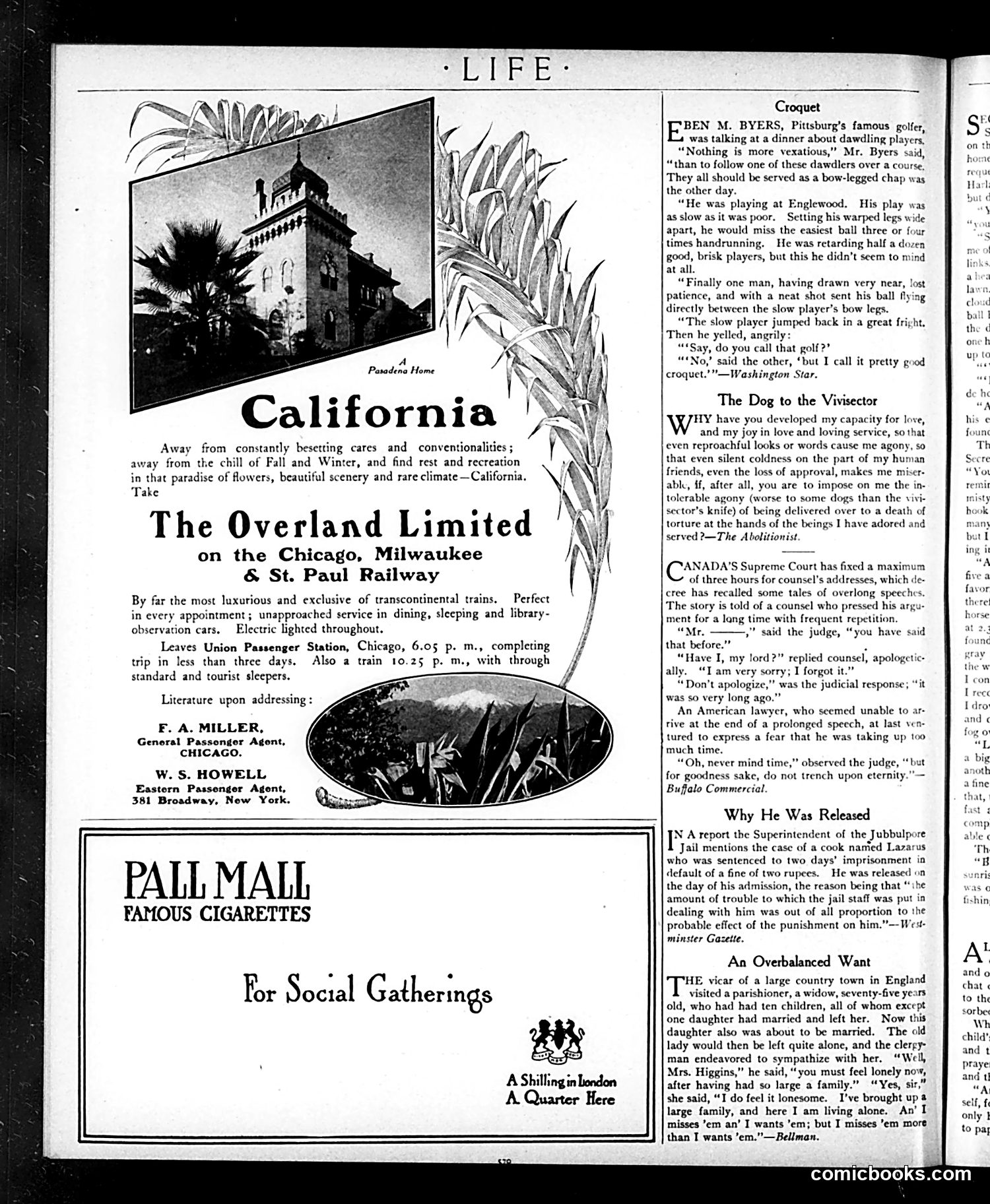
This page contains primarily **advertisements and humorous anecdotes** rather than political cartoons. The **California/Overland Limited advertisement** (top) promotes luxury train travel as an escape from urban congestion—appealing to Gilded Age affluence. The substantive humor pieces are short stories: 1. **"Croquet"**: A Ben Byers anecdote about slow golfers. The joke: when a slow player blocks faster golfers, one hits the ball between his legs. The slow player protests it's not golf; the reply: "I call it pretty good croquet"—a gentlemen's sport joke mocking both the slowpoke and retaliatory rudeness. 2. **"The Dog to the Vivisector"**: A sentimental animal-rights piece criticizing vivisection (animal testing), questioning why dogs are bred for loyalty only to face torture. 3. **Brief legal humor pieces** about overlong speeches in Canadian courts and a jail cook released due to staff inconvenience. The **Pall Mall cigarettes ad** offers no satire—straightforward luxury marketing.
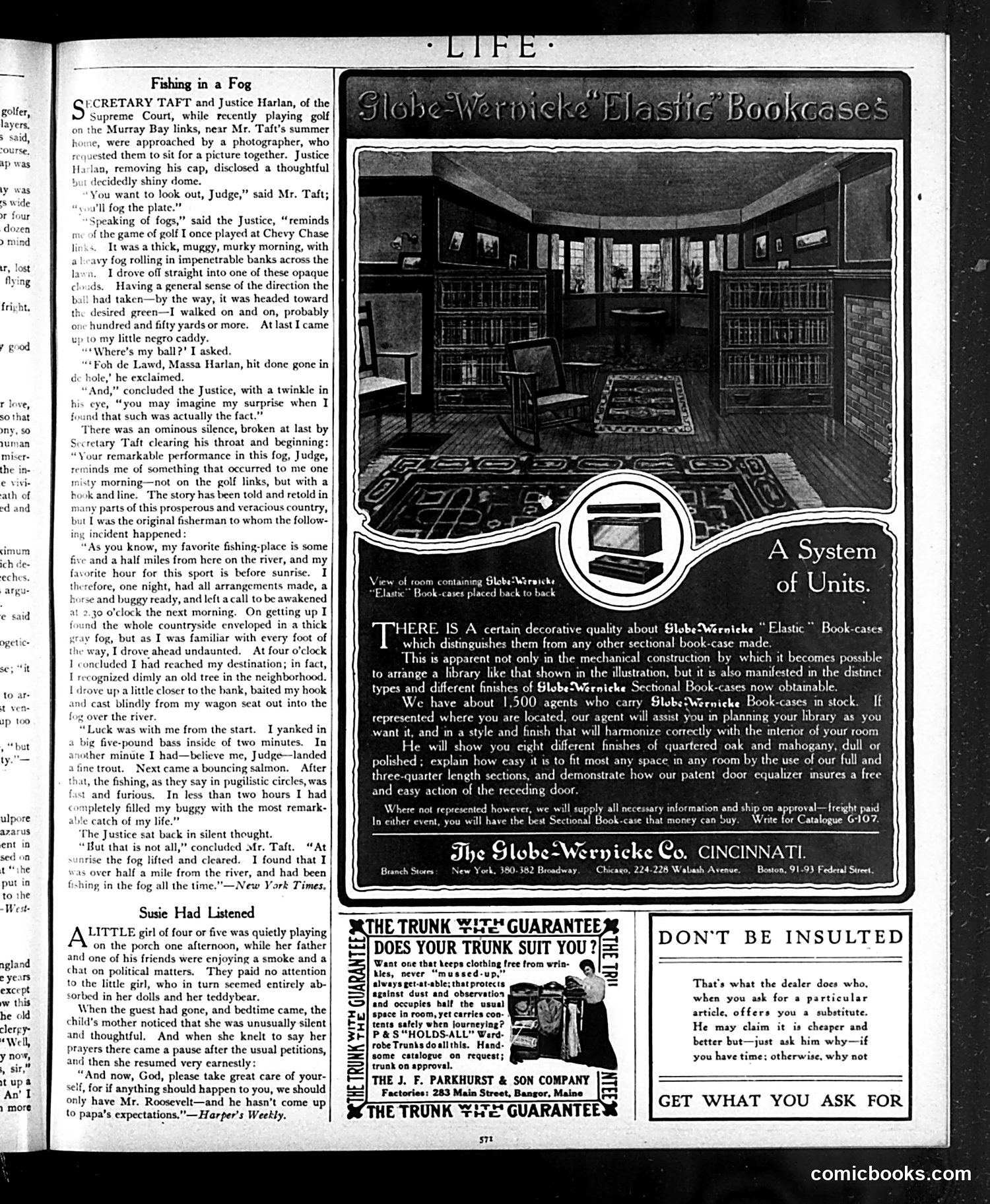
This page contains two satirical stories about prominent early-1900s figures: **"Fishing in a Fog"** features Secretary of State William Howard Taft and Supreme Court Justice John Harlan. The joke centers on Taft's tall tale about catching fish in thick fog—only to reveal he wasn't actually at the river but had been "fishing in the fog" the whole time. The humor lies in this anticlimactic reveal of Taft's exaggeration, and likely satirizes Taft's reputation for tall tales or unclear communication. **"Susie Had Listened"** mocks Theodore Roosevelt. A small girl overhears men discussing politics and concludes her prayer by asking God to care for himself "because if anything should happen to you, we should only have Mr. Roosevelt—and he hasn't come up to papa's expectations." This satirizes Roosevelt's public reputation as unpredictable or unfit, presented through innocent childhood logic for comic effect. The remaining content is advertising for Globe-Wernicke bookcases.
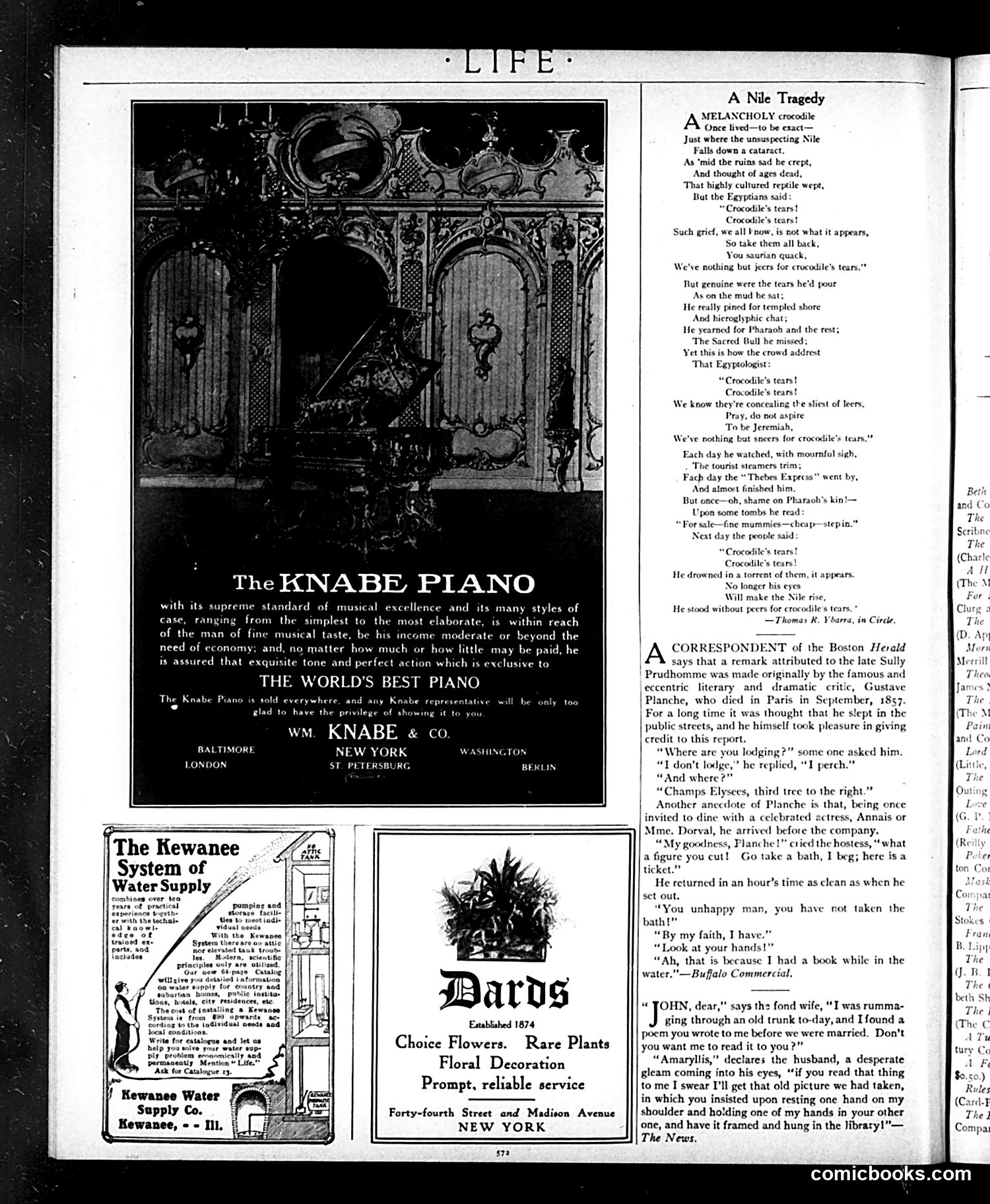
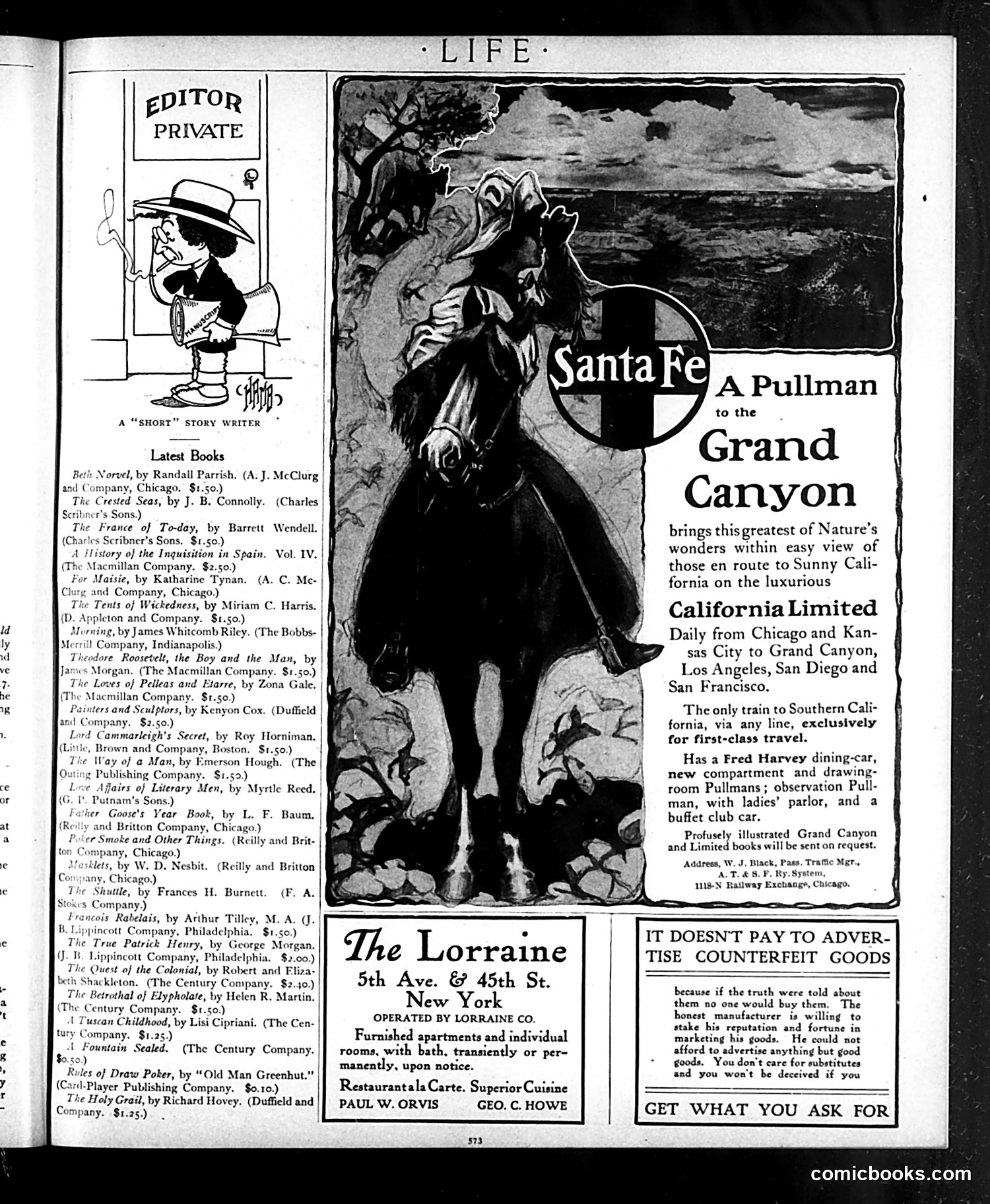
This page contains a small cartoon titled "A 'Short' Story Writer" in the upper left, showing a man at a desk labeled "EDITOR PRIVATE" holding what appears to be a rejected manuscript. The joke likely satirizes the proliferation of aspiring short-story writers submitting work to editors—a common frustration in publishing. The cartoonist (signed, appearing to be by an artist named Cesare) presents the editor's private moment, suggesting the volume and tedium of unsolicited submissions. The remainder of the page consists of advertisements (for the Santa Fe railway and the Lorraine hotel) and a book review section listing recent publications, which was typical Life magazine content of this era. The "counterfeit goods" notice at bottom warns readers to purchase authentic products only.
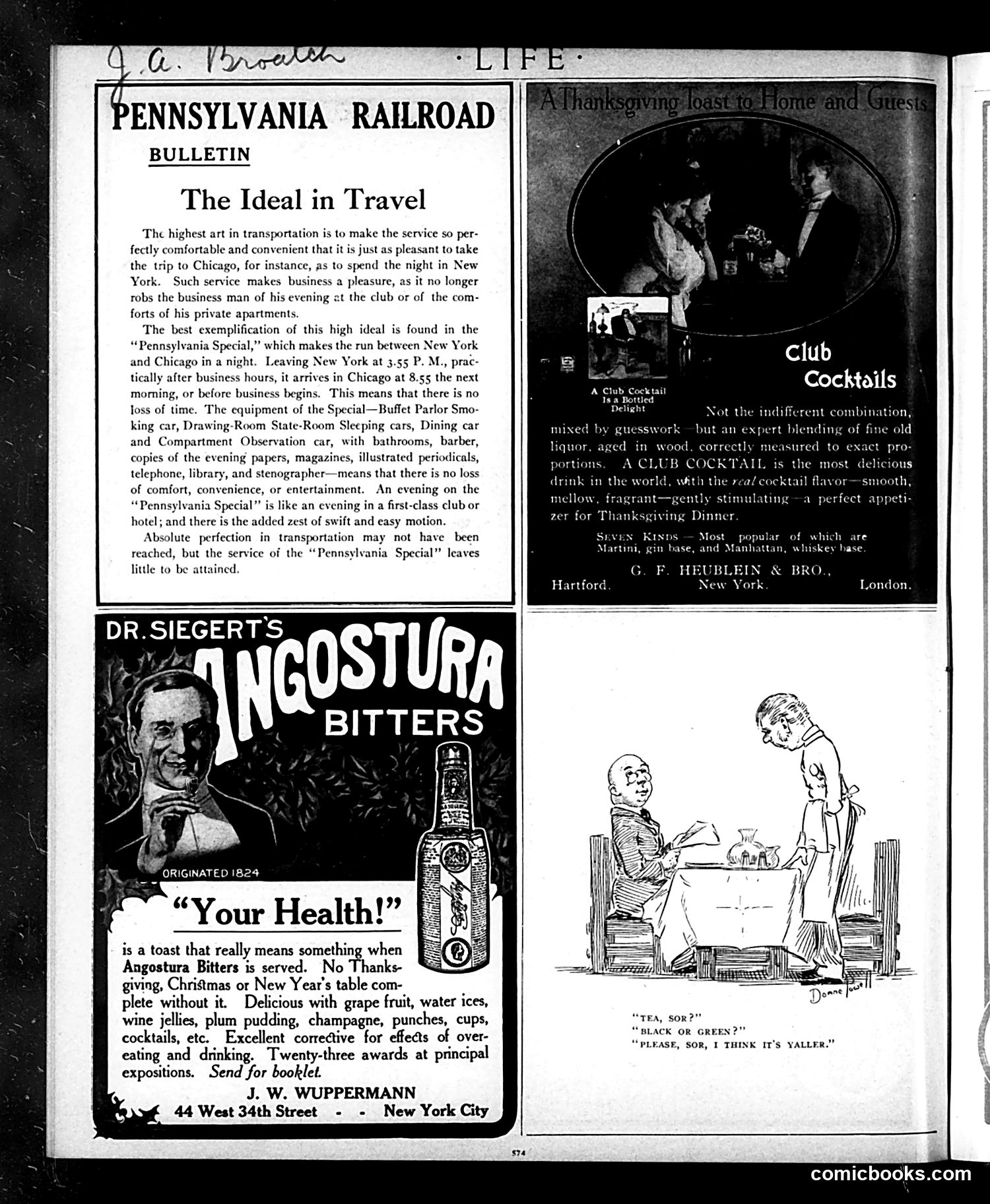
This page combines railroad advertising with social humor typical of early 20th-century Life magazine. **Main Content:** The Pennsylvania Railroad's "Pennsylvania Special" advertises luxury overnight train service between New York and Chicago, emphasizing that business travel need no longer sacrifice comfort—passengers enjoy club-like amenities (sleeping cars, dining facilities, library, stenographer) during transit. **The Cartoon:** The bottom illustration depicts a server asking a seated diner about tea preferences. The diner's response—"I think it's yaller"—is a joke about class and dialect. The humor relies on mocking working-class or immigrant speech patterns ("yaller" for "yellow," suggesting poor education or accent), contrasting with the refined Thanksgiving dinner setting described in adjacent cocktail advertisements. **Context:** This reflects early 1900s attitudes where Life magazine made humor from perceived social hierarchies and ethnic/class-based speech differences. The page overall targets affluent travelers and diners, with advertising repeatedly emphasizing luxury and sophistication.
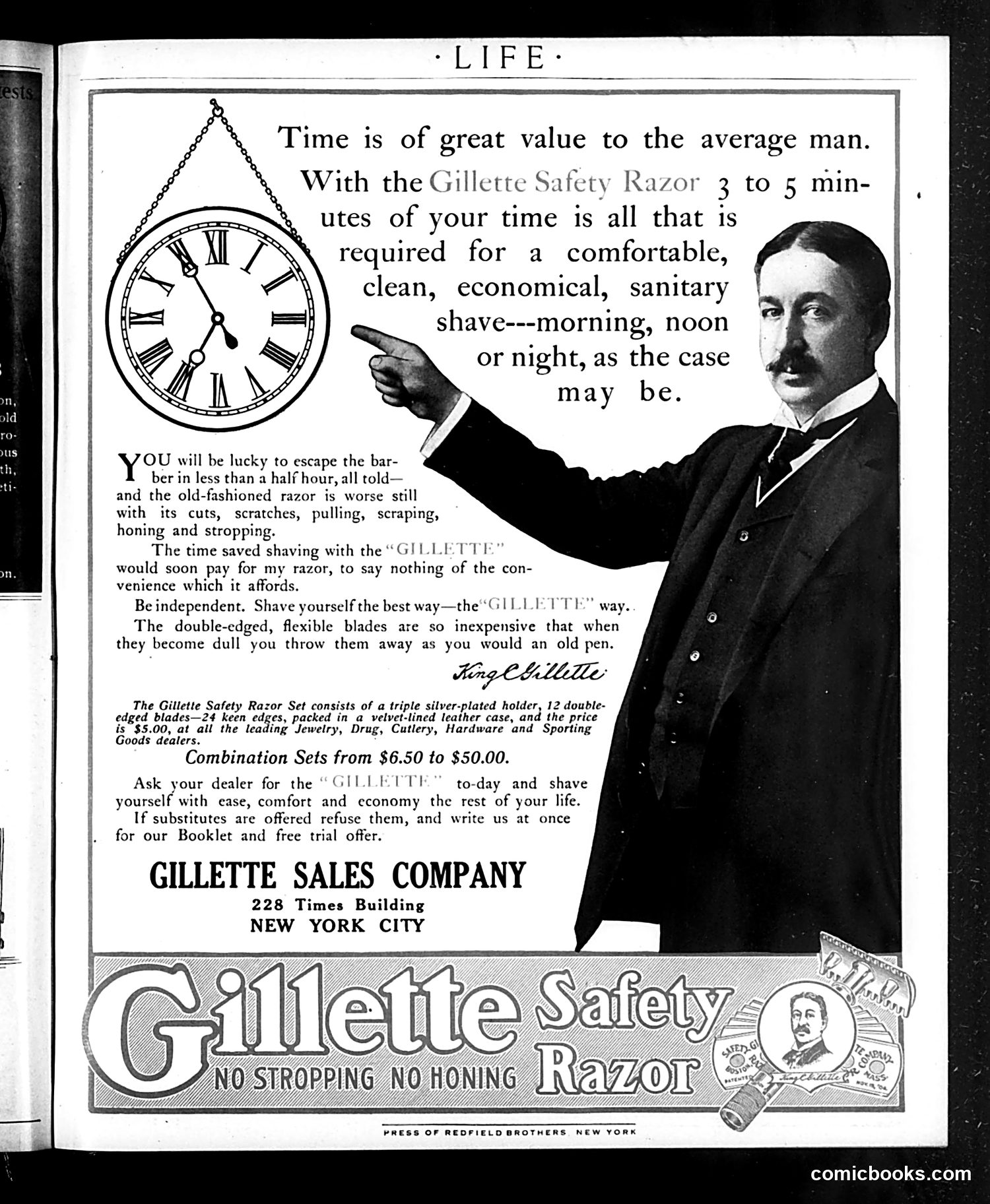
This is **not a political cartoon or satire**—it's a **full-page advertisement** for the Gillette Safety Razor from Life magazine. The page features a well-dressed man in formal attire pointing at a clock, endorsing the product. The ad's central pitch is about **time-saving**: shaving with a Gillette takes only 3–5 minutes versus a half-hour at the barber. It emphasizes modernity and independence—men can shave themselves at home rather than visit a barber. The language appeals to early-20th-century values: the razor is "economical," "sanitary," and "inexpensive" (disposable blades cost pennies). The signature at bottom appears to be from a notable figure of the era, likely lending celebrity endorsement, though the name is unclear in reproduction. This represents Gillette's marketing strategy: positioning their safety razor as a time-efficient, cost-saving innovation for the busy modern man, contrasting it against traditional barbering and straight-razor shaving methods.
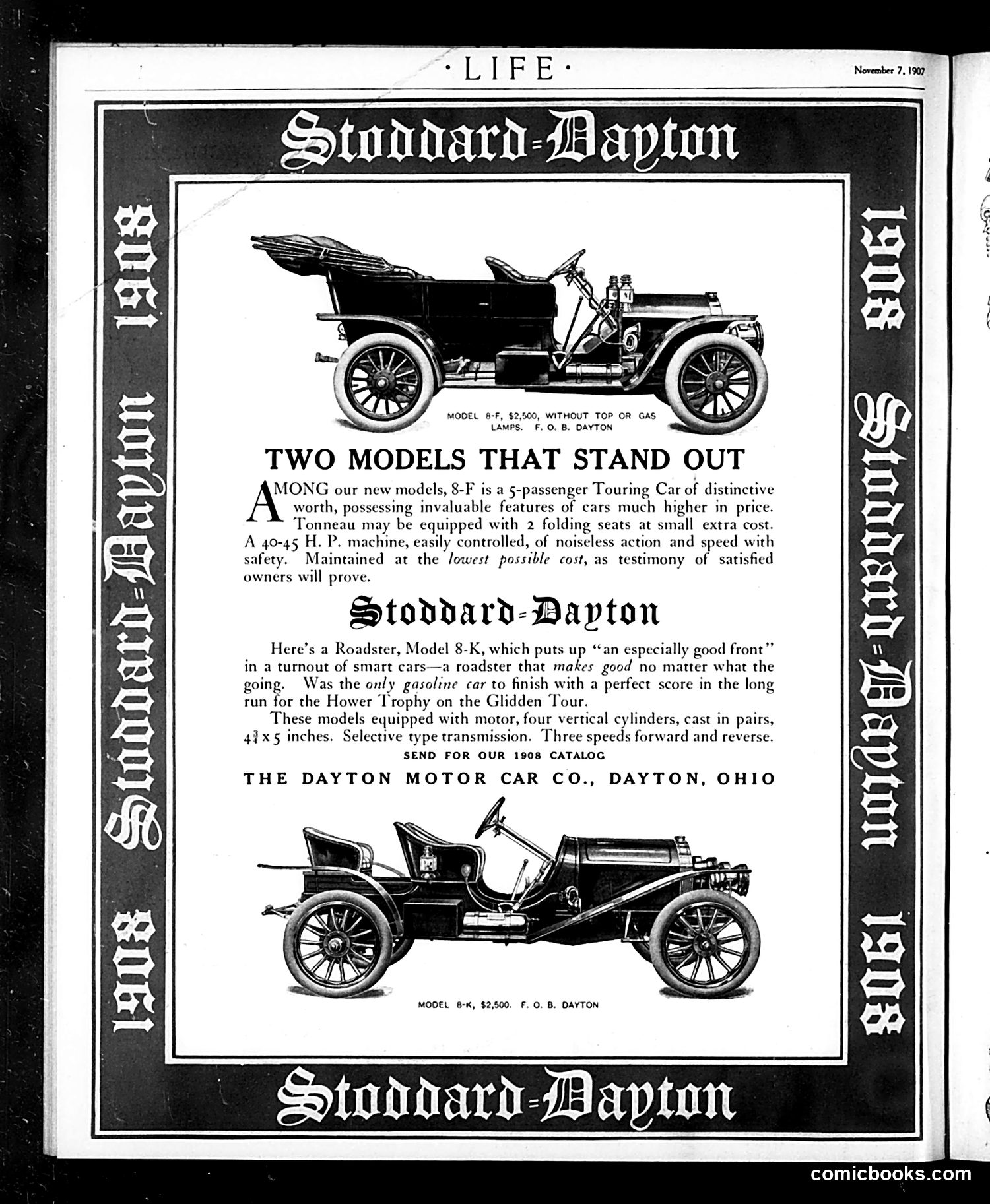
This is **not a cartoon or satire page**—it's a straightforward automobile advertisement from Life magazine (November 7, 1907). The page advertises two Stoddard-Dayton motor car models made by The Dayton Motor Car Co. in Ohio: - **Model 8-F**: A 5-passenger touring car priced at $2,500, featuring a 40-45 H.P. engine and optional folding seats - **Model 8-K**: A roadster also priced at $2,500, notably claimed as "the only gasoline car to finish with a perfect score" in the Glidden Tour (a famous automotive endurance race) Both vehicles feature four vertical cylinders, selective transmission, and three forward speeds. The decorative border reads "Stoddard-Dayton" repeatedly. This is a period automobile advertisement highlighting features and competitive achievements to appeal to affluent early-1900s buyers interested in reliable, well-engineered vehicles.