
Life, 1907-11-07 · page 32 of 50
Life — November 7, 1907 — page 32: what you’re looking at
What you’re looking at
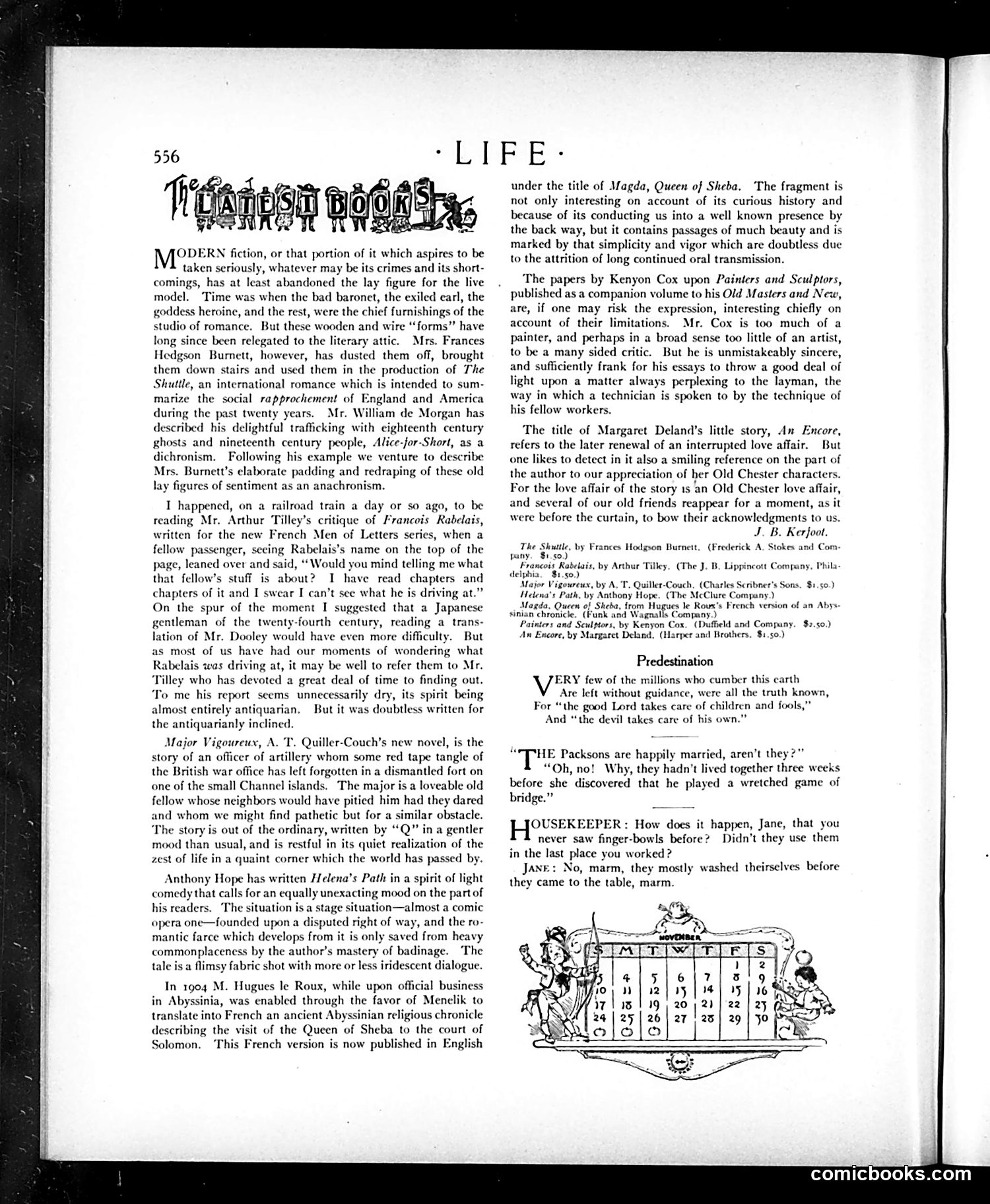
This page contains literary criticism rather than political satire. It reviews contemporary fiction from the early 1900s, discussing works by established authors like Frances Hodgson Burnett (*The Shuttle*), Arthur Quiller-Couch (*Major Vigoureux*), and Anthony Hope (*Helena's Path*). The critic argues that modern fiction has abandoned wooden "lay figures" (stock characters) for realistic portrayals. However, Burnett is criticized for reverting to this outdated practice in her novel about Anglo-American relations. At the bottom is a small decorative calendar illustration labeled "AUGUST," unrelated to the text. The page demonstrates Life magazine's dual function: while primarily known for political cartoons and satire, it also featured serious literary commentary aimed at educated readers interested in contemporary fiction and cultural criticism.
📄 Transcribed text from this page (OCR, searchable)
Machine-transcribed from the original scan — historical spelling and the odd misread are preserved.
“LA BAB N fiction, or that portion of it which aspires to be taken seriously, whatever may be its crimes and its short- comings, has at least abandoned the lay figure for the live model. Time was when the bad baronet, the exiled earl, the goddess heroine, and the rest, were the chief furnishings of the studio of romance, But these wooden and wire “forms” have long since been relegated to the literary attic. Mrs. Frances Hedgson Burnett, however, has dusted them off, brought them down stairs and used them in the production of The Shuttle, an international romance which is intended to sum- marize the social rapprochement of England and America during the past twenty years. Mr. William de Morgan has described his delightful trafficking with eighteenth century ghosts and nineteenth century people, Alice-jor-Short, as a dichronism. Following his example we Mrs. Burnett’s elaborate padding and red lay figures of sentiment as an anachronism. enture to de: ping of thes T happened, on a railroad train a day or so ago, to be reading Mr. Arthur Tilley’s critique of Francois Rabelais, written for the new French Men of Letters series, when a fellow passenger, secing Rabelais’s name on the top of the page, leaned over and said, “Would you mind telling me what that fellow’s stuff is about? Ih read chapters and chapters of it and I swear I can’t see what he is driving at.” On the spur of the moment I suggested that a Japanese gentleman of the twenty-fourth century, reading a trans- lation of Mr. Dooley would have even more difficulty. But as most of us have had our moments of wondering what Rabelais was driving at, it may be well to refer them to Mr. Tilley who has devoted a great deal of time to finding out. To me his report seems unnecessarily dry, its spirit being almost entirely antiquarian. But it was doubtless written for the antiquarianly inclined. Major Vigoureux, A. T. Quiller-Couch’s new novel, is the story of an officer of artillery whom some red tape tangle of the British war office has left forgotten in a dismantled fort on one of the small Channel islands. The major is a loveable old fellow whose neighbors would have pitied him had they dared and whom we might find pathetic but for a similar obstacle. ‘The story is out of the ordinary, written by “Q” ina gentler mood than usual, and is restful in its quiet realization of the zest of life in a quaint corner which the world has passed by. Anthony Hope has written Helena’s Path in a spirit of light comedy that calls for an equally unexacting mood on the part of his readers. The situation is a stage situation—almost a comic opera one—founded upon a disputed right of way, and the ro mantic farce which develops from it is only saved from heavy commonplaceness by the author's mastery of badinage. ‘The tale is a flimsy fabric shot with more or less iridescent dialogue. In 1904 M. Hugues le Roux, while upon official business in Abyssinia, was enabled through the favor of Menelik to translate into French an ancient Abyssinian religious chronicle describing the visit of the Queen of Sheba to the court of Solomon. ‘This French version is now published in English under the title of Magda, Queen of Sheba. The fragment is not only interesting on account of its curious history and because of its conducting us into a well known presence by the back way, but it contains passages of much beauty and is marked by that simplicity and vigor which are doubtless due to the attrition of long continued oral transmission. ‘The papers by Kenyon Cox upon Painters and Sculptors, published as a companion volume to his Old Masters and New, are, if one may risk the expression, interesting chiefly on account of their limitations. Mr. Cox is too much of a painter, and perhaps in a broad too little of an artist, to be a many sided critic. But he is unmistakeably sincer and sufficiently frank for his essays to throw a good deal of light upon a matter always perplexing to the layman, the way in which a technician is spoken to by the technique of his fellow workers. The title of Margaret Deland’s little story, An Encore, refers to the later renewal of an interrupted love affair. But one likes to detect in it also a smiling reference on the part of the author to our appreciation of her Old Chester characte! For the love affair of the story 1s an Old Chester love affai and several of our old friends reappear for a moment, as it were before the curtain, to bow their acknowledgments to us. J.B. Kerfoot. The Shattte by Frances Hodgson Burnett. (Frederick A. Stokes and C pany. 81-50.) Rabelais, by Arthur Tilley. (The J. B. Lippincott Company, Phil 1,50.) Vigowreux, by A. T. Quiller-Couch. (Charles Scribner's Sons. $1.50.) Hetena’s Path, by Anthony Hope. (The McClure Company.) Magda, Queen o} Skeba, from Hugues le Roux’s French version of an Abys. ‘Sinian chronicle. (Funk and Wagnalls Company.) Painters and Sculptors, by Kenyon Cox. (Duffield and Company. $2.50.) An Encore, by Margaret Deland. (Harper and Brothers, $1.50.) Predestination RY few of the millions who cumber this carth Are left without guidance, were all the truth known, For “the good Lord takes care of children and fools,” And “the devil takes care of his own.” “T! Packsons are happily married, aren't they?” Oh, no! Why, they hadn’t lived together three weeks before she discovered that he played a wretched game of bridge.” ER: How does it happen, Jane, that you Didn't they use them OUSEKEE! never saw finger-bowls before ? in the last place you worked ? Ja ‘0, marm, they mostly washed theirselves before they came to the table, marm. comicbooks.com