
Life, 1907-11-07 · page 29 of 50
Life — November 7, 1907 — page 29: what you’re looking at
What you’re looking at
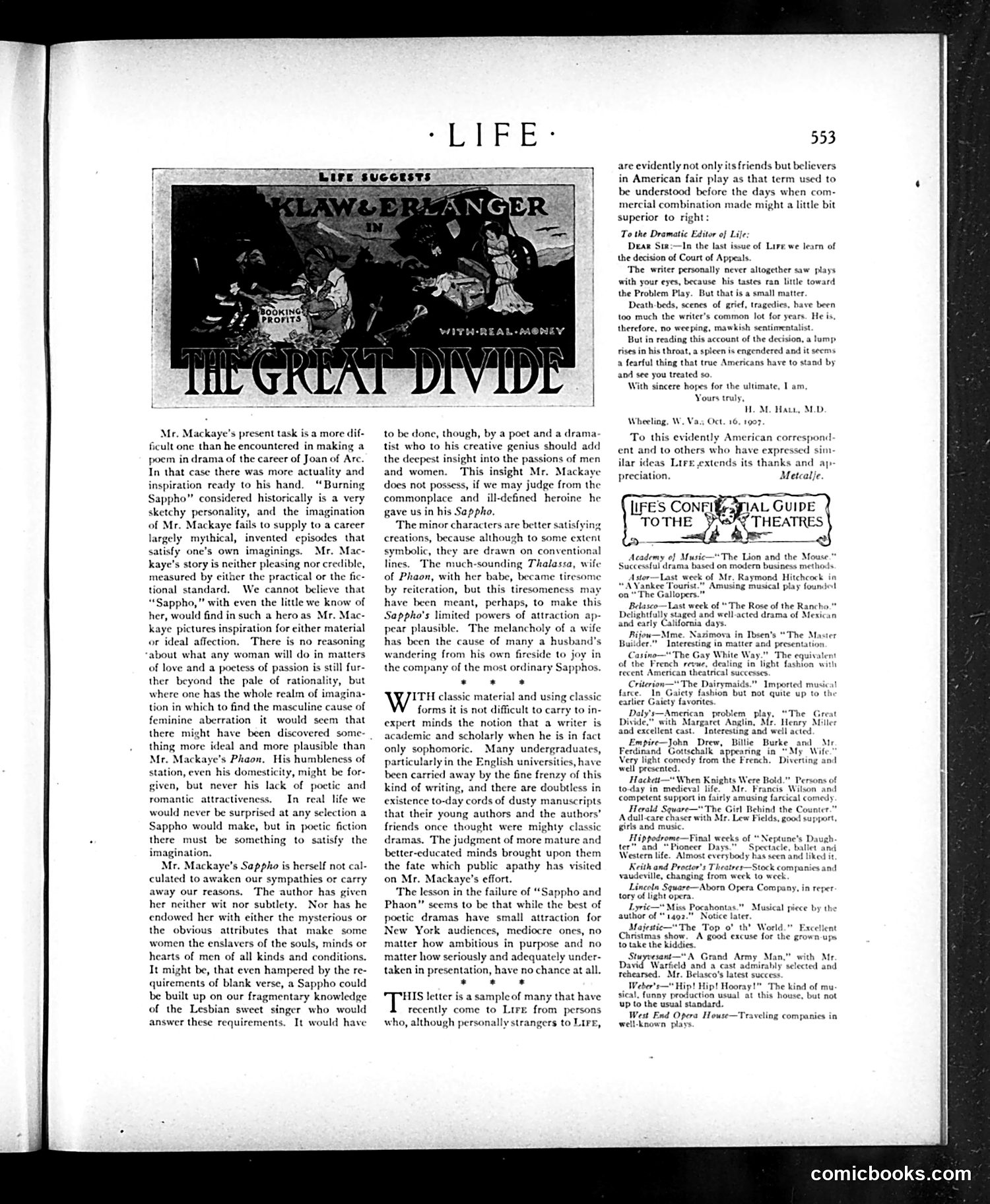
This page reviews a theatrical production of "Sappho and Phaon," a poetic drama by Percy Mackaye based on classical Greek subject matter. The cartoon at top advertises the play itself. The review is scathing. The critic argues that Mackaye's reimagining of the ancient poet Sappho fails because: (1) the male lead character Phaon lacks romantic appeal or poetic merit—he's merely a humble, domestic figure unconvincing as an object of passion; (2) Sappho herself is drawn without wit, subtlety, or the mysterious qualities that would justify her legendary status; and (3) using classical forms and material doesn't make mediocre work "scholarly"—it merely attracts unsophisticated audiences. The underlying point: ambitious but poorly executed "serious" drama cannot succeed with New York theatergoers, regardless of lofty subject matter.
📄 Transcribed text from this page (OCR, searchable)
Machine-transcribed from the original scan — historical spelling and the odd misread are preserved.
Mr. Mackaye’s present task is a more dif- ficult one than he encountered in makin poem in drama of the career of Joan of Arc. In that case there was more actuality and inspiration ready to his hand. “Burning Sappho” considered historically is a very sketchy personality, and the imagination of Mr. Mackaye fails to supply to a career largely mythical, invented episodes that satisfy one’s own imaginings. Mr. Mac- kaye’s story is neither pleasing nor credibl measured by either the practical or the fic- tional standard, We cannot believe that “Sappho,” with even the little we know of her, would find in such a heroas Mr. Mac- kaye pictures inspiration for either material or ideal affection, There is no reasoning pout what any woman will do in matters of love and a poctess of passion is still fu ther beyond the pale of rationality, but where one has the whole realm of imagina- tion in which to find the masculine cause of feminine aberration it would seem that there might have been discovered sor thing more ideal and more plausible than Mr. Mackaye’s Phaon. His humbleness of station, even his domesticity, might be for- given, but never his lack of poctic and romantic attractiveness. In real life we would never be surprised at any selection a Sappho would make, but in poctic fiction there must be something to satisfy the imagination, Mr. Mackaye's Sappho is herself not cal- culated to awaken our sympathies or carry away our reasons. The author has her neither wit nor subtlety. Nor has he endowed her with either the mysterious or the obvious attributes that make some women the enslavers of the souls, minds or hearts of men of all kinds and conditions. It might be, that even hampered by the re- quirements of blank verse, a Sappho could be built up on our fragmentary knowledge of the Lesbian sweet singer who would answer these requirements. It would have to be done, though, by a poet and a drama tist who to his creative genius should add the deepest insight into the passions of men and women. This insight Mr. Mackay does not possess, if we may judge from the commonplace and ill-defined heroine he gave us in his Sappho. The minor characters are better satisfyin; creations, because although to some extent symbolic, they are drawn on conventional lines, The much-sounding Thalassa, wifi of Phaon, with her babe, became tiresome by reiteration, but this tiresomeness m have been meant, perhaps, to make this Sappho's limited powers of attraction ap- pear plausible. The melancholy of a wife has been the cause of many a husband's wandering from his own fireside to joy in the company of the most ordinary Sapphos. * 8 8 ITH classic material and using classic forms it is not difficult to carry to in- expert minds the notion that a writer is academic and scholarly when he is in fact only sophomoric. Many undergraduates, particularly in the English universities, have been carried away by the fine frenzy of this kind of writing, and there are doubtless in existence to-day cords of dusty manuscripts that their young authors and the authors’ friends once thought were mighty classic dramas. The judgment of more mature and better-educated minds brought upon them the fate which public apathy has visited on Mr. Mackaye’s effort. ‘The lesson in the failure of “Sappho and Phaon” scems to be that while the best of poetic dramas have small attraction for New York audiences, mediocre ones, no matter how ambitious in purpose and no matter how seriously and adequately under- taken in presentation, have no chance at all. * 8 ¢ HIS letter is a sample of many that have recently come to Lire from persons who, although personally strangers to Lire, 553 are evidently not only its friends but believers in American fair play as that term used to be understood before the days when com- mercial combination made might a little bit superior to right: To the Dramatic Editor of Life: Dear Sia:—In the last issue of Lire we learn of the decision of Court of Appeals. ‘The writer personally never altogether saw plays with your eyes, because his tastes ran little toward the Problem Play Death-beds, scenes of grief, tragedies, have been too much the writer's common lot for years. He But that is a small matter. therefore, no weeping, mawkish sentinrentalist But in reading th rises in his throat, a spleen is engendered and it sec: a fearful thing that true Americans have to stand by and see you treated so. With sincere hopes for the ultimate, Tam Yours truly, HW. M. Hau, M.D Wheeling. W. Vas Oct. 16, 19 account of the decision, a lump To this evidently American correspond. ent and to others who have expressed sin ilar ideas Lire extends its thanks and ay preciation. Metcalje. [IFES CONFI Academy of Music—"'The Lion and the Mouse.” Successful drama based on modern business methods {stor—Last week of Mr. Raymond Hitchcock in “AYankee Tourist.” Amusing musical play foun ¢ Gallopers. Belasco—Last week of "The Rose of the Rancho." Delightfully staged and well-acted drama of Mexican and early California days. Rijon—Mme. Nazimova in Ibsen's “The Master Builder.” " Interesting in matter and presentation Casino—" The Gay White Way.” ‘The equivalent of the French revue, dealing in light fashion wit recent American theatrical successes. Criterion—""The Dairymaids.” Imported music farce. In Gaiety fashion but not quite up to th: earlier Gaiety favorites. Daly's—American problem play, Divide,” with Margaret Anglin, Me. and excellent cast. Interesting and well acted Empire—John Drew, Billie Burke and Mr Ferdinand Gottschalk appearing in “My Wife Very light comedy from the French. Diverting and well presented. Hackett—" When Knights Were Bold." Persons of to-day in medieval life. Mr. Francis Wilson and competent support in fairly amusing farcical comedy Herald Square—"The Girl Behind the Coun A dull-<are chaser with Mr. Lew Fields, good s girls and music Hippedrome—Final weeks of "* Neptu ter” and “Pioneer Days." Western life. Almost everybody has seen and liked it Keith and Proctor's Theatres—Stock co vaudeville, changing from week to week. Lincota Square—Aborn Opera Company, in r tory of light opera. Lyric— Miss Pocahontas author of 1492." Notice later. Mojestic—" The ‘Top o' th’ World.” Excellent Christmas show. A good excuse for the grown-ups, to take the kiddies. tuyvesant—"A Gran David Warfield and a rehearsed. Weber’s—" Hip! Hip! Hooray!" ‘The kind of mu sical, funny production usual at this house, but not up to the usual standard. West End Opera Howse—Traveling companies in well-known plays “The Great Henry Miller 's Daugh: Spectacle, ballet and ppanies and Musical piece by the Army Man.” with Mr st admirably selected and Mr. Belasco's latest success. comicbooks.com