
Life, 1907-11-07 · page 22 of 50
Life — November 7, 1907 — page 22: what you’re looking at
What you’re looking at
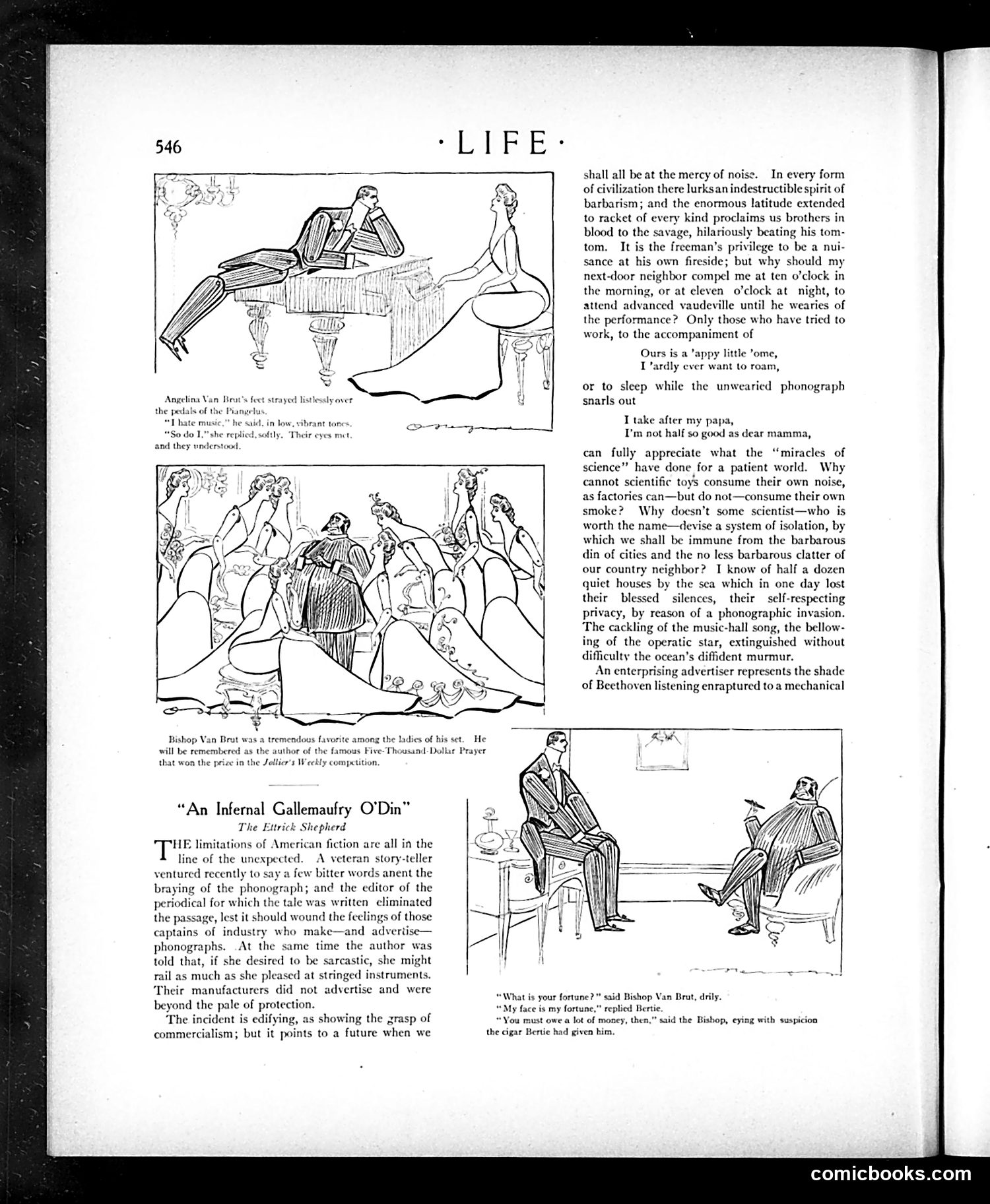
This page critiques two interconnected problems in early 20th-century America: the invasion of mechanical noise (particularly phonographs) into private life, and the censorship of social criticism by commercial interests. The top cartoons illustrate the author's complaint: phonographs and pianos invade homes and public spaces, forcing unwilling audiences to endure noise. The text sarcastically contrasts America's "freedom" with how neighbors can compel attendance at "advanced vaudeville" through phonographic noise. The lower section explains editorial censorship: a story criticizing phonographs was rejected because phonograph manufacturers advertise in the magazine, while criticism of stringed instruments was permitted since their makers don't advertise. The author identifies this as the "grasp of commercialism"—advertisers dictate editorial content. The final cartoon featuring "Bishop Van Brut" appears to illustrate this hypocrisy, though the specific reference is unclear from the visible text. The satire targets how commercial interests suppress legitimate social critique.
📄 Transcribed text from this page (OCR, searchable)
Machine-transcribed from the original scan — historical spelling and the odd misread are preserved.
shall all be at the mercy of noise. In every form of civilization there lurksan indestructible spirit of barbarism; and the enormous latitude extended to racket of every kind proclaims us brothers in blood to the savage, hilariously beating his tom- tom. It is the freeman’s privilege to be a nui- sance at his own fireside; but why should my next-door neighbor compel me at ten o’clock in the morning, or at eleven o’clock at night, to attend advanced vaudeville until he wearies of the performance? Only those who have tried to work, to the accompaniment of Ours is a ’appy little ’ome, I ’ardly ever want to roam, or to sleep while the unwearicd phonograph Angelina Van Beot's, st ¢ snarls out the pedals of the Piangelu: he said, in low, sibrant T take after my papa, d.softly, Their eyes met I'm not half so good as dear mamma, can fully appreciate what the “miracles of science” have done for a patient world. Why cannot scientific toys consume their own noise, as factories can—but do not—consume their own smoke? Why doesn’t some scientist—who is worth the name—devise a system of isolation, by which we shall be immune from the barbarous din of cities and the no less barbarous clatter of our country neighbor? I know of half a dozen quiet houses by the sea which in one day lost their blessed silences, their self-respecting privacy, by reason of a phonographic invasion. The cackling of the music-hall song, the bellow- ing of the operatic star, extinguished without difficulty the ocean’s diffident murmur. An enterprising advertiser represents the shade of Beethoven listening enraptured toa mechanical Bishop Van Brut w ¢ among the ladies of his set. He will be remembered as r of the famous Five-Thousand-Dollar Prayer that won the prize in the '5 Weekly competition. “An Infernal Gallemaufry O'Din” The Ettrick Shepherd HE limitations of American fiction are all in the line of the unexpected. A veteran story-teller yentured recently to say a few bitter words anent the braying of the phonograph; and the editor of the periodical for which the tale was written eliminated the passage, lest it should wound the feelings of those captains of industry who make—and advertise— phonographs. At the same time the author was told that, if she desired to be sarcastic, she might rail as much as she pleased at stringed instruments. Their manufacturers did not advertise and were asiratiesear eceanmetinae van tertove beyond the pale of protection. My face ls my forvane," replied Bente The incident is edifying, as showing the grasp of You must owe a lot of money, then,” said the Bishop, eying with suspicion commercialism; but it points to a future when we the cigar Bertie had given him. comicbooks.com