
Life, 1907-11-07 · page 24 of 50
Life — November 7, 1907 — page 24: what you’re looking at
What you’re looking at
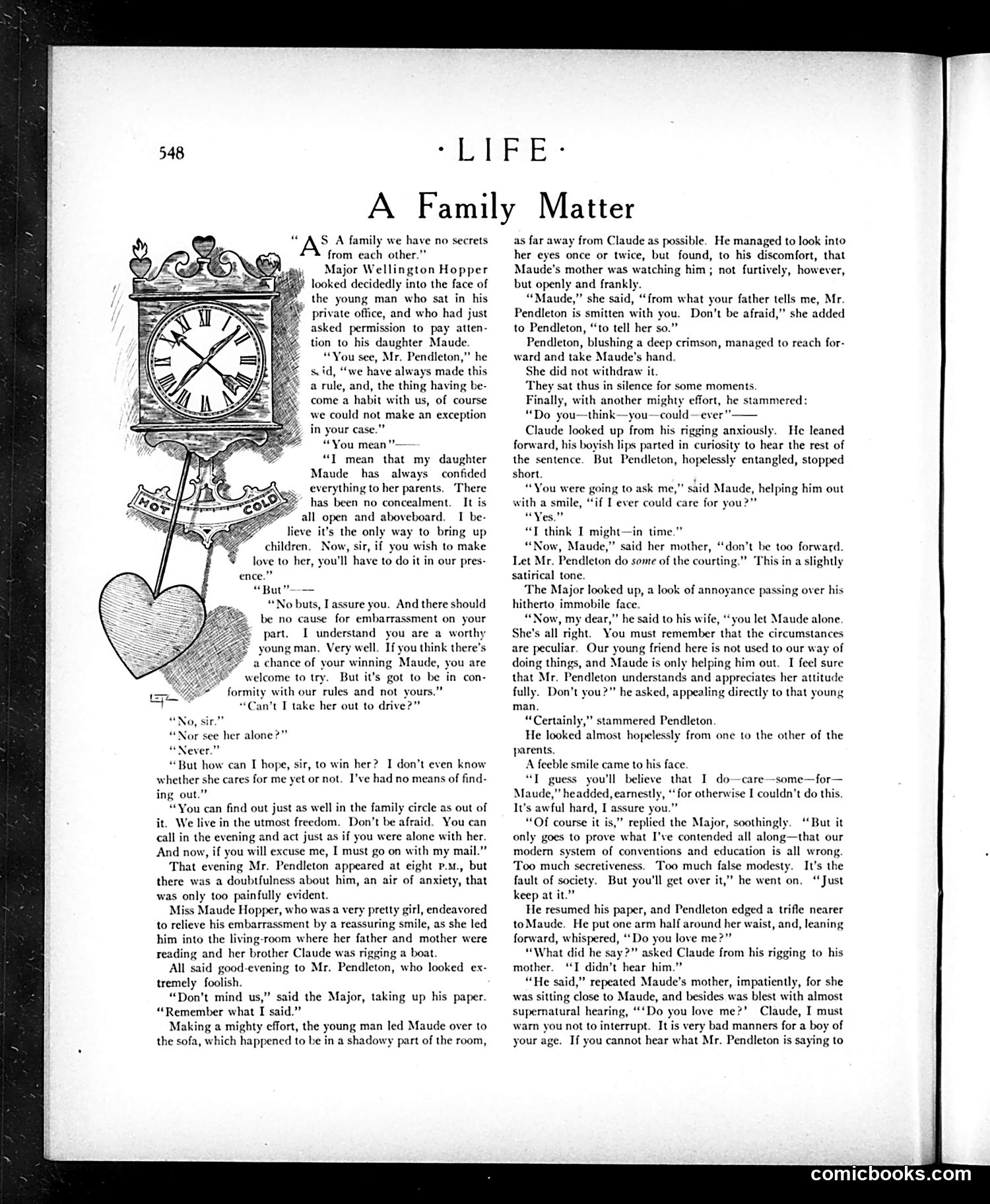
This satirical story mocks the Victorian ideal of complete family transparency and parental control over courtship. Major Hopper insists that suitor Mr. Pendleton must court his daughter Maude *only in the family's presence*, never alone—claiming this represents "utmost freedom" and openness. The humor lies in the contradiction: the family's constant surveillance under the guise of honesty actually prevents genuine courtship. Pendleton cannot speak privately to Maude, her mother openly watches him, and her brother eavesdrops—yet the parents frame this intrusive monitoring as progressive child-rearing. The satire targets late 19th/early 20th-century middle-class pretensions about "modern" parenting that paradoxically enforced stricter control than traditional courtship customs. The decorative clock illustration underscores time's importance—Pendleton literally cannot steal a moment alone.
📄 Transcribed text from this page (OCR, searchable)
Machine-transcribed from the original scan — historical spelling and the odd misread are preserved.
es eeee A Family Matter A family we have no secrets from each other.”” Major Wellington Hopper % looked decidedly into the face of * the young man who sat in his private office, and who had just asked permission to pay atten- tion to his daughter Maude. “You see, Mr. Pendleton,” he sid, “we have always made this a rule, and, the thing having be- come a habit with us, of course we could not make an exception in your case.” “You mean”’— “IT mean that my daughter Maude has always confided everything to her parents. There has been no concealment. It is * all open and aboveboard. I be- i it’s the only way to bring up children sir, if you wish to make love to her, you'll have to do it in our pres- ence.” “Bur!?—— “No buts, I assure you. And there should be no cause for embarrassment on your part. I understand you are a worth: young man. Very well. Ifyou think there’s a chance of your winning Maude, you are welcome to try. But it’s got to be in con- formity with our rules and not yours.” “Can't I take her out to drive?” Nor see her alone?” “Never.” “But how can I hope, sir, to win her? I don’t even know whether she cares for me yet or not. I’ve had no means of find- ing out.” “You can find out just as well in the family circle as out of it. We live in the utmost freedom. Don’t be afraid. You can call in the evening and act just as if you were alone with her. ‘And now, if you will excuse me, I must go on with my mail.” That evening Mr. Pendleton appeared at eight p.st., but there was a doubtfulness about him, an air of anxiety, that was only too painfully evident. Miss Maude Hopper, who was a very pretty girl, endeavored to relieve his embarrassment by a reassuring smile, as she led him into the living-room where her father and mother were reading and her brother Claude was rigging a boat. All said good-evening to Mr. Pendleton, who looked ex- tremely foolish. “Don’t mind us,” said the Major, taking up his paper “Remember what I said.” Making a mighty effort, the young man led Maude over to the sofa, which happened to be in a shadowy part of the room, as far away from Claude as possible. He managed to look into her eyes once or twice, but found, to his discomfort, that Maude’s mother was watching him ; not furtively, however, but openly and frankly “Maude,” she said, “from what your father tells me, Mr. Pendleton is smitten with you. Don’t be afraid,” she added to Pendleton, “to tell her so.” Pendleton, blushing a deep crimson, managed to reach for- ward and take Maude’s hand She did not withdraw it. They sat thus in silence for some moments. inally, with another mighty effort, he stammered: “Do you—think—you—could—ever” Claude looked up from his rigging anxiously. He leaned forward, his boyish lips parted in curiosity to hear the rest of But Pendleton, hopelessly entangled, stopped the sentence. short. i “You were going to ask me,” said Maude, helping him out with a smile, “if I ever could care for you?” “T think I might—in time.” Now, Maude,” said her mother, “don’t be too forward. Let Mr. Pendleton do some of the courting.” This in a slightly satirical tone. The Major looked up, a look of annoyance passing over his hitherto immobile face. Now, my dear,” he said to his wife, “you let Maude alone. She's all right. You must remember that the circumstances are peculiar. Our young friend here is not used to our way of doing things, and Maude is only helping him out. I feel sure that Mr. Pendleton understands and appreciates her attitude fully. Don’t you?” he asked, appealing directly to that young man. “Certainly,” stammered Pendleton He looked almost hopelessly from one to the other of the parents, A feeble smile came to his face. “T guess you'll believe that I do—care—some—for Maude,” headded, earnestly, “for otherwise I couldn’t do thi It’s awful hard, I assure you.” “Of course it is,” replied the Major, soothingly. “But it only goes to prove what I’ve contended all along—that our modern system of conventions and education is all wrong. Too much secretiveness. Too much false modesty. It’s the fault of society. But you'll get over it,” he went on, “Just keep at it.” He resumed his paper, and Pendleton edged a trifle nearer toMaude. He put one arm half around her waist, and, leaning forward, whispered, ‘Do you love me?” “What did he say?” asked Claude from his rigging to his mother. “I didn’t hear him.” “He said,” repeated Maude’s mother, impatiently, for she was sitting close to Maude, and besides was blest with almost supernatural hearing, “‘Do you love me?? Claude, I must warn you not to interrupt. It is very bad manners for a boy of your age. If you cannot hear what Mr. Pendleton is saying to comicbooks.com