
Life, 1907-11-07 · page 18 of 50
Life — November 7, 1907 — page 18: what you’re looking at
What you’re looking at
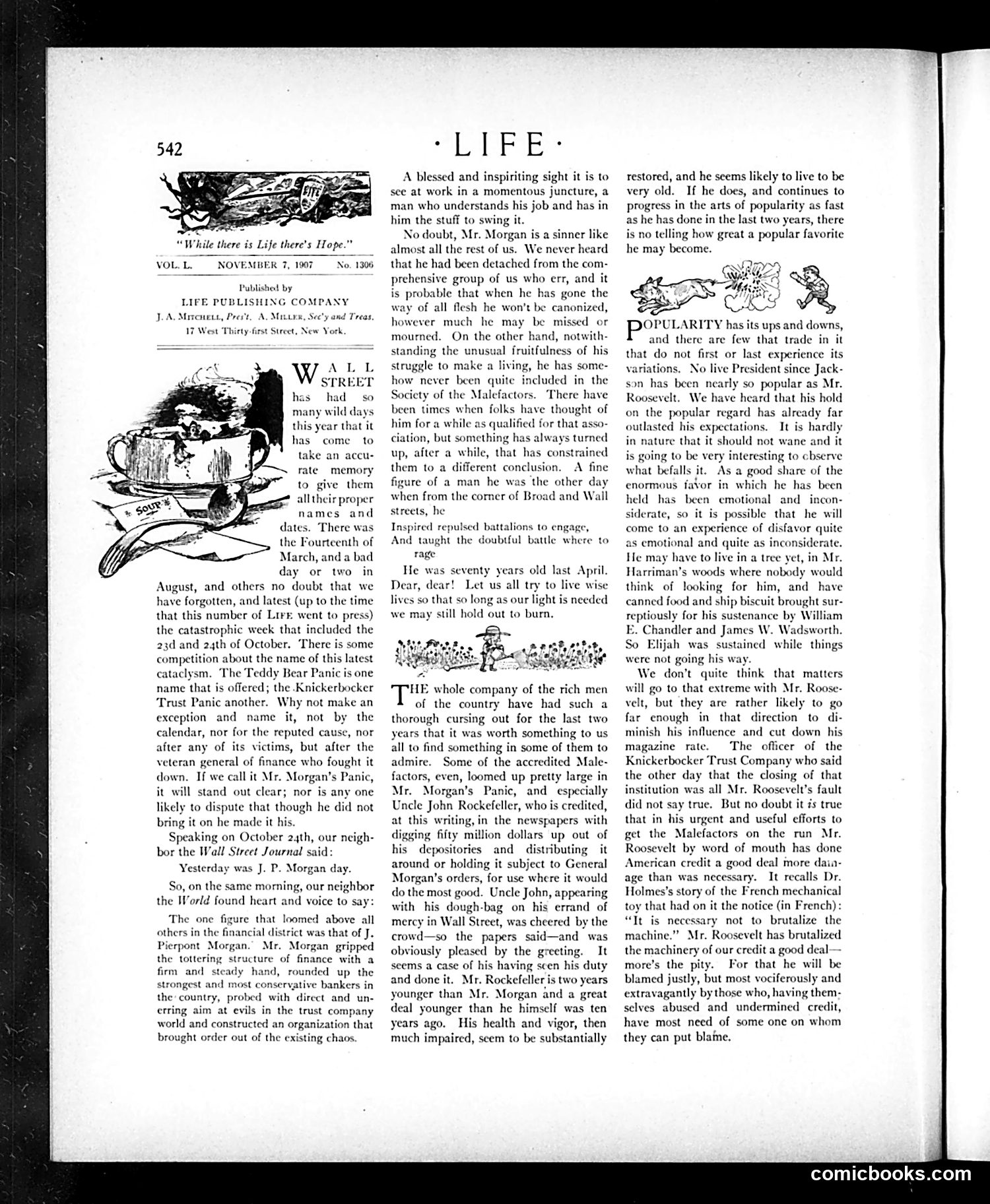
This page celebrates **J.P. Morgan's role in controlling the financial panic of October 1907**. The cartoon shows Morgan as a forceful figure commanding Wall Street during the crisis. **The Context:** The text describes the recent stock market collapse (October 23-24, 1907), proposing it be called "Mr. Morgan's Panic" because Morgan, not the initial cause, dominated the response. He mobilized conservative bankers and "brought order out of the existing chaos." **The Satire:** Life's tone is genuinely admiring yet tongue-in-cheek. While acknowledging Morgan is "a sinner like almost all the rest of us" and joking about his eventual canonization, the magazine praises his competence and steadiness. The piece notes even despised tycoons like Rockefeller gained public approval by contributing to Morgan's stabilization effort. **The Point:** During economic crisis, even America's most-criticized robber barons became heroes through decisive action. Morgan's financial authority was so absolute that he single-handedly restored confidence—a remarkable concentration of power the magazine presents with both admiration and irony.
📄 Transcribed text from this page (OCR, searchable)
Machine-transcribed from the original scan — historical spelling and the odd misread are preserved.
“While there is Life there's Hope.” NOVEMBER 7, 1907 No. 1306 VOL. L Published by LIFE PUBLISHING COMPANY JA. Mircette, Pres 17 West Thirty-first Street, New York A. Mitr, Sec'y and Treas, ALL STREET has had so many wild days this year that it has come to take an accu- rate memory to give them alltheir proper ames and . There was ‘ourteenth of March, and a bad day or two in August, and others no doubt that we have forgotten, and latest (up to the time that this number of Lire went to press) the catastrophic week that included the 23d and 24th of October. ‘There is some competition about the name of this latest cataclysm. The Teddy Bear Panic is one name that is offered; the .Knickerbocker ‘Trust Panic another. Why not make an exception and name it, not by the calendar, nor for the reputed cause, nor after any of its victims, but after the veteran general of finance who fought it down. If we call it Mr. Morgan’s Panic, it will stand out clear; nor is any one likely to dispute that though he did not bring it on he made it his. Speaking on October 24th, our neigh- bor the Wall Street Journal said: Yesterday was J. P. Morgan day. So, on the same morning, our neighbor the World found heart and voice to say: The one figure that loomed above all others in the financial district was that of J. Pierpont Morgan. Mr. Morgan gripped the tottering structure of finance with a firm and steady hand, rounded up the strongest and most conservative bankers in the:country, probed with direct and un- erring aim at evils in the trust company world and constructed an organization that brought order out of the existing chaos. oat (al ck A blessed and inspiriting sight it is to see at work in a momentous juncture, a man who understands his job and has in him the stuff to swing it. No doubt, Mr. Morgan is a sinner like almost all the rest of us. We never heard that he had been detached from the com- prehensive group of us who err, and it is probable that when he has gone the way of all flesh he won't be canonized, however much he may be missed or mourned. On the other hand, notwith- standing the unusual fruitfulness of his struggle to make a living, he has some- how never been quite included in. the Society of the Malefactors. There have been times when folks have thought of him for a while as qualified for that asso- ciation, but something has always turned up, after a while, that has constrained them to a different conclusion. A fine figure of a man he was the other day when from the corner of Broad and Wall streets, he Inspired repulsed battalions to engage, And taught the doubtful battle where to rage He was seventy years old last April. Dear, dear! Let us all try to live wise lives so that so long as our light is needed we may still hold out to burn, HE whole company of the rich men of the country have had such a thorough cursing out for the last two years that it was worth something to us all to find something in some of them to admire. Some of the accredited Male- factors, even, loomed up pretty large in Mr. Morgan’s Panic, and especially Uncle John Rockefeller, who is credited, at this writing, in the newspapers with digging fifty million dollars up out of his depositories and distributing it around or holding it subject to General Morgan’s orders, for use where it would do the most good. Uncle John, appearing with his dough-bag on his errand of mercy in Wall Street, was cheered by the crowd—so the papers said—and was obviously pleased by the greeting. It ems a case of his having scen his duty and done it. Mr. Rockefeller is two years younger than Mr. Morgan and a great deal younger than he himself was ten years ago. His health and vigor, then much impaired, seem to be substantially restored, and he seems likely to live to be very old. If he does, and continues to progress in the arts of popularity as fast as he has done in the last two years, there is no telling how great a popular favorite he may become. OPU Y has its ups and downs, and there are few that trade in it that do not first or last experience its variations, No live President since Jack- son has been nearly so popular as Mr. Roosevelt. We have heard that his hold on the popular regard has already far outlasted his expectations. It is hardly in nature that it should not wane and it is going to be very interesting to cbserve at befalls it. As a good share of the enormous favor in which he has been held has been emotional and incon- siderate, so it is possible that he will come to an experience of disfavor quite as emotional and quite as inconsiderate. He may have to live in a tree yet, in Mr. Harriman’s woods where nobody would think of looking for him, and have canned food and ship biscuit brought sur- reptiously for his sustenance by William E. Chandler and James W. Wadsworth. So Elijah was sustained while things were not going his way We don’t quite think that matters will go to that extreme with Mr. Roose- velt, but they are rather likely to go far enough in that direction to di- minish his influence and cut down his magazine rate. The officer of the Knickerbocker Trust Company who said the other day that the closing of that institution was all Mr. Roosevelt’s fault did not say true, But no doubt it és true that in his urgent and useful efforts to get the Malefactors on the run Mr. Roosevelt by word of mouth has done American credit a good deal more daia- age than was necessary. It recalls Dr. Holmes’s story of the French mechanical toy that had on it the notice (in French) “It is necessary not to brutalize the machine.” Mr. Roosevelt has brutalized the machinery of our credit a good deal more’s the pity. For that he will be blamed justly, but most vociferously and extravagantly by those who, having them- selves abused and undermined credit, have most need of some one on whom they can put blame. comicbooks.com