
Life, 1907-11-07 · page 21 of 50
Life — November 7, 1907 — page 21: what you’re looking at
What you’re looking at
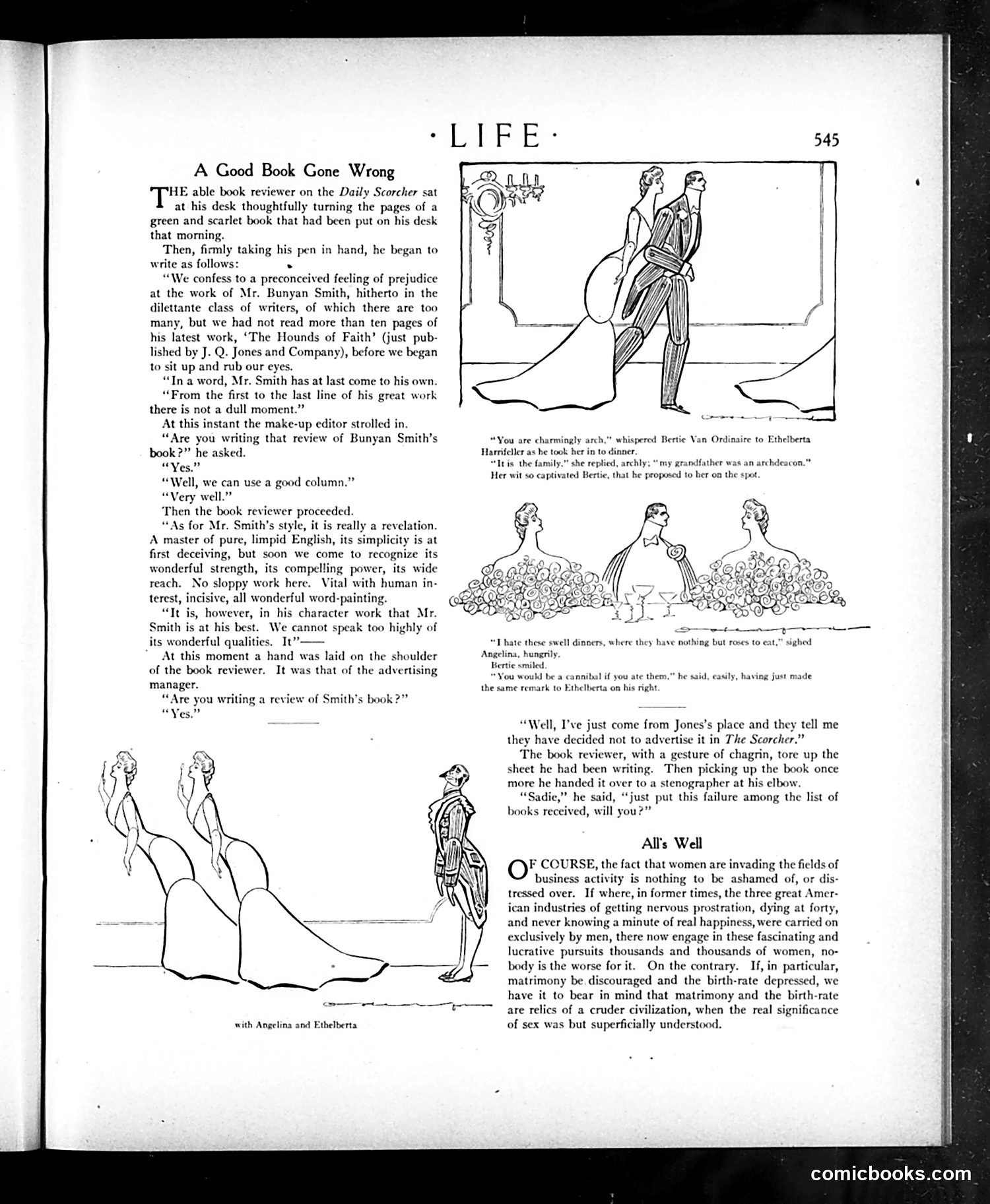
This cartoon satirizes the compromised nature of book reviewing. A reviewer enthusiastically praises a mediocre novel by Bunyan Smith, calling it a masterpiece with "wonderful strength" and "compelling power." However, the moment an advertising manager informs him that the book's publisher won't advertise in *The Scorcher* (the fictional newspaper), the reviewer immediately tears up his review and dismisses the same book as a "failure." The satire targets **pay-to-play book reviewing**—the implication that positive reviews depend on advertising revenue rather than literary merit. The joke exposes how commercial interests corrupt critical judgment: the book's quality hasn't changed, only its advertising budget. The three subsidiary cartoons about "Angelina and Ethelberta" appear unrelated social humor. The piece criticizes the publishing industry's mercenary practices and the lack of editorial independence in early 20th-century American journalism.
📄 Transcribed text from this page (OCR, searchable)
Machine-transcribed from the original scan — historical spelling and the odd misread are preserved.
A Good Book Gone Wrong 'HE able book reviewer on the Daily Scorcher sat at his desk thoughtfully turning the pages of a green and scarlet book that had been put on his desk that morning. Then, firmly taking his pen in hand, he began to write as follows: . “We confess to a preconceived feeling of prejudice at the work of Mr. Bunyan Smith, hitherto in the dilettante class of writers, of which there are too many, but we had not read more than ten pages of his latest work, ‘The Hounds of Faith’ (just pub- lished by J. Q. Jones and Company), before we began to sit up and rub our eyes. “In a word, Mr. Smith has at last come to his own. “From the first to the last line of his great work there is not a dull moment.” At this instant the make-up editor strolled in. “Are you writing that review of Bunyan Smith's book?” he asked. Ves! “Well, we can use a good column.” “Very well.” Then the book reviewer proceeded. “As for Mr. Smith’s style, it is really a revelation. A master of pure, limpid English, its simplicity is at first deceiving, but soon we come to recognize its wonderful strength, its compelling power, its wide reach. No sloppy work here. Vital with human in- terest, incisive, all wonderful word-painting. “Tt is, however, in his character work that Mr. Smith is at his best. We cannot speak too highly of its wonderful qualities. Iv’—— At this moment a hand was laid on the sho of the book reviewer. It was that of the advertising manager. “Are you writing a review of Smith’s book?” ores” a with Angelina and Ethelberta “You are charmingly a whispered Bertie Van Ordinaire to Ethetberta Harrifeller as he took her in to dinner. “Itis the family.” she replied, archly; “my grandfather was an archdeacon.” Her wit so captivated Bertie, that he proposed to her on the spot “Thate these swell dinners, where they have nothing but roses to eat,” sighed Angelina, hungrily. Bertie smiled. “You would be a cannibal if you ate them,” he said, easily, having just made the same remark to Ethelberta on his right. “Well, I’ve just come from Jones’s place and they tell me they have decided not to advertise it in The Scorcher.” The book reviewer, with a gesture of chagrin, tore up the sheet he had been writing. Then picking up the book once more he handed it over to a stenographer at his elbow. “Sadie,” he said, ‘‘just put this failure among the list of books received, will you?” All's Well F COURSE, the fact that women are invading the fields of business activity is nothing to be ashamed of, or dis- tressed over. If where, in former times, the three great Amer- ican industries of getting nervous prostration, dying at forty, and never knowing a minute of real happiness, were carried on exclusively by men, there now engage in these fascinating and lucrative pursuits thousands and thousands of women, no- body is the worse for it. On the contrary. If, in particular, matrimony be discouraged and the birth-rate depressed, we have it to bear in mind that matrimony and the birth-rate are relics of a cruder civilization, when the real significance of sex was but superficially understood. comicbooks.com