
Life, 1907-11-07 · page 28 of 50
Life — November 7, 1907 — page 28: what you’re looking at
What you’re looking at
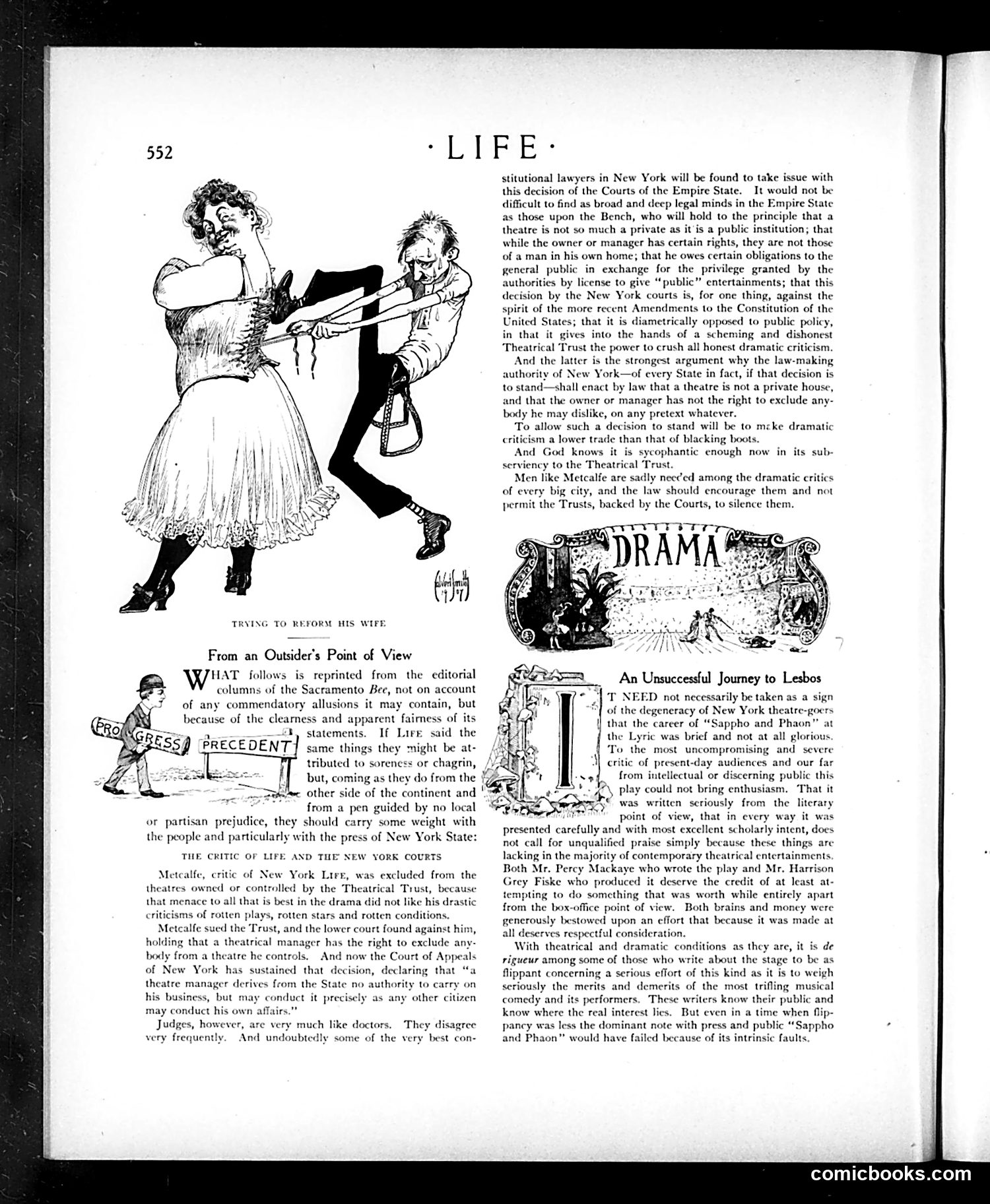
This page discusses a lawsuit by **Metcalfe, a theater critic for Life magazine**, against the **Theatrical Trust**—a powerful monopoly controlling major New York theaters. The Trust excluded Metcalfe because he published "drastic criticisms" of their productions. **The cartoon** (top left, captioned "Trying to Reform His Wife") illustrates the dispute through domestic satire: a man attempts to "reform" a resistant woman, paralleling efforts to control or silence the Theatrical Trust's practices. **The legal issue**: New York's Court of Appeals ruled theater managers could exclude anyone they disliked, treating theaters as private property. The editorial (reprinted from Sacramento's newspaper for credibility) argues this decision is wrong—theaters should be treated as public institutions with obligations to the public, not private houses. The piece contends the ruling unconstitutionally empowers a "scheming and dishonest" monopoly to crush honest dramatic criticism, making theater criticism "a lower trade than blacking boots."
📄 Transcribed text from this page (OCR, searchable)
Machine-transcribed from the original scan — historical spelling and the odd misread are preserved.
‘LTE ? TRYING TO REFORM HIS WIFE From an Outsider’s Point of View HAT follows is reprinted from the editorial columns of the Sacramento Bee, not on account of any commendatory allusions it may contain, but because of the clearness and apparent fairness of its 1 1) statements. If Lire said the ESSQ PRECEDENT] same things they might be at- tributed to sorencss or chagrin, but, coming as they do from the other side of the continent and from a pen guided by no local or partisan prejudice, they should carry some weight with the people and particularly with the press of New York State: THE CRITIC OF LIFE AND THE NEW YORK COURTS Metcalfe, critic of New York Lire, was excluded from the theatres owned or controlled by the Theatrical Trust, because that menace to all that is best in the drama did not like his drastic criticisms of rotten plays, rotten stars and rotten conditions. Metcalfe sued the Trust, and the lower court found against him, holding that a theatrical manager has the right to exclude any- body from a theatre he controls. And now the Court of Appeals of New York has sustained that decision, declaring that “a theatre manager derives fom the his business, but may conduct it precisely as any other citizen may conduct his own affairs.” Judges, however, are very much like doctors. They disagree very frequently. And undoubtedly some of the very best con- State no authority to carry on stitutional lawyers in New York will be found to take issue with this decision of the Courts of the Empire State. It would not be difficult to find as broad and deep legal minds in the Empire State as those upon the Bench, who will hold to the principle that a theatre is not so much a private as it'is a public institution; that while the owner or manager has certain rights, they are not those of a man in his own home; that he owes certain obligations to the general public in exchange for the privilege granted by the authorities by license to give “public” entertainments; that this decision by the New York courts is, for one thing, against the spirit of the more recent Amendments to the Constitution of the United States; that it is diametrically opposed to public policy, in that it gives into the hands of a scheming and dishonest ‘Theatrical Trust the power to crush all honest dramatic criticism. And the latter is the strongest argument why the law-making authority of New York—of every State in fact, if that decision is to stand—shall enact by law that a theatre is not a private house, and that the owner or manager has not the right to exclude any- body he may dislike, on any pretext whatever. To allow such a decision to stand will be to meke dramatic criticism a lower trade than that of blacking boots. And God knows it is sycophantic enough now in its sub- serviency to the Theatrical Trust. Men like Metcalfe are sadly nec’ed among the dramatic critics of every big city, and the law should encourage them and not permit the Trusts, backed by the Courts, to silence them. An Unsuccessful Journey to Lesbos + "| 7 NEED not necessarily be taken as a sign of the degeneracy of New York theatre-goers |] that the career of “Sappho and Phaon” at the Lyric was brief and not at all glorious ‘To the most uncompromising and_ severe of present-day audiences and our far from intellectual or discerning public this +. Y\ play could not bring enthusiasm. ‘That it was written seriously from the literary point of view, that in every way it was presented carefully and with most excellent scholarly intent, does all for unqualified praise simply because these things are lacking in the majority of contemporary theatrical entertainments Both Mr. Percy Mackaye who wrote the play and Mr, Harrison Grey Fiske who produced it deserve the credit of at least at- tempting to do something that was worth while entirely apart from the box-office point of view. Both brains and moncy were gencrously bestowed upon an effort that because it was made at all deserves respectful consideration. With theatrical and dramatic conditions as they are, it is de rigueur among some of those who write about the stage to be as flippant concerning a serious effort of this kind as it is to weigh seriously the merits and demerits of the most trifling musical comedy and its performers. These writers know their public and know where the real interest lies. But even in a time when fip- pancy was less the dominant note with press and public “Sappho and Phaon” would have failed because of its intrinsic faults, comicbooks.com