
A complete issue · 24 pages · 1907
Life — May 23, 1907
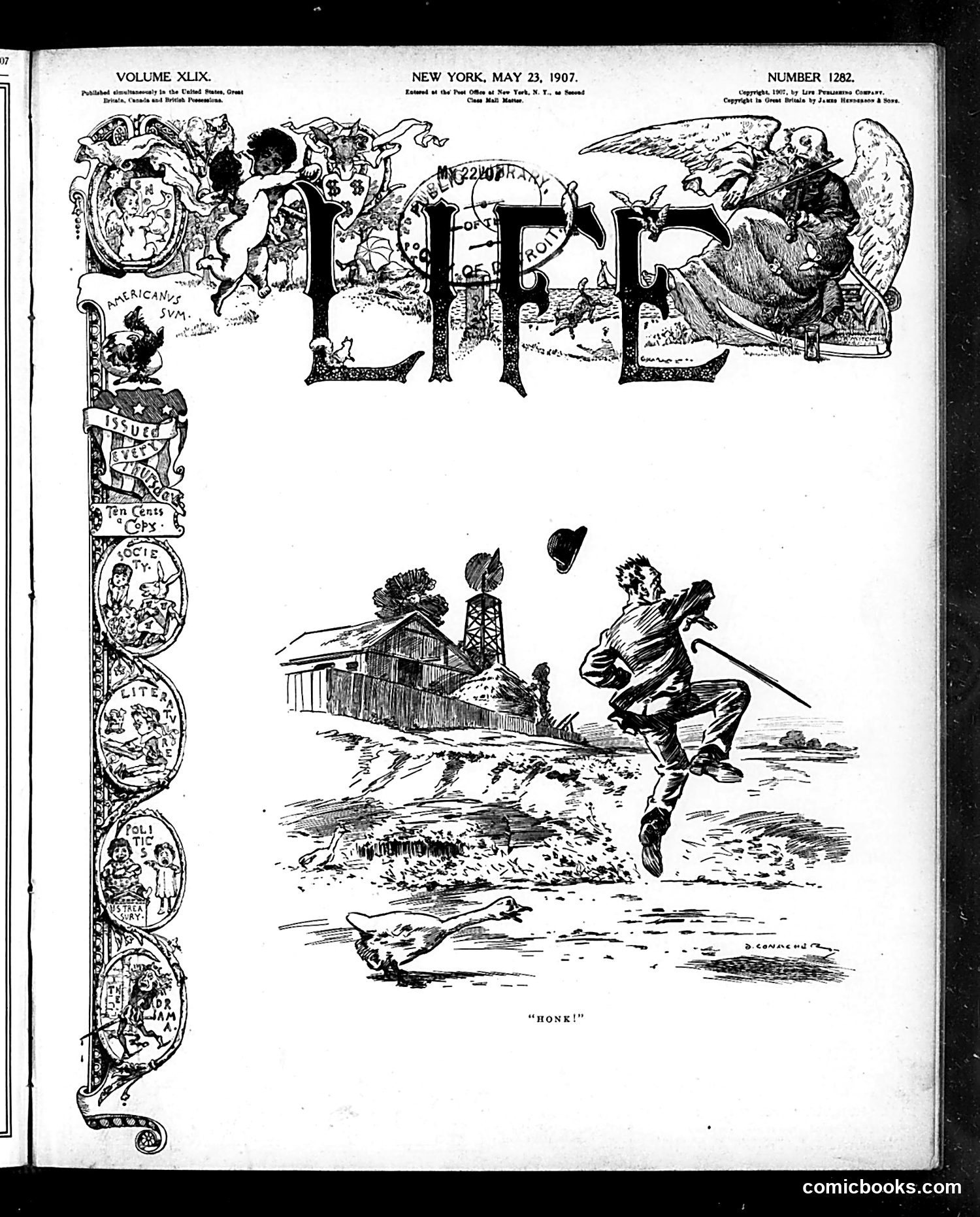
This page features a cartoon titled "Honk!" depicting a man in early 1900s clothing being startled or chased by what appears to be a goose or similar bird near a rural farmhouse. The man is shown in exaggerated motion, jumping or running away from the bird, which is characteristic of Life magazine's humorous domestic scenarios. The elaborate decorative border on the left contains small vignettes illustrating various scenes and figures, typical of Life's design aesthetic. Without additional context from the article text, the specific political or social satire—if any—remains unclear. The cartoon appears to be primarily comedic rather than overtly political, playing on the universal experience of encountering an aggressive farm animal.
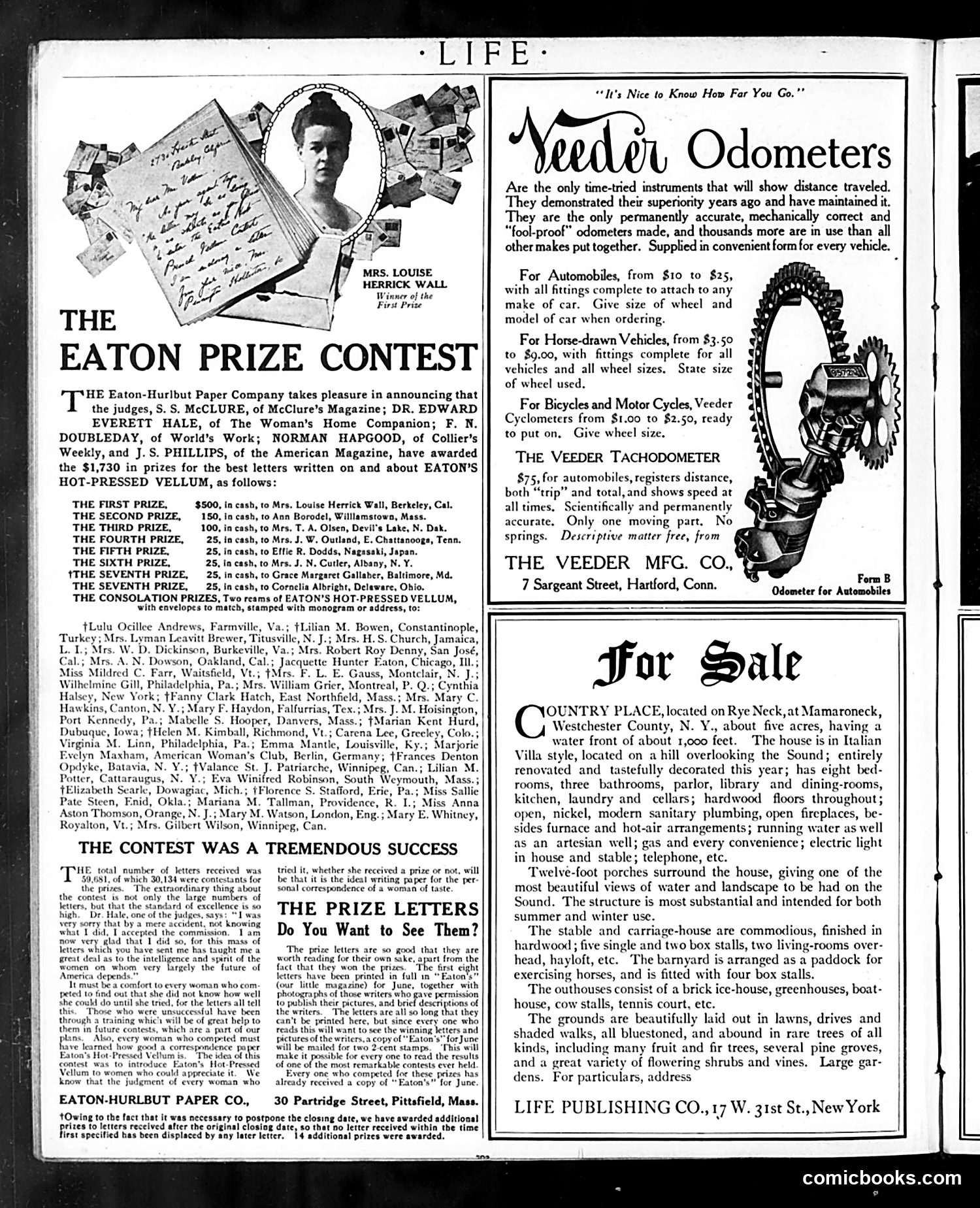
This page is primarily **advertising and announcements**, not political satire or editorial cartooning. The content features: 1. **The Eaton Prize Contest** — a writing competition by Eaton-Hurlbut Paper Company offering cash prizes ($1,250 total) for the best letters about Eaton's hot-pressed vellum paper. The winner, Mrs. Louise Herrick Wall, is pictured with sample letters. 2. **Veeder Odometer Advertisement** — promoting distance-measuring instruments for automobiles, horse-drawn vehicles, bicycles, and motorcycles. 3. **Real Estate Listing** — advertising a country property in Mamaroneck, Westchester County, New York. The page demonstrates how early 20th-century *Life* blended editorial content with commercial advertising to generate revenue. There is no political commentary or satirical cartoon present.
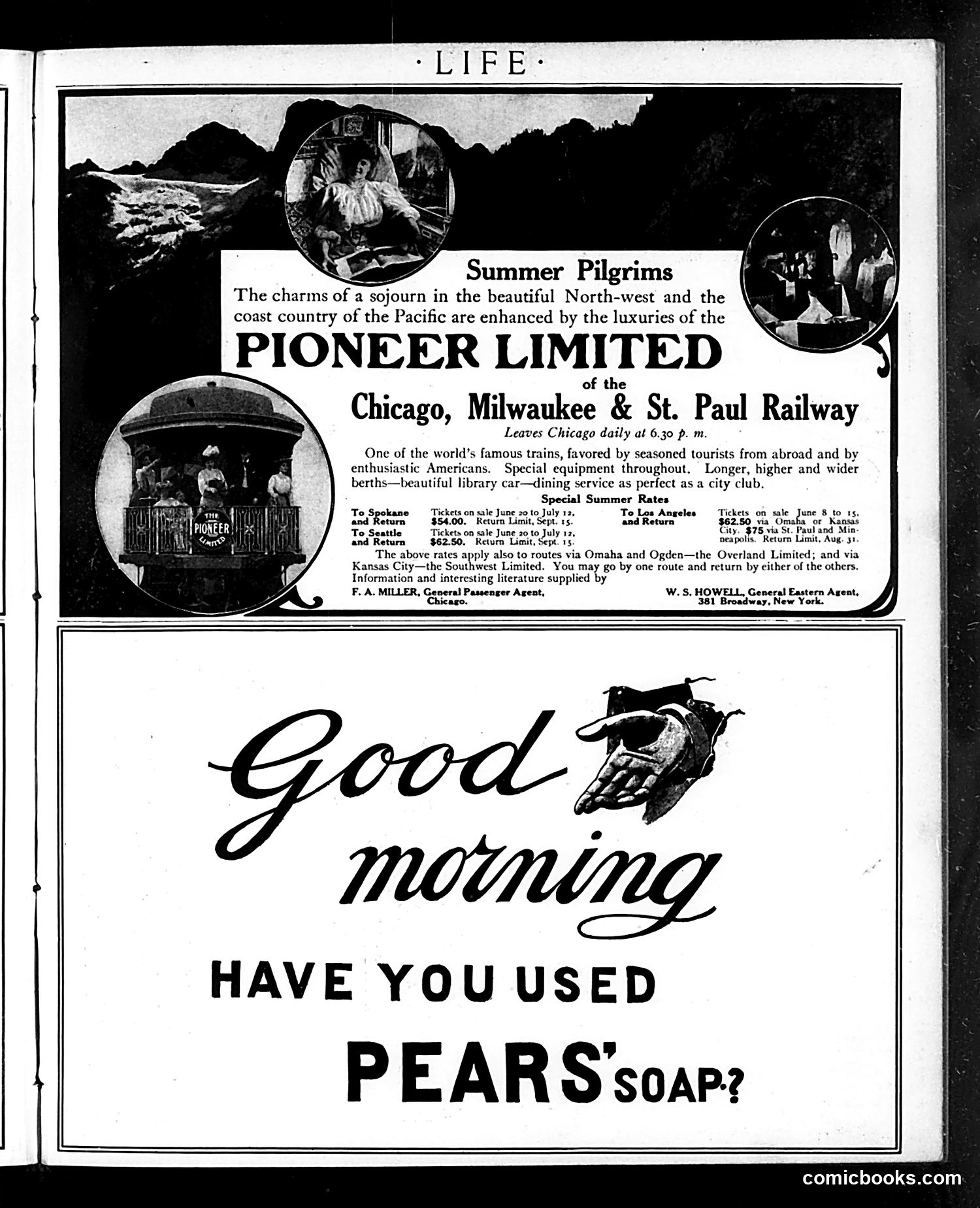
This page contains **two separate advertisements** rather than political satire or editorial cartoons. The top half advertises the **Pioneer Limited train** of the Chicago, Milwaukee & St. Paul Railway, promoting summer travel to the Pacific Northwest. It emphasizes luxury amenities (library car, dining service) and lists ticket prices and departure times for various routes. The bottom half is a **Pears' Soap advertisement** featuring the slogan "Good morning—Have you used Pears' Soap?" with an illustration of a rooster. There is **no political commentary or satire** on this page. Both ads represent typical early 20th-century magazine advertising: one promoting rail travel to tourists, the other a consumer product using a cheerful morning greeting as a marketing hook.
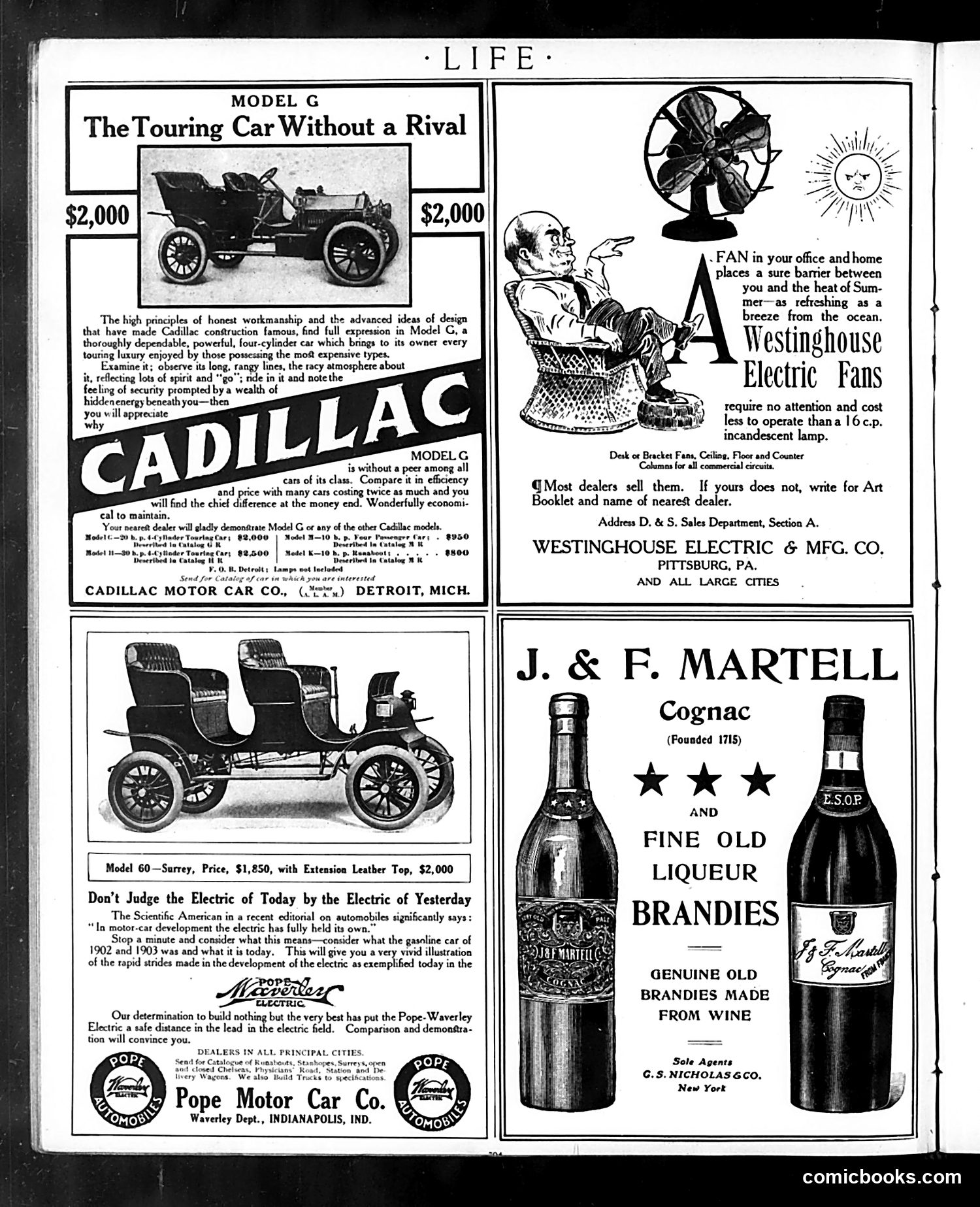
This page contains **no political cartoons or satire**—it is primarily **advertising** from what appears to be an early 1910s issue of Life magazine. The ads promote: - **Cadillac Model G** touring car ($2,000), positioned as superior in design and engineering - **Westinghouse Electric Fans**, marketed as affordable cooling alternatives to ocean breezes - **Pope Motor Car Company**, defending electric vehicles against gasoline cars, comparing development since 1902 - **J. & F. Martell Cognac and Brandies**, emphasizing age and quality ("Founded 1715") The Pope Motors ad contains the only potentially satirical element, defensively arguing that electric cars deserve reconsideration—suggesting contemporary skepticism about this competing automotive technology. Otherwise, the page reflects period consumer culture and product competition.
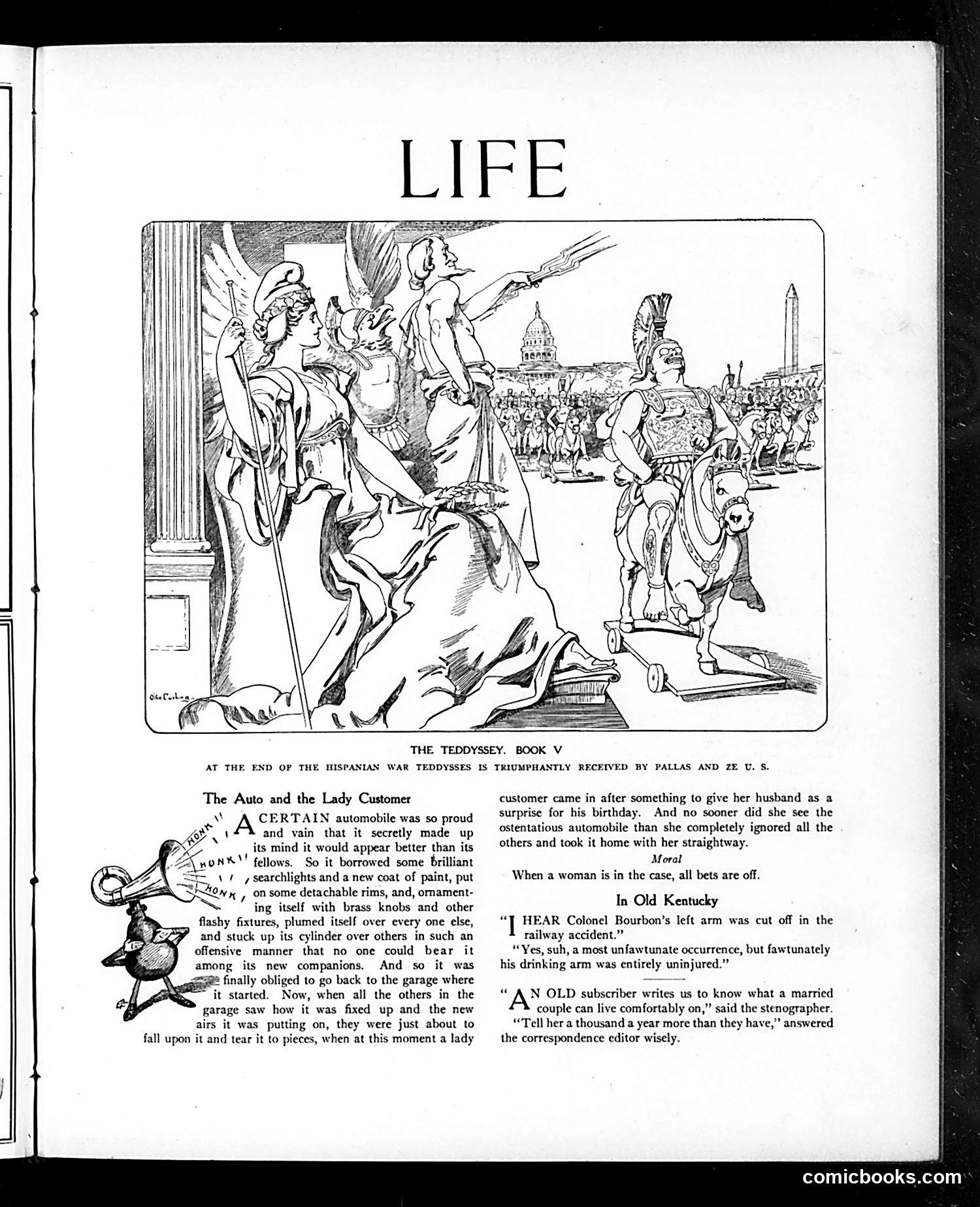
**Main Illustration (Top):** "The Teddyssey, Book V" depicts what appears to be Theodore Roosevelt (identifiable by the distinctive figure and "Teddy" reference) triumphantly received in Washington, D.C., with the Capitol visible. The caption indicates this celebrates the end of the Hispanic-American War with "Teddysses" (a playful term for Roosevelt supporters or those inspired by his actions) being "triumphantly received by Pallas and Ze U.S." **The Satire:** The classical allegorical style ironically elevates Roosevelt's wartime role to mythic status, suggesting contemporary Americans viewed him as a heroic figure worthy of ancient Roman honors. **Lower Content:** Three separate humor pieces about automobiles, Kentucky, and marriage advice—typical of Life's satirical magazine format mixing political commentary with social humor. The page reflects early 1900s American triumphalism following the Spanish-American War and Roosevelt's rising political prominence.
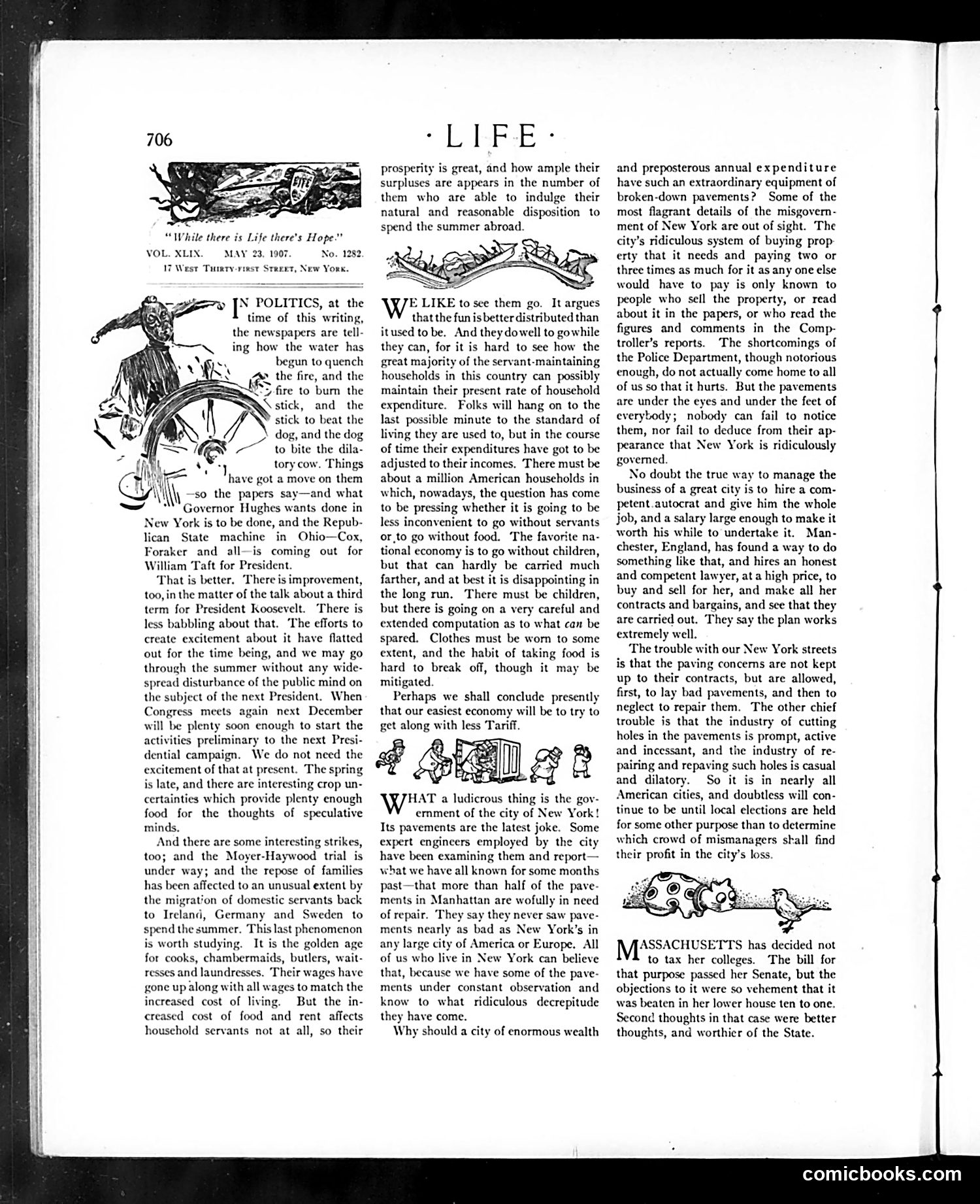
The page contains political commentary rather than cartoons. The main illustration depicts a rotund figure on a bicycle, likely representing a politician or public figure struggling with balance—a common metaphor for political instability. The text discusses several 1907 issues: Governor Hughes's reform efforts in New York and Ohio politics; the Republican/Taft succession question; President Roosevelt's upcoming December congressional address; and critiques of New York City's deteriorating infrastructure (particularly street pavements). A brief section mocks New York City's government incompetence regarding street maintenance. The final paragraph references Massachusetts's decision not to tax colleges. The satire targets political corruption, bureaucratic mismanagement, and the challenges facing Progressive Era urban governance.
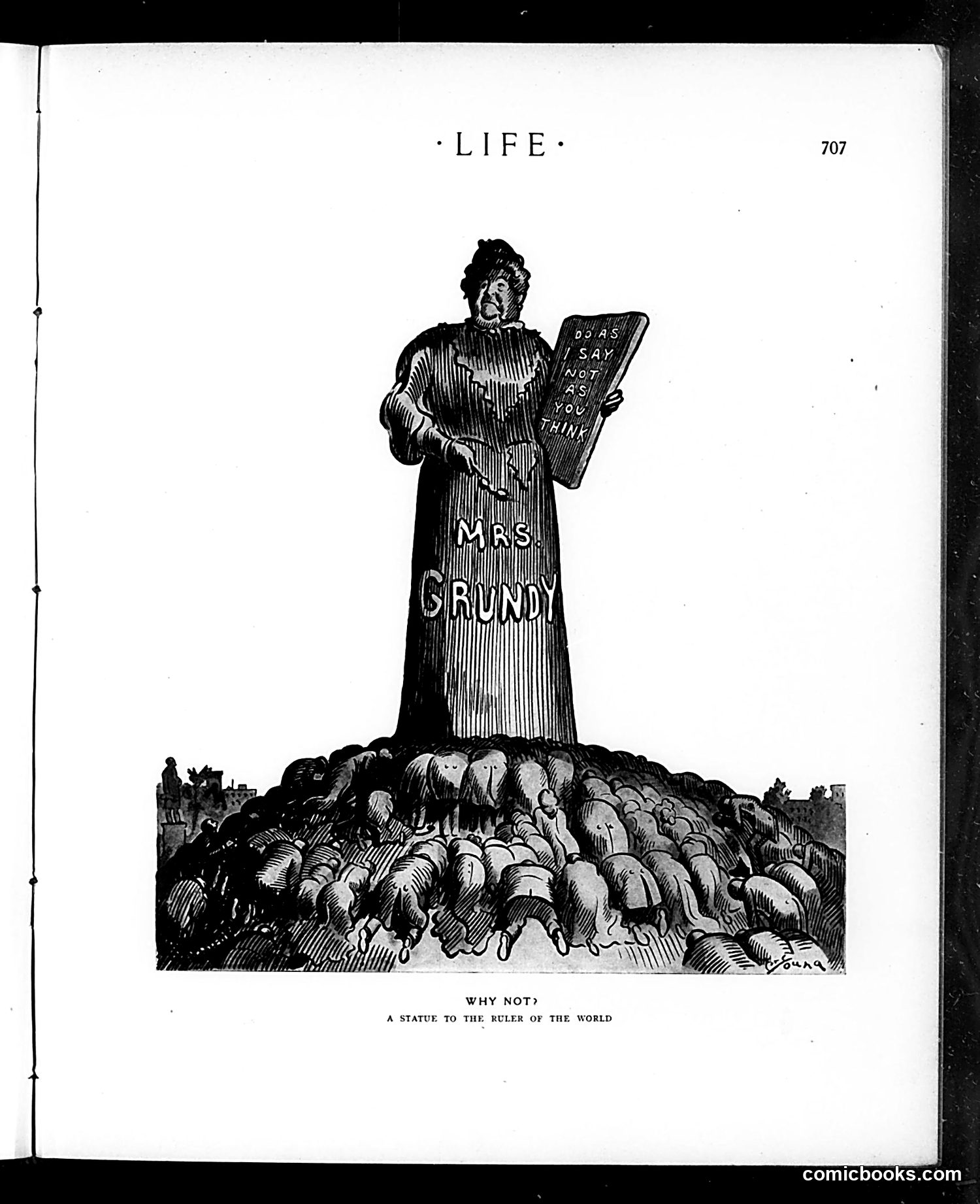
This political cartoon depicts **Mrs. Grundy**, a figure representing conservative social morality and propriety, standing atop a heap of human heads. She holds a tablet reading "I SAY NOT DO YOU THINK," embodying the censorious voice that dictates social rules. The caption "WHY NOT? A STATUE TO THE RULERS OF THE WORLD" appears sarcastic—suggesting Mrs. Grundy deserves a monument for controlling public behavior through moral judgment. The cartoon satirizes how rigid social conventions, personified by Mrs. Grundy, dominate and suppress individual thought and action. The heads beneath her represent those whose autonomy she has effectively crushed through shame and social pressure. This reflects early 20th-century cultural debates between traditionalism and modernism.
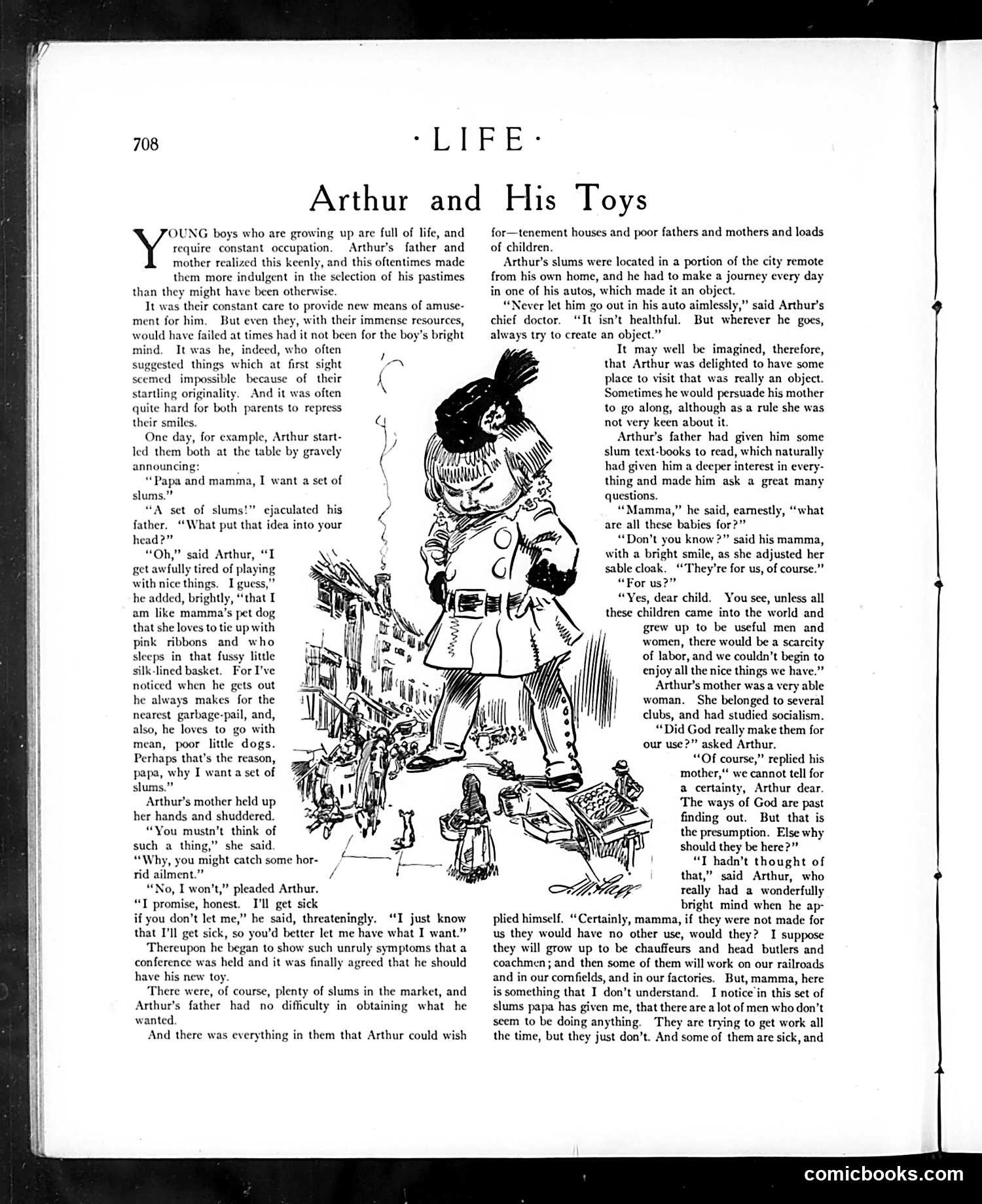
This appears to be a humorous story about a young boy named Arthur from a poor urban neighborhood ("slums") who wants toys. The illustration shows a large woman (his mother) with a child and toy vehicles. The satire targets middle-class parental anxieties about child-rearing. Arthur's mother worries about providing proper entertainment, while his father gifts him slum text-books to encourage curiosity. The dialogue satirizes contemporary debates about poverty, labor, and social responsibility—suggesting that poor children might become "useful men and women" through work in factories, railroads, and coachmen positions rather than play. The piece mocks both sentimental middle-class attitudes toward childhood and the harsh economic realities that forced working-class children into labor rather than leisure.
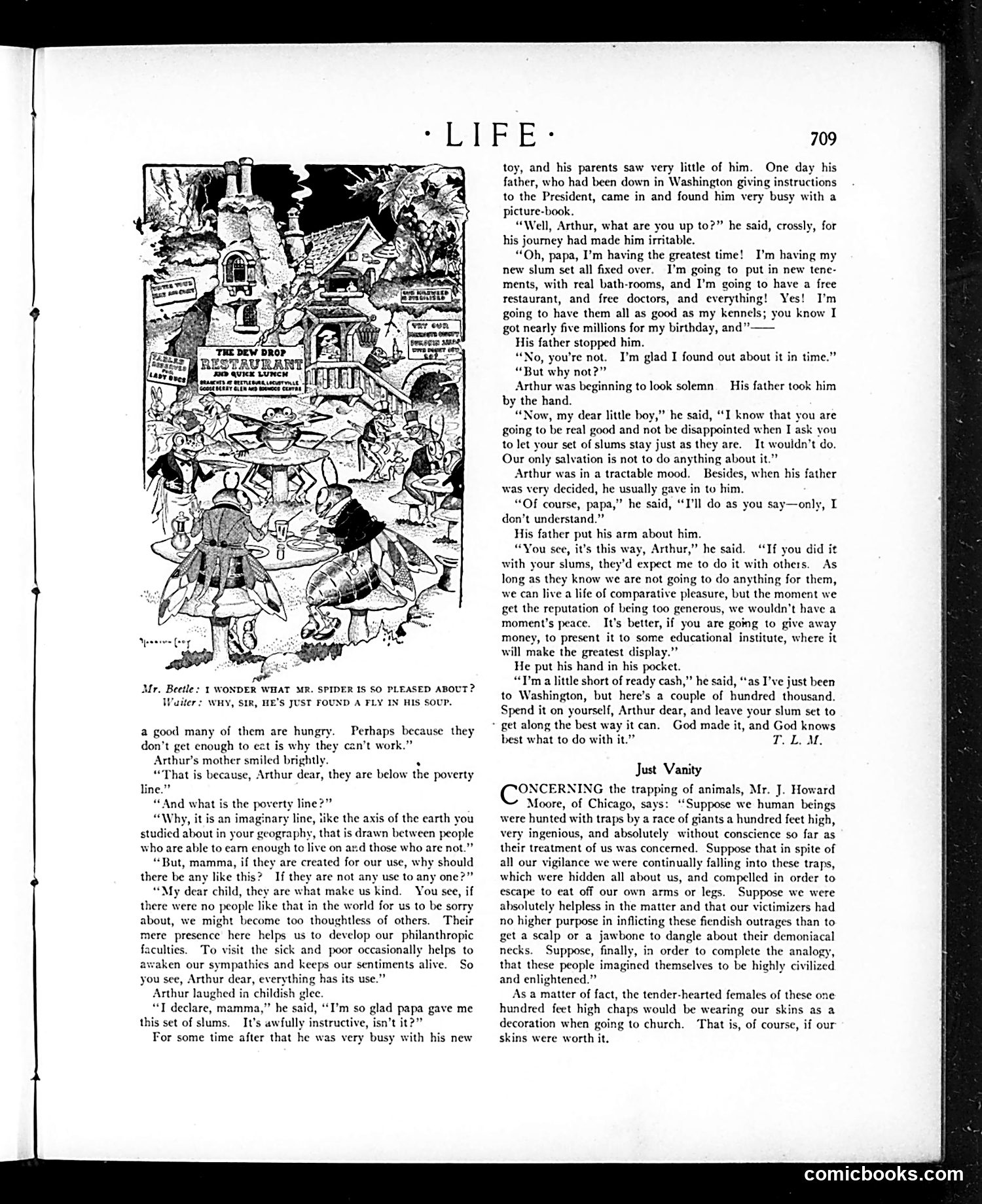
The large cartoon depicts a chaotic urban slum scene filled with various activities and establishments—tenements, shops, and street life. The caption reads: "Mr. Beetle: 'I wonder what Mr. Spider is so pleased about?' Waiter: 'Why, sir, he's just found a fly in his soup.'" This is a dark joke comparing slum inhabitants to insects finding sustenance in filthy conditions. The accompanying text discusses poverty and "the poverty line," suggesting Life is satirizing wealthy philanthropists and their patronizing attitudes toward poor urban neighborhoods. The dialogue mocks the notion that slum residents should be grateful for minimal improvements to their terrible living conditions—a critique of inadequate charitable responses to urban poverty in early 20th-century America.
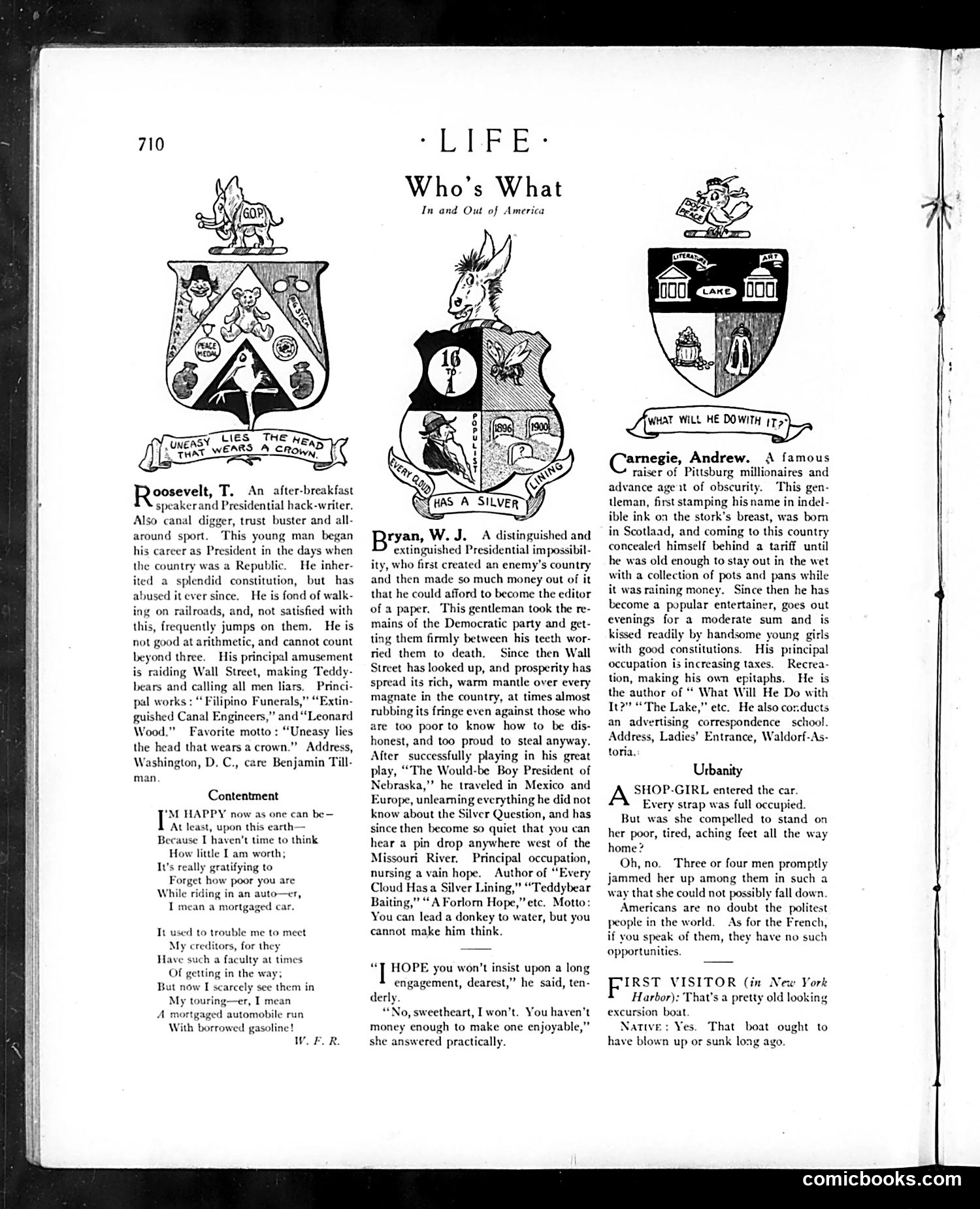
This is a "Who's What" satirical column about prominent Americans. The three coats of arms represent: 1. **Roosevelt, T.** - A caricatured presidential figure depicted as a "rank closer" (loud, crude speaker) and hack-writer who jumps on others. The motto "Uneasy lies the head that wears a crown" mocks his political ambitions. 2. **Bryan, W.J.** - A distinguished but failed presidential candidate who made money from his defeated causes. The satire suggests he profited from positions he previously opposed, now keeping quiet about his flip-flopping. 3. **Carnegie, Andrew** - The famous industrialist depicted with heraldic mockery, questioning "What will he do with it?"—satirizing how he wields his vast wealth and influence. The page combines visual heraldry parody with sharp political commentary on Gilded Age figures.
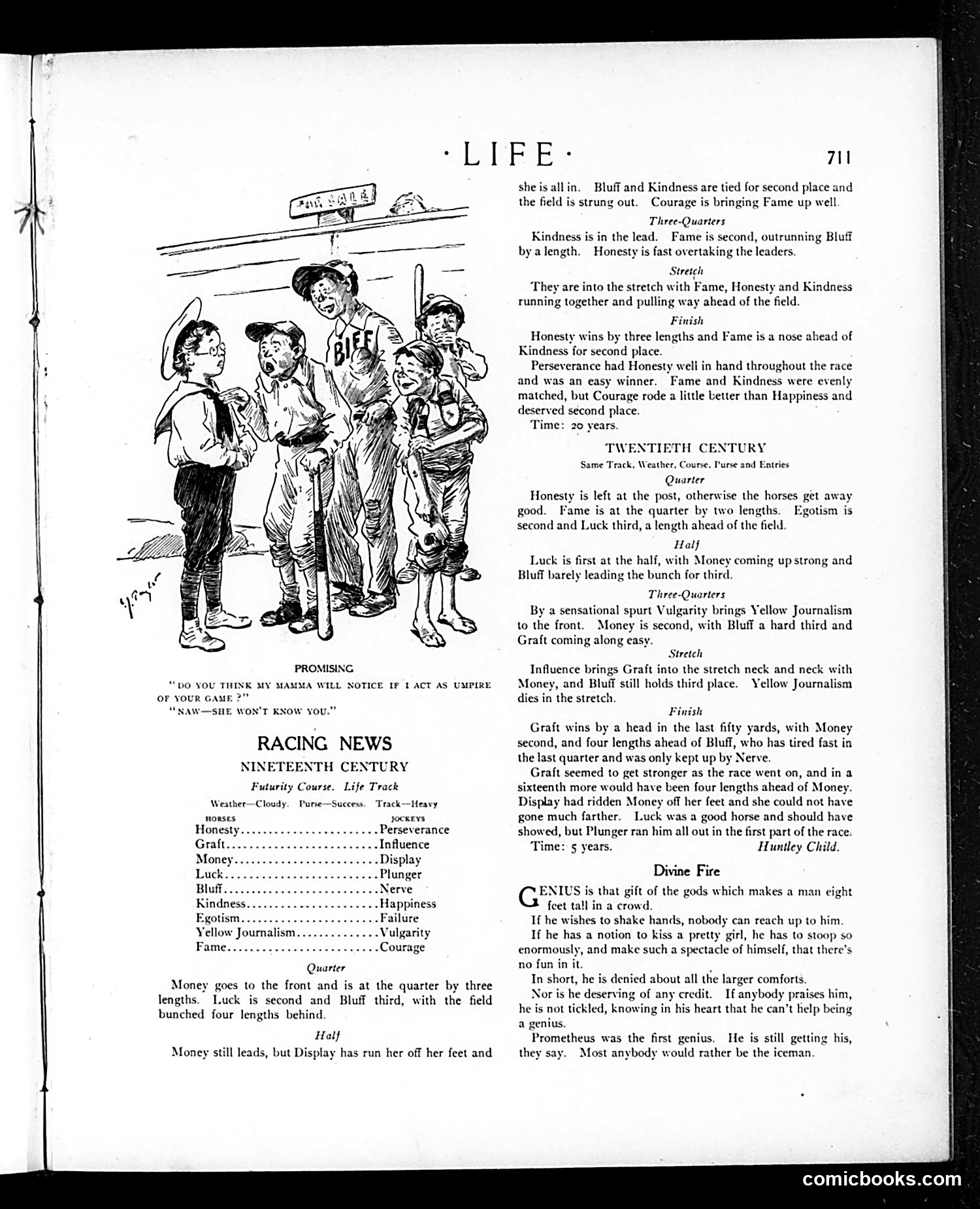
This page contains two allegorical horse races personifying abstract concepts and virtues. The illustration depicts children as jockeys riding horses named for human qualities: Honesty, Kindness, Bluff, Courage, Fame, Luck, Money, Display, and others. The cartoon satirizes American society by racing these personified traits against each other across different time periods ("Nineteenth Century" and "Twentieth Century"). The races track which virtues supposedly "win" in each era—suggesting the author's commentary on shifting values. For example, in the nineteenth-century race, Honesty wins; in the twentieth century, traits like Money and Yellow Journalism (vulgar sensationalism) advance further. The small dialogue beneath the illustration pokes fun at parental hypocrisy regarding sportsmanship.
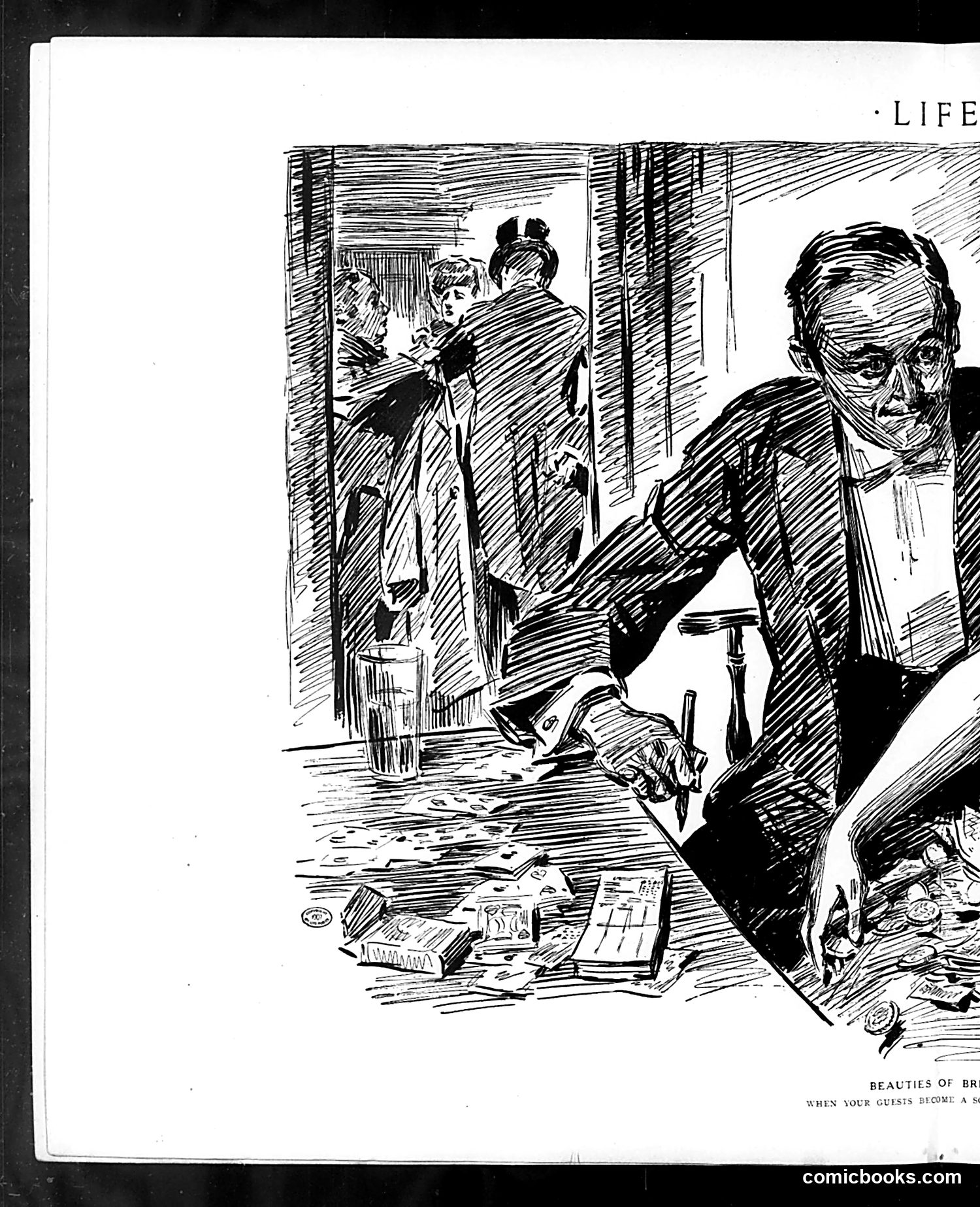
This appears to be a satirical illustration from Life magazine depicting a domestic scene. In the foreground, a well-dressed man in formal attire sits at a table surrounded by scattered papers and coins, appearing to be counting money or managing finances. In the background, through a doorway, a woman (likely his wife) is visible with what appears to be a child. The partial caption visible reads "BEAUTIES OF BR[ITISH]" and "WHEN YOUR GUESTS BECOME A S[...]" suggesting the cartoon comments on hospitality or social obligations and their financial burden. The scattered money and papers at the man's feet, combined with his focused expression, suggest satire about the economic strain of entertaining guests or maintaining social appearances—a theme common to Life's early commentary on middle-class anxieties.
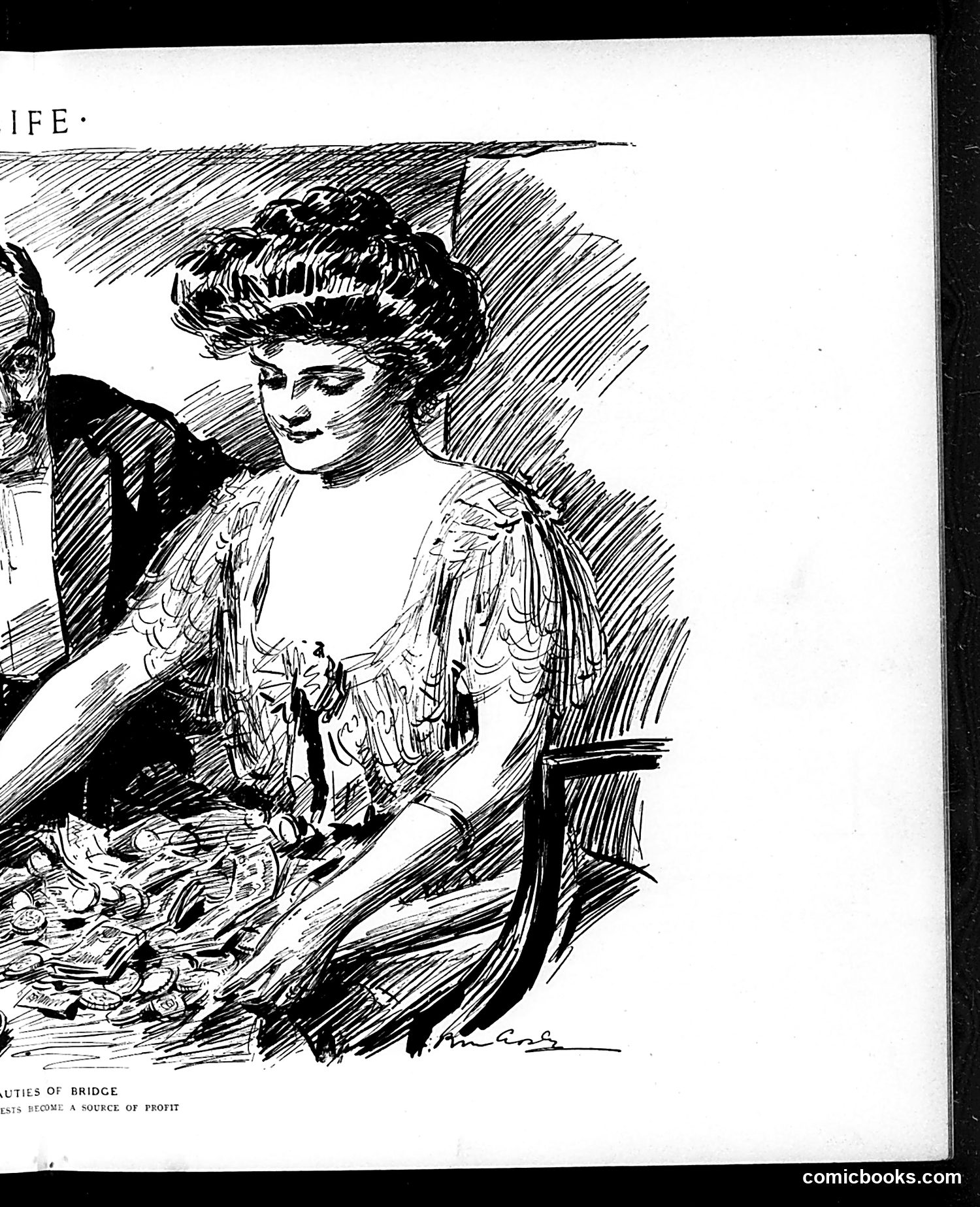
This is a page from *Life* magazine showing a satirical illustration titled "BEAUTIES OF BRIDGE" with a subtitle "CENTS BECOME A SOURCE OF PROFIT." The sketch depicts an elegantly dressed woman at what appears to be a bridge game, surrounded by money and coins scattered on the table. The satire targets the social practice of women playing bridge for monetary stakes—a fashionable leisure activity among upper-class women of the early 20th century. The joke critiques how bridge had become a vehicle for gambling and profit-making among society women, transforming what was ostensibly a genteel parlor game into a money-making enterprise. The woman's refined appearance contrasts with the mercenary nature of the activity, mocking the pretensions of high society while commenting on women's involvement in gambling.
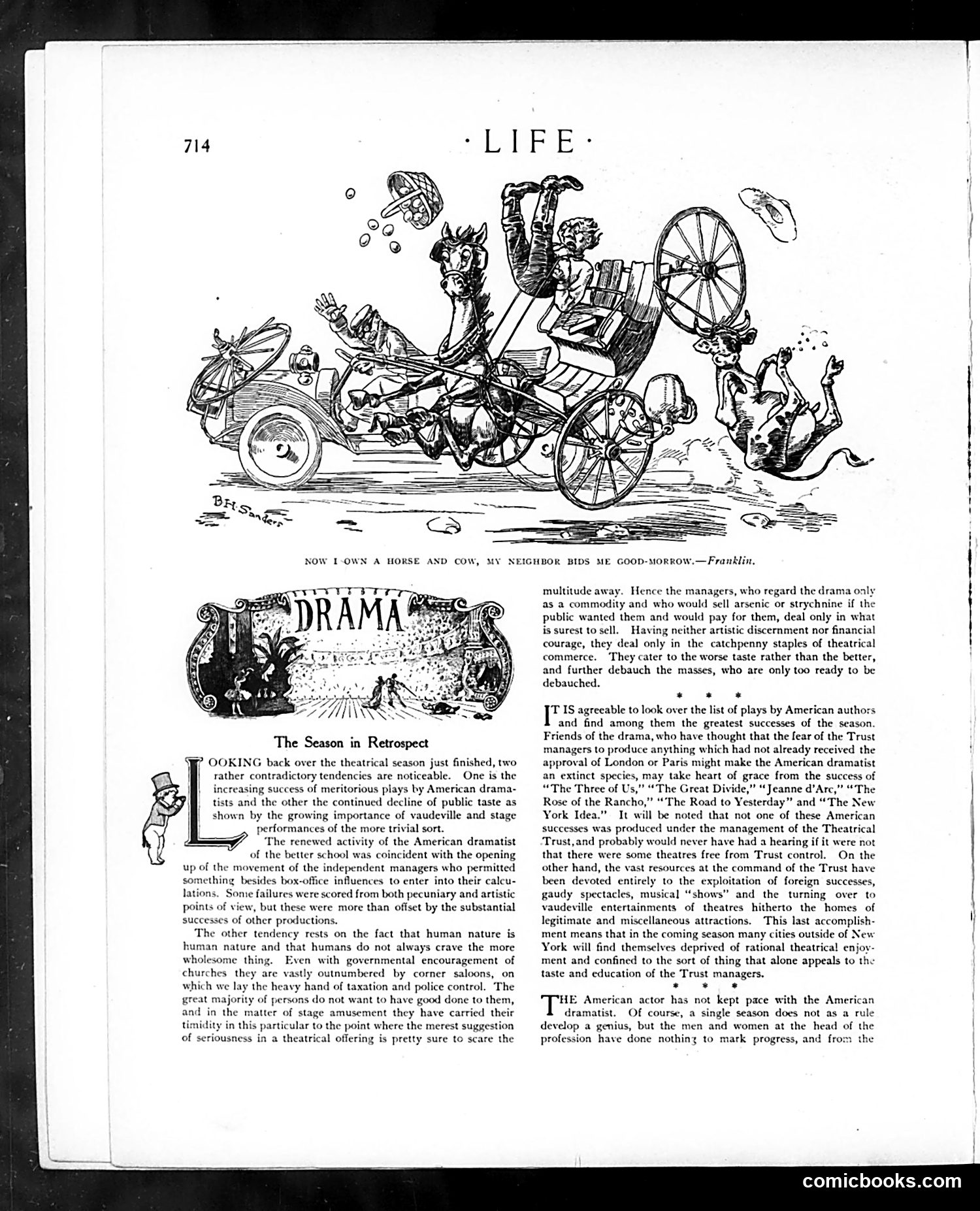
This page critiques the theatrical landscape of early 20th-century America. The top cartoon depicts a chaotic horse-drawn carriage—likely satirizing the theatrical "industry" as disorganized and overstuffed with frivolous entertainment. The article "The Season in Retrospect" presents a paradox: while American playwrights produced genuine successes ("The Three of Us," "The Great Divide"), popular taste declined toward vaudeville and trivial performances. The author blames theater managers who treat drama as mere commodity rather than art. A key target is the "Theatrical Trust"—a monopoly controlling most theaters. The article credits independent managers for producing quality American plays, noting the Trust instead exploited foreign spectacles and musical shows. The author argues this monopolistic control degraded theatrical standards, restricting serious drama outside New York. The Franklin epigraph about owning "a horse and cow" likely underscores themes of humble authenticity versus commercial manipulation—contrasting genuine art with mercenary entertainment practices.
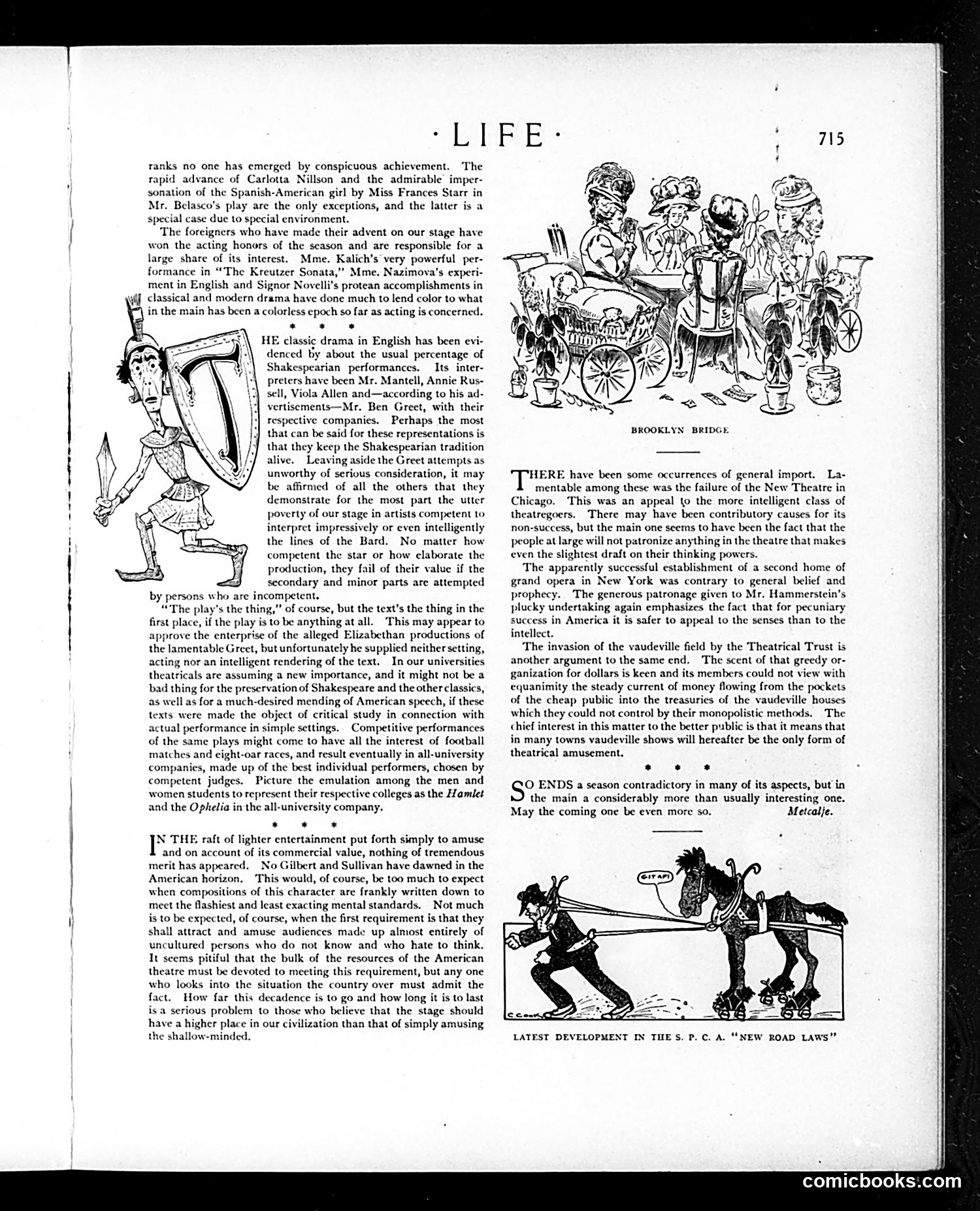
This page contains theater criticism rather than political satire. The text discusses the 1908-1909 theatrical season, lamenting that American drama lacks distinguished native talent. Foreign performers—specifically Mme. Kalich, Mme. Nazimova, and Signor Novelli—are praised for elevating the season. The critique dismisses most Shakespearean productions as poor, particularly Ben Greet's attempts, arguing that mediocre supporting actors undermine even star-driven stagings. **The cartoons** appear to be unrelated decorative illustrations: one shows a figure in theatrical costume; another depicts what the caption identifies as "Latest Development in the S.P.C.A. 'New Road Laws'"—a humorous commentary on animal protection efforts, showing someone struggling with what appears to be a recalcitrant horse or donkey. The overall message criticizes American theater's commercial focus on mass entertainment over artistic merit.
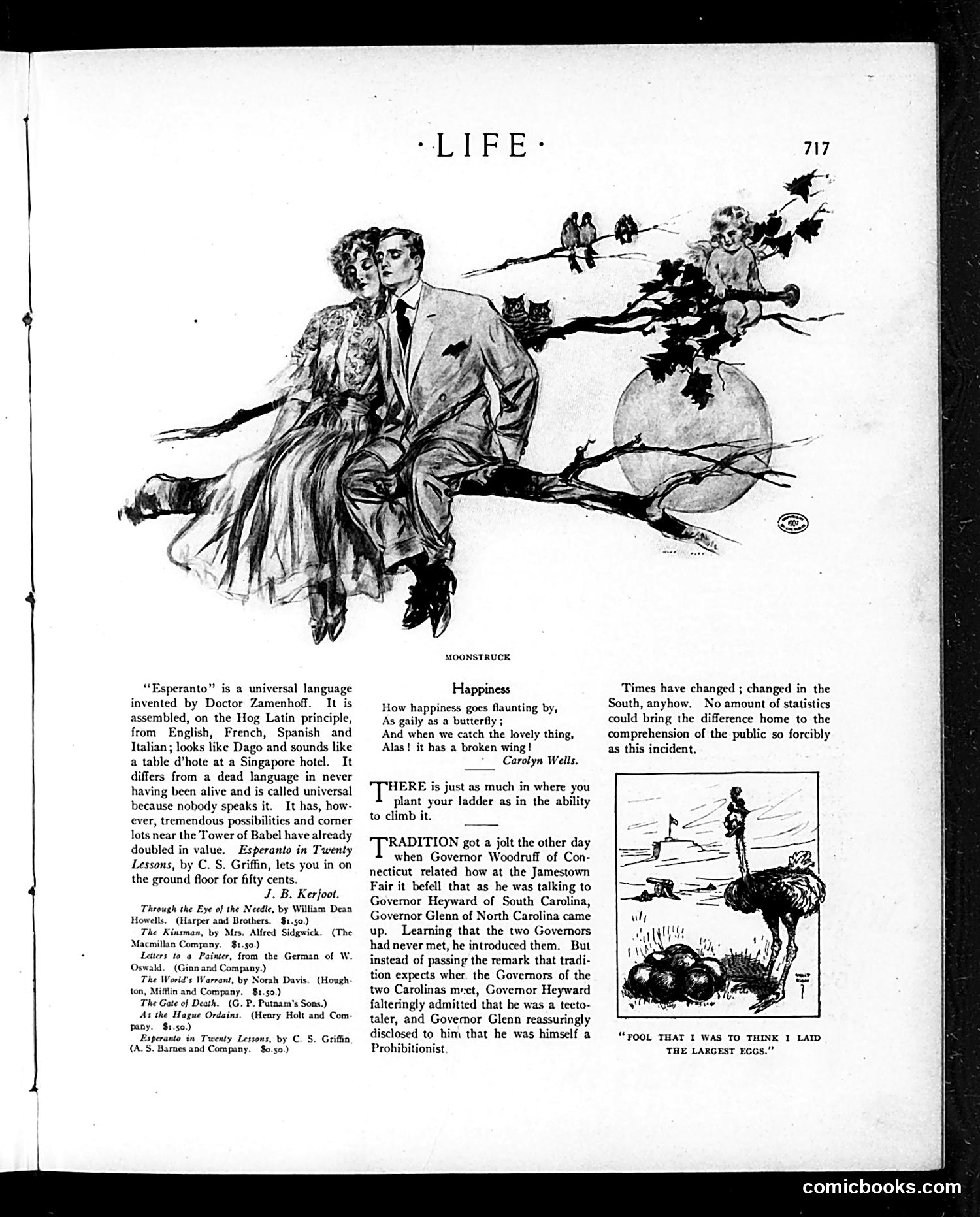
**Top Illustration ("Moonstruck"):** A couple sits on a crescent moon amid swirling clouds—a romantic, dreamy scene. This illustrates Carolyn Wells' poem about happiness being fleeting and fragile ("broken wing"). **Text Content:** The page primarily comprises book reviews and humorous commentary. J.B. Kerfoot satirizes **Esperanto**, an artificial international language invented by L.L. Zamenhoff. Kerfoot mocks it as absurd—assembled from multiple languages, sounding like "table d'hote at a Singapore hotel," and paradoxically "universal because nobody speaks it." He jokes that land near the Tower of Babel (biblical symbol of language confusion) has doubled in value. **Bottom Section ("Tradition"):** Governor Woodruff describes meeting South Carolina and North Carolina governors. Tradition supposedly dictates their greeting should reference regional customs. Instead, both governors admit to being **teetotalers and prohibitionists**—shocking for the post-Civil War South, where alcohol culture was traditional. The satire highlights how prohibition sentiment has disrupted Southern conventions. **Small cartoon (bottom right):** An ostrich laments laying small eggs—illustrating overconfidence or misplaced pride.
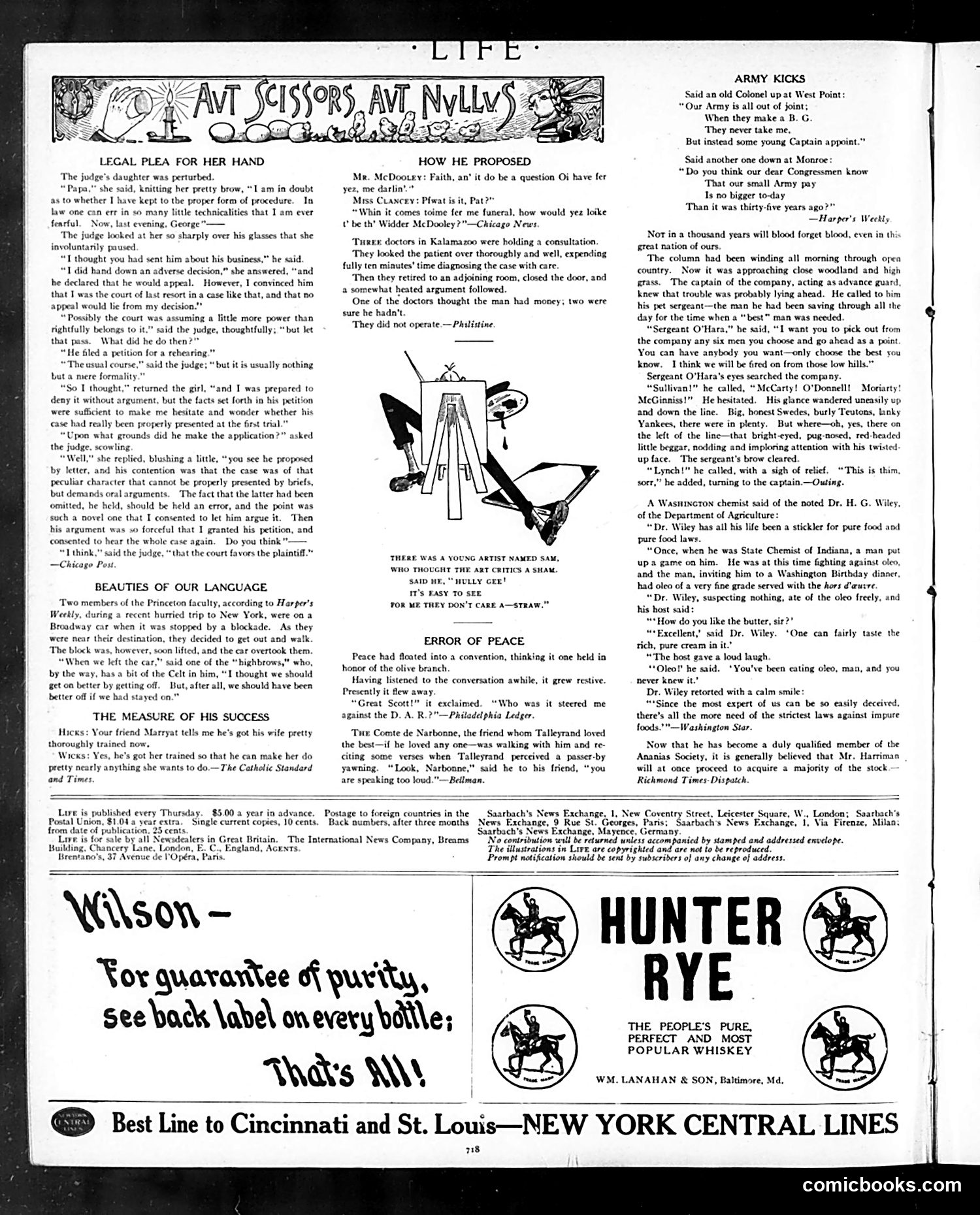
This page features multiple short satirical pieces. The main story, "Legal Plea for Her Hand," uses legal terminology humorously. A judge's daughter has rejected a suitor's marriage proposal, treating it like a court case with an "adverse decision." The man appeals by requesting a "rehearing," arguing his proposal—like a legal brief—requires oral argument to be properly presented. The daughter, charmed by his persistence, agrees to hear him again and grants his petition. The satire mocks both legal formality and courtship conventions of the era, suggesting romantic pursuit parallels litigation. The punchline comes when the judge observes the "court favors the plaintiff"—meaning his daughter has been won over. Other short pieces on the page include jokes about Irish courtship, medical economics, and wordplay, typical of *Life* magazine's variety format. The advertisements for whiskey and railroad service complete the period publication.
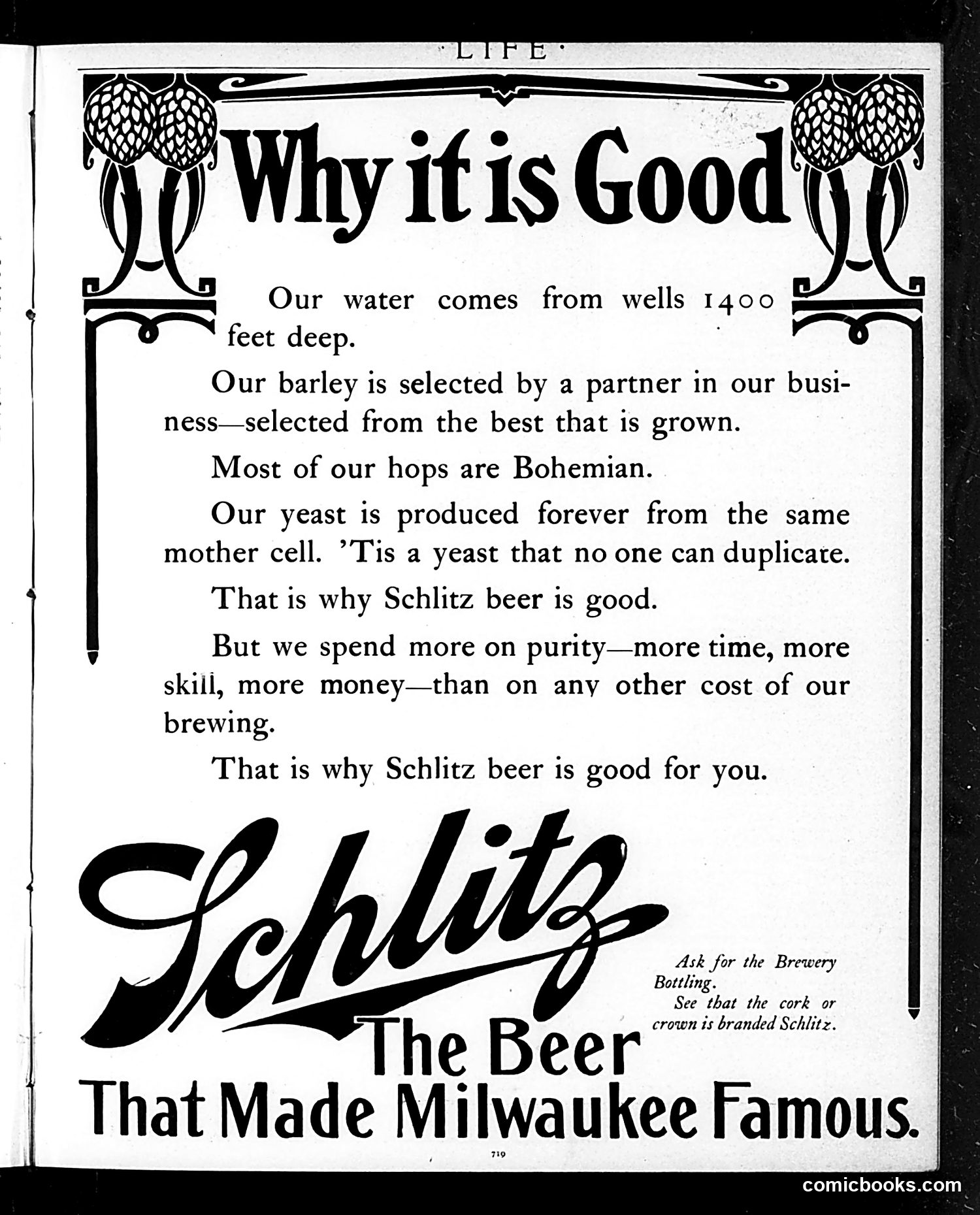
This is a **straightforward advertisement**, not satire or political commentary. It's a Schlitz brewery advertisement emphasizing product quality to appeal to early 20th-century consumers concerned about food and beverage purity. The ad highlights Schlitz's competitive advantages: - Deep well water (1400 feet) - Premium barley and Bohemian hops - A proprietary yeast strain that "no one can duplicate" - Exceptional investment in purity over other costs The tagline "The Beer That Made Milwaukee Famous" references Milwaukee's historic prominence as an American brewing center, particularly among German-American communities. The decorative hop motifs frame the text, reinforcing the brewing theme. This represents early advertising strategy: building brand identity through claims of superior ingredients and manufacturing standards during an era when food safety was a genuine public concern.
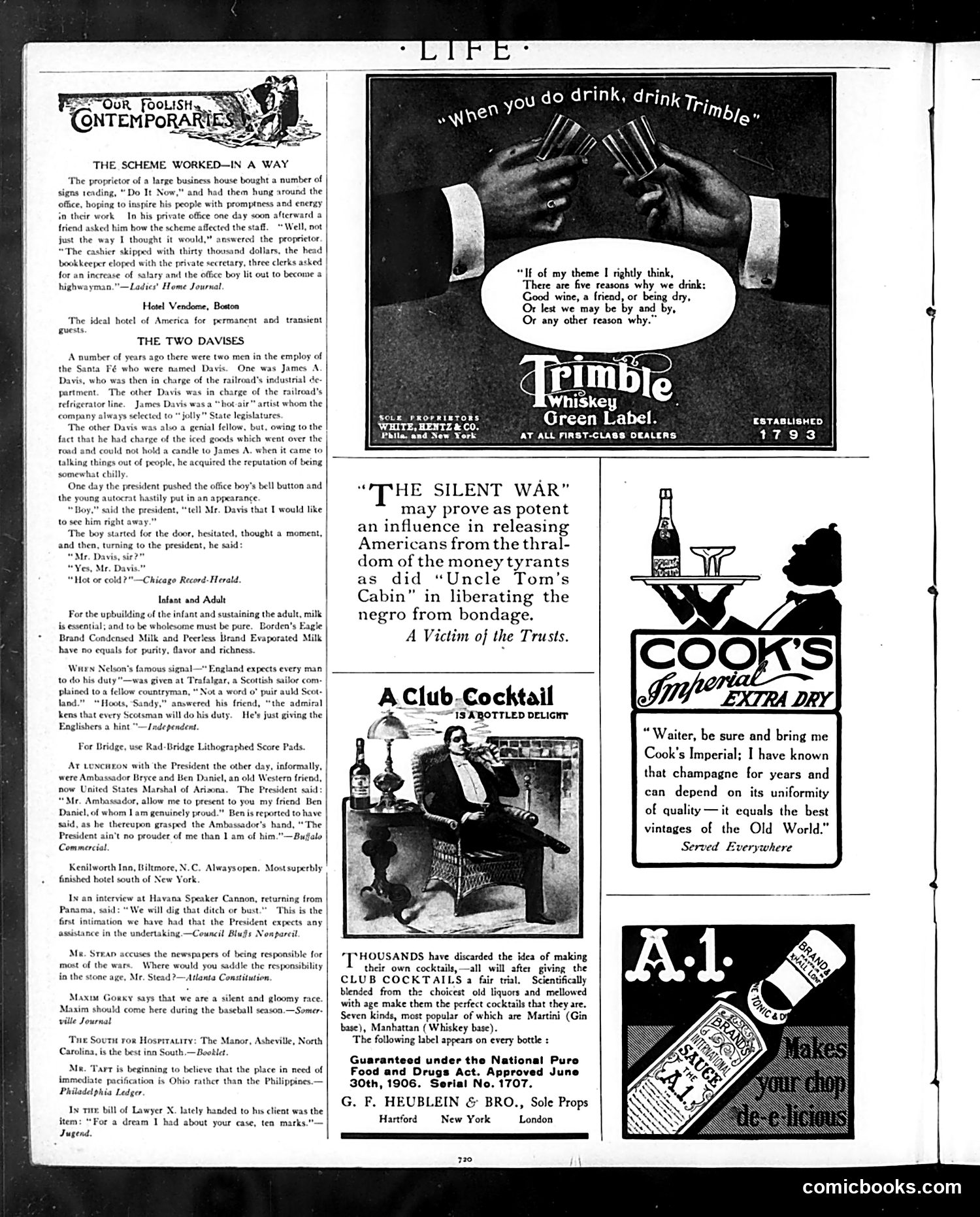
This page from *Life* magazine contains several humor pieces and advertisements, primarily from the early 1900s (advertisements mention 1906 Pure Food and Drugs Act approval). **Main Content:** The page features brief satirical anecdotes mocking contemporary attitudes and social dynamics. "The Scheme Worked—In a Way" jokes about motivational signage backfiring when employees interpret "Do It Now" as permission for personal ambitions (theft, elopement, desertion). "The Two Davises" plays on a railroad dispatcher's confusion distinguishing between two employees named Davis—one known for "hot air" (talk) and another for refrigeration—asking whether the president wants the "hot or cold" Davis. **Advertisements:** The right side contains whiskey and liquor advertisements (*Trimble*, *Cook's Imperial Extra Dry*, *A.J.*), typical of pre-Prohibition American magazines. These ads feature testimonials and establishment dates meant to convey respectability and quality. The humor reflects early 20th-century workplace culture and class attitudes; no specific political figures are caricatured on this particular page.
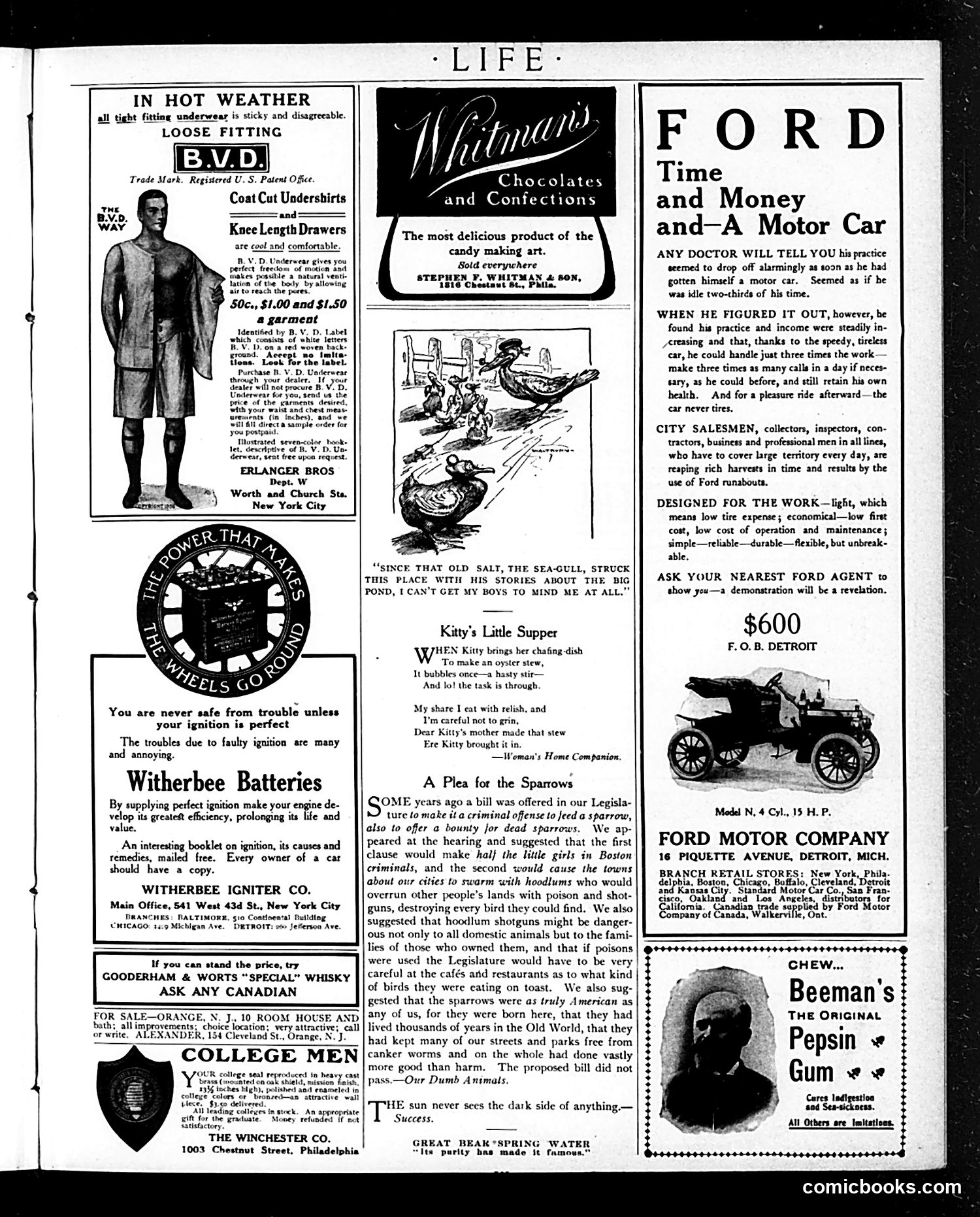
This page consists primarily of **advertisements** from approximately the 1910s-1920s era, with one substantive satirical piece. The main content of note is **"A Plea for the Sparrows,"** which satirizes proposed legislation to criminalize feeding sparrows and offer bounties for dead ones. The author argues the bill is impractical and counterproductive: making it illegal to feed sparrows would criminalize "half the little girls in Boston"; offering bounties would attract dangerous "hoodlums" with shotguns onto private property; and poisoning sparrows risks contaminating restaurant food. The piece defends sparrows as "truly American" contributors to urban ecology. The remaining space contains period advertisements for B.V.D. underwear, batteries, whisky, and candy—typical commercial content of the era. A humorous poem about "Kitty's Little Supper" and a cartoon showing a man complaining that a sea-gull's tall tales distract his boys provide light entertainment filler. The sparrow piece reflects Progressive Era conservation debates and American humor about legislative overreach.
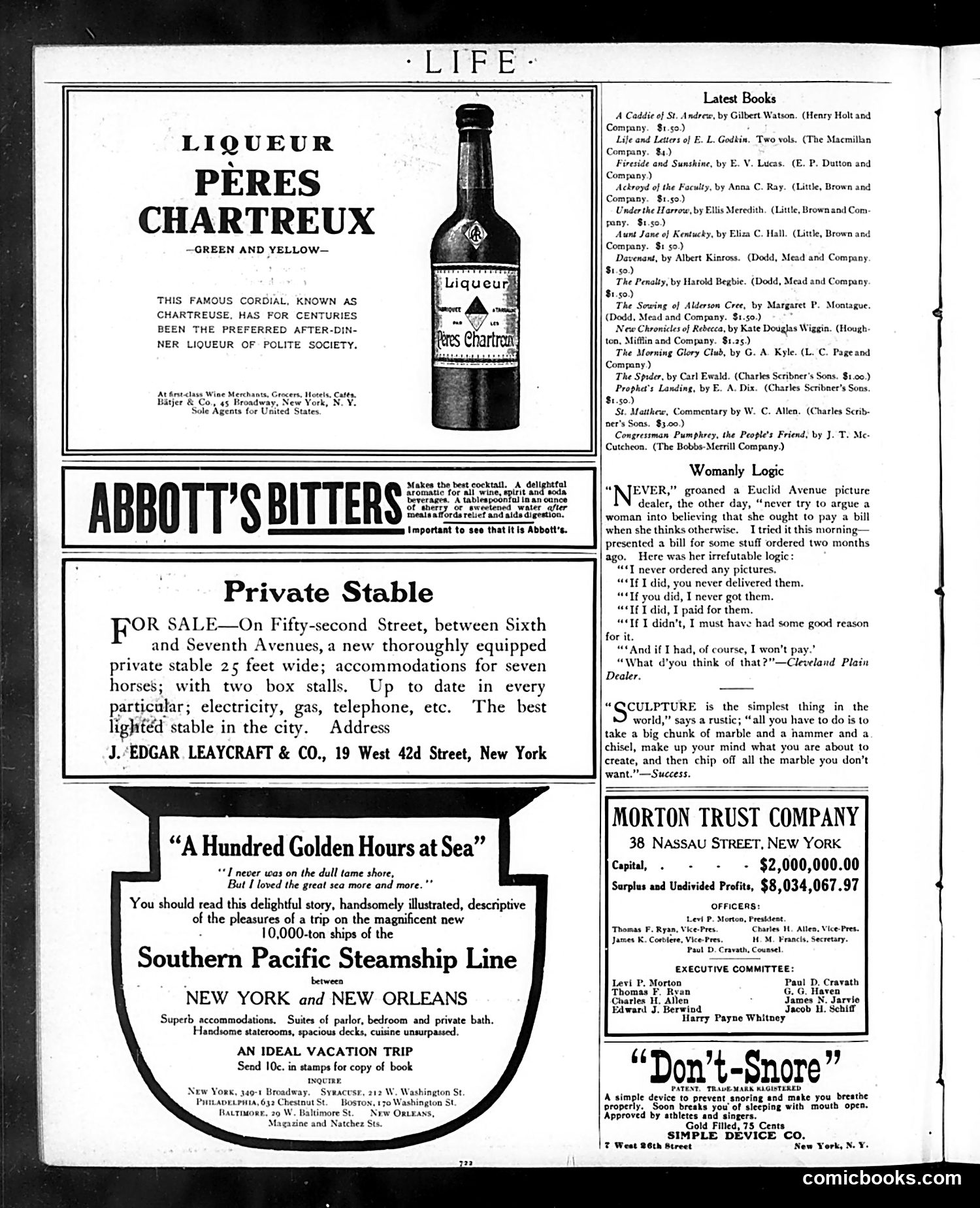
This page is primarily **advertisements and miscellaneous content** from an early 20th-century *Life* magazine, not political satire requiring historical context. The main elements include: **Advertisements** for liqueur, bitters, a private stable, and steamship travel—typical commercial pitches of the era. **Book reviews** listing contemporary publications (titles now largely forgotten). **Two brief humorous anecdotes**: One about a woman's illogical refusal to pay a bill (mocking female reasoning), and another quoting a rustic's simplistic definition of sculpture. These reflect period attitudes—the first trades in mild sexist humor about women's supposed irrationality; the second mocks rural "simple-mindedness." There are **no political cartoons** on this page. The humor is domestic and mild by modern standards. The "Womanly Logic" piece is the closest to social commentary, but it's simply a joke about gender stereotypes common to the era.
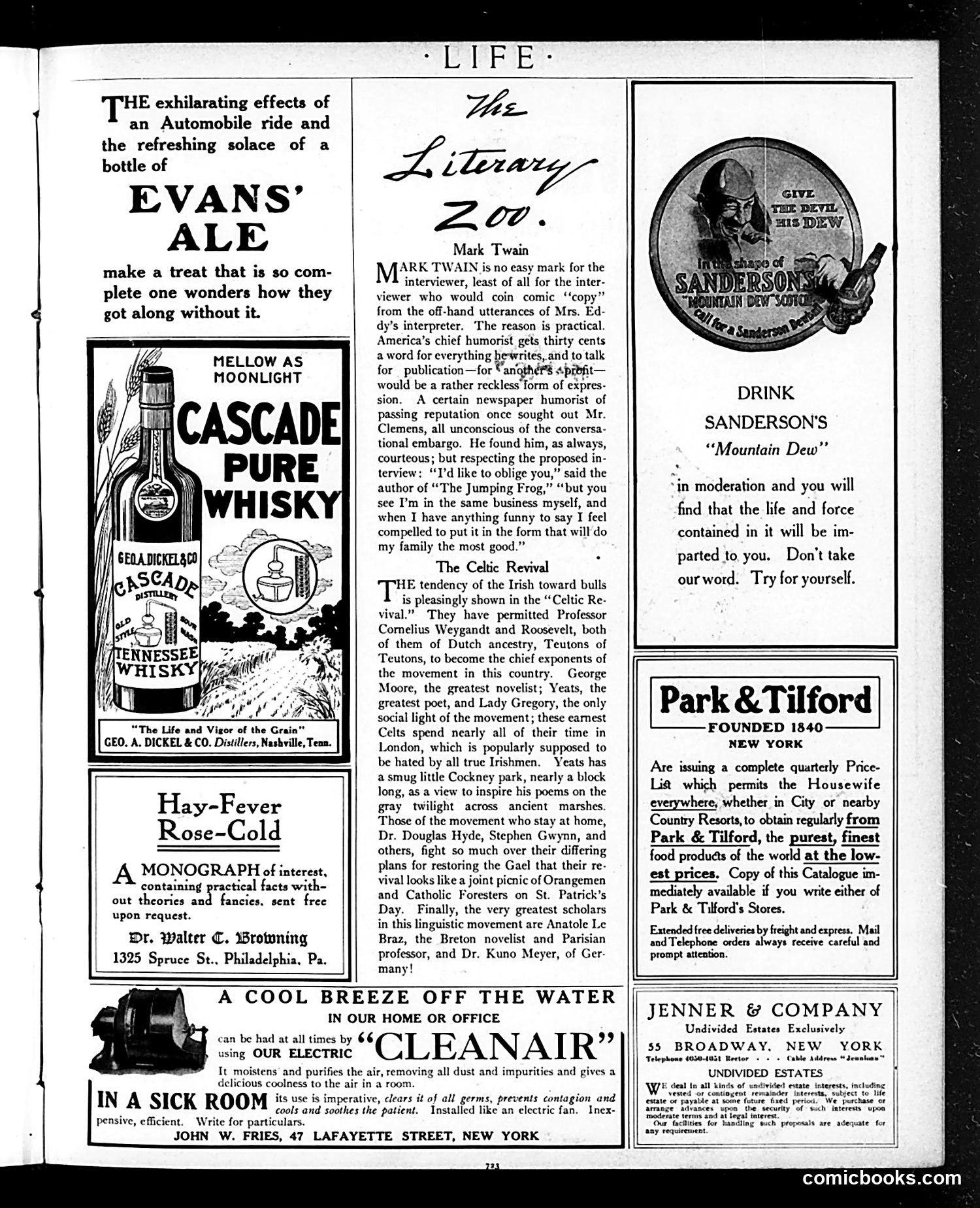
This page is primarily **advertising**, with one substantive article: ## "The Celtic Revival" The satire mocks the **Irish Literary Revival movement** for its apparent contradictions: - **The irony**: Dutch-descended figures (Professor Weygandt and Theodore Roosevelt) have become the movement's "chief exponents," not actual Irish people - **The hypocrisy**: Yeats, the greatest Irish poet, spends nearly all his time in London—supposedly hated by "true Irishmen"—with only a small park for Irish inspiration - **Internal conflict**: Irish leaders staying home (Douglas Hyde, Stephen Gwynn) constantly quarrel over revival methods, making it look like "a joint picnic of Orangemen and Catholic Foresters"—i.e., bitter historical enemies partying together - **The punchline**: The movement's greatest scholars are actually Breton and German (Le Braz and Meyer), not Irish The humor targets the movement's pretentiousness and failure to achieve its stated goals. The remaining content consists of period advertisements for alcohol (Evans' Ale, Cascade Whiskey, Sanderson's Mountain Dew) and consumer goods.
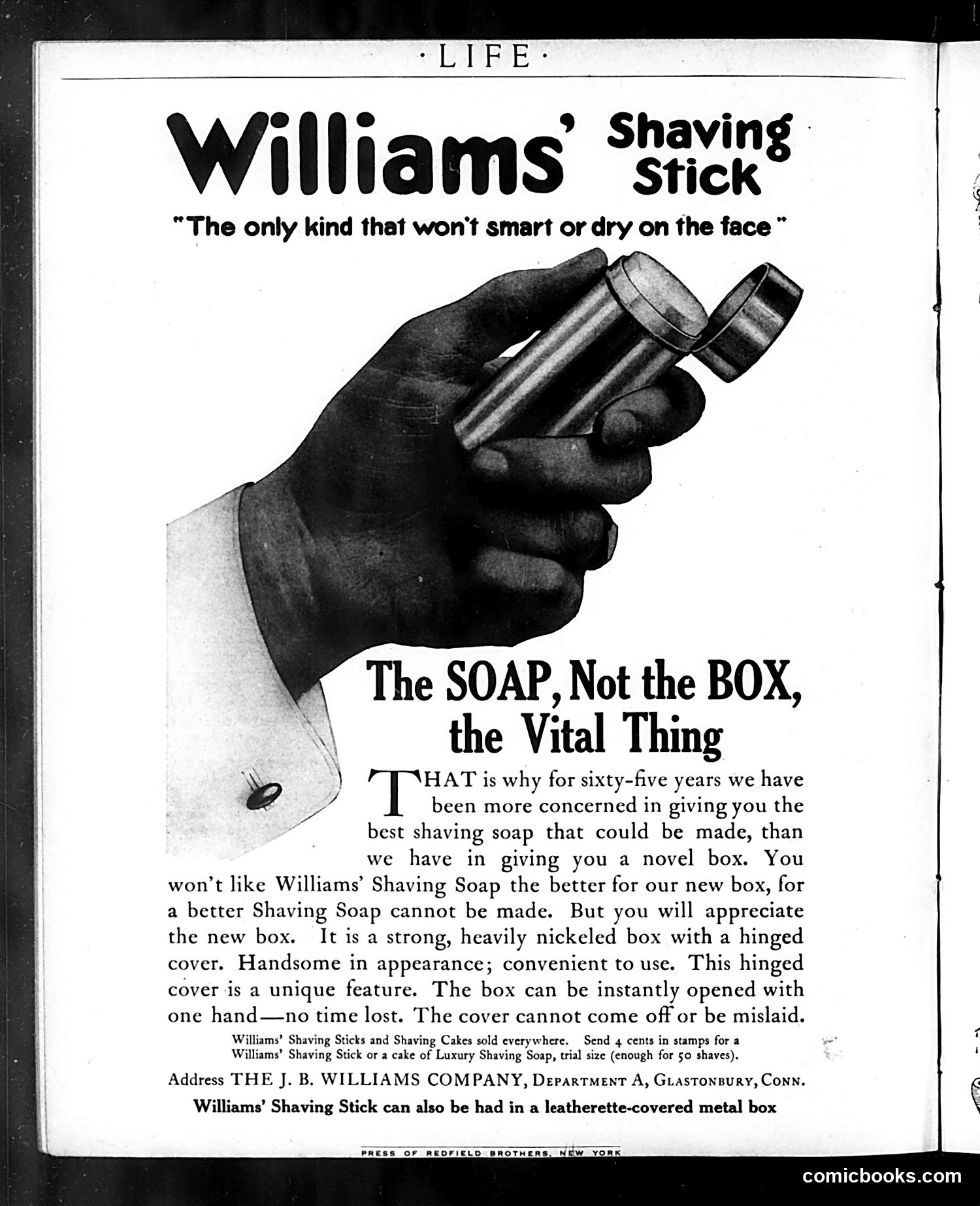
This is a **product advertisement**, not political satire. The J.B. Williams Company promotes their shaving soap and stick by emphasizing that quality of the product matters more than packaging novelty. The ad features a hand holding the shaving stick and makes a humorous claim: the soap "won't smart or dry on the face"—addressing common complaints about competing products. The company stresses they've prioritized formula over flashy presentation for 65 years. However, they then introduce a new nickel-plated hinged box, framing it as a practical convenience rather than a gimmick. The copy reassures consumers that the improved packaging doesn't mean the soap itself has changed—the formula remains superior. This reflects early 20th-century advertising strategy: combining product claims with appeals to tradition and value-consciousness while still promoting modern conveniences.