
Life, 1907-05-23 · page 14 of 24
Life — May 23, 1907 — page 14: what you’re looking at
What you’re looking at
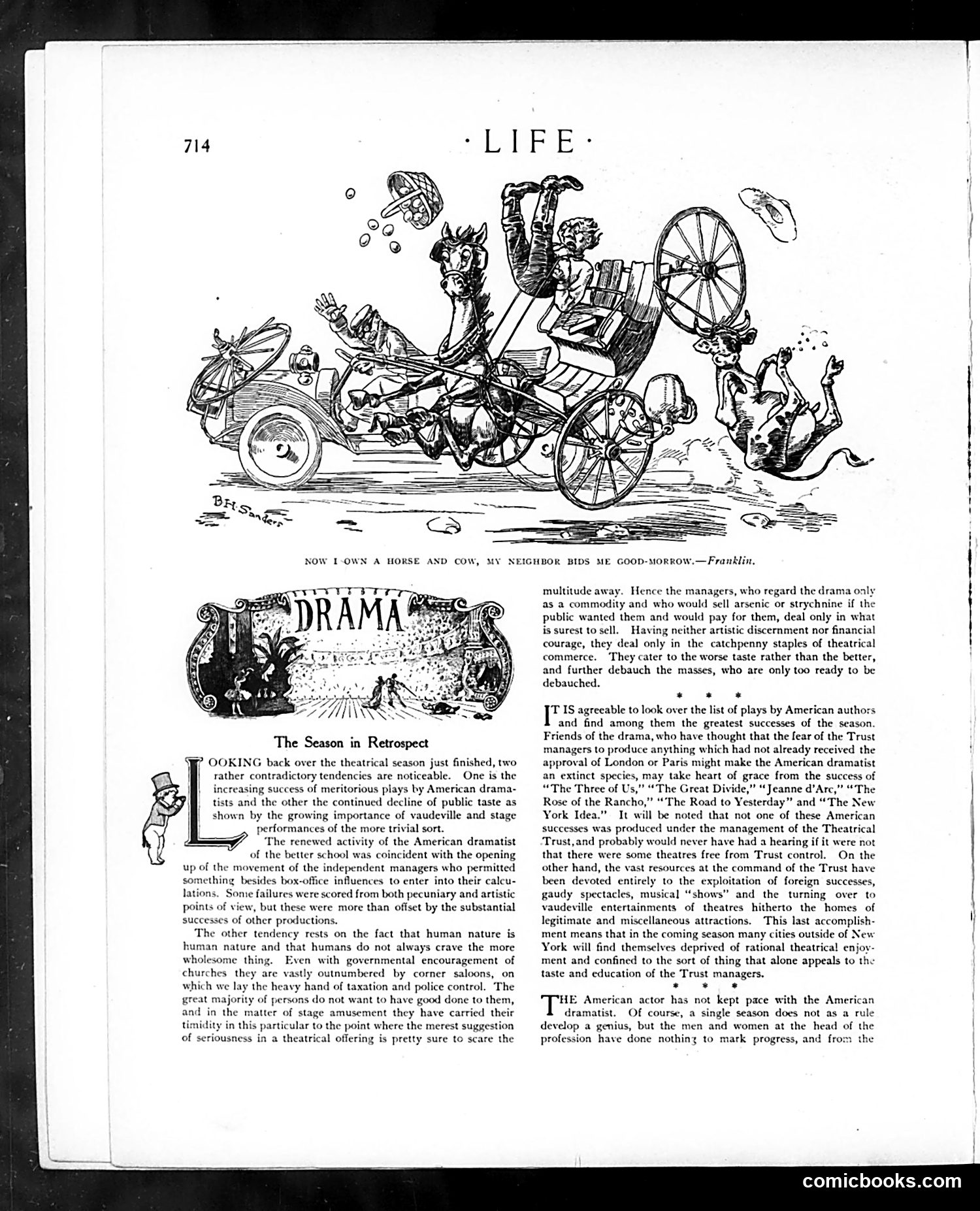
This page critiques the theatrical landscape of early 20th-century America. The top cartoon depicts a chaotic horse-drawn carriage—likely satirizing the theatrical "industry" as disorganized and overstuffed with frivolous entertainment. The article "The Season in Retrospect" presents a paradox: while American playwrights produced genuine successes ("The Three of Us," "The Great Divide"), popular taste declined toward vaudeville and trivial performances. The author blames theater managers who treat drama as mere commodity rather than art. A key target is the "Theatrical Trust"—a monopoly controlling most theaters. The article credits independent managers for producing quality American plays, noting the Trust instead exploited foreign spectacles and musical shows. The author argues this monopolistic control degraded theatrical standards, restricting serious drama outside New York. The Franklin epigraph about owning "a horse and cow" likely underscores themes of humble authenticity versus commercial manipulation—contrasting genuine art with mercenary entertainment practices.
📄 Transcribed text from this page (OCR, searchable)
Machine-transcribed from the original scan — historical spelling and the odd misread are preserved.
pth 27MIN EES The Season in Retrospect ? OOKING back over the theatrical season just finished, two rather contradictory tendencies are noticeable. One is the increasing success of meritorious plays by American drama- tists and the other the continued decline of public taste as shown by the growing importance of vaudeville and stage performances of the more trivial sort. The renewed activity of the American dramatist of the better school was coincident with the opening up of the movement of the independent managers who permitted something besides box-office influences to enter into their calcu- lations, Some failures were scored from both pecuniary and artistic points of view, but these were more than offset by the substantial successes of other productions. The other tendency rests on the fact that human nature is human nature and that humans do not always crave the more wholesome thing. Even with governmental encouragement of churches they are vastly outnumbered by corner saloons, on which we lay the heavy hand of taxation and police control. The great majority of persons do not want to have good done to them, and in the matter of stage amusement they have carried their timidity in this particular to the point where the merest suggestion of seriousness in a theatrical offering is pretty sure to scare the NOW L-OWN A HORSE AND COW, MY NEIGHBOR BIDS ME GOOD-MoRROW.—Franklin, multitude away. Hence the managers, who regard the drama only as a commodity and who would sell arsenic or strychnine if the public wanted them and would pay for them, deal only in what is surest to sell. Having neither artistic discernment nor financial courage, they deal only in the catchpenny staples of theatrical commerce. ‘hey cater to the worse taste rather than the better, and further debauch the masses, who are only too ready to be debauched. * 8 & [" IS agreeable to look over the list of plays by American authors and find among them the greatest successes of the season. Friends of the drama, who have thought that the fear of the Trust managers to produce anything which had not already received the approval of London or Paris might make the American dramatist an extinct species, may take heart of grace from the success of “The Three of Us,” “The Great Divide,” “Jeanne d’Arc,” “The Rose of the Rancho,” “The Road to Yesterday” and “The New York Idea.” It will be noted that not one of these American successes was produced under the management of the Theatrical ‘Trust,and probably would never have had a hearing if it were not that there were some theatres free from Trust control. On the other hand, the vast resources at the command of the Trust have been devoted entirely to the exploitation of foreign successes, gaudy spectacles, musical “shows” and the turning over to vaudeville entertainments of theatres hitherto the homes of legitimate and miscellaneous attractions. This last accomplish- ment means that in the coming season many cities outside of York will find themselves deprived of rational theatrical enjov- ment and confined to the sort of thing that alone appeals to the taste and education of the Trust managers. + 2's HE American actor has not kept pace with the American dramatist. Of course, a single season does not as a rule develop a genius, but the men and women at the head of the profession have done nothing to mark progress, and from the comicbooks.com