
Life, 1907-05-23 · page 9 of 24
Life — May 23, 1907 — page 9: what you’re looking at
What you’re looking at
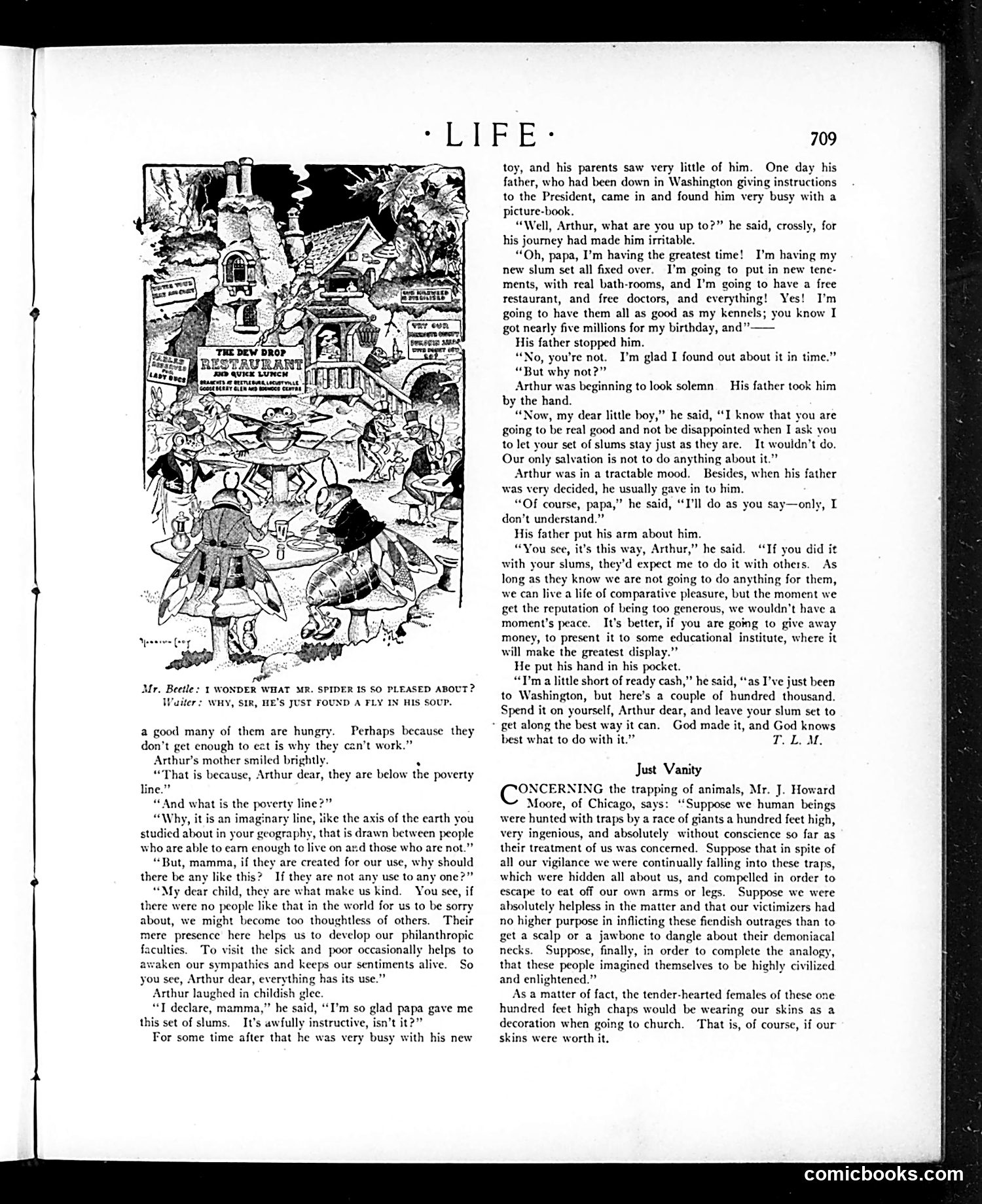
The large cartoon depicts a chaotic urban slum scene filled with various activities and establishments—tenements, shops, and street life. The caption reads: "Mr. Beetle: 'I wonder what Mr. Spider is so pleased about?' Waiter: 'Why, sir, he's just found a fly in his soup.'" This is a dark joke comparing slum inhabitants to insects finding sustenance in filthy conditions. The accompanying text discusses poverty and "the poverty line," suggesting Life is satirizing wealthy philanthropists and their patronizing attitudes toward poor urban neighborhoods. The dialogue mocks the notion that slum residents should be grateful for minimal improvements to their terrible living conditions—a critique of inadequate charitable responses to urban poverty in early 20th-century America.
📄 Transcribed text from this page (OCR, searchable)
Machine-transcribed from the original scan — historical spelling and the odd misread are preserved.
Al re era RESTAURANTP 407 soca] Mr. Beetle: Waiter: wi I WONDER WHAT MR. SPIDER IS SO PLEASED ABOUT? , SIR, HE'S JUST FOUND A FLY IN HIS SOUP. a good many of them are hungry. Perhaps because they don’t get cnough to eat is why they can’t work.” Arthur’s mother smiled brightly. “That is because, Arthur dear, they are below the poverty line.” “And what is the poverty line?” “Why, it is an imaginary line, tike the axis of the earth you studied about in your geography, that is drawn between people who are able to earn enough to live on ard those who are not.” “But, mamma, if they are created for our use, why should there be any like this? If they are not any use to any one?” “My dear child, they are what make us kind. You see, if there were no people like that in the world for us to be sorry about, we might become too thoughtless of others. Their mere presence here helps us to develop our philanthropic faculties. To visit the sick and poor occasionally helps to awaken our sympathies and keeps our sentiments alive. So you see, Arthur dear, everything has Arthur laughed in childish glee. “T declare, mamma,” he said, “I’m so glad papa gave me this set of slums. It’s awfully instructive, isn’t it?” For some time after that he was very busy with his new VEE * get along the best way 709 toy, and his parents saw very little of him. One day his father, who had been down in Washington giving instructions to the President, came in and found him very busy with a picture-book. “Well, Arthur, what are you up to?” he said, crossly, for his journey had made him irritable. “Oh, papa, I’m having the greatest time! I’m having my new slum set all fixed over. I’m going to put in new tene- ments, with real bath-rooms, and I’m going to have a free restaurant, and free doctors, and everything! Yes! I’m going to have them all as good as my kennels; you know I got nearly five millions for my birthday, and” — His father stopped him. “No, you’re not. I’m glad I found out about it in time.” “But why not?” Arthur was beginning to look solemn by the hand. “Now, my dear little boy,” he said, “I know that you are going to be real good and not be disappointed when I ask you to let your set of slums stay just as they are. It wouldn’t do. Our only salvation is not to do anything about it.” Arthur was in a tractable mood. Besides, when his father was very decided, he usually gave in to him. “Of course, papa,” he said, “I'll do as you say—only, T don’t understand.” His father put his arm about him. “You see, it’s this way, Arthur,” he said. “If you did it with your slums, they’d expect me to do it with others. As long as they know we are not going to do anything for them, we can live a life of comparative pleasure, but the moment we get the reputation of being too gencrous, we wouldn’t have a moment’s peace. It’s better, if you are going to give away money, to present it to some educational institute, where it will make the greatest display.” He put his hand in his pocket. “I'ma little short of ready cash,” he said, “as I’ve just been to Washington, but here’s a couple of hundred thousand. Spend it on yourself, Arthur dear, and leave your slum set to it can. God made it, and God knows best what to do with it.” T.L. M. His father took him Just Vanity ONCERNING the trapping of animals, Mr. J. Howard Moore, of Chicago, says: ‘Suppose we human beings were hunted with traps by a race of giants a hundred feet high, very ingenious, and absolutely without conscience so far as their treatment of us was concemed. Suppose that in spite of all our vigilance we were continually falling into these traps, which were hidden all about us, and compelled in order to escape to eat off our own arms or legs. Suppose we were absolutely helpless in the matter and that our victimizers had no higher purpose in inflicting these fiendish outrages than to get a scalp or a jawbone to dangle about their demoniacal necks. Suppose, finally, in order to complete the analogy, that these people imagined themselves to be highly civilized and enlightened.” As a matter of fact, the tender-hearted females of these one hundred feet high chaps would be wearing our skins as a decoration when going to church. That is, of course, if our skins were worth it. comicbooks.com