
Life, 1907-05-23 · page 6 of 24
Life — May 23, 1907 — page 6: what you’re looking at
What you’re looking at
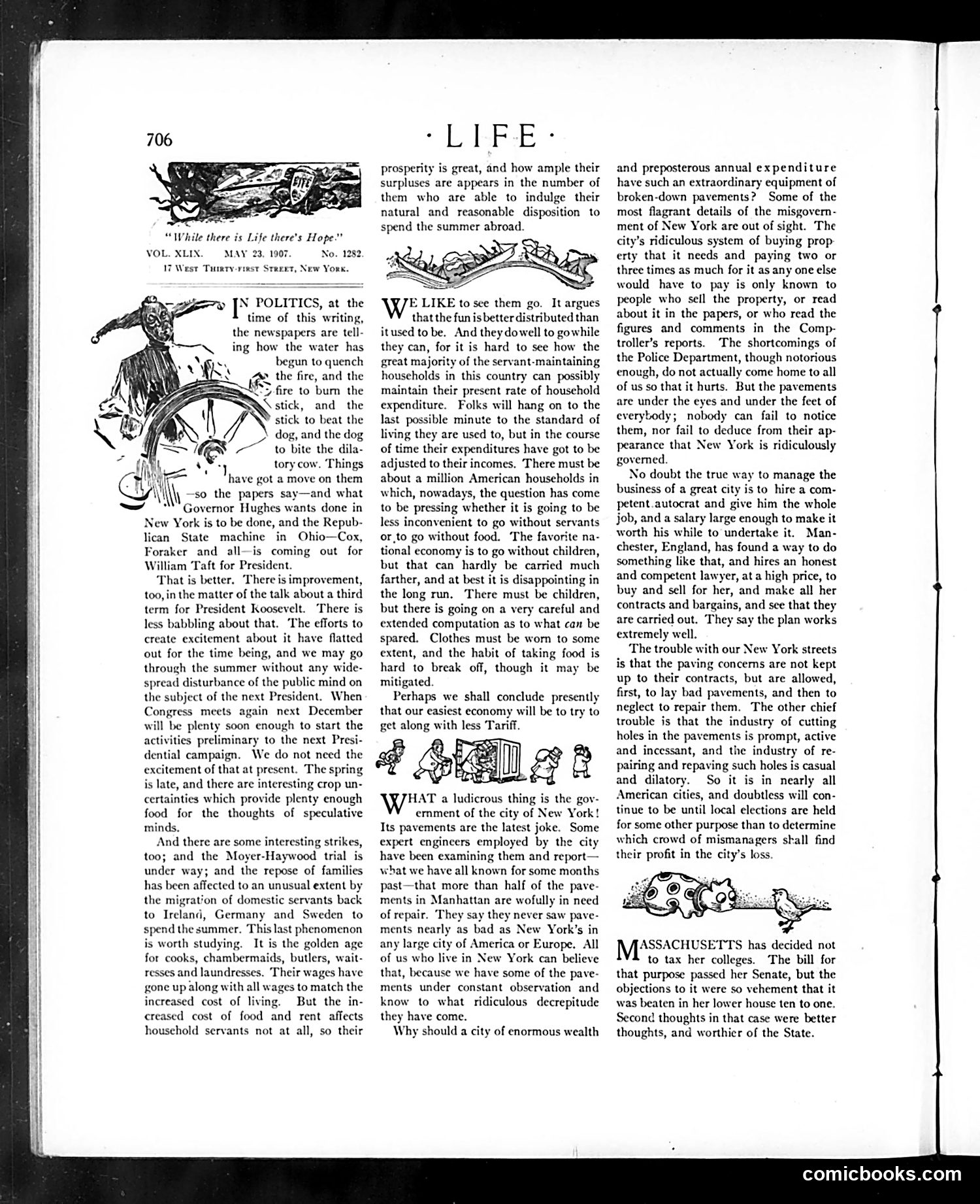
The page contains political commentary rather than cartoons. The main illustration depicts a rotund figure on a bicycle, likely representing a politician or public figure struggling with balance—a common metaphor for political instability. The text discusses several 1907 issues: Governor Hughes's reform efforts in New York and Ohio politics; the Republican/Taft succession question; President Roosevelt's upcoming December congressional address; and critiques of New York City's deteriorating infrastructure (particularly street pavements). A brief section mocks New York City's government incompetence regarding street maintenance. The final paragraph references Massachusetts's decision not to tax colleges. The satire targets political corruption, bureaucratic mismanagement, and the challenges facing Progressive Era urban governance.
📄 Transcribed text from this page (OCR, searchable)
Machine-transcribed from the original scan — historical spelling and the odd misread are preserved.
While there is Life there's Hope.” VOL. XLIX. MAY 23, 1907. No. 1282. 17 West Turety-rinst Staret, New Yore. N POLITICS, at the time of this writing, the newspapers are tell- ing how the water has begun to quench » the fire, and the gs fire to bum the \ stick, and the NN stick to beat the dog, and the dog to bite the dila- tory cow. Things have got a move on them so the papers say—and what Governor Hughes wants done in New York is to be done, and the Repub- lican State machine in Ohio—Cox, Foraker and all—is coming out for William Taft for President. ‘That is better. There is improvement, too, in the matter of the talk about a third term for President Koosevelt. There is less babbling about that. ‘The efforts to create excitement about it have flatted out for the time being, and we may go through the summer without any wide- spread disturbance of the public mind on the subject of the next President. When Congress meets again next December will be plenty soon enough to start the activities preliminary to the next Presi- dential campaign. We do not need the excitement of that at present. The spring is late, and there are interesting crop un- certainties which provide plenty enough food for the thoughts of speculative minds, And there are some interesting strikes, too; and the Moyer-Haywood trial is under way; and the repose of families has been affected to an unusual extent by the migration of domestic servants back to Ireland, Germany and Sweden to spend the summer. This last phenomenon is worth studying. It is the golden age for cooks, chambermaids, butlers, wait- resses and laundresses. Their wages have gone up along with all wages to match the increased cost of living. But the in- creased cost of food and rent affects household servants not at all, so their * LEE : prosperity is great, and how ample their surpluses are appears in the number of them who are able to indulge their natural and reasonable disposition to spend the summer abroad. E LIKE to see them go. It argues that the fun is better distributed than itused to be. And they dowell to gowhile they can, for it is hard to see how the great majority of the servant-maintaining households in this country can possibly maintain their present rate of household expenditure. Folks will hang on to the last possible minute to the standard of living they are used to, but in the course of time their expenditures have got to be adjusted to their incomes, There must be about a million American households in which, nowadays, the question has come to be pressing whether it is going to be less inconvenient to go without servants orto go without food. The favorite na- tional economy is to go without children, but that can hardly be carried much farther, and at best it is disappointing in the long run. There must be children, but there is going on a very careful and extended computation as to what can be spared. Clothes must be worn to some extent, and the habit of taking food is hard to break off, though it may be mitigated. Perhaps we shall conclude presently that our easiest economy will be to try to get along with less Tariff. wrt a ludicrous thing is the gov- ernment of the city of New York! Its pavements are the latest joke. Some expert engineers employed by the city have been examining them and report— what we have all known for some months past—that more than half of the pave- ments in Manhattan are wofully in need of repair. ‘They say they never saw pave- ments nearly as bad as New York’s in any large city of America or Europe. All of us who live in New York can believe that, because we have some of the pave- ments under constant observation and know to what ridiculous decrepitude they have come. Why should a city of enormous wealth and preposterous annual expenditure have such an extraordinary equipment of broken-down pavements? Some of the most flagrant details of the misgovern- ment of New York are out of sight. The city’s ridiculous system of buying prop- erty that it needs and paying two or three times as much for it as any one else would have to pay is only known to people who sell the property, or read about it in the papers, or who read the figures and comments in the Comp- troller’s reports. The shortcomings of the Police Department, though notorious enough, do not actually come home to all of us so that it hurts. But the pavements. are under the eyes and under the feet of everybody; nobody can fail to notice them, nor fail to deduce from their ap- pearance that New York is ridiculously governed. No doubt the true way to manage the business of a great city is to hire a com- petent.autocrat and give him the whole job, and a salary large enough to make it worth his while to undertake it. Man- chester, England, has found a way to do something like that, and hires an honest and competent lawyer, at a high price, to buy and sell for her, and make all her contracts and bargains, and see that they are carried out. They say the plan works extremely well. ‘The trouble with our New York streets is that the paving concems are not kept up to their contracts, but are allowed, first, to lay bad pavements, and then to neglect to repair them. The other chief trouble is that the industry of cutting holes in the pavements is prompt, active and incessant, and the industry of re- pairing and repaving such holes is casual and dilatory. So it is in nearly all American cities, and doubtless will con- tinue to be until local elections are held for some other purpose than to determine which crowd of mismanagers skall find their profit in the city’s loss. Mie SSACHUSETTS has decided not to tax her colleges. The bill for that purpose passed her Senate, but the objections to it were so vehement that it was beaten in her lower house ten to one. Second thoughts in that case were better thoughts, and worthier of the State. comicbooks.com