
Life, 1907-05-23 · page 17 of 24
Life — May 23, 1907 — page 17: what you’re looking at
What you’re looking at
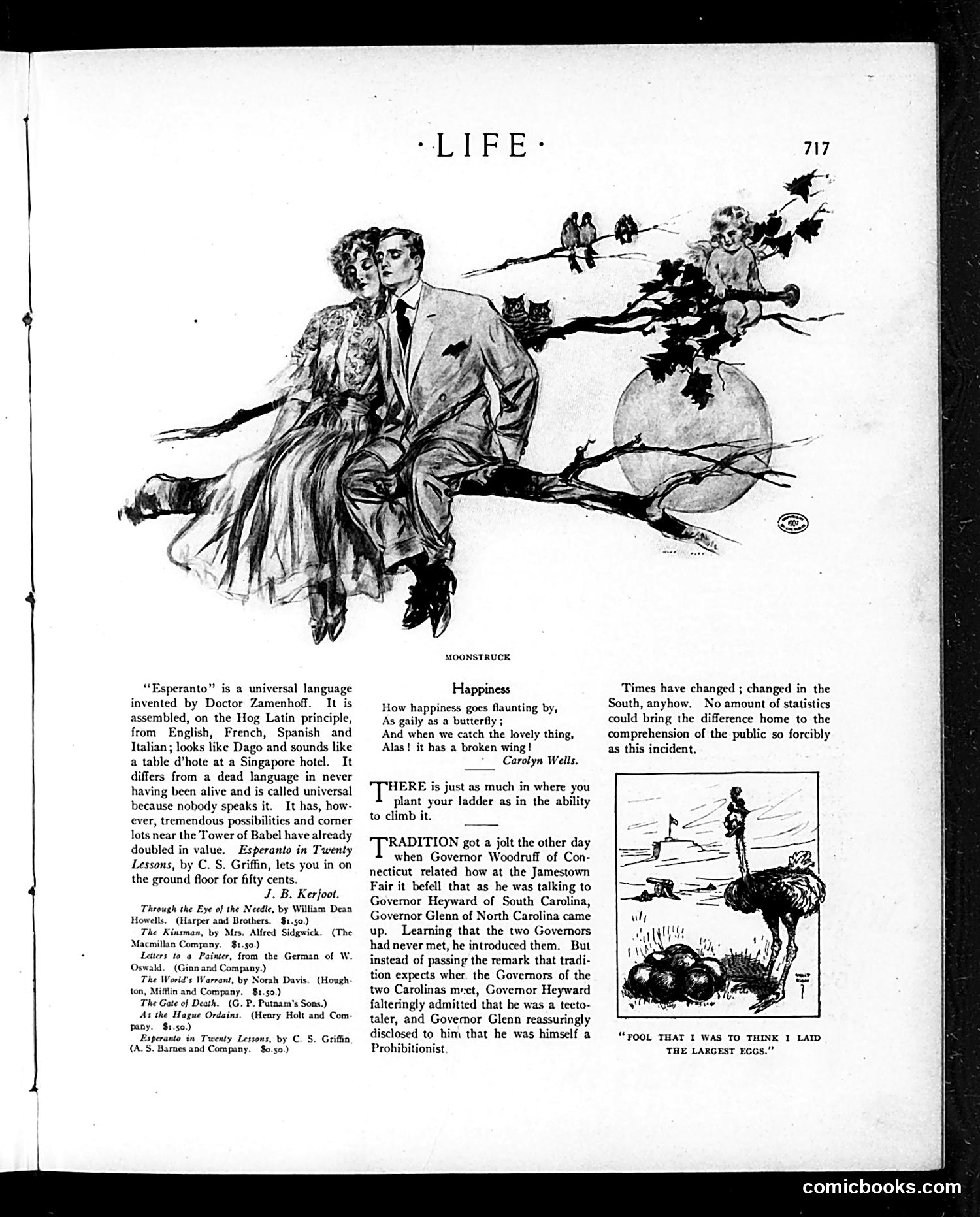
**Top Illustration ("Moonstruck"):** A couple sits on a crescent moon amid swirling clouds—a romantic, dreamy scene. This illustrates Carolyn Wells' poem about happiness being fleeting and fragile ("broken wing"). **Text Content:** The page primarily comprises book reviews and humorous commentary. J.B. Kerfoot satirizes **Esperanto**, an artificial international language invented by L.L. Zamenhoff. Kerfoot mocks it as absurd—assembled from multiple languages, sounding like "table d'hote at a Singapore hotel," and paradoxically "universal because nobody speaks it." He jokes that land near the Tower of Babel (biblical symbol of language confusion) has doubled in value. **Bottom Section ("Tradition"):** Governor Woodruff describes meeting South Carolina and North Carolina governors. Tradition supposedly dictates their greeting should reference regional customs. Instead, both governors admit to being **teetotalers and prohibitionists**—shocking for the post-Civil War South, where alcohol culture was traditional. The satire highlights how prohibition sentiment has disrupted Southern conventions. **Small cartoon (bottom right):** An ostrich laments laying small eggs—illustrating overconfidence or misplaced pride.
📄 Transcribed text from this page (OCR, searchable)
Machine-transcribed from the original scan — historical spelling and the odd misread are preserved.
“Esperanto” is a universal language invented by Doctor Zamenhoff. It is assembled, on the Hog Latin principle, from English, French, Spanish and Italian ; looks like Dago and sounds like a table d’hote at a Singapore hotel. It differs from a dead language in never having been alive and is called universal because nobody speaks it. It has, how- ever, tremendous possibilities and corner lots near the Tower of Babel have already doubled in value. Esperanto in Twenty Lessons, by C. S. Griffin, lets you in on the ground floor for fifty cents. J.B. Kerfoot. Through the Eye of the Needle, by William Dean Howells. (Harper and Brothers. $1.50.) The Kinsman, by Mrs. Alfred Sidgwick Macmillan Company. $1.50.) Letters to a Painter, from the German of W. Oswald. (Ginn and Company.) The World's Warrant, by Norah Davis. (Hough- ton, Mifflin and Company. 81.50.) The Gate of Death. (G. P, Putnam's Sons.) As the Hague Ordains. (Henry Holt and Com- pany. $1.50.) Esperanto in Twenty Lessons, by C. $. Griffin, (A.S. Barnes and Company. $0.50.) (The “Es PE MOONSTRUCK Happiness How happiness goes flaunting by, As gaily as a butterfly ; And when we catch the lovely thing, Alas! it has a broken wing! Carolyn Wells. 'HERE is just as much in where you plant your ladder as in the ability to climb it. SERADITION, got a jolt the other day when Governor Woodruff of Con- necticut related how at the Jamestown Fair it befell that as he was talking to Governor Heyward of South Carolina, Governor Glenn of North Carolina came up. Learning that the two Governors had never met, he introduced them. But instead of passing the remark that tradi- tion expects wher. the Governors of the two Carolinas met, Governor Heyward falteringly admitted that he was a tecto- taler, and Governor Glenn reassuringly disclosed to him that he was himself a Prohibitionist Times have changed ; changed in the South, anyhow. No amount of statistics could bring the difference home to the comprehension of the public so forcibly as this incident. “FOOL THAT I WAS TO THINK I LAID THE LARGEST EGGS.” comicbooks.com