
Life, 1907-05-23 · page 8 of 24
Life — May 23, 1907 — page 8: what you’re looking at
What you’re looking at
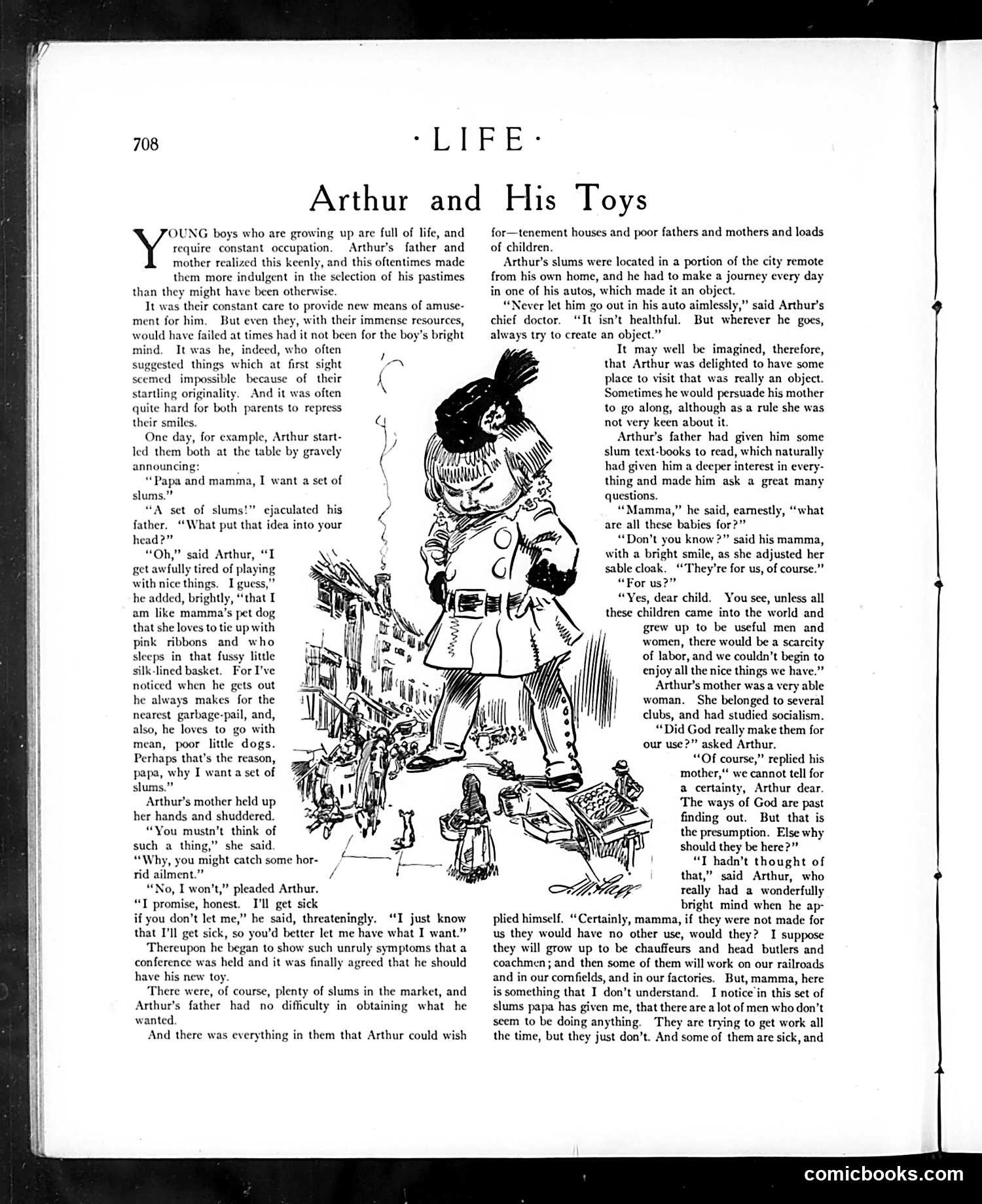
This appears to be a humorous story about a young boy named Arthur from a poor urban neighborhood ("slums") who wants toys. The illustration shows a large woman (his mother) with a child and toy vehicles. The satire targets middle-class parental anxieties about child-rearing. Arthur's mother worries about providing proper entertainment, while his father gifts him slum text-books to encourage curiosity. The dialogue satirizes contemporary debates about poverty, labor, and social responsibility—suggesting that poor children might become "useful men and women" through work in factories, railroads, and coachmen positions rather than play. The piece mocks both sentimental middle-class attitudes toward childhood and the harsh economic realities that forced working-class children into labor rather than leisure.
📄 Transcribed text from this page (OCR, searchable)
Machine-transcribed from the original scan — historical spelling and the odd misread are preserved.
*LIFE- Arthur and His Toys ‘OUNG boys who are growing up are full of life, and Y require constant occupation, Arthur’s father and mother realized this keenly, and this oftentimes made them more indulgent in the selection of his pastimes than they might have been otherwise It was their constant care to provide new means of amuse- ment for him, But even they, with their immense resources, would have failed at times had it not been for the boy’s bright mind. It was he, indeed, who often ested things which at first sight seemed impossible because of their startling originality. And it was often quite hard for both parents to repress their smiles, One day, for example, Arthur start- led them both at the table by gravely announcing: “Papa and mamma, I want a set of slums.” “A set of slums!” ejaculated his father. “What put that idea into your head?” “Oh,” said Arthur, “IT get awfully tired of playing with nice things. I guess,” he added, brightly, “that I am like mamma's pet dog that she loves to tic up with pink ribbons and who sleeps in that fussy little silk-lined basket. For I’ve noticed when he gets out he always makes for the nearest _garbage-pail, and, also, he loves to go with mean, poor little dogs. Perhaps that’s the reason, papa, why I want a set of slums.” Arthur’s mother held up her hands and shuddered. “You mustn’t think of such a thing,” she said you might catch some hor- rid ailment.” “No, I won't,” pleaded Arthur. “I promise, honest. I'll get sick if you don’t let me,” he said, threateningly. “I just know that I'll get sick, so you'd better let me have what I want.” Thereupon he began to show such unruly symptoms that a conference was held and it was finally agreed that he should have his new toy. There were, of course, plenty of slums in the market, and Arthur’s father had no difficulty in obtaining what he wanted. And there was everything in them that Arthur could wish for—tenement houses and poor fathers and mothers and loads of children, Arthur’s slums were located in a portion of the city remote from his own home, and he had to make a journey every day in one of his autos, which made it an object. “Never let him go out in his auto aimlessly,” said Arthur’s chief doctor. “It isn’t healthful. But wherever he goes, always try to create an object.” It may well be imagined, therefore, that Arthur was delighted to have some place to visit that was really an object. Sometimes he would persuade his mother to go along, although as a rule she was not very keen about it. Arthur’s father had given him some slum text-books to read, which naturally had given him a deeper interest in every- thing and made him ask a great many questions. “Mamma,” he said, eamestly, “what are all these babies for?” “Don’t you know ?” said his mamma, with a bright smile, as she adjusted her sable cloak. “They’re for us, of course.” “For us?” “Yes, dear child. You see, unless all these children came into the world and grew up to be useful men and women, there would be a scarcity of labor, and we couldn’t begin to enjoy all the nice things we have. Arthur’s mother was a very able woman. She belonged to several clubs, and had studied socialism. “Did God really make them for our use?” asked Arthur. “Of course,” replied his mother,“ we cannot tell for a certainty, Arthur dear. The ways of God are past finding out. But that is the presumption. Else why should they be here?” “T hadn't thought of that,” said Arthur, who really had a wonderfully bright mind when he ap- plied himself. “Certainly, mamma, if they were not made for us they would have no other use, would they? I suppose they will grow up to be chauffeurs and head butlers and coachmen ; and then some of them will work on our railroads and in our comfields, and in our factories. But, mamma, here is something that I don’t understand. I notice’in this set of slums papa has given me, that there are a lot of men who don’t seem to be doing anything. They are trying to get work all the time, but they just don’t. And some of them are sick, and comicbooks.com