
Life, 1907-05-23 · page 16 of 24
Life — May 23, 1907 — page 16: what you’re looking at
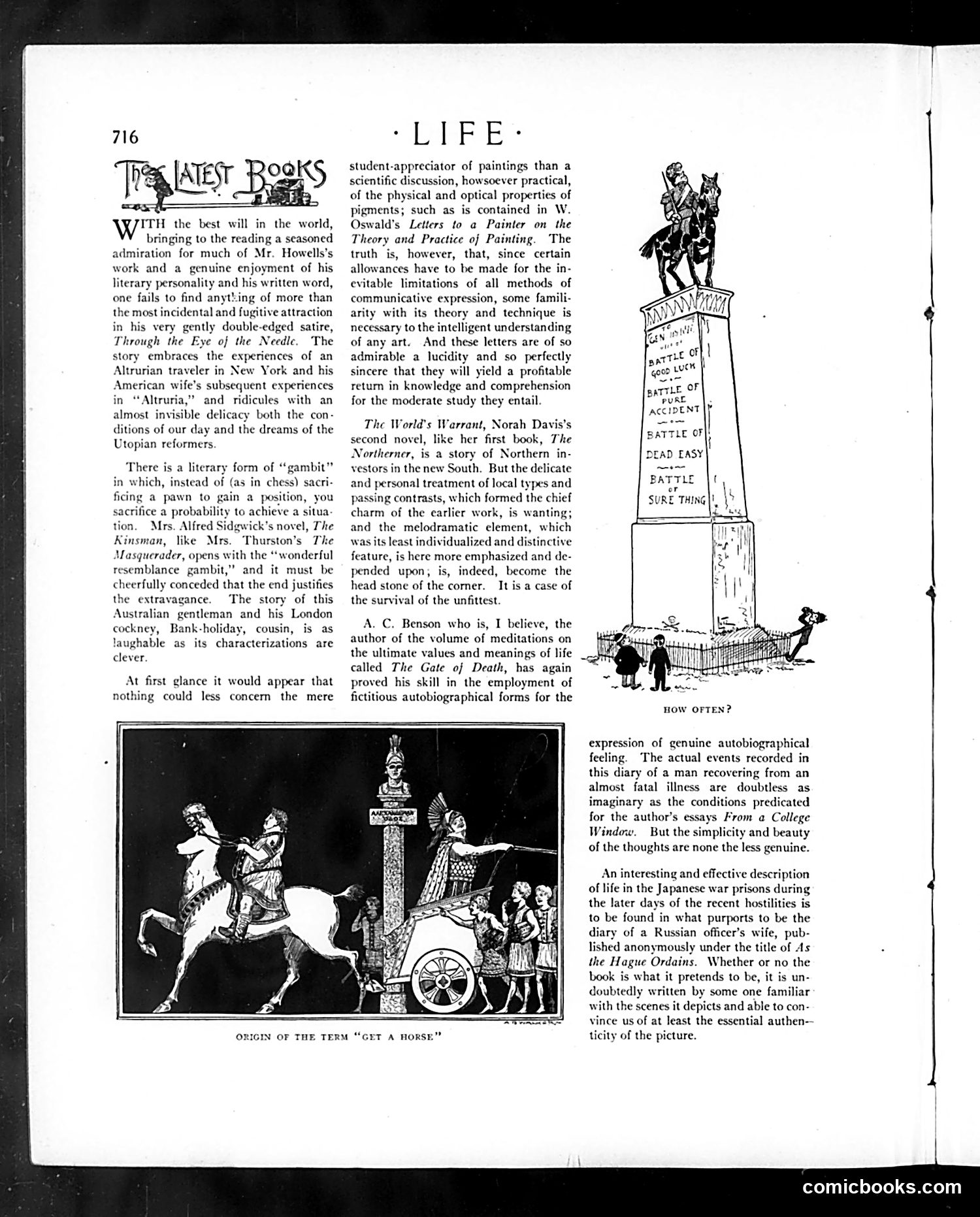
A restored page from Life, 1907-05-23. Page through the whole issue in the reader above.
📄 Transcribed text from this page (OCR, searchable)
Machine-transcribed from the original scan — historical spelling and the odd misread are preserved.
716 PpAer Bags ITH the best will in the world, bringing to the reading a seasoned admiration for much of Mr. Howells’s work and a genuine enjoyment of his literary personality and his written word, one fails to find anyting of more than the most incidental and fugitive attraction in his very gently double-edged satire, Through the Eye of the Needle. The story embraces the experiences of an Altrurian traveler in New York and his American wife's subsequent experiences in ‘Altruria,” and ridicules with an almost invisible delicacy both the con- ditions of our day and the dreams of the Utopian reformers. There is a literary form of “gambit” which, instead of (as in chess) sacri- ing a pawn to gain a position, you sacrifice a probability to achieve a situa tion. Mrs. Alfred Sidgwick’s novel, The Kinsman, like Mrs. Thurston’s The Masquerader, opens with the “wonderful resemblance gambit,” and it must be cheerfully conceded that the end justifies the extravagance. The story of this Australian gentleman and his London cockney, Bank-holiday, cousin, is as laughable as its characterizations are clever. At first glance it would appear that nothing could less concem the mere HARE * student-appreciator of paintings than a scientific discussion, howsoever practical, of the physical and optical properties of pigments; such as is contained in W. Oswald's Letters to a Painter on the Theory and Practice of Painting. The truth is, however, that, since certain allowances have to be made for the in- evitable limitations of all methods of communicative expression, some famili- arity with its theory and technique is necessary to the intelligent understanding of any art. And these letters are of so admirable a lucidity and so perfectly sincere that they will yield a profitable return in knowledge and comprehension for the moderate study they entail. The World's Warrant, Norah Davis’s second novel, like her first book, The Northerner, is a story of Northern in- vestors in the new South. But the delicate and personal treatment of local types and passing contrasts, which formed the chief charm of the earlier work, is wanting; and the melodramatic element, which was its least individualized and distinctive feature, is here more emphasized and de- pended upon; is, indeed, become the head stone of the corner. It is a case of the survival of the unfittest. A. C. Benson who is, I believe, the author of the volume of meditations on the ultimate values and meanings of life called The Gate oj Death, has again proved his skill in the employment of fictitious autobiographical forms for the ORIGIN OF THE TERM “GET A HORSE” BATTLE OF], DEAD EASY HOW OFTEN? expression of genuine autobiographical feeling. The actual events recorded in this diary of a man recovering from an almost fatal illness are doubtless as imaginary as the conditions predicated for the author’s essays From a College Window. But the simplicity and beauty of the thoughts are none the less genuine. An interesting and effective description of life in the Japanese war prisons during the later days of the recent hostilities is to be found in what purports to be the diary of a Russian officer’s wife, pub- lished anonymously under the title of As the Hague Ordains. Whether or no the book is what it pretends to be, it is un- doubtedly written by some one familiar with the scenes it depicts and able to con- vince us of at least the essential authen- ticity of the picture. comicbooks.com