
Life, 1907-05-23 · page 15 of 24
Life — May 23, 1907 — page 15: what you’re looking at
What you’re looking at
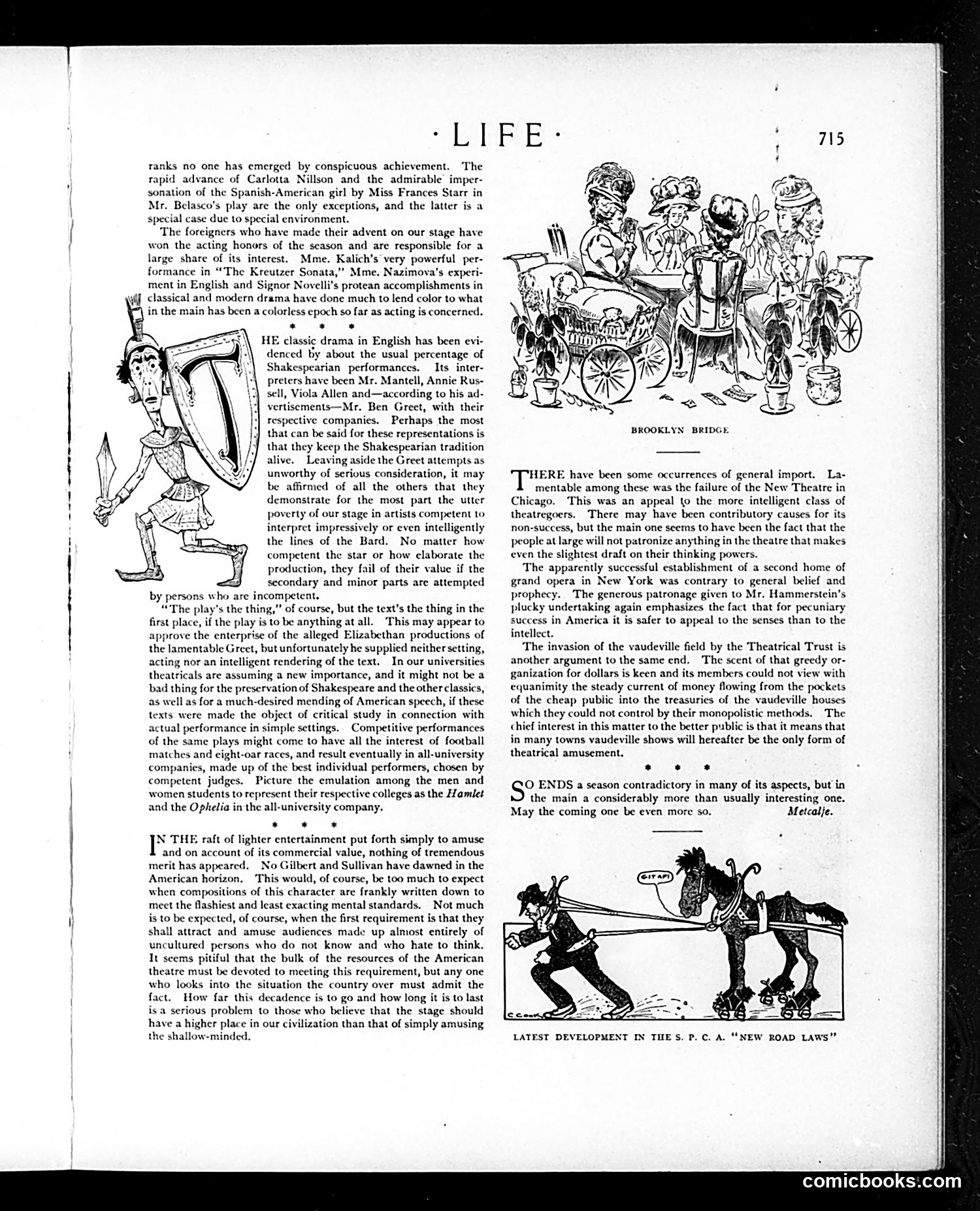
This page contains theater criticism rather than political satire. The text discusses the 1908-1909 theatrical season, lamenting that American drama lacks distinguished native talent. Foreign performers—specifically Mme. Kalich, Mme. Nazimova, and Signor Novelli—are praised for elevating the season. The critique dismisses most Shakespearean productions as poor, particularly Ben Greet's attempts, arguing that mediocre supporting actors undermine even star-driven stagings. **The cartoons** appear to be unrelated decorative illustrations: one shows a figure in theatrical costume; another depicts what the caption identifies as "Latest Development in the S.P.C.A. 'New Road Laws'"—a humorous commentary on animal protection efforts, showing someone struggling with what appears to be a recalcitrant horse or donkey. The overall message criticizes American theater's commercial focus on mass entertainment over artistic merit.
📄 Transcribed text from this page (OCR, searchable)
Machine-transcribed from the original scan — historical spelling and the odd misread are preserved.
“IESE: ranks no one has emerged by conspicuous achievement. ‘The rapid advance of Carlotta Nillson and the admirable imper- sonation of the Spanish-American girl by Miss Frances Starr in Mr. Belasco's play are the only exceptions, and the latter is a special case due to special environment. The foreigners who have made their advent on our stage have won the acting honors of the season and are responsible for a large share of its interest. Mme. Kalich’s very powerful per- formance in “The Kreutzer Sonata,” Mme. Nazimova’s experi- ment in English and Signor Novelli’s protean accomplishments in \iif classical and modern drama have done much to lend color to what (7) in the main has been a colorless epoch so far as acting is concerned. * 8 8 HE classic drama in English has been evi- denced by about the usual percentage of Shakespearian performances. Its. inter- preters have been Mr. Mantell, Annie Rus- sell, Viola Allen and—according to his ad- vertisements—Mr, Ben Greet, with their respective companies. Perhaps the most that can be said for these representations is that they keep the Shakespearian tradition alive. Leaving aside the Greet attempts as unworthy of serious consideration, it may be affirmed of all the others that they demonstrate for the most part the utter poverty of our stage in artists competent to interpret impressively or even intelligently the lines of the Bard. No matter how competent the star or how elaborate the production, they fail of their value if the secondary and minor parts are attempted by persons who are incompetent. “The play’s the thing,” of course, but the text’s the thing in the first place, if the play is to be anything at all. This may appear to approve the enterprise of the alleged Elizabethan productions of the lamentable Greet, but unfortunately he supplied neither setting, acting nor an intelligent rendering of the text. In our universities theatricals are assuming a new importance, and it might not be a bad thing for the preservation of Shakespeare and the other classics, as well as for a much-desired mending of American speech, if these texts were made the object of critical study in connection with actual performance in simple settings. Competitive performances of the same plays might come to have all the interest of football matches and eight-oar races, and result eventually in all-university companies, made up of the best individual performers, chosen by competent judges. Picture the emulation among the men and women students to represent their respective colleges as the Hamlet and the Ophelia in the all-university company. 8 & N THE raft of lighter entertainment put forth simply to amuse and on account of its commercial value, nothing of tremendous merit has appeared. No Gilbert and Sullivan have dawned in the American horizon, This would, of course, be too much to expect when compositions of this character are frankly written down to mect the flashiest and least exacting mental standards. Not much is to be expected, of course, when the first requirement is that they shall attract and amuse audiences made up almost entirely of uncultured persons who do not know and who hate to think. It seems pitiful that the bulk of the resources of the American theatre must be devoted to meeting this requirement, but any one who looks into the situation the country over must admit the fact. How far this decadence is to go and how long it is to last isa serious problem to those who believe that the stage should have a higher place in our civilization than that of simply amusing the shallow-minded, BROOKLYN BRIDGE HERE have been some occurrences of general import. La- mentable among these was the failure of the New Theatre in Chicago. This was an appeal to the more intelligent class of theatregoers. There may have been contributory causes for its non-success, but the main one seems to have been the fact that the people at large will not patronize anything in the theatre that makes even the slightest draft on their thinking powers. The apparently successful establishment of a second home of grand opera in New York was contrary to general belief and prophecy. ‘The gencrous patronage given to Mr. Hammerstein's plucky undertaking again emphasizes the fact that for pecuniary success in America it is safer to appeal to the senses than to the intellect. The invasion of the vaudeville field by the Theatrical Trust is another argument to the same end. The scent of that greedy or- ganization for dollars is keen and its members could not view with equanimity the steady current of money flowing from the pockets of the cheap public into the treasuries of the vaudeville houses which they could not control by their monopolistic methods. The chief interest in this matter to the better public is that it means that in many towns vaudeville shows will hereafter be the only form of theatrical amusement, O ENDS a season contradictory in many of its aspects, but in the main a considerably more than usually interesting one. May the coming one be even more so. Metcalje. LATEST DEVELOPMENT IN THE S. P. C. A. “NEW ROAD LAWS” comicbooks:com