
A complete issue · 36 pages · 1907
Life — April 18, 1907
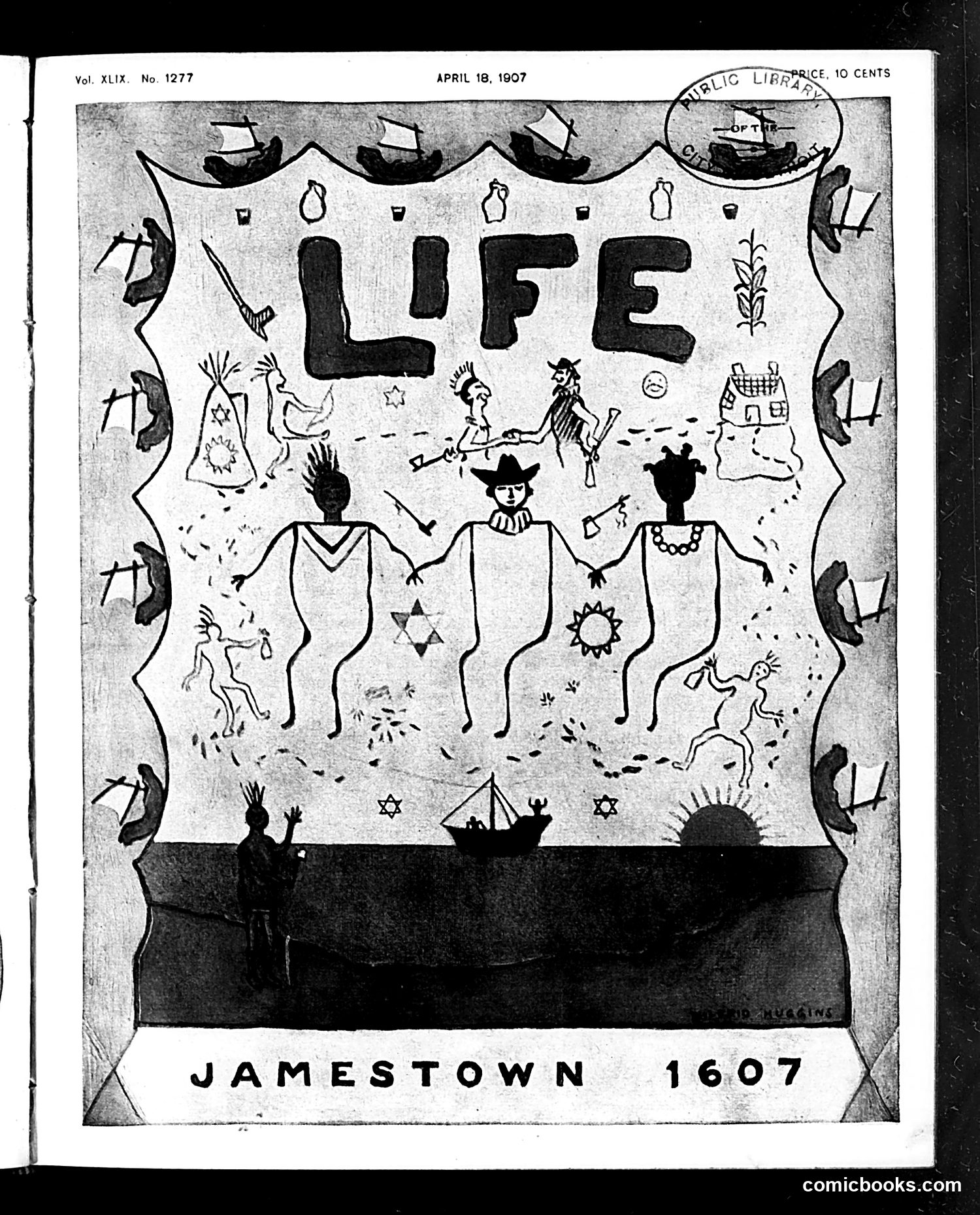
This cover illustrates "Jamestown 1607," commemorating the 300th anniversary of the English settlement of Jamestown, Virginia. The central image shows three stick-figure colonists displaying symbols of their endeavors: a Star of David (likely representing Jewish settlers or commerce), a sun (agriculture/prosperity), and other emblems suggesting various colonial activities. The border features silhouettes of period ships and indigenous figures, while the foreground shows a ship and a Native American figure in silhouette—acknowledging the colonial encounter that defined Jamestown's founding. The whimsical, almost primitive drawing style creates a deliberately naive or satirical tone, possibly mocking period romanticism about colonial origins or commenting on the historical oversimplification of colonization's complex realities.
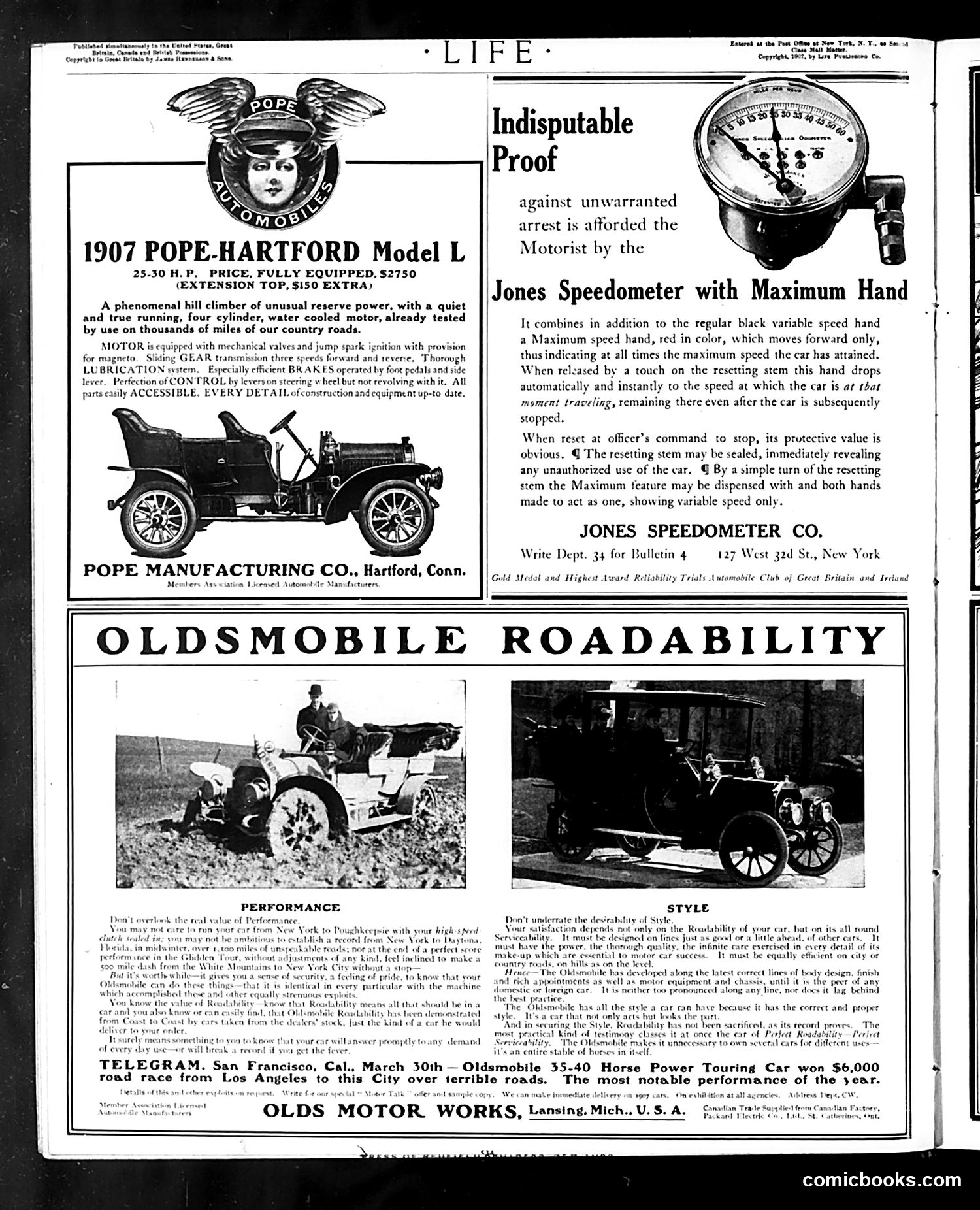
This page is primarily **advertising**, not satirical content. It contains three automobile advertisements from 1907: 1. **Pope-Hartford Model L** — a high-end motorcar emphasizing reliability and mechanical innovation ("four cylinder, water cooled motor"). 2. **Jones Speedometer with Maximum Hand** — a device allowing police to record a car's maximum speed, protecting motorists against "unwarranted arrest" by providing evidence of their actual speed. 3. **Oldsmobile Roadability** — emphasizing the car's performance and style, with photos demonstrating its capabilities on rough terrain. The page reflects early automotive marketing priorities: mechanical sophistication, legal protection for drivers, and proof of vehicle reliability. No political satire or caricature is present—this is straightforward period advertising aimed at wealthy consumers.
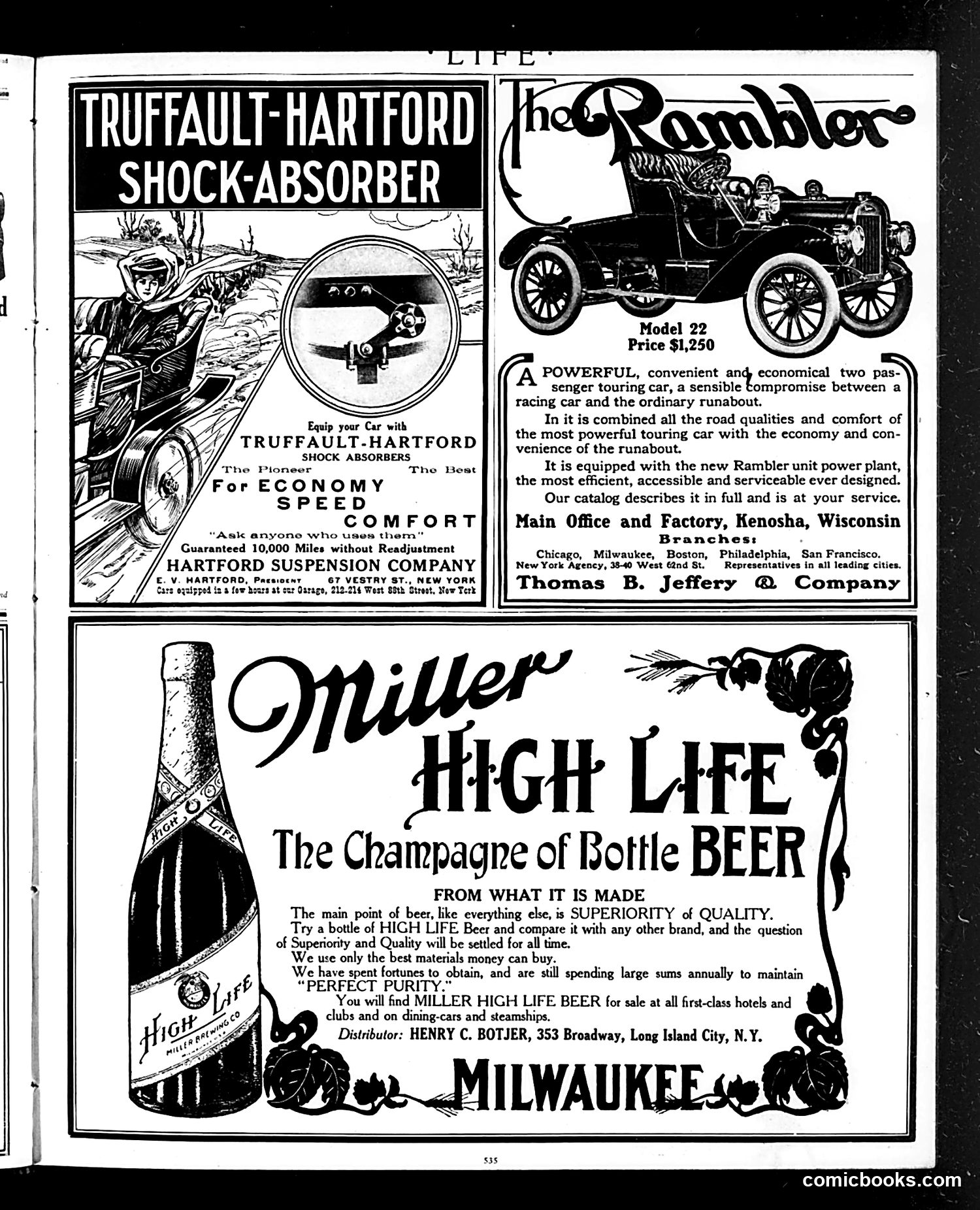
This page is primarily **advertising, not satire or political commentary**. It contains three distinct advertisements from what appears to be an early 1900s issue of Life magazine: 1. **Truffault-Hartford Shock-Absorber**: An automobile suspension product claiming economy, speed, and comfort. 2. **Rambler Model 22**: A $1,250 touring car positioned as a compromise between racing cars and basic runabouts, manufactured by Thomas B. Jeffery Company in Kenosha, Wisconsin. 3. **Miller High Life Beer**: Milwaukee beer marketed as "The Champagne of Bottle Beer," emphasizing quality and purity, distributed by Henry C. Botjer in Long Island City, New York. The advertisements reflect early automotive and consumer goods industries, with no satirical content visible. This represents typical Life magazine revenue from commercial advertising rather than editorial commentary.
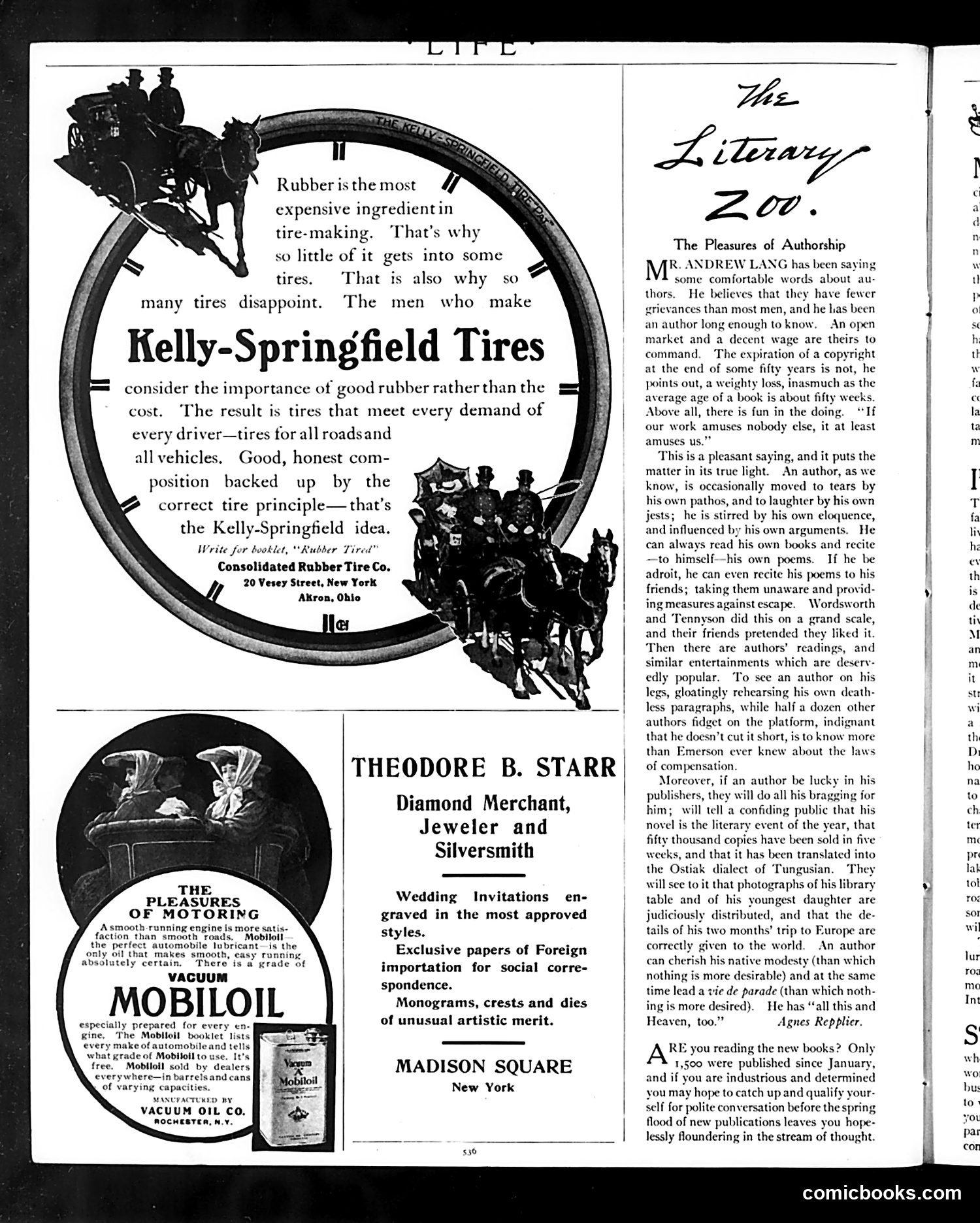
This page is primarily **advertising**, not satire or political commentary. The main visual content includes ads for **Kelly-Springfield Tires** (featuring a large tire graphic with horses and passengers), **Vacuum Mobiloil** (motor oil), and **Theodore B. Starr** (jeweler/silversmith). The right column contains "The Literary Zoo," a brief essay by Andrew Lang about the pleasures of authorship—noting that authors' lives are short (average 50 weeks) and discussing their compensations, including public readings and recognition. There is no identifiable political cartoon or satire on this page. It represents typical Life magazine content: a mix of advertisements and literary commentary aimed at educated, affluent readers interested in consumer goods and cultural commentary.
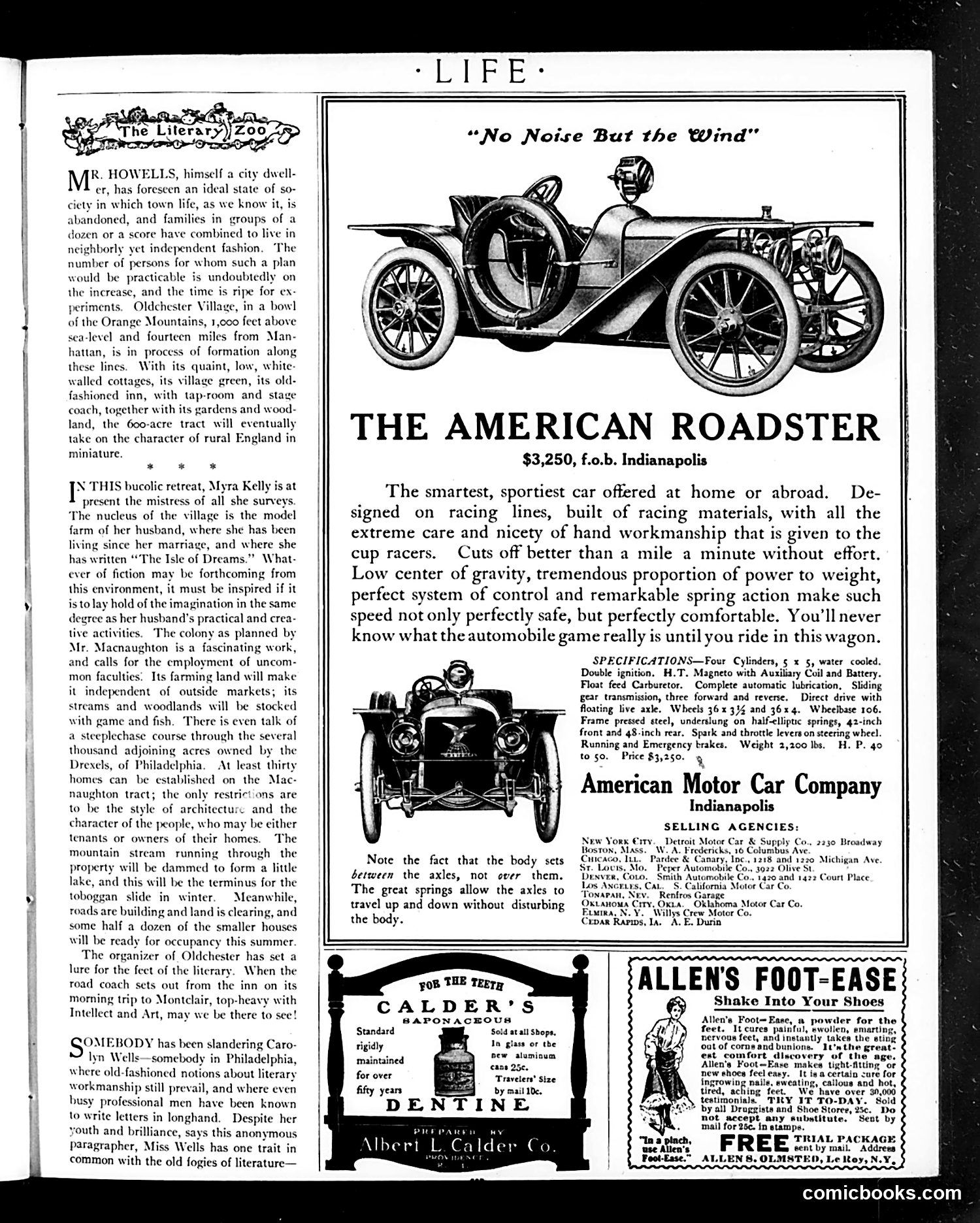
This page is primarily **advertising**, not satire or political commentary. The dominant content is a full-page advertisement for the American Roadster automobile ($3,250, manufactured in Indianapolis), featuring detailed specifications and selling agencies across the United States. Below the car ad are two smaller advertisements: one for Calder's Dentine (tooth powder) and one for Allen's Foot-Ease (a foot powder/remedy). The upper left contains brief editorial text about Mr. Howells' vision for an ideal society and mentions of Oldchester Village and Myra Kelly, but this appears to be standard magazine content rather than political commentary. **No political cartoons or satirical figures appear on this page.** It represents typical early 20th-century magazine composition: editorial matter with substantial advertising revenue.
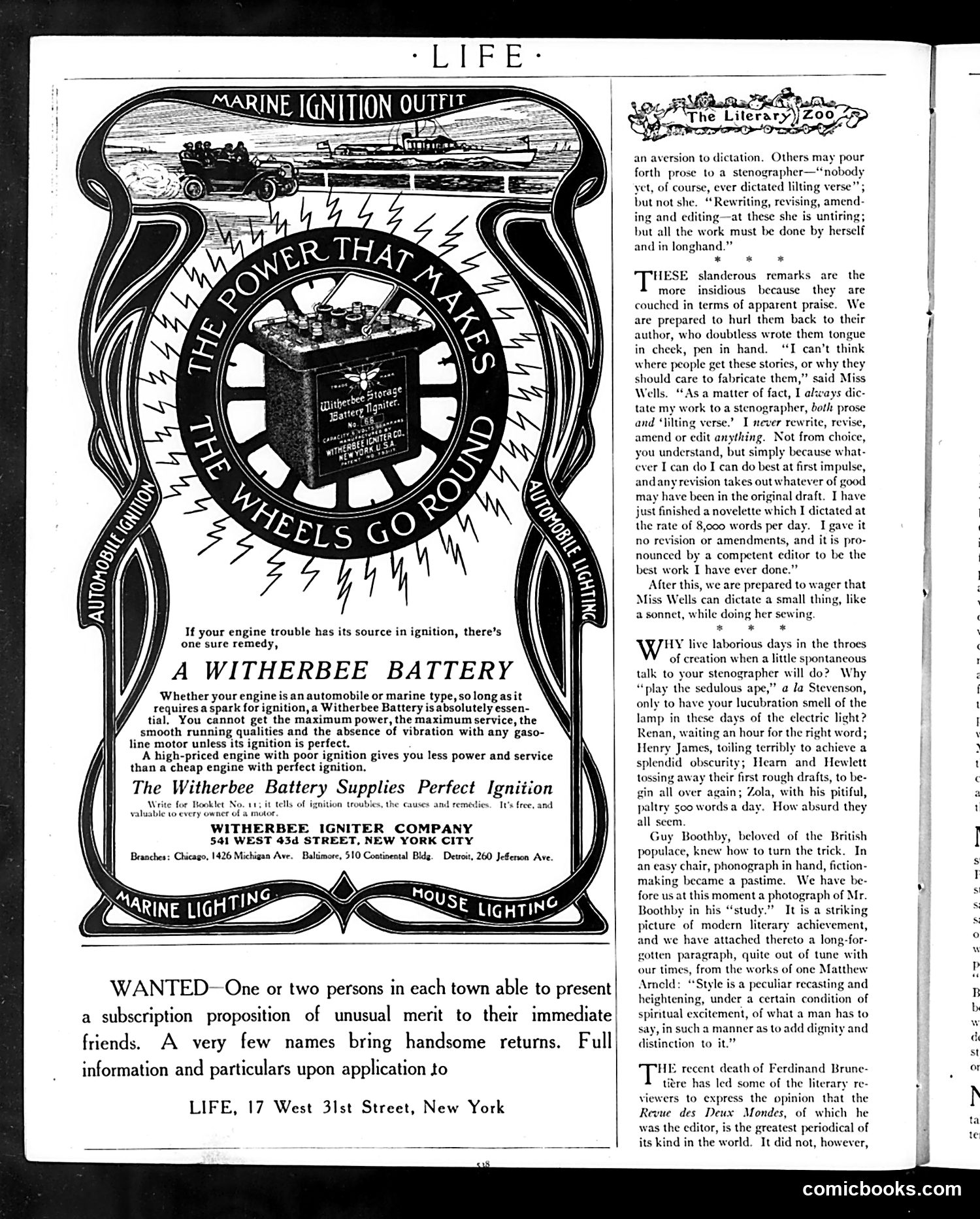
This page is primarily **advertising and editorial content** rather than political satire. The main visual element is a large advertisement for a Witherbee Battery, featuring decorative Art Nouveau styling with a central battery image surrounded by ornamental borders. The ad emphasizes the battery's reliability for automobile and marine ignition systems. The right column contains "The Literary Zoo," a section discussing writing practices. It critiques stenographers and celebrates authors like H.G. Wells who revise their own work, contrasting their approach with writers who dictate to stenographers. The bottom includes a recruitment notice for Life magazine subscription agents. The page reflects early 20th-century concerns about emerging technologies (automobiles) and evolving literary production methods.
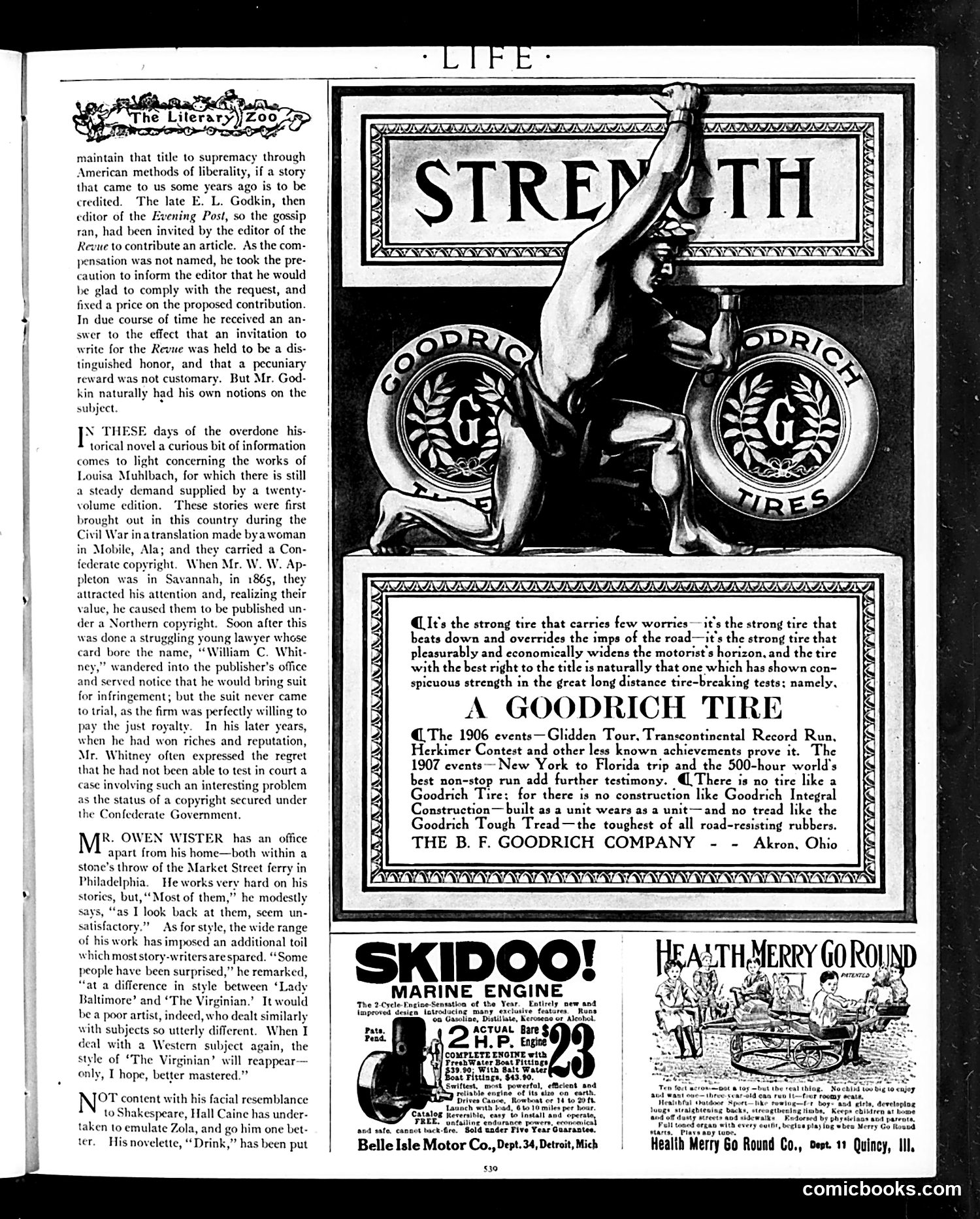
This page is primarily **advertising**, not satire or political commentary. The dominant image is a **Goodrich Tires advertisement** featuring a classical female figure labeled "STRENGTH" holding up automobile tires. The ad emphasizes tire durability through 1906-1907 racing events and long-distance tests. Below are smaller product ads for a **Skidoo Marine Engine** and **Health Merry Go Round** equipment. The left column contains **book review text** (labeled "The Literary Zoo") discussing historical novels, including works by Louisa Muhlbach and commentary on copyright issues during the Civil War era. This is a typical Life magazine page from the early 1900s mixing literary content with brand advertising—not satirical material.
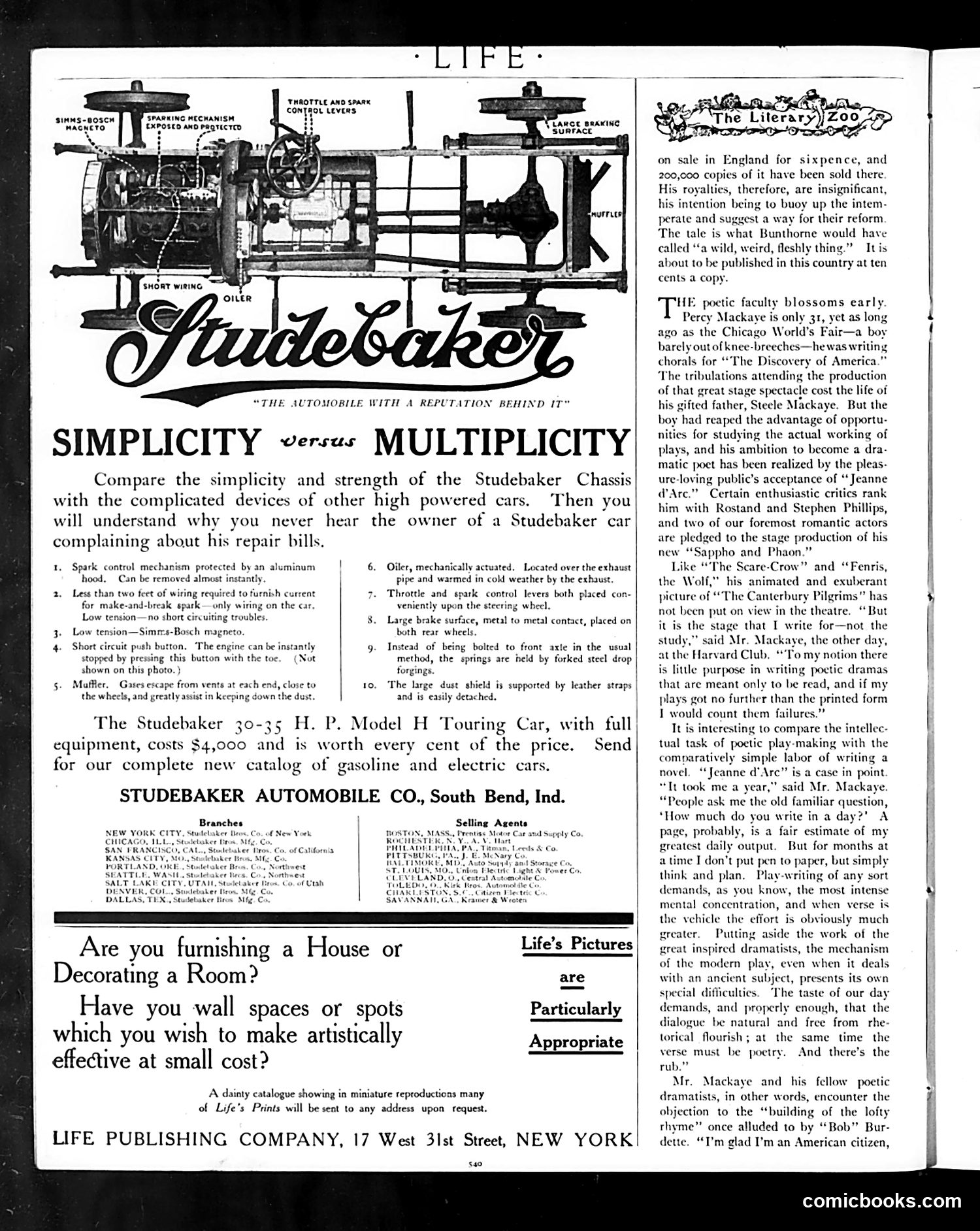
This page is primarily **advertising and editorial content** rather than political satire. The top half features a detailed **Studebaker automobile advertisement** emphasizing the car's mechanical simplicity versus competitors' complexity. A technical diagram shows the engine and components, with numbered callouts explaining design features. The right column contains **"The Literary Zoo,"** a brief article about Percy Mackaye, a playwright and poet. It discusses his prolific output, theatrical ambitions, and writing philosophy—notably that play-writing requires mental concentration and poetic discipline. The bottom sections advertise **Life Publishing Company's house-furnishing catalogs** and decorating services. No political cartoons or satire appear on this page. It represents typical early 20th-century magazine content mixing automobiles, arts, and commercial services.
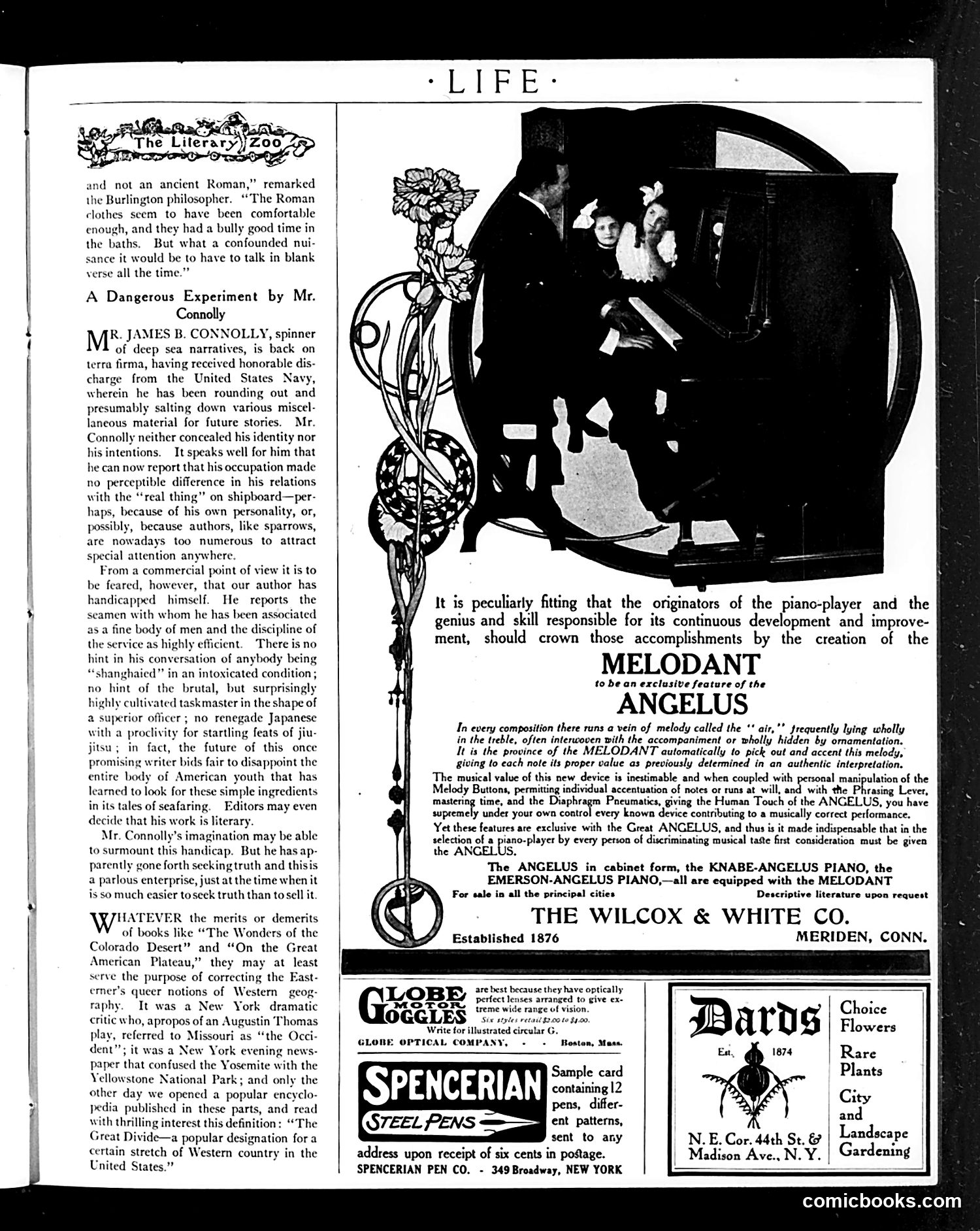
This page is primarily **advertising and literary commentary**, not political satire. The left column discusses **Mr. James B. Connolly**, a spinner of deep-sea narratives and former U.S. Navy officer, who writes maritime fiction. The text debates whether his seafaring background gives his work authentic credibility or if it's merely novelty. The "Literary Zoo" header suggests humorous profiling of authors. The large right-side image shows what appears to be a **player piano or mechanical music device** from Angelus/Willcox & White Co. (established 1876). The remainder consists of period **advertisements**: Globe Optical Company goggles, Spencerian steel pens, and Dards flower/landscape gardening services. This is a typical early 20th-century magazine layout mixing editorial content with commercial advertisements.
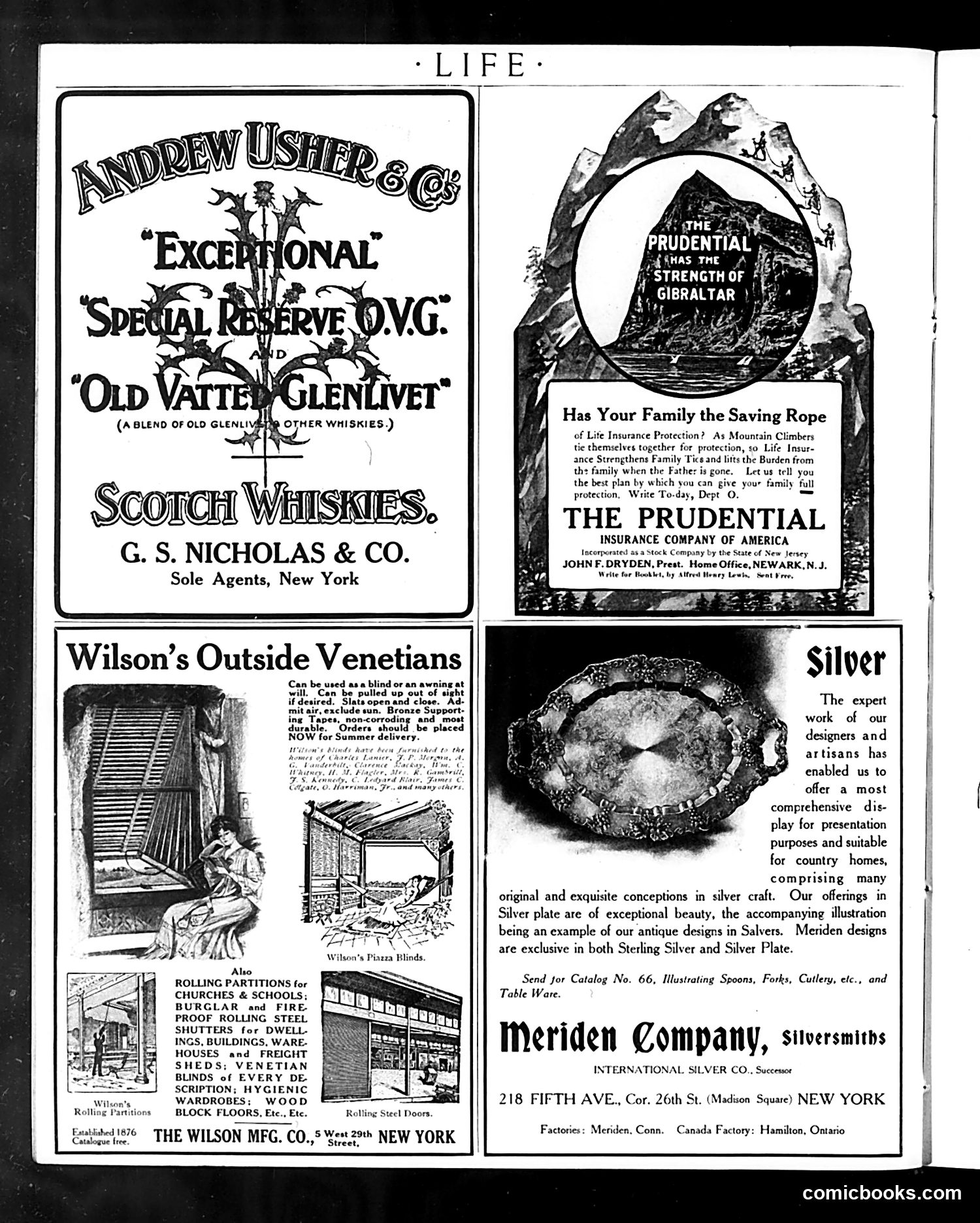
This page contains **advertisements, not political satire or comics**. It features four commercial ads: 1. **Andrew Usher & Co.** — Scottish whisky advertisement 2. **The Prudential Insurance Company** — Life insurance ad using Gibraltar's Rock as a metaphor for strength and family financial protection 3. **Wilson's Outside Venetians** — Window blinds and related products 4. **Meriden Company** — Silversmith goods (forks, spoons, cutlery) These are standard early-20th-century magazine advertisements with decorative illustrations and persuasive copy typical of *Life* magazine's revenue model. There is no political commentary, satire, or cartoon humor present on this page—it is purely commercial content.
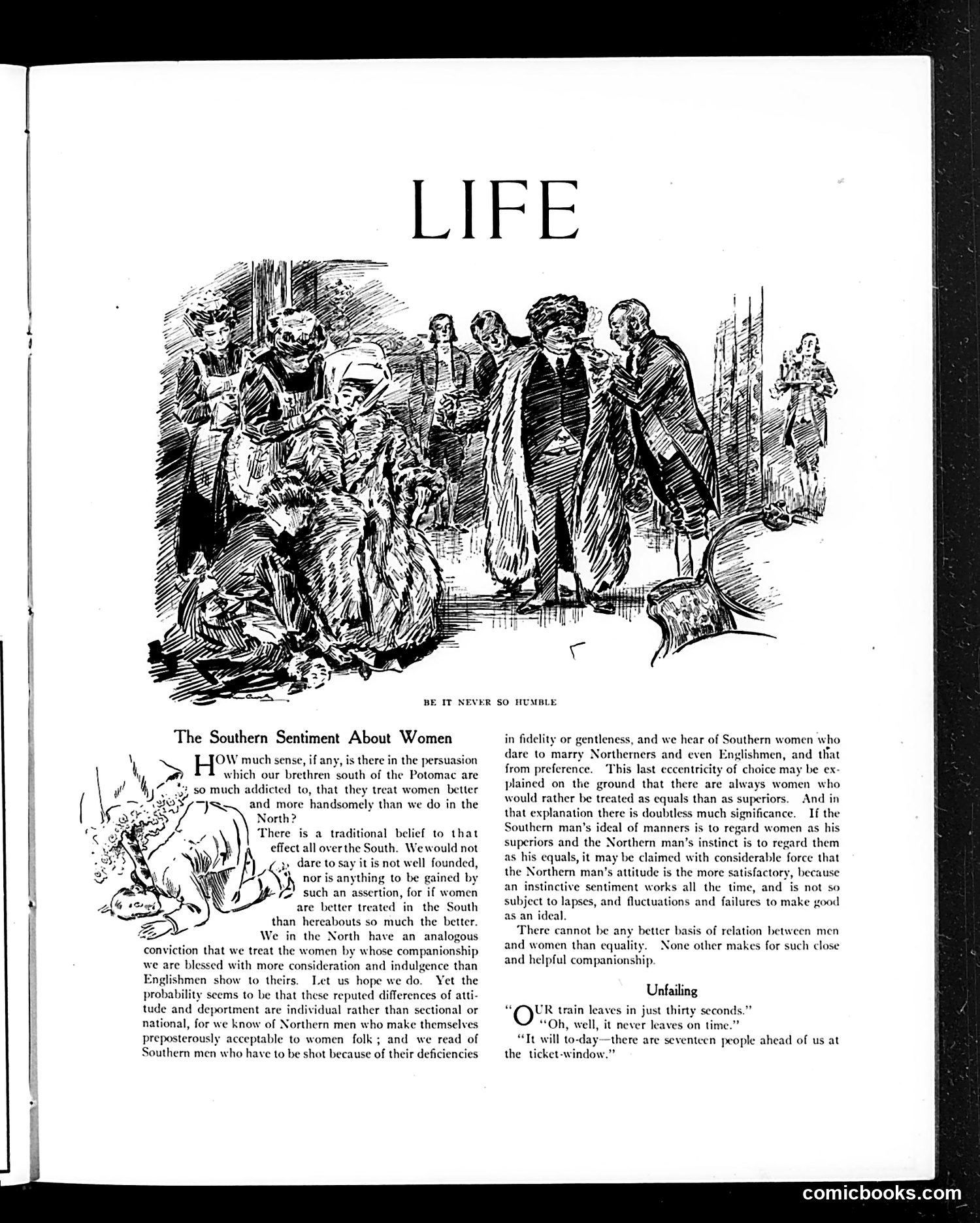
This page from *Life* magazine presents satirical commentary on Southern attitudes toward women, particularly regarding marriage. **Main Article: "The Southern Sentiment About Women"** The text ironically defends the South's superior treatment of women while simultaneously mocking this claim. It argues that Southern men treat women "better and more handsomely" than Northern men, claiming this explains why Southern women prefer marrying Southerners over Northerners or Englishmen. The satire lies in the contradiction: the author suggests Southern superiority stems from regarding women as equals deserving "close and helpful companionship"—yet uses this to justify why women would naturally choose Southern men, undermining the equality argument. **"Unfailing" Section** A brief comedic anecdote about train punctuality appears unrelated to the main content. The cartoon illustration above depicts a social gathering, likely emphasizing the genteel Southern social scene being discussed.
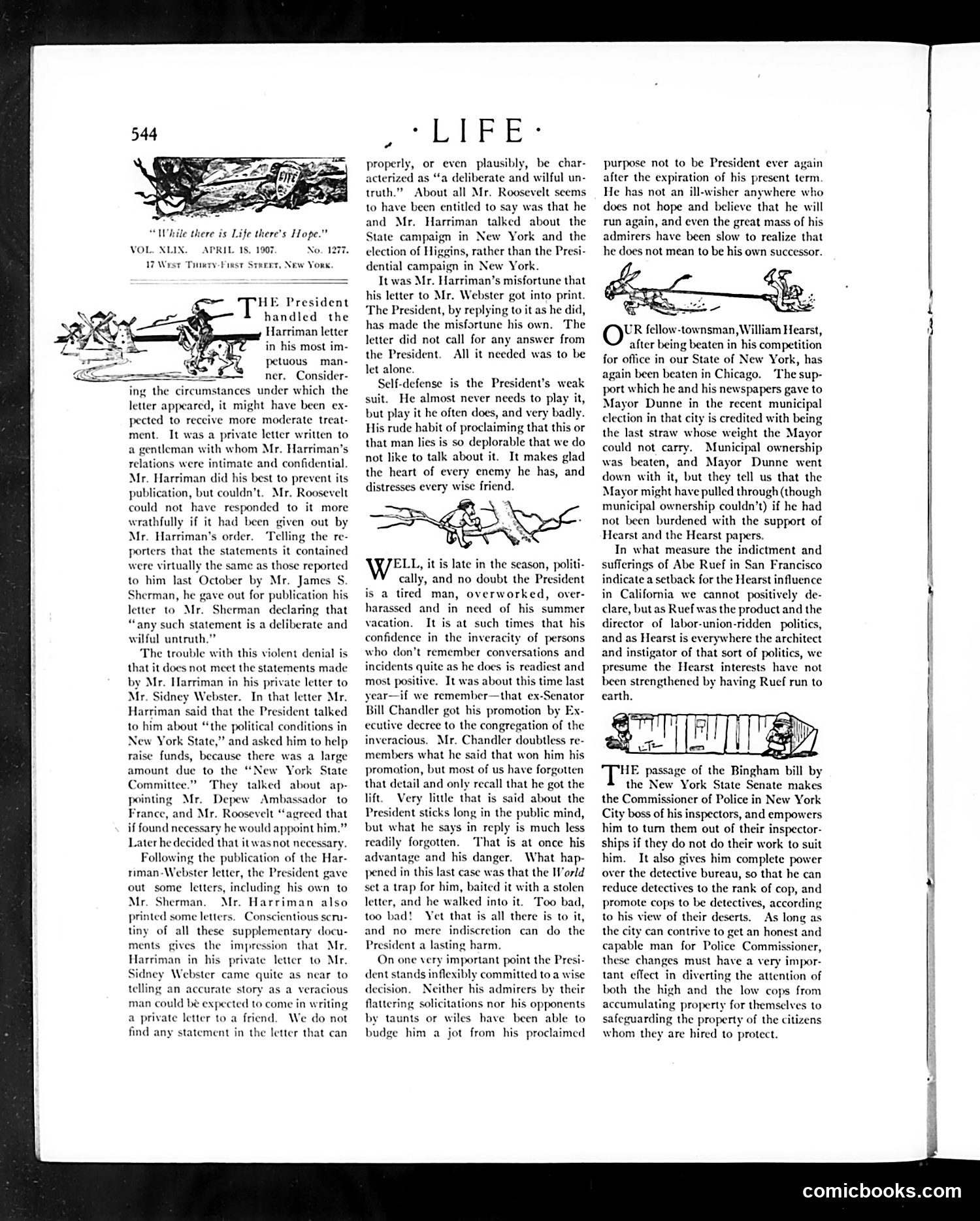
This page critiques President Theodore Roosevelt's handling of the Harriman letter controversy. The text discusses Roosevelt's defensive response to criticism regarding a private letter to Sidney Webster about political conditions in New York. The cartoons (though small and difficult to read in detail) appear to illustrate the political tension and Roosevelt's combative reaction to press scrutiny. Key satirical points: Roosevelt is depicted as tired and overworked, his "rude habit of proclaiming" wrongdoing is mocked, and the article suggests his violent denials damage rather than help his position. The piece also criticizes how Roosevelt allowed the controversy to escalate through poor handling of the initial publication. The satire targets Roosevelt's aggressive personality and his tendency to make political situations worse through defensive proclamations.
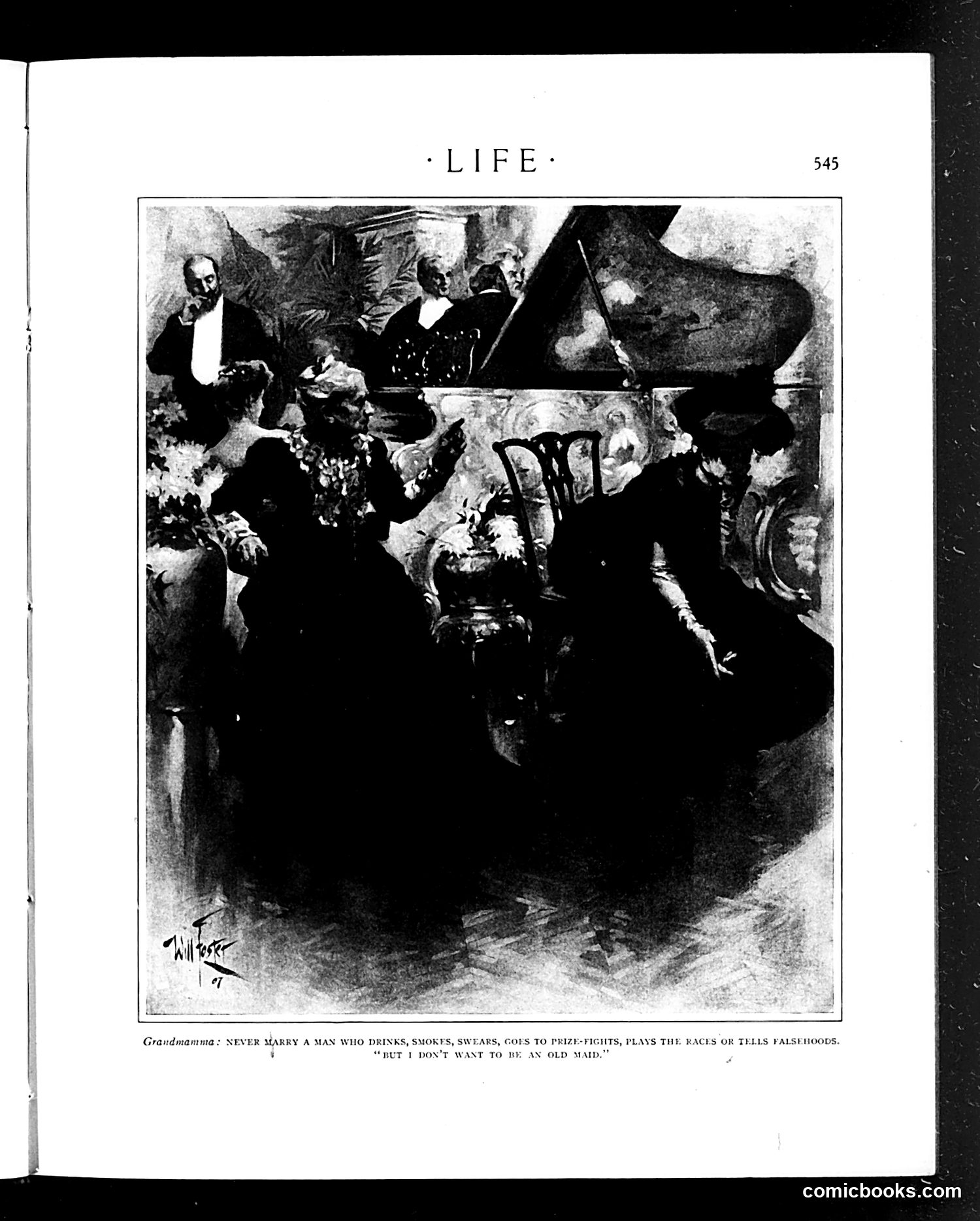
This is a satirical illustration depicting a grandmother giving advice to her granddaughter. The caption reads: "NEVER MARRY A MAN WHO DRINKS, SMOKES, SWEARS, GOES TO PRIZE-FIGHTS, PLAYS THE RACES OR TELLS FALSEHOODS. 'BUT I DON'T WANT TO BE AN OLD MAID.'" The joke satirizes the impossible standards women were expected to uphold when choosing husbands. By listing vices nearly universal among men of the era—drinking, smoking, swearing, gambling, and boxing—the grandmother's advice becomes absurdly impractical. The granddaughter's retort highlights the contradiction: following such strict criteria would leave her unmarriageable, as few men met such exacting moral standards. The cartoon mocks both rigid female virtue expectations and the reality of male behavior in early 20th-century society.
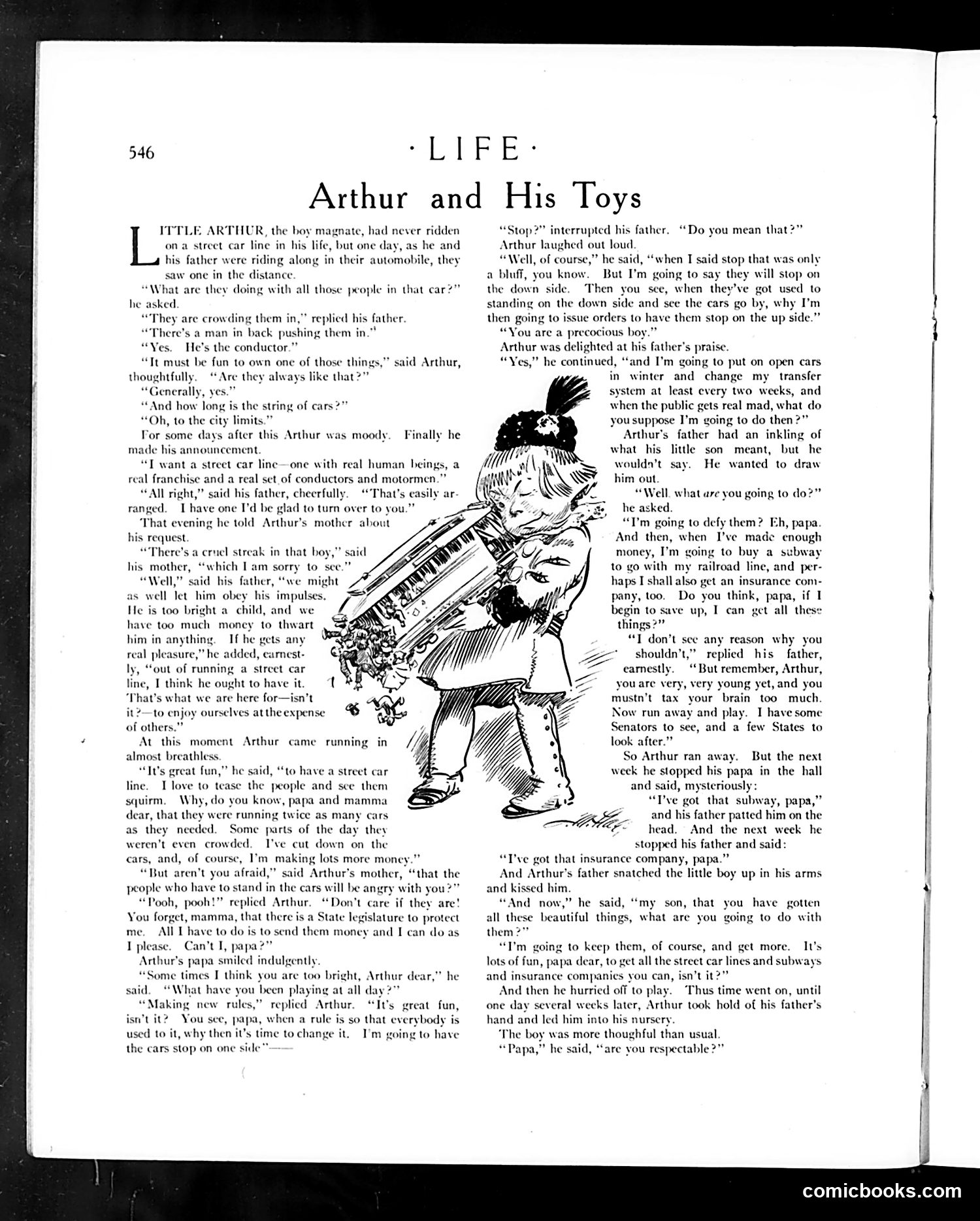
This story satirizes **turn-of-the-century American business practices and political corruption**. Little Arthur represents ruthless capitalists who exploit public utilities for personal profit and amusement. The satire targets: 1. **Monopolistic practices**: Arthur cuts streetcars to increase profits despite public inconvenience—reflecting real transit company behavior of the era. 2. **Political bribery**: Arthur casually states he sends money to state legislators to protect his interests, depicting the normalized corruption between business and government. 3. **Regulatory capture**: The father's indulgent acceptance ("we're here to enjoy ourselves at others' expense") critiques wealthy elites' entitlement. 4. **Consumer manipulation**: Arthur deliberately changes rules to confuse and anger riders, viewing their frustration as entertainment. The illustration shows Arthur as a cherubic boy holding a streetcar, emphasizing the absurdity that such power rests with someone so morally undeveloped. The story's dark humor exposes how unchecked capitalism treats the public as victims for profit and amusement.
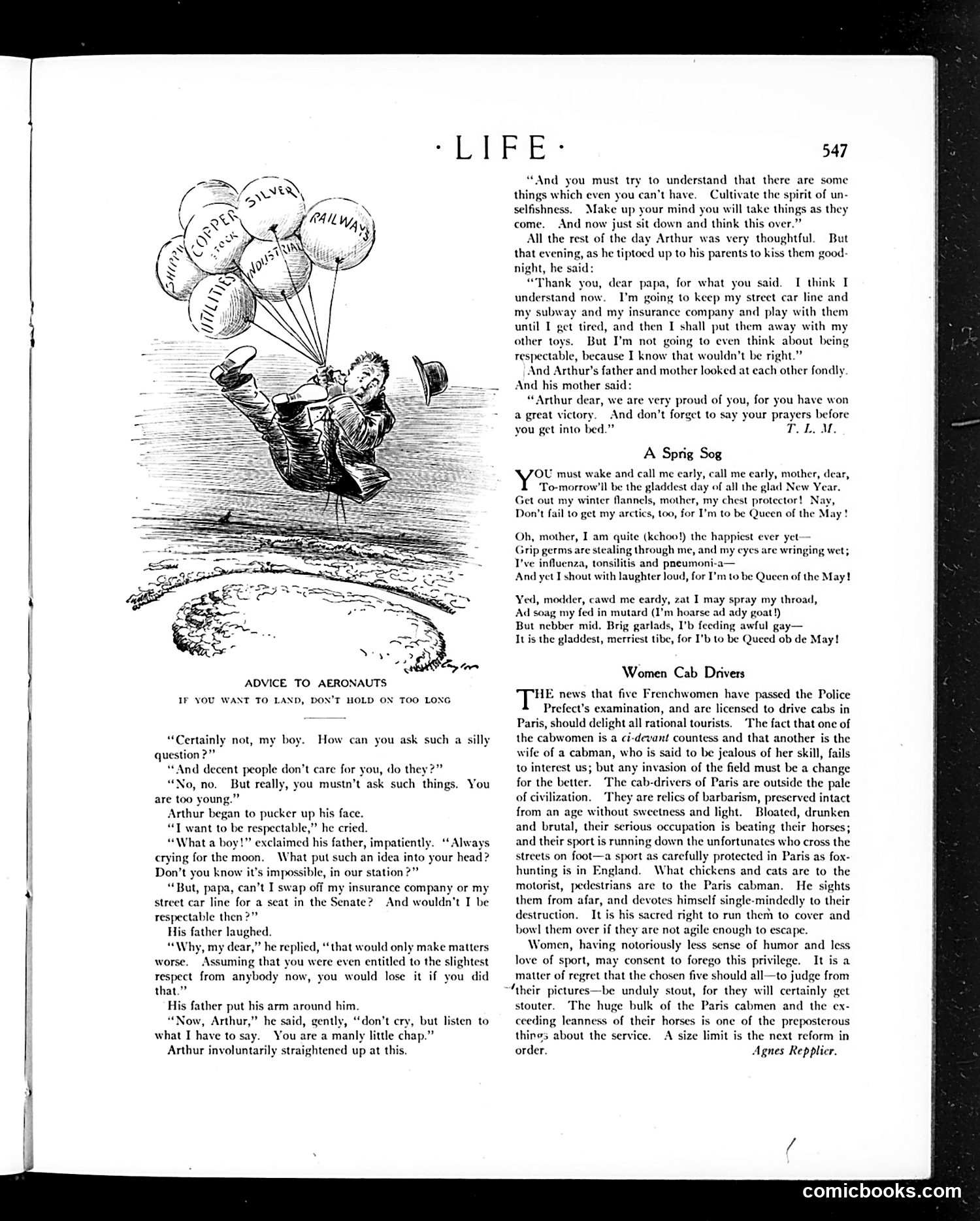
**The Main Cartoon ("Advice to Aeronauts"):** This satirical dialogue depicts a wealthy boy (Arthur) and his father discussing respectability. Arthur naively suggests trading his insurance company or street car line for a Senate seat to become respectable. His father explains this would actually *lose* him respect—the joke being that the family's wealth already comes from morally questionable sources (insurance and transit companies), so trying to launder it through politics would only make things worse. The cartoon mocks both the boy's innocent idealism and his father's cynical acceptance that their ill-gotten gains are preferable to the hypocrisy of political respectability. **"A Sprig Sog":** A humorous poem parodying Tennyson's "Maud," where a sick girl (with influenza, tonsilitis, pneumonia) still celebrates becoming "Queen of the May"—finding joy despite illness. **"Women Cab Drivers":** Commentary on five Frenchwoman cab drivers licensed in Paris. The author celebrates this as progress, characterizing Parisian male cab drivers as brutal, drunken, and dangerous to pedestrians—presenting female drivers as a civilizing reform.
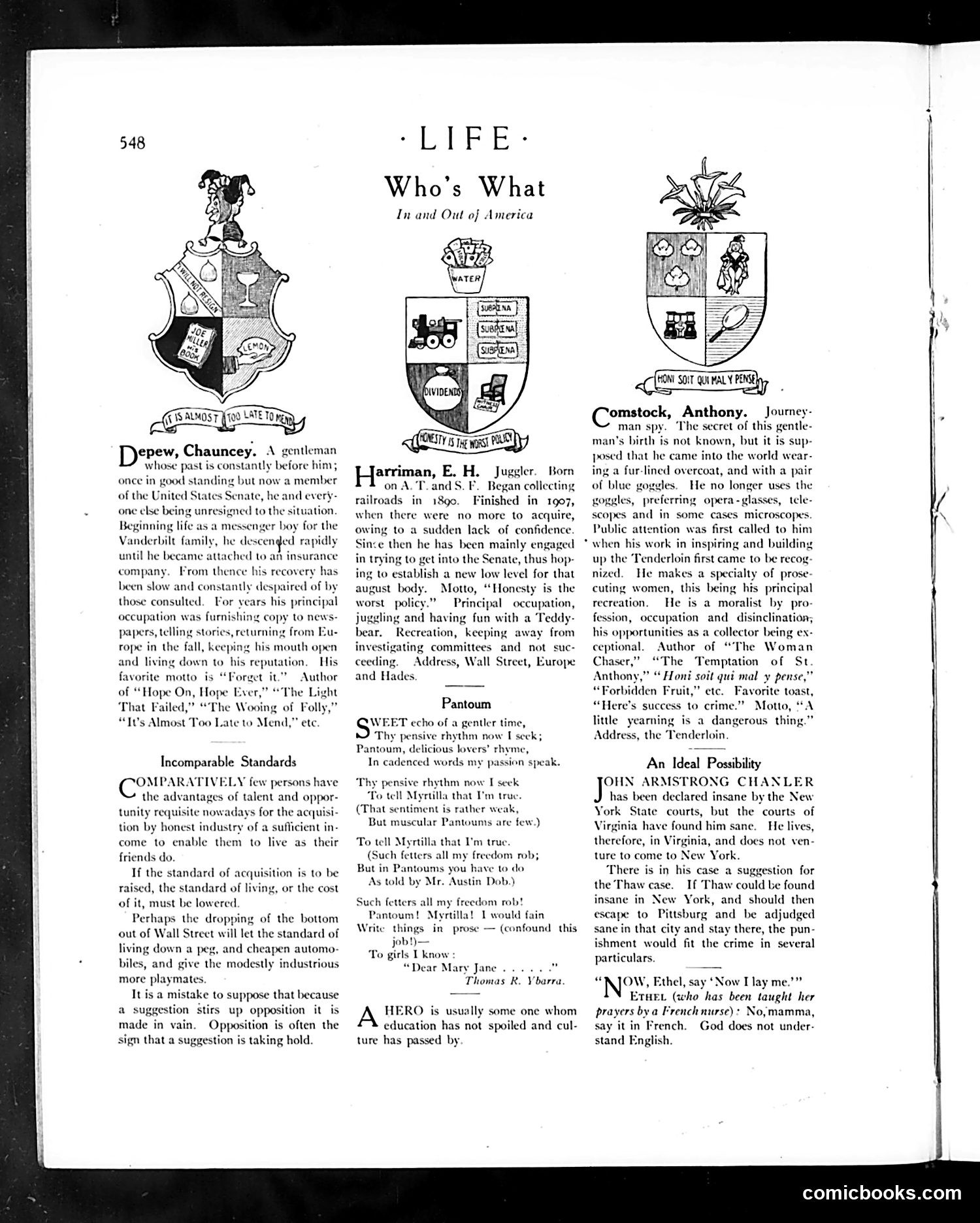
This page from *Life* magazine features satirical biographical sketches of prominent American figures. The caricatures mock: **Chauncey Depew**: A U.S. Senator whose career declined from respectable Vanderbilt family messenger to insurance company attachment. The satire criticizes his constant storytelling and self-promotion ("keeping his mouth open"). **E.H. Harriman**: A railroad magnate who "finished" collecting railroads by 1907, now attempting to enter the Senate—portrayed as seeking a "new low level" for that body. The mockery suggests both his ruthlessness and the Senate's degradation. **Anthony Comstock**: A vice-crusader and moralist depicted as obsessively prosecuting women in the Tenderloin district. The satire suggests his crusade is prurient rather than principled—he's equipped with "opera-glasses" and "microscopes" rather than genuine moral authority. The sketches exemplify *Life*'s satirical style: exposing hypocrisy, greed, and moral posturing among the wealthy and powerful through exaggerated biographical parodies.
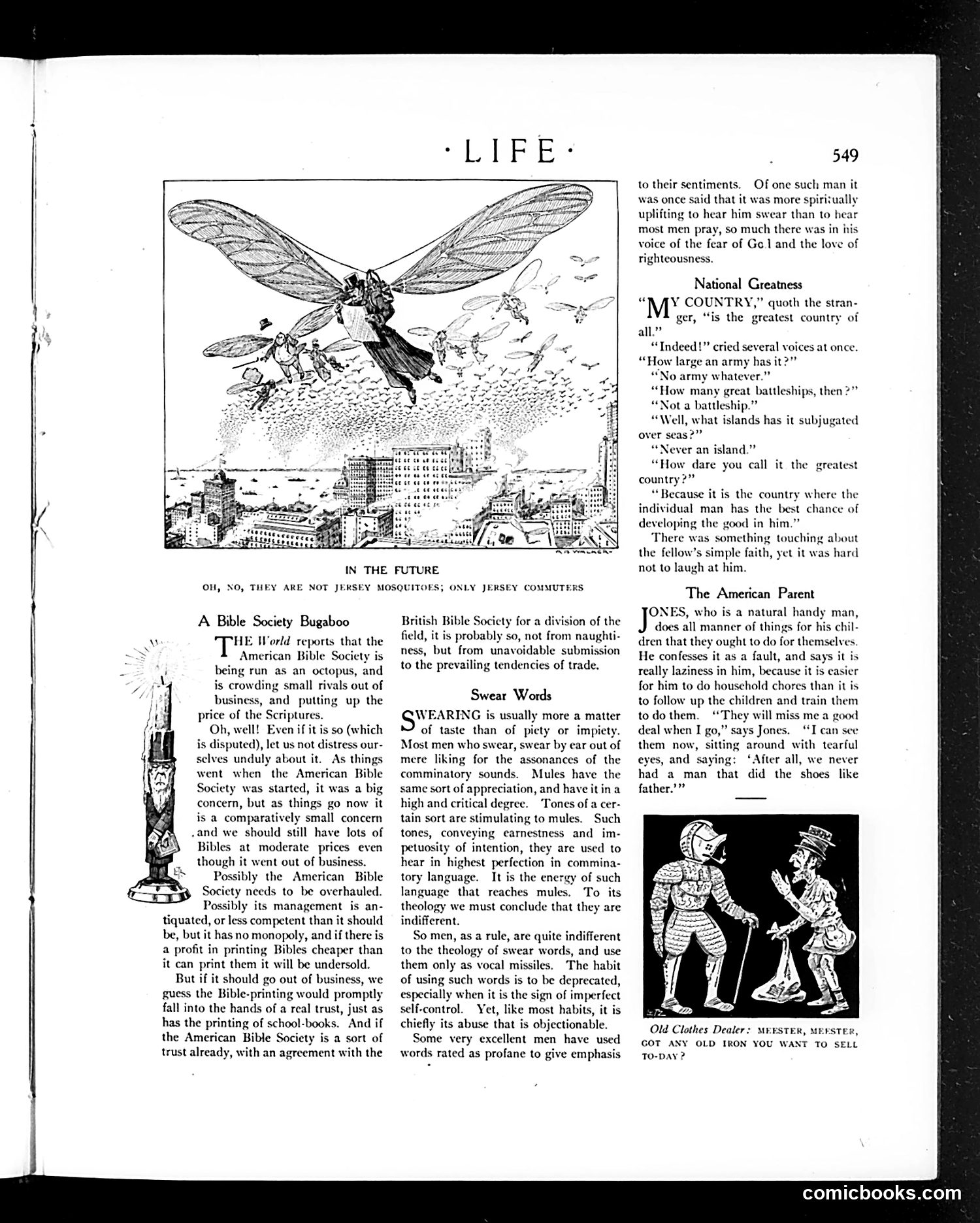
**"In the Future" cartoon (top):** Giant mosquitoes labeled "Jersey commuters" hover over a cityscape. The joke plays on New Jersey's reputation for large mosquitoes, but sarcastically reframes commuters as the real pest invading the city. **"A Bible Society Bugaboo":** Defends the American Bible Society against accusations of monopolistic practices. The satire suggests that even if the organization is problematic, competition and market forces will naturally check its power—unless it becomes a true trust (cartel), which the author implies is happening anyway due to inevitable economic consolidation. **"Swear Words":** Humorously argues that profanity is about *sound* and emphasis, not theology. Men swear like mules respond to forceful tones—for effect, not meaning. The piece defends swearing as stylistically legitimate when used by earnest, moral people. **"National Greatness":** A parable where a foreigner defines greatness not by military or imperial power, but by individual opportunity for self-development—a distinctly American idealist argument, which the satirist gently mocks as naive.
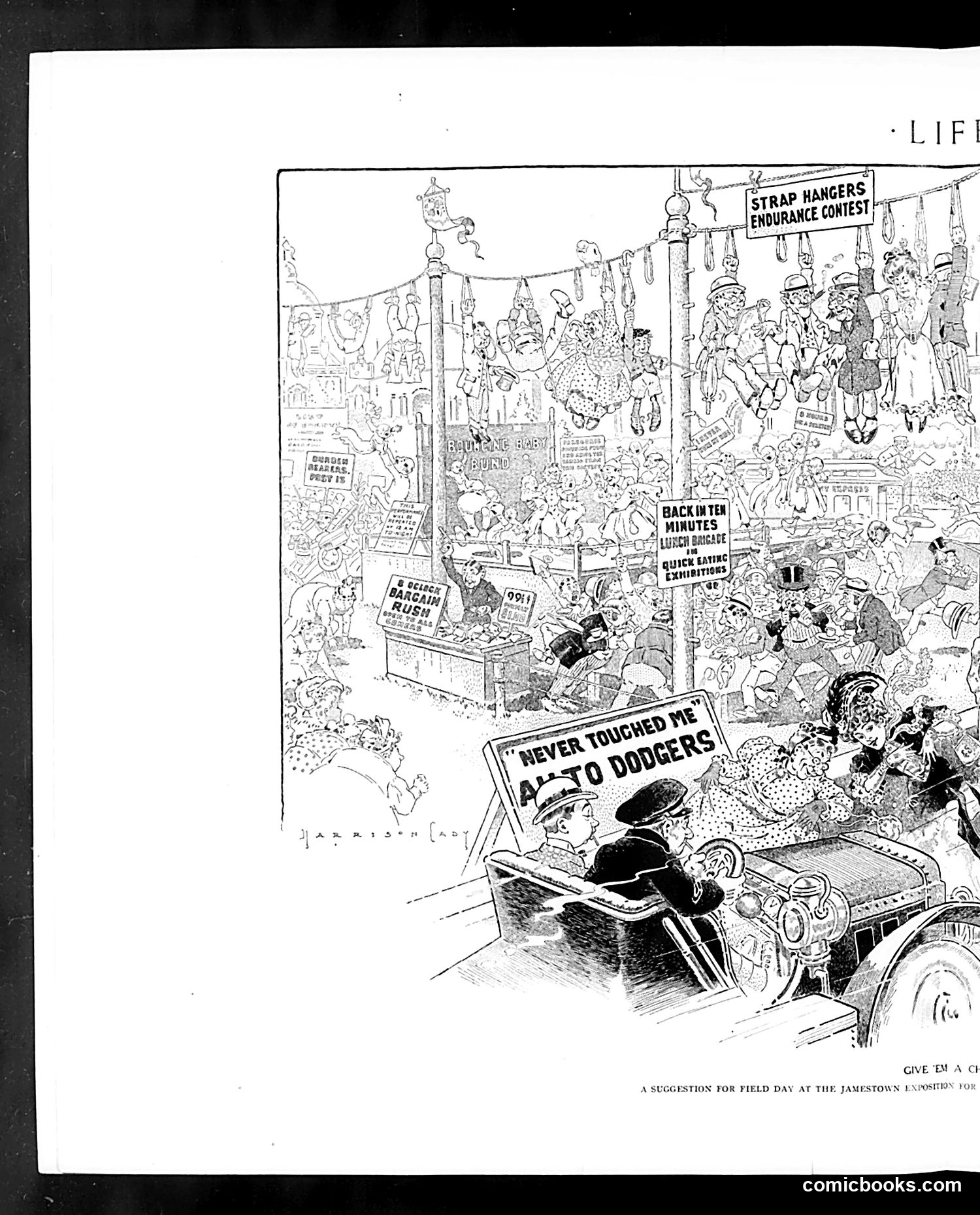
This is a satirical illustration titled "A Suggestion for Field Day at the Jamestown Exposition," depicting a crowded fairground scene. The main joke appears in the foreground: two men in a car displaying a banner reading "NEVER TOUCHED PIE / AUTO DODGERS" — mocking drivers who claim to avoid accidents despite reckless driving. The fair itself features multiple carnival attractions with signs: "Strap Hangers Endurance Contest," "Back in Ten Minutes Lunch Brigade," and "Quick Eating Exhibitions." These parody contemporary urban complaints about overcrowded transit and rushed city life. The satire criticizes both dangerous drivers and the hectic pace of modern city living by presenting exaggerated versions as carnival attractions. The Jamestown Exposition was a real 1907 Virginia fair celebrating colonial settlement.
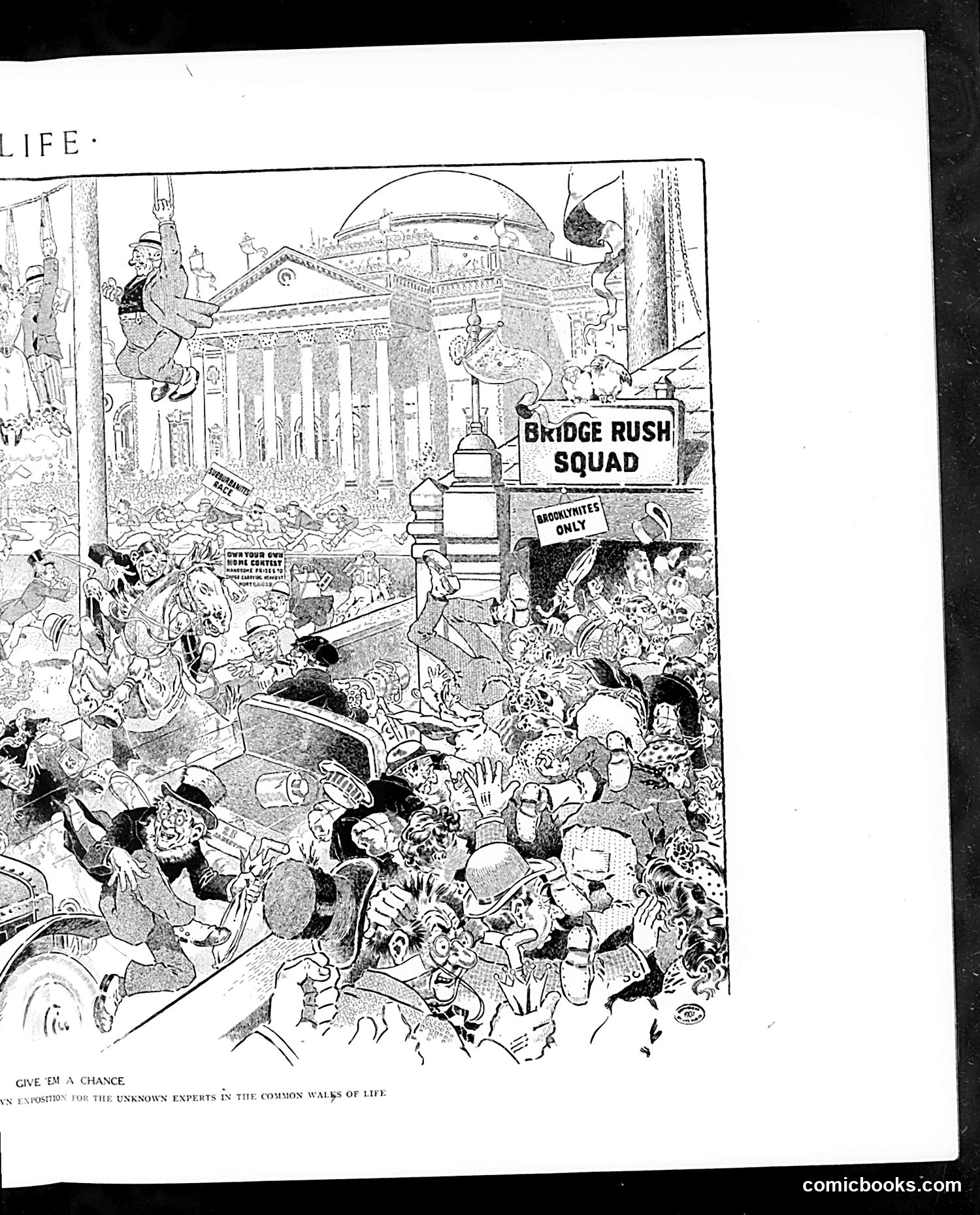
This satirical cartoon depicts a chaotic crowd scene at what appears to be a classical government building (likely the Capitol, given the columned architecture). The sign reading "BRIDGE RUSH SQUAD" with "BROOKLYNITES ONLY" suggests a reference to Brooklyn residents seeking access or opportunity. The cartoon's title, "Give 'Em a Chance," combined with the subtitle about "unknown experts in the common walks of life," satirizes the notion of ordinary people attempting to enter or influence government institutions. The crowded, disorderly masses suggest skepticism about democratic participation by working-class citizens—portraying them as chaotic rather than capable. This likely critiques either nepotism, political favoritism, or populist movements of the early 20th century, mocking the idea that untrained common people deserve governmental roles or influence.
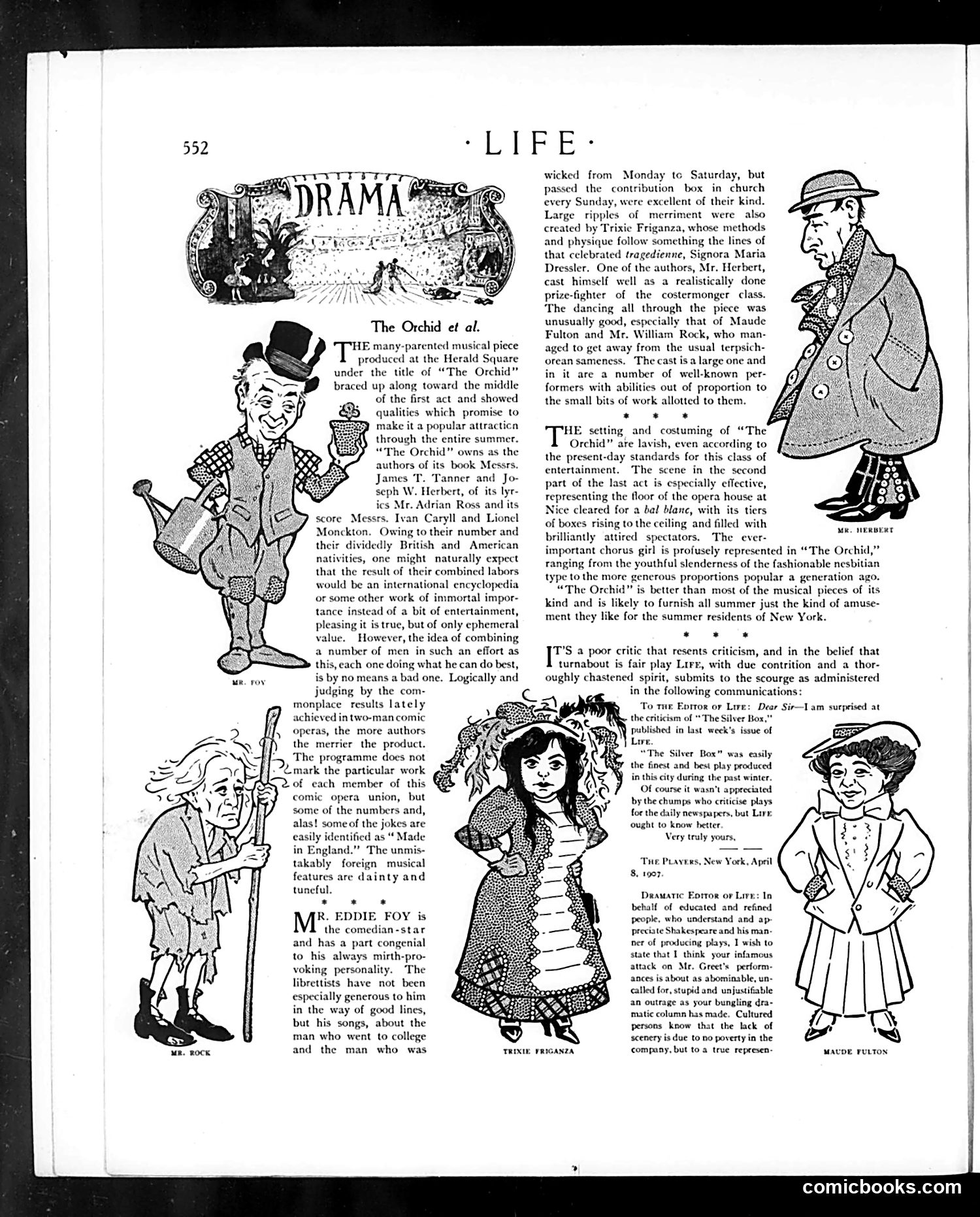
This is a theater review of the musical comedy *"The Orchid,"* performed at Herald Square Theatre. The page critiques the production's creative team—British and American writers James T. Tanner, Joseph W. Herbert, Adrian Ross, Ivan Caryll, and Lionel Monckton—noting that combining multiple authors, while logically sound, produces predictably mediocre results. The reviewer praises comedian Eddie Foy's performance and the dancing of Maude Fulton and William Rock, though criticizes weak libretto contributions. The lavish staging and chorus (featuring various body types, including the fashionable "Nesbit type") merit approval. The page concludes with a sarcastic letter from a reader defending *"The Silver Box"* against Life's prior criticism—illustrating the magazine's practice of publishing reader rebuttals. The illustrations show Foy, Rock, Friganza, and Fulton as recognizable theater personalities of the era.
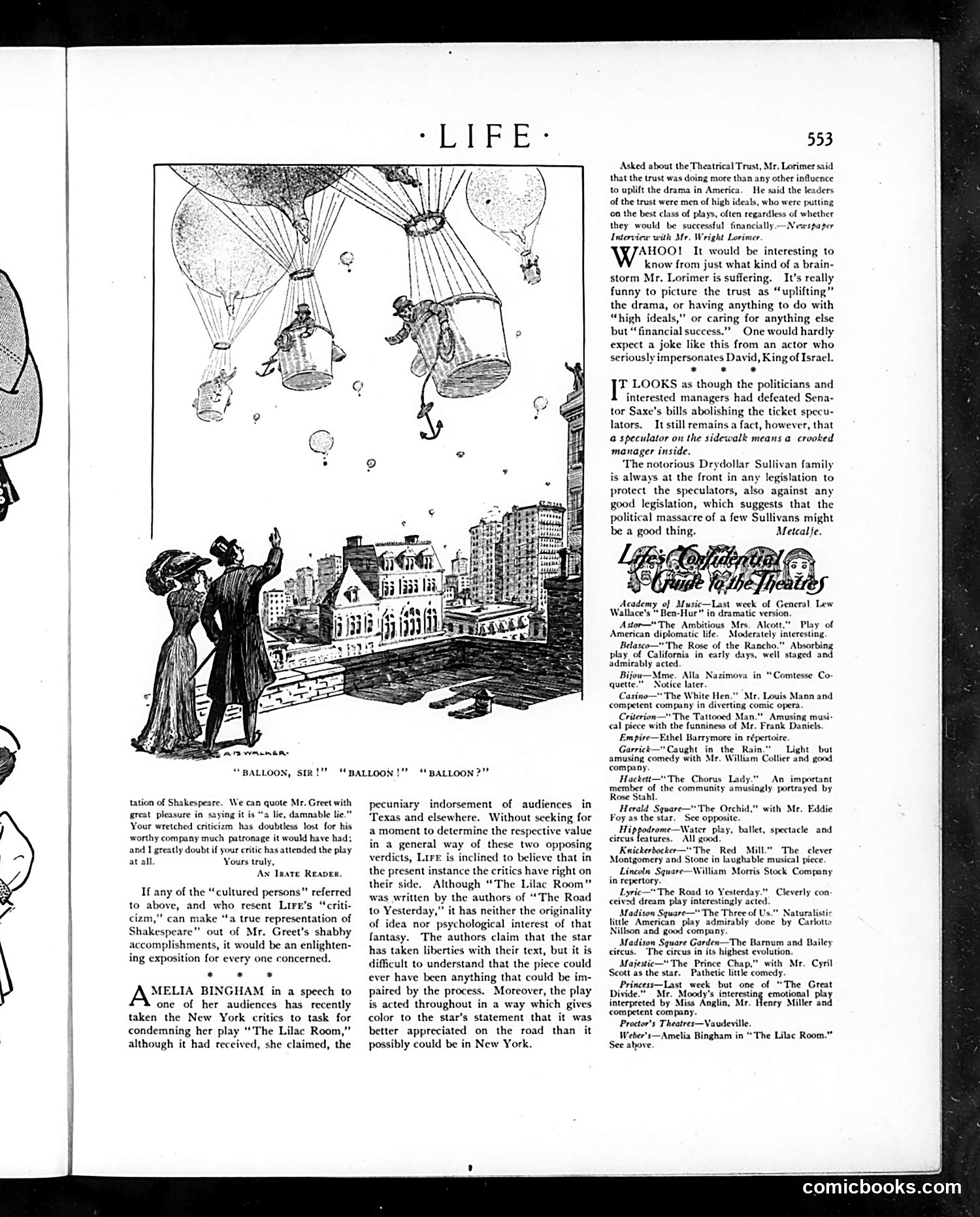
The cartoon depicts people suspended from hot air balloons descending over a cityscape, captioned "BALLOON, SIR!" This illustrates Life's criticism of theatrical impresario **Wright Lorimer**, who claimed the **Theatrical Trust** was "uplifting" American drama through "high ideals." Life's satire is cutting: Lorimer's statement is presented as absurd fantasy—people literally floating detached from reality. The magazine argues the Trust cares only about "financial success," not artistic merit, and sarcastically notes it's "funny to picture the trust as 'uplifting' the drama." The page also critiques **Amelia Bingham**, an actress defending her play "The Lilac Room" based on its financial success in Texas rather than critical merit. Life sides with New York critics, arguing the play lacks originality and psychological depth. Additionally, Life attacks the **Drydollar Sullivan family** for blocking legislation against ticket speculators, suggesting corrupt "managers inside" profit from this collusion—linking entertainment industry corruption to political malfeasance.
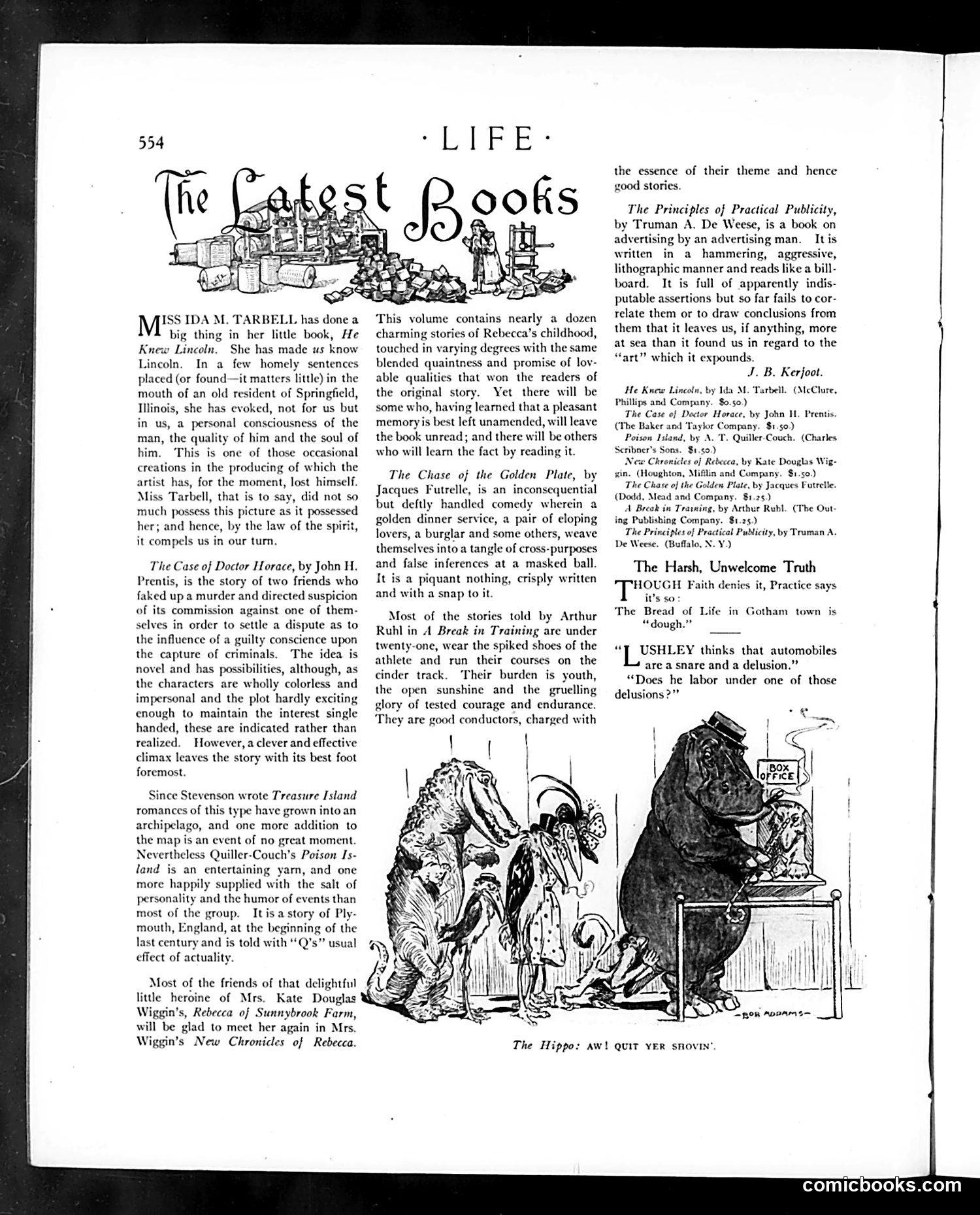
This is a book review section titled "The Latest Books," featuring literary critiques of contemporary publications. The cartoon at bottom right, captioned "The Hippo: aw! Quit Yer Shovin'," appears to be editorial filler—a humorous drawing of a hippopotamus character pushing or shoving, though its relevance to surrounding reviews is unclear. The reviews themselves discuss early 1900s literature, including Ida M. Tarbell's Lincoln biography and Arthur Ruhl's sports-themed story collection. A notable review criticizes Truman De Weese's advertising manual, finding it bombastically written and unhelpful despite its ostensibly practical subject. The page reflects Life magazine's role as a cultural arbiter, offering middle-class readers guidance on which books merited attention—a significant function before modern review aggregators. The tone is sophisticated but occasionally wry, dismissing some works as minor contributions to existing genres.
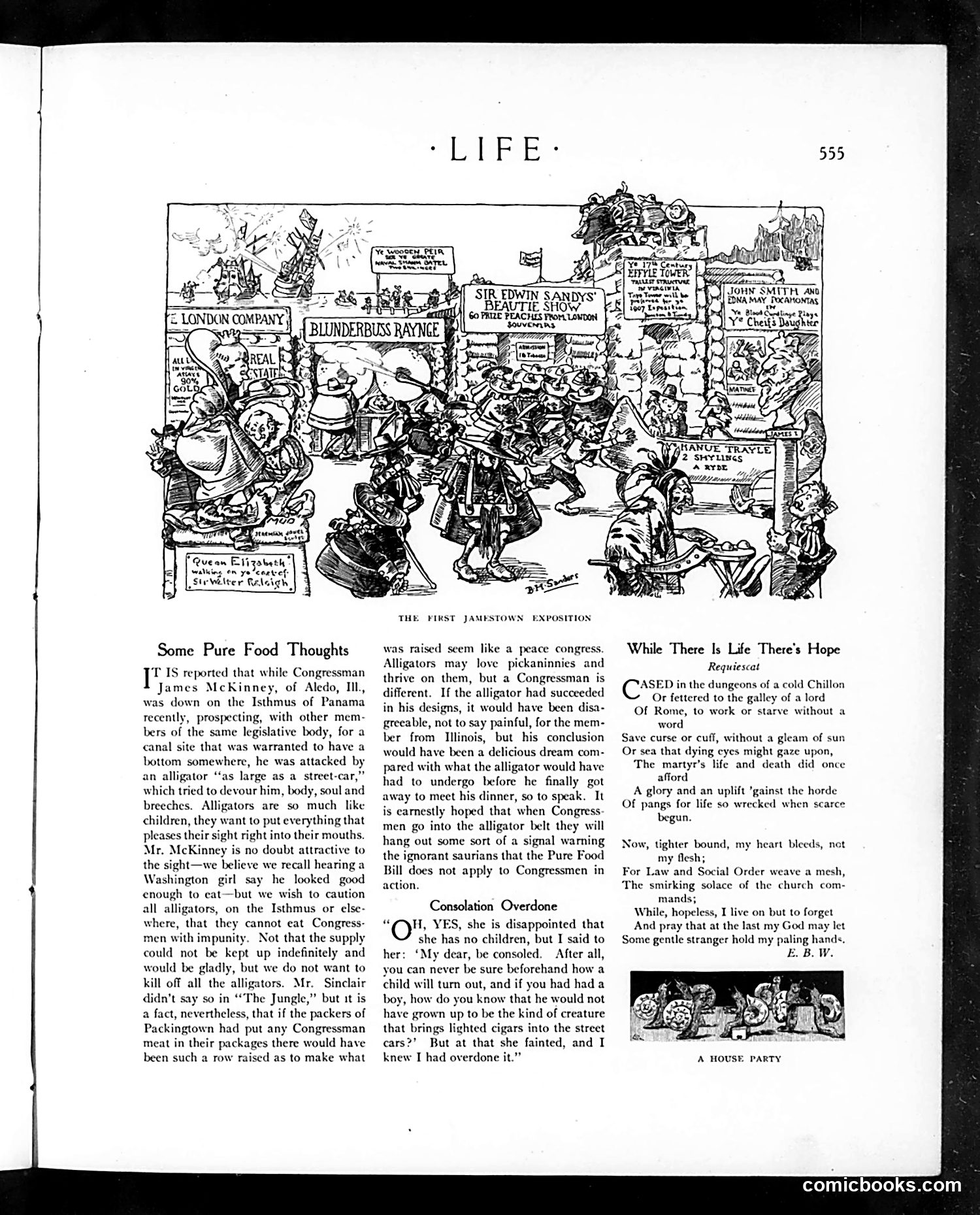
This page contains three distinct pieces satirizing early 1900s America. **"Some Pure Food Thoughts"** mocks Congressman James McKinney of Illinois, who reportedly nearly became an alligator's meal while surveying Panama canal sites. The satire jokes that if packers had sold congressman meat, public outrage would dwarf current food safety scandals—referencing Upton Sinclair's *The Jungle*, which exposed meatpacking industry horrors. The piece sarcastically suggests congressmen are inedible and essentially toxic, implying their worthlessness or corruption. **"Consolation Overdone"** is a brief anecdote about tactless condolence regarding childlessness, concluding darkly that at least one avoids raising a son who might smoke cigars on streetcars. **"While There Is Life There's Hope"** is a melancholic poem about spiritual imprisonment and hopelessness under modern social systems. The top illustration depicts **The First Jamestown Exposition**, a 1907 historical exhibition celebrating the Virginia settlement's 300th anniversary, shown as a crowded, chaotic fairground.
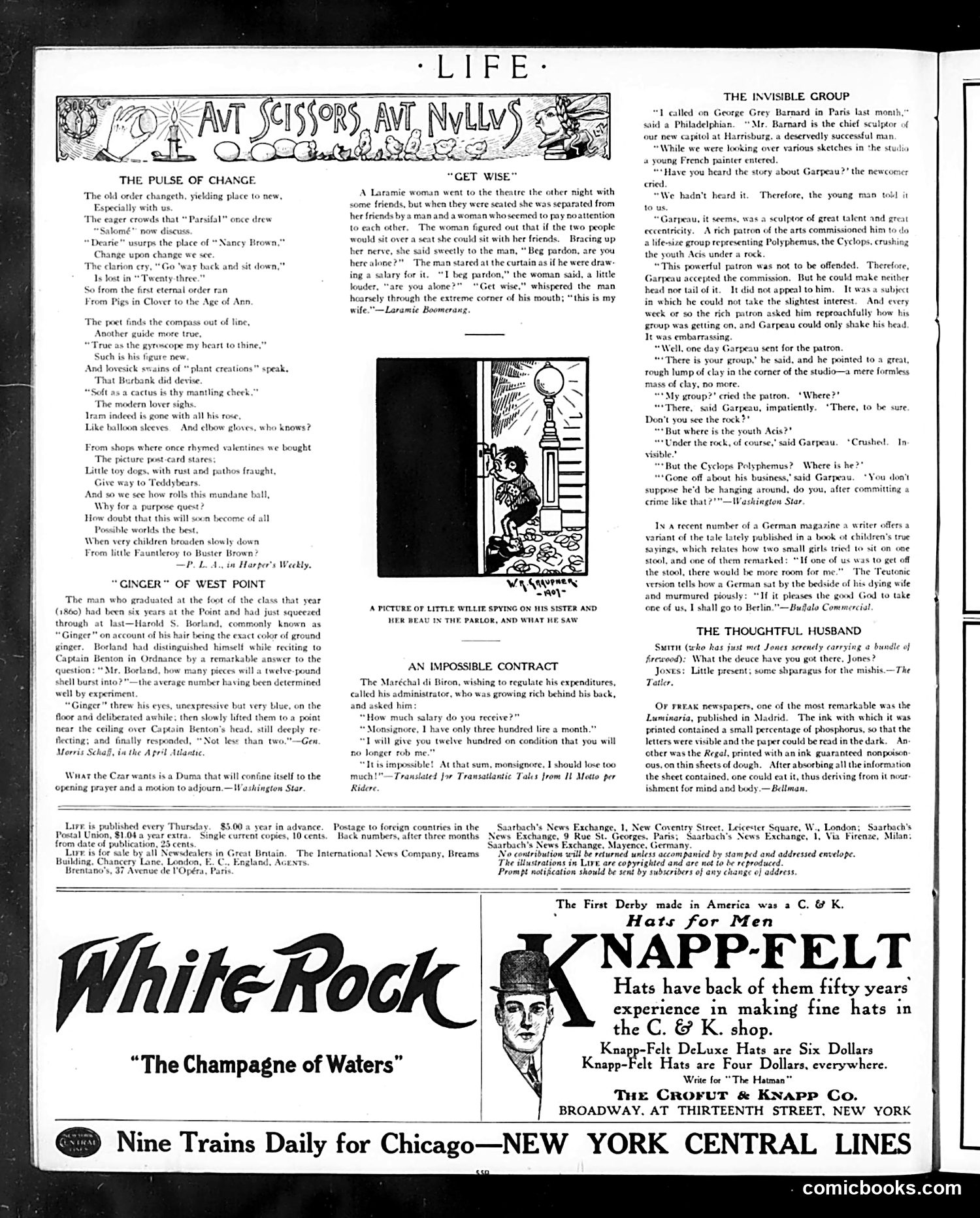
This page contains several humorous short stories and poems satirizing contemporary social changes in early 1900s America. **"The Pulse of Change"** mocks how modern literature and romantic expression have become overly intellectual and botanical—lovers now quote "plant creations" and "gyroscopes" rather than traditional romantic poetry, reflecting anxieties about modernism replacing classical sentiment. **"Get Wise"** is a theater anecdote about a woman trying to sit with friends who is rebuffed by a man claiming the woman beside him is his wife, using the period slang phrase "get wise" (meaning "understand/wake up"). **"Ginger of West Point"** recounts a cadet nicknamed for his red hair who gave an unexpectedly clever answer during an ordnance exam, contrasting his unremarkable appearance with hidden ability. The remaining pieces are brief satirical tales and advertisements typical of Life's format—mixing social commentary with humor about contemporary manners and fashions.
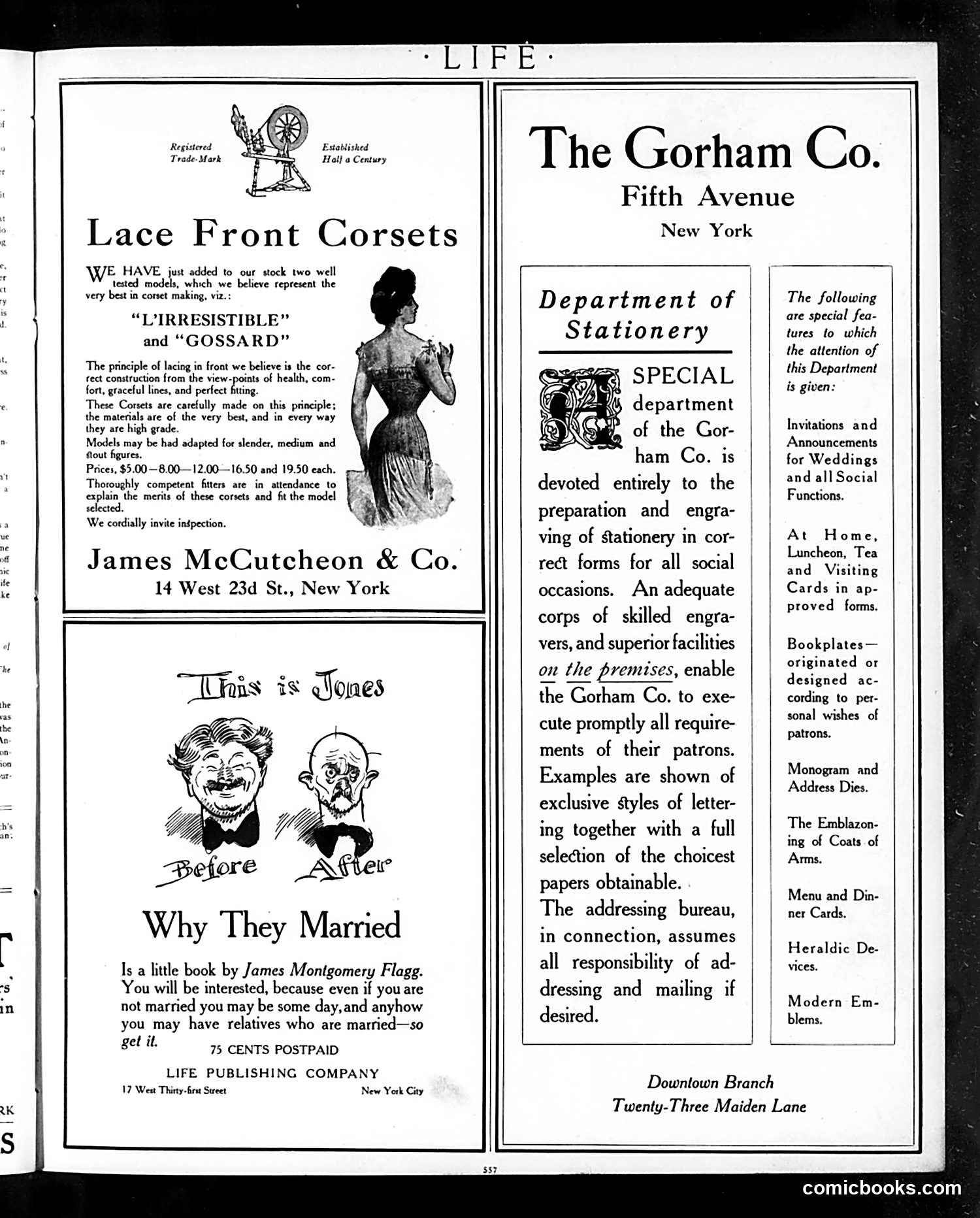
The page contains three separate advertisements with minimal satirical content: 1. **James McCutcheon & Co.** advertises lace-front corsets ("L'IRRESISTIBLE" and "GOSSARD"), emphasizing health benefits and proper fit—typical early 20th-century corset marketing. 2. **"This is Jones / Why They Married"** features a small cartoon showing a man's face labeled "Before" and "After," promoting James Montgomery Flagg's humorous book about marriage. The joke appears to be that marriage transforms a man's appearance or demeanor, though the specific satire is unclear from the image alone. 3. **The Gorham Co.** showcases their stationery department services for social occasions, particularly wedding invitations and formal cards. This is primarily a commercial page from *Life* magazine functioning as a vehicle for upscale New York advertisers rather than political or social satire.
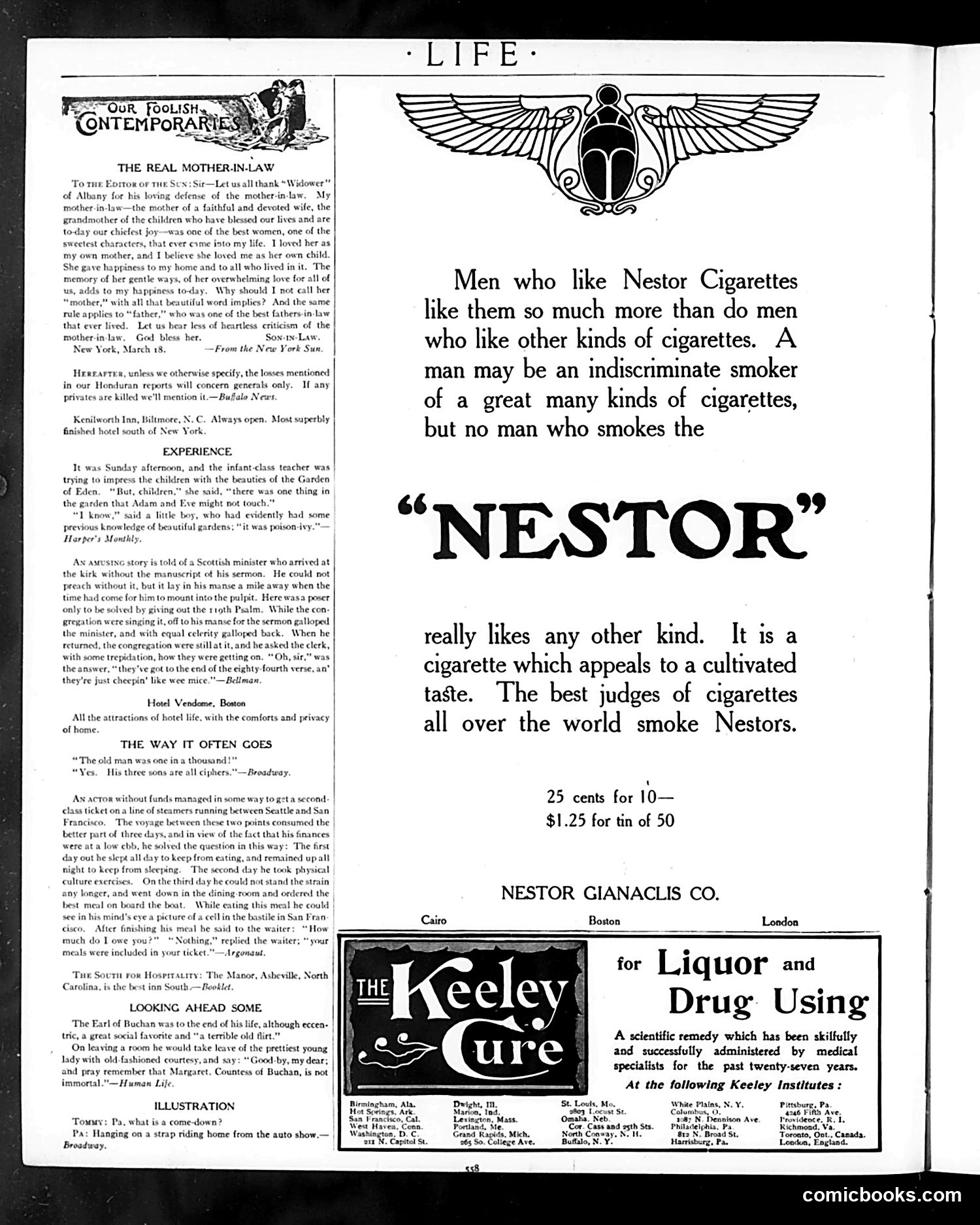
This page combines satirical commentary with period advertising. The left side features "Our Foolish Contemporaries"—a humor column showcasing amusing letters and anecdotes. Notable pieces include a deflationary response to prior criticism of mothers-in-law, a joke about Honduran military casualties, and witty exchanges about unexpected life lessons (a child mistaking poison ivy for the forbidden fruit in Eden). The right side is dominated by a full-page **Nestor Cigarettes advertisement**, claiming the brand appeals to "cultivated taste" and is smoked by "the best judges of cigarettes all over the world." The ad emphasizes exclusivity and sophistication—a common advertising strategy of this era. Below appears an advertisement for "The Keeley Cure," a medical treatment for "Liquor and Drug Using" offered at various institutes nationwide—reflecting early 20th-century attitudes toward addiction as a treatable medical condition. The page reflects pre-regulation advertising that made direct health and quality claims without scientific substantiation, alongside satirical content poking fun at contemporary manners and mishaps.
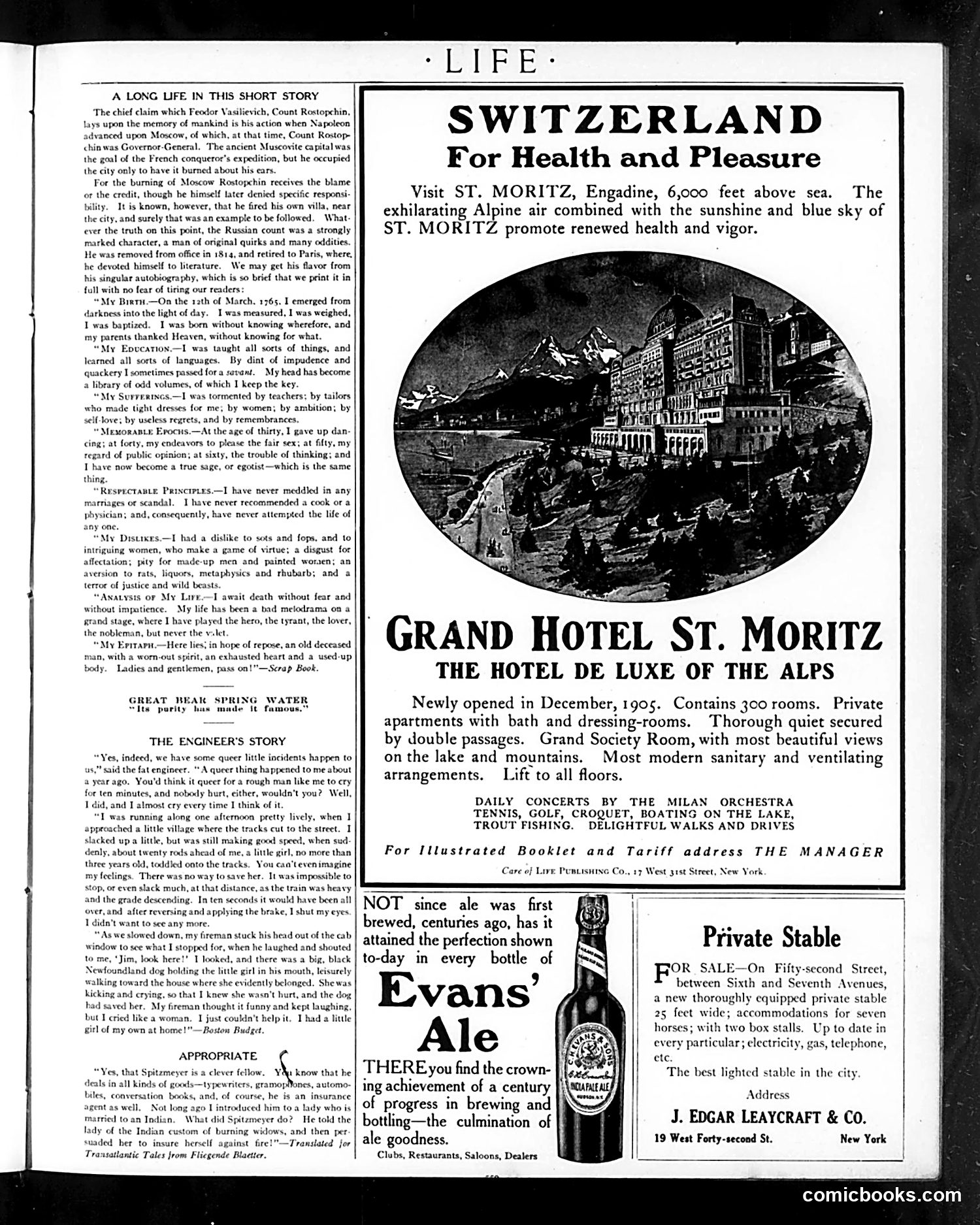
This page from *Life* magazine is primarily **advertising and autobiographical content**, not political satire. The left column features Count Rostopchine's brief autobiography—a historical Russian general famous for burning Moscow during Napoleon's 1812 invasion. His sardonic life summary is presented as humor: he progressively abandoned social concerns (dancing at 30, pleasing women at 40, public opinion at 50, thinking itself at 60) to become a "true sage, or egoist." The joke relies on his brutally honest self-assessment and the irony that abandoning all responsibility is presented as wisdom. Below this is "The Engineer's Story," beginning a railway anecdote (likely leading to sentimental resolution). The right side contains advertisements: the Grand Hotel St. Moritz in Switzerland, Evans' Ale, and a private stable for sale in New York. The page demonstrates *Life*'s editorial formula: mixing satirical biographical excerpts with commercial advertisements and serialized human-interest stories.
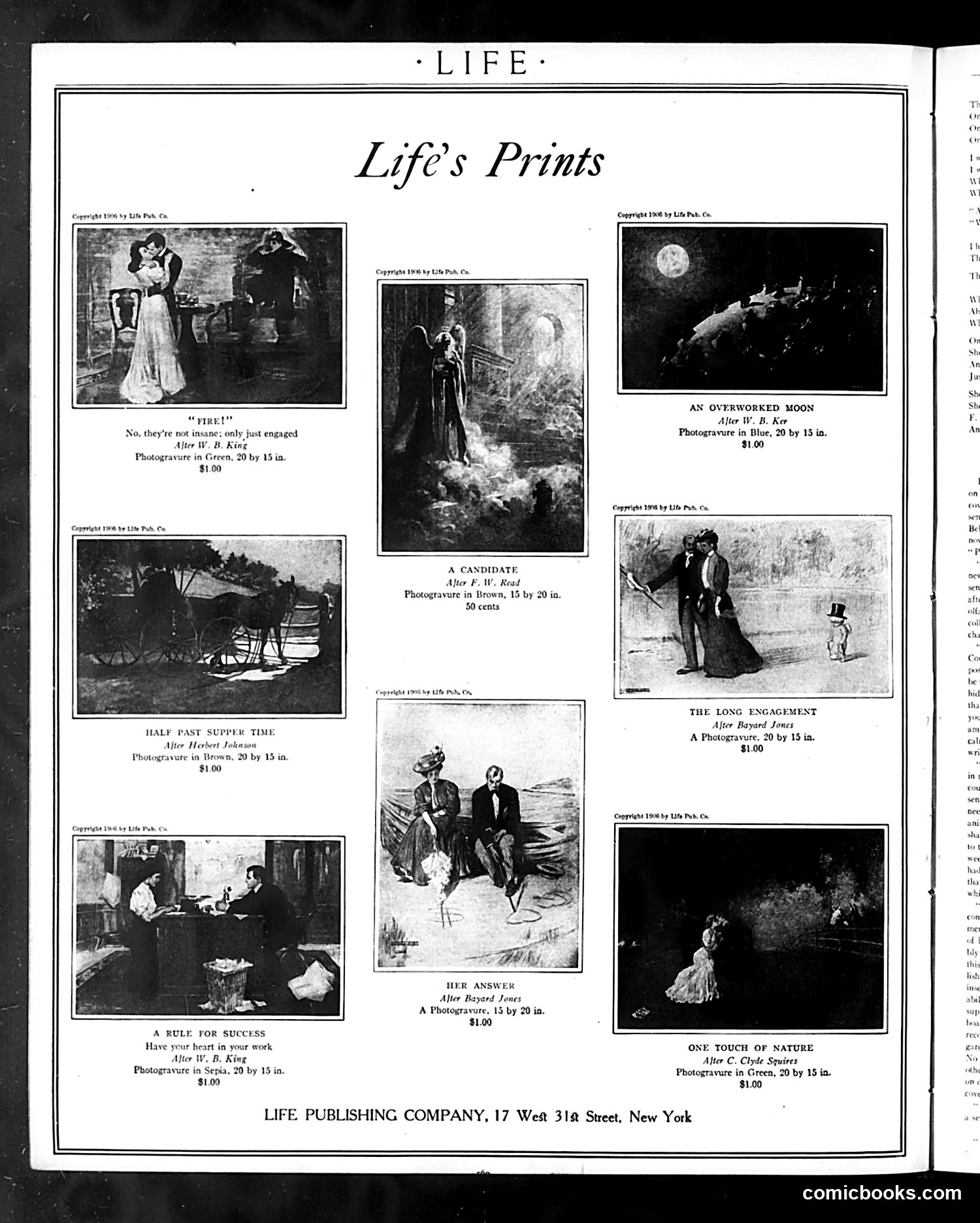
This is an advertisement page for decorative photogravure prints sold by Life Publishing Company. Rather than political cartoons, these are reproductions of satirical illustrations on romantic and domestic themes—reflecting early 1900s middle-class anxieties. The titles reveal the humor: "No, they're not insane; only just engaged" mocks courtship behavior; "Half Past Supper Time" likely satirizes domestic routines; "A Rule for Success" appears to offer ironic life advice; "The Long Engagement" and "Her Answer" play on marriage delays and romantic uncertainty; "An Overworked Moon" treats the moon as a clichéd romantic prop. These weren't meant as biting social critique but rather genteel humor for home display—affordable ($0.50–$1.00) decorative pieces for parlors. They capture turn-of-the-century anxieties about courtship, gender relations, and domesticity in accessible, sentimental form. The page functions primarily as a catalog for Life's profitable print business.
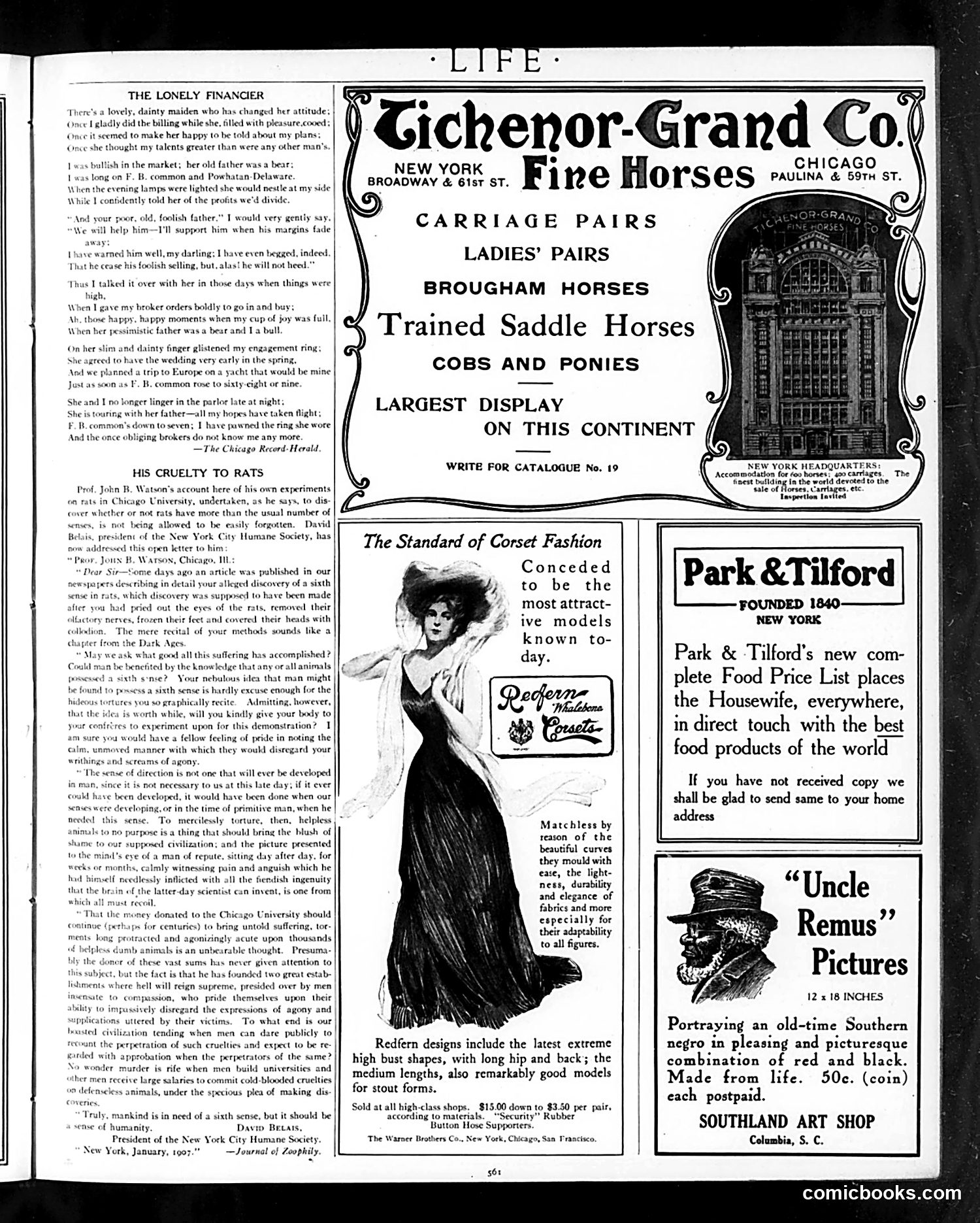
This page contains two satirical pieces from *Life* magazine (January 1907). **"The Lonely Financier"** is a poem mocking a speculator who courts a wealthy woman while boasting of his financial prowess. When stock markets crash, she abandons him—he's pawned her engagement ring and lost everything. The satire targets get-rich-quick financiers and their hollow promises. **"His Cruelty to Rats"** is a public letter from David Belals of the New York City Humane Society attacking Professor John B. Watson's experiments on rats at the University of Chicago. Watson apparently blinded rats, removed their feet, and covered their heads to study navigation—claiming it would reveal a "sixth sense" in humans. Belals sarcastically condemns the cruelty as pointless and asks if Watson would volunteer his own body for such torture. The piece critiques both animal experimentation and the era's unchecked scientific brutality. Both satirize contemporary excess: financial speculation and unethical science.
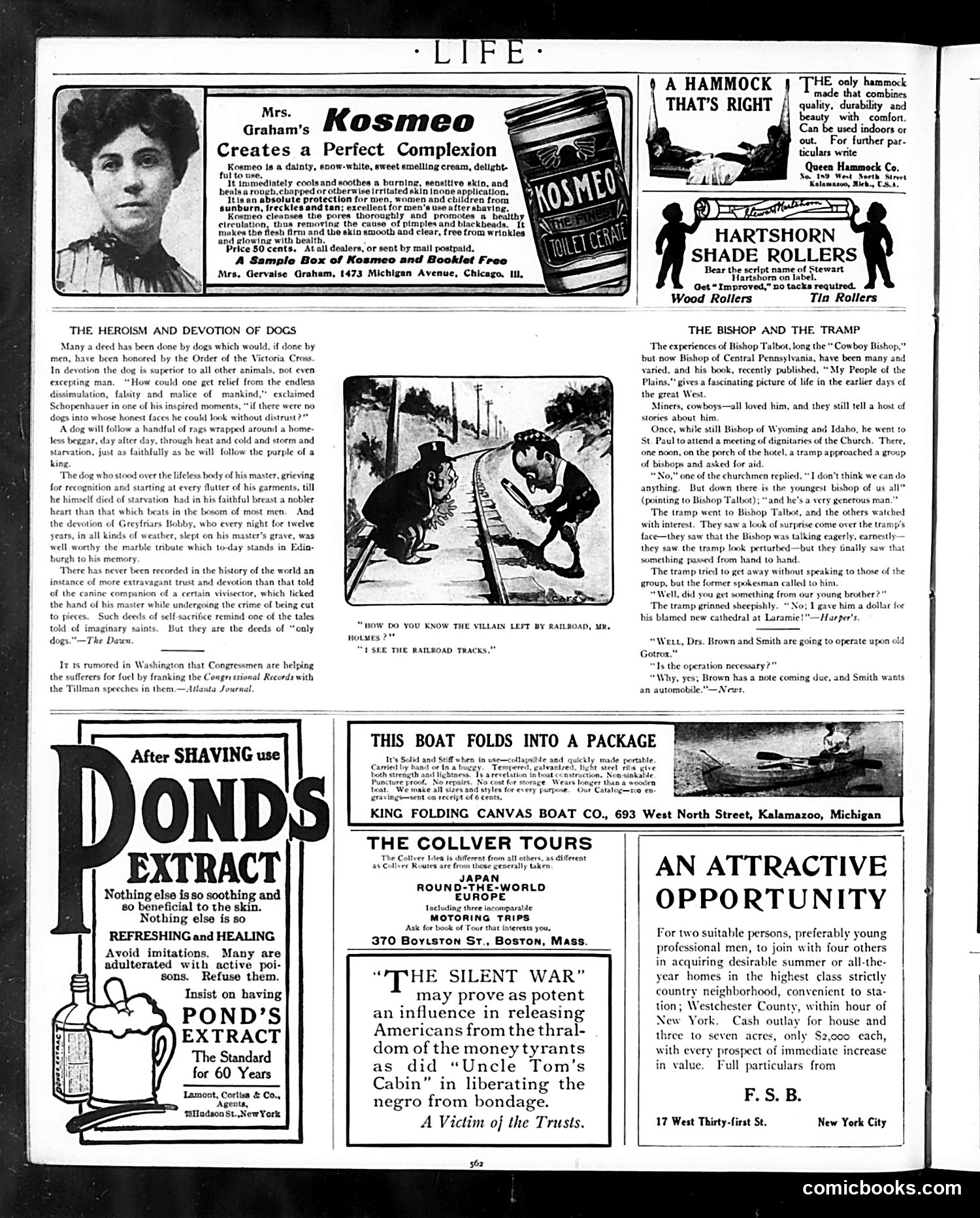
This page combines advertisements with several editorial pieces. The main cartoon depicts a railroad scene where someone has left by train, and another character deduces this by observing railroad tracks—a visual joke about stating the obvious. "The Bishop and the Tramp" tells an anecdote about Bishop Talbot (a real historical figure who served in Wyoming and Idaho). The text describes his encounters with miners and cowboys in the American West during the frontier era. "The Heroism and Devotion of Dogs" is a sentimental essay praising dogs' loyalty, referencing Greyfriars Bobby (a famous historical dog who mourned his master's grave for years). The advertisements include Kosmeo face cream, Pond's Extract aftershave, folding canvas boats, and real estate opportunities—typical of early 20th-century Life magazine, which mixed satirical content with commercial promotions.
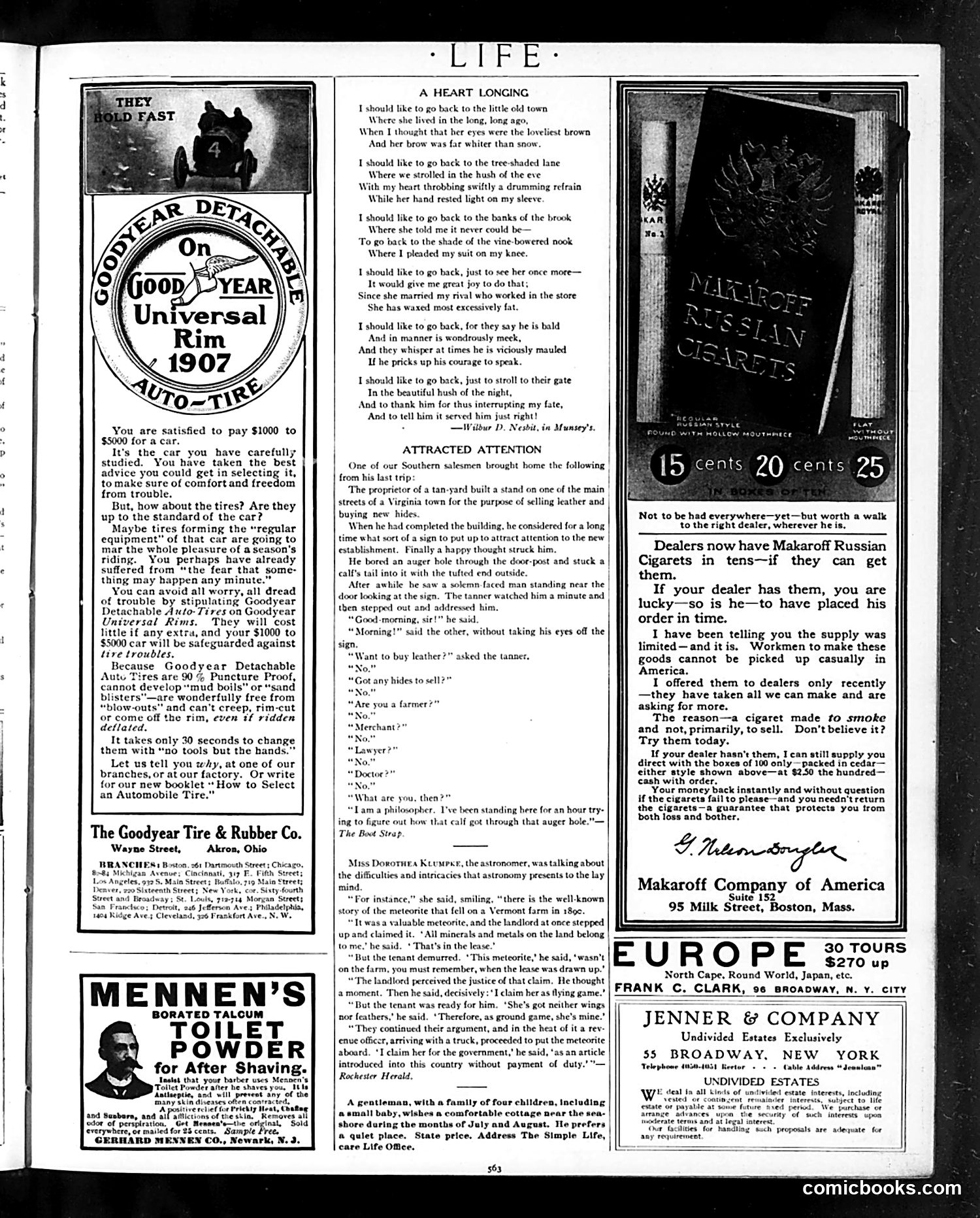
This page contains primarily **advertisements and poetry**, not political cartoons. The dominant ad is for **Goodyear Detachable Auto Tires** (1907), targeting wealthy car owners ($1000-5000 vehicles) by emphasizing tire reliability and safety—a practical concern of early motorists worried about punctures and breakdowns. The poetry, "A Heart Longing" by Wilbur D. Nesbit, is **sentimental romantic verse with a sardonic twist**: a man nostalgically recalls his lost love, but the final stanza reveals his schadenfreude—he's actually relieved she married his rival because the rival has become bald, meek, and apparently abused by her. It's gentle satire on self-delusion and male vanity. The "Attracted Attention" anecdote describes a Virginia leather merchant's clever marketing: he hangs a calf's tail from his shop sign to advertise his business. The joke is the simple, direct advertising approach. Minor ads include Mennen's talcum powder and travel/real estate services. **This is primarily a commercial page** with light entertainment rather than political content.
This is not a cartoon page but an **advertiser's pledge** — essentially a quality guarantee from Life Publishing Company to readers. The text asserts that Life maintains high standards for advertised products, assuring readers they can trust what they buy through the magazine's pages. The publishers claim to vet advertisers and require products to meet stated quality standards. The rhetorical punch comes in the final question: "Have you any ground for such confidence in unadvertised articles?" This is **subtle advertising satire** — by emphasizing Life's vetting of *advertised* products, the publisher implicitly suggests that *unadvertised* items (sold elsewhere) lack such oversight and trustworthiness. It's clever marketing disguised as consumer protection: buy from Life's advertisers because we guarantee them; don't buy unvetted products elsewhere. The page ironically uses an ethics pledge to promote advertising revenue.
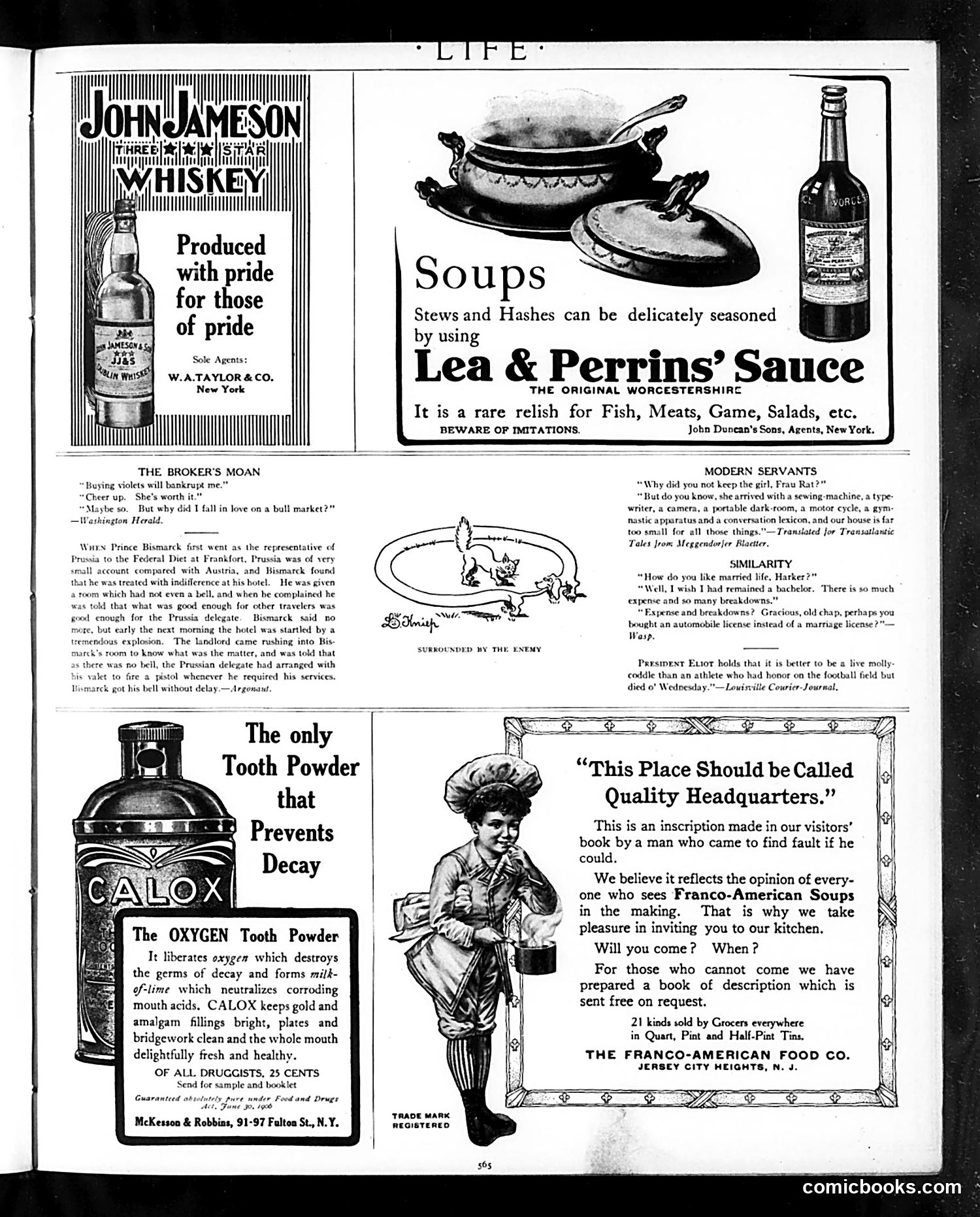
This page is primarily **advertising**, featuring product promotions interspersed with brief humorous anecdotes typical of Life's satirical humor. The main cartoons are short comedic pieces: **"The Broker's Moan"** satirizes financial anxiety during what appears to be market volatility, where a broker laments buying violets will "bankrupt" him—poking fun at the disconnect between romantic gestures and economic reality. **"Surrounded by the Enemy"** shows a small figure surrounded by larger figures, likely referencing a political or social situation where someone is outnumbered or threatened, though the specific historical reference is unclear. **"Modern Servants"** and **"Similarity"** are domestic humor pieces mocking the changing nature of servant employment and marriage—servants now arrive with modern conveniences (typewriters, cameras, motorcycles), and marriage is compared to purchasing a car regarding "breakdowns" and expenses. The advertisements (Lea & Perrins sauce, Calox tooth powder, Franco-American soups) represent typical early-20th-century product marketing, emphasizing scientific benefits and convenience for middle-class consumers.
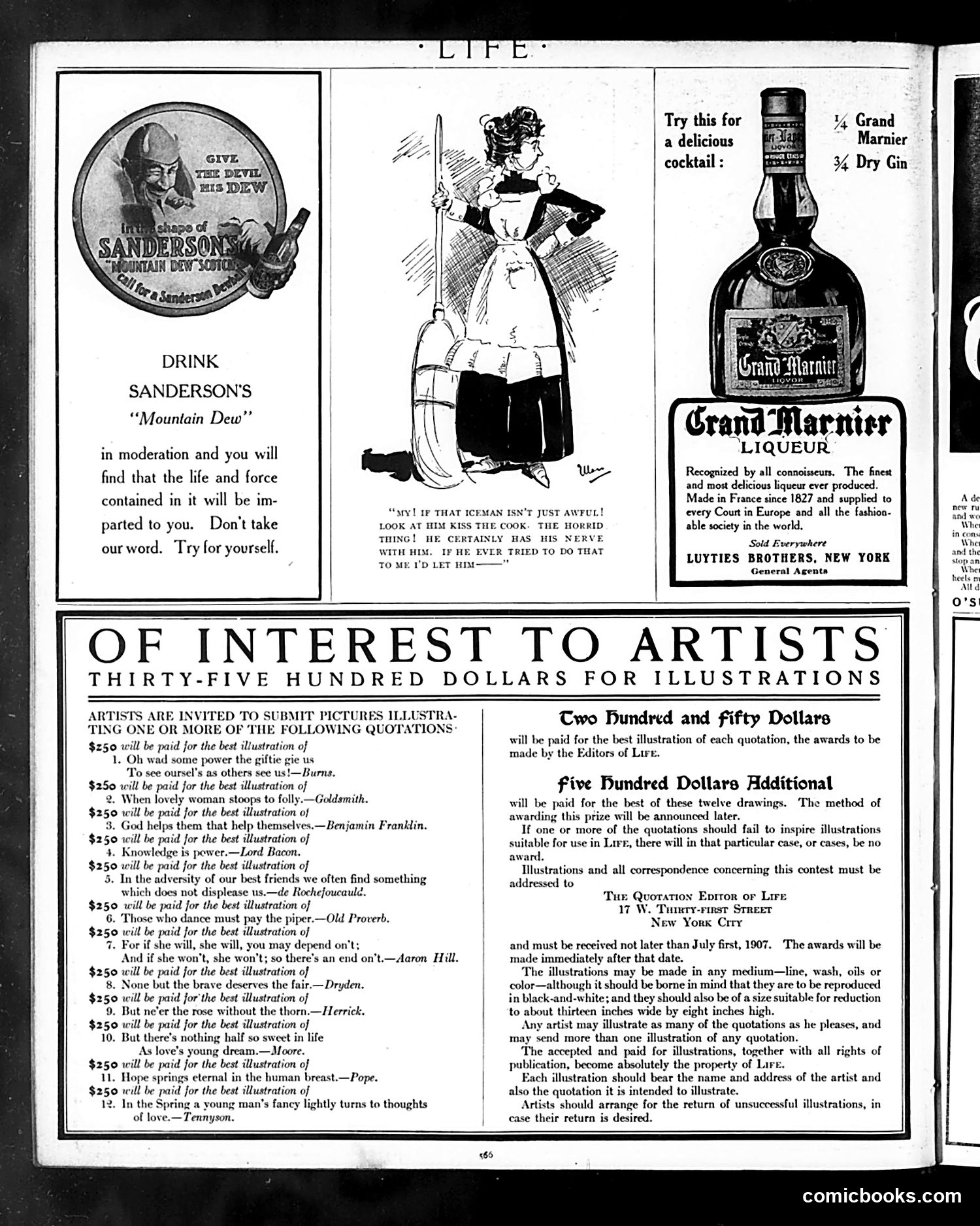
This page combines **advertisements** with a major **art contest announcement**. The ads feature liquor products (Sanderson's "Mountain Dew" whiskey and Grand Marnier liqueur) typical of early 1900s magazine marketing. The central cartoon depicts a woman confronting an iceman about kissing her maid. The joke reflects anxieties about working-class men (icemen made regular home deliveries) having unsupervised access to female servants. The woman's indignation and threat ("I'd let him—") suggests the social scandal and class tensions around such encounters. This satirizes both the vulnerability of domestic servants and the perceived boldness of delivery workers. The large section announces a **1907 illustration contest** offering $3,500 total ($250 per quotation, twelve entries, plus $500 bonus for best overall). Artists could submit illustrations for famous literary and philosophical quotations. This was typical of *Life*'s efforts to showcase visual talent and engage its artistic audience.
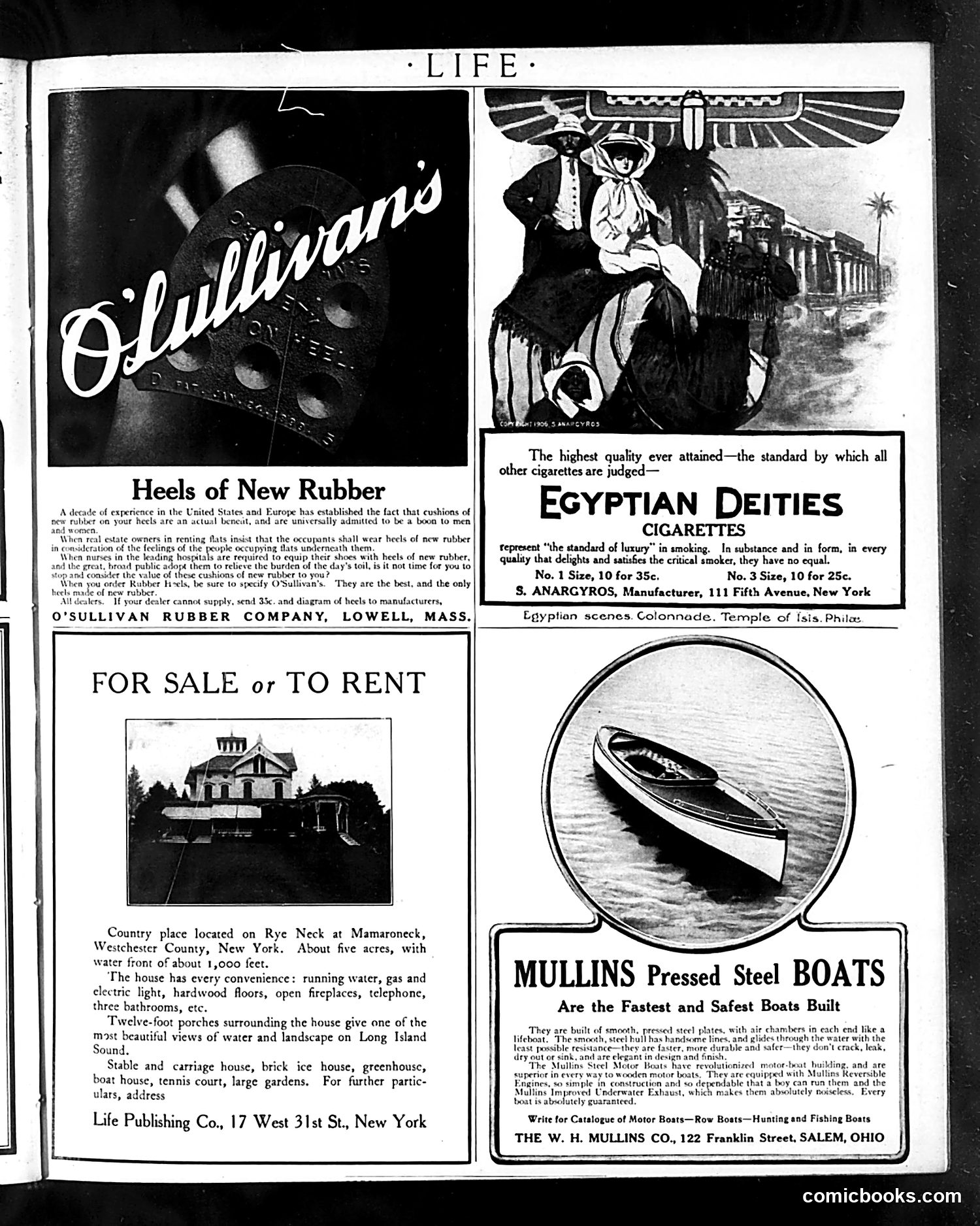
This page is primarily **advertising**, not satire or political commentary. It contains four commercial advertisements typical of early 20th-century magazines: 1. **O'Sullivan Rubber Heels** — promotes cushioned rubber heels for shoe comfort, claiming they benefit both wearers and apartment dwellers below by reducing noise. 2. **Egyptian Deities Cigarettes** — luxury cigarettes marketed with Egyptian temple imagery, positioning the product as a high-quality standard. 3. **Real Estate Listing** — a country property for sale/rent in Mamaroneck, New York, emphasizing amenities and waterfront views. 4. **Mullins Pressed Steel Boats** — motor and row boats marketed as faster and safer than wooden alternatives. There are no political cartoons, caricatured figures, or satirical commentary visible. The page reflects consumer culture and product positioning of the era, with advertisements using aspirational imagery (Egyptian luxury, waterfront estates, modern steel technology).
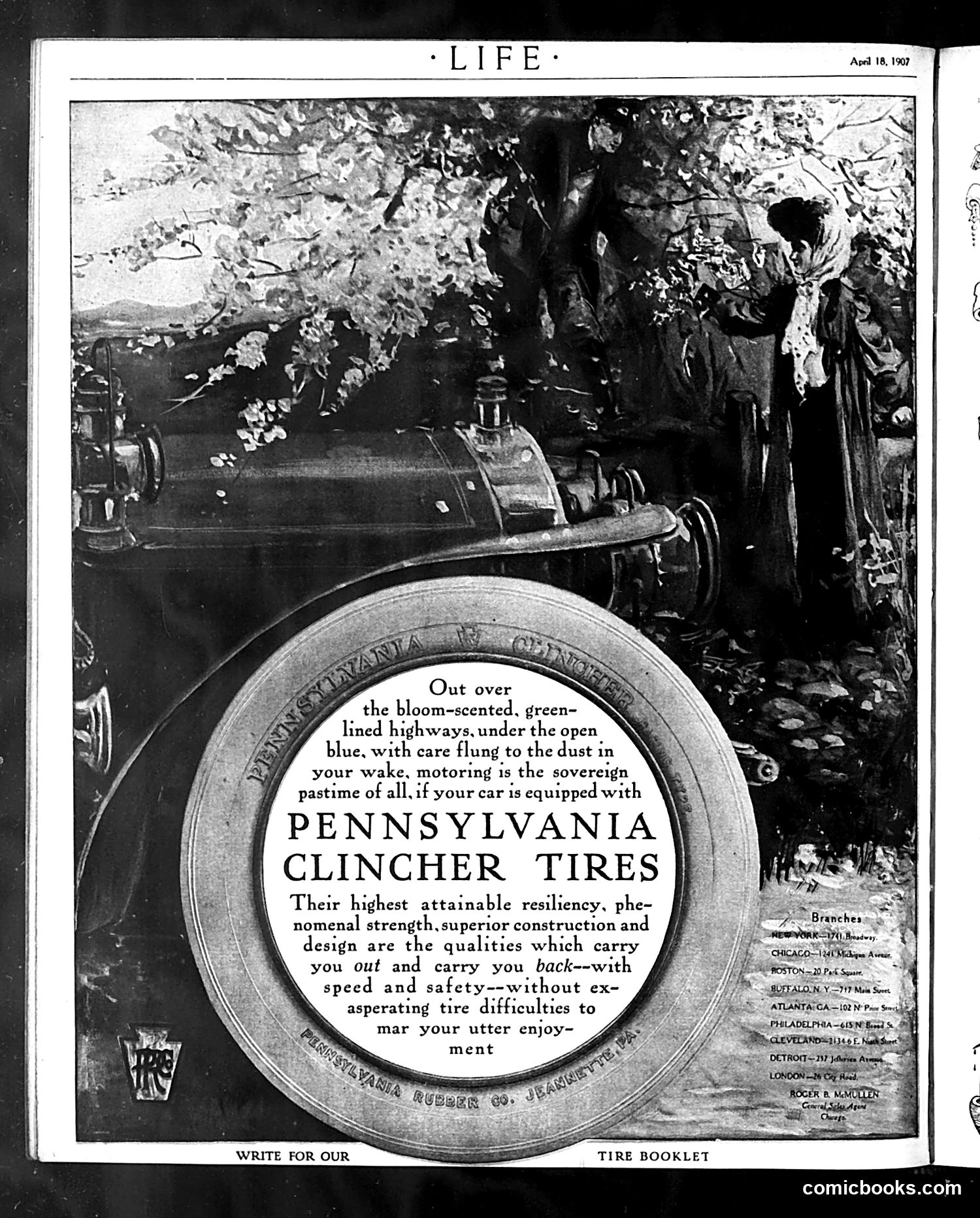
This is a full-page advertisement, not satire. It promotes Pennsylvania Clincher Tires by romanticizing early automobile motoring as leisure activity. The image shows a well-dressed couple in an open-air motorcar driving beneath flowering trees on a scenic country road—depicting "motoring" as "the sovereign pastime of all." The ad emphasizes the tires' reliability ("resiliency," "phenomenal strength") to assure buyers that their cars won't suffer "tire difficulties" during recreational drives. The text uses flowery language ("bloom-scented," "open blue") to associate the product with pleasure and freedom. This reflects the early 1900s context when automobiles were novel luxuries for the wealthy, and driving for pleasure was becoming fashionable among the upper classes. The ad targets affluent readers of *Life* magazine.