
Life, 1907-04-18 · page 22 of 36
Life — April 18, 1907 — page 22: what you’re looking at
What you’re looking at
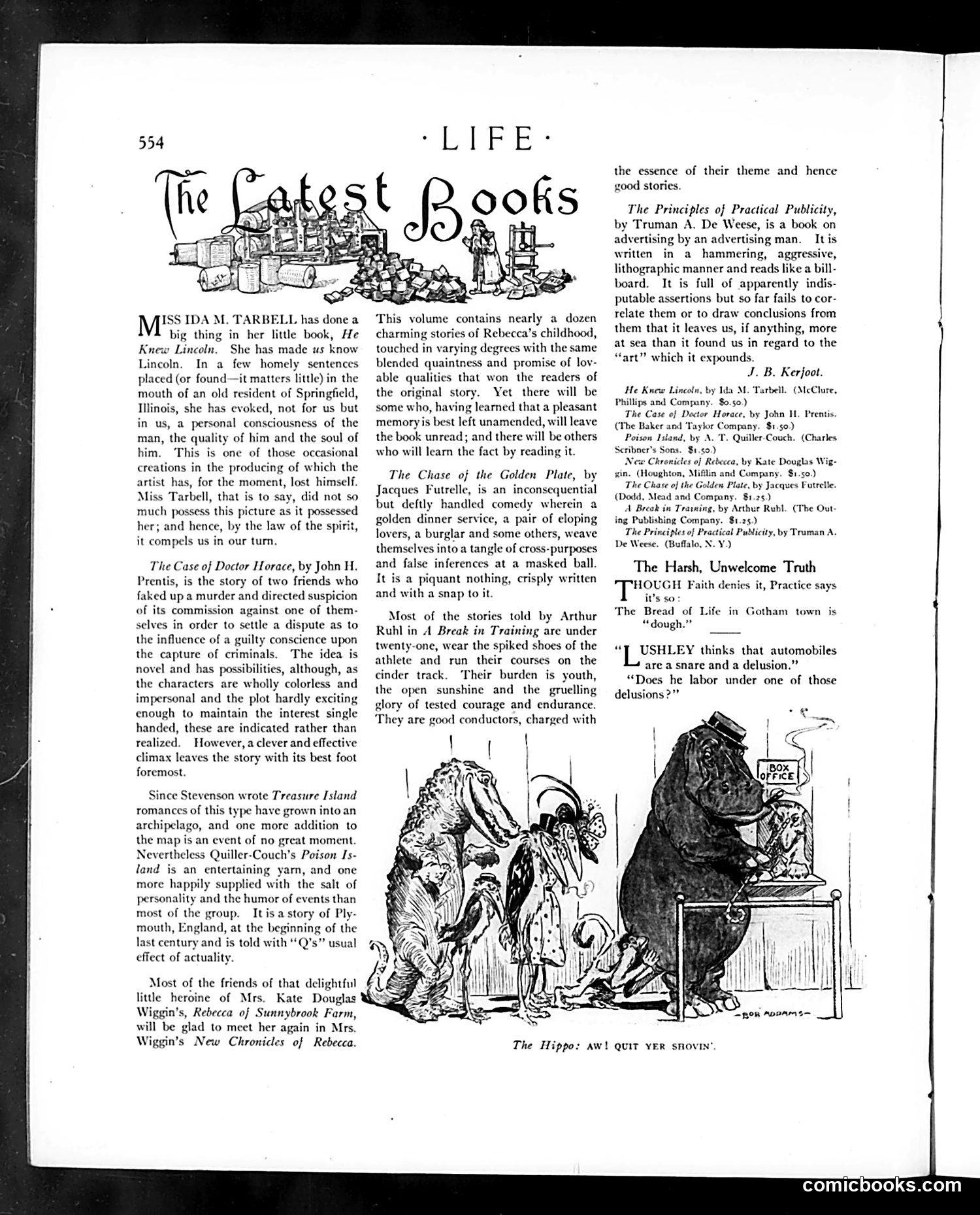
This is a book review section titled "The Latest Books," featuring literary critiques of contemporary publications. The cartoon at bottom right, captioned "The Hippo: aw! Quit Yer Shovin'," appears to be editorial filler—a humorous drawing of a hippopotamus character pushing or shoving, though its relevance to surrounding reviews is unclear. The reviews themselves discuss early 1900s literature, including Ida M. Tarbell's Lincoln biography and Arthur Ruhl's sports-themed story collection. A notable review criticizes Truman De Weese's advertising manual, finding it bombastically written and unhelpful despite its ostensibly practical subject. The page reflects Life magazine's role as a cultural arbiter, offering middle-class readers guidance on which books merited attention—a significant function before modern review aggregators. The tone is sophisticated but occasionally wry, dismissing some works as minor contributions to existing genres.
📄 Transcribed text from this page (OCR, searchable)
Machine-transcribed from the original scan — historical spelling and the odd misread are preserved.
IDA M. TARBELL has done a big thing in her little book, He Knew Lincoln. She has made us know Lincoln. In a few homely sentences placed (or found—it matters little) in the mouth of an old dent of Springfield, Illinois, she has evoked, not for us but in us, a personal consciousness of the man, the quality of him and the soul of him. This is one of those occasional creations in the producing of which the artist has, for the moment, lost himself. Miss Tarbell, that is to say, did not so much possess this picture as it possessed her; and hence, by the law of the spi it compels us in our turn, The Case of Doctor Horace, by John H. Prentis, is the story of two friends who faked up a murder and directed suspicion of its commission against one of them- selves in order to settle a dispute as to the influence of a guilty conscience upon the capture of criminals. The idea is novel and has possibilities, although, as the characters are wholly colorless and impersonal and the plot hardly exciting enough to maintain the interest single handed, these are indicated rather than realized. However, a clever and effective climay ves the story with its best foot foremost. Since Stevenson wrote Treasure Island romances of this type have grown into an archipelago, and one more addition to the map is an event of no great moment. Nevertheless Quiller-Couch’s Poison Is- land is an entertaining yarn, and one more happily supplied with the salt of personality and the humor of events than most of the group. It is a story of Ply- mouth, England, at the beginning of the last century and is told with Q’s” usual effect of actuality. Most of the friends of that delightful litle heroine of Mrs. Kate Douglas Wiggin’s, Rebecca of Sunnybrook Farm, will be glad to meet her again in Mrs. Wiggin’ New Chronicles of Rebecca. This volume contains nearly a dozen charming stories of Rebecca’s childhood, touched in varying degrees with the same blended quaintness and promise of lov- able qualities that won the readers of the original story. Yet there will be some who, having learned that a pleasant memory is best left unamended, will leave the book unread; and there will be others who will learn the fact by reading it. The Chase oj the Golden Plate, by Jacques Futrelle, is an inconsequential but deftly handled comedy wherein a golden dinner service, a pair of eloping lovers, a burglar and some others, weave themselves into a tangle of cross-purposes and false inferences at a masked ball. It is a piquant nothing, crisply written and with a snap to it Most of the stories told by Arthur Ruhl in A Break in Training are under twenty-one, wear the spiked shoes of the athlete and run their courses on the cinder track. Their burden is youth, the open sunshine and the gruelling glory of tested courage and endurance. They are good conductors, charged with The Hippo: aw! Quit YER snoviy’. the essence of their theme and hence good stories. The Principles of Practical Publicity, by Truman A. De Weese, is a book on advertising by an advertising man. It written in a hammering, aggressive, lithographic manner and reads like a bill- board. It is full of apparently indis- putable assertions but so far fails to cor- relate them or to draw conclusions from them that it leaves us, if anything, more at sea than it found us in regard to the “art” which it expounds. J. B. Kerjoot. He Knew Lincoln, by Ida M. Tarbell. (McClure, Phillips and Company. $0.50.) The Case of Doctor Horace, by John H. Prentis. (The Baker and Taylor Company. $1.50.) Poison Island, 0 Quiller-Couch. (Charles Scribner's Sons. $1.50.) New Chronicles of Rebecca, Kate Douglas Wig- xin. (Houghton, Miflin and Company. $1.0.) The Chase o] the Golden Plate, by Jacques Futrelle. (Dodd, Mead and Company. $1.25.) A Break in Training, by Arthur Rubl. (The Out ing Company. $1.25.) iples of Practical Pudicity, by Truman A. De Weese. (Buffalo, X.Y.) The Harsh, Unwelcome Truth 'HOUGH Faith denies it, Practice says it’s so: ‘The Bread of Life “dough.” in Gotham town is “T USHLEY thinks that automobiles are a snare and a delusion.” “Does he labor under one of those delusions ?”” =new ApeAms— comicbooks.com