
Life, 1907-04-18 · page 12 of 36
Life — April 18, 1907 — page 12: what you’re looking at
What you’re looking at
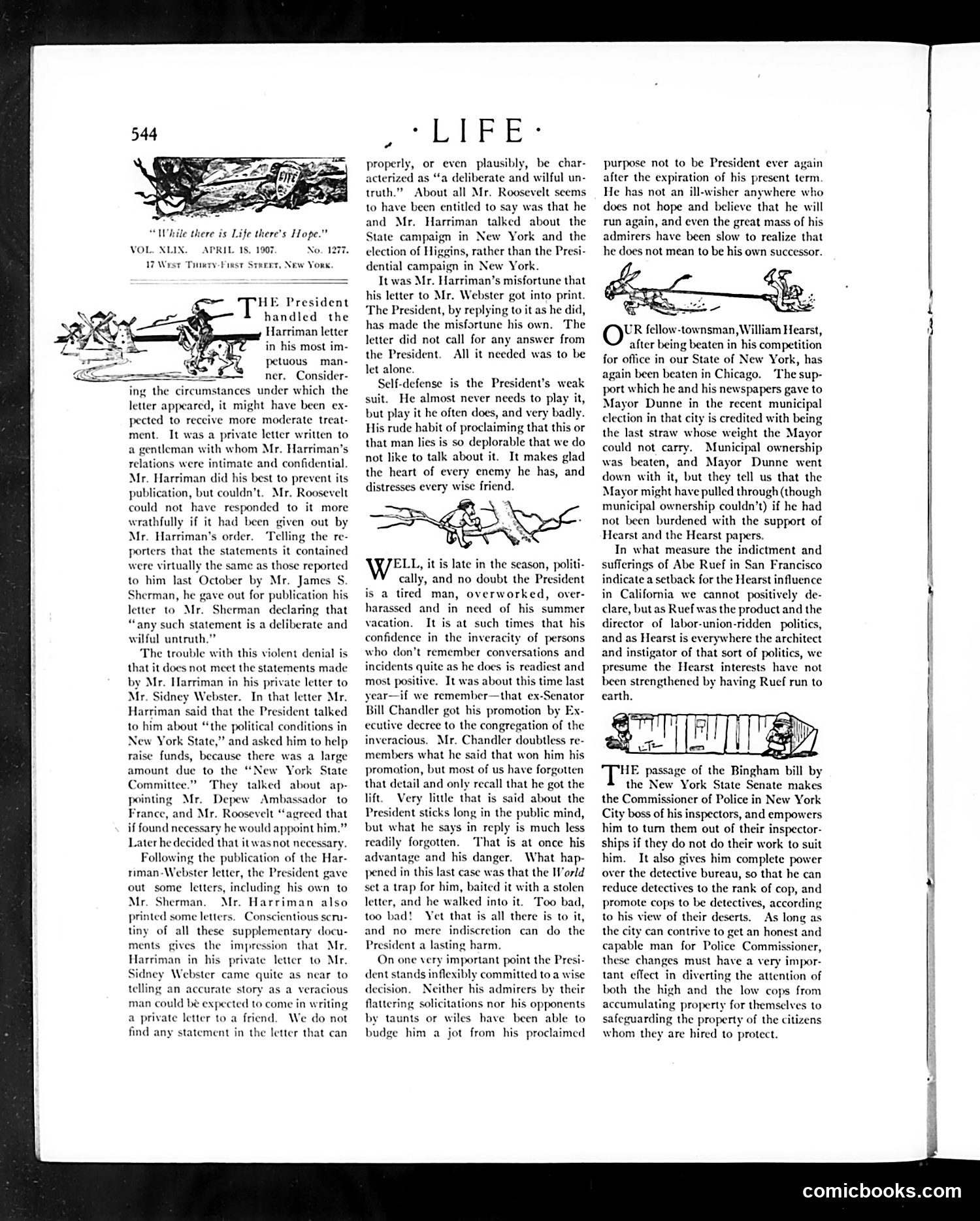
This page critiques President Theodore Roosevelt's handling of the Harriman letter controversy. The text discusses Roosevelt's defensive response to criticism regarding a private letter to Sidney Webster about political conditions in New York. The cartoons (though small and difficult to read in detail) appear to illustrate the political tension and Roosevelt's combative reaction to press scrutiny. Key satirical points: Roosevelt is depicted as tired and overworked, his "rude habit of proclaiming" wrongdoing is mocked, and the article suggests his violent denials damage rather than help his position. The piece also criticizes how Roosevelt allowed the controversy to escalate through poor handling of the initial publication. The satire targets Roosevelt's aggressive personality and his tendency to make political situations worse through defensive proclamations.
📄 Transcribed text from this page (OCR, searchable)
Machine-transcribed from the original scan — historical spelling and the odd misread are preserved.
“While there is Life there’s Hope.” VOL. XLIX. APRIL 18, 1907. No. 1277. 17 West Truty-Finst Street, New York. HE President handled the Harriman letter in his most im- petuous man- ner. Consider ing the circumstances under which the letter appeared, it might have been ex- pected to receive more moderate treat- ment. It was a private letter written to a gentleman with whom Mr. Harriman’s relations were intimate and confidential Mr. Harriman did his best to prevent its publication, but couldn’t. Mr. Roosevelt could not have responded to it more wrathfully if it had been given out by Mr. Harriman’s order. Telling the re- porters that the statements it contained were virtually the same as those reported to him last October by Mr. James S Sherman, he gave out for publication his. letter to Mr. Sherman declaring that “any such statement is a deliberate and wilful untruth,” The trouble with this violent denial is that it does not meet the statements made by Mr. Harriman in his private letter to Mr. Sidney Webster. In that letter Mr. Harriman said that the President talked to him about “the political conditions in New York State,” and asked him to help raise funds, because there was a large amount due to the “New York State Committee.” ‘They talked about ap- pointing Mr. Depew Ambassador to France, and Mr. Roosevelt “agreed that if found necessary he would appoint him.” Later he decided that itwas not necessary. Following the publication of the Har- riman-Webster letter, the President gave out some letters, including his own to Mr. Sherman. Mr. Harriman also printed some letters. Conscientious scru- tiny of all these supplementary docu- ments gives the impression that Mr. Harriman in his private letter to Mr. Sidney Webster came quite as near to telling an accurate story as a veracious man could be expected to come in writing a private letter to a friend. We do not find any statement in the letter that can LIFE: properly, or even plausibly, be char- acterized as “a deliberate and wilful un- truth.” About all Mr. Roosevelt seems to have been entitled to say was that he and Mr. Harriman talked about the State campaign in New York and the election of Higgins, rather than the Presi- dential campaign in New York. It was Mr. Harriman’s misfortune that his letter to Mr. Webster got into print. The President, by replying to it as he did, has made the misfortune his own, The letter did not call for any answer from the President. All it needed was to be let alone. Self-defense is the President’s weak suit. He almost never needs to play it, but play it he often does, and very badly. His rude habit of proclaiming that this or that man lies is so deplorable that we do not like to talk about it. It makes glad the heart of every enemy he has, and distresses every wise friend. ELL, it is late in the season, politi- cally, and no doubt the President is a tired man, overworked, over- harassed and in need of his summer vacation. It is such times that his confidence in the inveracity of persons who don’t remember conversations and incidents quite as he does is readiest and most positive. It was about this time last year—if we remember—that ex-Senator Bill Chandler got his promotion by ecutive decree to the congregation of the inveracious. Mr. Chandler doubtless re- members what he said that won him his promotion, but most of us have forgotten that detail and only recall that he got the lift. Very little that is said about the President sticks long in the public mind, but what he says in reply is much less readily forgotten. That is at once his advantage and his danger. What hap- pened in this last case was that the World set a trap for him, baited it with a stolen letter, and he walked into it. Too bad, too bad! Yet that is all there is to it, and no mere indiscretion can do the President a lasting harm, On one very important point the Presi- dent stands inflexibly committed to a wise decision. ither his admirers by their flattering solicitations nor his opponents by taunts or wiles have been able to budge him a jot from his proclaimed purpose not to be President ever again after the expiration of his present term He has not an ill-wisher anywhere who does not hope and believe that he will run again, and even the great mass of his admirers have been slow to realize that he does not mean to be his own successor. IR fellow-townsman, William Hearst, after being beaten in his competition for office in our State of New York, has again been beaten in Chicago. ‘The sup- port which he and his newspapers gave to Mayor Dunne in the recent municipal tion in that city is credited with being the last straw whose weight the Mayor could not carry. Municipal ownership was beaten, and Mayor Dunne went down with it, but they tell us that the Mayor might have pulled through (though municipal ownership couldn’t) if he had not been burdened with the support of Hearst and the Hearst papers. In what measure the indictment and sufferings of Abe Ruef in San Francisco indicate a setback for the Hearst influence in California we cannot positively de- clare, but as Ruef was the product and the director of labor-union-ridden politics, and as Hearst is everywhere the architect and instigator of that sort of politics, we presume the Hearst interests have not been strengthened by having Ruef run to earth, HE, passage of the Bingham bill by the New York State Senate makes the Commissioner of Police in New York City boss of his inspectors, and empowers him to tum them out of their inspector- ships if they do not do their work to suit him. It also gives him complete power over the detective bureau, so that he can reduce detectives to the rank of cop, and promote cops to be detectives, according to his view of their deserts. As long as the city can contrive to get an honest and capable man for Police Commissioner, these changes must have a very impor- tant effect in diverting the attention of both the high and the low cops from accumulating property for themselves to safeguarding the property of the citizens whom they are hired to protect. comicbooks.com as