
Life, 1907-04-18 · page 14 of 36
Life — April 18, 1907 — page 14: what you’re looking at
What you’re looking at
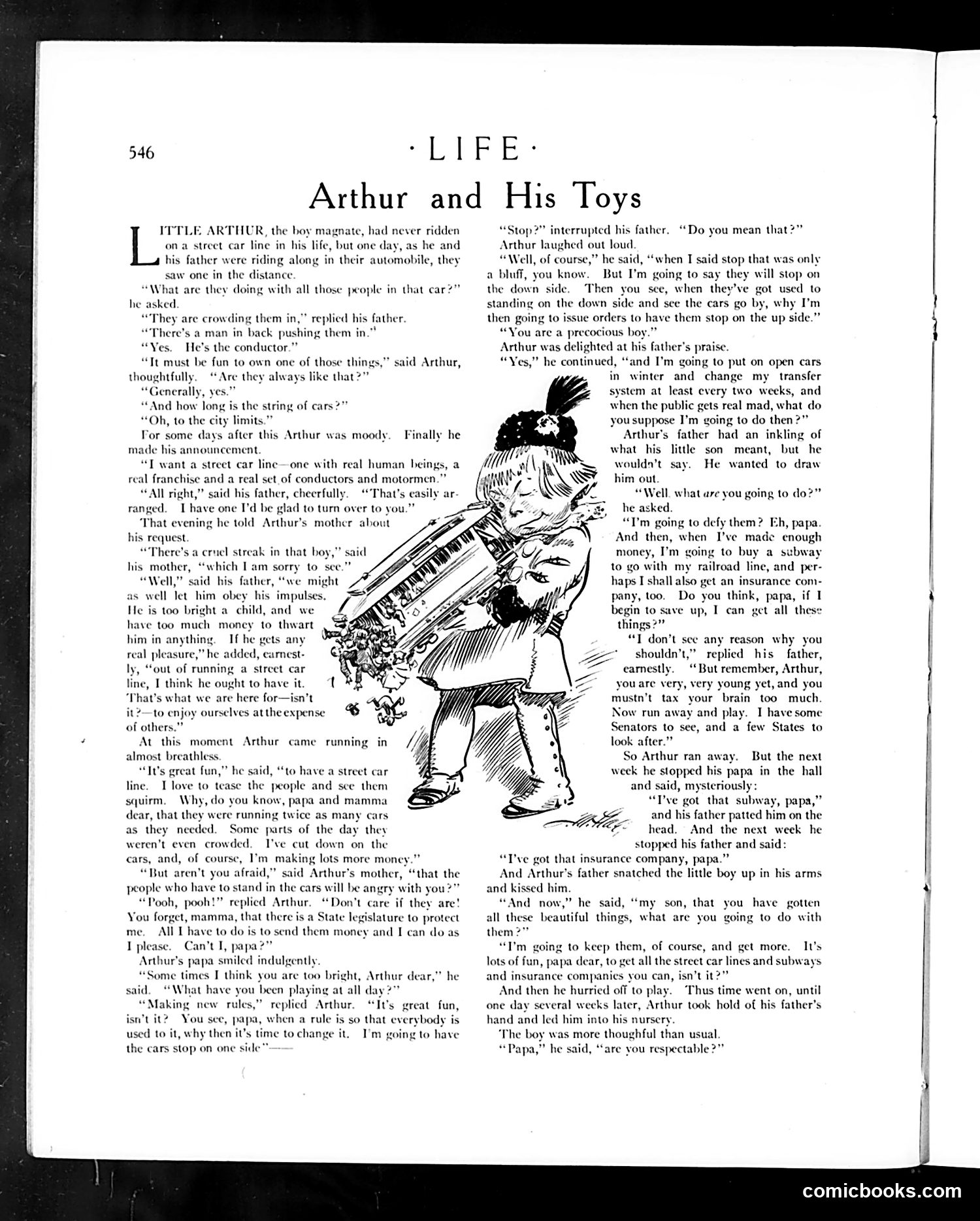
This story satirizes **turn-of-the-century American business practices and political corruption**. Little Arthur represents ruthless capitalists who exploit public utilities for personal profit and amusement. The satire targets: 1. **Monopolistic practices**: Arthur cuts streetcars to increase profits despite public inconvenience—reflecting real transit company behavior of the era. 2. **Political bribery**: Arthur casually states he sends money to state legislators to protect his interests, depicting the normalized corruption between business and government. 3. **Regulatory capture**: The father's indulgent acceptance ("we're here to enjoy ourselves at others' expense") critiques wealthy elites' entitlement. 4. **Consumer manipulation**: Arthur deliberately changes rules to confuse and anger riders, viewing their frustration as entertainment. The illustration shows Arthur as a cherubic boy holding a streetcar, emphasizing the absurdity that such power rests with someone so morally undeveloped. The story's dark humor exposes how unchecked capitalism treats the public as victims for profit and amusement.
📄 Transcribed text from this page (OCR, searchable)
Machine-transcribed from the original scan — historical spelling and the odd misread are preserved.
“14 ITTLE ARTHUR, the boy magnate, had never ridden on a street car line in his life, but one day, as he and his father were riding along in their automobile, they saw one in the distance. “What are they doing with all those people in that car?” he asked “They are crowding them in,” replied his father. “There’s a man in back pushing them in.” “Yes, He's the conductor.” “Tt must be fun to own one of those things,” thoughtfully. “Are they always like that?” “Generally, yes.” “And how long is the string of cars?” “Oh, to the city limits.” Yor some days after this Arthur was moody. made his announcement. “T want a street car line—one with real human beings, a real franchise and a real set of conductors and motormen.” “All right,” said his father, cheerfully. “That's easily ar: ranged. I have one I'd be glad to turn over to you.” That evening he told Arthur’s mother about his request “There's a cruel streak in that boy,” said s mother, “which Lam sorry to see.” “Well,” said his father, “we might as well let him obey his impulses. He is too bright a child, and we © too much money to thwart nin anything. If he gets any real pleasure," he added, carest- ly, “out of running a street car line, I think he ought to have it. ‘That’s what we are here for—isn’t it ?—to enjoy ourselves at the expense of others.” 7 At this. almost breathless. “It's great fun,” he said, “to have a street car line. I love to tease the people and sce them squirm. Why,do you know, papa and mamma dear, that they were running twice as many cars as they needed. Some parts of the day they weren't even crowded. I've cut down on the cars, and, of course, I'm making lots more money.’ “But aren't you afraid,” said Arthur's mother, “that the people who have to stand in the cars will be angry with you?” “Pooh, pooh!” replied Arthur, “Don’t care if they ar You forget, mamma, that there is a State legislature to protect me, All [ have to do is to send them money and I can do as I please. Can't I, papa?” Arthur's papa smiled indulgently I think you are too bright, Arthur dear,” he ve you been playing at all day?” replied Arthur. “It's great’ fun, 1, when a rule is so that everybod) time tochange it. I'm going to have said Arthur, Finally he moment Arthur came running. in “What ha “Making new rule isn’t it? You see, pa used to it, why then it’ the cars stop on one s is Arthur and His Toys FE- “Stop?” interrupted his father. ‘Do you mean that?” Arthur laughed out loud. “Well, of course,” he said, ‘when T said stop that was only a bluff, you know. But I’m going to say they will stop on the down side. Then you see, when they've got used to standing on the down side and sce the cars go by, why I'm then going to issue orders to have them stop on the up side.” 1 “You are a precocious boy.” Arthur was delighted at his father’s praise. “Yes,” he continued, “and I’m going to put on open cars in winter and change my transfer em at least every two weeks, and when the public gets real mad, what do you suppose I’m going to do then ?” Arthur's father had an inkling of | his little son meant, but he wouldn’t say. He wanted to draw him out “Well. what are you going to do?” he asked. “Pm going to defy them? Eh, papa. And then, when I’ve made enough money, I’m going to buy a subwa to go with my railroad line, and per- haps I shall also get an insurance com- pany, too. Do you think, papa, if I ry begin to save up, I can get all these things?” “T don’t sce any reason why you shouldn’t,” replied his father, eamestly. ‘But remember, Arthur, } you are very, very young yet, and you mustn’t tax your brain too much. Now run away and play. I have some Senators to see, and a few States to I look after.” So Arthur ran away. But the next week he stopped his papa in the hall and said, mysteriously : “T’'ve got that subway, papa,” and his father patted him on the head. And the next week he stopped his father and said: “T've got that insurance company, papa And Arthur’s father snatched the little boy up in his arms and kissed him. oY “And now,” he said, “my son, that you have gotten all th beautiful things, what are you going to do with them?” “Tm going to keep them, of course, and get more. It's lots of fun, papa dear, to get all the strect car lines and subways and insurance companies you can, isn’t it?” And then he hurried off to play. Thus time went on, until one day several weeks later, Arthur took hold of his father's hand and led him into his nursery. ‘The boy was more thoughful than usual “Papa,” he said, “are you respectable?” comicbooks.com