
Life, 1907-04-18 · page 20 of 36
Life — April 18, 1907 — page 20: what you’re looking at
What you’re looking at
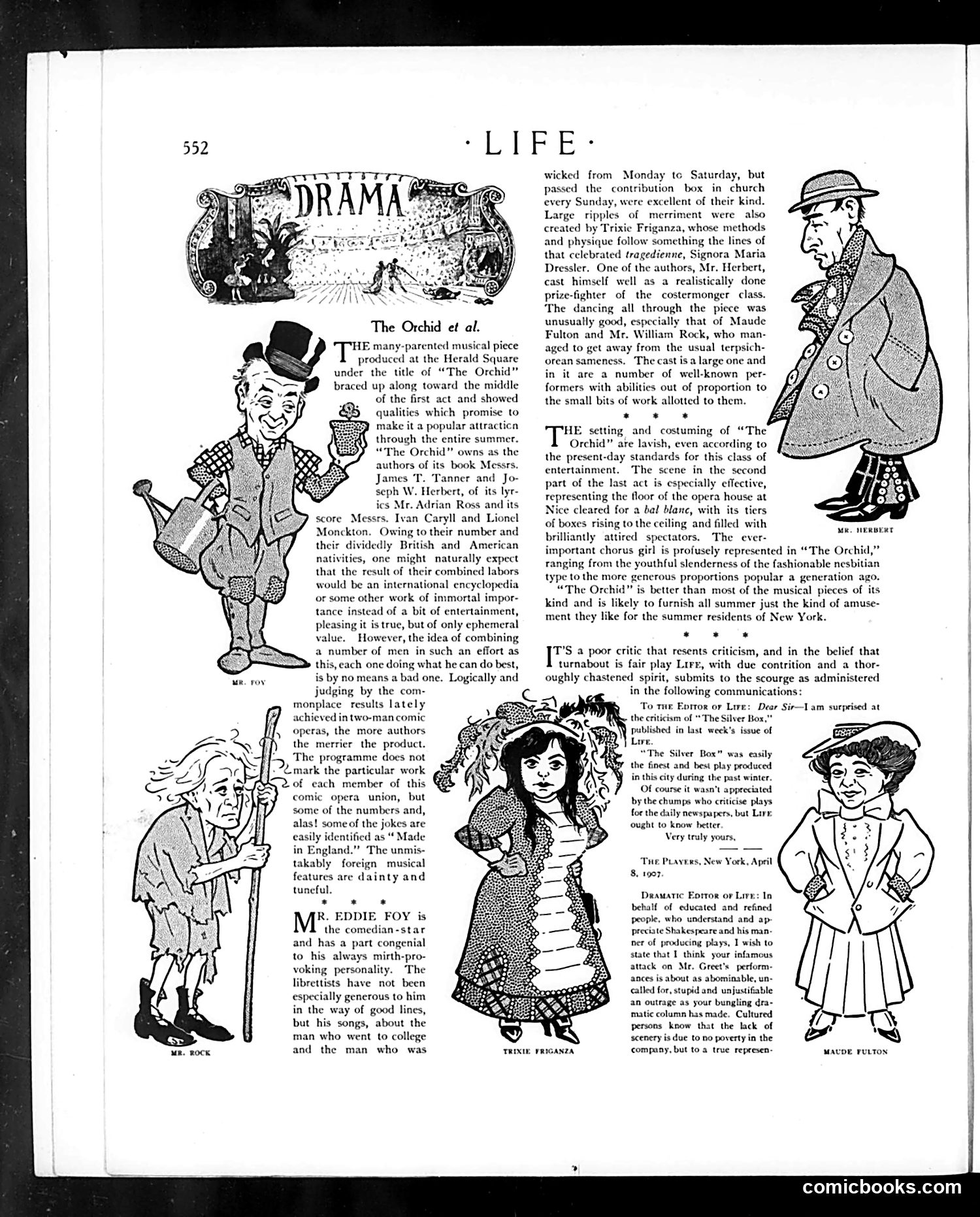
This is a theater review of the musical comedy *"The Orchid,"* performed at Herald Square Theatre. The page critiques the production's creative team—British and American writers James T. Tanner, Joseph W. Herbert, Adrian Ross, Ivan Caryll, and Lionel Monckton—noting that combining multiple authors, while logically sound, produces predictably mediocre results. The reviewer praises comedian Eddie Foy's performance and the dancing of Maude Fulton and William Rock, though criticizes weak libretto contributions. The lavish staging and chorus (featuring various body types, including the fashionable "Nesbit type") merit approval. The page concludes with a sarcastic letter from a reader defending *"The Silver Box"* against Life's prior criticism—illustrating the magazine's practice of publishing reader rebuttals. The illustrations show Foy, Rock, Friganza, and Fulton as recognizable theater personalities of the era.
📄 Transcribed text from this page (OCR, searchable)
Machine-transcribed from the original scan — historical spelling and the odd misread are preserved.
The Orchid et al. HE many-parented musical piece produced at the Herald Square under the title of “The Orchid” braced up along toward the middle of the first act and showed qualities which promise to make it a popular attractica through the entire summer. “The Orchid” owns as the authors of its book Messrs James ‘T. Tanner and Jo- seph W. Herbert, of its lyr- ics Mr. Adrian Ross and its score Messrs. Ivan Caryll and Lionel Monckton. Owing to their number and their dividedly British and American nativities, one might naturally expect that the result of their combined labors would be an international encyclopedia or some other work of immortal impor- tance instead of a bit of entertainment, pleasing it is true, but of only ephemeral value. However, the idea of combining a number of men in such an effort as this, each one doing what he can do best, << is by no means a bad one. Logically and judging by the com- monplace results lately achieved in two-man comic operas, the more authors the merrier the product. The programme does not -72 mark the particular work 2 of each member of this comic opera union, but some of the numbers and, alas! some of the jokes are easily identified Made in England.” The unmis- takably foreign musical features are dainty and tuneful. s 8 8 R. EDDIE FOY is the comedian-star and has a part congenial to his always mirth-pro- voking personality. The librettists have not been especially generous to him in the way of good lines, but his songs, about the man who went to college and the man who was “LIFE: wicked from Monday to Saturday, but passed the contribution box church every Sunday, were excellent of their kind. Large ripples of merriment were also created by Trixie Friganza, whose methods and physique follow something the lines of that celebrated tragedienne, Signora Maria Dressler. One of the authors, Mr. Herbert, cast himself well as a realistically done prize-fighter of the costermonger class. ‘The dancing all through the piece was unusually good, especially that of Maude Fulton and Mr. William Rock, who man- aged to get away from the usual terpsich- orean sameness. ‘The cast isa large one and in it are a number of well-known per- formers with abilities out of proportion to the small bits of work allotted to them. * 8 HE setting and costuming of “The Orchid” are lavish, even according to the present-day standards for this class of entertainment. The scene in the second part of the last act is especially effective, representing the floor of the opera house at Nice cleared for a bal blanc, with its tiers of boxes rising to the ceiling and filled with brilliantly attired spectators. The ever- important chorus girl is profusely represented in “The Orchid,” ranging from the youthful slenderness of the fashionable nesbit type to the more generous proportions popular a generation ago. “The Orchid better than most of the musical pieces of kind and is likely to furnish all summer just the kind of amuse- ment they like for the summer residents of New York. Me. HERBERT * * « T'S a poor critic that resents criticism, and in the belief that turnabout is fair play Ltr, with due contrition and a thor- oughly chastened spirit, submits to the scourge as administered in the following communications: ‘To Tue Eprror or Lire: Dear Sir—I am surprised at the criticism of “The Silver Box,” published in last week's issue of Lo The Silver Box” was easily the finest and best play produced in this city during the past winter. Of course it wasn't appreciated by the chumps who criticise plays for the daily newspapers, but Lire ought to know better. Very truly yours, Tue Prayers, New York, April 8, 1997 Daamatic Eorror or Lire: In behalf of educated and refined people, who understand and ap preciate Shakespeare and his man- ner of producing plays, I wish to state that I think your infamous attack on Mr. Greet’s perform ances is about as abominable, un- alled for, stupid and unjustifiable an outrage as your bungling dra- matic column has made. Cultured persons know that the lack of scenery is due to no poverty in the company, but toa true represen- comicbooks.com