
Life, 1907-04-18 · page 27 of 36
Life — April 18, 1907 — page 27: what you’re looking at
What you’re looking at
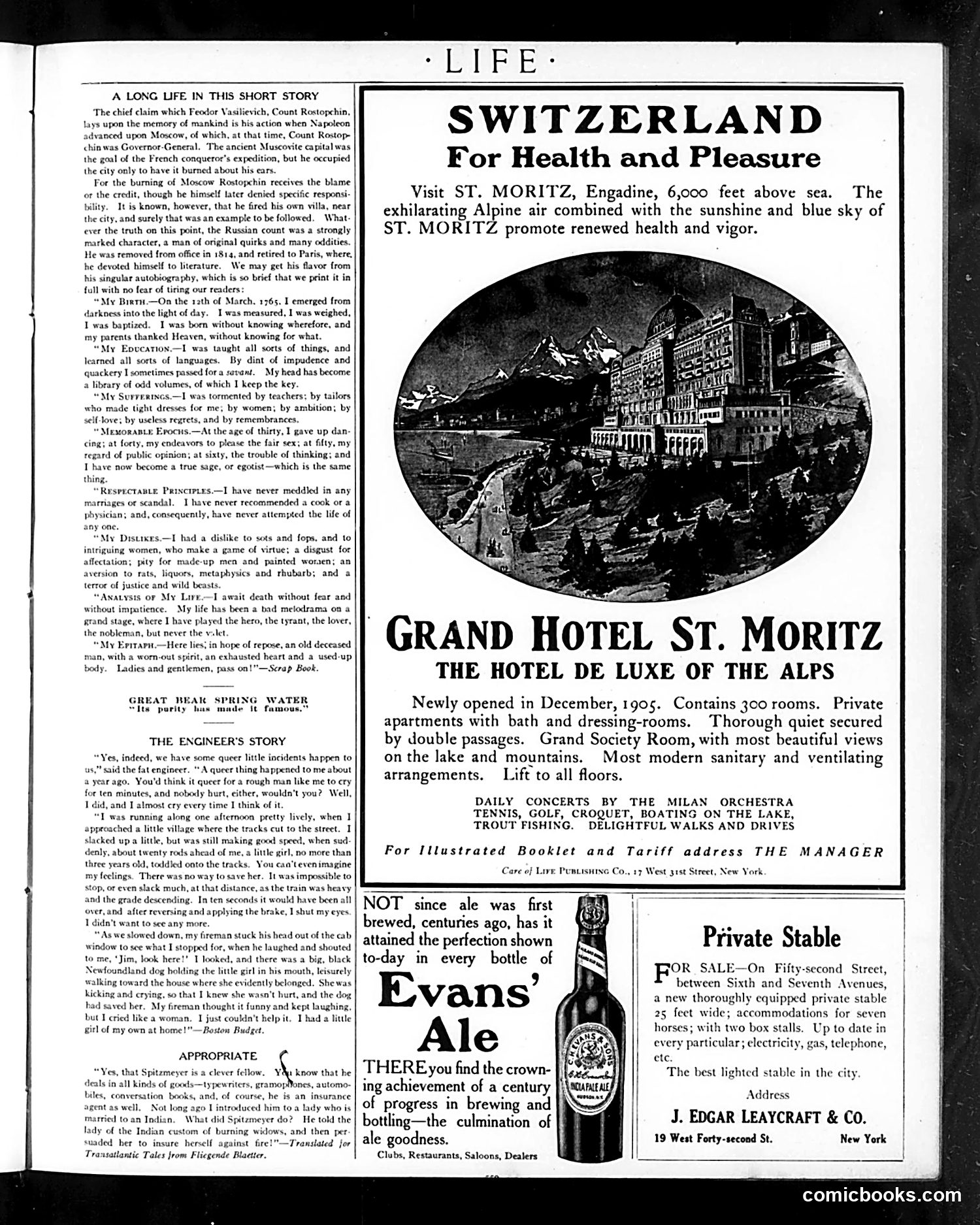
This page from *Life* magazine is primarily **advertising and autobiographical content**, not political satire. The left column features Count Rostopchine's brief autobiography—a historical Russian general famous for burning Moscow during Napoleon's 1812 invasion. His sardonic life summary is presented as humor: he progressively abandoned social concerns (dancing at 30, pleasing women at 40, public opinion at 50, thinking itself at 60) to become a "true sage, or egoist." The joke relies on his brutally honest self-assessment and the irony that abandoning all responsibility is presented as wisdom. Below this is "The Engineer's Story," beginning a railway anecdote (likely leading to sentimental resolution). The right side contains advertisements: the Grand Hotel St. Moritz in Switzerland, Evans' Ale, and a private stable for sale in New York. The page demonstrates *Life*'s editorial formula: mixing satirical biographical excerpts with commercial advertisements and serialized human-interest stories.
📄 Transcribed text from this page (OCR, searchable)
Machine-transcribed from the original scan — historical spelling and the odd misread are preserved.
A LONG LIFE IN THIS SHORT STORY “The chief claim which Feodor Vasilievich, Count Rostopchin, lays upon the memory of mankind is his action when Napoleon advanced upon Moscow, of which, at that time, Count Rostop- chin was Governor-General. The ancient Muscovite capital was the goal of the French conqueror’s expedition, but he occupied the city only to have it burned about his ears. For the burning of Moscow Restopchin receives the blame or the credit, though be himself later denied specific responsi- t It is known, however, that he fired his own villa, near the city, and surely that was an example to be followed. What- ever the truth on this point, the Russian count was a strongly marked character, a man of original quirks and many oddities. He was removed from office in 1814, and retired to Paris, where, he devoted himself to literature. We may get his flavor from his singular autobiography, which is so brief that we print it in full with no fear of tiring our readers: “My Birrit.—On the 12th of March, 1765. I emerged from darkness into the light of day, Iwas measured, I was weighed, I was baptized. I was born without knowing wherefore, and my parents thanked Heaven, without knowing for what. “My Epvcarion.—I was taught all sorts of things, and learned all sorts of languages. By dint of impudence and quackery I sometimes passed fora savant. My head has become a library of odd volumes, of which I keep the key. “My Survemincs.—I was tormented by teachers; by tailors who made tight dresses for me; by women; by ambition; by self-love; by useless regrets, and by remembrances. * Mestorantr Erocus.—At the age of thirty, I gave up dan- cing; at forty, my endeavors to please the fair sex; at fifty, my regard of public opinion; at sixty, the trouble of thinking; and I have now become a true sage, or egotist—which is the same thing. “ RespectamLe Prixctrixs.—I have never meddled in any marriages of scandal. I have never recommended a cook or a physician; and, consequently, have never attempted the life of any one, “My Distixes.—I had a dislike to sots and fops, and to intriguing women, who make a game of virtue; a disgust for affectation; pity for made-up men and painted worsen; an aversion to rats, liquors, metaphysics and rhubarb; and a terror of justice and wild beasts. “Awatysis or My Lire.—TI await death without fear and without impatience. My life has been a bad melodrama on a grand stage, where I have played the hero, the tyrant, the lover, the nobleman, but never the vilet "My Errrarit.—Here lies; in hope of repose, an old deceased man, with a worn-out spirit, an exhausted heart and a used-up body. Ladies and gentlemen, pass on!" rap Book. GREAT BEAK SPRING WATER “Ite parity hus made it famous.” THE ENGINEER'S STORY cs, indeed, we have some queer little incidents happen to tas," said the fat engineer. "A queer thing happened to me about a year ago. You'd think it queer for a rough man like me to cry for ten minutes, and nobody burt, either, wouldn't you? Well, I did, and I almost cry every time I think of it. “Twas running along one afternoon pretty lively, when I approached a little village where the tracks cut to the street, I slacked up a little, but was still making good speed, when sud denly, about twenty rods ahead of me, a little girl, no more than $ old, toddied onto the tracks. You caa'teven imagine my feelings. There was no way to save her. It was impossible to stop, or even slack much, at that distance, as the train was heavy and the grade descending. In ten seconds it would have been all and after reversing and applying the brake, I shut my eyes 1 didn’t want to sce any more. “As we slowed down, my fireman stuck his head out of the cab ow to sce what I stopped for, when he laughed and shouted to me, ‘Jim, look here! T looked, and there was a big, black Newfoundland dog holding the little girl in his mouth, leisurely walking toward the house where she evidently belonged. She was kicking and crying, so that I knew she wasn't hurt, and the dog had saved ber. My fireman thought it funny and kept laughing, I cried like a woman. I just couldn't help it. Thad a little girl of my own at home!" —Boston Budget. APPROPRIATE “Yes, that Spitzmeyer is a clever fellow, know that he deals in all kinds of goods—typewriters, gramoy Nes, automo- biles, conversation books, and, of course, he is an insurance agent as well, Not long married toan Indian. What di¢ hh duced him toa lady who is 1 Spitzmeyer do? He told the of the Indian custom of burning widows, and then per. ded her to insure herself against fire!"—Translated jor Transatlantic Tales jrom Fliegende Blactter. on the lake and mountains. arrangements. Lift to all floors. For Illustrated Booklet and Tariff address THE Care of Lire Puntisiixe Co., 17 West 31st Street, New York. SWITZERLAND For Health and Pleasure Visit ST. MORITZ, Engadine, 6,000 feet above sea. The exhilarating Alpine air combined with the sunshine and blue sky of ST. MORITZ promote renewed health and vigor. GRAND HOTEL ST. MORITZ THE HOTEL DE LUXE OF THE ALPS Newly opened in December, 1905. Contains 300 rooms. Private apartments with bath and dressing-rooms. by double passages. Grand Society Room, with most beautiful views Most modern sanitary and ventilating DAILY CONCERTS BY THE MILAN ORCHESTRA TENNIS, GOLF, CROQUET, BOATING ON THE LAKE, TROUT FISHING. DELIGHTFUL WALKS AND DRIVES Thorough quiet secured MANAGER NOT since ale was first brewed, centuries ago, has it attained the perfection shown to-day in every bottle of Evans’ Ale THERE you find the crown- ing achievement of a century of progress in brewing and bottling—the culmination of ale goodness. Clubs, Restaurants, Saloons, Dealers Private Stable 'OR SALE—On Fifty-second Street, between Sixth and Seventh Avenues, | a new thoroughly equipped private stable 25 feet wide; accommodations for seven ; with two box stalls. Up to date in every particular; electricity, gas, telephone, horses ete. The best lighted stable in the city Address J. EDGAR LEAYCRAFT & CO. 19 West Forty-second St. New York comicbooks.com