
A complete issue · 40 pages · 1907
Life — March 21, 1907
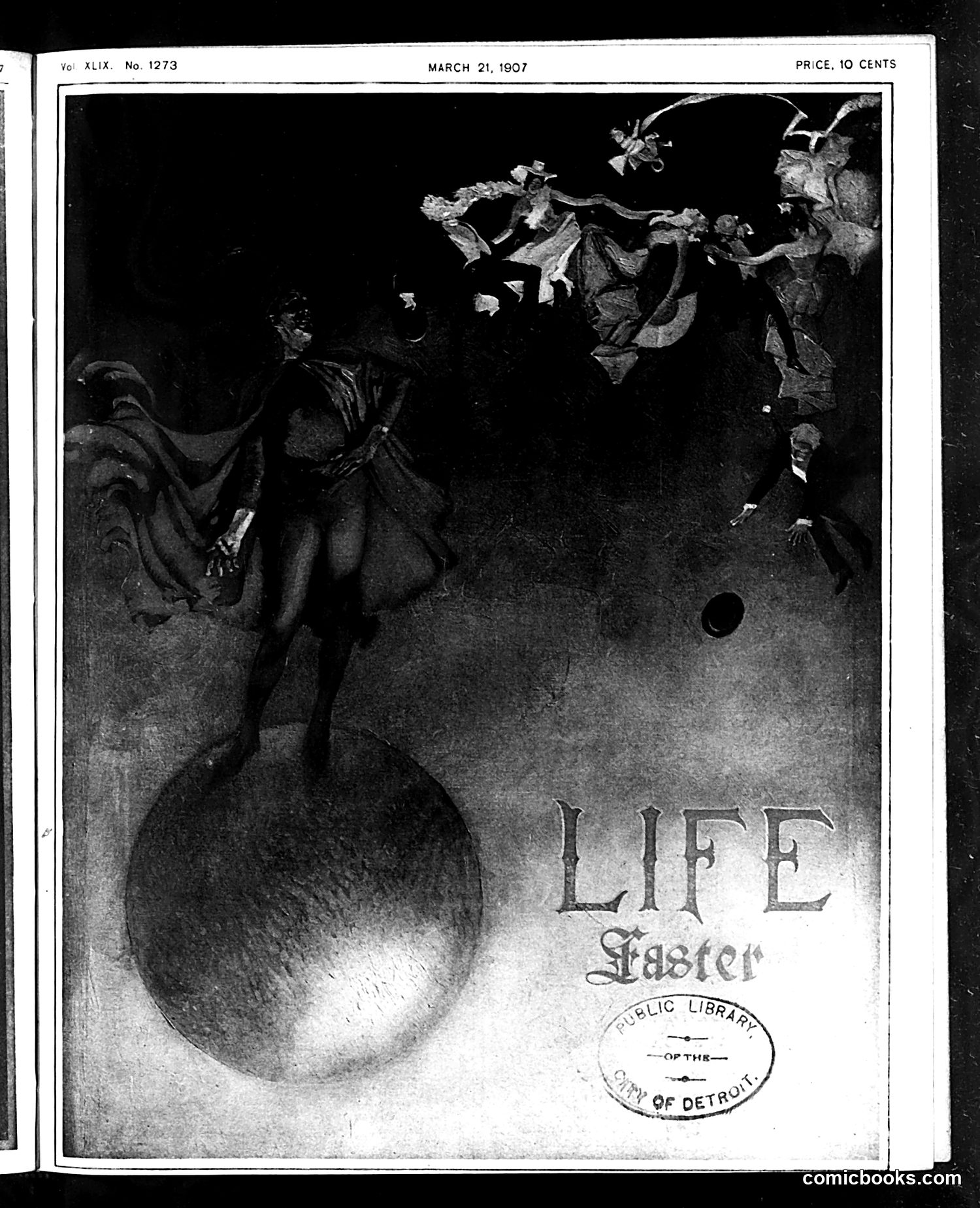
This is an Easter-themed cover illustration. The image depicts a classical or allegorical figure (appearing to represent Life or Spring) riding a rearing horse, gesturing upward toward flying cherubs or angels in the sky. Below is a large egg, a traditional Easter symbol. The composition uses classical artistic style typical of early 1900s magazine cover design. The "LIFE Easter" text prominently displays the magazine's name and seasonal theme. The Library of Detroit stamp indicates this copy was held in that city's public collection. The cover appears to be primarily decorative rather than satirical—celebrating the Easter holiday and themes of renewal and resurrection with allegorical imagery rather than political commentary.
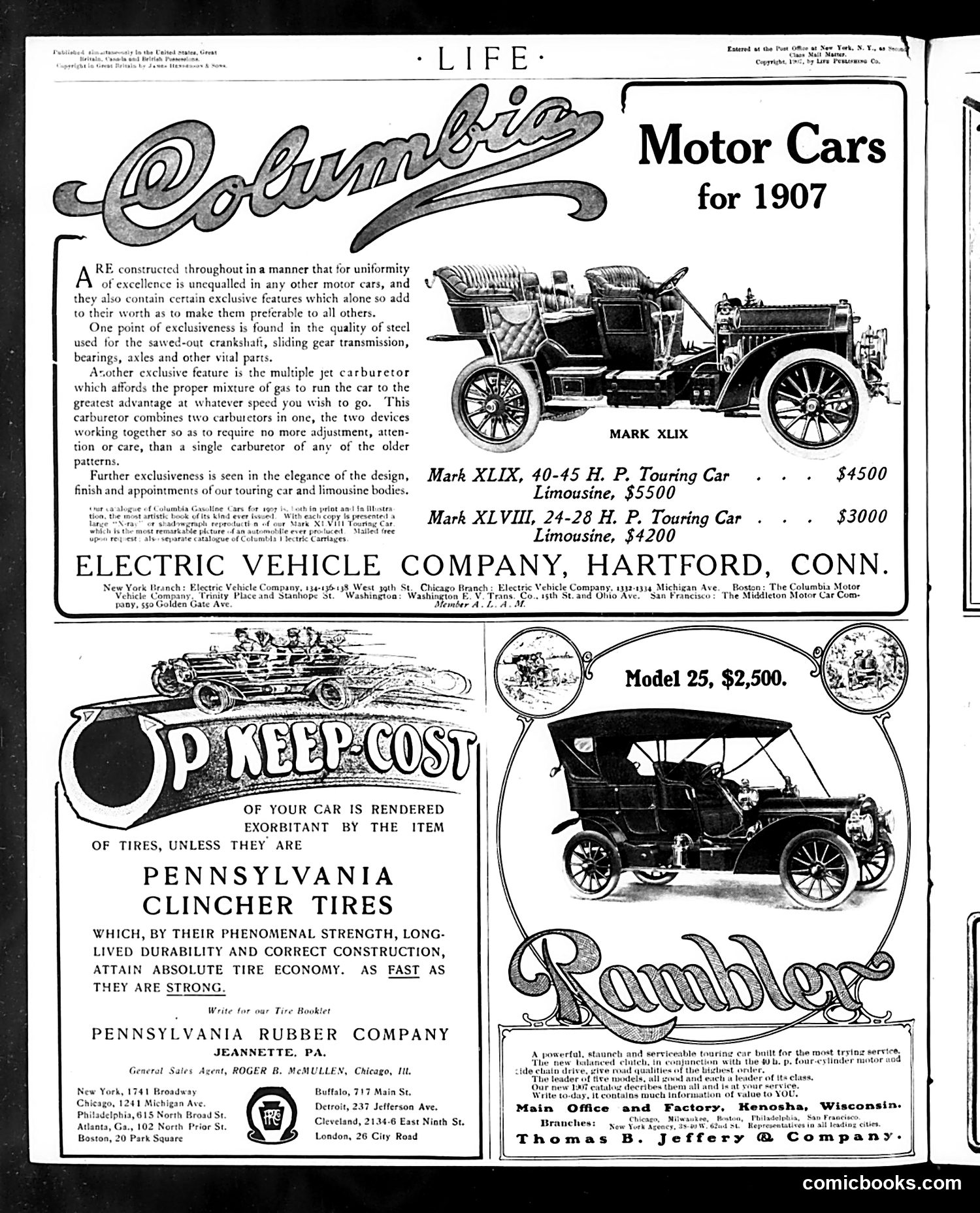
This page is **primarily advertising**, not satire or political commentary. It contains three automobile advertisements from 1907: 1. **Columbia Motor Cars** (top): Highlights engineering features like steel construction and multiple-jet carburetors. Prices range from $3,000-$4,500. 2. **Pennsylvania Clincher Tires** (bottom left): A pun-based ad ("Keep Cost" with a tire mascot) emphasizing tire durability and economy. 3. **Rambler Model 25** (bottom right): A $2,500 touring car advertisement from Thomas B. Jeffery Company. There is **no political cartoon or satire present**. This represents typical early-1900s automotive marketing targeting affluent buyers, with emphasis on mechanical innovation and reliability—key selling points when automobiles were still novel, expensive luxuries.
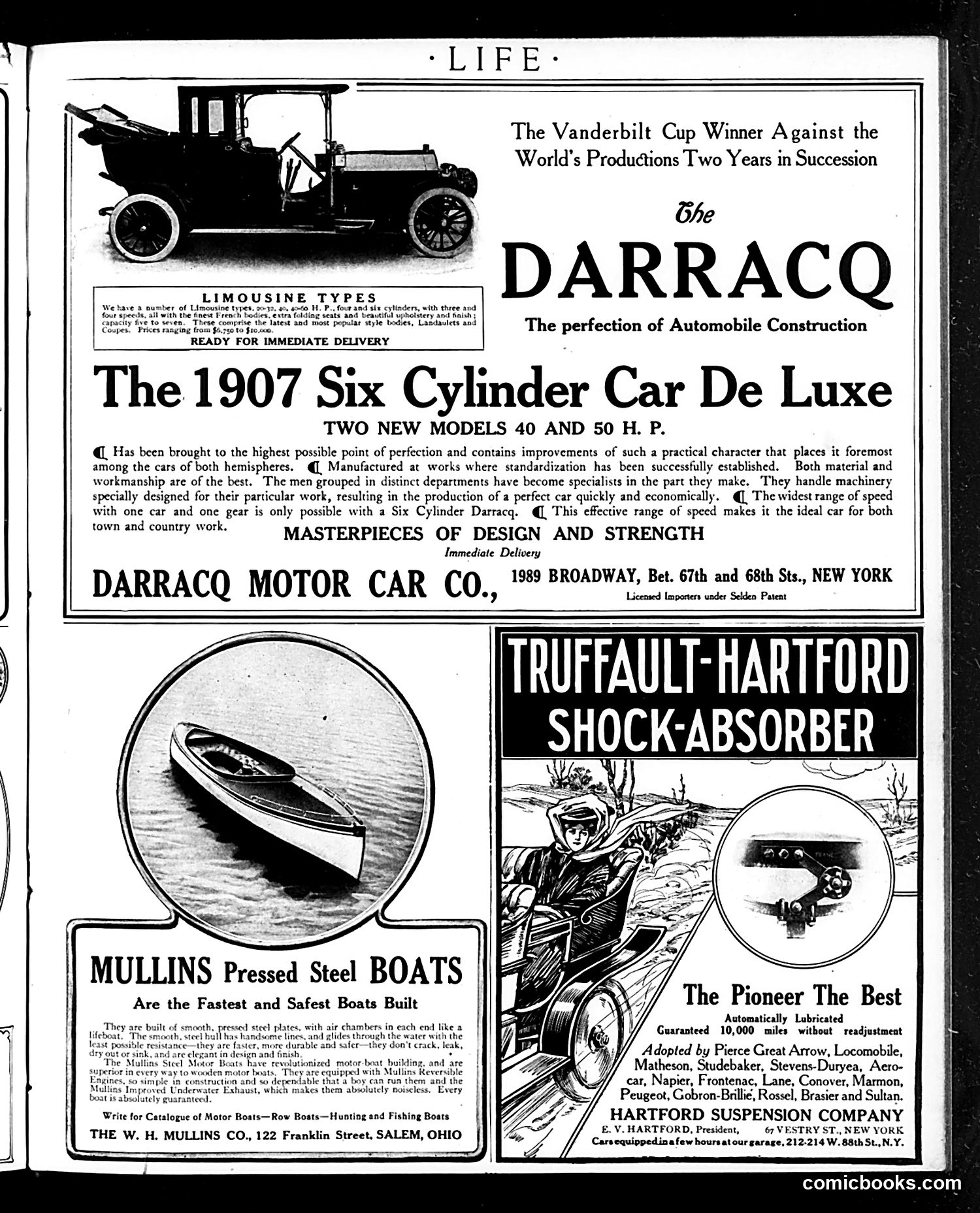
This page is primarily **advertising content**, not satirical cartoon material. It contains three separate automobile and product advertisements from approximately 1907: 1. **Darraco Motor Car Co.** promotes their "1907 Six Cylinder Car De Luxe," highlighting its Vanderbilt Cup racing victory and French engineering. 2. **Mullins Pressed Steel Boats** advertises recreational watercraft built from pressed steel. 3. **Truffault-Hartford Shock-Absorber** showcases an automotive suspension component, illustrating its adoption across multiple car manufacturers. The page reflects early 1900s consumer marketing in *Life* magazine, targeting wealthy readers interested in luxury automobiles, recreational boating, and automotive innovations. There is no political satire or social commentary present—it is straightforward commercial advertising from the period.
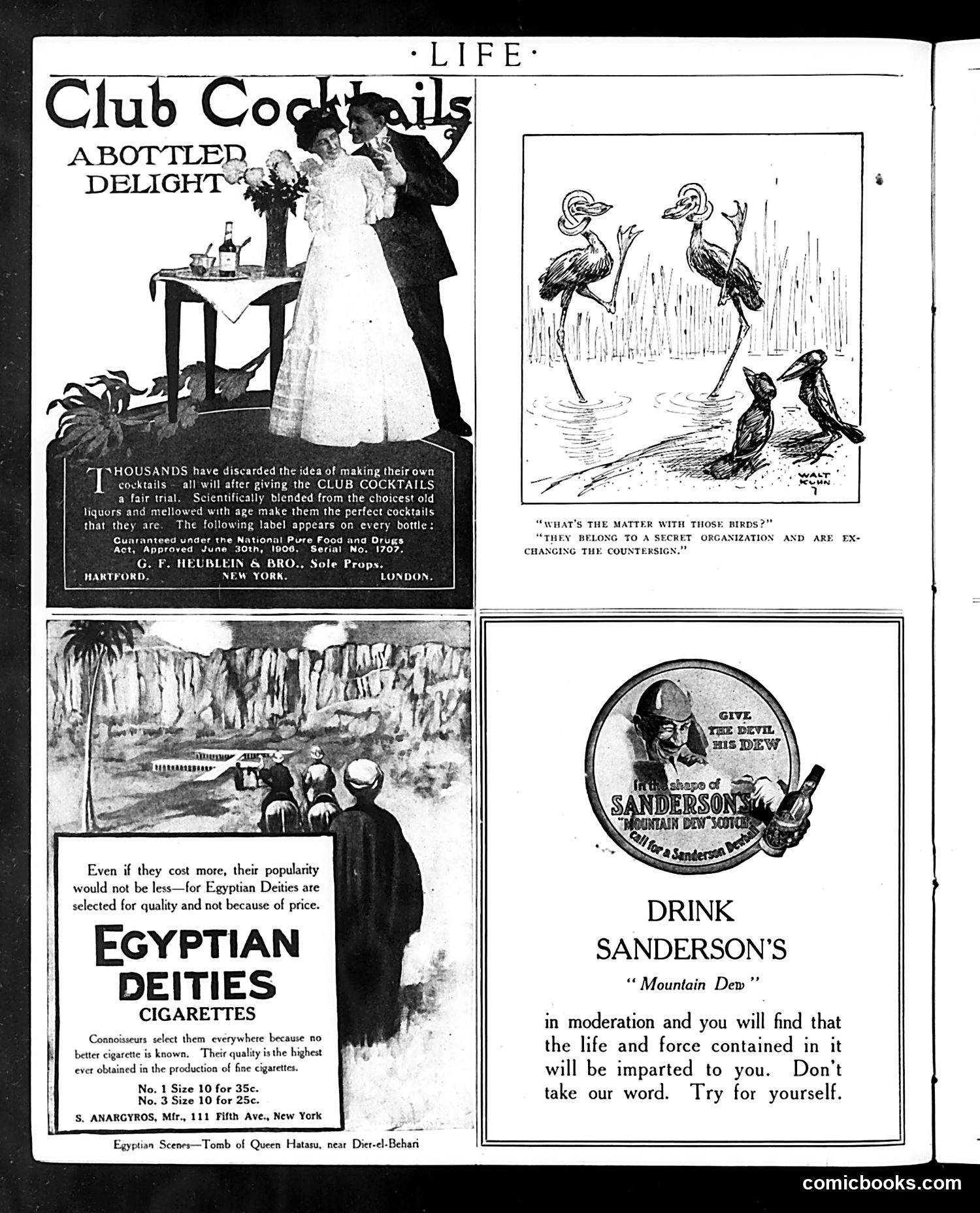
This page is primarily **advertising content** rather than editorial satire. The top advertisement promotes "Club Cocktails," a bottled cocktail product by G.F. Heublein & Bro., marketed to those tired of making their own drinks at home. The accompanying illustration depicts a couple in formal attire. Below are advertisements for Egyptian Deities Cigarettes and Sanderson's Mountain Dew (a non-alcoholic beverage). The only cartoon element is a small humorous illustration of birds with the caption "What's the matter with those birds?" answered by "They belong to a secret organization and are exchanging the countersign." This appears to be generic animal humor rather than political commentary. The page reflects early-20th-century consumer culture and prohibition-era beverage marketing.
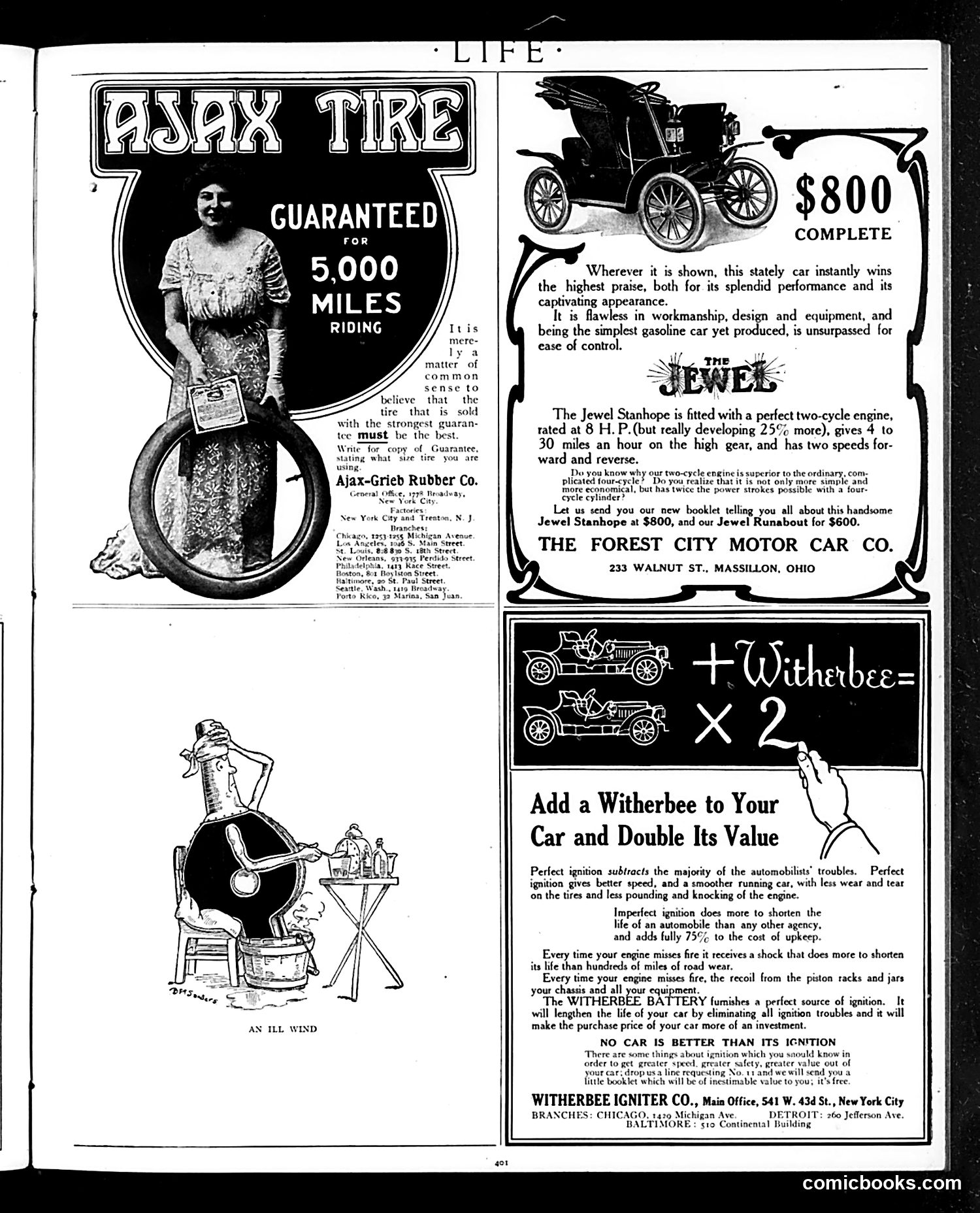
This page is primarily **advertising**, not satire or political content. It contains four product advertisements: 1. **Ajax Tire** (top left): Features a woman endorsing tires guaranteed for 5,000 miles of riding 2. **Jewel Stanhope car** (top right): A $800 automobile with a two-cycle engine 3. **An Ill Wind** (bottom left): A cartoon illustration (purpose unclear from visible text) 4. **Witherbee Ignition System** (bottom right): Claims adding their product doubles a car's value by improving ignition reliability These are typical early 20th-century automobile and automotive accessory advertisements. The Witherbee ad explicitly states "NO CAR IS BETTER THAN ITS IGNITION," marketing improved engine performance. There is no apparent political satire on this page.
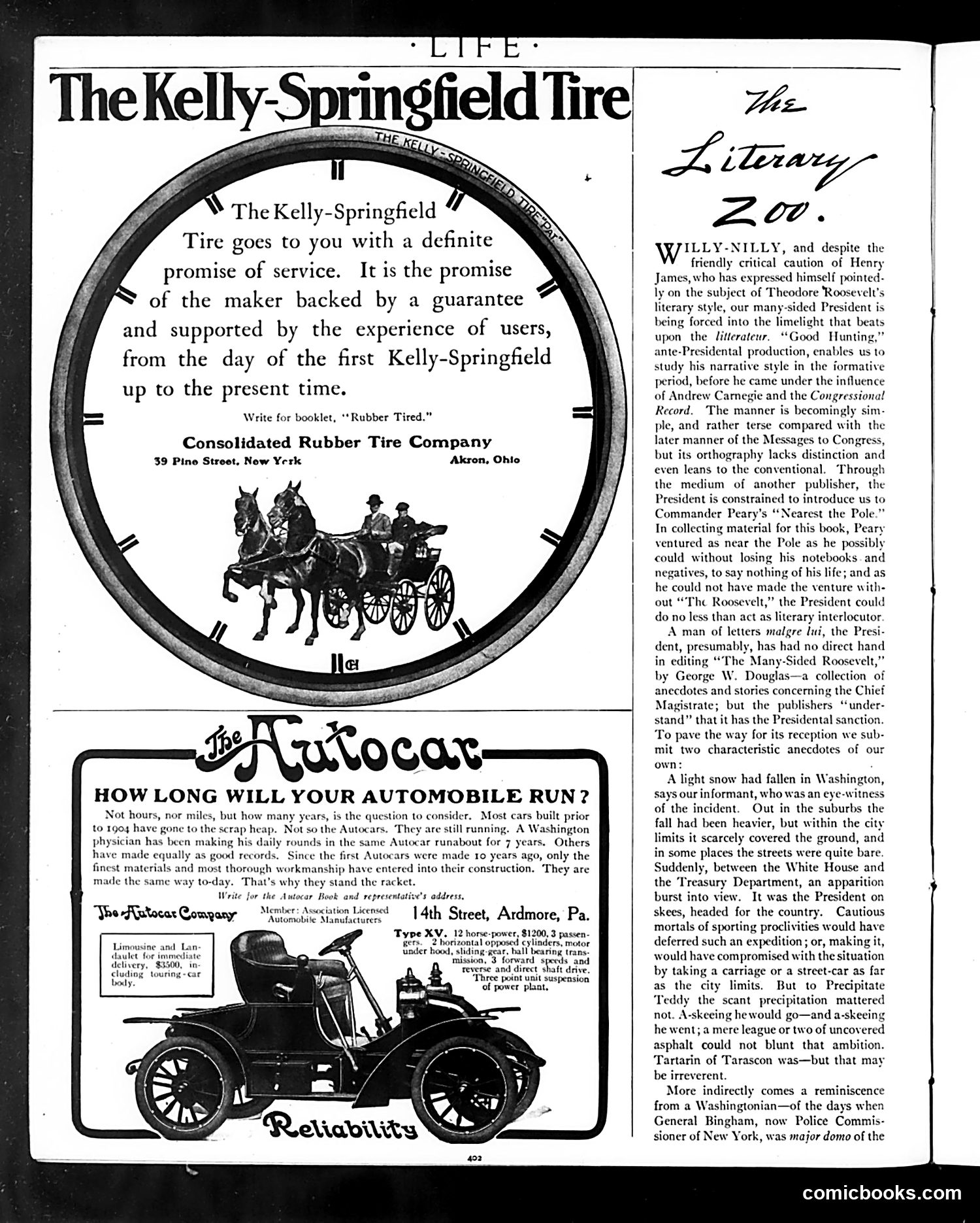
This page consists primarily of **advertisements rather than political satire**. The top half features a Kelly-Springfield Tire ad showing a horse-drawn wagon, emphasizing reliability and longevity—a company promise "backed by a guarantee and supported by the experience of users." Below is an Autocar automobile advertisement addressing "How Long Will Your Automobile Run?" It references a Washington physician who has driven an Autocar for seven years, promoting durability through "finest materials and most thorough workmanship." The right column contains "The Literary Zoo," a book review discussing Theodore Roosevelt's *Hunting Trip* and *The Many-Sided Roosevelt*, critiquing Roosevelt's narrative style and his role as literary editor. The page represents early 1900s advertising culture emphasizing reliability and endurance for emerging automobile technology.
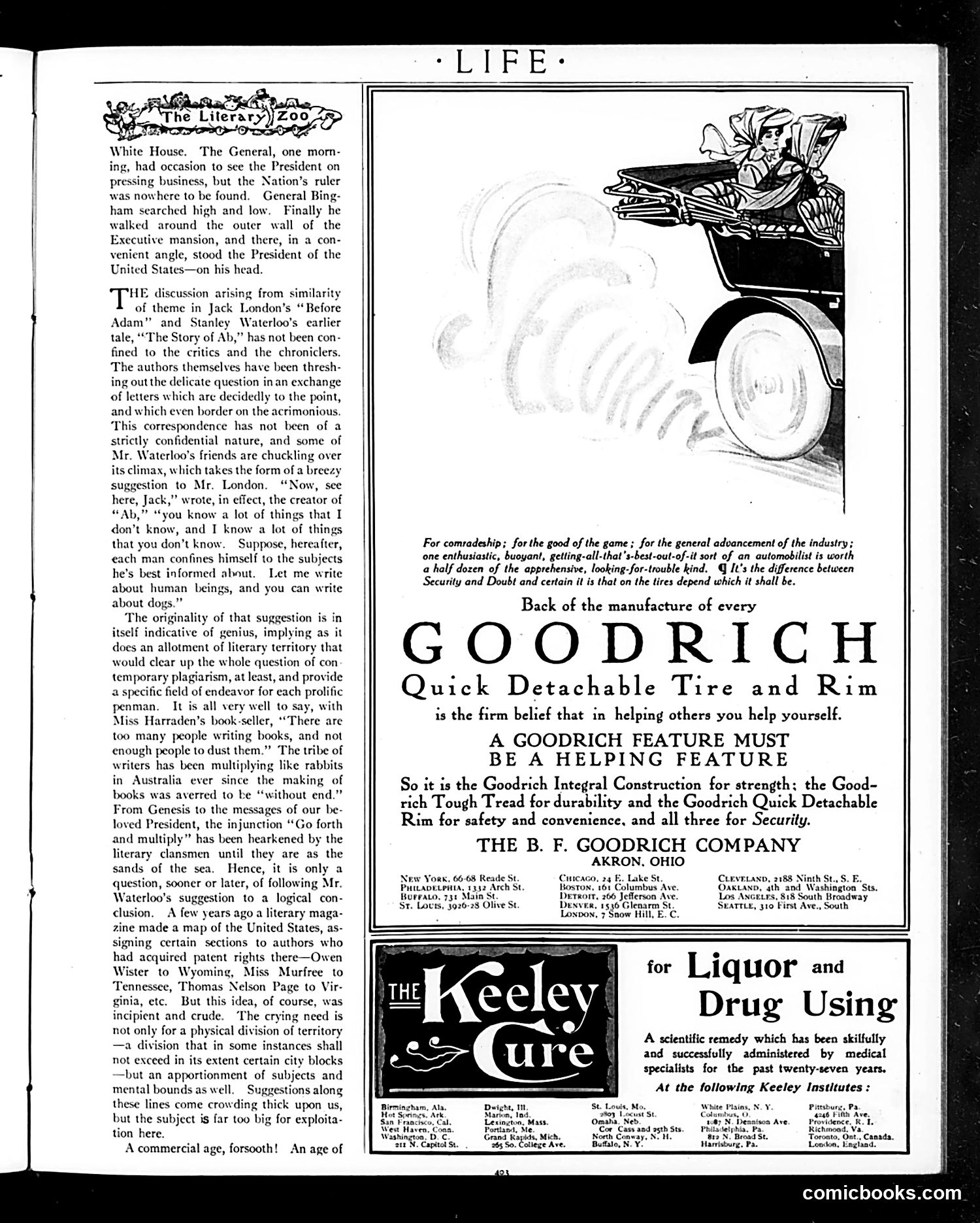
This page is primarily **advertising**, not editorial content or political satire. The top half features an article titled "The Literary Zoo," discussing literary controversies—specifically about Jack London's "Before Adam" and Stanley Waterloo's "The Story of Ab," and debates over authorship and plagiarism in literature. The illustrations are **product advertisements**: a Goodrich Quick Detachable Tire and Rim ad (featuring a car), and a Keeley Cure ad for "Liquor and Drug Using" (a treatment facility). There is **no political cartoon** on this page. The only illustration with narrative content—the car image—is simply promotional imagery for the tire product. This is a typical mixed editorial-and-advertising page from an early 20th-century American magazine.
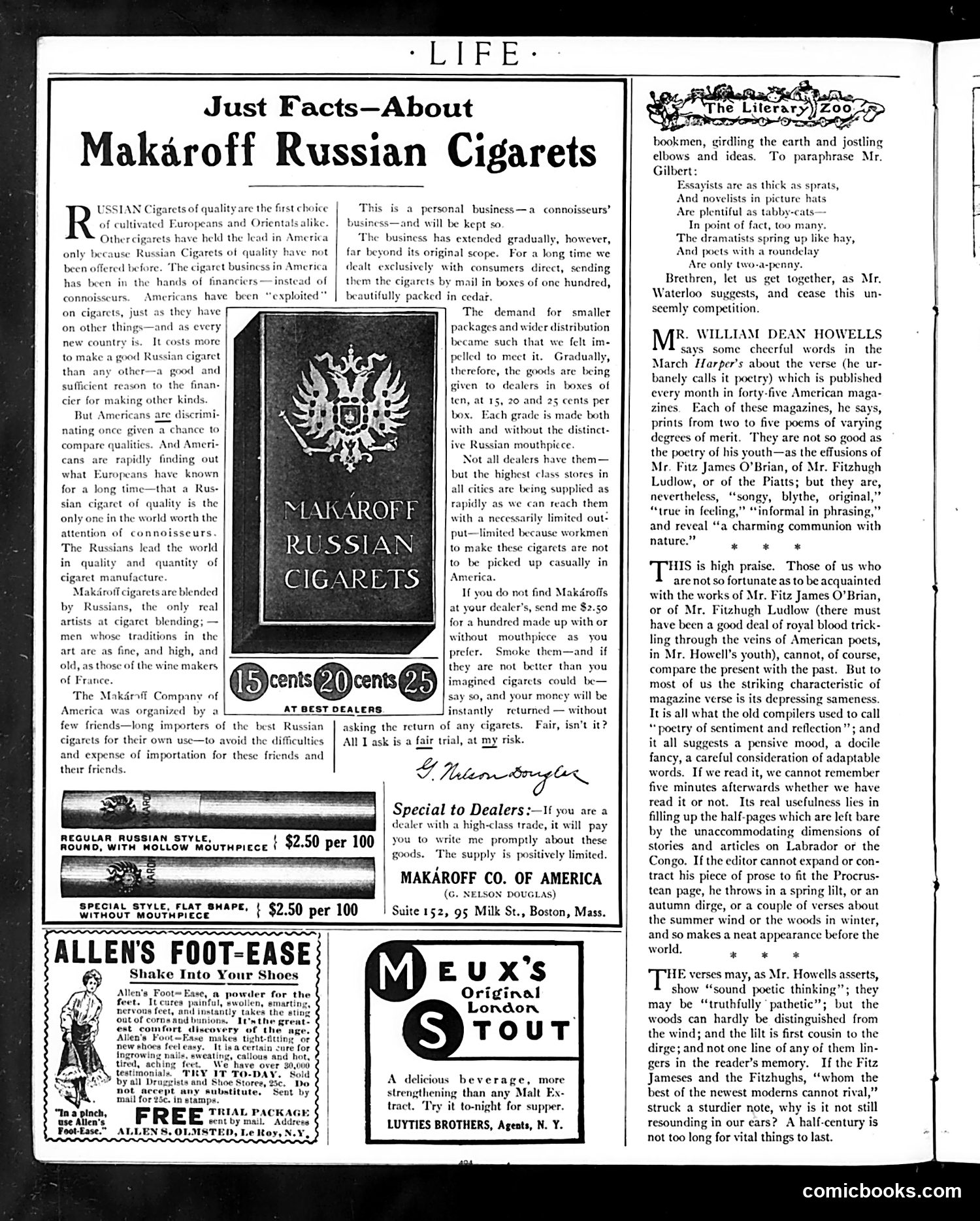
This page is primarily **advertising and literary commentary**, not political satire. The main content features ads for **Makaroff Russian Cigarettes** (emphasizing their quality and European appeal) and other products like Allen's Foot-Ease and Meux's Stout beer. The right column contains a literary piece about **William Dean Howells**, praising his poetry contributions to *Harper's* magazine. The writer compares Howells favorably to other contemporary poets (Fitz James O'Brien, Ludlow), arguing his verse has "sound poetic thinking" though perhaps lacking their romanticism. There's no political cartoon visible—this is a **commercial and cultural page** from what appears to be an early 20th-century *Life* magazine, mixing advertisements with literary criticism typical of the era's periodicals.
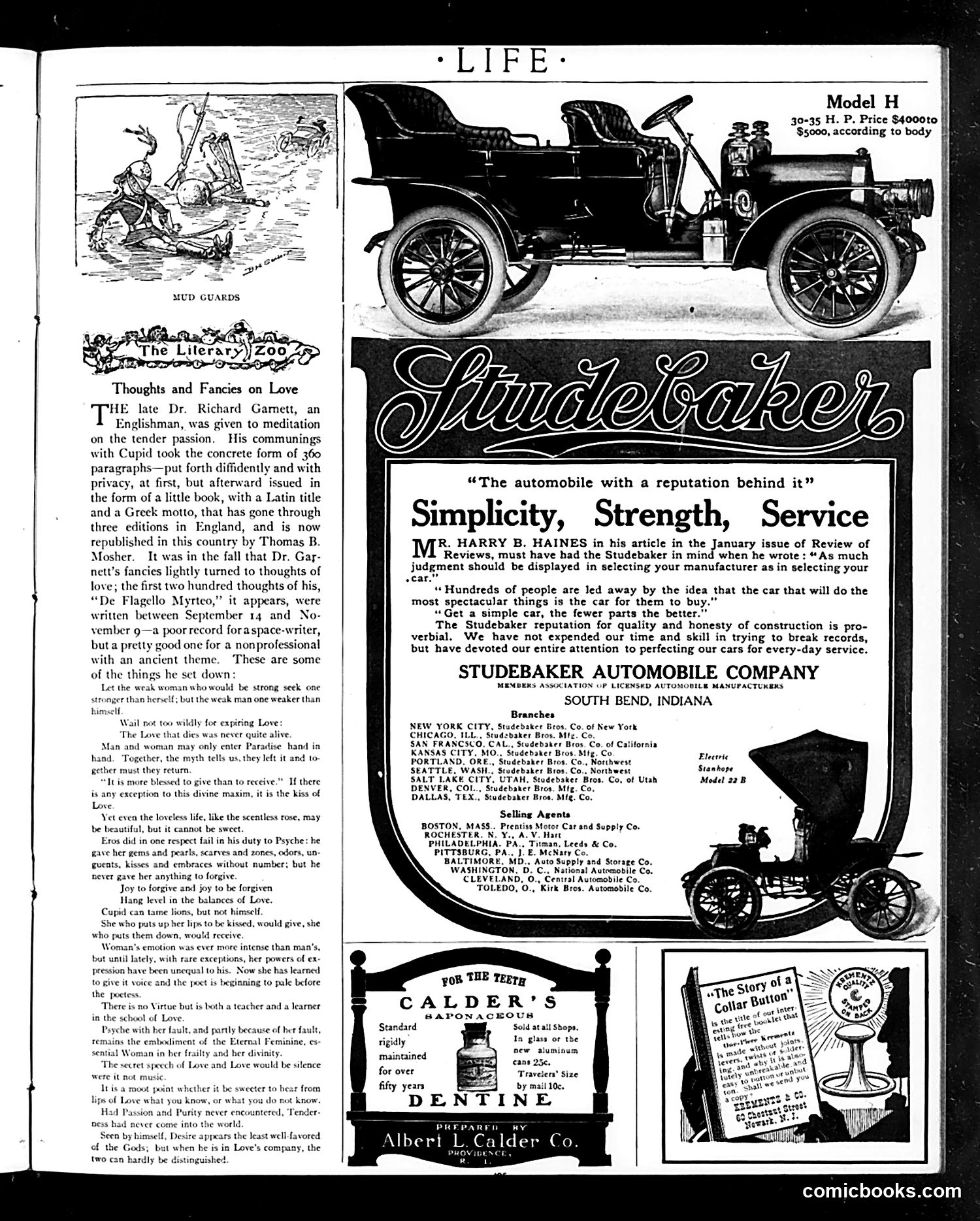
This page is primarily **advertising**, not political satire. The dominant content is a Studebaker automobile advertisement (Model H) emphasizing "Simplicity, Strength, Service." The ad quotes a Mr. Harry B. Haines from *Review of Reviews* magazine, advocating careful manufacturer selection based on reputation rather than flashy features. The left side contains "The Liberty Zoo" — a whimsical column titled "Mud Guards" with philosophical musings on love by an English writer. Below are additional advertisements for Calder's Dentine toothpaste and "The Story of a Cotton Button." There is **no significant political cartoon or satire** on this page. It represents early 20th-century *Life* magazine's mixed format of light editorial content and commercial advertising.
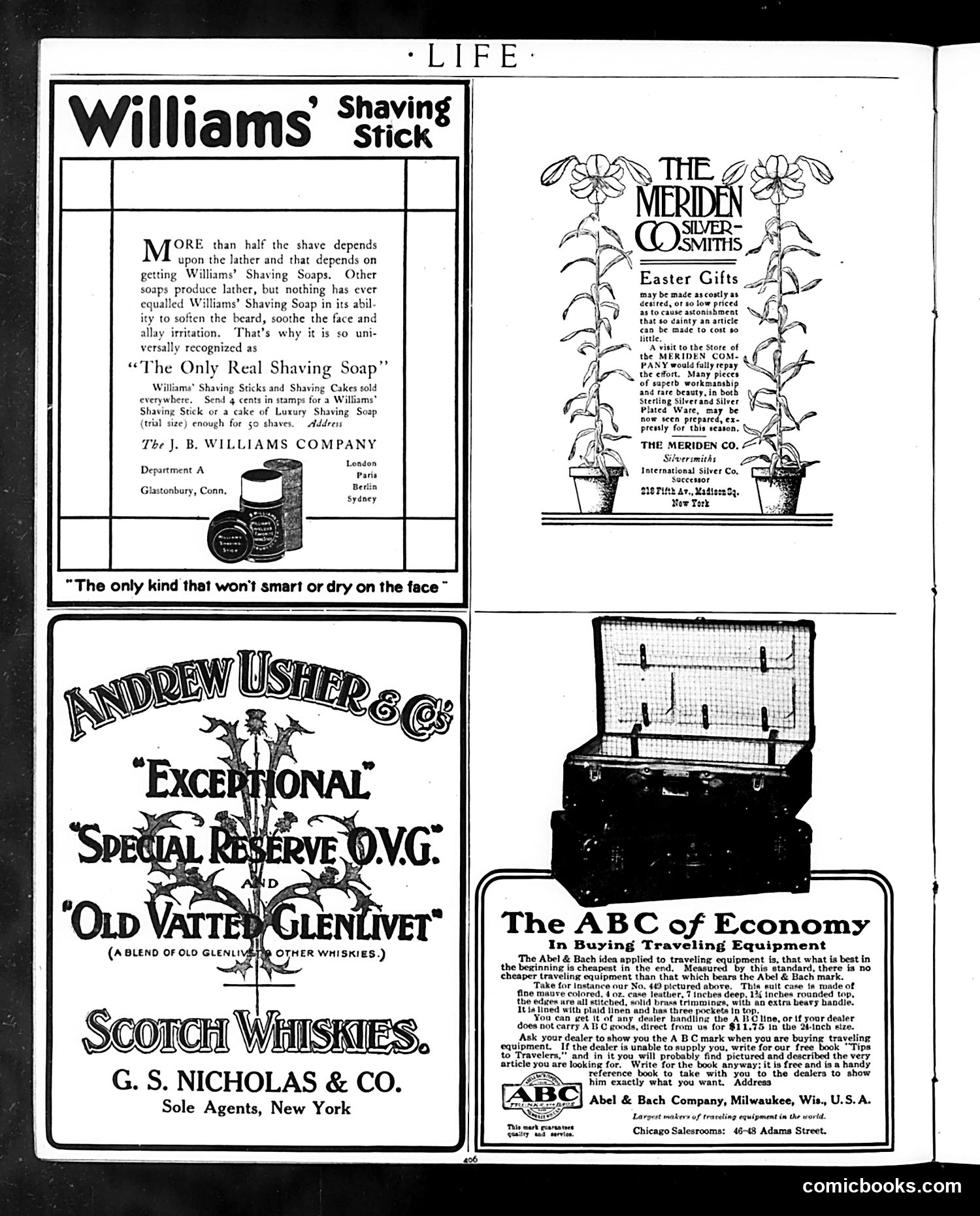
This page consists primarily of **period advertisements** rather than satirical content. The ads include: - **Williams' Shaving Stick** (top left): Claims to be "The Only Real Shaving Soap," emphasizing superior lathering properties - **Meriden Co. Silversmiths** (top right): Promotes Easter gift silverware - **Andrew Usher & Co.** (bottom left): Advertises Scotch whiskies sold by G.S. Nicholas & Co. in New York - **ABC of Economy** (bottom right): Promotes traveling trunks and luggage from Abel & Bach Company The advertisements reflect early 20th-century consumer goods and reflect what *Life* magazine's readership—likely middle and upper-class Americans—would purchase. No political satire or cartooning is evident on this page.
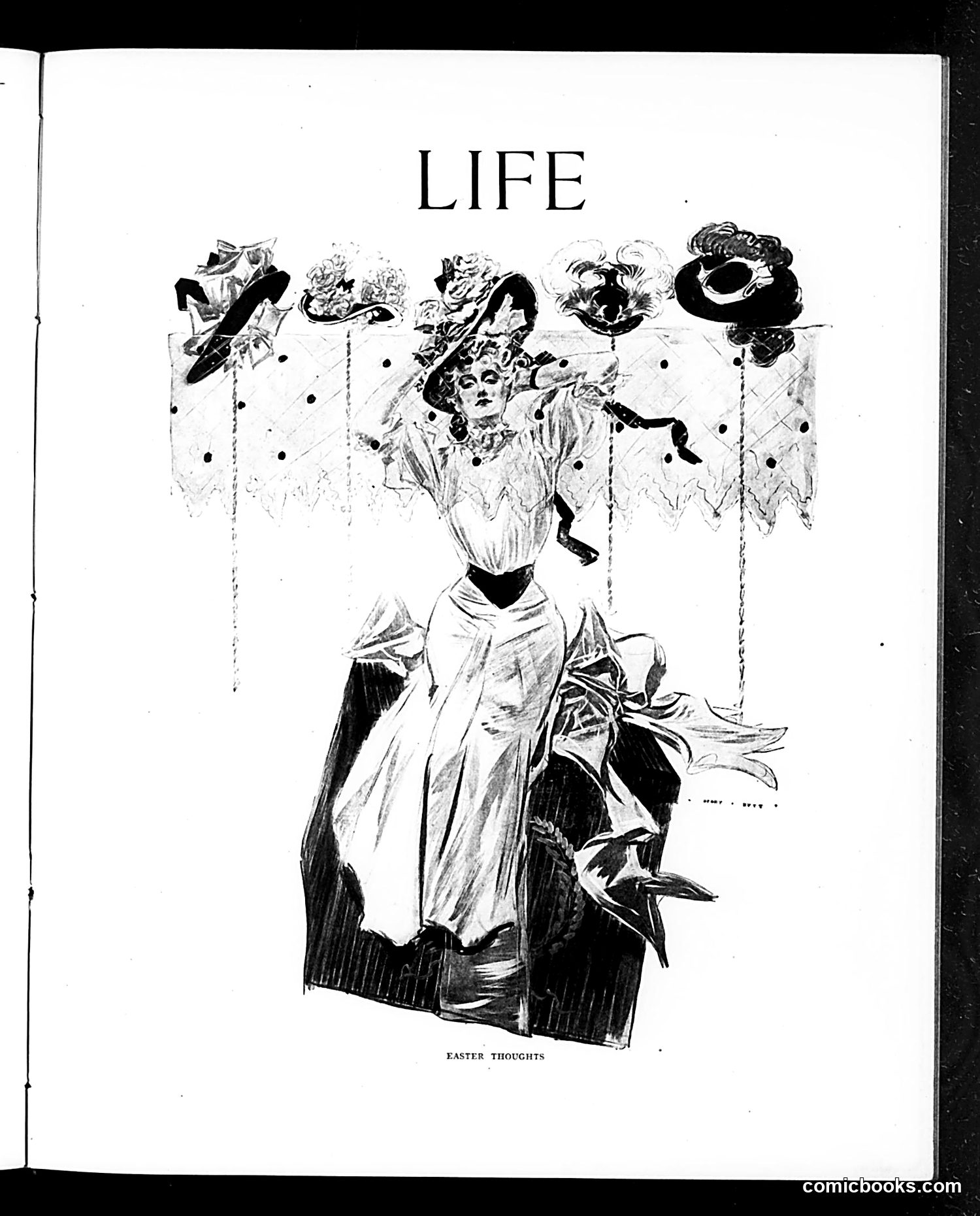
This is a title page for a section called "Easter Thoughts" in *Life* magazine. The illustration depicts a fashionable woman in Edwardian-era dress holding five elaborate Easter bonnets on long stems, like flowers in a bouquet. The bonnets are ornately decorated with feathers, ribbons, and other embellishments. The satire targets the extravagance of Easter fashion, particularly women's elaborate hats that were status symbols of the period. By presenting the bonnets as flowers being held by the woman, the artist mocks how women treated expensive hat purchases as natural springtime acquisitions—frivolous seasonal displays of wealth. This reflects early-20th-century social commentary on consumerism and gender.
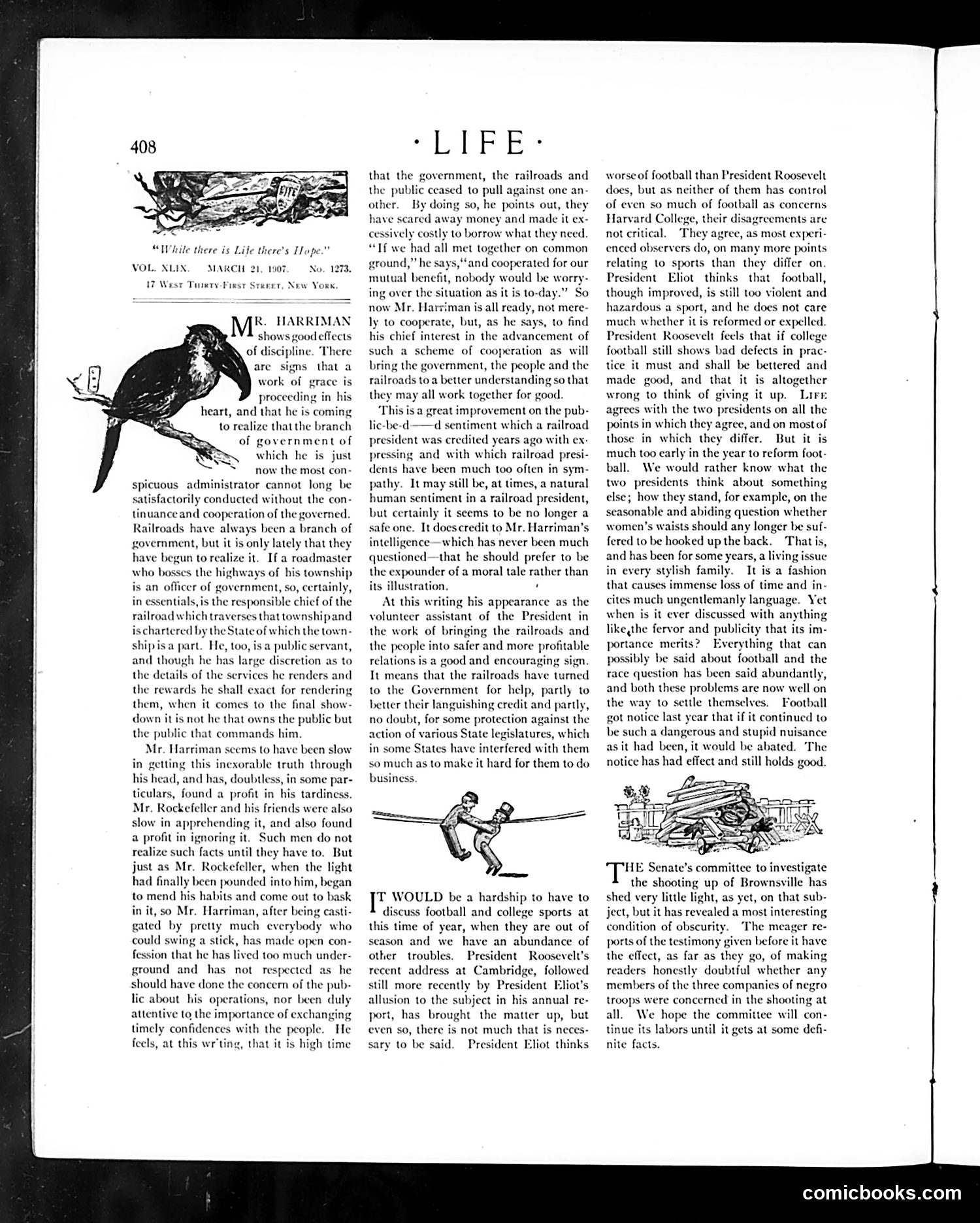
This page features editorial commentary on Mr. Harriman (likely E.H. Harriman, the prominent railroad magnate) and government relations. The text praises Harriman's willingness to cooperate with the government on railroad matters, arguing that such collaboration benefits the public interest. The page also critiques discussion of football and college sports, suggesting such debates distract from more serious issues. The author argues that while football has problems, debating its merits is less important than addressing substantive governance matters. The small cartoon illustrations appear to be decorative vignettes related to the text topics rather than standalone satirical pieces. The overall tone is earnest political commentary rather than sharp satire.
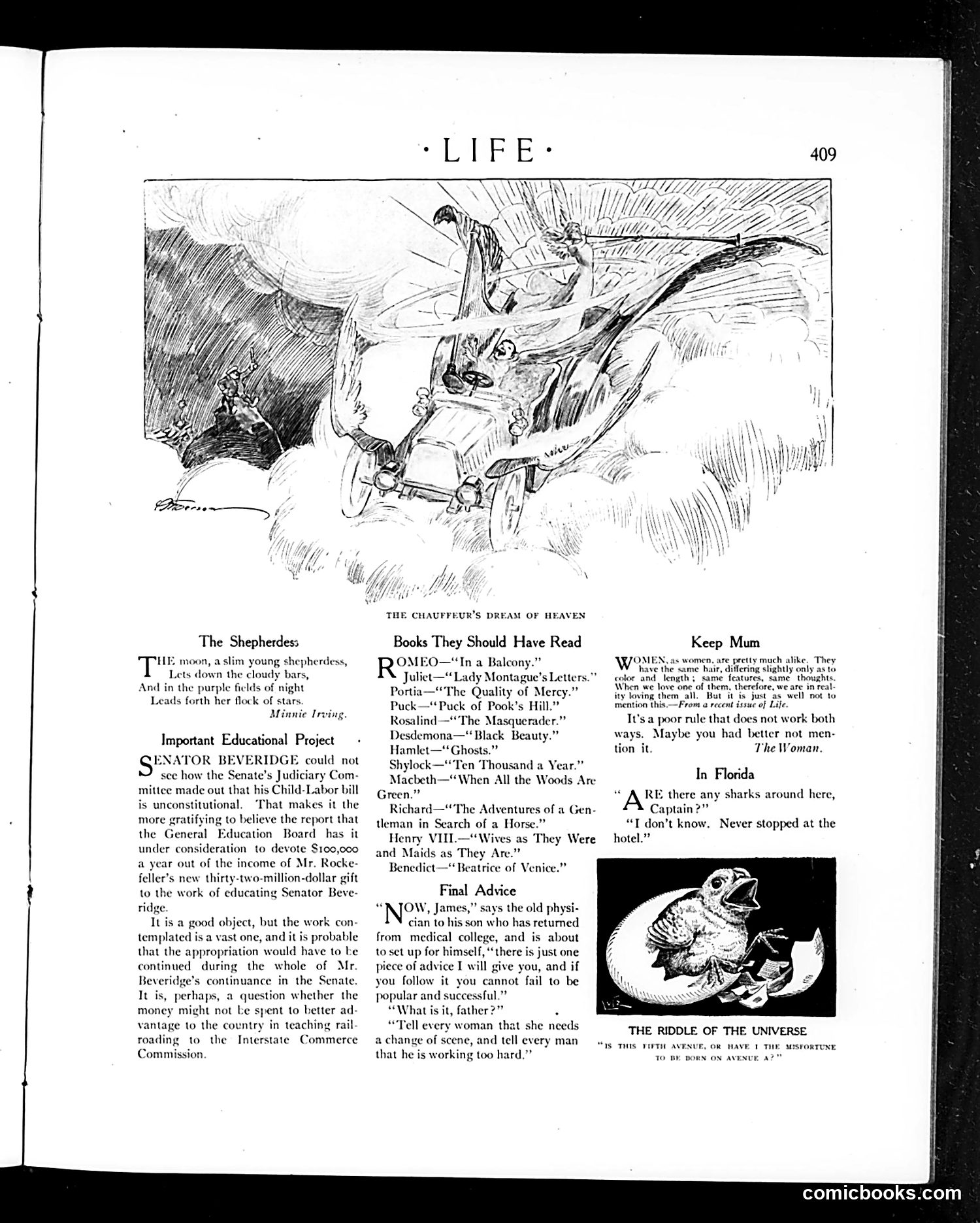
This page contains several satirical pieces rather than a single unified cartoon: 1. **"The Shepherdes"** - A poem by Herune Irving about societal leadership 2. **"Important Educational Project"** - Satirizes Senator Beveridge's proposed $250,000 annual educational initiative, questioning whether money would be better spent on railroad education via the Interstate Commerce Commission 3. **"Books They Should Have Read"** - Lists classic literature titles as humorous recommendations 4. **"Keep Mum"** - Brief commentary on women's conversation habits 5. **"In Florida"** - A dialogue joke about sharks 6. **"Final Advice"** - A physician's advice to his son about success with women and work The page also features "The Riddle of the Universe," a small illustration of a creature (possibly meant as absurdist humor). The content reflects early 20th-century American satirical magazine style, mixing social commentary, literary references, and domestic humor.
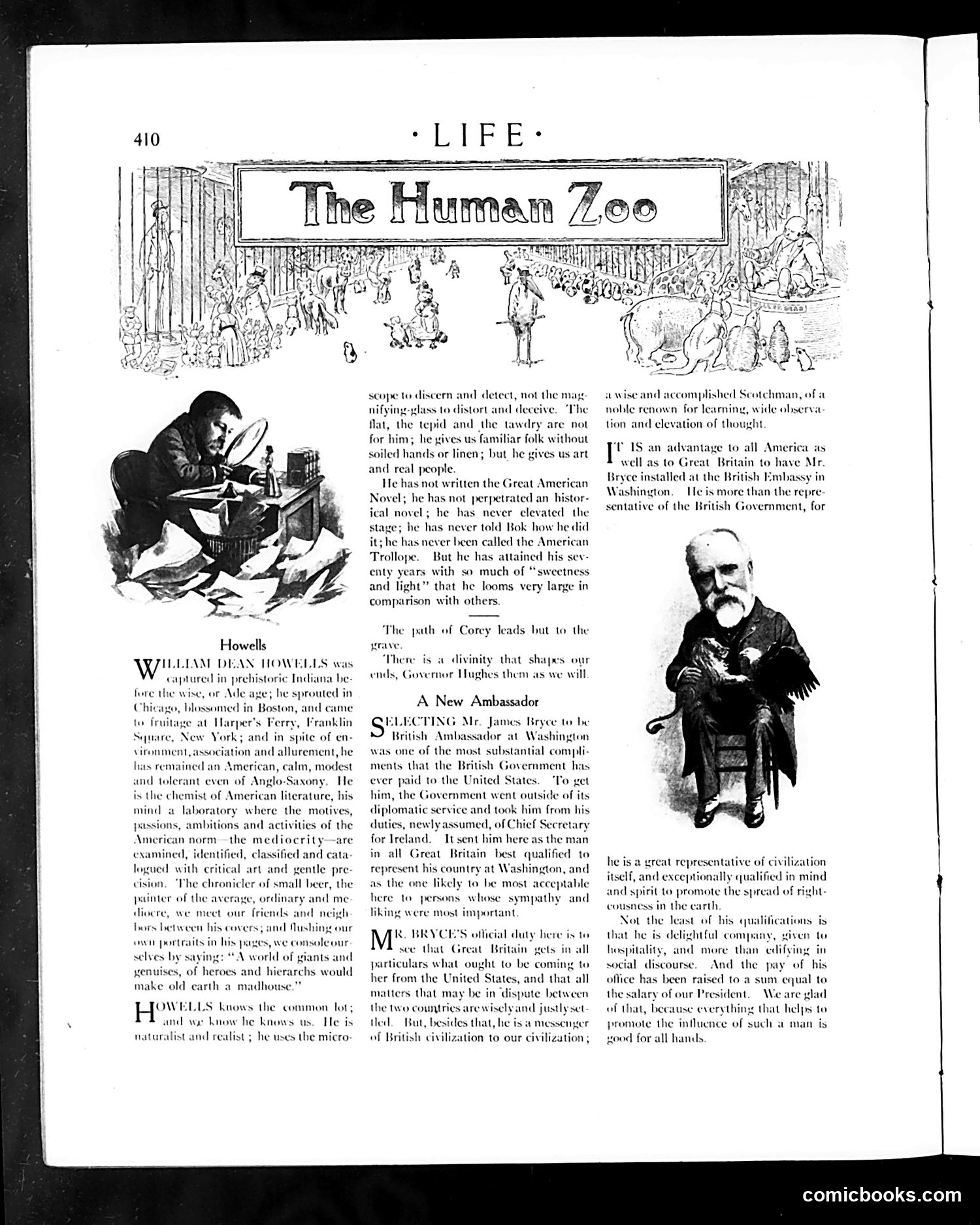
This page contains two profiles of prominent figures: **William Dean Howells** (left illustration): A celebrated American novelist and literary realist. The text praises him as a keen observer of ordinary American life—a "chemist" who examines average people and everyday situations without sentimentality. The satire gently mocks his refusal of grandiose subjects: he hasn't written the "Great American Novel," hasn't been called the "American Trollope," yet remains hugely influential through his modest, careful work. **James Bryce** (right portrait): Newly appointed British Ambassador to Washington. The text celebrates this as a major compliment to America—the British government elevated him from Chief Secretary for Ireland specifically for this post. He's praised as both a skilled diplomat and a cultured representative of "British civilization," worthy of a presidential-level salary. The page's satirical title, "The Human Zoo," suggests these are specimens of civilized accomplishment worth observing.
This page features letters from prominent American figures responding to *Life* magazine's inquiry about their favorite recent books. The content reveals early 20th-century literary tastes among the elite. **Key Respondents:** - **David Starr Jordan** (Stanford president): endorses Andrew D. White's autobiography - **Oscar Fay Adams** (Boston): praises "Suffolk Tales" by Lady Camilla Gurdon for its sympathetic portrayal of rural working-class life - **Grover Cleveland** (former president): declines to recommend a specific book, claiming insufficient reading time - An unnamed Princeton figure discusses Dante's *Paradiso* and Jack London's "White Fang" **The Point:** This is essentially a prestige feature showcasing what educated, influential Americans were reading—functioning as a cultural authority marker. The selections reflect period values: autobiographies, literary fiction with social sympathy, and classical literature. The page documents early-1900s intellectual life rather than satirizing it.
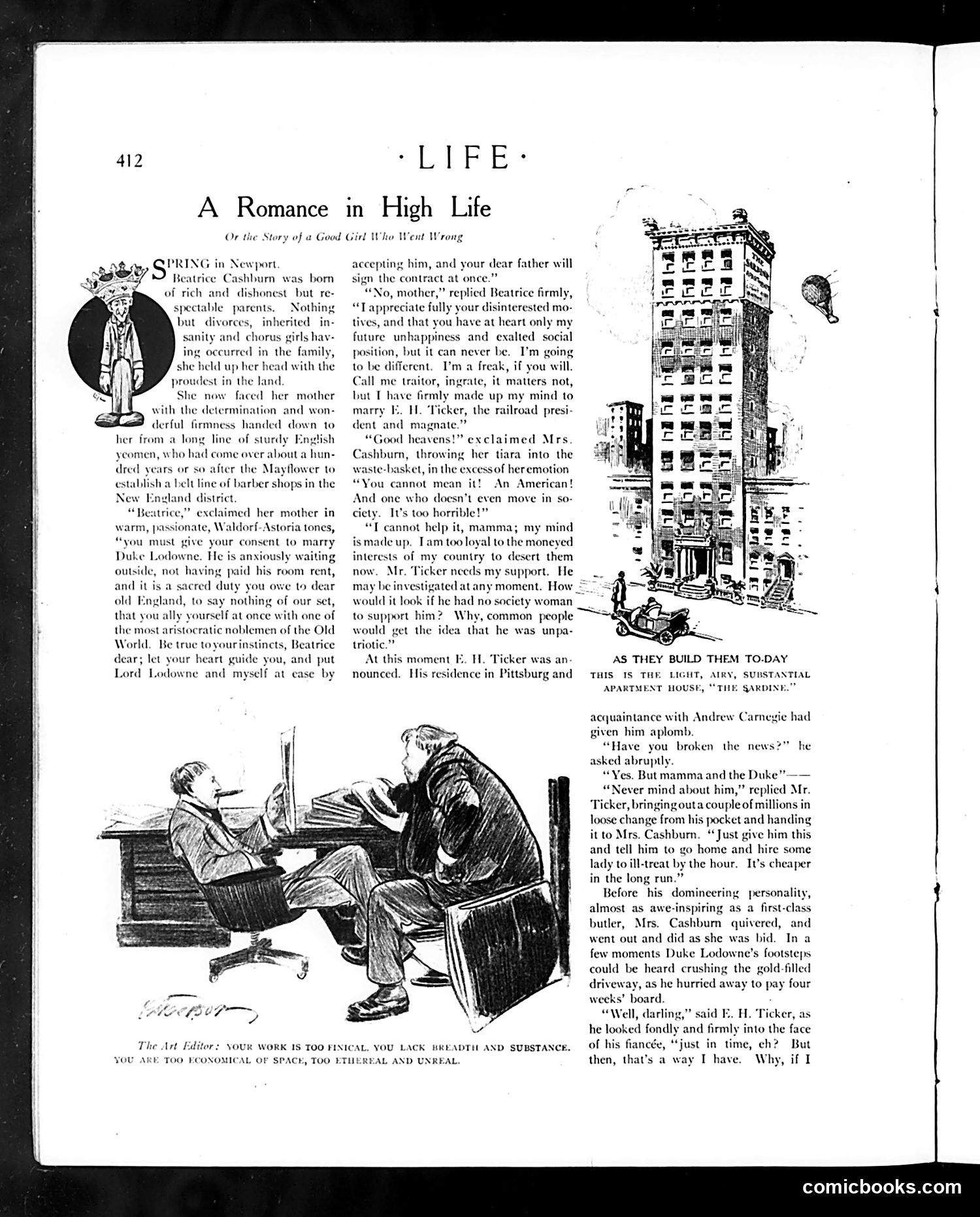
This story satirizes the American obsession with aristocratic titles and old money. Beatrice Cashburn, born into a "respectable" but morally dubious family (barber-shop lineage masquerading as aristocracy), is pressured by her mother to marry a broke European duke to elevate social status. Beatrice rebels by choosing E.H. Ticker, a wealthy railroad president—representing new American industrial money. The satire cuts both ways: the mother's worship of European nobility despite the duke's financial desperation, and Ticker's casual display of millions in loose change, treating the duke's departure as a minor transaction. The accompanying editor cartoon mocks journalistic pretension: an editor criticizing a writer's work as "too finical" and "economical of space"—ironic given Life's own satirical refinement. The humor targets both old-money snobbery and new-money vulgarity as equally ridiculous.
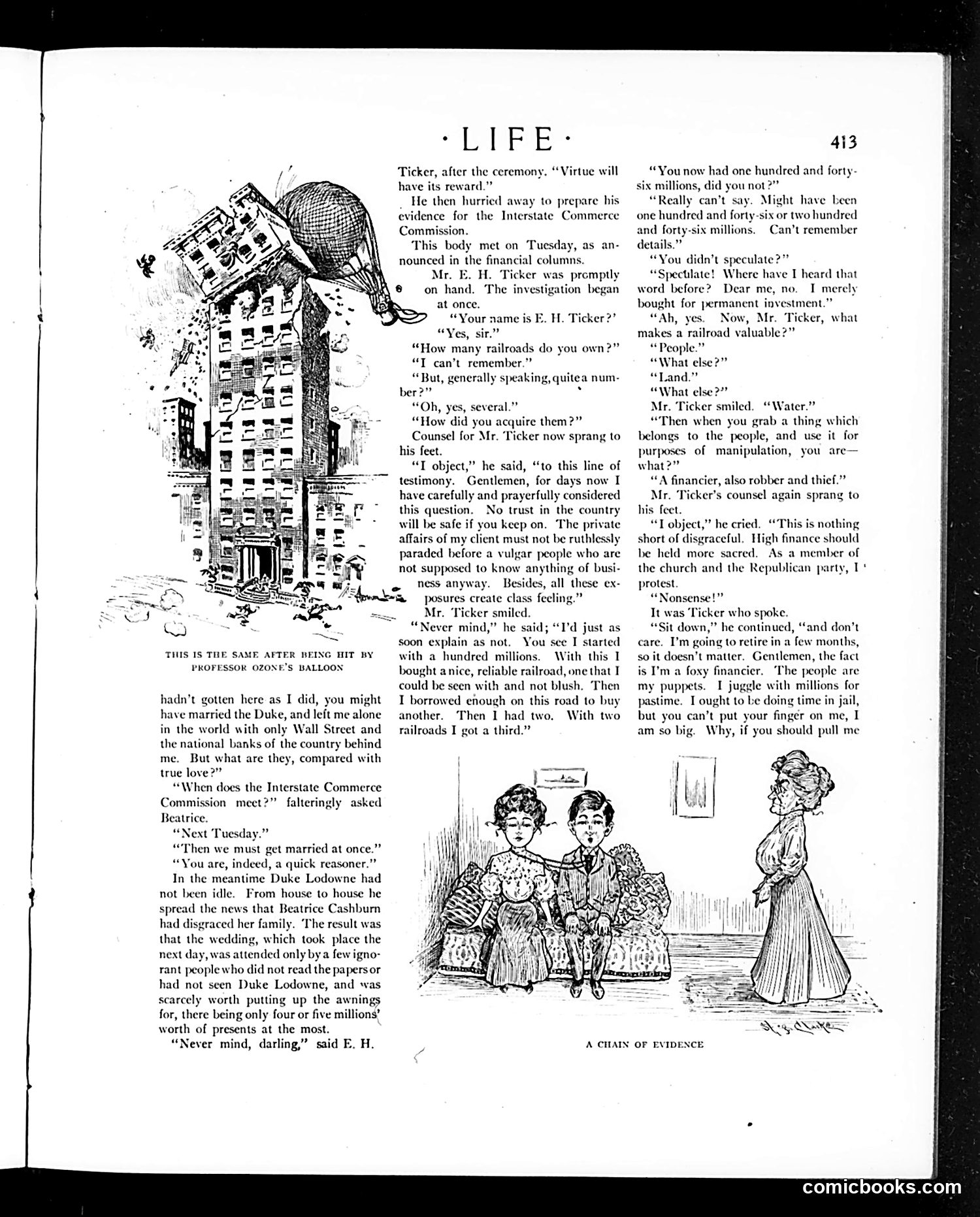
This page satirizes the corrupt practices of Gilded Age railroad magnates and the toothlessness of regulatory bodies like the Interstate Commerce Commission. **The Main Figure:** E. H. Ticker, a wealthy railroad baron who openly admits—under oath—to financial manipulation. He describes acquiring railroads through circular borrowing schemes: buying one railroad, borrowing against it to buy another, repeating the process to accumulate hundreds of millions. **The Satire's Point:** Ticker's counsel protests that exposing such practices creates "class feeling" and threatens "high finance," suggesting the wealthy expect legal protection. Ticker himself boasts he's "too big" to prosecute, despite admitting to being "a foxy financier" who treats the public as "puppets" for his schemes. **The Joke:** The Interstate Commerce Commission hearing supposedly designed to regulate railroad monopolies accomplishes nothing—the financier freely confesses corruption while authorities remain powerless. The left illustration shows a building being crushed, captioned "hit by Professor Ozone's Balloon"—likely referencing contemporary anxieties about financial bubbles.
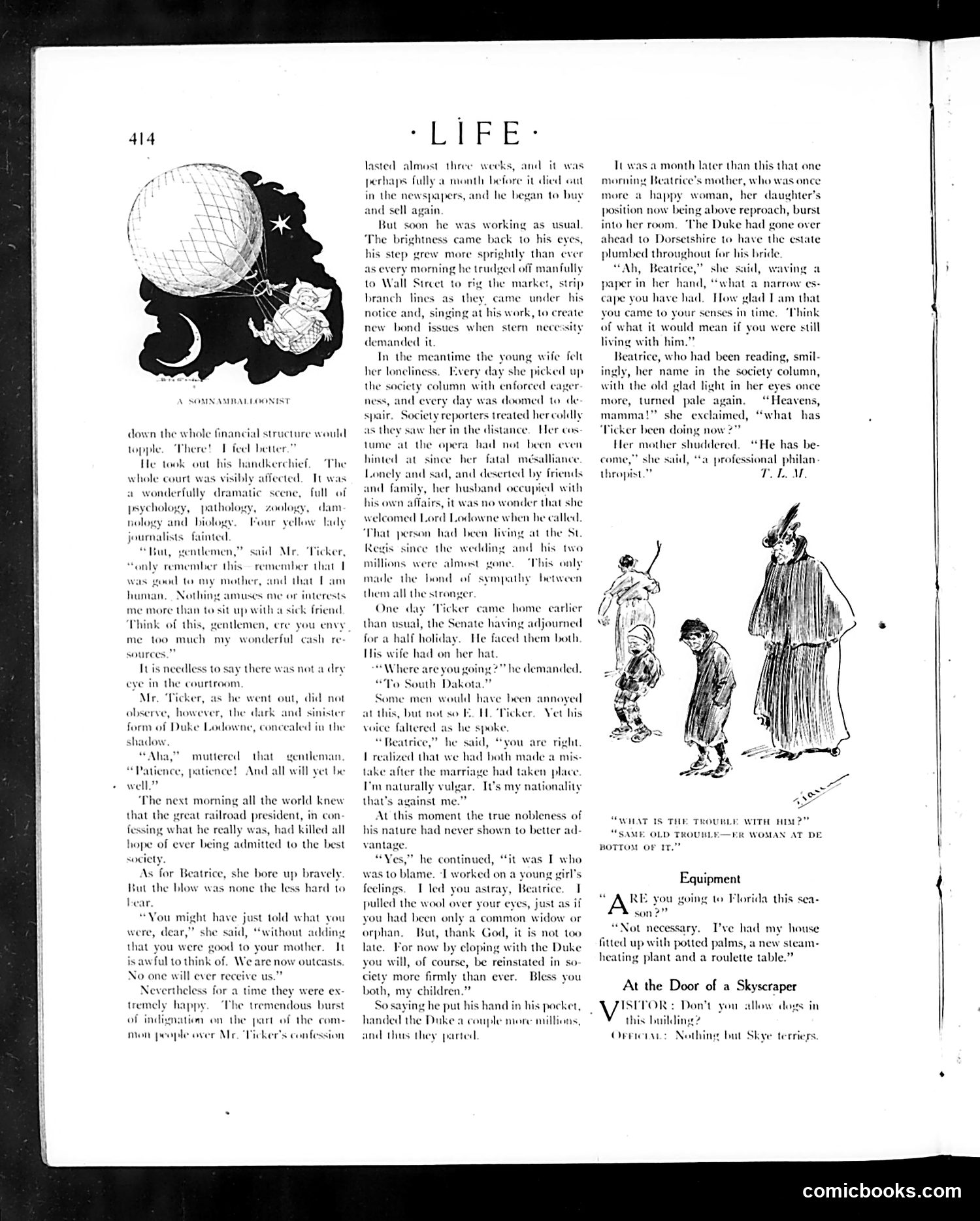
This page contains a serialized satirical story mocking wealthy financiers and high society's shallow values. The protagonist is Mr. Ticker, a railroad magnate who publicly confesses his humble origins and working-class mother in court. This admission—shocking to the elite—destroys his social standing, though his wife Beatrice initially accepts him. However, when Ticker's fortune recovers through unethical market manipulation ("rig the market, strip branch lines"), his wife grows lonely after being shunned by society. A titled but broke nobleman, Lord Lodowne, courts her. In absurd fashion, Ticker **supports her elopement**, reasoning that marrying a duke will restore her social status more effectively than remaining with him. The satire targets: ruthless capitalists' moral emptiness, society's obsession with titles over character, and the desperation of the ultra-wealthy to climb social hierarchies. The cartoon's title "A Somnambuloonist" (sleepwalker/buffoon) reflects Ticker's blind pursuit of wealth while sleepwalking through morality.
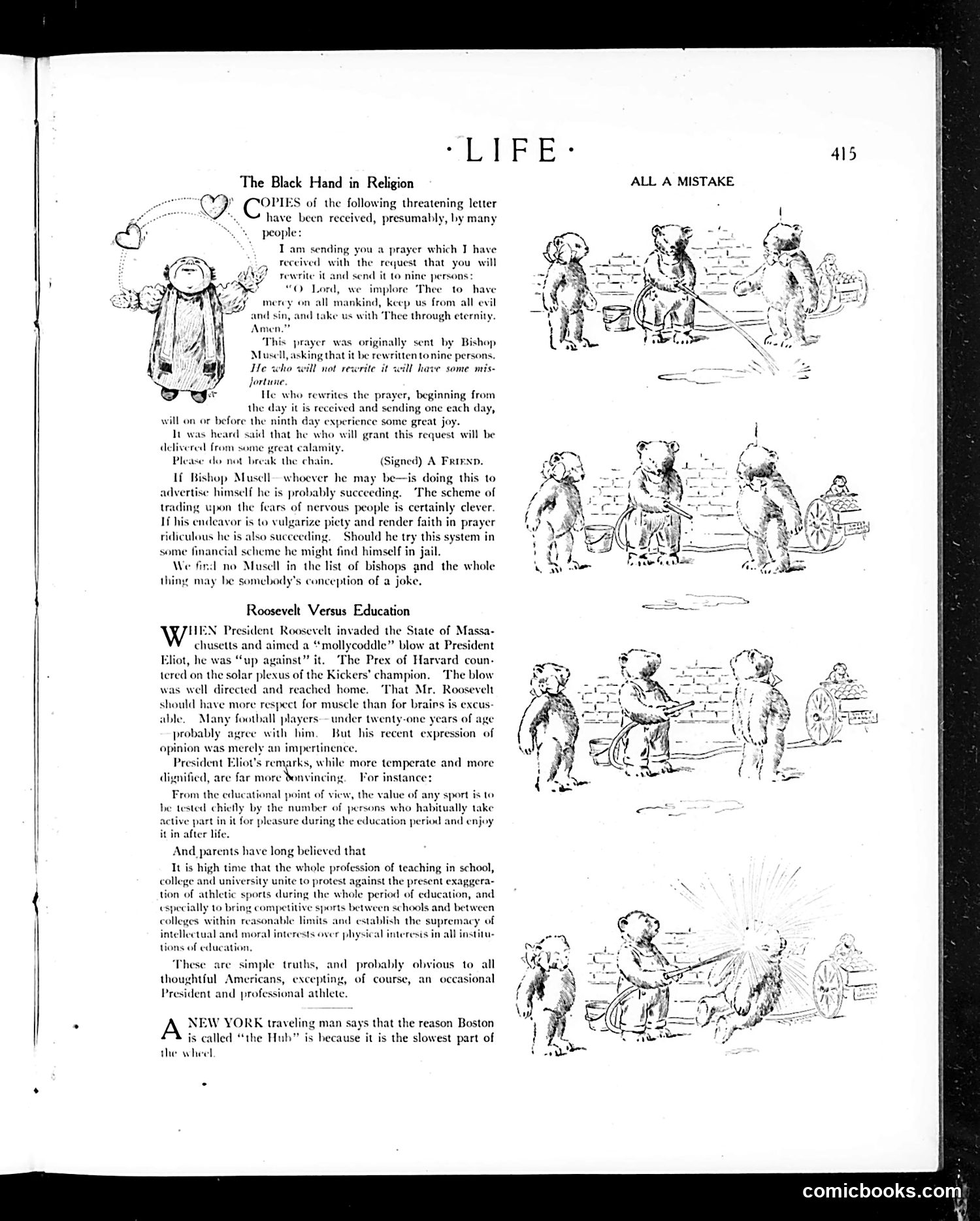
This page satirizes two distinct targets: **"The Black Hand in Religion"** mocks chain-letter prayer schemes circulating under the name "Bishop Musell." The satire ridicules how such letters exploit people's religious fears and superstitions—promising misfortune to those who don't copy and distribute the prayer. Life notes no such bishop exists, suggesting this is either fraud or a hoax, and warns that whoever perpetrates this scheme trades cynically on nervous believers' anxieties. **"Roosevelt Versus Education"** critiques President Theodore Roosevelt's recent attack on Harvard President Charles Eliot as a "mollycoddle" (weakling) for valuing intellectual education over athletics. Life defends Eliot's position that sports should serve education, not dominate it. The piece argues Roosevelt—despite his reputation—shows more respect for "muscle than brains," while Eliot's measured argument about limiting competitive sports and prioritizing intellectual development is far more convincing and sensible. The accompanying illustrations show children at play, contrasting innocent recreation with organized athletic excess.
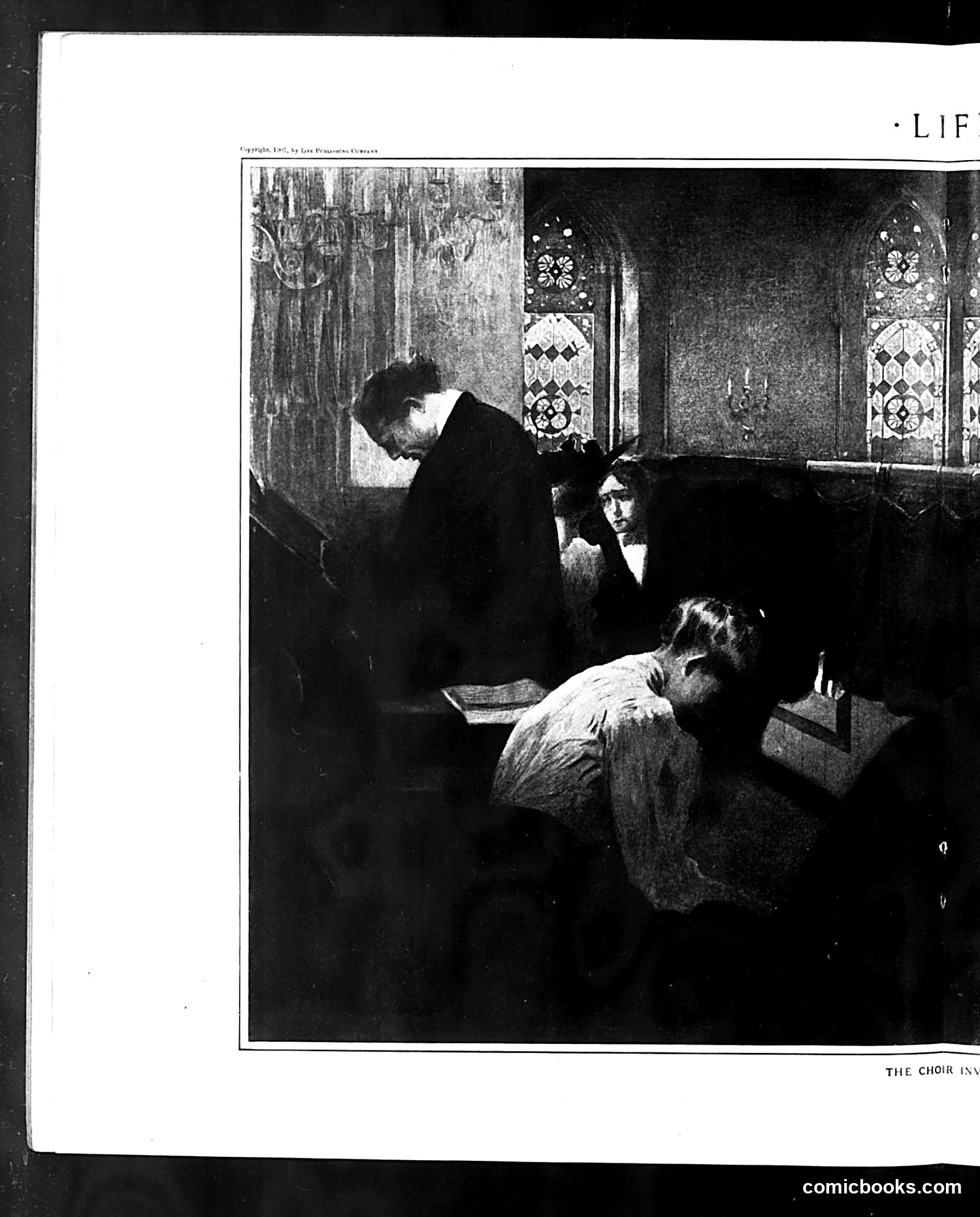
This page shows a black and white photograph rather than a political cartoon. The image depicts what appears to be a church or cathedral interior, with decorative Gothic windows visible in the background. Three figures in dark clothing are shown—one standing and leaning over, apparently instructing or observing two seated figures. The caption reads "THE CHOIR IN..." (text is cut off), suggesting this is documenting a choir practice or religious musical instruction scene. Without the complete caption or surrounding context from the Life magazine page, I cannot definitively identify the specific individuals, the satirical target, or the intended joke. The photograph appears to be satirizing some aspect of religious or musical practice, but the exact point of the satire remains unclear from the visible portion alone.
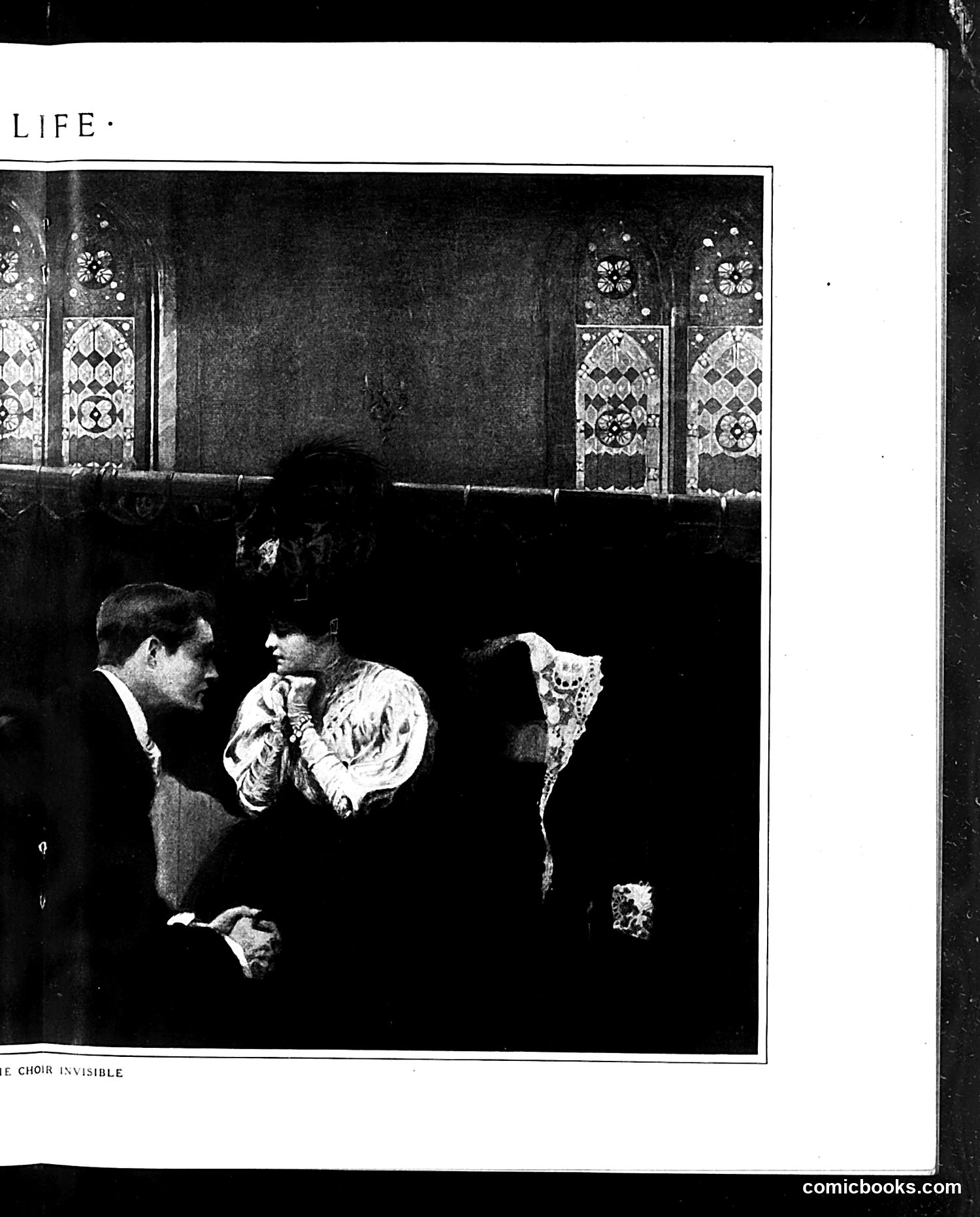
This appears to be a satirical illustration from *Life* magazine showing three figures in formal attire in what seems to be a theater or concert hall setting, with ornate doors visible in the background. The caption "The Choir Invisible" suggests a play on words—likely referencing something that should be heard but isn't present or audible. Without additional context about the specific historical period or clearer identification of the figures depicted, the exact political or social targets remain unclear. The satire appears to mock some form of absent or silent authority, possibly commenting on political figures or institutions that fail to speak up or act when expected. The formal setting and theatrical backdrop suggest commentary on public performance or political theater.
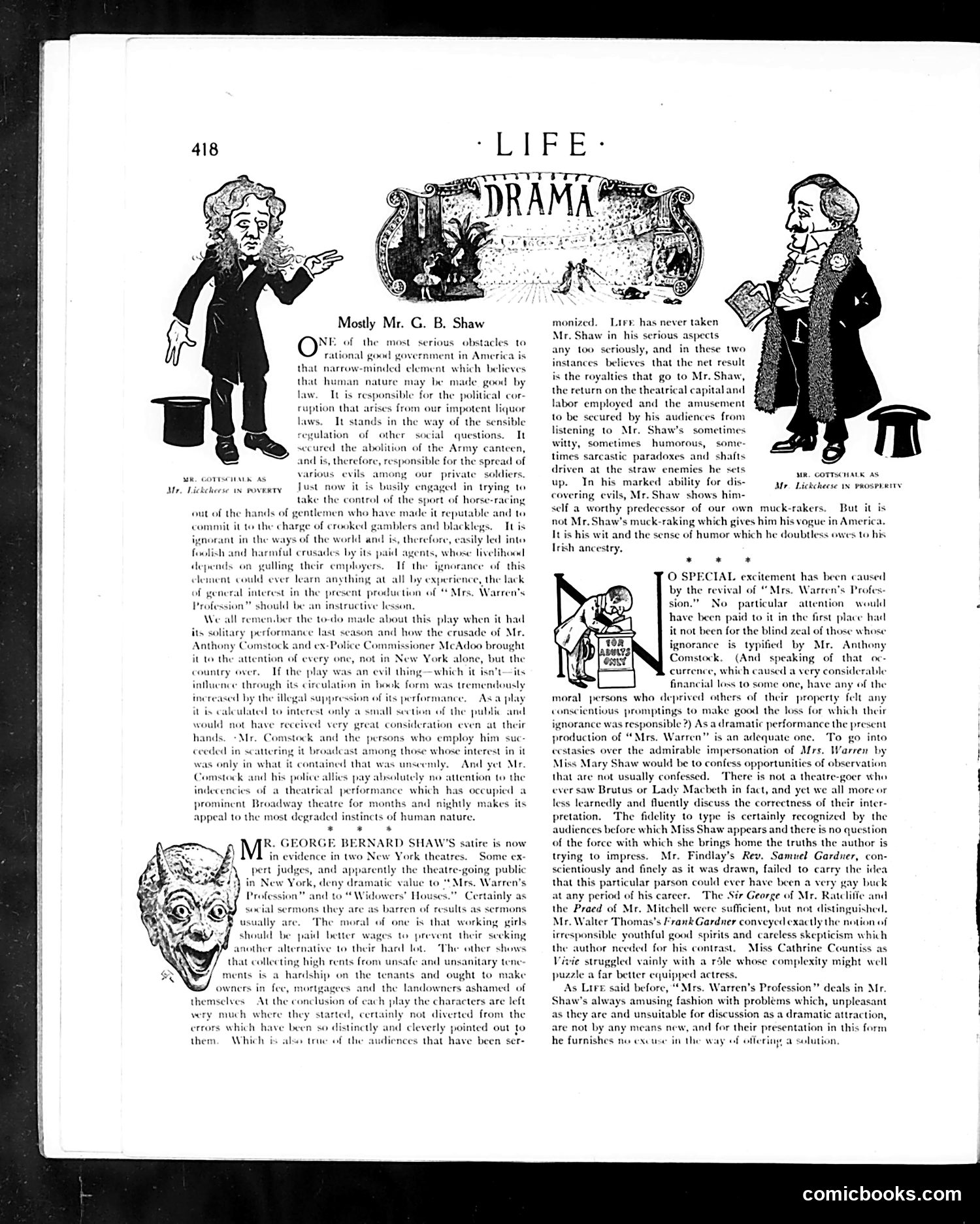
This page critiques **George Bernard Shaw's** plays—specifically *Mrs. Warren's Profession* and *Widowers' Houses*—which were recently performed in New York theaters. The cartoons flank the text: on the left, a caricatured figure (Shaw) gestures dramatically; on the right, another figure sits primly. **The satire's point:** Life mocks the self-righteous crusaders (particularly **Anthony Comstock**, a famous anti-vice activist, and ex-Police Commissioner **McAdoo**) who suppressed Shaw's plays as immoral. The magazine argues these moralists are hypocritical: they ban Shaw's work for its content while ignoring actual moral failures—like allowing degraded theatrical performances nightly on Broadway, or tolerating corrupt housing practices and low wages for working girls. The piece contends Shaw's serious social critiques, while well-intentioned, achieve nothing except enriching Shaw. It suggests the real problem isn't Shaw's plays but society's structural evils and the self-appointed guardians of morality who tackle symptoms rather than root causes.
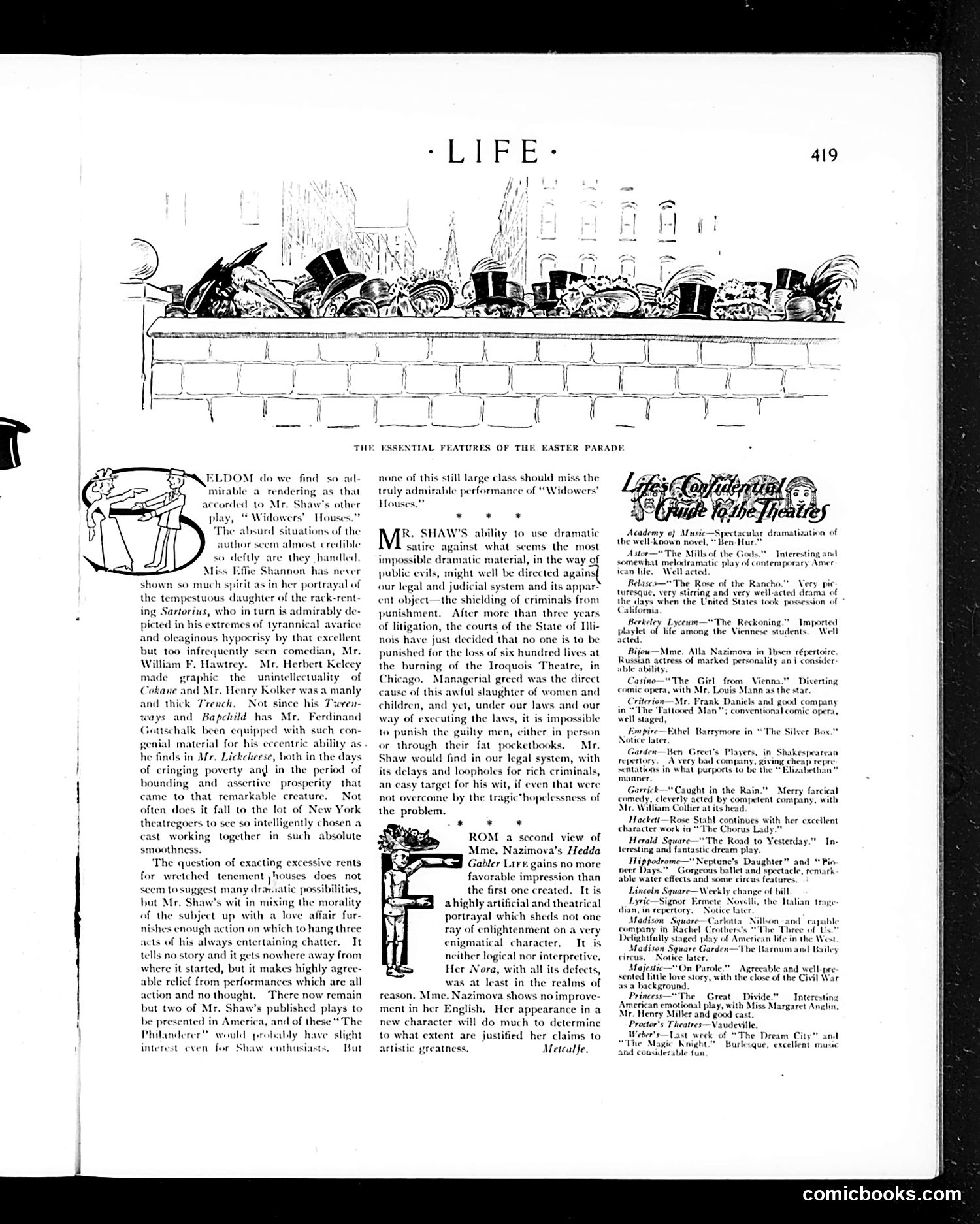
The main cartoon at the top depicts **"The Essential Features of the Easter Parade"**—a satirical illustration showing wealthy New Yorkers in top hats and finery parading atop a brick wall, apparently oblivious to or separated from urban life below. This mocks the ostentatious display of wealth and fashion during Easter parade season, a real Manhattan social event where the wealthy showcased expensive clothing. The text below critiques **George Bernard Shaw's play "Widowers' Houses,"** praising its social satire about slum housing and managerial greed. The reviewer notes Shaw could similarly attack America's judicial system, specifically citing the **Iroquois Theatre fire in Chicago**—a real 1903 disaster killing over 600 people where, despite obvious criminal negligence, no one was punished due to legal loopholes protecting the wealthy. The page also reviews actress **Mme. Nazimova's performance** in Ibsen's "Hedda Gabler," finding her theatrical interpretation artificial and lacking insight.
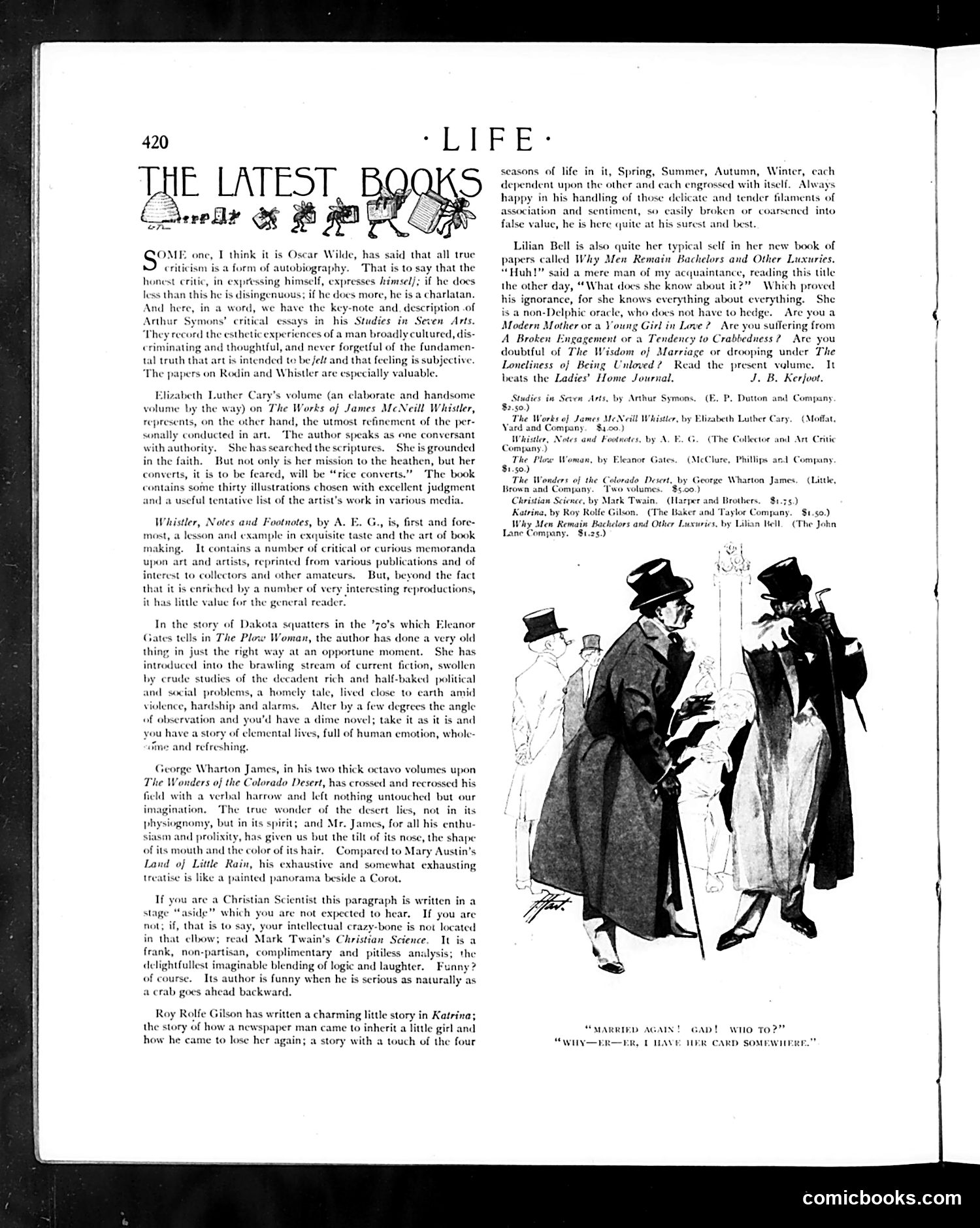
This page reviews recent books rather than containing political cartoons. The single illustration shows three well-dressed men in top hats examining what appears to be a card or document, with the caption: "Married again! Gad! Who to?" / "Why—er—I, I have her card somewhere." The joke depicts the confusion of a man encountering an ex-wife (or former romantic acquaintance) remarried to someone else—a social awkwardness played for humor. The "card" reference reflects Edwardian-era etiquette where calling cards were essential social currency. The surrounding text reviews books by Arthur Symons, Elizabeth Luther Cary, Eleanor Gates, George Wharton James, Mark Twain, and Roy Rolfe Gilson. The critic discusses aesthetic merit and literary merit with references to James McNeill Whistler and Mary Austin, reflecting *Life* magazine's role as a venue for literary criticism alongside satire and humor.
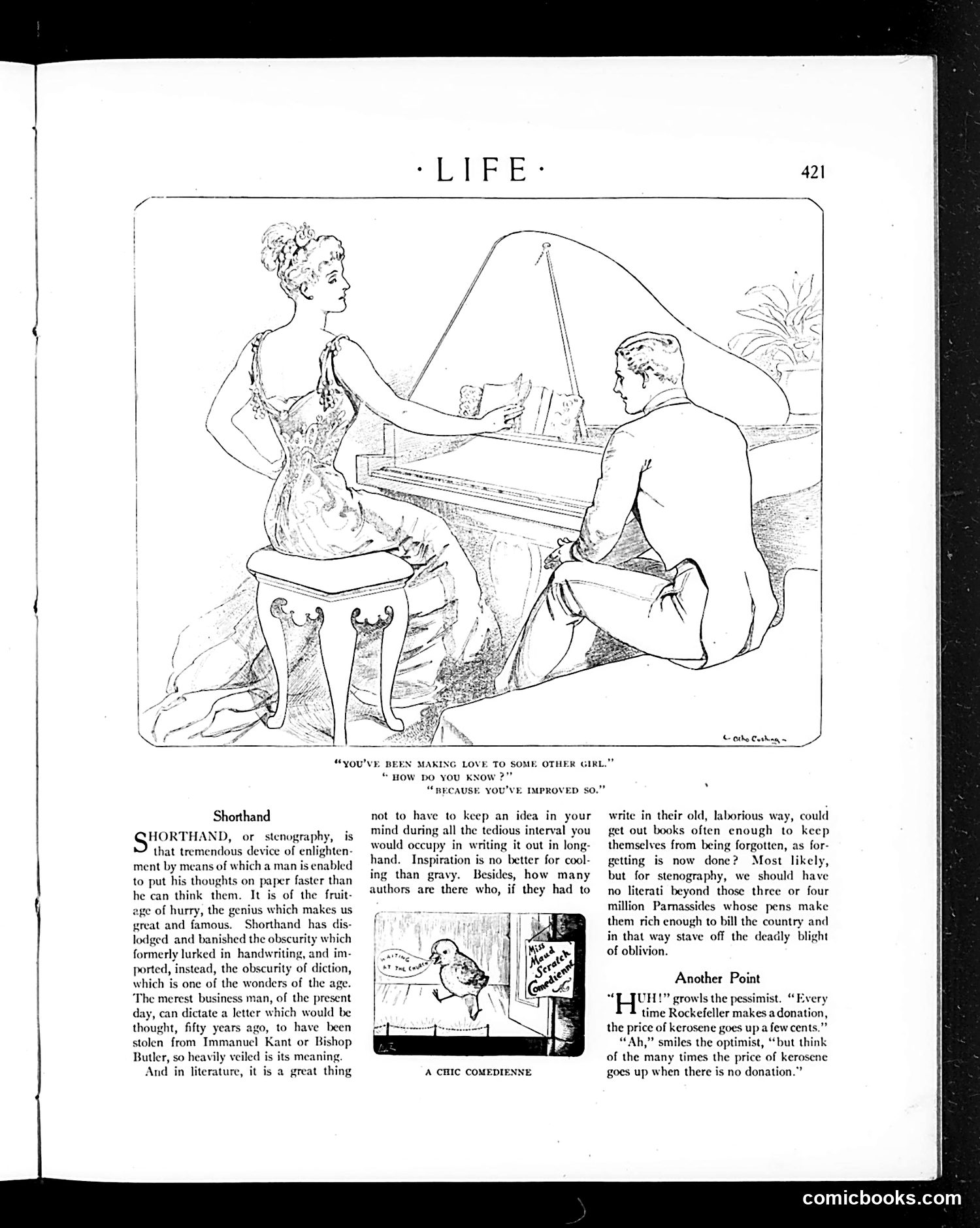
This page contains satirical commentary on early-20th-century American life. **Main cartoon** (top): A flirtatious scene where a woman tells a man he's "improved" at lovemaking. The joke plays on the double meaning—she's implying he's been practicing with other women, which he denies by asking "how do you know?" The satire mocks romantic deception and modern courtship rituals. **"Shorthand" essay**: Satirizes stenography (shorthand writing) as a symbol of modern rush culture. The author argues it enables thoughtless writing—people dictate letters faster than they can compose them clearly, producing pretentious but meaningless prose. The jab at "three or four million Parnassides" (hack writers) suggests mass-produced mediocre literature flourishes because stenography allows prolific but low-quality output. **"Another Point"**: A brief joke contrasting pessimist and optimist views of Rockefeller's charitable donations. The pessimist assumes he raises kerosene prices to offset donations; the optimist notes prices rise anyway without donations—so donations don't worsen the situation. All three pieces critique modern convenience, mass culture, and hypocrisy.
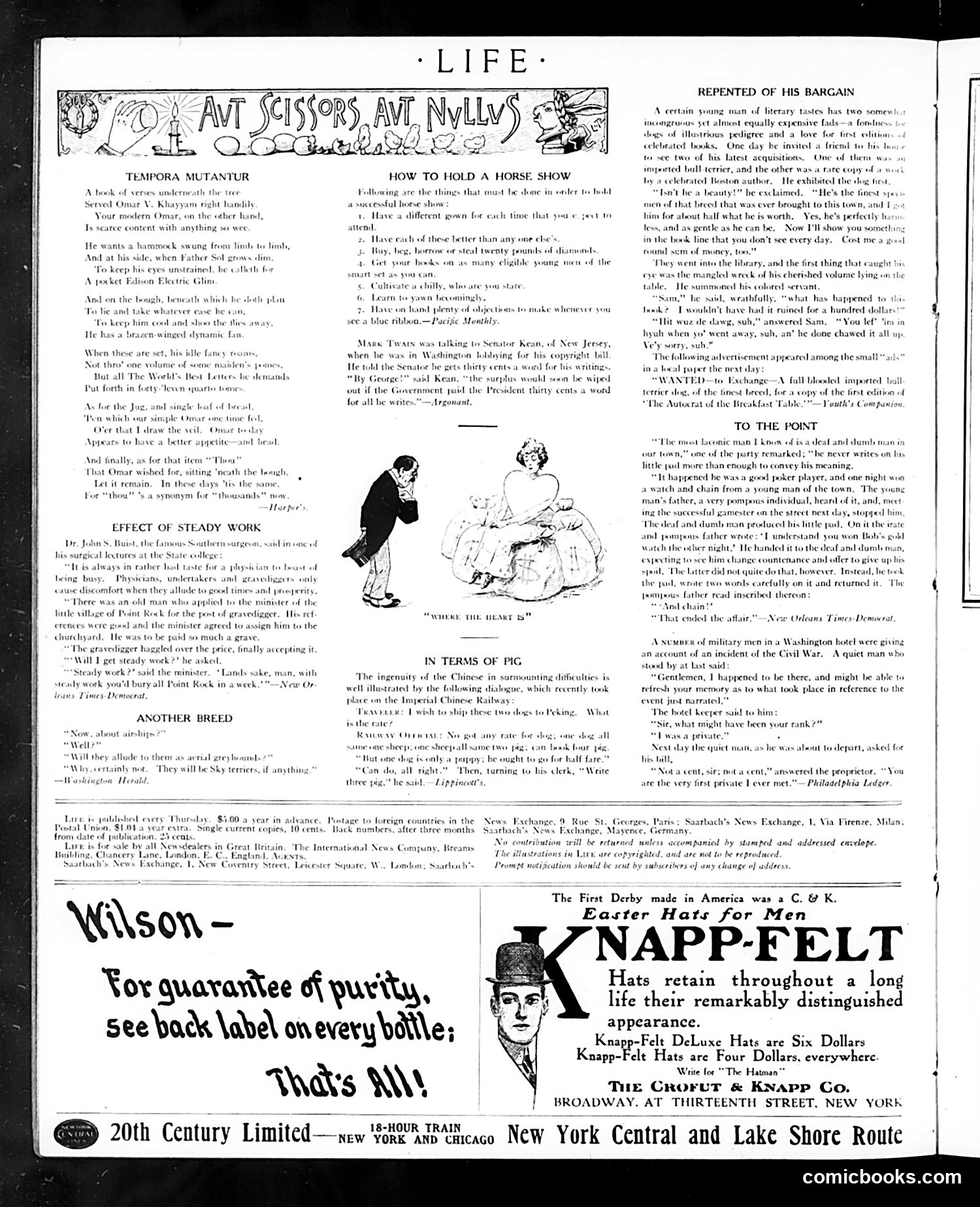
This page from *Life* magazine contains three separate satirical stories: **"Repented of His Bargain"**: A literary man buys both an expensive imported bull terrier and a rare book. His servant destroys the book while the owner is away. The joke mocks wealthy collectors who care equally about status symbols—whether pets or first editions—only to regret expensive acquisitions. **"Effect of Steady Work"**: A gravedigger's son becomes a successful gamester but writes to his father asking for money. The father responds with a cryptic note about "watching thy chain." The satire criticizes either the son's moral corruption through gambling or the father's cryptic (unhelpful) response. **"In Terms of Pig"**: A man inquires about shipping dogs to Peking via the Chinese Railway. The satire likely plays on language barriers or absurd bureaucratic translation difficulties in dealing with foreign logistics. The broader theme: mocking American pretension, greed, and miscommunication. The advertisements (Knapp-Felt hats, Wilson whiskey, trains) were standard magazine revenue.
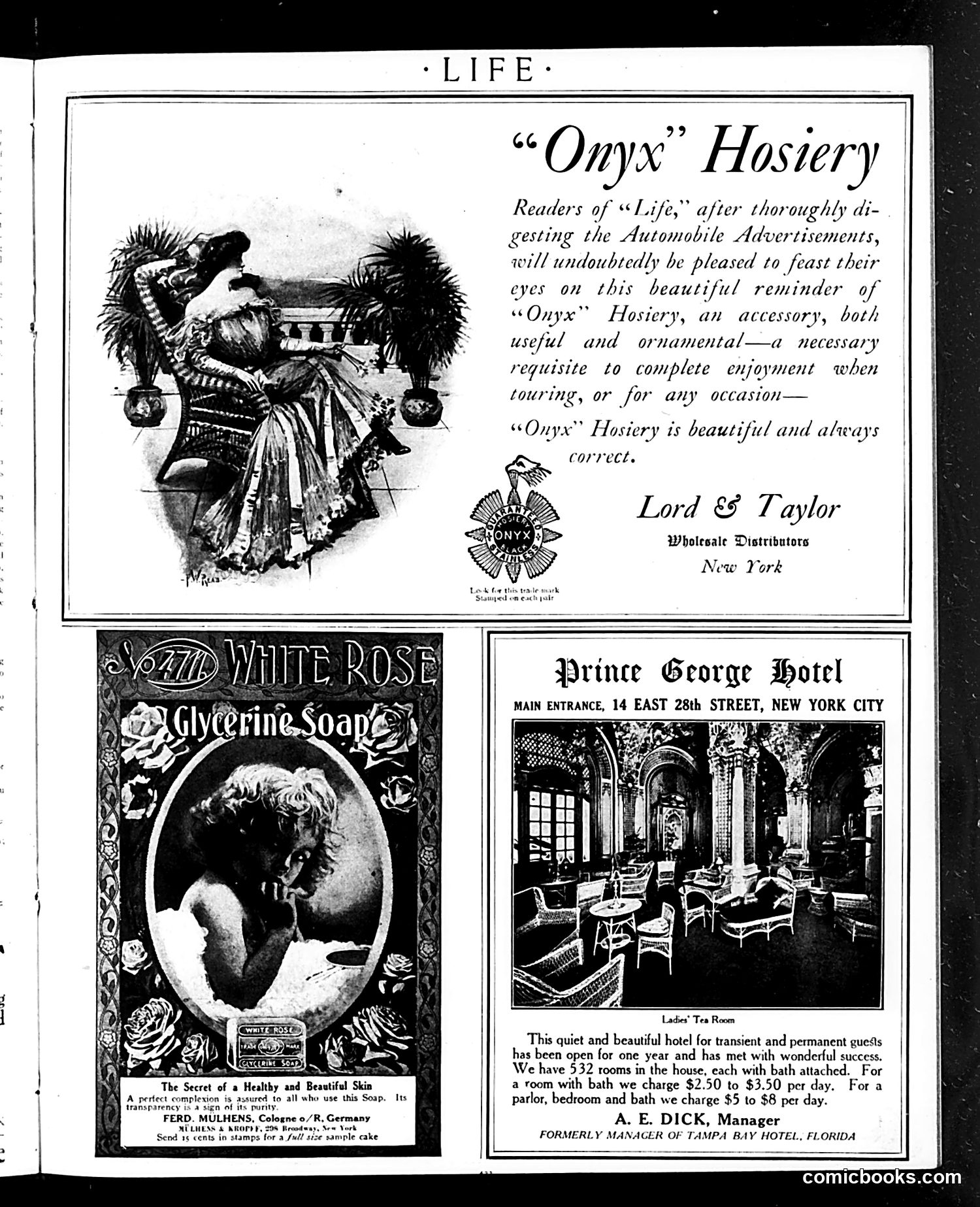
This page is primarily **advertising**, not satire. The top features a stylized illustration of a fashionable woman in elegant dress, promoting "Onyx" brand hosiery as a luxury accessory for automobile touring and social occasions. The art deco styling and ornate presentation were typical of early 20th-century luxury goods marketing. Below are additional advertisements: White Rose Glycerine Soap (emphasizing beauty and complexion) and the Prince George Hotel in New York City (advertising modern amenities like private bathrooms in each room—a notable luxury feature at the time). The page's humor lies in **Life magazine's self-aware structure**: it sardonically notes that readers, after viewing automobile advertisements, will appreciate this "beautiful reminder" of hosiery. This playfully acknowledges the magazine's heavy advertising content while positioning these products as refinements for the modern, mobile lifestyle automobiles enabled. No specific political figures or events are referenced—it's purely commercial messaging reflecting early 20th-century consumer culture.
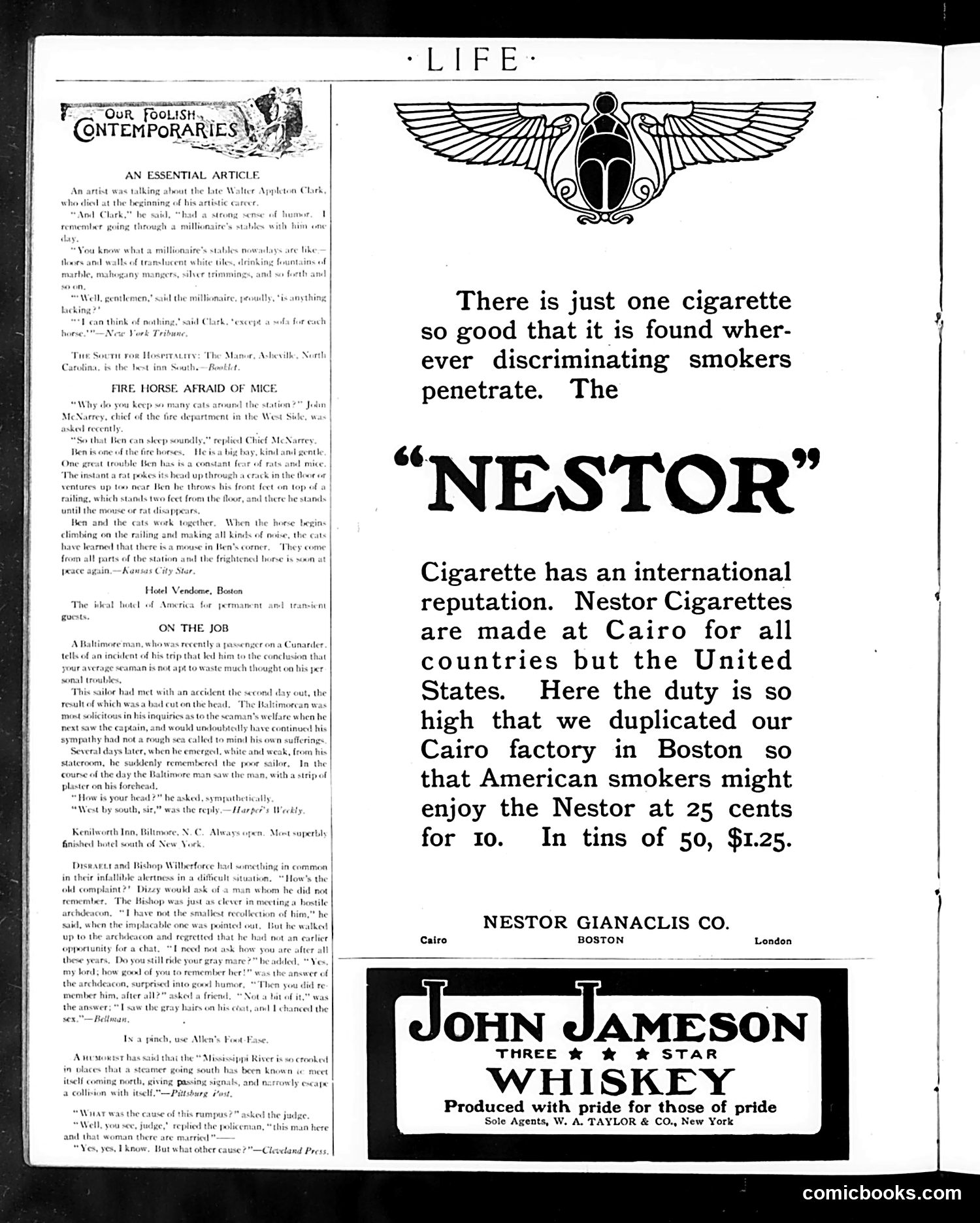
This page is primarily **advertising**, not satire or political commentary. It contains two major product advertisements: 1. **Nestor Cigarettes**: Marketed as internationally prestigious ("found wherever discriminating smokers penetrate"). The ad emphasizes that the brand is made in Cairo but established a Boston factory to bypass high U.S. tariffs, allowing American consumers to buy the product cheaply (25 cents for 10 cigarettes). 2. **John Jameson Three Star Whiskey**: A brief luxury spirits advertisement. The small section titled "Our Foolish Contemporaries" appears to be humorous anecdotes about various people, but the specific content is too unclear to parse reliably from this image. **Historical context**: This likely dates from the early 1900s, when cigarette advertising was unregulated and tariff issues significantly affected import pricing. The page reflects an era when such products were openly advertised in mainstream publications without health warnings.
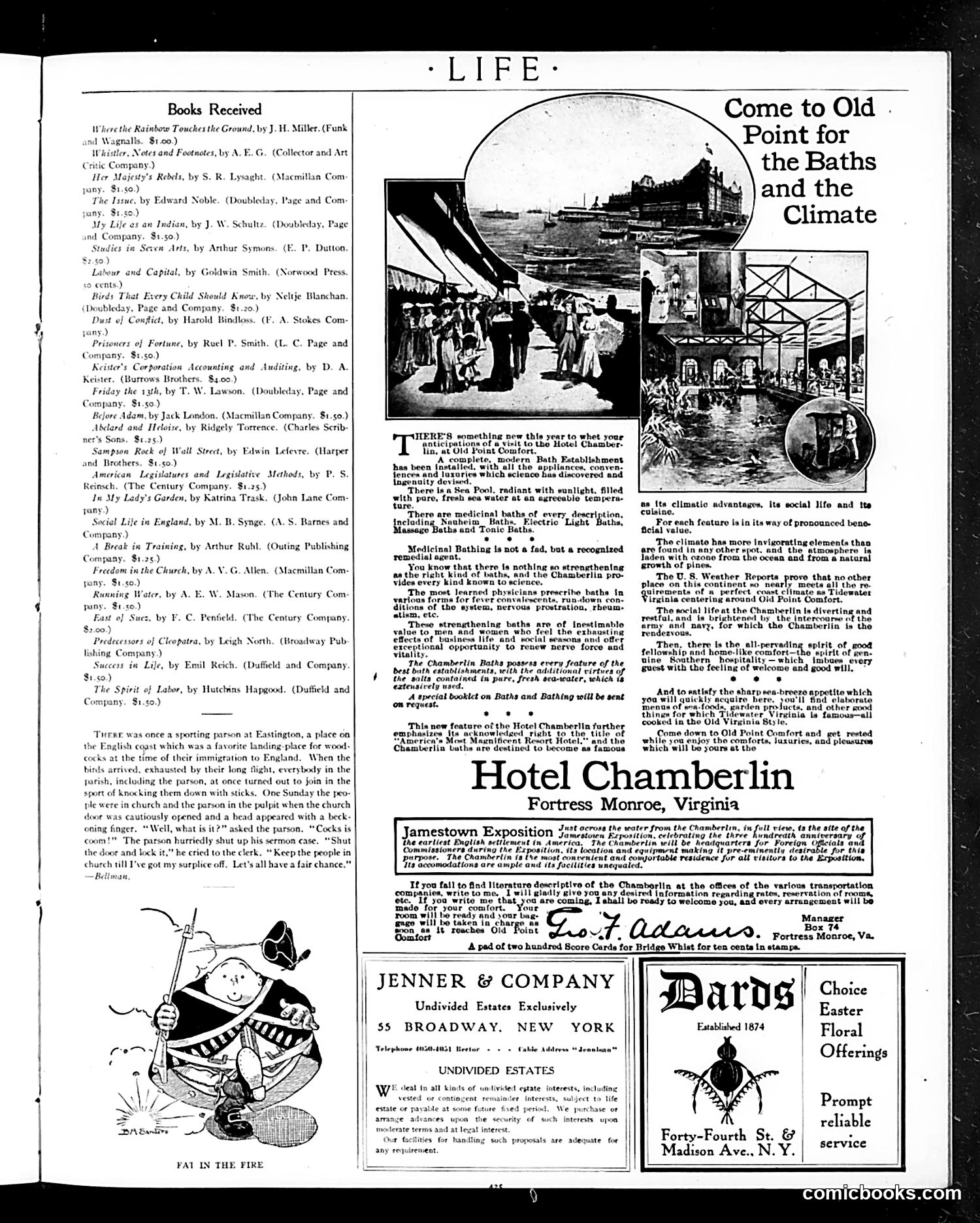
This page consists primarily of **book reviews and advertisements** rather than political cartoons. The main content includes: **"FAI IN THE FIRE"** (bottom left): A small cartoon depicting a portly figure in formal dress, apparently caught in an awkward situation—likely a visual pun on the idiom "fall in the fire," showing the figure tumbling or stumbling. **Primary Content**: The page advertises the **Hotel Chamberlin** at Old Point Comfort, Virginia, emphasizing its therapeutic baths and health benefits—a common theme for luxury resorts of the early 20th century. The ad includes landscape photographs of the hotel. **Supporting Advertisements**: Includes ads for Jenner & Company (real estate), and Dards florist (Easter offerings). The modest cartoon appears to be filler humor rather than pointed satire. The page demonstrates Life magazine's mixed format of literary reviews, advertisements, and light comedic illustrations typical of the era.
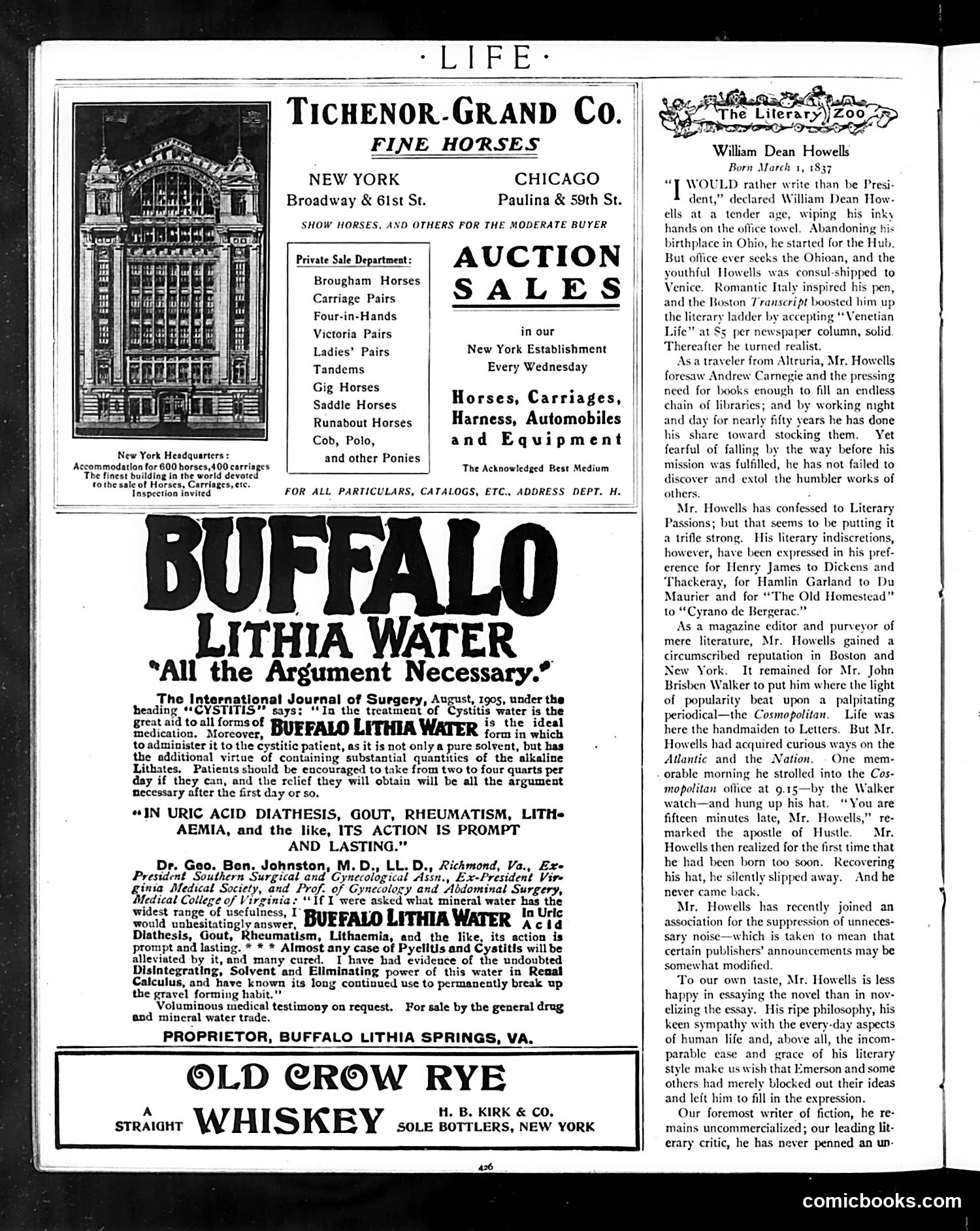
This page is primarily **advertising** with one substantial editorial feature. The advertisements promote horses (Tichenor-Grand Co.), Buffalo Lithia Water mineral springs, and Old Crow Whiskey—typical early 1900s products. The notable content is a profile of **William Dean Howells**, a major American writer and editor born 1837. The piece celebrates his career trajectory from Ohio to Boston literary circles to international prominence as an editor and advocate for literature. It notes his preferences for Henry James over Dickens, and mentions his work at *The Cosmopolitan* magazine. The profile's tone is admiring but slightly satirical—it gently mocks his earnest literary ambitions and his somewhat pretentious literary tastes. References to him wanting to "write rather than be President" and his championing of lesser-known works suggest a portrait of a serious, if occasionally overwrought, literary figure of his era. The page reflects Life magazine's dual purpose: entertainment/satire alongside commercial advertising.
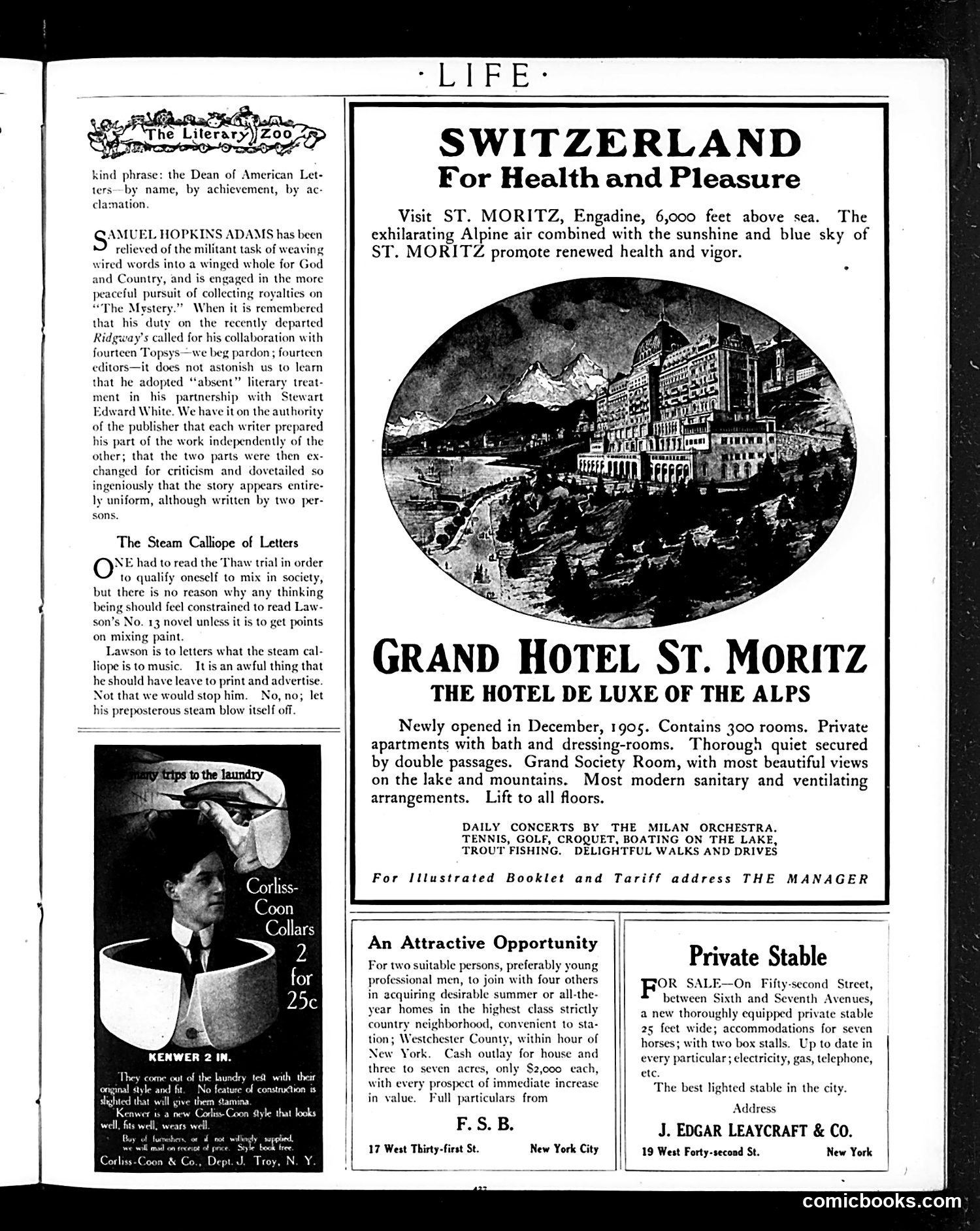
This page is primarily **advertising and literary commentary**, not political satire. The text discusses literary figures: Samuel Hopkins Adams (relieved of editorial duties to collect royalties) and Thomas W. Lawson, criticized as a noisy, self-promotional novelist compared to a "steam calliope"—a loud, attention-grabbing carnival instrument. The comparison mocks Lawson's aggressive advertising style and literary quality. The page contains advertisements for: - Grand Hotel St. Moritz in Switzerland (luxury alpine resort, opened 1905) - Corliss-Coon Collars (laundry-resistant shirt collars) - Private stable for rent in New York - Summer home investment opportunity There are **no political cartoons** on this page. The "Steam Calliope of Letters" is figurative commentary, not visual satire. This reflects Life's typical early-1900s mix of literary criticism, humor, and high-end advertising targeting affluent readers.
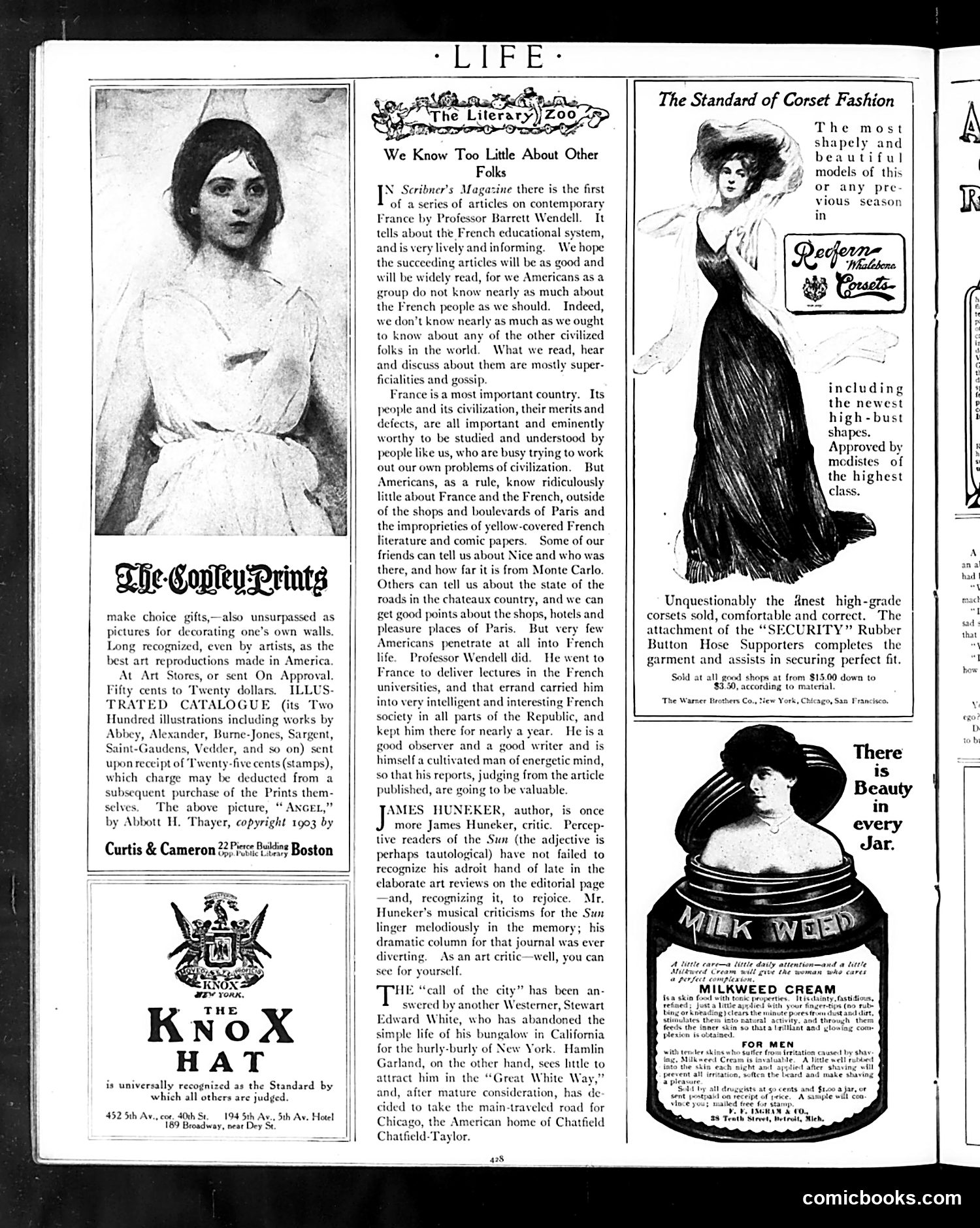
This page is primarily **advertising and literary commentary**, not political satire. The main content includes: - **"The Coskey Prints"** advertisement featuring an "Angel" artwork by Abbott H. Thayer (1903), marketing art reproductions as home decoration - **"The Literary Zoo"** column discussing Professor Barrett Wendell's articles about France, critiquing Americans' superficial knowledge of French culture (limited to Paris shops, yellow-covered literature, and gossip) - Commentary on **James Huneker**, a respected art critic returning to write for the Sun newspaper - Notes on **Stewart Edward White and Hamlin Garland**, Western writers relocating to/from New York - Advertisements for **Knox Hats** and **Redfern Corsets** (fashion items) The satire is mild: the "Literary Zoo" gently mocks Americans' ignorance of civilized nations, reducing France to tourist clichés and cheap literature. There's no sharp political cartoon—just genteel criticism of American provincialism typical of early 20th-century Life magazine's intellectual stance.
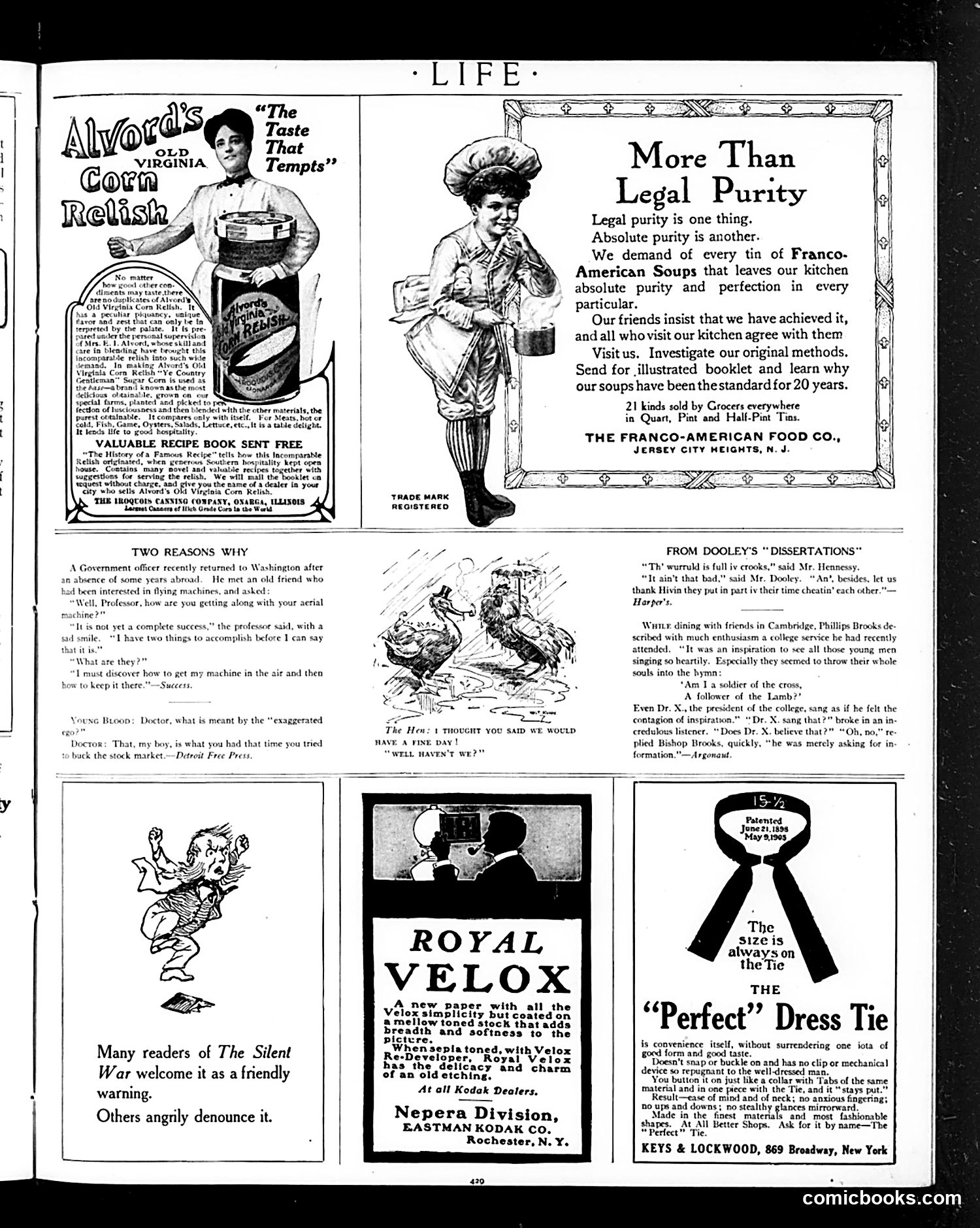
This is primarily an **advertising page** with several distinct ads and humorous filler content. **Main advertisements:** - **Alvord's Corn Relish**: Victorian-era product pitch emphasizing special farms and purity - **Franco-American Soups**: Claims of "absolute purity" beyond legal standards - **Royal Velox**: Photography paper for Kodak cameras - **"Perfect" Dress Tie**: A patented necktie with tabs, marketed as convenient for "well-dressed men" **Humor sections:** - **"Two Reasons Why"**: A dialogue about an impractical flying machine inventor - **"From Dooley's Dissertations"**: Satirical observations (appears to reference the humorist Finley Peter Dunne's character Mr. Dooley) about human nature and hypocrisy - **Cartoon references**: One mentions *The Silent War* as controversial reading material; another is a small comic illustration The page reflects early-1900s consumer culture, with ads emphasizing purity standards and technological novelty alongside period humor.
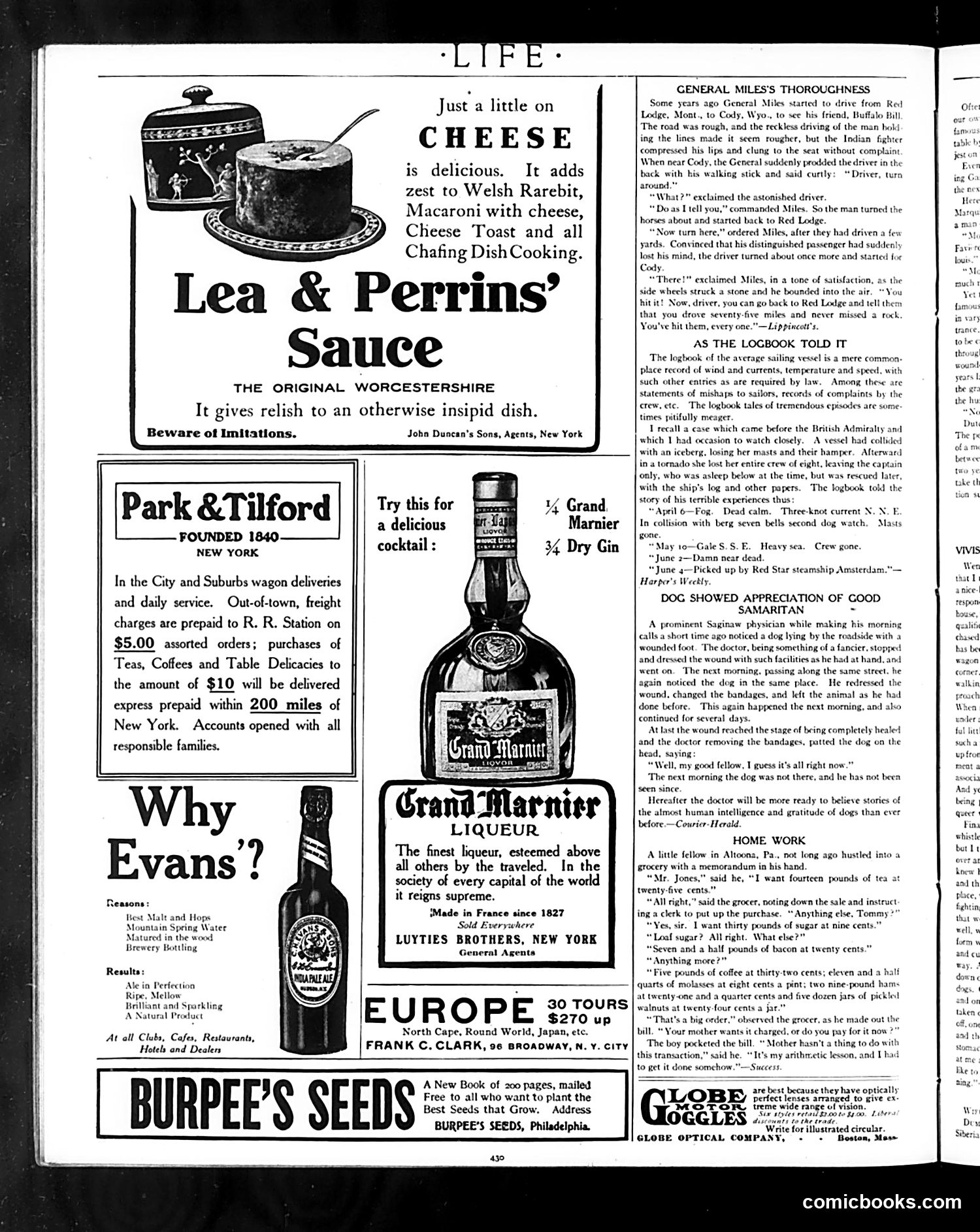
This page is primarily **advertisements** interspersed with three short humorous anecdotes. The advertisements promote luxury goods (Lea & Perrins sauce, Park & Tilford provisions, Evans beverages, Grand Marnier liqueur, and Burpee's Seeds)—typical of *Life* magazine's affluent readership. The three brief stories appear designed as light entertainment: 1. **"General Miles's Thoroughness"** jokes about military precision—General Nelson Miles supposedly ordered a driver to turn around repeatedly to verify he'd hit every rock on a 75-mile journey. 2. **"As the Logbook Told It"** satirizes naval bureaucracy: a ship's logbook records catastrophic disasters (iceberg collision, crew loss) in absurdly spare language ("Damn near dead"). 3. **"Dog Showed Appreciation of Good Samaritan"** (partially visible) appears to tell of a physician helping an injured dog. These anecdotes employ the deadpan humor typical of early 20th-century *Life*—finding comedy in obsessive attention to detail, bureaucratic understatement, and ironic contrasts between events' severity and their documentation.
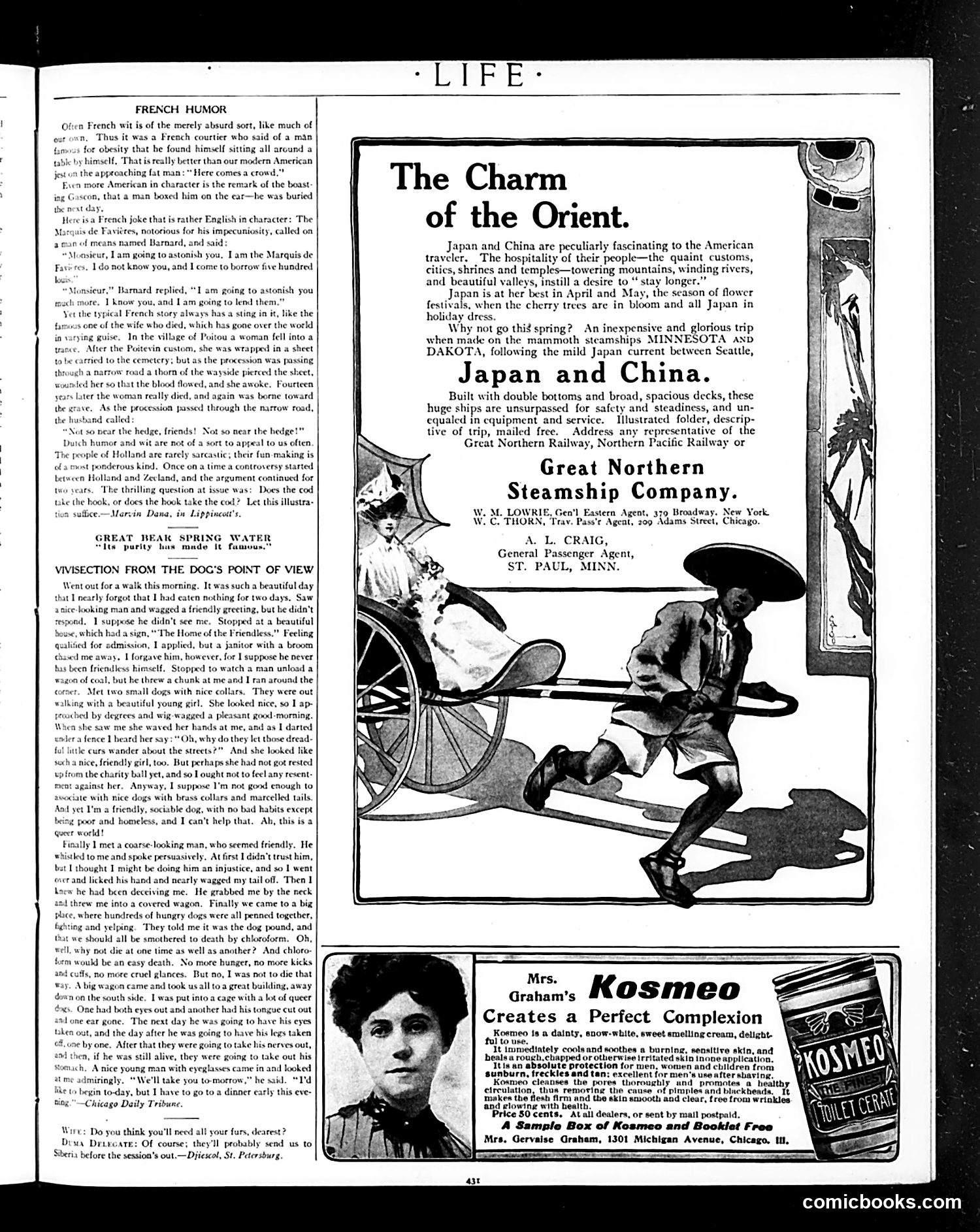
This page contains two distinct sections: **Left side**: A humor column featuring anecdotes about French, Dutch, and English wit—mostly absurdist jokes contrasting French and American sensibilities. Example: a marquis borrows money by claiming he'll "astonish" the lender, who replies he'll astonish the marquis by actually lending it. The humor relies on unexpected reversals and dry deadpan delivery typical of early-20th-century magazine comedy. **Right side**: A satirical piece titled "Vivisection from the Dog's Point of View"—a sympathetic monologue from a stray dog's perspective. It satirizes both urban indifference to homeless animals and the social hierarchy that rejects poor creatures while welcoming well-dressed ones. The dog's naive, dignified voice critiques human hypocrisy. The page also contains period advertisements (Great Bear Spring Water, Kosmeo complexion cream), typical of *Life* magazine's mixed editorial-advertising format.
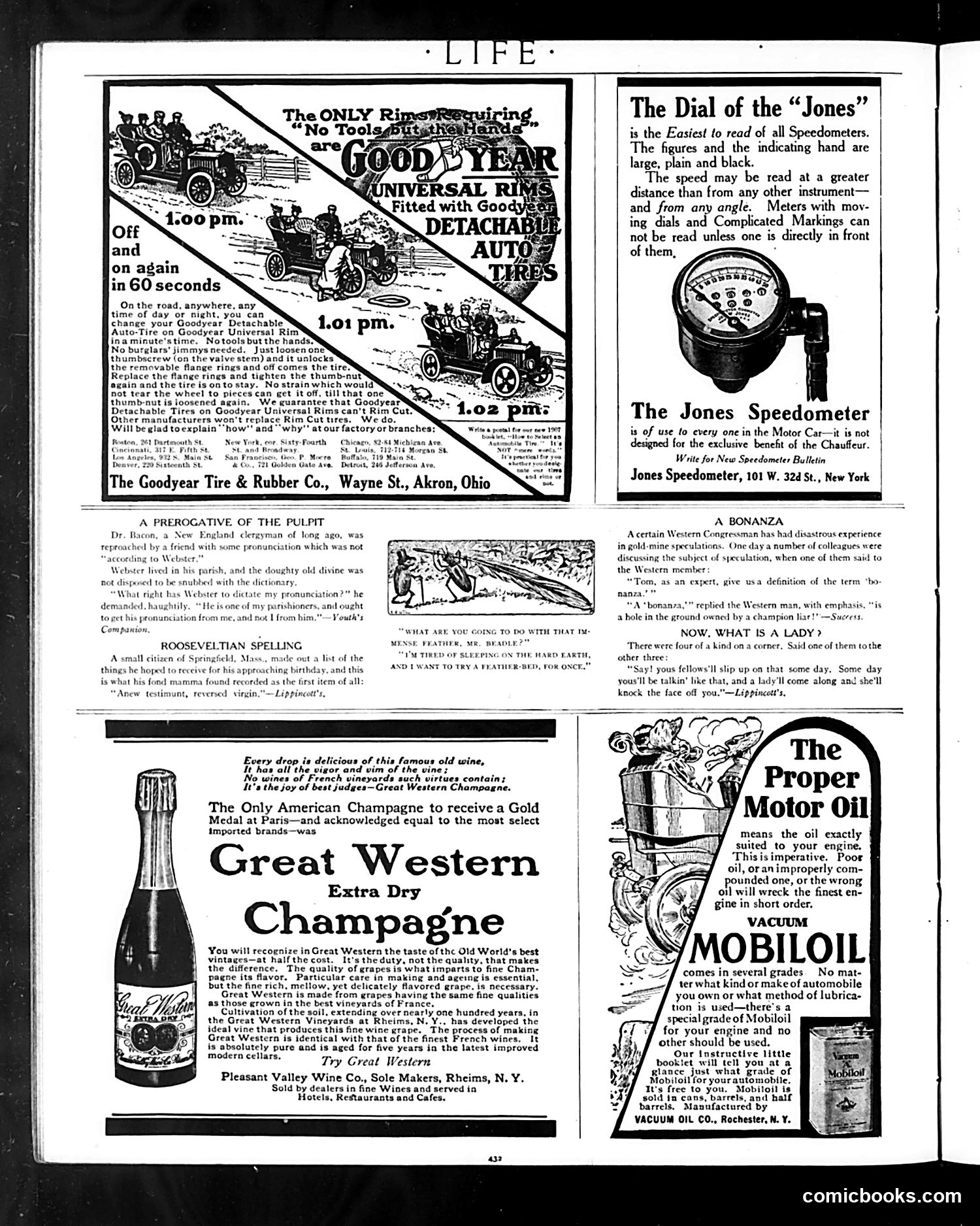
This page is primarily **advertising**, featuring prominent ads for Goodyear tires, Jones Speedometers, Great Western Champagne, and Mobiloil motor oil. The small non-advertising content consists of brief **humorous anecdotes**: 1. "A Prerogative of the Pulpit" mocks a clergyman's insistence on pronouncing words correctly while being corrected by a friend—satirizing clerical pomposity. 2. "Rooseveltian Spelling" references Theodore Roosevelt's spelling reform movement, presenting a child's deliberately misspelled birthday wish list as absurd. 3. "A Bonanza" depicts a Western Congressman defining a gold-mine bonanza as "a hole in the ground owned by a champion liar"—satirizing both get-rich-quick speculation and political dishonesty of the era. 4. "Now, What is a Lady?" uses street dialect humor about working-class men who'll be exposed as crude when a lady overhears them. These are gentle, satirical vignettes typical of Life's humor section, not political cartoons.
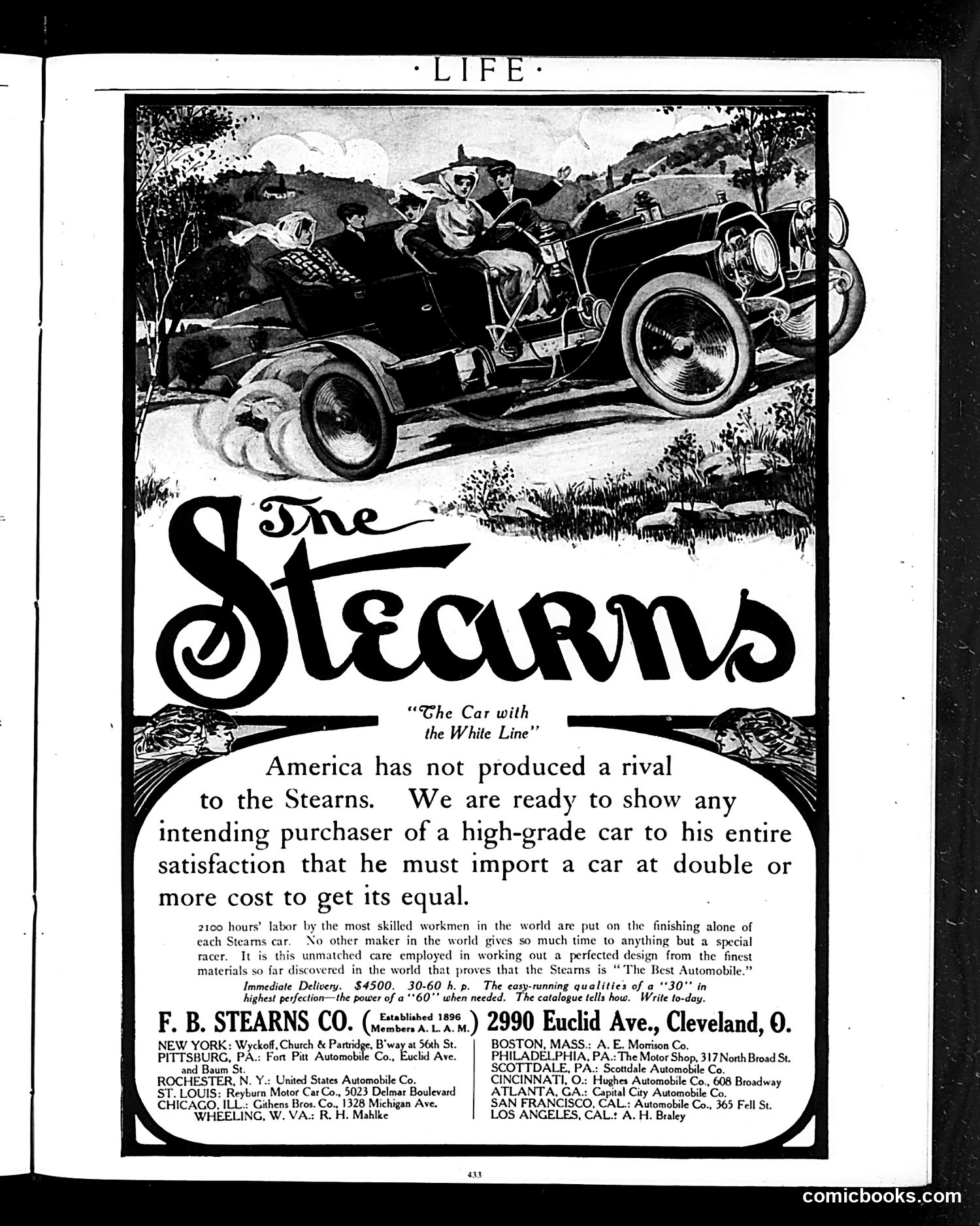
This is primarily a **luxury car advertisement**, not satire. The "cartoon" depicts well-dressed passengers enjoying a leisurely drive in a Stearns automobile, emphasizing comfort and status. The ad's claim—that America has produced no rival to the Stearns, and that importing a foreign car costs double—reflects early 1900s automotive competition. The phrase "The Car with the White Line" (visible on the vehicle) was apparently the brand's marketing tagline. The text boasts of 2,100 hours of skilled labor per vehicle and positions the Stearns as "The Best Automobile" through meticulous craftsmanship. At $4,500 (substantial for the era), it targets wealthy buyers. The extensive dealer list across major American cities underscores the company's reach. This represents a period when American automobiles were still competing for legitimacy against European imports—before American mass production would dominate the market.
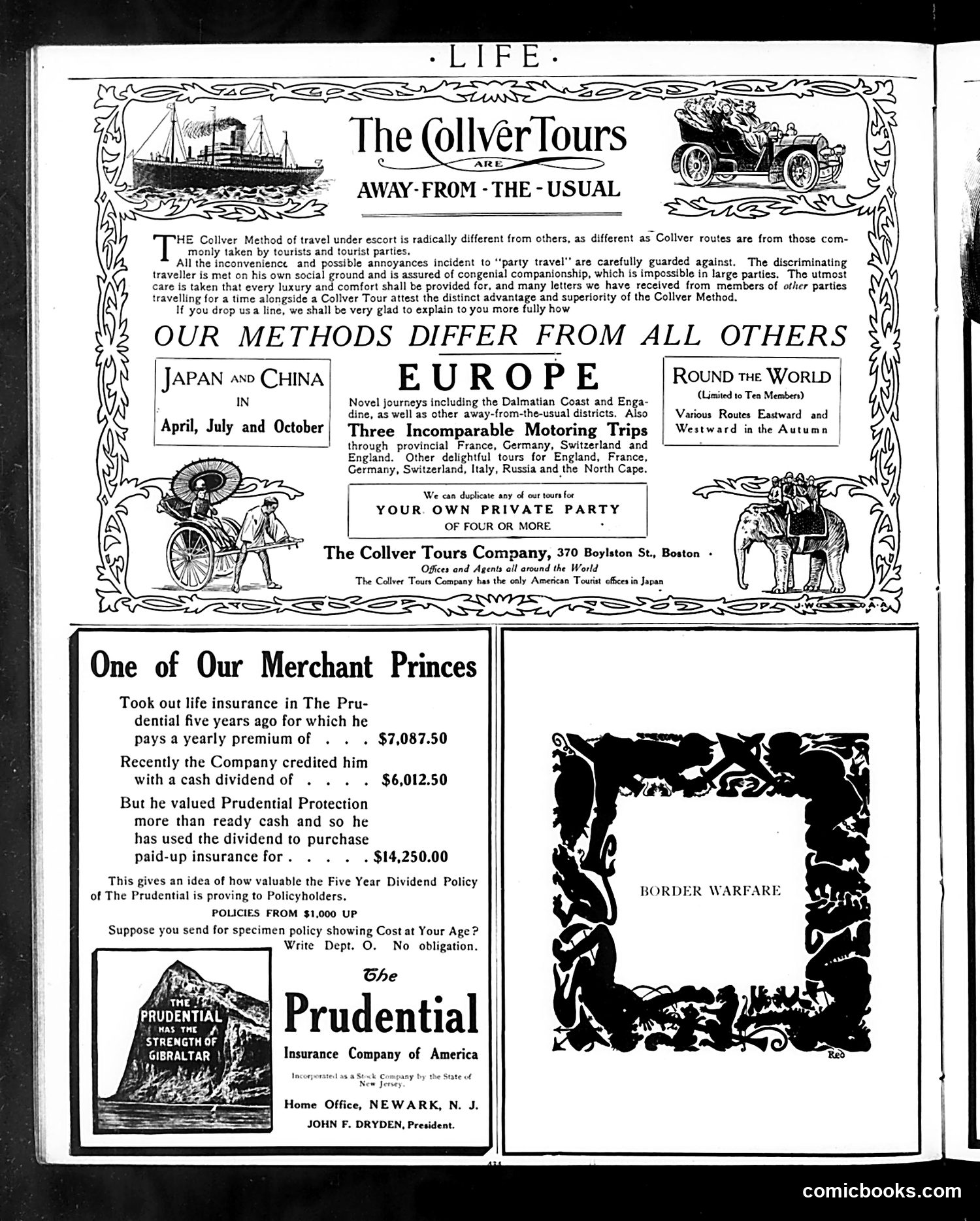
This is primarily a **advertising page**, not satire. It contains two major advertisements: **Top:** The Collver Tours Company promotes luxury travel services, emphasizing exclusive, small-group escorted tours to Japan, China, Europe, and worldwide destinations. The pitch emphasizes comfort, avoiding "party travel" annoyances, and personalized companionship—catering to wealthy clientele seeking distinction from ordinary tourists. **Bottom:** The Prudential Insurance Company features a success story of a "Merchant Prince" whose five-year dividend policy proved so valuable he reinvested dividends into additional coverage ($14,250), demonstrating the policy's returns. This is aspirational advertising targeting affluent businessmen. The decorative border illustrations (steamship, automobiles, international scenes) and the "Border Warfare" illustration support the travel/insurance themes. The page reflects early-20th-century consumer culture targeting the wealthy, with no evident satire—just straightforward luxury marketing.
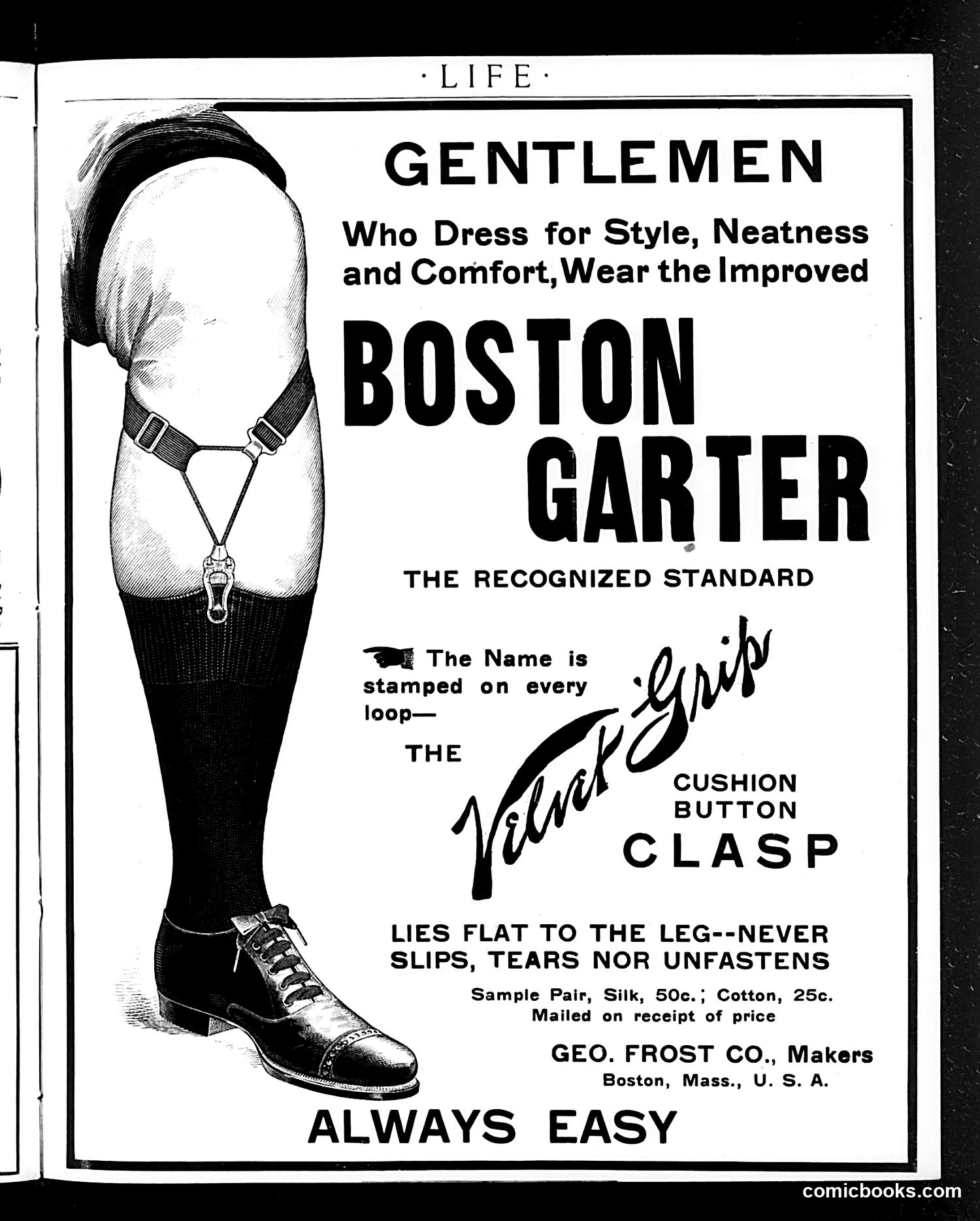
This is a straightforward **product advertisement**, not political satire or cartoon humor. It promotes the "Boston Garter," a men's sock garter—a device worn below the knee to keep socks pulled up, essential before elastic became standard. The ad targets gentlemen concerned with appearance, emphasizing the garter's features: a cushion button clasp that "lies flat to the leg," never slips or tears, and stays fastened. The illustration shows the garter in use on a man's leg with period shoes. The tagline "Always Easy" suggests effortless elegance. Pricing (50¢ silk, 25¢ cotton) with mail-order availability indicates this was an accessible luxury item. The manufacturer, Geo. Frost Co. of Boston, leverages the city's name for credibility as "the recognized standard." This represents typical early 20th-century menswear advertising—purely promotional, not satirical.
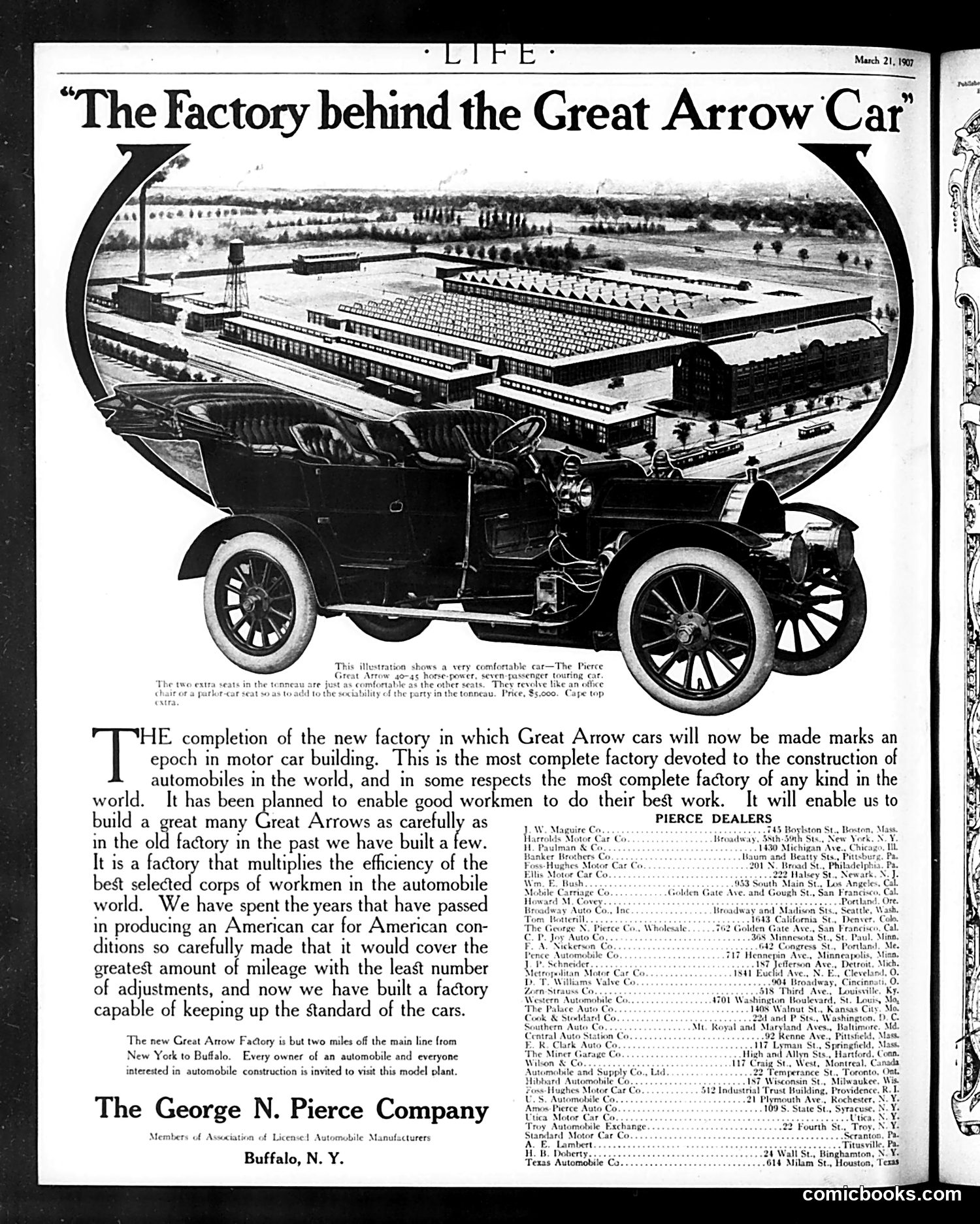
This is primarily **advertising content**, not satire. The page promotes the George N. Pierce Company's new automobile factory in Buffalo, New York, which manufactured the "Great Arrow" luxury car (priced at $5,000—extremely expensive for 1907). The illustration shows the factory complex with an inset image of the Pierce Great Arrow automobile itself—a high-end, seven-passenger touring car. The accompanying text emphasizes the factory's modern efficiency and quality control, positioning it as "the most complete factory devoted to the construction of automobiles in the world." The extensive dealer list at bottom indicates national distribution. This represents early automotive-industry boosterism: manufacturers were showcasing their manufacturing prowess as evidence of product quality and American industrial superiority. There is no political cartoon or satire here—it's a straightforward trade publication advertisement celebrating modern manufacturing capabilities.