
Life, 1907-03-21 · page 15 of 40
Life — March 21, 1907 — page 15: what you’re looking at
What you’re looking at
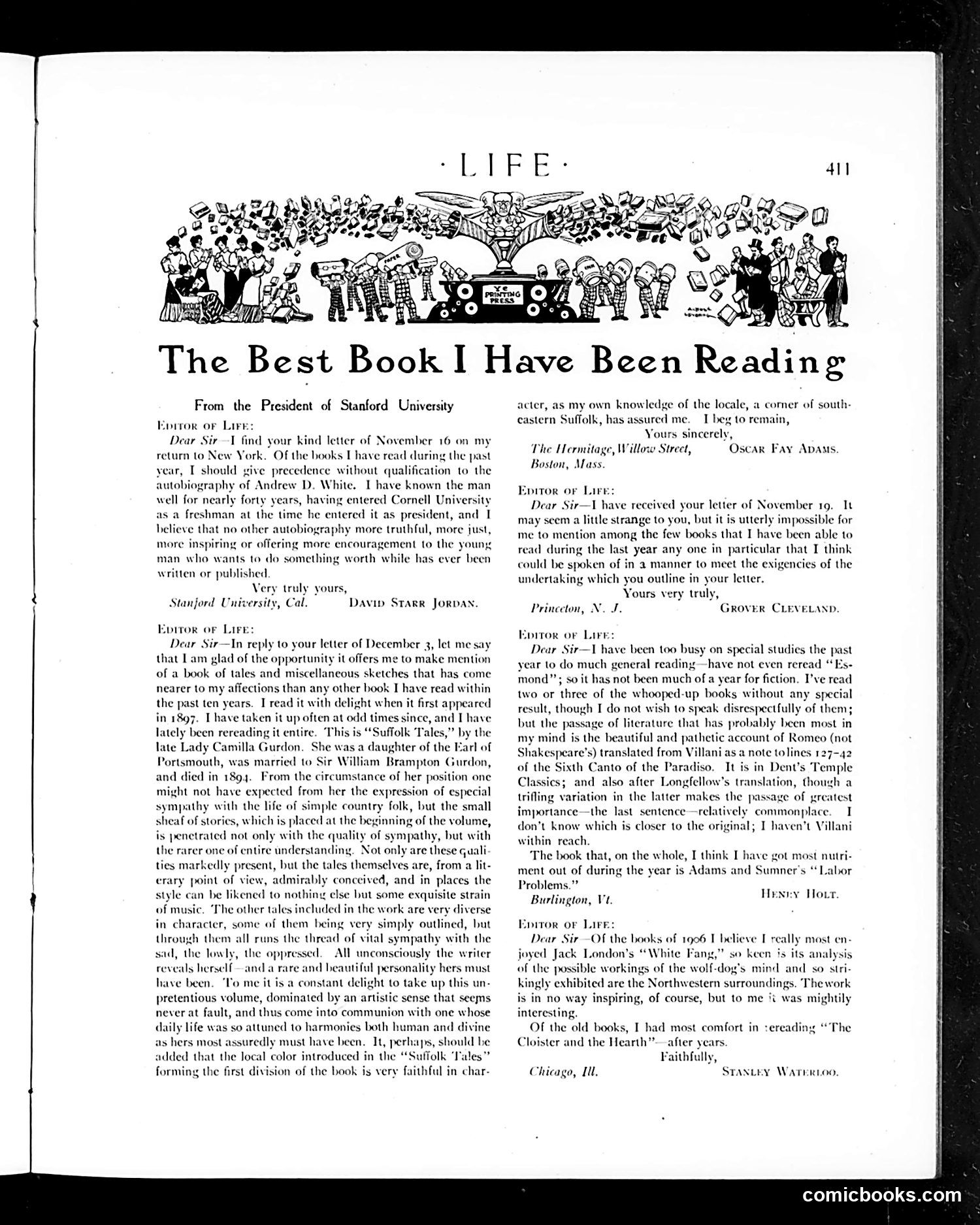
This page features letters from prominent American figures responding to *Life* magazine's inquiry about their favorite recent books. The content reveals early 20th-century literary tastes among the elite. **Key Respondents:** - **David Starr Jordan** (Stanford president): endorses Andrew D. White's autobiography - **Oscar Fay Adams** (Boston): praises "Suffolk Tales" by Lady Camilla Gurdon for its sympathetic portrayal of rural working-class life - **Grover Cleveland** (former president): declines to recommend a specific book, claiming insufficient reading time - An unnamed Princeton figure discusses Dante's *Paradiso* and Jack London's "White Fang" **The Point:** This is essentially a prestige feature showcasing what educated, influential Americans were reading—functioning as a cultural authority marker. The selections reflect period values: autobiographies, literary fiction with social sympathy, and classical literature. The page documents early-1900s intellectual life rather than satirizing it.
📄 Transcribed text from this page (OCR, searchable)
Machine-transcribed from the original scan — historical spelling and the odd misread are preserved.
From the President of Stanford University [DITOR OF LIFE: Dear Sir -1 find your kind letter of November 16 on my return to New York. Of the books I have read during the past year, T should give precedence without qualification to the autobiography of Andrew D. White. I have known the man well for nearly forty years, having entered Cornell University as a freshman at the time he entered it as president, and I believe that no other autobiography more truthful, more just, more inspiring or offering more encouragement to the youny man who wants to do something worth while has ever been written or published Ver yy Stanjord University, Cal. ours, Davip Starr Jorvay. Epiror oF Lire: Dear Sir—In reply to your letter of December 3, let me say that Lam glad of the opportunity it offers me to make mention book of tales and miscellaneous sketches that has come nearer to my affections than any other book I have read within the past ten years. I read it with delight when it first appeared in 1897. I have taken it up often at odd times since, and I have lately been rereading it entire. This is “Suffolk Tale: late Lady Camilla Gurdon. She was a daughter of the Earl of Portsmouth, was married to Sir William Brampton Gurdon, and died in 1894. From the circumstance of her position one might not have expected from her the expression of especial sympathy with the life of simple country folk, but the small sheaf of stories, which is placed at the beginning of the volume, is penetrated not only with the quality of sympathy, but with the rarer one of entire understanding. Not only are these quali ties markedly present, but the tales themselves are, from a lit- y point of view, admirably conceived, and in places the an be likened to nothing else but some exquisite strain “he other tales included in the work are very diverse in character, some of them being very simply outlined, but through them all runs the thread of vital sympathy with the sad, the lowly, the oppressed. All unconsciously the writer reveals herself —and a rare and beautiful personality hers must have been. ‘Vo me it is a constant delight to take up this un- pretentious volume, dominated by an artistic sense that seems never at fault, and thus come into communion with one whose daily life was so attuned to harmonies both human and divine as hers most assuredly must have been. It, perhaps, should be added that the local color introduced in the “Suffolk ‘Tales” forming the first division of the book is very faithful in char- The Best Book I Have Been Reading acter, as my own knowledge of the locale, a comer of south: castern Suffolk, has assured me. I beg to remain, Yours sincerely, The Hermitage, Willow Strect, Oscar Fay Apaus. Boston, Mass. Eprtor or Lire: Dear Sir—1 have received your letter of November 19. It may seem a little strange to you, but it is utterly impossible for me to mention among the few books that I have been able to read during the last year any one in particular that I think could be spoken of in a manner to meet the exigencies of the undertaking which you outline in your letter. Yours very truly, i Grover CLEVELAND. Princeton, N. Epiror or Lire: Dear Sir—1 have been too busy on special studies the past year to do much general reading —have not even reread “ mond”; so it has not been much of a year for fiction. I’ve read two or three of the whooped-up books without any special result, though I do not wish to speak disrespectfully of them; but the passage of literature that has probably been most in my mind is the beautiful and pathetic account of Romeo (not Shakespeare's) translated from Villani as a note tolines 1 of the Sixth Canto of the Paradiso. It is in Dent’s Temple Class and also after Longfellow’s translation, though a trifling variation in the latter makes the passage of greatest importance—the last sentence —relatively commonplace. I don’t know which is closer to the original; I haven’t Villani within reach. The book that, on the whole, I think I have got most nutri- ment out of during the year is Adams and Sumner’s “ Labor Problems.” Burlington, Vt. Henry Hovr. Enitor or Lit Dear Sir —-Of the books of 1906 T believe T really most en- joyed Jack London's “White Fang,” so keen js its analysis of the possible workings of the wolf-dog’s mind and so. stri- kingly exhibited are the Northwestern surroundings. The work y inspiring, of course, but to me i was mightily is in no interesting. Of the old books, I had most comfort in :ereadiny, Cloister and the Hearth’ after years, Faithfully, STANLEY WATERLOO, The Chicago, Ml. comicbooks.com