
Life, 1907-03-21 · page 25 of 40
Life — March 21, 1907 — page 25: what you’re looking at
What you’re looking at
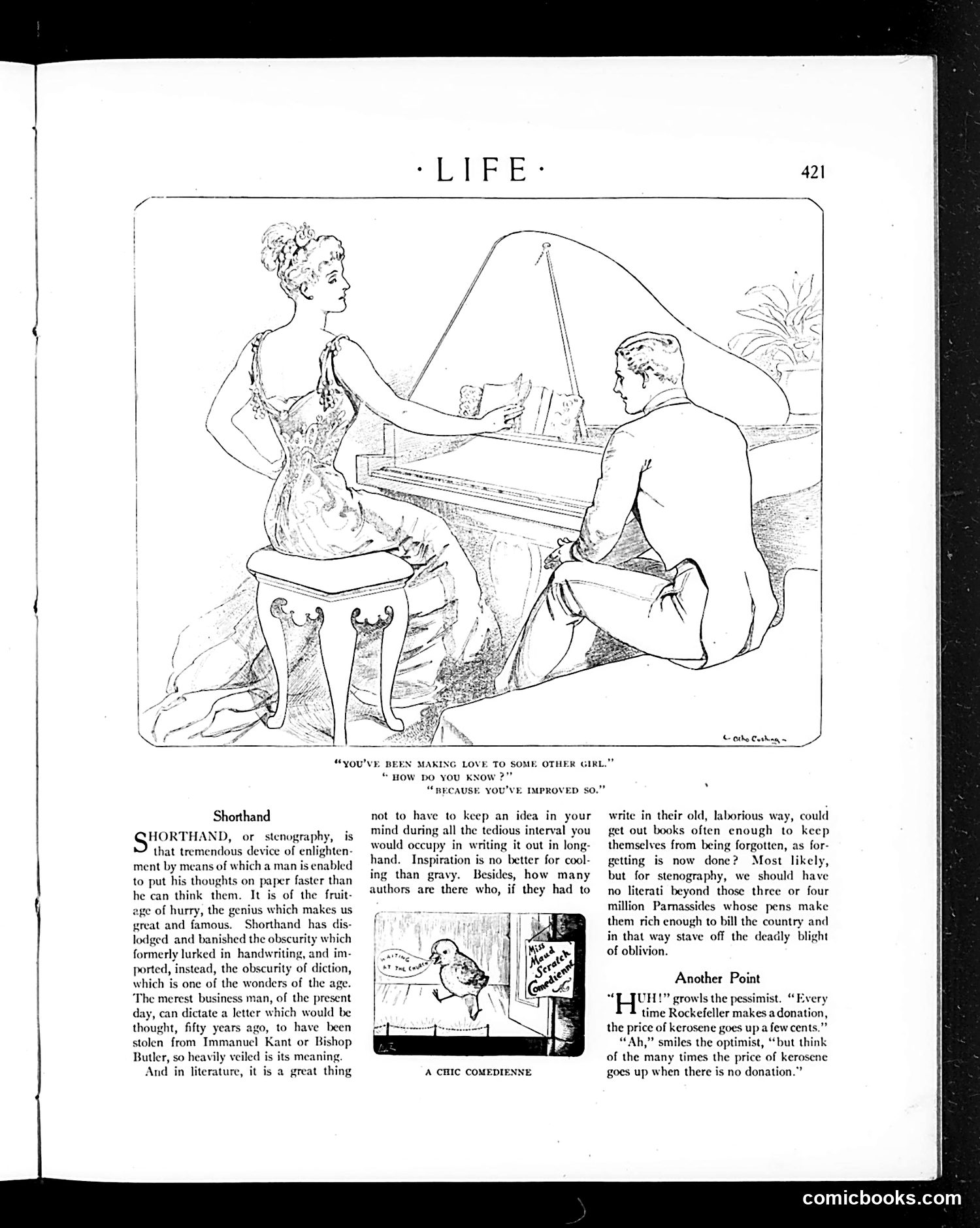
This page contains satirical commentary on early-20th-century American life. **Main cartoon** (top): A flirtatious scene where a woman tells a man he's "improved" at lovemaking. The joke plays on the double meaning—she's implying he's been practicing with other women, which he denies by asking "how do you know?" The satire mocks romantic deception and modern courtship rituals. **"Shorthand" essay**: Satirizes stenography (shorthand writing) as a symbol of modern rush culture. The author argues it enables thoughtless writing—people dictate letters faster than they can compose them clearly, producing pretentious but meaningless prose. The jab at "three or four million Parnassides" (hack writers) suggests mass-produced mediocre literature flourishes because stenography allows prolific but low-quality output. **"Another Point"**: A brief joke contrasting pessimist and optimist views of Rockefeller's charitable donations. The pessimist assumes he raises kerosene prices to offset donations; the optimist notes prices rise anyway without donations—so donations don't worsen the situation. All three pieces critique modern convenience, mass culture, and hypocrisy.
📄 Transcribed text from this page (OCR, searchable)
Machine-transcribed from the original scan — historical spelling and the odd misread are preserved.
{othe Corhag “YOU'VE BEEN MAKING Shorthand HORTHAND, or stenography, is that tremendous device of enlighten- ment by means of which a man is enabled to put his thoughts on paper faster than he can think them. It is of the fruit- age of hurry, the genius which makes us great and famous. Shorthand has dis- lodged and banished the obscurity which formerly lurked in handwriting, and im- ported, instead, the obscurity of diction, which is one of the wonders of the age. The merest business man, of the present day, can dictate a letter which would be thought, fifty years ago, to have been stolen from Immanuel Kant or Bishop Butler, so heavily veiled is its meaning. And in literature, it is a great thing * HOW pO YoU KNOW “RECAUSE YOU'VE IMPROVED SO.’” not to have to keep an idea in your mind during all the tedious interval you would occupy in writing it out in long- hand. Inspiration is no better for cool- ing than gravy. Besides, how many authors are there who, if they had to A CHIC COMEDIENNE OVE TO SOME OTHER GIRL. write in their old, laborious way, could get out books often enough to keep themselves from being forgotten, as for- getting is now done? Most likely, but for stenography, we should have no literati beyond those three or four million Parnassides whose pens make them rich enough to bill the country and in that way stave off the deadly blight of oblivion. Another Point “H JH!” growls the pessimist. “Every time Rockefeller makes adonation, the price of kerosene goes up a few cents.” “Ah,” smiles the optimist, “but think of the many times the price of kerosene goes up when there is no donation.” comicbooks.com