
Life, 1907-03-21 · page 18 of 40
Life — March 21, 1907 — page 18: what you’re looking at
What you’re looking at
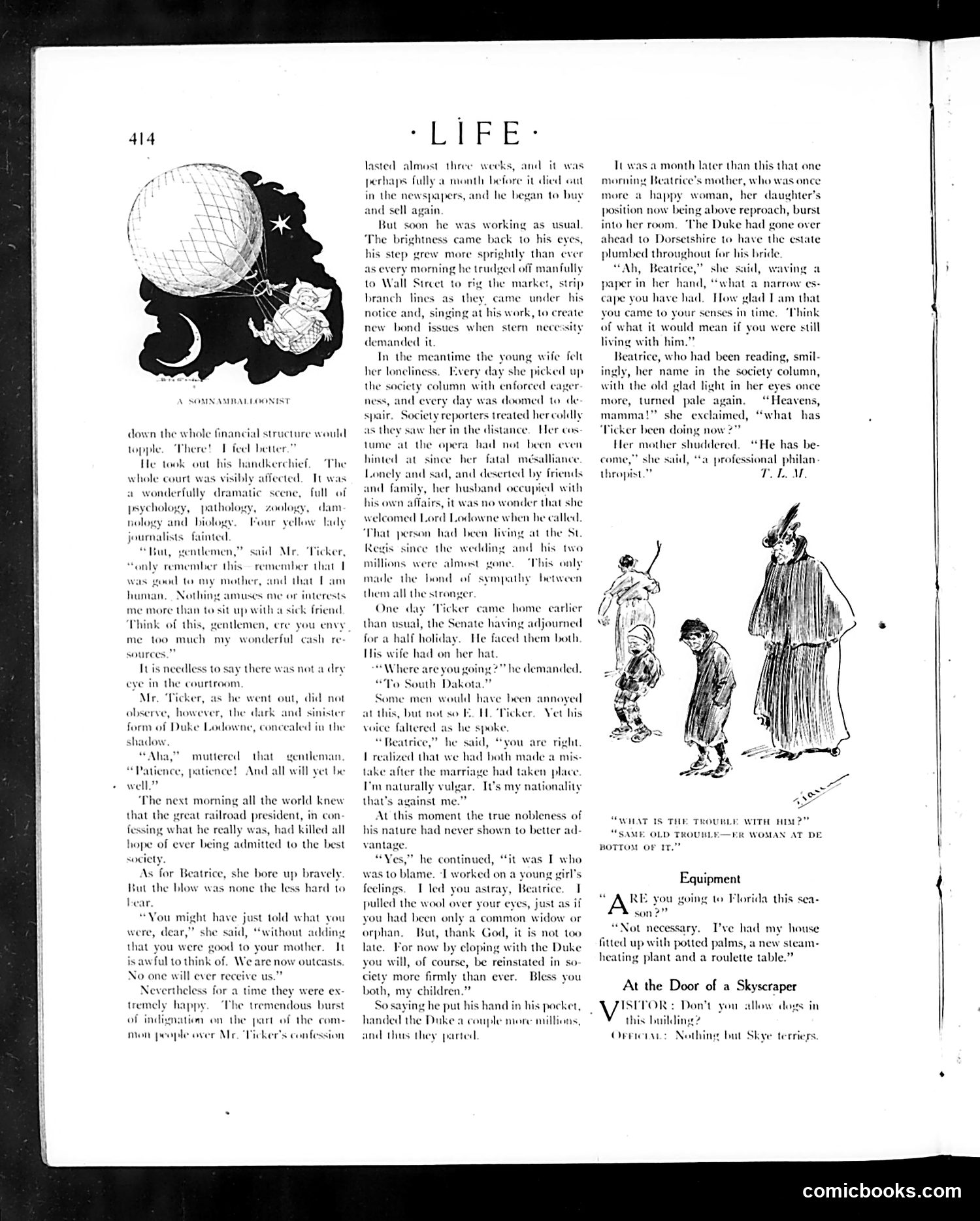
This page contains a serialized satirical story mocking wealthy financiers and high society's shallow values. The protagonist is Mr. Ticker, a railroad magnate who publicly confesses his humble origins and working-class mother in court. This admission—shocking to the elite—destroys his social standing, though his wife Beatrice initially accepts him. However, when Ticker's fortune recovers through unethical market manipulation ("rig the market, strip branch lines"), his wife grows lonely after being shunned by society. A titled but broke nobleman, Lord Lodowne, courts her. In absurd fashion, Ticker **supports her elopement**, reasoning that marrying a duke will restore her social status more effectively than remaining with him. The satire targets: ruthless capitalists' moral emptiness, society's obsession with titles over character, and the desperation of the ultra-wealthy to climb social hierarchies. The cartoon's title "A Somnambuloonist" (sleepwalker/buffoon) reflects Ticker's blind pursuit of wealth while sleepwalking through morality.
📄 Transcribed text from this page (OCR, searchable)
Machine-transcribed from the original scan — historical spelling and the odd misread are preserved.
A SOMNAMMALLOONIST down the whole financial structure would topple. ‘There! [feel better.” He took out his handkerchief. The vurt was visibly aficeted. Tt was. nderfully dramatic scene, full of psychology, pathology, zoology, dam whole aw nology and. biology nted. Four yellow: luly journalists fa gentlemen,” said Mr. ‘Ticker “only remember this remember that 1 was good to my mother, and that Fam human. Nothin gamuses me or interests me more than to sit up with a sick friend ‘Think of this, gentlemen, ere you envy me too much my wonderful cash re sources.” It is needless to say there was not a dry eye in the courtroom Mr. ‘Ticker, as he went out, did not observe, however, the dark and si form of Duke Lodowne, conce: ister Hed in the shadow “Aha,” muttered that gentleman. “Patience, patience! And all will yet be well.” ‘The next morning all the world knew that the great railroad president, in con fessing what he really was, had killed all hope of ever being admitted to the best iety. As for Beatrice, she bore up bravely But the blow was none the less hard to hear. “You might have just told what you were, dear,” she said, “without adding that you were good to your mother. It is awful to think of. We are now outcasts. No one will ever receive us.” Nevertheless for a time they were ex- tremely happy. ‘The tremendous burst indiynation on the part of the com- mon people over Me. ‘Ticker's eanfession lasted almost three weeks, and it was perhaps fully a month before it died out in the newspapers, and he began to buy and sell again. But soon he was working as usual The brightness came back to his eyes, ghtly than ev as every morning he trudged off manfully to Wall Street to rig the marker, strip branch lines as they, came under his notice and, singing at his work, to create new bond issues when stern necessity demanded it his step grew more spr In the meantime the young wife felt her loneliness. Every day she picked up Cr the society column with enforced ©; ness, and every day was doomed to de air. Society reporters treated her coldly as they saw her in the distance. Her cos lume at the opera had not been even hinted at since her fatal meésalliance. Lonely and sad, and deserted by fi and family, her husband occupied with his own aff tls airs, it was no wonder that she welcomed Lord Lodowne when he ealled at the St ‘That person had been livin: is since the wedding and his two millions were almost gone. ‘This only made the bond of sympathy between them all the stronger One day ‘Vieker came home earlier than usual, the Senate having « a half holiday. He His wife had on her hat “ Where are you goings?” he demanded. To South Dakota.” ame men would have been annoyed at this, but not so EEL ‘Ticker. Yet his voice faltered as he spoke. djourned jaced them both. Beatrice,” he said, “you are right 1 realized that we had both made a take after the marriage had taken place I'm naturally vulgar, It’s my nationality that’s inst me.” At this moment the true nobleness of his nature had never shown to better ad- vantage: mis- “Ves,” he continued, “it was T who was to blame. ‘I worked on a young girl's feelings. I led you astray, Beatrice. 1 pulled the wool over your eyes, just as if you had been only a common widow or orphan, But, thank God, it is not too late. For now by eloping with the Duke you will, of course, be reinstated in so ciety more firmly than ever. Bless you both, my children.” » saying he put his hand in his pocket, handed the Duke a couple mere millions, and thus they parted Tt was a month later than this that one i Beatrice’s mother, who was once more a happy woman, her daughter’ position now being above reproach, burst into her room. ‘The Duke had gone over ahead to Dorsetshire to have the estate plumbed throughout for his bride. “Ah, Beatrice,” she said, wa mornit paper in her hand, “what a narrow es- cape you have had. How glad Tam that you came to your senses in time, ‘Think of what it would mean if you were still living with him.” Beatrice, who had been reading, smil- ingly, her name in the society column, with the old glad fi more, turned. pale mamma!” she excl ‘Fieker be tin her eyes once in. “Heavens, med, “what has y now ?”” n doir Her mother shuddered. “He has be come,” she said, “a professional philan thropist.” T.LM “WHAT IS THE TROURLE WITH HIM?” “SAME OLD TROUBLE—ER WOMAN AT DE KOTTOM OF IT.” Equipment . RE you going to Florida this sea- son?” “Not necessary. T've had my house fitted up with potted palms, a new steam- heating plant and a roulette table.” At the Door of a Skyscraper ISHPFOR : Don't you allow dogs in this building? Orrin: Nothing but Skye terriers. comicbooks.com