
Life, 1907-03-21 · page 24 of 40
Life — March 21, 1907 — page 24: what you’re looking at
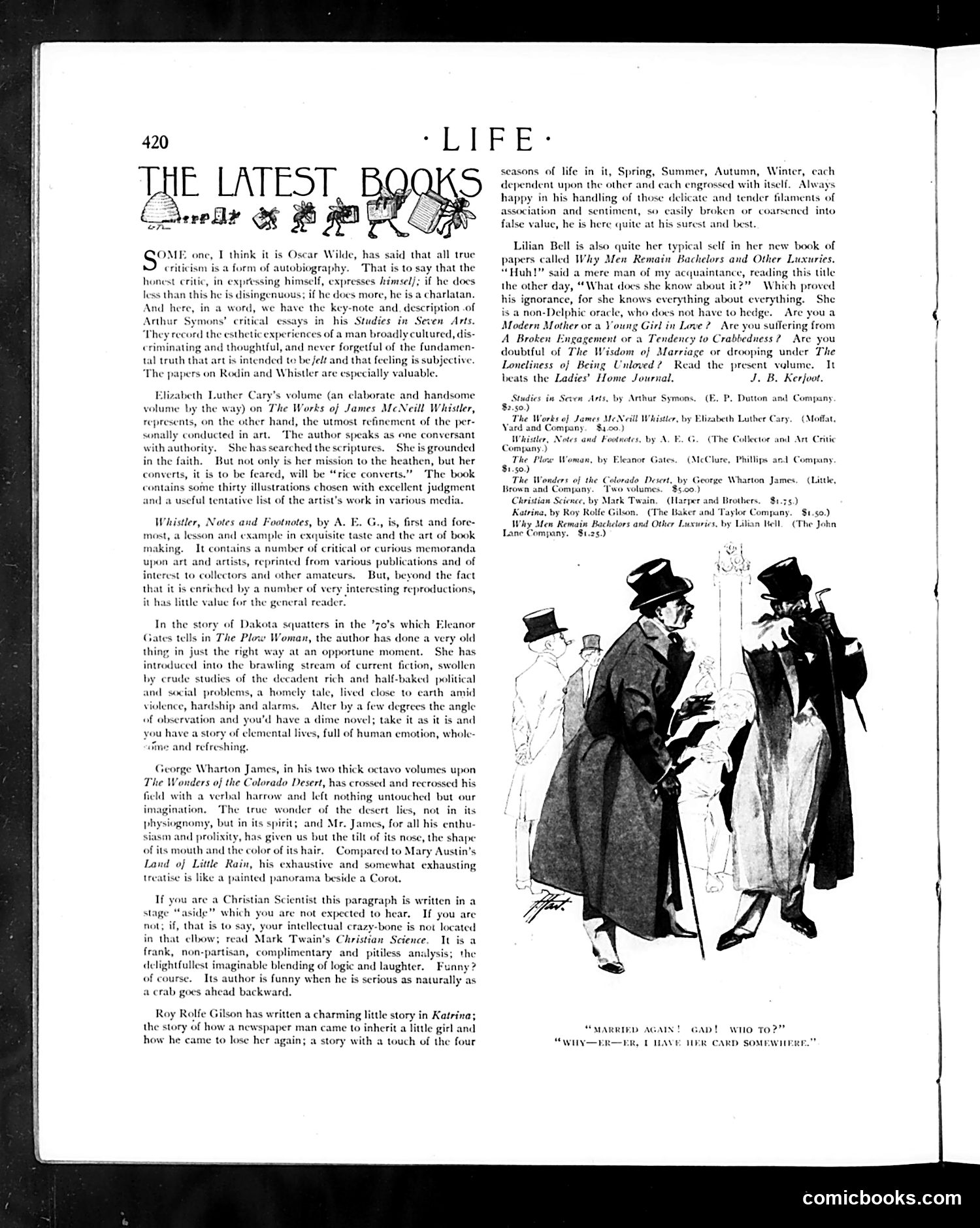
What you’re looking at
This page reviews recent books rather than containing political cartoons. The single illustration shows three well-dressed men in top hats examining what appears to be a card or document, with the caption: "Married again! Gad! Who to?" / "Why—er—I, I have her card somewhere." The joke depicts the confusion of a man encountering an ex-wife (or former romantic acquaintance) remarried to someone else—a social awkwardness played for humor. The "card" reference reflects Edwardian-era etiquette where calling cards were essential social currency. The surrounding text reviews books by Arthur Symons, Elizabeth Luther Cary, Eleanor Gates, George Wharton James, Mark Twain, and Roy Rolfe Gilson. The critic discusses aesthetic merit and literary merit with references to James McNeill Whistler and Mary Austin, reflecting *Life* magazine's role as a venue for literary criticism alongside satire and humor.
📄 Transcribed text from this page (OCR, searchable)
Machine-transcribed from the original scan — historical spelling and the odd misread are preserved.
S Sone, T think it is Oscar Wilde, has said that all true criticism is a form of autobiography. ‘That is to say that the honest critic, in expressing himself, expresses himselj; if he docs less than this he is disingenuous; if he docs more, he is a charlatan. And here, in a word, we have the key-note and. description .of Arthur Symons’ critical essays in his Studies in Seven Arts. “They record the esthetic experiences of a man broadly cultured, dis- criminating and thoughtful, and never forgetful of the fundamen- tal truth that art is intended to be felt and that feeling is subjective. The papers on Rodin and Whistler are especially valuable. Elizabeth Luther Cary’s volume (an claborate and handsome volume by the way) on The Works of James McNeill Whistler, represents, on the other hand, the utmost refinement of the per- sonally conducted in art, ‘The author speaks as one conversant with authority, She has searched the scriptures. She is grounded in the faith. But not only is her mission to the heathen, but her converts, it is to be feared, will be “rice converts.” ‘The book contains sone thirty illustrations chosen with excellent judgment and a useful tentative list of the artist’s work in various media. Whistler, Notes and Footnotes, by A. E. G., is, first and fore- most, at lesson and example in exquisite taste and the art of book making. upon art and artists, reprinted from various publications and of curs. But, beyond the fact interesting reproductions, It contains a number of critical or curious memoranda interest to collectors and other ama that it is enriched by a number of ve it has little value for the general reader! In the story of Dakota squatters in the ’7o’s which Eleanor Gates tells in’ The Plow Woman, the author has done a very old thing, in just the right way at an opportune moment. She has introduced into the brawling. strea by crude studies of the decadent rich and half-baked political and social problems, a homely tale, lived close to earth amid vi Alter by a few degrees the angle ud have a dime novel; take it as it is and n of current fiction, swollen lence, hardship and alarms. of observation and y you have a story of elemental lives, full of human emotion, whole- a 1 refreshing. George Wharton James, in his two thick octavo volumes upon he Wonders of the Colorado Desert, has crossed and recrossed his field with a verbal harrow and left nothing untouched but our imagination, ‘The true wonder of the desert lies, not in its physiognomy, but in its spirit; and Mr. James, for all his enthu- siasm and prolixity, has given us but the tilt of its nose, the shape of its mouth and the color of its hair. Compared to Mary Austin’s Land of Little Rain, his exhaustive and somewhat exhausting treatise is like a painted panorama beside a Corot. If you are a Christian Scientist this paragraph is written in a stage “aside” which you are not expected to hear. If you are not; if, that is to say, your intellectual crazy-bone is not located in that elbow; read Mark Twain's Christian Science. It is a frank, non-partisan, complimentary and_ pitiless analysis; the delightfullest imaginable blending of logic and laughter. Fuany? of course. Its author is funny when he is serious as naturally as a crab goes ahead backward. Roy Rolfe Gilson has written a charming little story in Katrina; the story Of how a newspaper man came to inherit a little girl and how he came to lose her again; a story with a touch of the four - LIFE - seasons of life in it, Spring, Summer, Autumn, Winter, cach dependent upon the other and cach engrossed with itself. Always happy in his handling of those delicate and tender filaments of association and sentiment, so casily broken or coarscned into false value, he is here quite at his surest and best. Lilian Bell is also quite her typical self in her new book of papers called Why Men Remain Bachelors and Other Luxuries. “Huh!” said a mere man of my acquaintance, reading this title the other day, “What docs she know about it?” Which proved his ignorance, for she knows everything about everything. She a non-Delphie oracle, who docs not have to hedge. Are you a Modern Mother or a Young Girl in Love 2 Are you suffering from A Broken Engagement or a Tendency to Crabbedness? Are you doubttul of The Wisdom of Marriage or drooping under The Loneliness 0} Being Unloved 2 Read the present valume. It beats the Ladies’ Home Journal. J.B. Kerfoot. Studies in Seven Arts, by Arthur Symons. (E 0.) rhe Works of James MeNeill Whistler, by Elizabeth Luther Cary. (Moffat, and Company. $4.00.) Whistler, Notes and Footne Company.) The Plow Woman, by Eleanor Gates. (McClure, Phillips and Company $1.50.) The Wonders of the Colorado Desert, by George Wharton James. (Little, Browa and Company. Two volumes. $5.00.) Christian Science, by Mark Twain. (Harper and Brothers. $1.75.) Katrina, by Roy Rolfe Gilson, (The Baker and Taylor Company. $1.50.) Why Men Remain Bachelors and Other Luxuries, by Lilian Keil. (The John Lane Company. $1.25.) . Dutton and Company ¥ he Collector Art Critic by AEG. (1 “MARRIED AGAIN! GAD! wo To?” “WHYER—ER, EP MAVE HER CARD SOMEWHERE comicbooks.com