
Life, 1907-03-21 · page 12 of 40
Life — March 21, 1907 — page 12: what you’re looking at
What you’re looking at
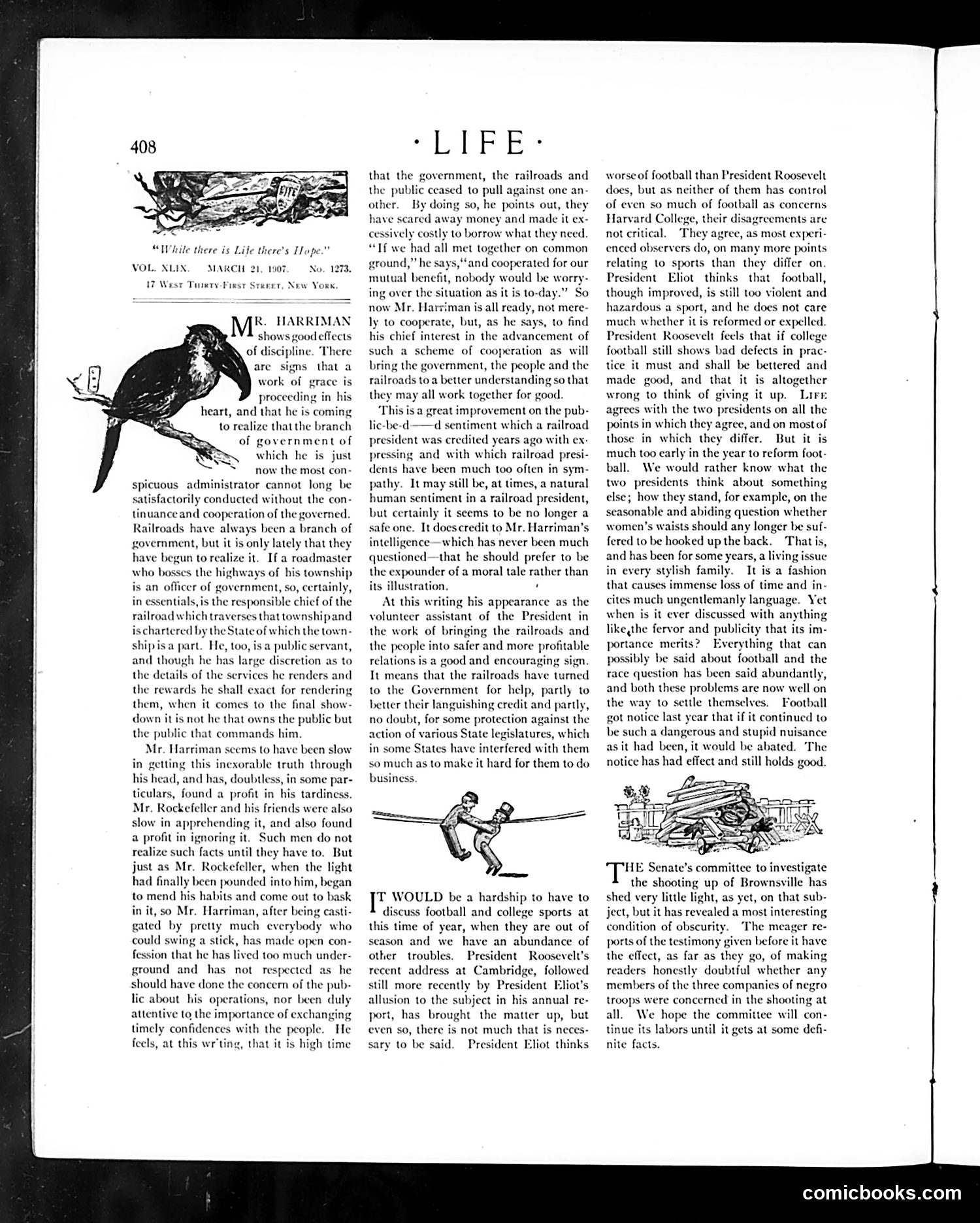
This page features editorial commentary on Mr. Harriman (likely E.H. Harriman, the prominent railroad magnate) and government relations. The text praises Harriman's willingness to cooperate with the government on railroad matters, arguing that such collaboration benefits the public interest. The page also critiques discussion of football and college sports, suggesting such debates distract from more serious issues. The author argues that while football has problems, debating its merits is less important than addressing substantive governance matters. The small cartoon illustrations appear to be decorative vignettes related to the text topics rather than standalone satirical pieces. The overall tone is earnest political commentary rather than sharp satire.
📄 Transcribed text from this page (OCR, searchable)
Machine-transcribed from the original scan — historical spelling and the odd misread are preserved.
“While there is Life there's Hope." VOL. XLIX, MARCH 21, 1907 No. 12 17 West Turery-First Srarer, New York. R. HARRIMAN shows good effects cipline. There are signs that a work of grace is proceeding in his heart, and that he is coming to realize thatthe branch of government of which he is just now the most con- spicuous administrator cannot long be satisfactorily conducted without the con- tinuanceand cooperation of the governed. Railroads have always been a branch of government, but it is only lately that they have begun to realize it. If a roadmaster who bosses the highways of his township is an officer of government, so, certainly, in essentials, is the responsible chief of the railroad which traverses that townshipand ischartered by the State of which the town- shipisa part. He, too, isa public servant, and though he has large discretion as to the details of the services he renders and the rewards he shall exact for rendering them, when it comes to the final show- down itis not he that owns the public but the public that commands him. Mr. Harriman seems to have been slow in getting this inexorable truth through his head, and has, doubtless, in some par- ticulars, found a profit in his tardiness. Mr. Rockefeller and his friends were also slow in apprehending it, and also found a profit in ignoring it. Such men do not realize such facts until they have to. But just as Mr. Rockefeller, when the light had finally been pounded into him, began to mend his habits and come out to bask in it, so Mr. Harriman, after being casti- gated by pretty much everybody who could swing a stick, has made open con- fession that he has lived too much under- ground and has not respected as he should have done the concern of the pub- lic about his operations, nor been duly attentive to the importance of exchanging timely confidences with the people. He feels, at this writing, that it is high time "LIF E* that the government, the railroads and the public ceased to pull against one an other. By doing so, he points out, they have seared away money and made it ex- cessively costly to borrow what they need. “Tf we had all met together on common sround,” he says,“‘and cooperated for our mutual benefit, nobody would be worry- ing over the situation as it is to-da So now Mr. Harriman is all ready, not mere- ly to cooperate, but, as he says, to find his chief interest in the advancement of such a scheme of cooperation will bring the government, the people and the railroads toa better understanding so that they may all work together for good. ‘This is a great improvement on the pub- lic-be-d——d sentiment which a railroad president was credited years ago with ex- pressing and with which railroad presi- dents have been much too often in sym- pathy. It may still be, at times, a natural human sentiment in a railroad president, but certainly it seems to be no longer a safe one. It doescredit to Mr. Harriman’s. intelligence—which has never been much questioned—that he should prefer to be the expounder of a moral tale rather than its illustration, ' At this writing his appearance as the volunteer assistant of the President in the work of bringing the railroads and the people into safer and more profitable relations is a good and encouraging sign. It means that the railroads have turned to the Government for help, partly to better their languishing credit and partly, no doubt, for some protection against the action of various State legislatures, which in some States have interfered with them so much as to make it hard for them to do business. T WOULD be a hardship to have to discuss football and college sports at this time of year, when they are out of season and we have an abundance of other troubl President Roosevelt's recent address at Cambridge, followed still more recently by President Eliot’s allusion to the subject in his annual re- port, has brought the matter up, but even so, there is not much that is neces- sary to be said. President Eliot thinks worse of football than President Roosevelt does, but as neither of them has control of even so much of football as concerns Harvard College, their disagreements are not critical. They agr most experi- enced observers do, on many more points relating to sports than they differ on. President Eliot thinks that football, though improved, is still too violent and hazardous a sport, and he does not care much whether it is reformed or expelled President Roosevelt feels that if college football still shows bad defects in. prac- tice it must and shall be bettered and made good, and that it is altogether wrong to think of giving it up. Lirr agrees with the two presidents on all the points in which they agree, and on most of those in which they differ. But it is much too early in the year to reform foot- ball. We would rather know what the two presidents think about something else; how they stand, for example, on the seasonable and abiding question whether women’s waists should any longer be suf- fered to be hooked up the back. Thatis, and has been for some years, a living issue in every stylish family. It is a fashion that causes immense loss of time and in- cites much ungentlemanly language. Yet when is it ever discussed with anything like,the fervor and publicity that its im- portance merits? Everything that can possibly be said about football and the race question has been said abundantly, and both these problems are now well on the way to settle themselves. Football got notice last year that if it continued to be such a dangerous and stupid nuisance asit had been, it would be abated. The notice has had effect and still holds good. HE Senate’s committee to investigate the shooting up of Brownsville has shed very little light, as yet, on that sub- ject, but it has revealed a most interesting condition of obscurity. ‘The meager re- ports of the testimony given before it have the effect, as far as they go, of making readers honestly doubtiul whether any members of the three companies of negro troops were concerned in the shooting at all. We hope the committee will con- tinue its labors until it gets at some defi- nite facts. comicbooks.com