
A complete issue · 33 pages · 1906
Life — December 27, 1906
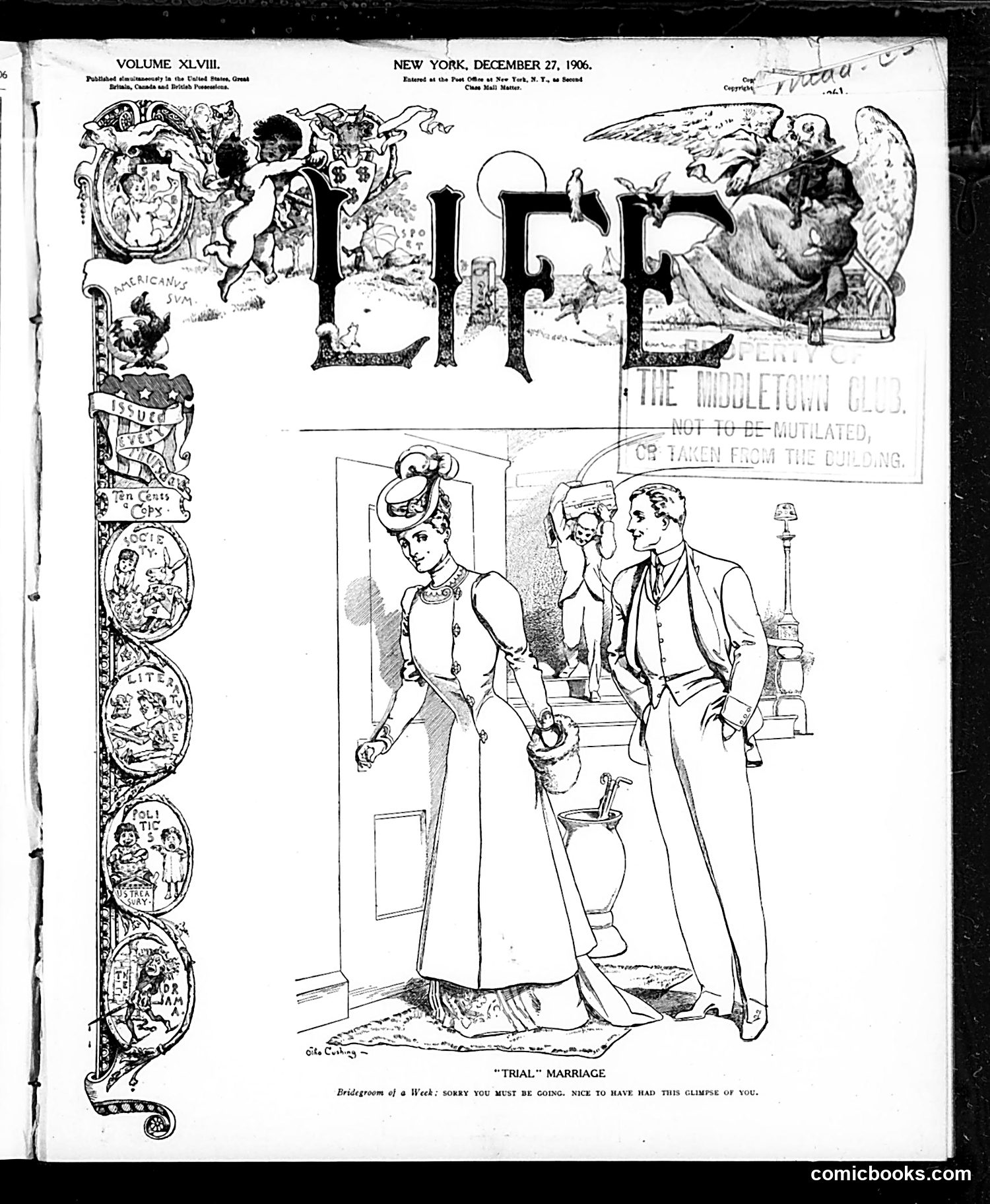
This cartoon satirizes the early-1900s social controversy over "trial marriages"—unmarried couples living together to test compatibility before formal marriage. The scene depicts a bridegroom confronting a woman (his bride) at their wedding, saying "Sorry you must be going. Nice to have had this glimpse of you." The caption "Trial Marriage: Bridegroom of a Week" suggests he's ending their arrangement after only seven days. The satire mocks both the concept's impracticality and society's anxiety about it. By showing a man casually dismissing his bride after a week, the cartoon ridicules the notion that such relationships could work, implying they're unstable and mercenary. The ornate decorative border with classical motifs emphasizes the contrast between traditional matrimonial values and this modern, questioned arrangement.
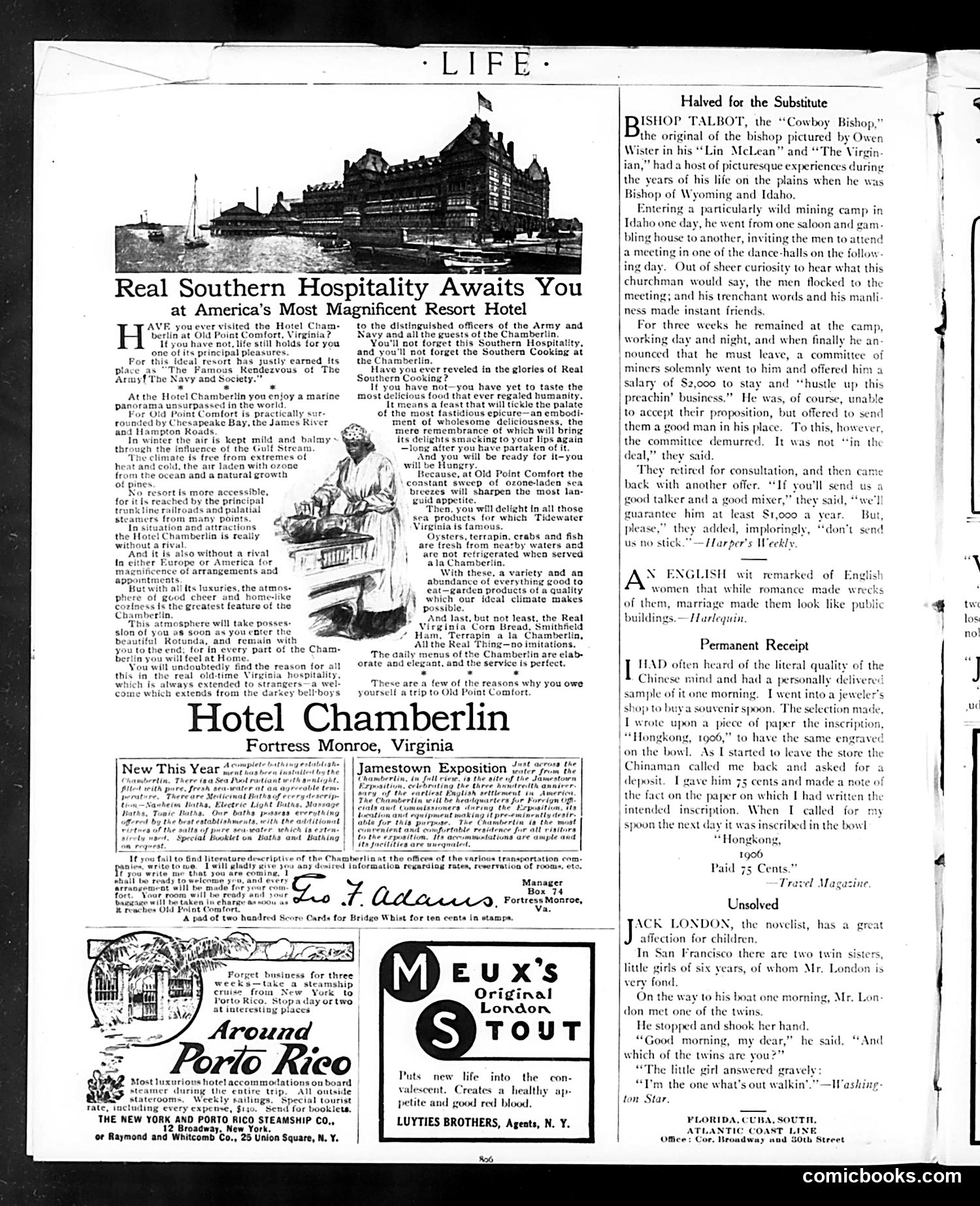
This page is **primarily advertising** rather than satirical content. The dominant features are commercial advertisements: - **Hotel Chamberlin** (Fortress Monroe, Virginia) — a large resort hotel ad emphasizing "Southern Hospitality" - **Around Porto Rico** — tourism advertisement - **Meux's Original London Stout** — beer advertisement - **Jamestown Exposition** notice The right column contains brief anecdotal pieces ("Halved for the Substitute," "An English Wit," "Permanent Receipt," "Unsolved") — humorous short stories rather than political satire. There are **no identifiable political cartoons or caricatures** on this page. The small illustrations are decorative elements supporting the advertisements rather than satirical commentary. This appears to be a standard early-20th-century *Life* magazine page mixing light humor content with paid advertising.
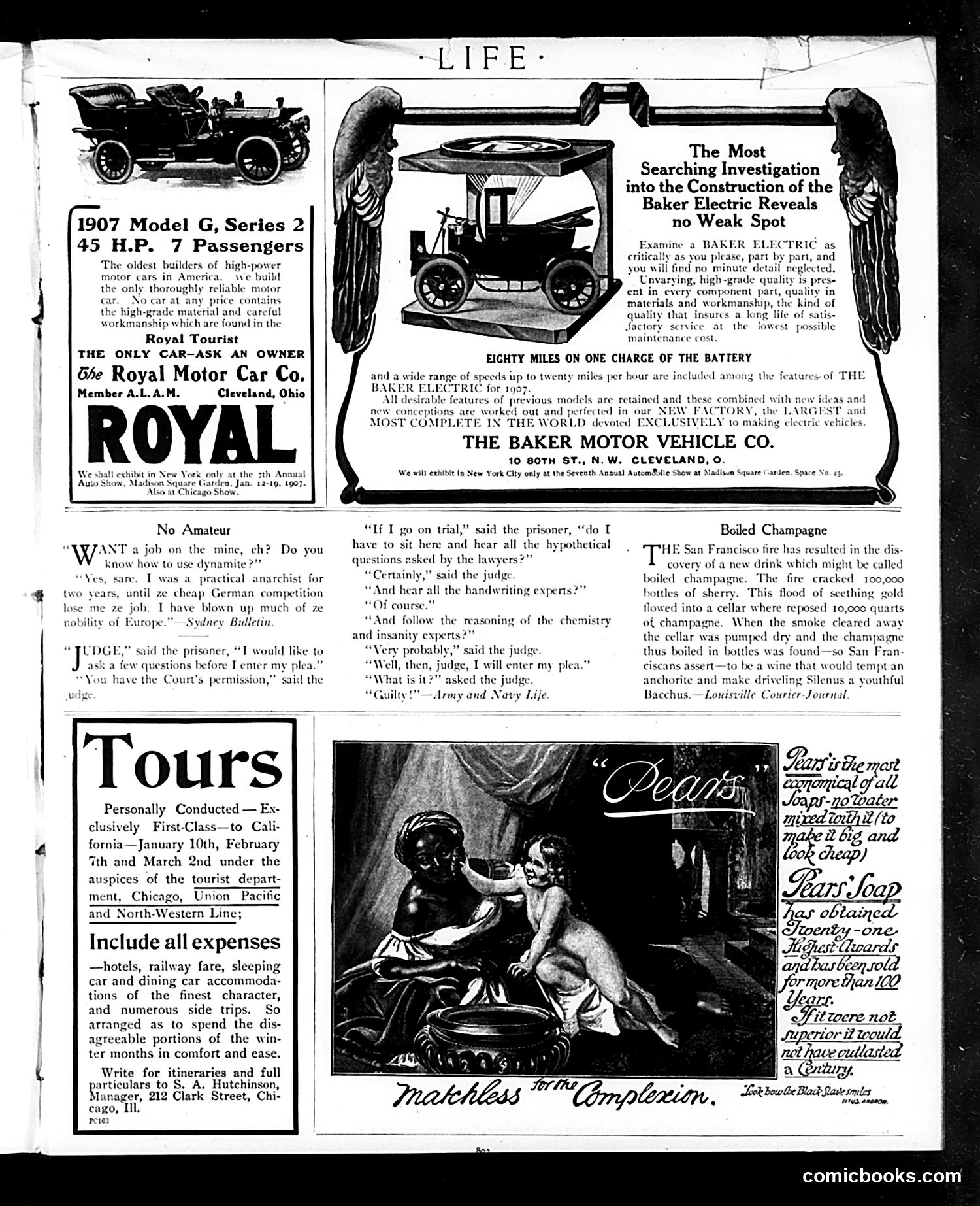
This page is primarily **advertising**, not political satire. It contains three vehicle ads (Royal Motor Car, Baker Electric) and a travel tour promotion, along with brief humorous anecdotes. The small comedy pieces—"No Amateur," "Boiled Champagne," and a prisoner/judge exchange—are generic jokes typical of early 1900s humor magazines, not political commentary. They rely on wordplay and situational irony rather than topical references. The illustrated advertisement for "Pears" soap (bottom right) uses sentimental Victorian imagery common to period advertising, promoting the product's longevity and quality. Overall, this is a commercial page showcasing consumer products available to wealthy Americans circa 1907, with light entertainment filler. No significant political or social satire is evident.
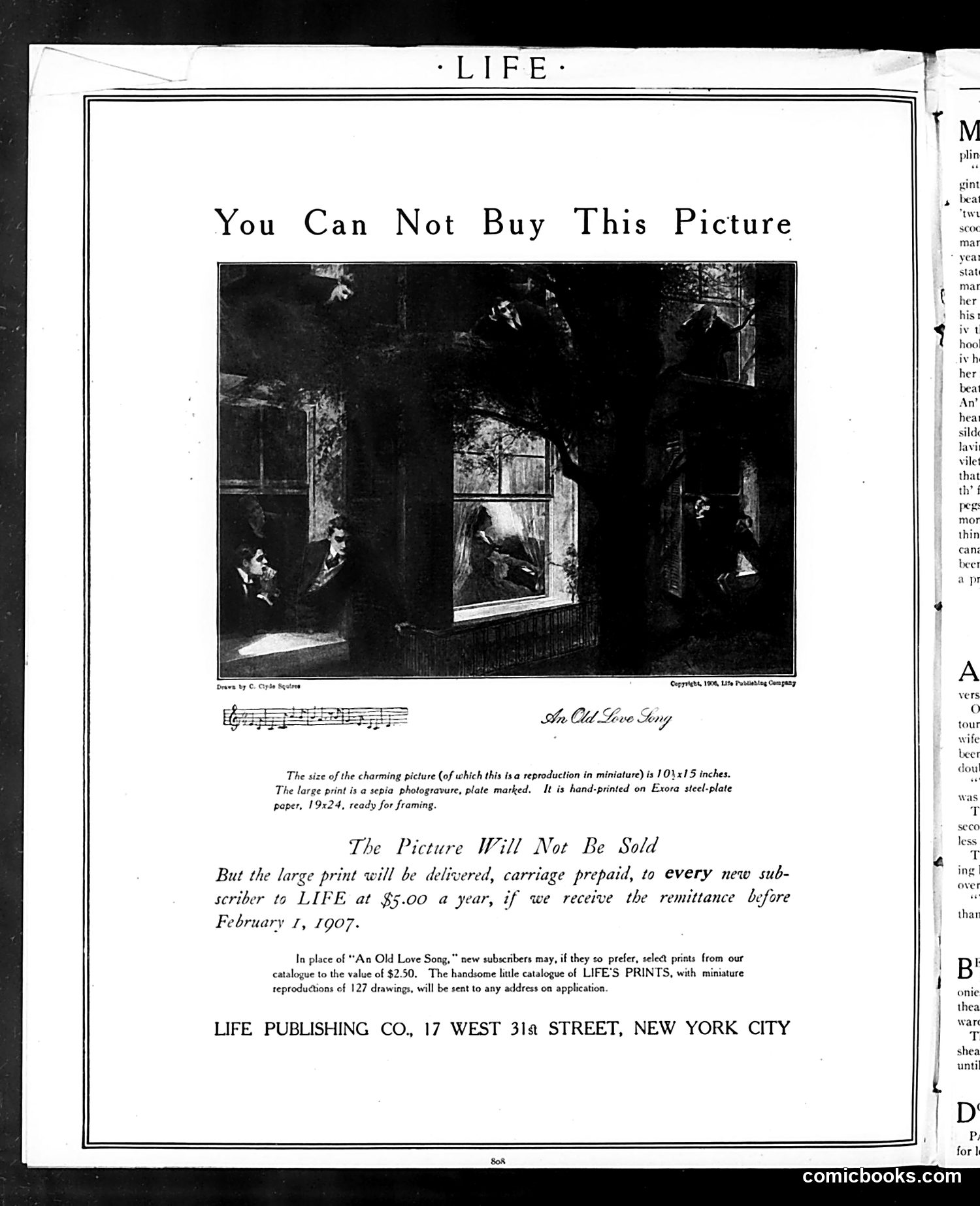
This page is primarily **advertising**, not satire or political commentary. Life Publishing Company is promoting a picture titled "An Old Love Song," drawn by C. Clyde Forsythe. The headline "You Can Not Buy This Picture" is a marketing hook—the artwork won't be sold separately, but the large print (10x15 inches) will be given free to new subscribers paying $5 annually, if they remit payment before February 1, 1907. The image itself appears to be a sentimental illustration of figures near a building at night, consistent with the romantic title. The page also mentions an alternative: new subscribers can instead select prints from Life's catalogue of 127 drawings for $2.50. This is essentially a **subscription drive advertisement** using exclusivity as an incentive.
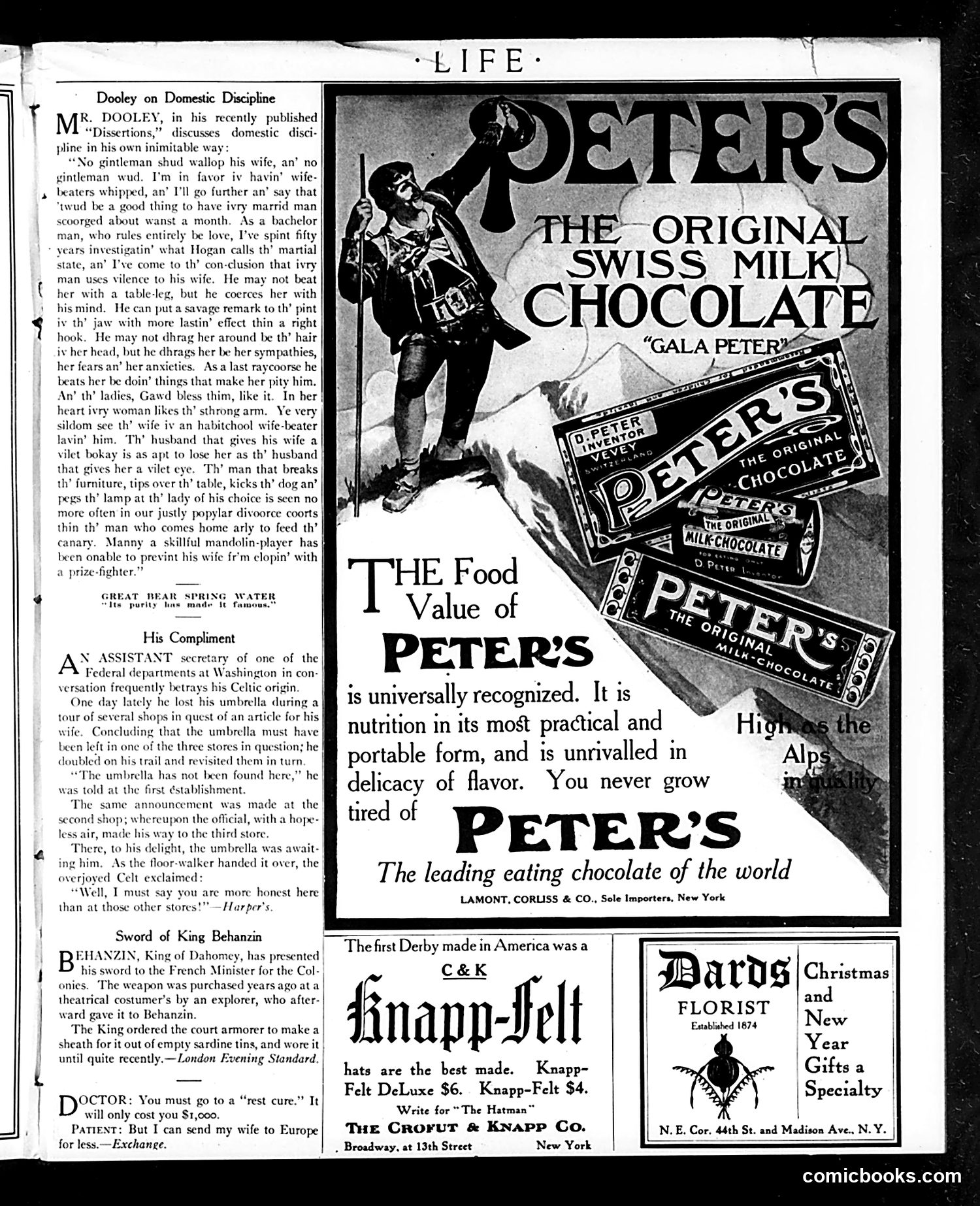
This page is **primarily advertising** with minimal satirical content. The dominant feature is a Peter's Chocolate advertisement showing a figure climbing an Alpine mountain, promoting "The Original Swiss Milk Chocolate" as "the leading eating chocolate of the world." The left column contains three brief humorous anecdotes rather than political cartoons: 1. **"Dooley on Domestic Discipline"** - satirizes marital dynamics and spousal obedience 2. **"His Compliment"** - a brief joke about an umbrella mix-up at a Washington department 3. **"Sword of King Behanzin"** - references a historical artifact presented to the French War Ministry The remaining content consists of advertisements for Knapp-Felt hats and Bards Florist. There is **no clear political cartoon or satire** addressing contemporary events on this page.
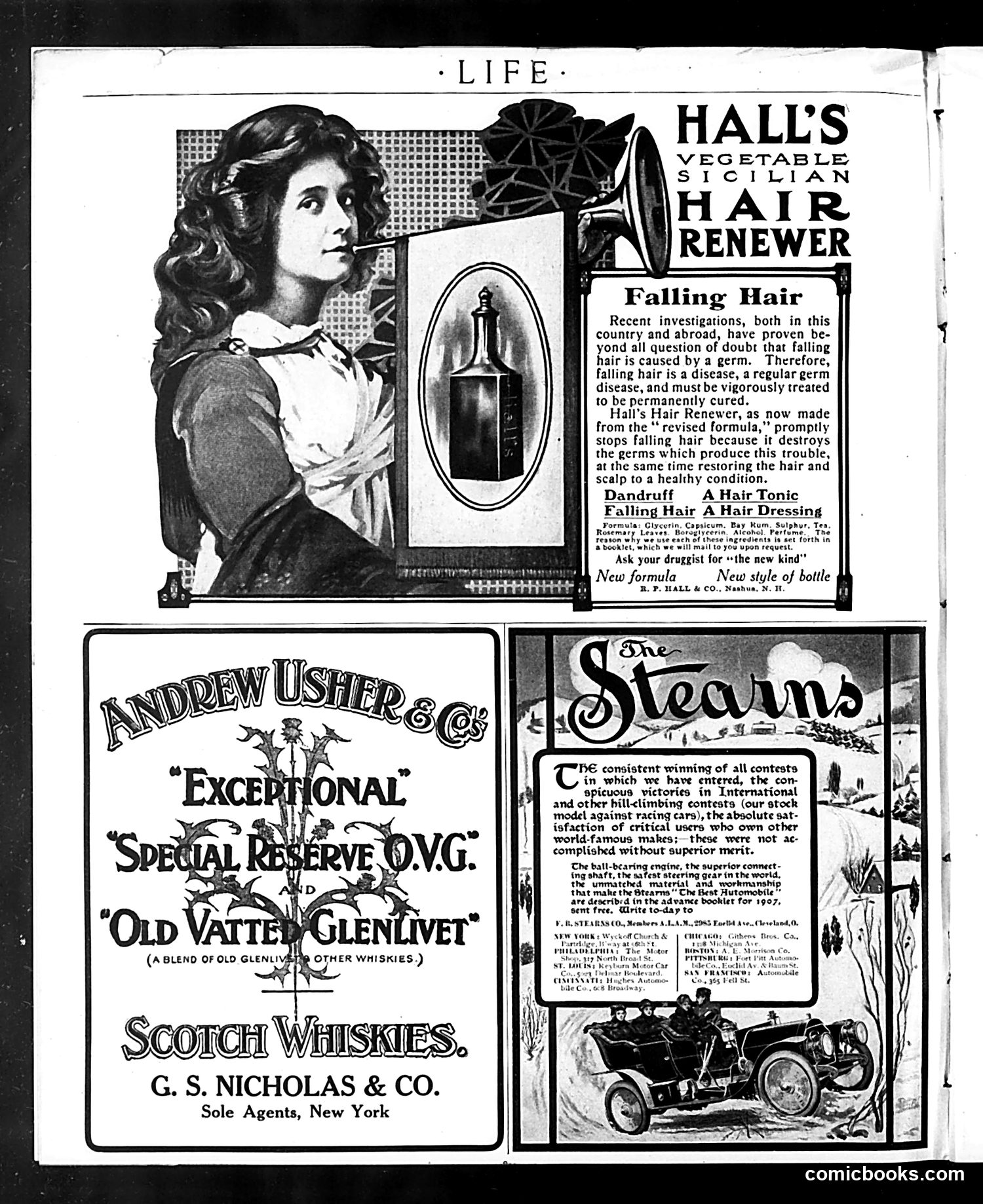
This page is **primarily advertising** rather than satirical content. It contains three distinct ads: 1. **Hall's Hair Renewer** (top): Markets a hair loss treatment claiming to cure baldness by destroying disease-causing germs. The ad features a woman with luxuriant hair and includes medical-sounding language typical of early 20th-century patent medicines. 2. **Andrew Usher Scotch Whisky** (bottom left): Advertisement for Scottish whisky sold by G.S. Nicholas & Co. in New York, emphasizing "Special Reserve" quality. 3. **The Stearns Automobile** (bottom right): Promotes a motorcar, highlighting contest victories and technical superiority, with an illustration of an early racing vehicle. The page reflects typical early 1900s advertising practices, mixing dubious health claims with luxury goods marketing.
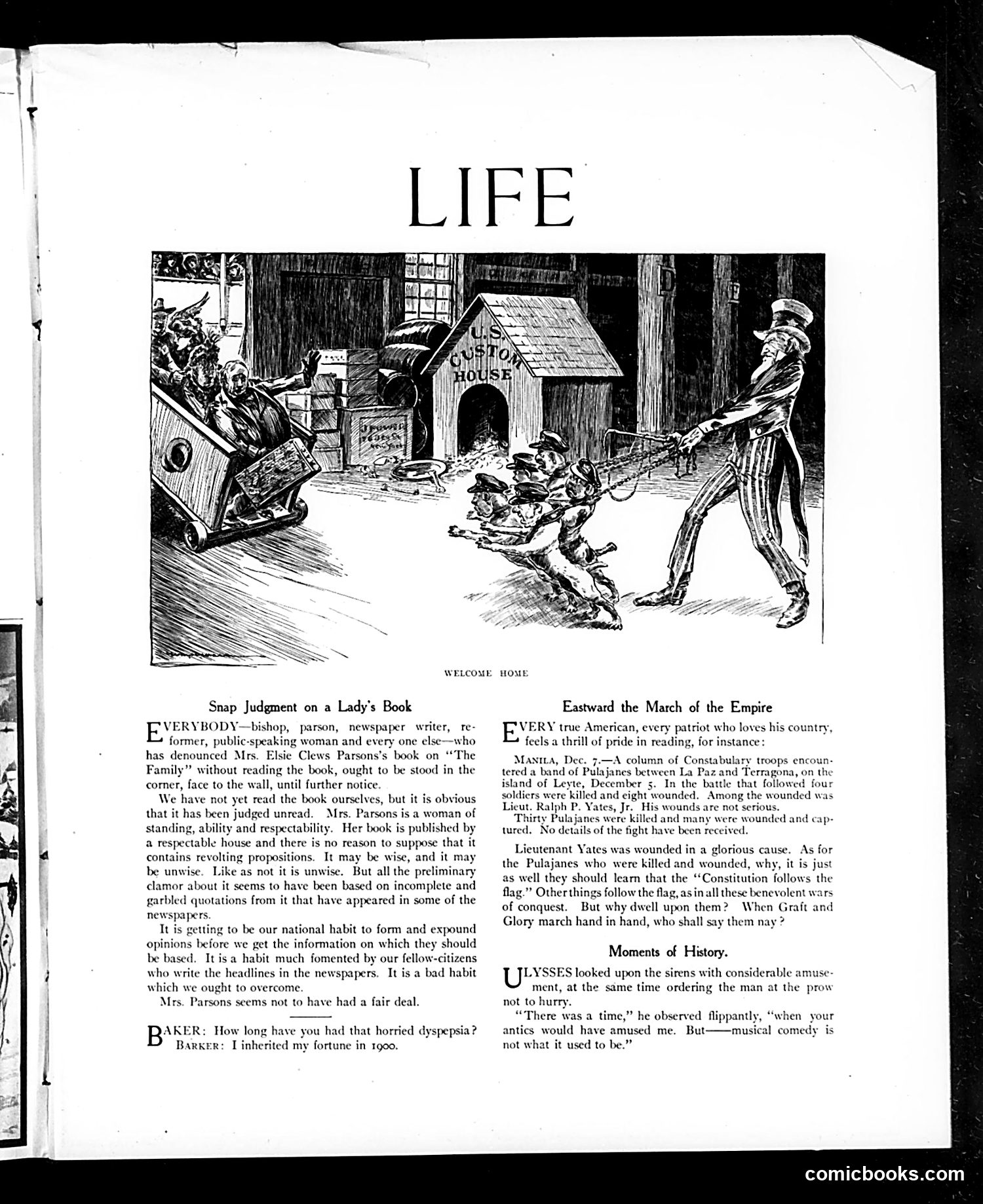
This page contains editorial content criticizing social judgment and commentary. The top illustration, titled "Welcome Home," depicts a scene with a man being taunted by children near a "Custom House," likely satirizing public shaming or gossip. The main article "Snap Judgment on a Lady's Book" defends Mrs. Elsie Clews Parsons against harsh newspaper criticism of her book "The Family." The author argues that critics have judged it unfairly without reading it completely, and that forming and publishing opinions on incomplete information is a national problem that should be overcome. Below are brief humor pieces, including a joke about inherited dyspepsia (digestive illness). The second article discusses American patriotism regarding Philippine troops during military conflict, with a historical anecdote about naval amusement.
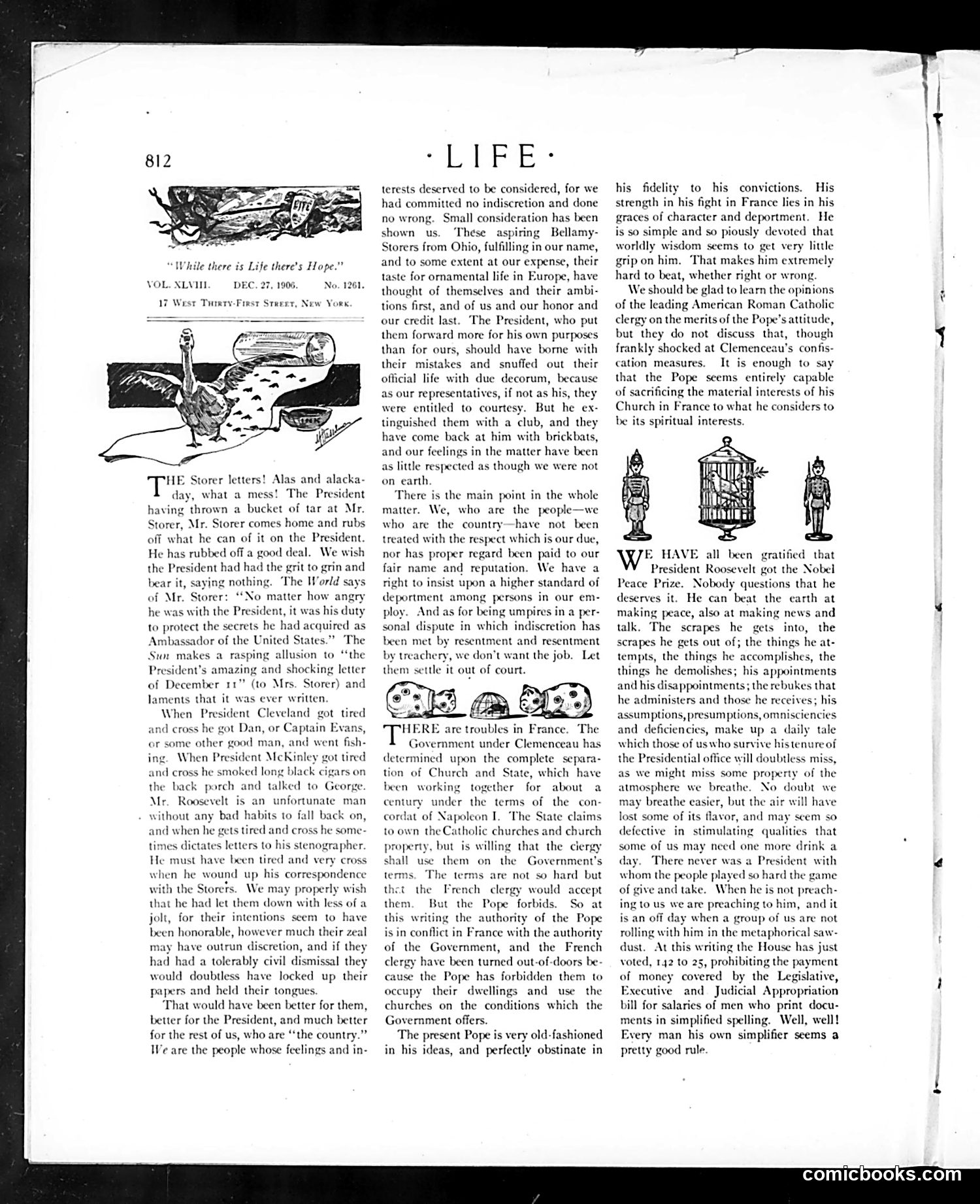
The main cartoon depicts **President Theodore Roosevelt** as a figure being struck or attacked, illustrating criticism over the **Storer letters scandal**. The text discusses how Roosevelt dismissed Ambassador Bellamy Storer and his wife after they publicly criticized the President's handling of Church-State relations in France. The cartoon criticizes Roosevelt's response—using a "club" against those who questioned him—as disrespectful to American citizens' right to voice opinions. The article argues that while Roosevelt deserves credit for his Nobel Peace Prize, he's shown poor judgment in how he treated the Storers, who were prominent Republicans. The satire suggests the President's famous aggressive personality ("grit") becomes counterproductive when directed at fellow citizens exercising free speech.
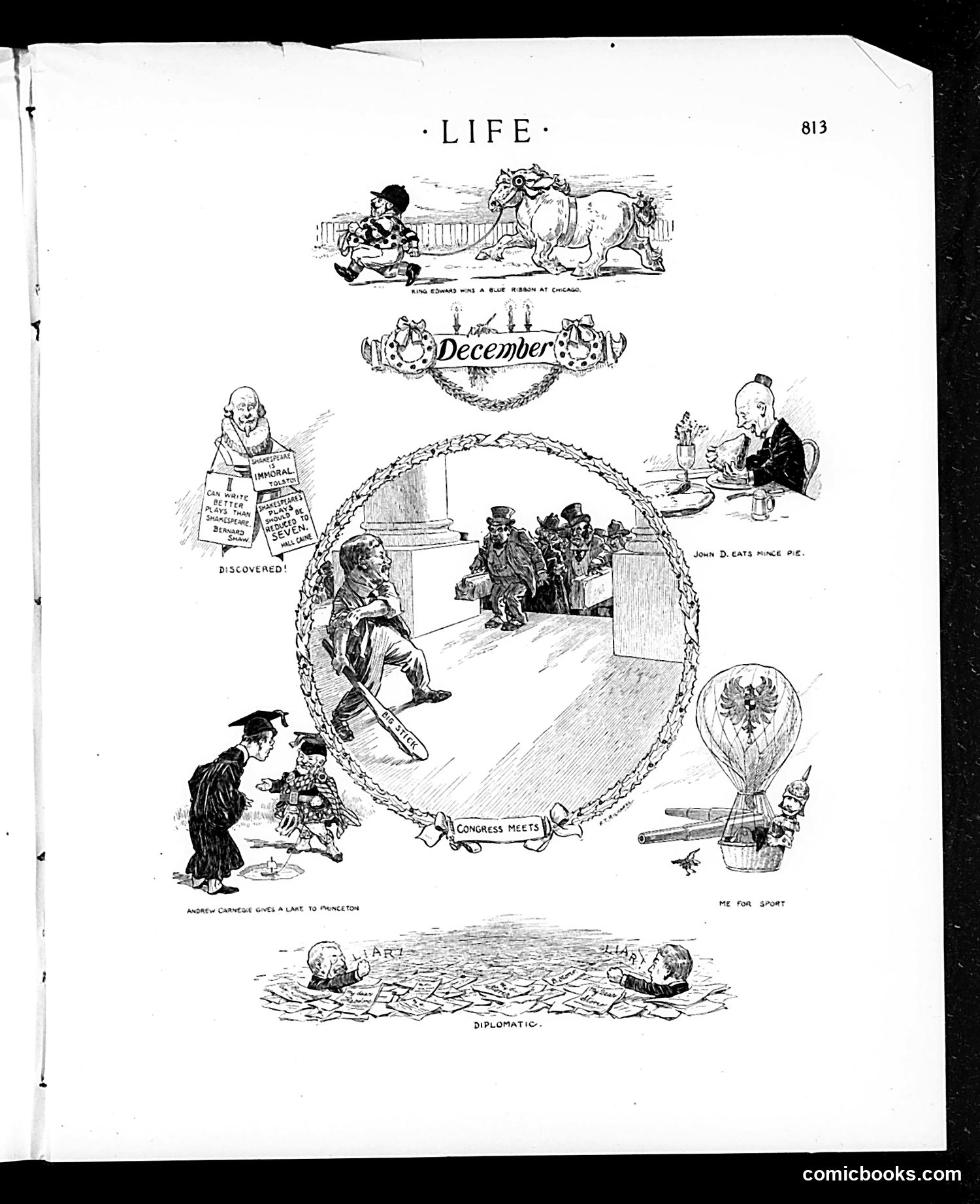
This December-themed satirical page features several contemporary political and social commentary cartoons: **Central scene ("Congress Meets")**: Depicts Congress in session, likely satirizing legislative proceedings during a specific political moment. **"Discovered"** (left): Shows a figure reading newspapers with sensational headlines, mocking yellow journalism or political scandal-mongering. **"John D. Eats Mince Pie"** (right): References John D. Rockefeller, the wealthy industrialist, in a domestic scene—possibly satirizing wealth disparity or the contrast between the ultra-rich and ordinary citizens. **Bottom cartoon ("Diplomatic")**: Two figures buried in papers labeled "Art" and "Heart," with "Diplomatic" caption—likely criticizing diplomatic negotiations or peace talks as paperwork-heavy bureaucracy. **Additional vignettes**: Including "Andrew Carnegie Gives a Cake to Princeton" and "Me for Sport" (hot air balloon), commenting on wealthy philanthropists and leisure activities. The page overall satirizes American politics, wealth, and current events through visual humor.
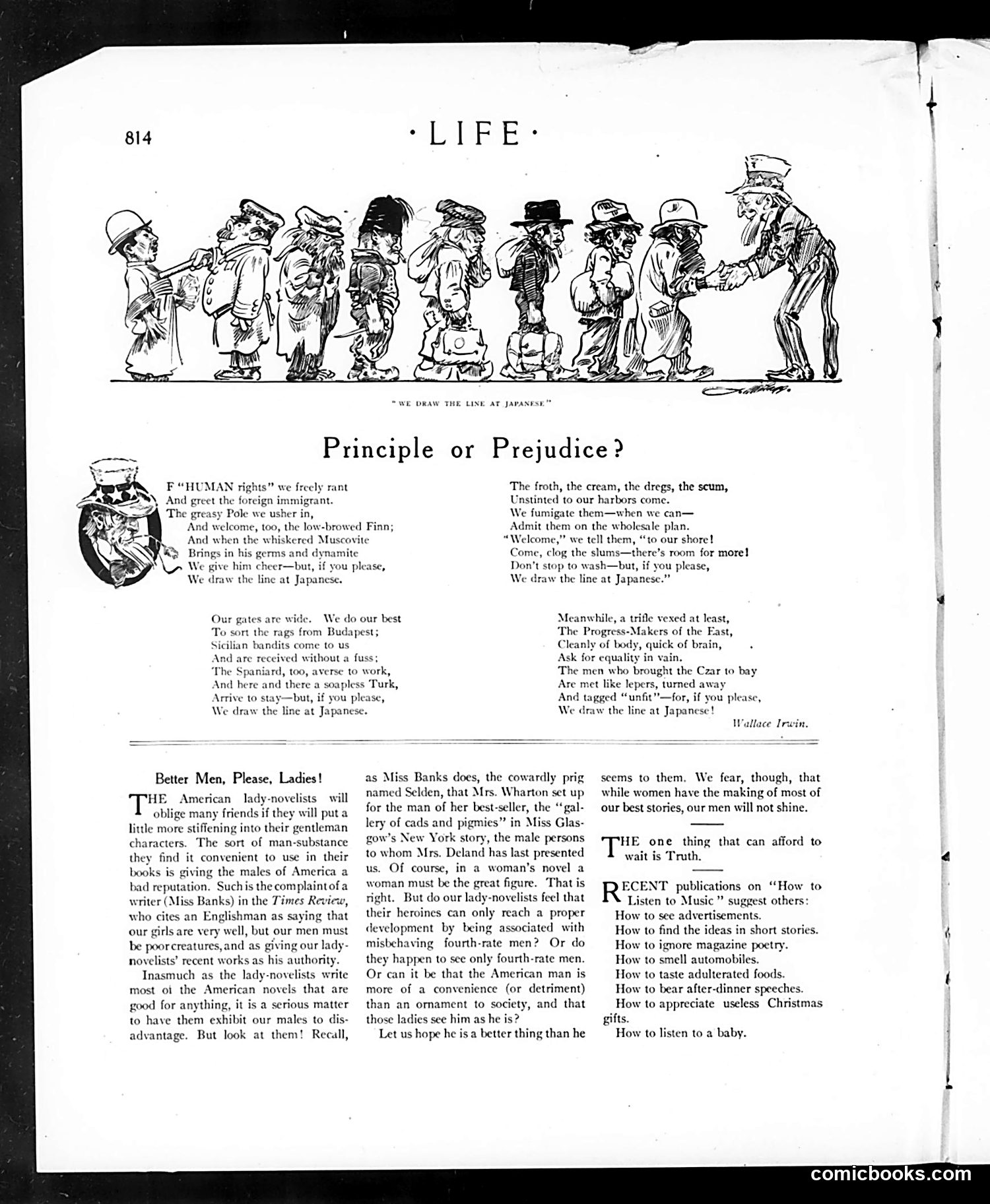
**The Cartoon:** The top illustration shows Uncle Sam (right, in stars-and-stripes hat) refusing entry to a line of immigrants of various ethnicities—representing "the froth, the cream, the dregs, the scum" mentioned in the accompanying poem. The caption "We Draw the Line at Japanese" indicates this specifically targets Japanese immigration exclusion. **The Point:** The satirical poem "Principle or Prejudice?" critiques American immigration hypocrisy. While America claims to welcome all races and nationalities, it selectively excludes Japanese immigrants despite professing "human rights." The cartoon mocks this contradiction—Uncle Sam welcomes Europeans (Finns, Muscovites, Turks, Spaniards) but rejects Japanese applicants, exposing that American "principles" mask racial prejudice.
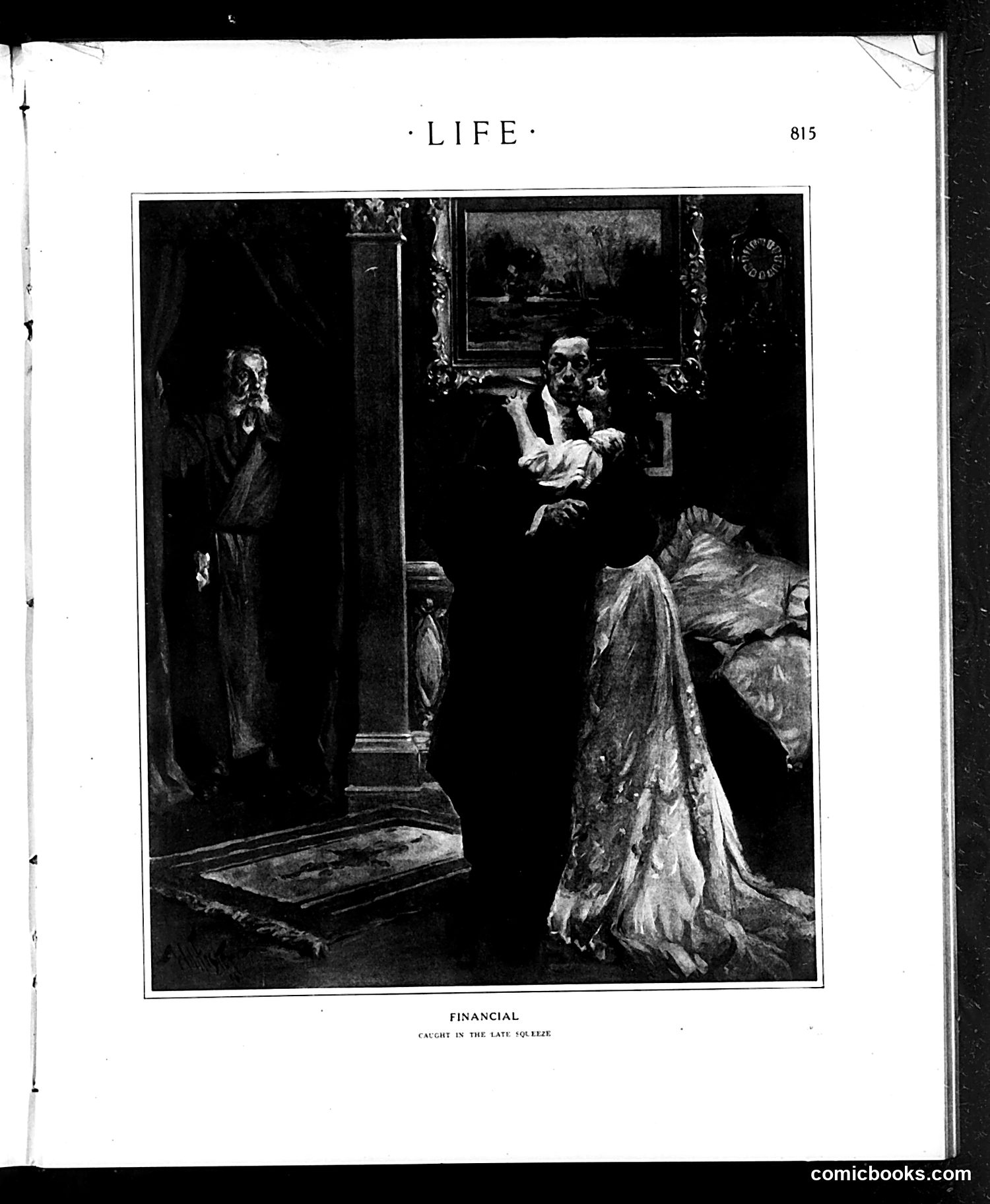
This satirical illustration depicts a domestic scene where a woman in an elaborate dress confronts two men in what appears to be a wealthy home. The caption "Caught in the Late Squeeze" suggests financial hardship or economic pressure affecting the upper class. The artwork satirizes the tension between maintaining appearances of wealth and luxury (evident in the woman's ornate clothing and home furnishings) while facing actual financial difficulties. The "squeeze" likely refers to economic constraints—possibly inflation, market downturns, or personal debt—forcing even wealthy households to account for their spending. The composition captures the awkward moment when financial reality intrudes upon genteel society, mocking the pretense of the affluent class during economically strained times.
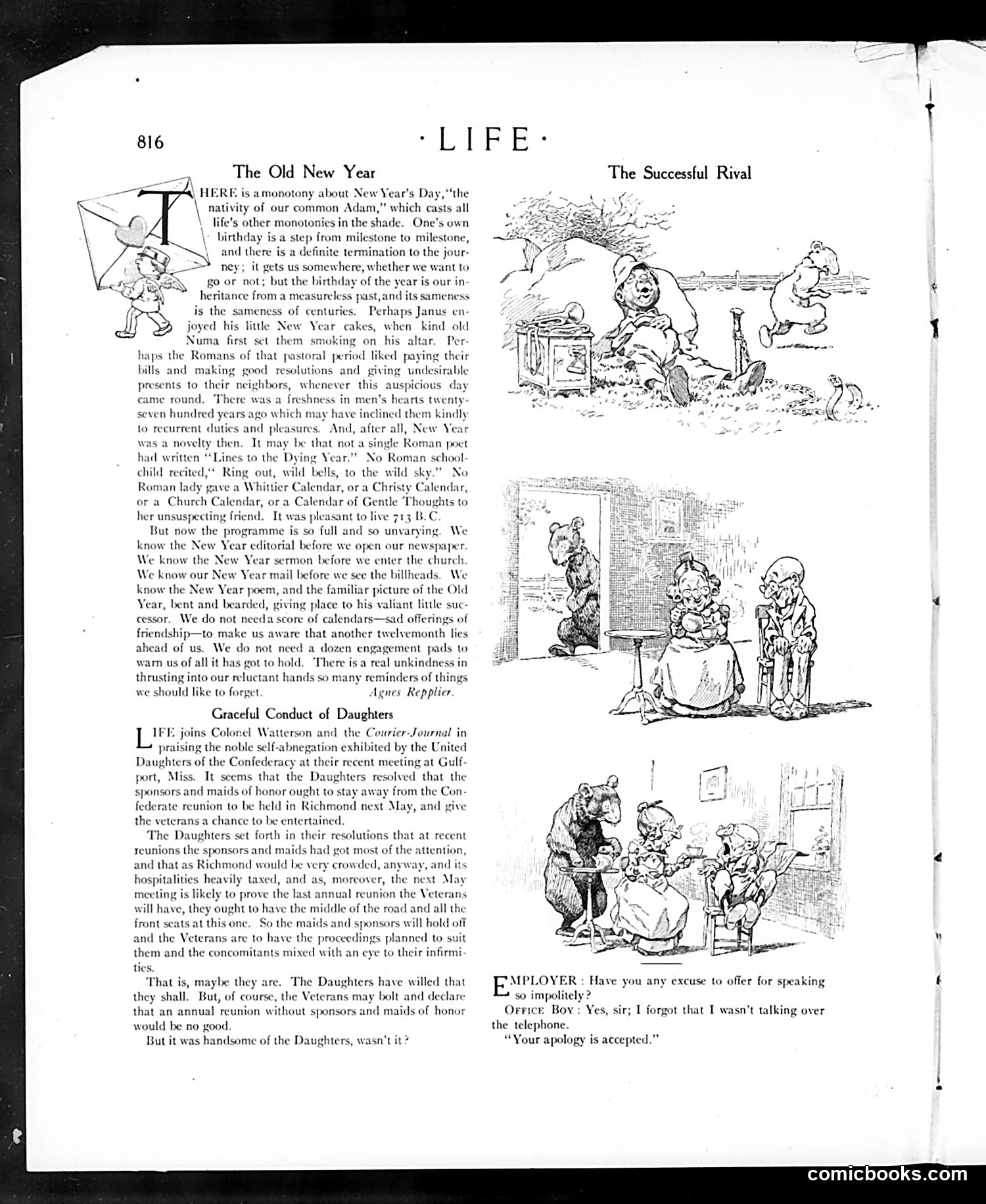
This page contains three distinct pieces: **"The Old New Year"** (left column): An essay by Agnes Repplier critiquing the monotony of New Year observances and commercialization—calendars, gifts, and social obligations have made the holiday routine rather than meaningful. **"The Successful Rival"** (top right): A comic strip showing children playing with a toy soldier, illustrating sibling rivalry or competition for attention. **"Graceful Conduct of Daughters"** (bottom left): A brief article praising the United Daughters of the Confederacy for not requiring sponsors and maids of honor at their reunions, reducing strain on veterans' hospitality. **Untitled comic dialogue** (bottom right): An office scene where an employee makes an excuse for speaking improperly (forgot he wasn't on the telephone), receiving a curt apology from his employer—satirizing workplace politeness and the intrusion of telephone etiquette into face-to-face conversation.
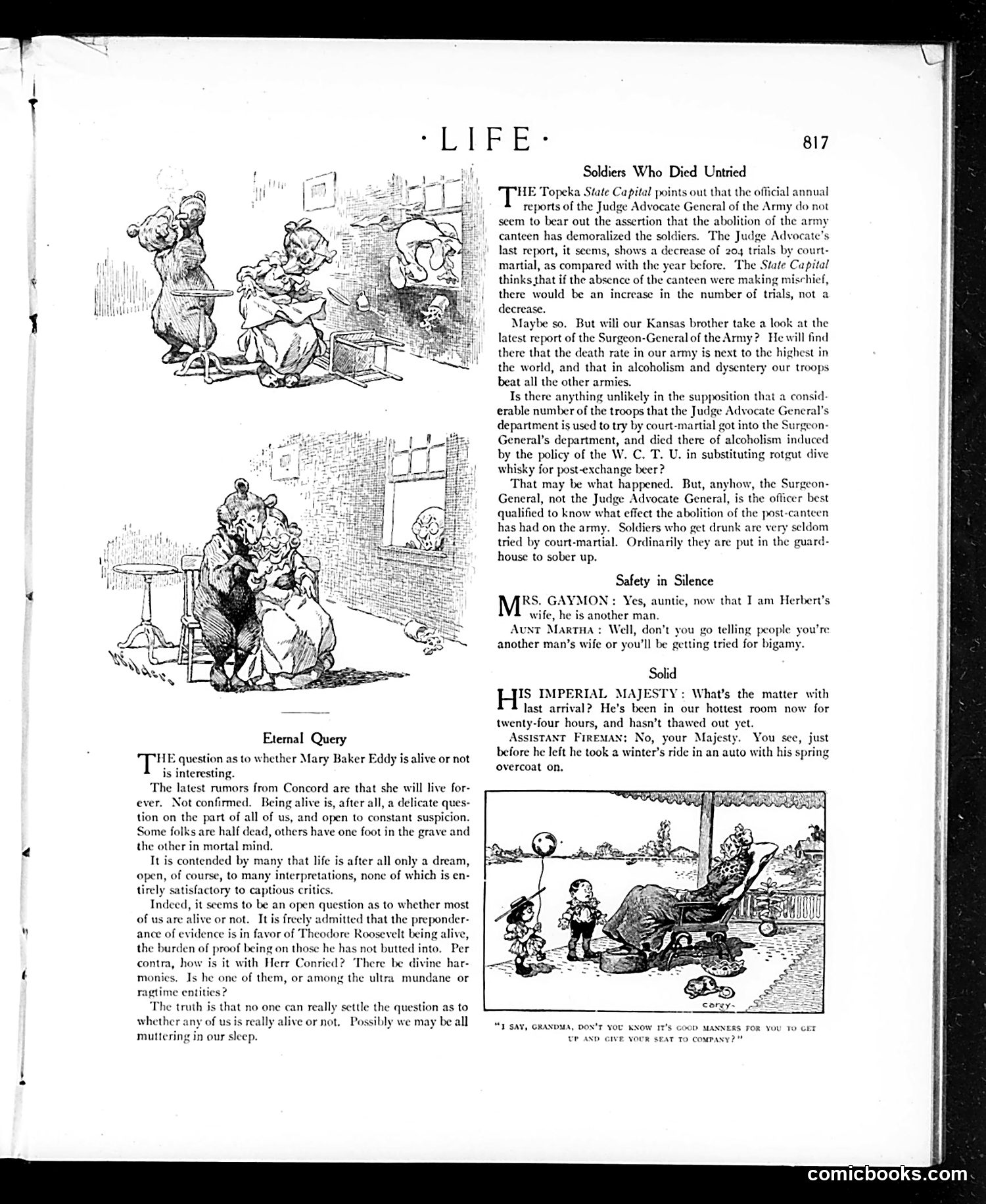
This page contains three distinct sections: **"Soldiers Who Died Untried"** (top) critiques the Army's abolition of the canteen, arguing the policy increased soldier deaths from alcoholism and dysentery. The cartoons show soldiers drinking from bottles in barracks, suggesting the canteen's removal drove drinking underground rather than preventing it. **"Eternal Query"** (left) discusses speculation about whether Mary Baker Eddy (Christian Science founder) is alive or dead, reflecting public fascination with her mysterious status and the various rumors circulating. **"Safety in Silence," "Solid,"** and the bottom cartoon appear to be humor pieces about domestic life and social conduct, with the final cartoon showing someone being corrected about proper etiquette regarding giving up seats.
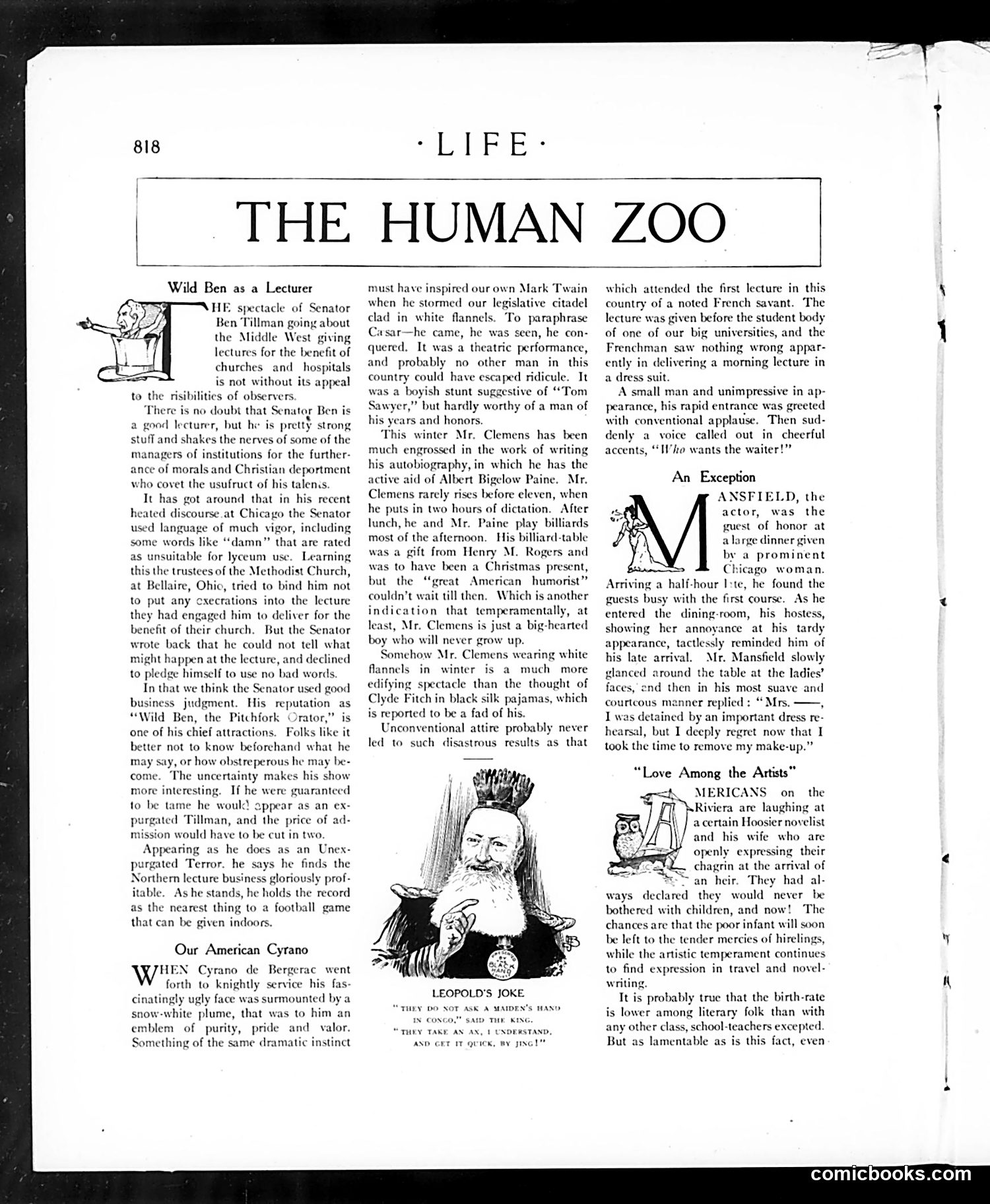
This page satirizes three American public figures through mock-serious criticism: **"Wild Ben as a Lecturer"**: Senator Ben Tillman, a notorious firebrand politician, lectures across the Midwest. The satire highlights the contradiction in hiring him for church fundraisers while expecting him to censor his notorious profanity—his main appeal to audiences. Life mocks that removing his colorful language would make him worthless, comparing him to a "football game" for entertainment value rather than moral edification. **"Our American Cyrano"**: Mark Twain's recent appearance in white flannels (casual summer wear in winter) before Congress is compared to theatrical posturing. The writer criticizes this as beneath his dignity, though admitting only Twain could pull off such a "boyish stunt" without ridicule. **"Leopold's Joke"**: A crude cartoon mocking King Leopold II of Belgium's brutal Congo regime, presenting colonial violence as casual humor. The page presents these figures as spectacles—human exhibits in a "zoo"—for public entertainment rather than serious statesmen.
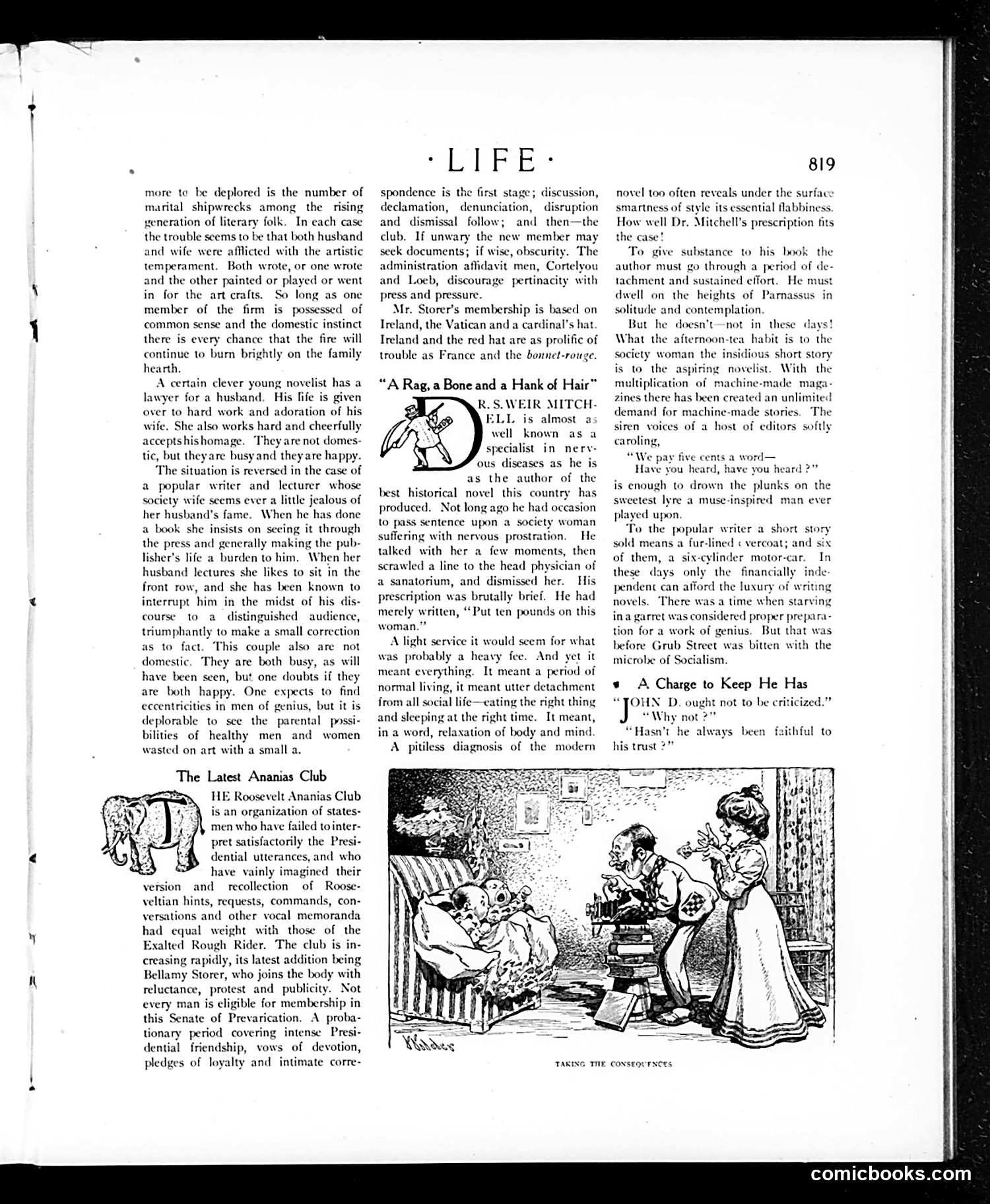
This page contains social commentary on literary life and politics circa the Theodore Roosevelt era (likely early 1900s). **"A Rag, a Bone and a Hank of Hair"** discusses novelist R.S. Weir Mitchell's prescription for a nervous society woman: "Put ten pounds on this woman." The satire critiques modern novelists' superficiality—they mistake stylistic cleverness for substance. Mitchell's remedy ironically prescribes simple living and detachment from social life as the cure for modern ailments. **"The Latest Ananias Club"** satirizes a supposed organization of politicians who misrepresent President Theodore Roosevelt's statements. The reference is biblical (Ananias = liar). Bellamy Storer, recently added to this "club," apparently disagreed publicly with Roosevelt over diplomatic matters involving Ireland, the Vatican, and a cardinal's appointment. The satire suggests members progress from praised friendship with Roosevelt to public dispute to obscurity—using documents risks presidential retaliation via aides Cortelyou and Loeb. The cartoon illustration (captioned "TAKING THE CORRECTED FACTS") appears to depict this confrontation over disputed accounts.
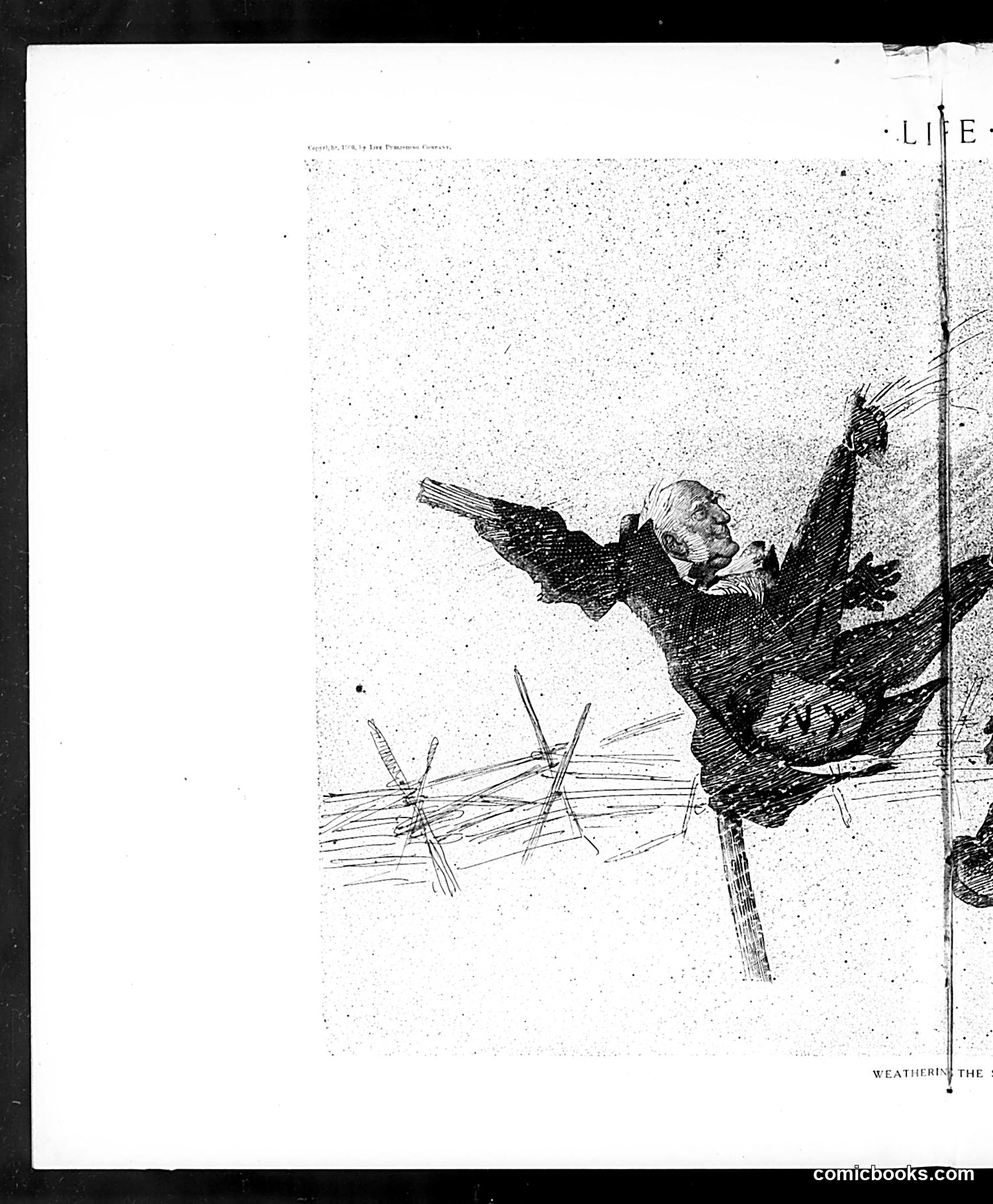
This page from *Life* magazine shows a political cartoon depicting a man in formal attire clinging to a wooden fence or railing, appearing to struggle against wind or weather. The illustration style uses cross-hatching typical of late 19th/early 20th-century engravings. The partial text visible at bottom reads "WEATHERING THE..." (text cut off), suggesting the cartoon's theme involves weathering some kind of storm or difficult period. The figure's desperate grip and the dynamic composition suggest he's enduring hardship. Without the complete caption and given the publication date is not clearly visible, I cannot definitively identify the specific political figure or event being satirized. The cartoon likely references a contemporary political crisis or controversy that readers of the era would have immediately recognized.
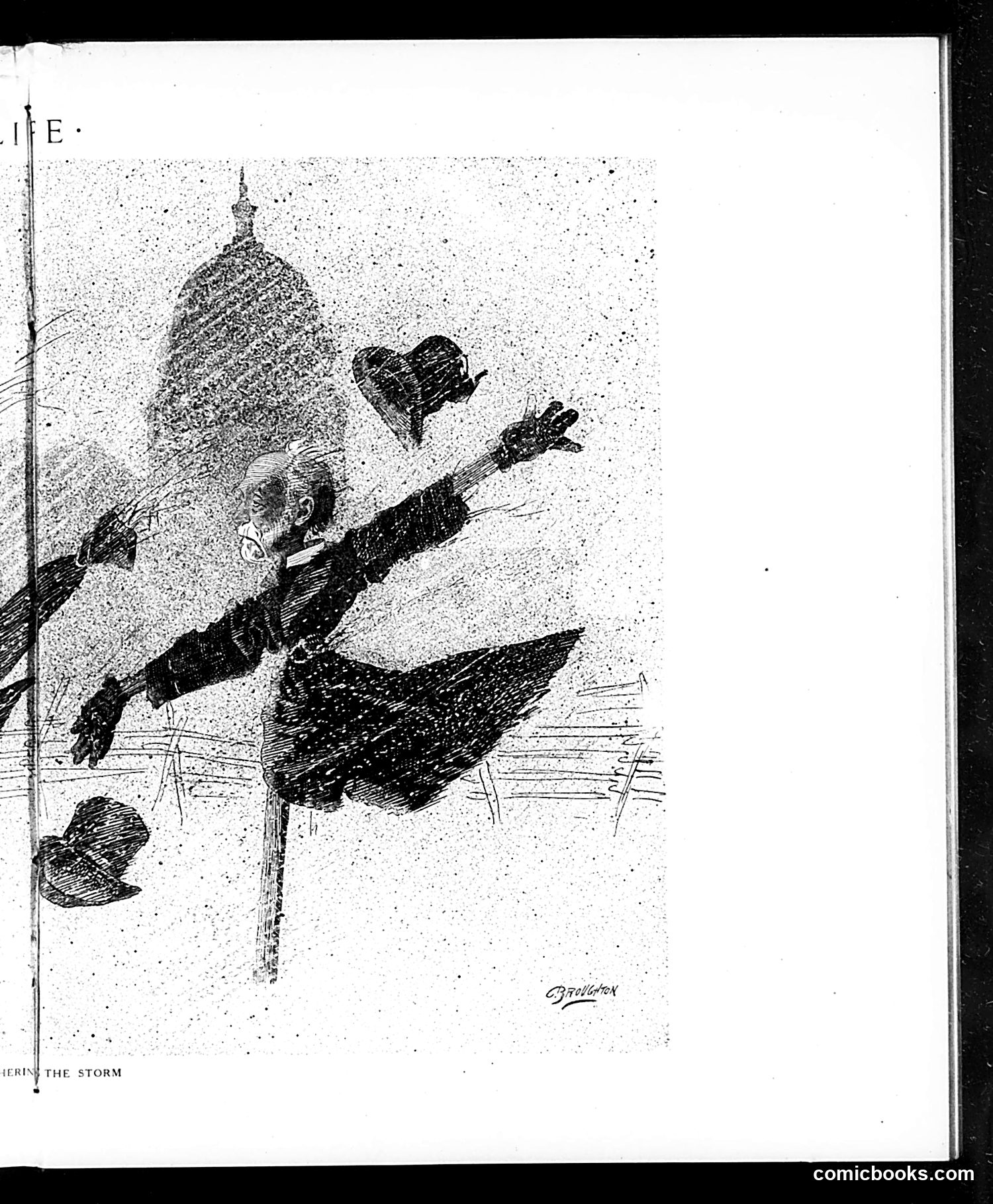
This cartoon depicts a figure being blown by violent wind toward the U.S. Capitol building in the background. The figure appears to be a politician or public official losing control—their coat and hat are flying away, and they're being swept along helplessly. A heart symbol floats in the air above. The title "The Storm" suggests turbulent political circumstances overwhelming the subject. Without a clear date or additional context, the specific historical event isn't certain, but the imagery conveys chaos, loss of power, or being caught in forces beyond one's control during a political crisis. The signature appears to be Cesare, the cartoonist's mark.
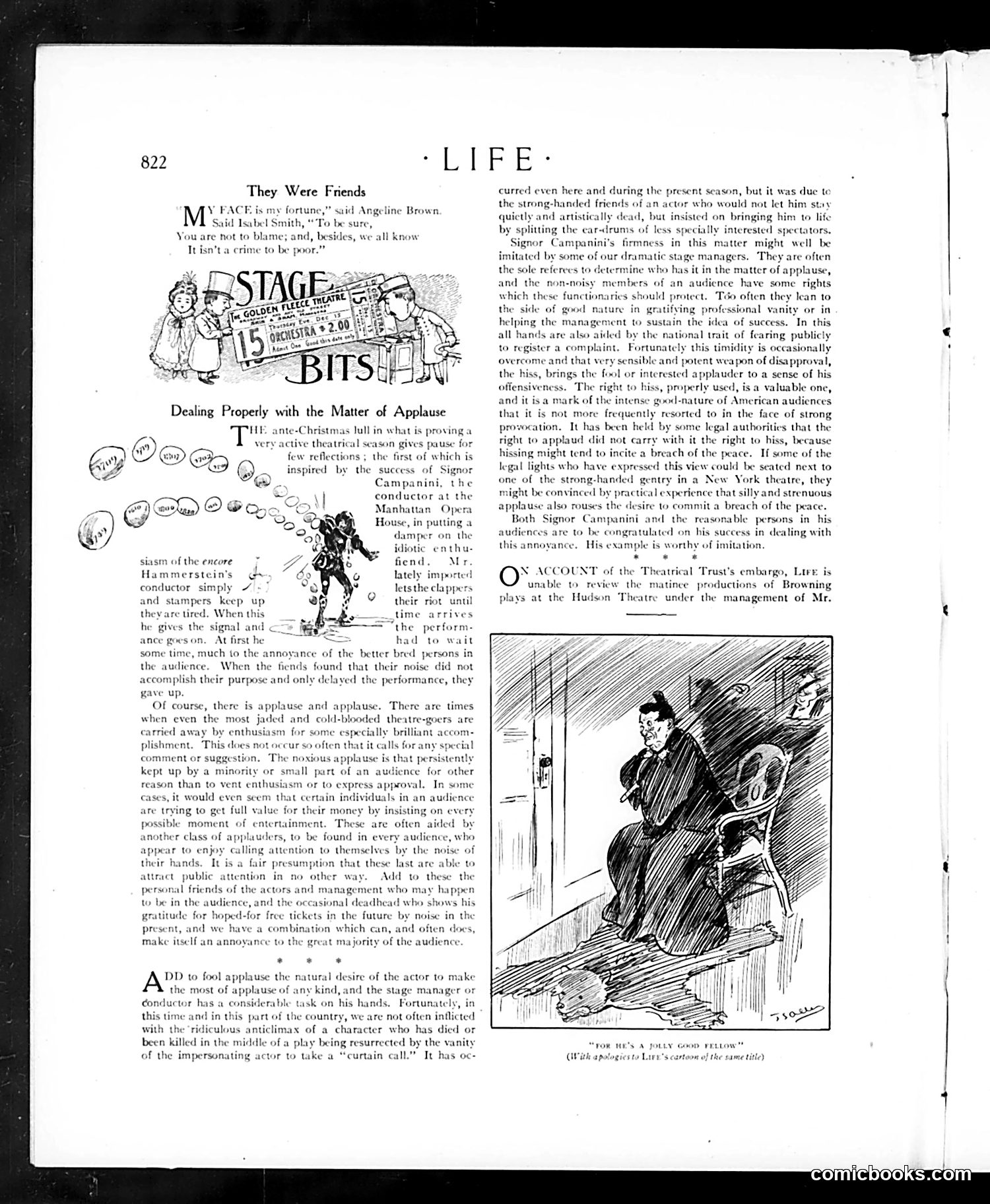
This Life magazine page discusses theatrical etiquette around applause, using Signor Campanini (conductor at Manhattan Opera House) as an exemplar of proper audience management. The article critiques excessive clapping orchestrated by actors' friends and paid "clappers" who delay performances and annoy genuinely cultured theatergoers. It describes various problematic applause types: persistent noise from small cliques seeking attention, coordinated applause from personal connections, and even actors demanding curtain calls after death scenes. The cartoon (signed Tooker) illustrates this absurdity: a supposedly dead character lies on stage while someone pulls him up for applause—the exact practice the text condemns. The satire targets both theatrical vanity and American audiences' reluctance to register disapproval publicly, suggesting that organized hissing would effectively curb such behavior. The piece advocates for stage managers to protect paying audiences' interests against manipulated enthusiasm.
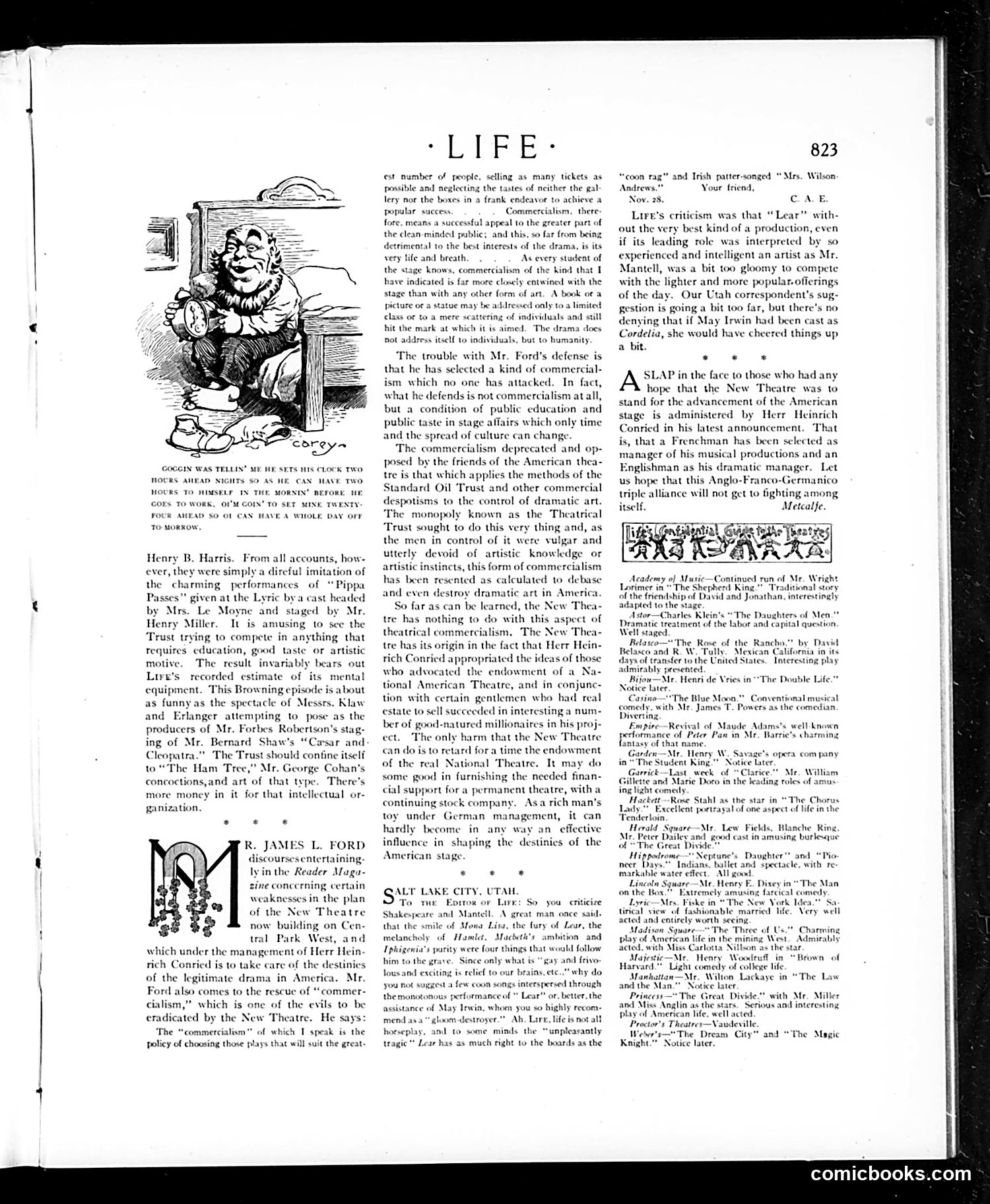
This page contains a small cartoon at the top-left depicting two men discussing setting their clocks ahead to gain extra time off work—a simple visual joke about time management that needs no historical context. The bulk of the page comprises theater criticism by James L. Ford defending "commercialism" in American theater. Ford argues that appealing to broad audiences isn't harmful; rather, the real problem is the "Theatrical Trust"—a monopoly that applied exploitative business methods to drama, controlled by "vulgar" men lacking artistic knowledge. Ford distinguishes between healthy commercialism (reaching the general public) and destructive monopolism. He discusses the emerging "New Theatre" being built on Central Park West under Heinrich Conried's management, suggesting it won't address the real issue: the need for a properly endowed National Theatre independent of commercial interests. The satire targets theatrical monopolies stifling American drama through profit-driven control rather than artistic merit.
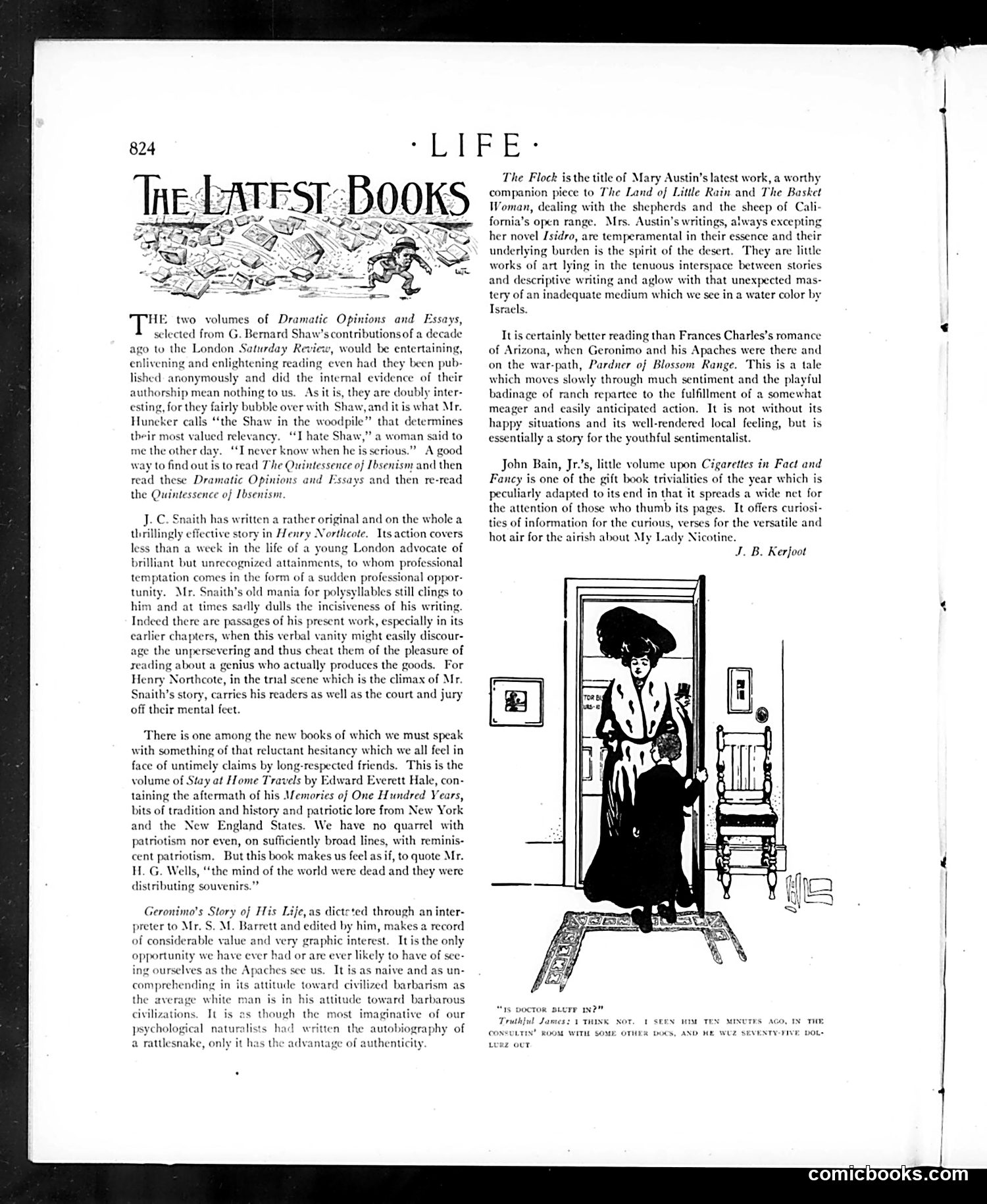
This is a literary review section from *Life* magazine featuring illustrations and commentary on new publications. The main cartoon shows a woman in her home interior with furniture and a baby carriage, accompanying a review of John Bain Jr.'s *Cigarettes in Fact and Fancy*. The caption beneath reads: "Dr. BLEET IN?" with dialogue about "Doctor James" visiting "ten minutes ago" — a mild domestic scene playing on the book's subject matter about smoking. The page primarily reviews recent works by George Bernard Shaw, J.C. Snaith, Edward Everett Hale, and notably **Geronimo's autobiography**, which the critic praises as offering rare authentic perspective on Apache views of white civilization. The reviewer uses this as satire: comparing it favorably to psychological naturalism, while ironically noting Geronimo's "naive and uncomprehending" attitude toward "civilized barbarism" — mirroring white condescension toward indigenous peoples. The reviews mix literary criticism with social commentary typical of *Life*'s satirical approach to contemporary culture and letters.
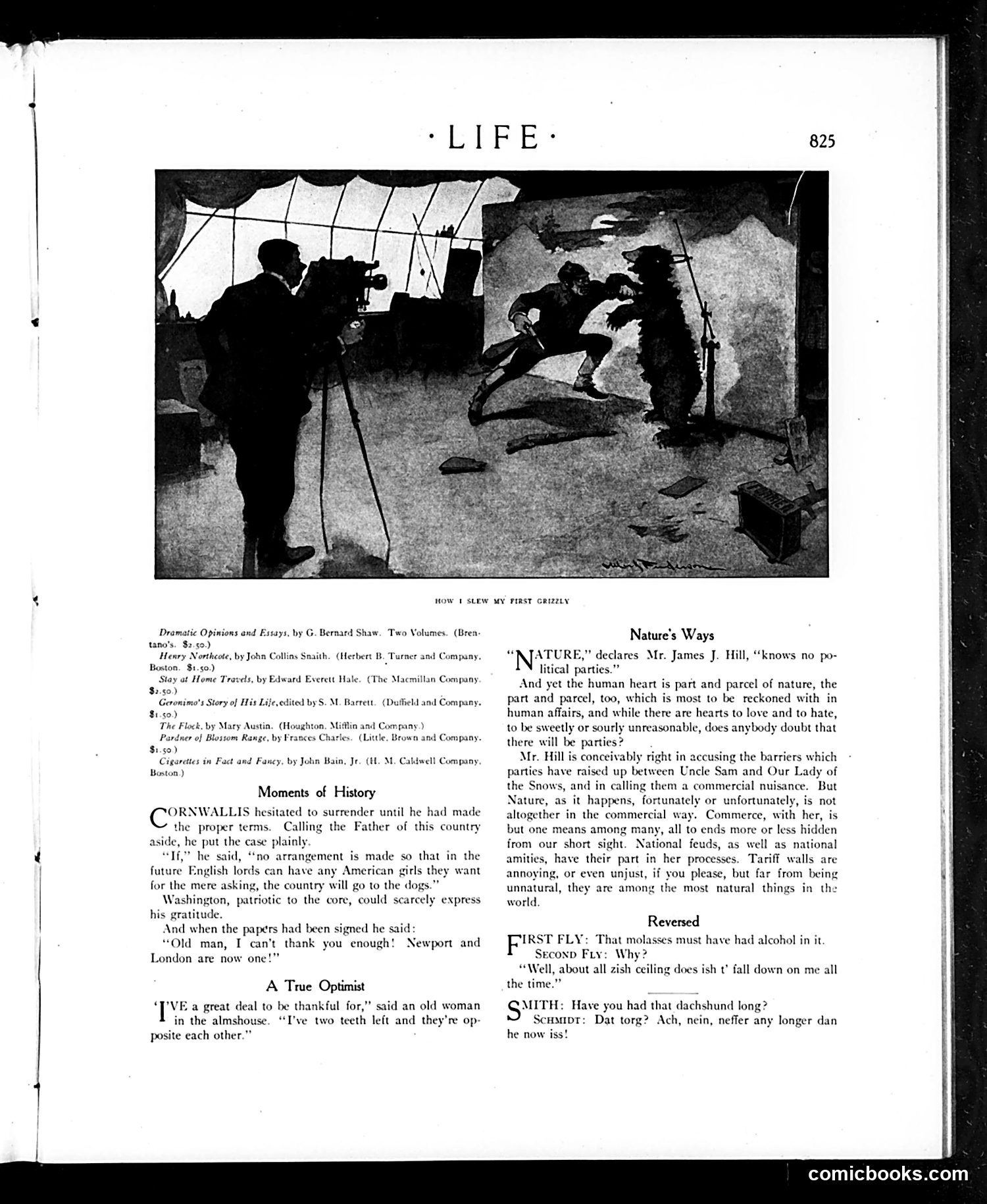
This page contains multiple satirical pieces typical of early Life magazine humor: **Top Image ("How I Slew My First Grizzly"):** A film or theatrical production scene, likely satirizing adventure narratives or celebrity hunting stories popular at the time. **"Moments of History":** A joke rewriting the Cornwallis surrender at Yorktown (American Revolution), imagining the British general negotiating future access to American women for English lords. Washington supposedly agrees, quipping that "Newport and London are now one" — satirizing the social/cultural connection between wealthy American and British elite, particularly through marriage. **"Nature's Ways":** Commentary on James J. Hill (railroad magnate) claiming nature knows no political parties. The author argues human nature inevitably creates parties and tariffs, mocking Hill's naive optimism about commerce transcending national interests. **"Reversed" and "Smith" jokes:** Brief ethnic/dialect humor typical of the era (flies and a dachshund owner), representing common vaudeville-style comedy of the period. The page blends political satire with light social humor.
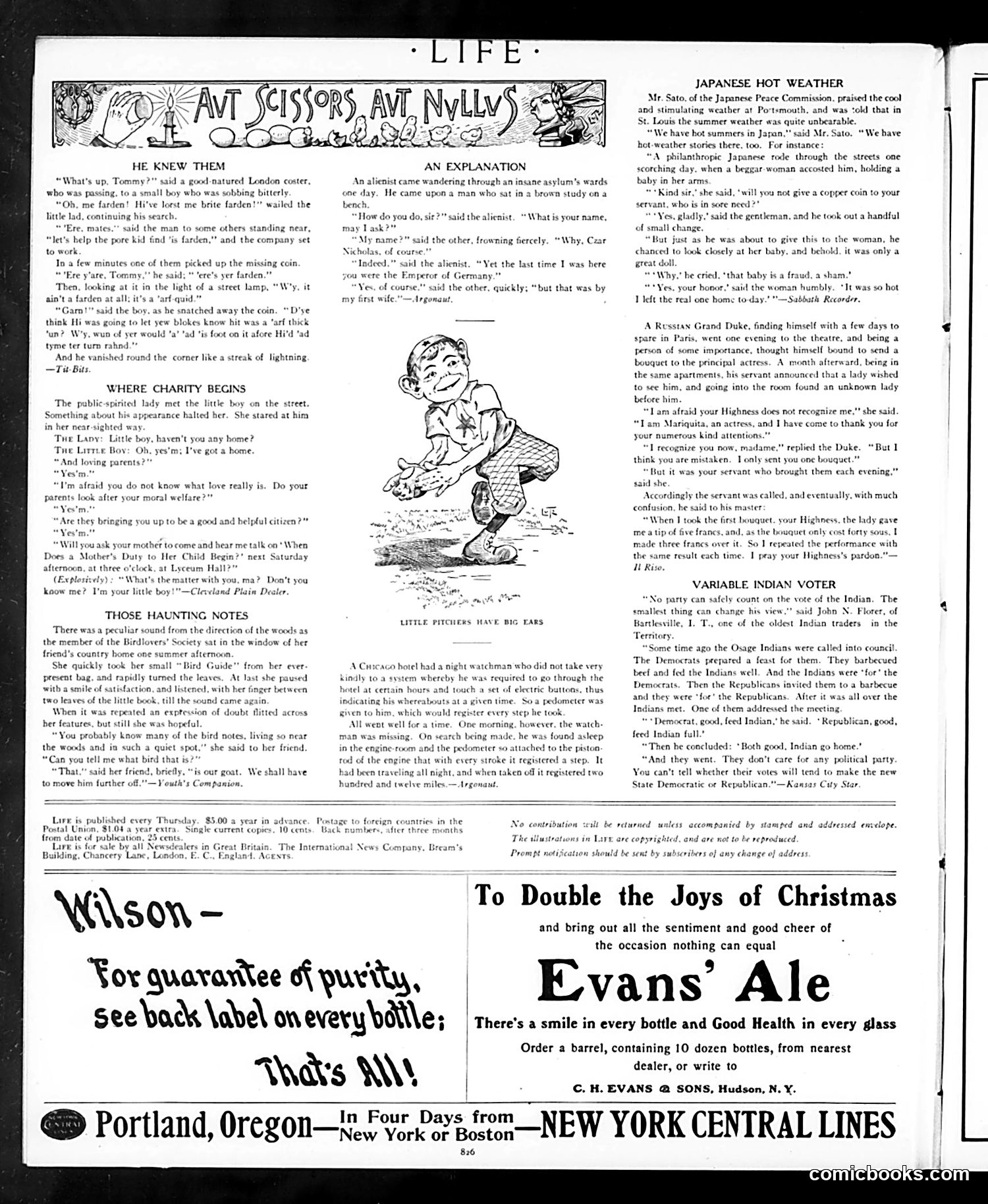
This page contains several humorous anecdotes and cartoons satirizing human nature and contemporary society: **"He Knew Them"** depicts a street urchin who cleverly deceives a kind man searching for a lost farthing (coin), pretending to help while secretly pocketing it—mocking both working-class cunning and naive charity. **"Where Charity Begins"** shows a well-meaning society lady interrogating a street boy about his home life, only to have him innocently invite her to visit his mother—satirizing condescending upper-class "do-gooders." **"Those Haunting Notes"** describes a woman at her friend's country home mistaking their goat's bleating for a rare bird, repeatedly consulting a bird guide—mocking amateur naturalism and gullibility. **"An Explanation"** features an asylum scene where a patient claims to be the Emperor of Germany, then admits he was merely joking—commentary on mental illness perception or wartime German sentiment (unclear which). The page also includes advertisements (Wilson ale, Evans' Ale, railroad service) typical of the era's *Life* magazine format.
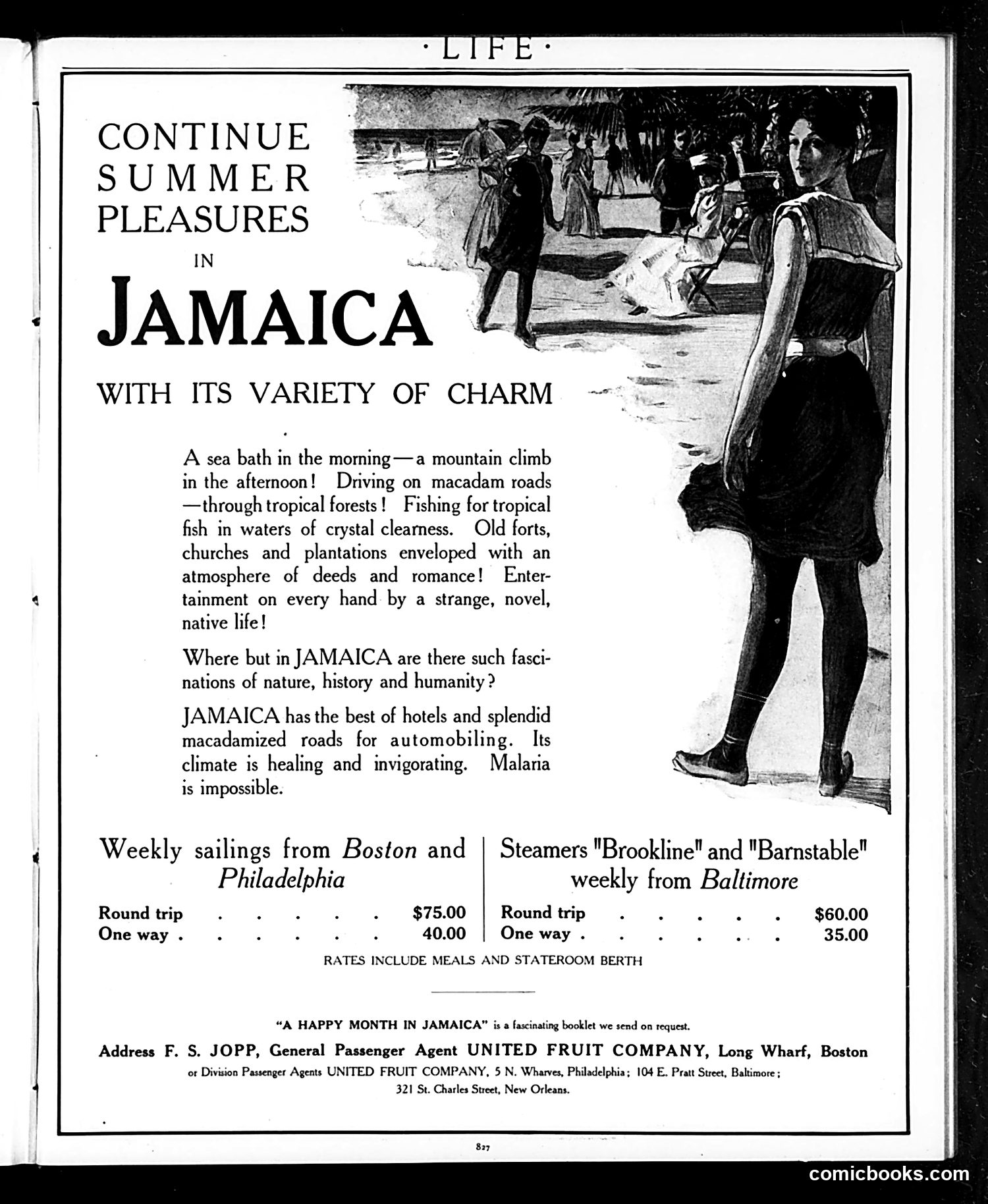
This is primarily a **travel advertisement**, not satire or political cartoon. The United Fruit Company promotes Jamaica tourism to American readers, emphasizing exotic pleasures: sea bathing, mountain climbing, tropical forests, fishing, and colonial-era sites ("old forts, churches and plantations"). The image shows a woman in period dress observing locals on a beach—likely depicting the "strange, novel, native life" promised in the text. Modern readers should note the **colonial perspective**: Jamaica is presented as an entertainment destination for American tourists, with emphasis on "native life" as spectacle. The ad highlights practical amenities (hotels, macadam roads for automobiles) and health benefits, notably claiming "Malaria is impossible"—likely exaggerated. Shipping rates from multiple U.S. cities (Boston, Philadelphia, Baltimore) underscore the accessibility for wealthy American travelers. This reflects early-20th-century tourism marketing that exoticized Caribbean destinations while serving American commercial interests.
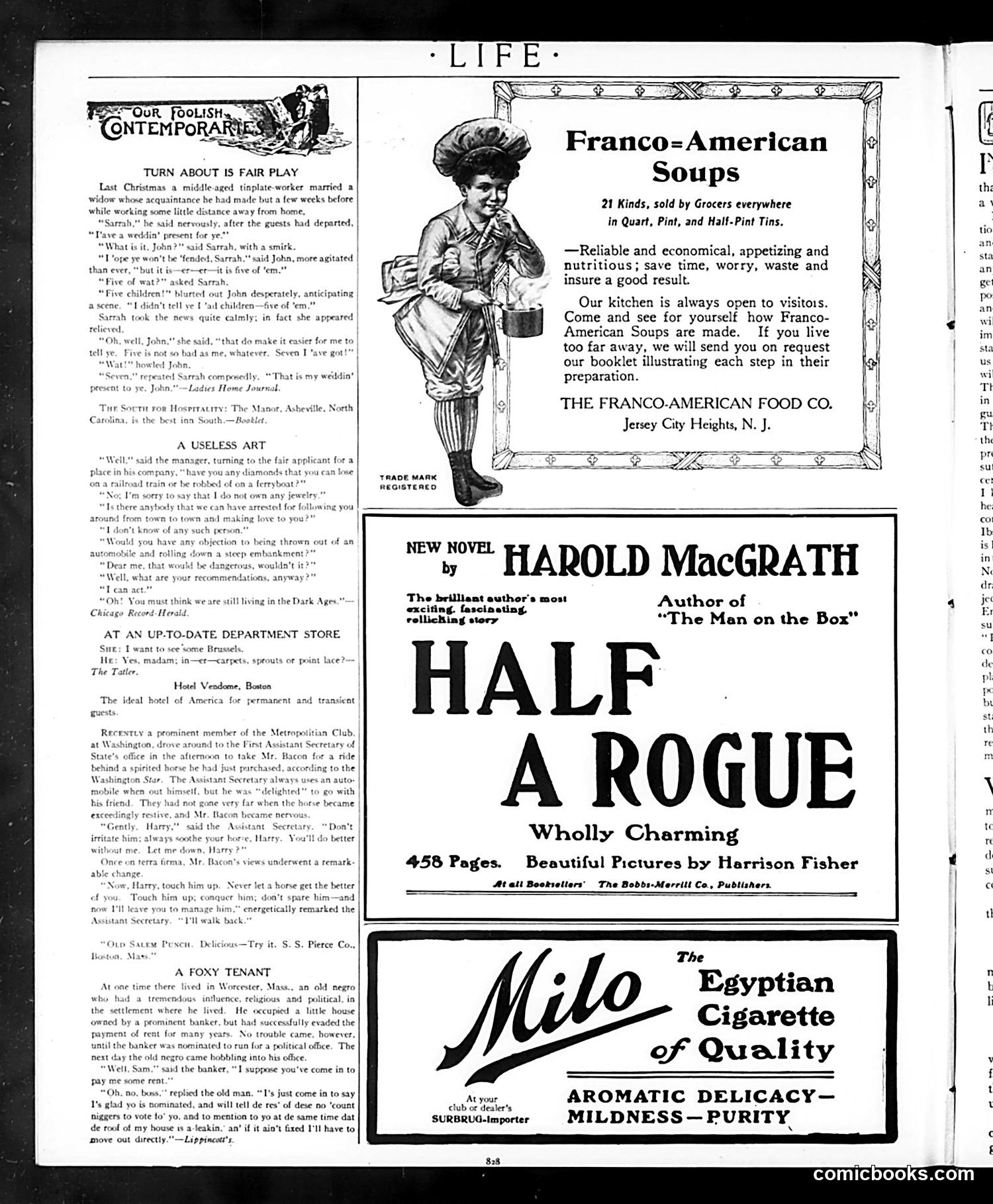
This page contains multiple short humorous anecdotes typical of Life's satirical style, plus period advertisements. **"Turn About Is Fair Play"** jokes about a newlywed couple's marital negotiation: the husband offers a modest wedding gift, but the wife reveals she's already been married seven times—implying she views marriage transactionally. The humor targets both the husband's naïveté and contemporary anxieties about women's independence and remarriage. **"A Foxy Tenant"** depicts a Black tenant leveraging political patronage: he's owed rent for years but withholds payment until the landlord (now running for office) needs his vote. He then demands repairs as condition of support. The satire critiques machine politics and corruption, though the racial caricature reflects the magazine's problematic era. **Other brief anecdotes** satirize department store confusion, equestrian instruction mishaps, and social pretension. The page is primarily **advertising-driven**, featuring Franco-American Soups, Harold MacGrath's novel *Half a Rogue*, and Milo Egyptian cigarettes—products marketed to middle-class readers of this period.
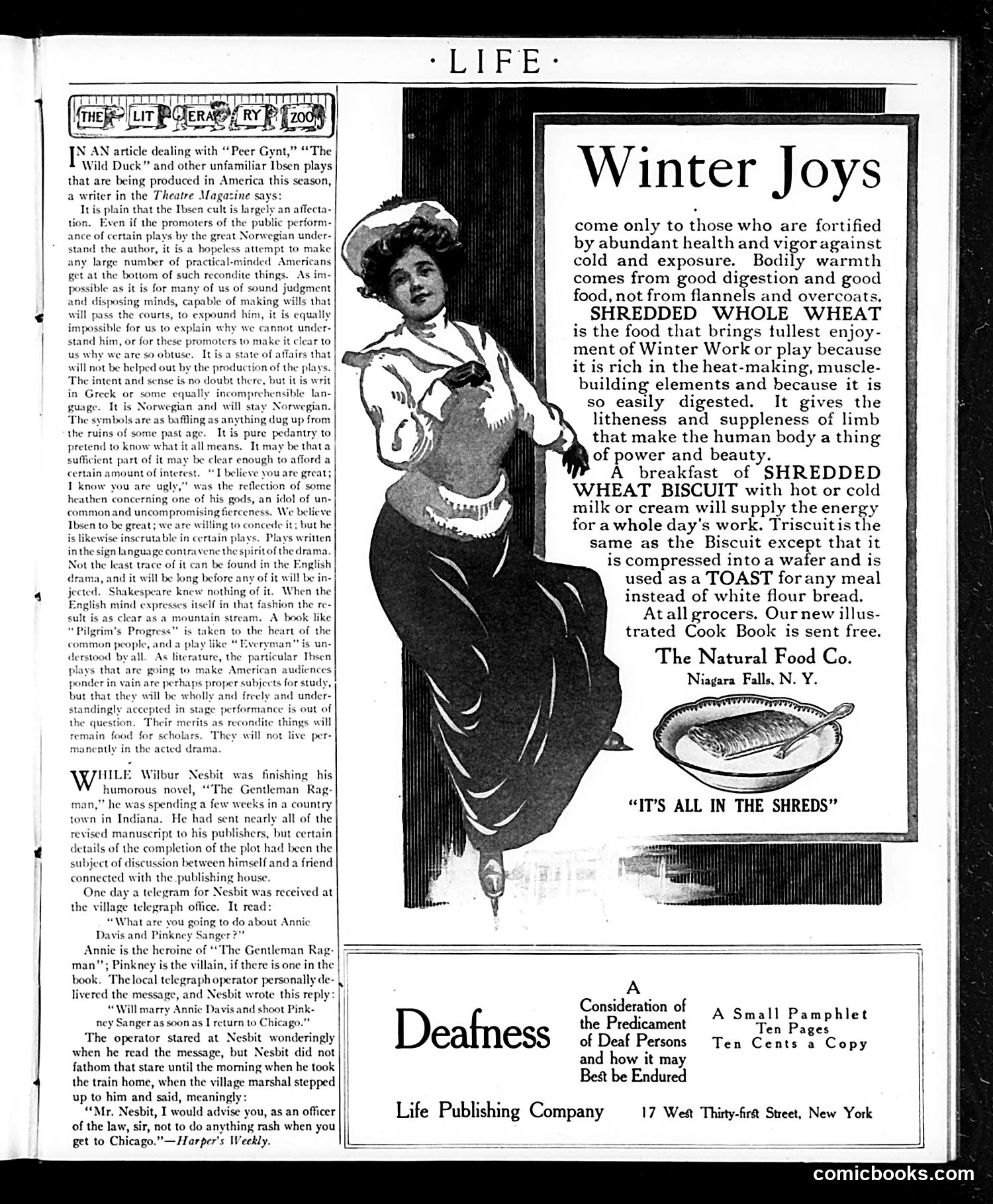
This page contains **two distinct pieces of content**: literary criticism and advertising, with no political cartoon. **Left column**: A critique of Henrik Ibsen's plays being produced in America. The writer dismisses them as incomprehensibly obscure—written in "sign language" and "Norwegian" symbolism that practical Americans cannot understand. The tone is dismissive yet admiring; Ibsen is "great" but deliberately obscure, unlike accessible works like *Pilgrim's Progress* or *Everyman*. **Embedded anecdote**: A humorous story about novelist Wilbur Nesbit. A telegraph operator takes literally Nesbit's joking reply about marrying his novel's heroine and shooting the villain, alerting the local marshal—a joke about the operator's inability to recognize hyperbole. **Right side**: A full-page advertisement for Shredded Wheat cereal, featuring an illustrated woman and promoting the product as body-warming winter food rich in digestible nutrients. The slogan reads "It's All in the Shreds." The page reflects early 1900s attitudes toward modernist drama as elitist and impenetrable to average readers.
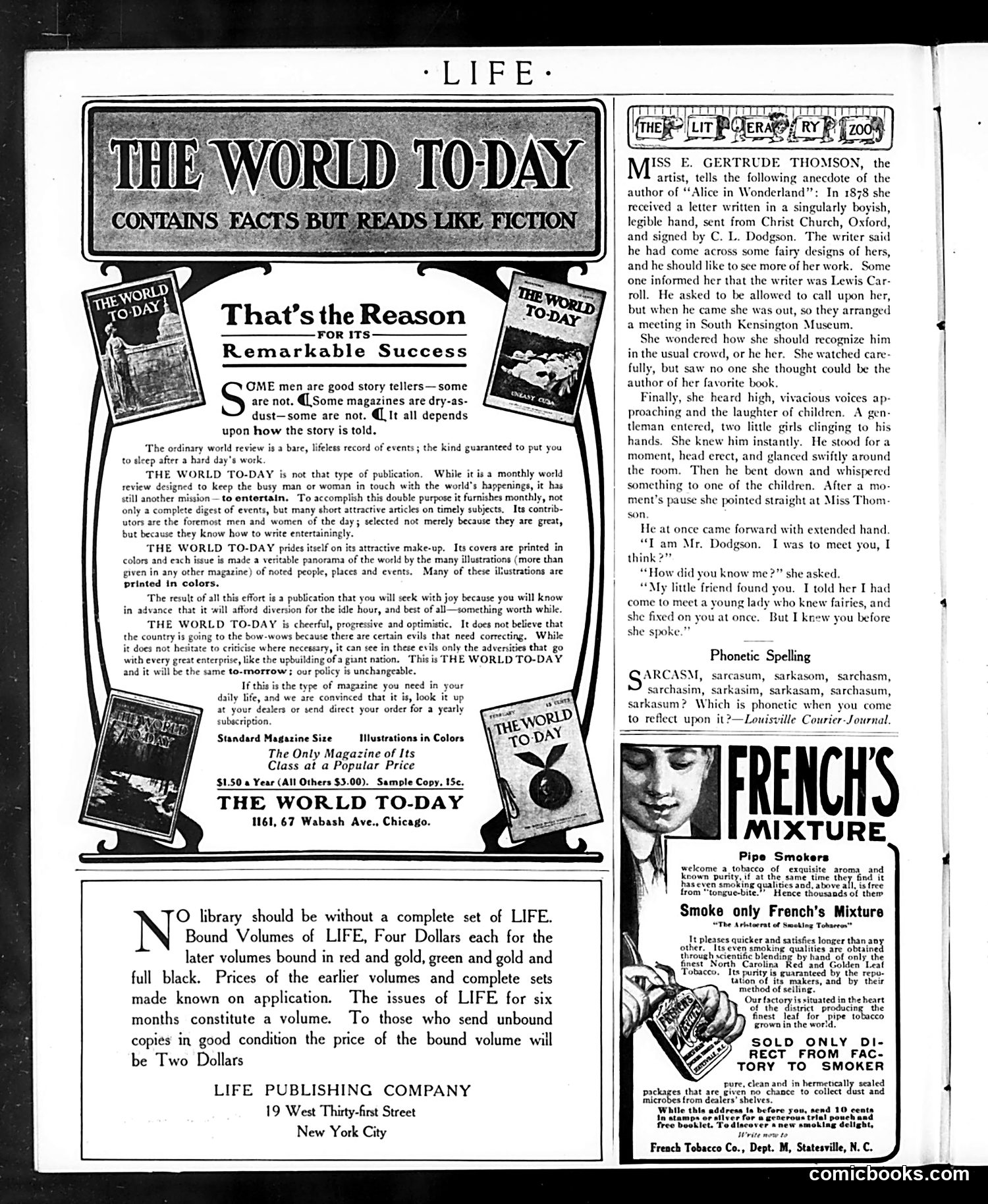
This page is primarily **advertising and promotional content**, not political satire. The main feature advertises "The World To-Day" magazine, emphasizing its success stems from combining news reporting with entertaining writing and colorful illustrations. It positions itself as superior to "dry-as-dust" competitors by featuring well-known contributors and attractive design. The right column contains unrelated items: an anecdote about artist Gertrude Thomson meeting Lewis Carroll (author of *Alice in Wonderland*) through his admiration of her fairy designs, a word-puzzle about phonetic spelling, and an advertisement for French's Mixture pipe tobacco. The bottom promotes bound volumes of *Life* magazine itself—the publication this page appears in. **No political cartoons or satire are present.** This represents typical early-20th-century magazine layout mixing editorial content with advertising to generate revenue.
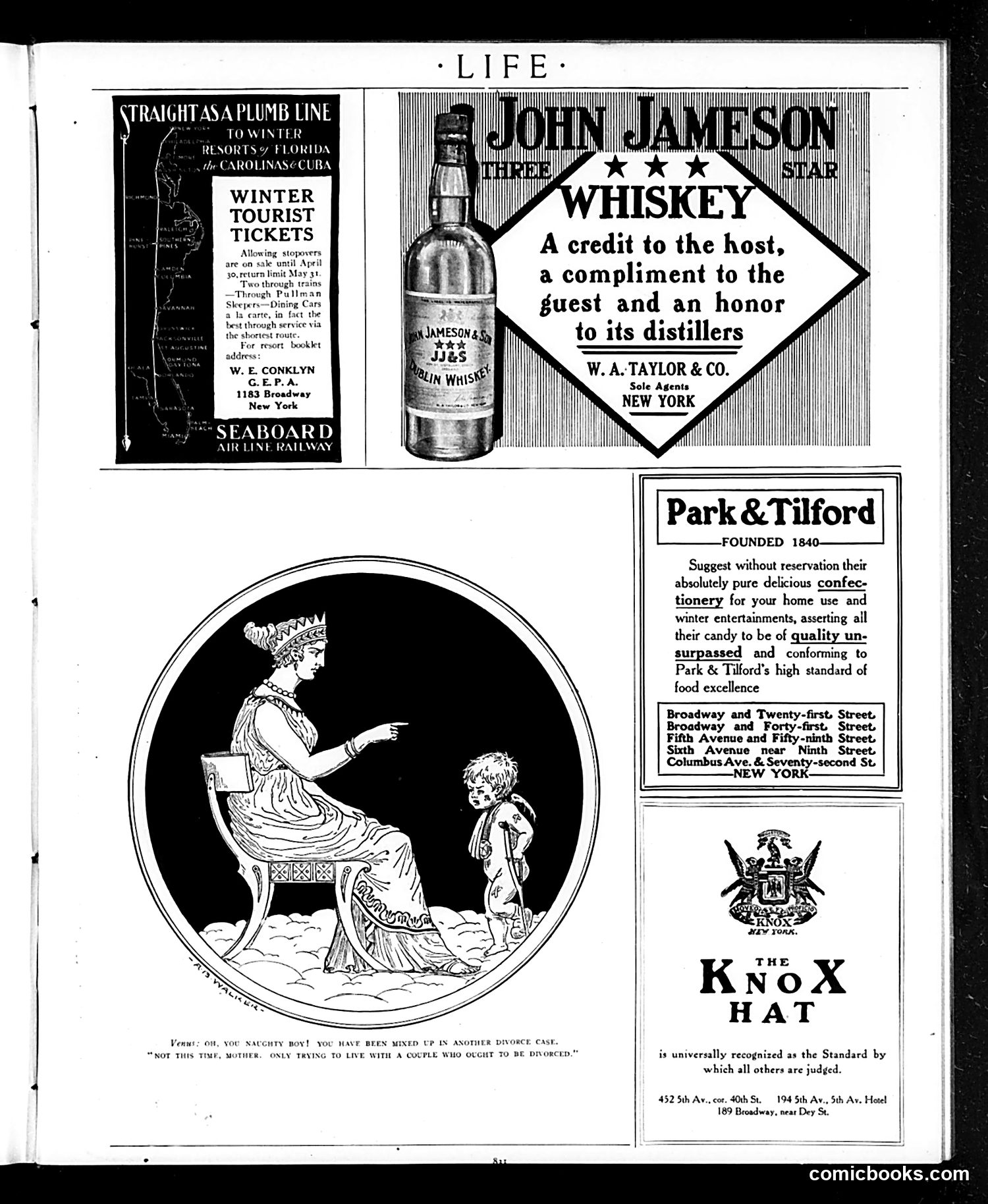
This page is primarily **advertisements** interspersed with one satirical cartoon. The main cartoon depicts **Venus (the Roman goddess)** scolding a **Cupid figure** about involvement in a divorce case. The caption's joke is darkly humorous: Cupid claims he's not responsible for *this* divorce—he's merely trying to help a couple who "ought to be divorced" stay together. **The satire**: This reflects early 20th-century anxieties about rising divorce rates. The cartoon suggests divorce is so common and socially accepted that even the mythological god of love can't prevent unsuitable marriages from dissolving. It's cynical commentary on modern marriage's fragility. The surrounding ads (whiskey, candy, hats, train travel) are period typical—targeting affluent readers planning winter leisure activities.
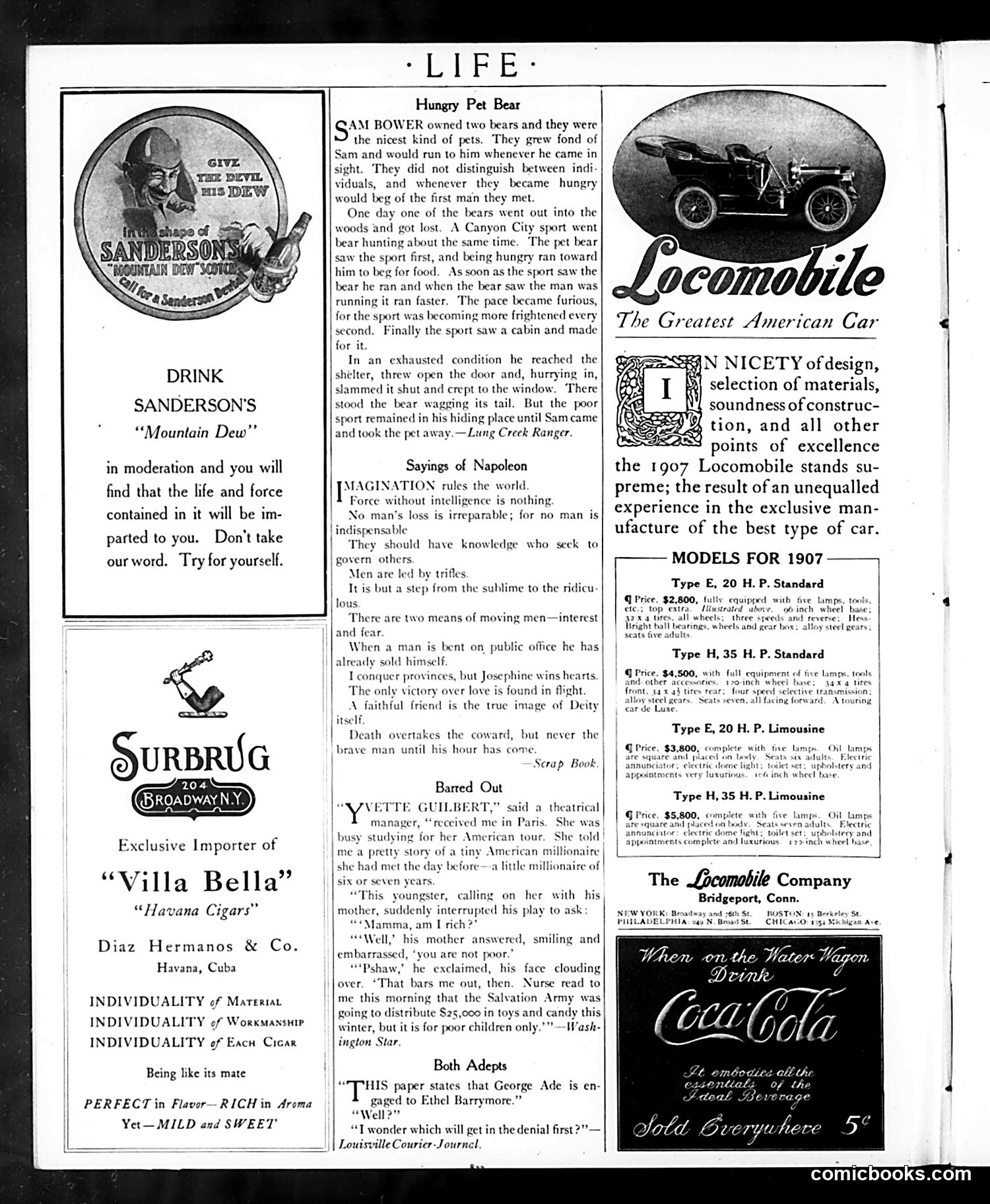
This page is primarily **advertisements** rather than political satire. The main content includes: **Left side:** Ads for Sanderson's "Mountain Dew" (an alcoholic beverage), Surburg importer (Broadway, NY), and Villa Bella Havana cigars. **Center:** Humorous anecdotes and quotes, including "Hungry Pet Bear" (a comedic frontier story about a pet bear mistaken for a wild animal), "Sayings of Napoleon" (philosophical quotes), and brief jokes like "Barred Out" (a child excluded from charity because he's not poor enough) and "Both Adepts" (wordplay about George Ade and Ethel Barrymore's engagement denial). **Right side:** Advertisement for the 1907 Locomobile automobile and Coca-Cola. The page reflects early-1900s American consumer culture and light humor typical of Life magazine's satirical approach—mocking social pretensions and absurdities through brief, witty observations rather than sustained political commentary.
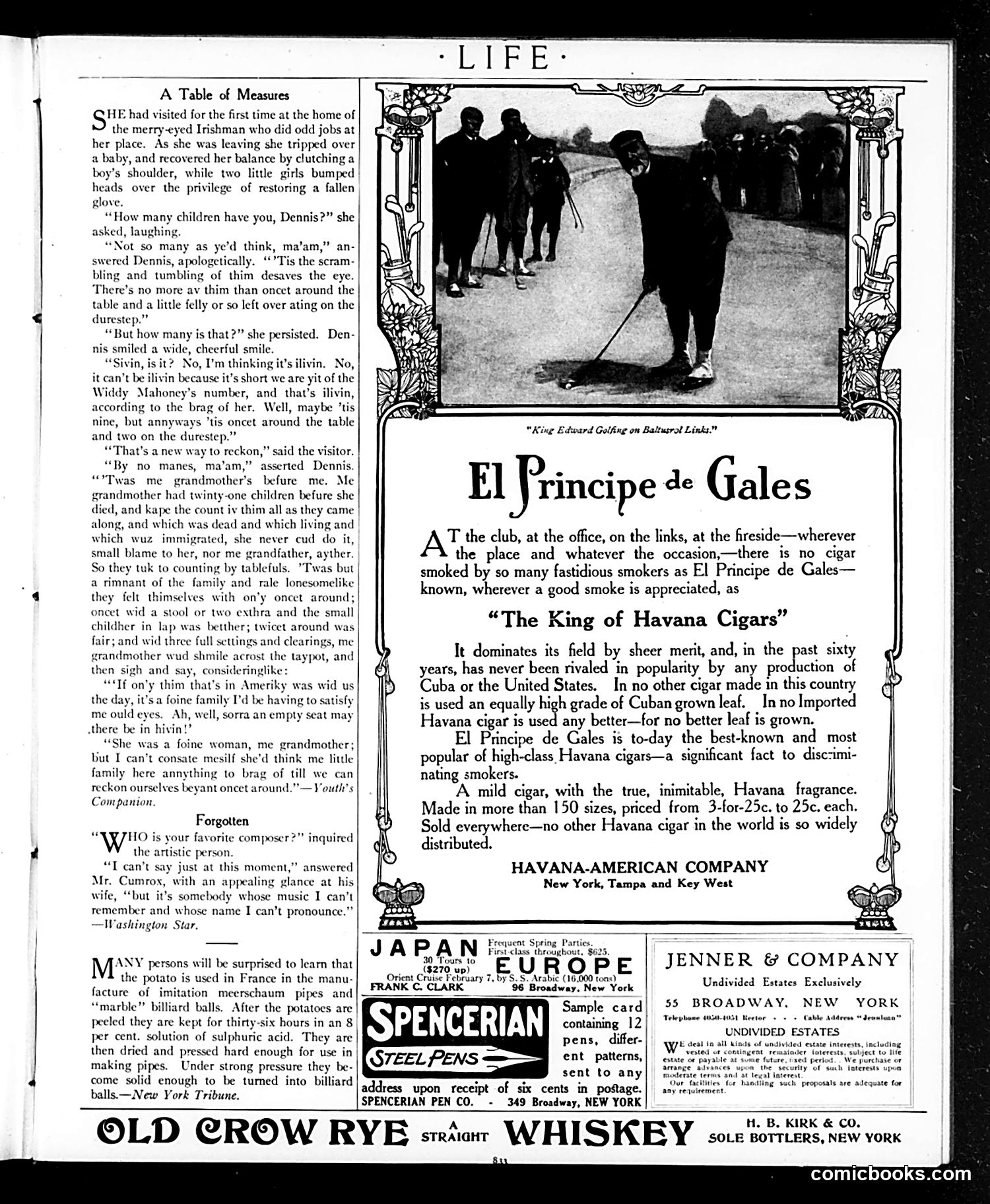
This page is primarily **advertisements and light humor** rather than political satire. The left column contains two brief comedic pieces: "A Table of Measures" presents an Irish immigrant's humorous method of counting children by table-settings rather than numbers, playing on ethnic stereotypes of Irish families and accents. "Forgotten" is a one-liner about a man unable to recall his favorite composer's name. The center features a photograph labeled "King Edward Golfing on Baltusrot Links" (likely King Edward VII), accompanying an advertisement for El Principe de Gales cigars marketed as "The King of Havana Cigars." The bottom contains various product advertisements: Spencerian steel pens, Japan frequent-siring parties, Jenner & Company real estate, and Old Crow rye whiskey. The page lacks substantive political commentary or satirical cartoons. It represents typical early 20th-century *Life* magazine content—mixing genteel humor, celebrity references, and luxury goods advertising aimed at middle-class readers.
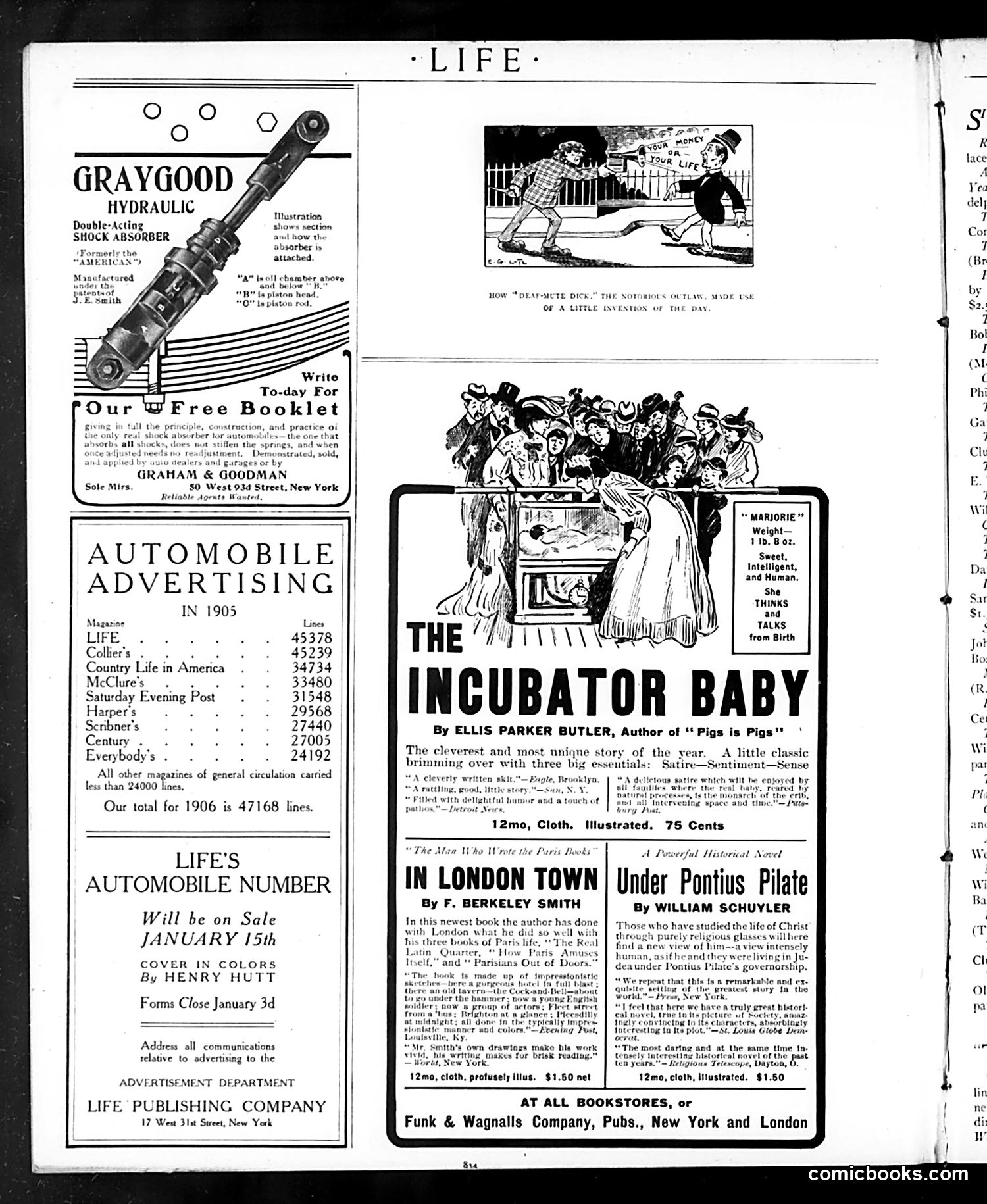
This page is primarily **advertising and book promotion** from an early 1900s American magazine. The main elements are: **Top cartoon**: Shows "Deaf-Mute Dick," a notorious outlaw, using a small mechanical invention (appears to be a shock absorber or similar device). The humor likely plays on the incongruity of a dangerous criminal exploiting mundane new technology—reflecting contemporary anxiety about how modern innovations could be misused by criminals. **Center feature**: "The Incubator Baby" by Ellis Parker Butler—a humorous story about an artificially incubated infant. This references the genuine public fascination with incubators as cutting-edge medical technology circa 1900-1910, when they were novelties displayed at world's fairs. **Advertisements**: Graygood hydraulic shock absorbers, automobile advertising statistics, and book promotions (including novels about London and Biblical history) dominate the page. The overall tone reflects turn-of-the-century American optimism about technological progress, mixed with satire about how such innovations captured public imagination.
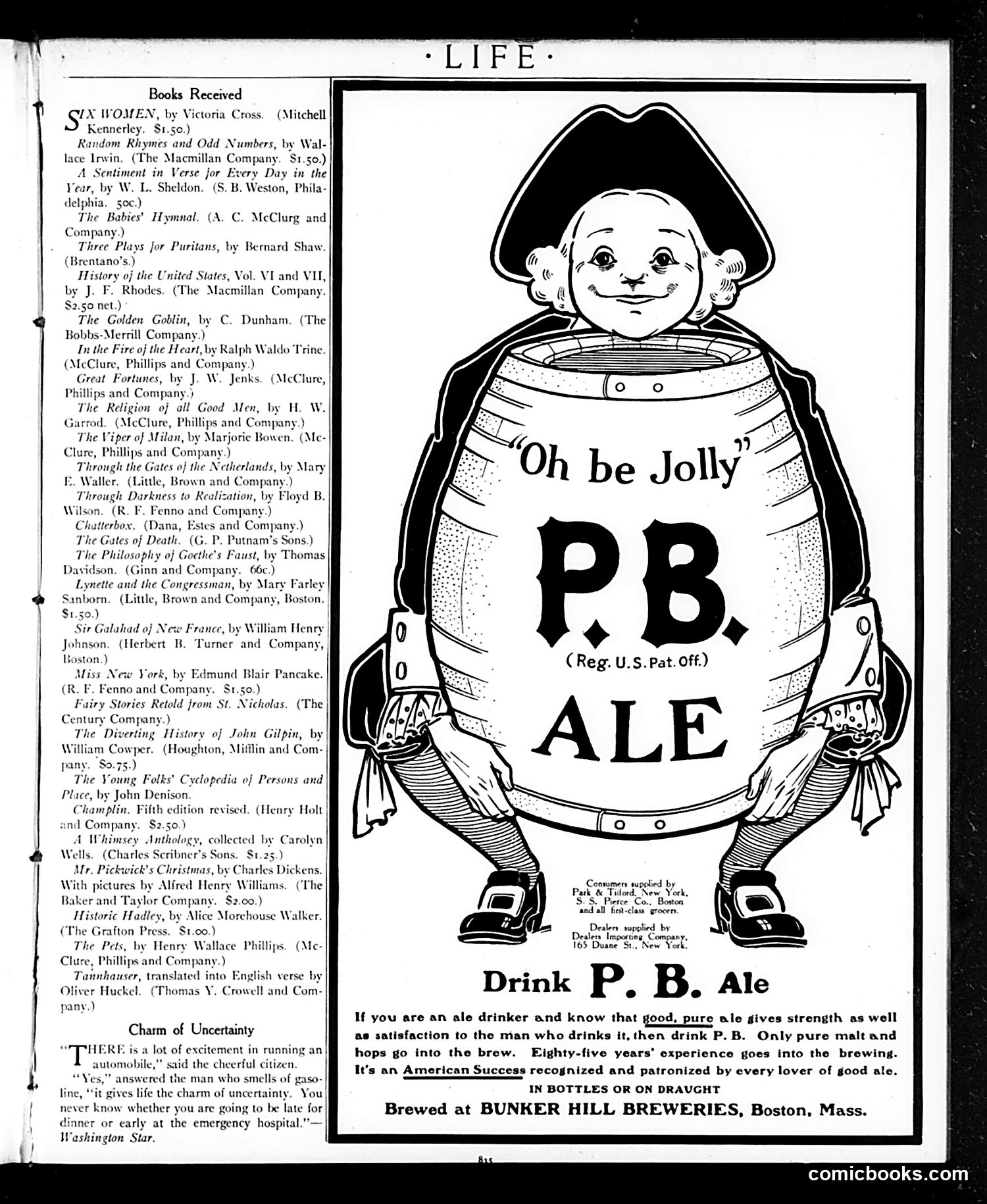
This page is primarily a **book advertisement section** paired with a **beer advertisement**. The left column lists recently published books from various publishers (typical for *Life* magazine's literary coverage). The dominant image is a **P.B. Ale advertisement** featuring a rotund, jolly character in period clothing with the slogan "Oh be Jolly." The ad copy emphasizes the product's purity, American heritage, and eighty-five years of brewing tradition—common marketing claims of the early 1900s. The smaller text snippet titled "Charm of Uncertainty" is a humorous society column quoting the *Washington Star*, joking about automobile ownership's unpredictability (arriving late to dinner or early to the hospital). This reflects the novelty and danger of early automobiles. **Context**: This appears to be from the early 1900s when *Life* combined literary reviews with advertisements. The beer ad's emphasis on "American Success" and traditional brewing reflects pre-Prohibition marketing strategies.
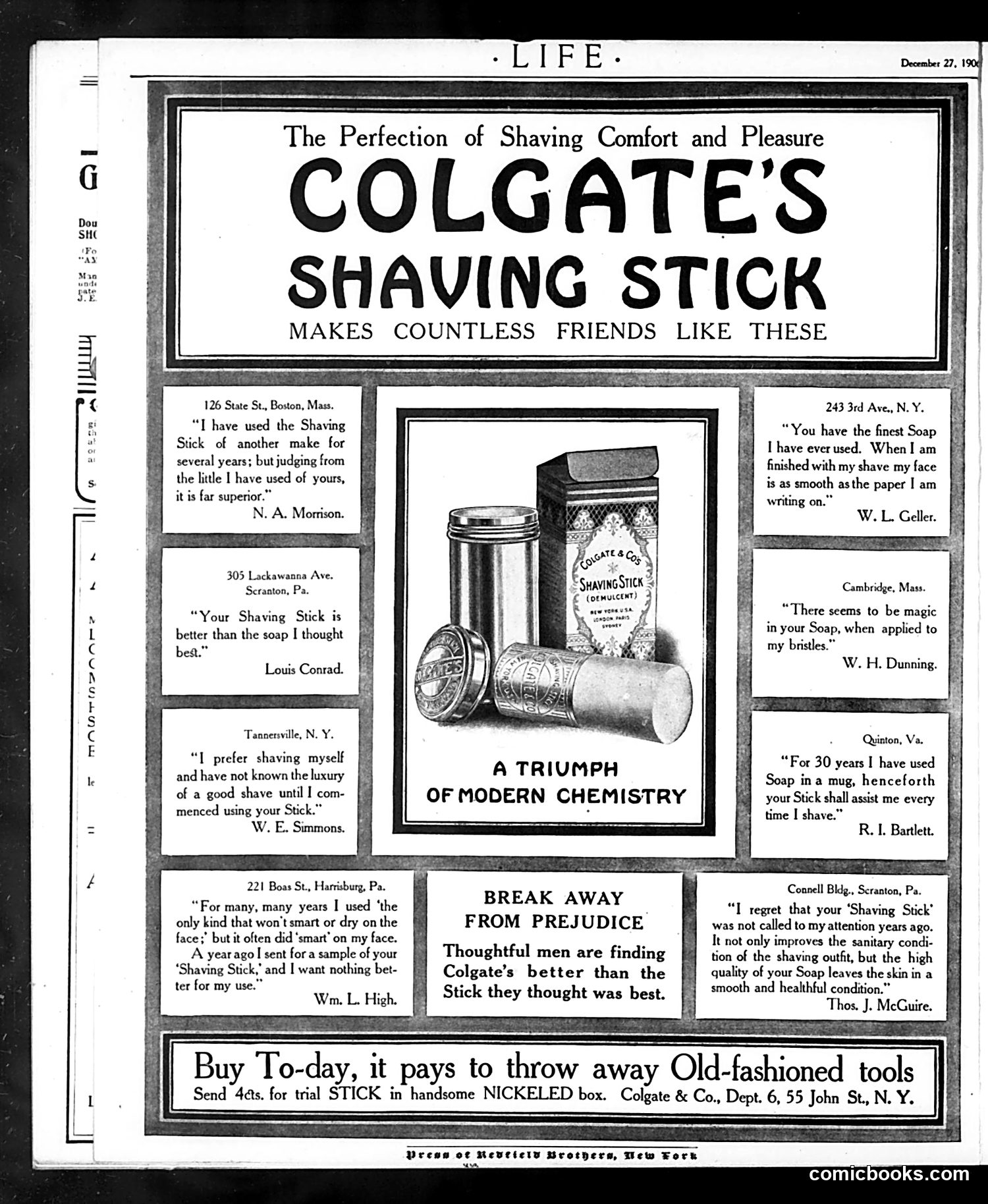
This is primarily a **product advertisement**, not political satire. Colgate promotes its new "Shaving Stick" as a modern innovation replacing traditional shaving soaps and tools. The page features testimonials from satisfied customers across various U.S. cities (Boston, Scranton, Harrisburg, etc.), emphasizing the product's superiority. The central image shows the stick alongside traditional shaving containers, labeled "A Triumph of Modern Chemistry." The key marketing angle appears in the lower box: "Break Away From Prejudice"—targeting men who cling to old-fashioned shaving methods. The copy urges customers to discard "old-fashioned tools" in favor of this modern convenience. This reflects early 20th-century consumer culture's embrace of scientific progress and convenience products. The testimonials use a marketing technique (customer endorsements) that creates social proof of the product's quality and effectiveness.
This page is largely blank or illegible in the image provided. The left margin contains fragmented OCR text that appears to be incomplete phrases ("Soap," "I am face," "I am eller") without clear context or coherence. Without being able to see actual cartoon artwork, recognizable figures, or complete readable text, I cannot identify specific political or social references, caricatures, or satire points. To provide accurate historical analysis as requested, I would need a clearer image showing the actual cartoon(s) or legible complete text content from this Life magazine page.