
Life, 1906-12-27 · page 19 of 33
Life — December 27, 1906 — page 19: what you’re looking at
What you’re looking at
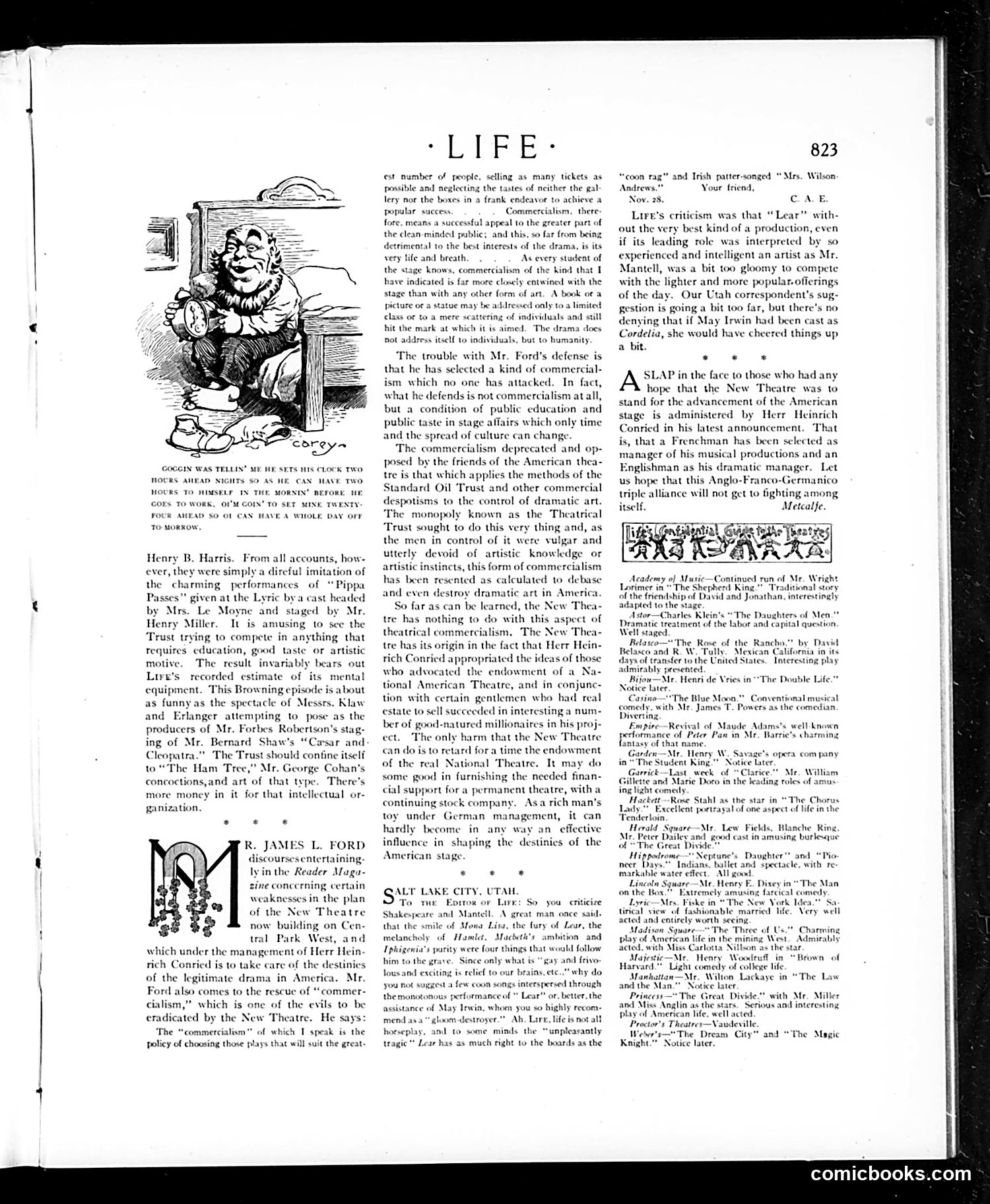
This page contains a small cartoon at the top-left depicting two men discussing setting their clocks ahead to gain extra time off work—a simple visual joke about time management that needs no historical context. The bulk of the page comprises theater criticism by James L. Ford defending "commercialism" in American theater. Ford argues that appealing to broad audiences isn't harmful; rather, the real problem is the "Theatrical Trust"—a monopoly that applied exploitative business methods to drama, controlled by "vulgar" men lacking artistic knowledge. Ford distinguishes between healthy commercialism (reaching the general public) and destructive monopolism. He discusses the emerging "New Theatre" being built on Central Park West under Heinrich Conried's management, suggesting it won't address the real issue: the need for a properly endowed National Theatre independent of commercial interests. The satire targets theatrical monopolies stifling American drama through profit-driven control rather than artistic merit.
📄 Transcribed text from this page (OCR, searchable)
Machine-transcribed from the original scan — historical spelling and the odd misread are preserved.
DCGIN WAS TELLIN S48 HP SETS MIS CLOCK Two S ANEAD NIGHTS SOAS HE CAN HAVE TWO IN THE MORNIN’ BEFORE HE MM GOIN’ TO SET MINE TWENTY YOUR AHEAD SO O1 CAN HAVE A WHOLE Day Orr MOURS To NIMs COrS TO WORK, To MORROW. Henry B. Harris. From all accounts, how- ever, they were simply a direful imitation of the charming performances of “Pippa Passes” given at the Lyric bya cast headed by Mrs. Le Moyne and staged by Mr. Henry Miller. It is amusing to see the ‘Trust trying to compete in anything that tic y bears out requires education, good taste or arti motive. The result invariab Live’s recorded estimate of its mental equipment. ‘This Browning episode is about as funny as the spectacle of Messrs. Klaw and Erlanger attempting to pose as the producers of Mr. Forbes Robertson's stag- ing of Mr. Bernard Shaw's “Cesar and Cleopatra.” The Trust should confine itself to“The Ham Tree,” Mr. George Cohan's concoctions,and art of that type. There's more money in it for that intellectual or- ganization. . 8 8 R. JAMES L. FORD ourses entertaining. lyin the Reader Muga- zine concerning certain weaknesses in the plan of the New Theatre now building on Cen- tral Park West, and hich under the management of Herr Hein rich Conried is to take care of th of the legitimate drama in America. Mr. Ford also comes to the rescue of “commer- ism,” which is one of the evils to be eradicated by the New Theatre. He says ‘The “commercialism” of which I speak is policy of choosing those plays that will suit the great- ¢ destinies “LIFE: est number of people, selling as many tickets as possible and neglecting the tastes of neither the al lery nor pe boxes ina frank endeavor to ach popular success Commercialism. fore, means a successful appeal to he greater part of the clean-minded public; and this, so far from being detrimental to the best interests of very life and breath As every student of the ciage knows, commercialism of the kind that I have indica entwined with the stage than with any other form of art. A book of a ye may be ad.dressed oaly toa limited drama, is its is far more close ring of individuals and it is aimed. ‘The drama does ess itself to individuals, but to humanity ‘The trouble with Mr. Ford’s defense is that he has selected a kind of commercial- ism which no one has attacked. In fact, what he defends is not commercialism at all, but a condition of public education and public taste in stage affairs which only time and the spread of culture can change The commercialism deprecated and op- posed by the friends of the American thea- tre is that which applies the methods of th Standard Oil Trust and other commercial despotisms to the control of dramatic art. ‘The monopoly known as the Theatrical Trust sought to do this very thing and, as the men in control of it were vulgar and utterly devoid of artistic knowledge or artistic instincts, this form of commercialism has been resented as calculated to deba and even destroy dramatic art in Americ So far as can be learned, the New The tre has nothing to do with this aspect of theatrical commercialism. The New The: tre has its origin in the fact that Herr Hein- rich Conried appropriated the ideas of tho: who advocated the endowment of a N: tional American Theatre, and in conjuni tion with certain gentlemen who had real estate to sell succeeded in interesting a num- ber of good-natured millionaires in his pro ect. The only harm that the New Theatre can do is to retard for a time the endowment of the real National ‘Theatre. It may do some good in furnishing the needed finan- cial support for a permanent theatre, with continuing stock company. Asa rich man’s toy under German management, it can hardly become in any way an_ effective influence in shaping the destinies of the American stage. * 8 « ALT LAKE CITY, UTAH. To mer Eotroe or Lire Shakespeare and Mantell, A great man oace sai So you criticize that the smile of Mona Lisa, the fury melancholy of Hamlet, Macteth’s amb Iphigenia’s parity were four things that would fol him to the is “gay and you not suggest a few Since usand exciting is relief to our brains, ete why do. n songs interspersed through or. better. the whom you so hig! Ab, Lire the monoton of Lear” assistance of May I mend asa" gl ly Fecom- isnot all unpleasaatly 1¢ boards as the horseplay, and to som tragic Lear has as much right to 823 “coon rag” and Irish patter-songed “ Mrs, Wilson: Andrews.”” Your friend, Nov. 28. CAE Live's criticism was that “Lear” with- out the very best kind of a production, even if its leading role was interpreted by so experienced and intelligent an artist as Mr. Mantell, was a bit too gloomy to compete with the lighter and more popularofferings of the day. Our Utah correspondent’s sug. gestion is going a bit too far, but there's no denying that if May Irwin had been cast as Cordelia, she would have cheered things up a bit. . 8 « SLAP in the face to those who had any hope that the New Theatre was to stand for the advancement of the American stage is administered by Herr Heinrich Conried in his latest announcement. That is, that a Frenchman has been selected as manager of his musical productions and an nglishman as his dramatic manager. Let us hope that this Anglo-Franco-Germanico triple alliance will not get to fighting among itself. Metcalfe. TAR RS Academy of Music—Continucd tun 0 Lorimer in “The Shepherd King.” Tr of the friendship of David and Jonathan, i pted to the stage. A stor—Charles Klein's 7 Dramatic treatment of th Well Belasco—*The Rose of the Rancho." by David Relasco and RW. Tully. Mexican California in its days of transfer to the United States. Interestio admirably peesented Bijon—Mr. Henri de Vries in “The Double Life.” Notice later ino—*The Blue Moon.” Conventional ith Mr. James T. Powers as the ce he Dau, bor and capital question. performance of Peter fantasy of that name Garden —Mr. Hen Student King.” Garrick —Last_ week Gillette and Marie Doro medy Rose Stahl as the star in "The Chorus cellent portrayal af one aspect of life in the opera com pany ter. c." Mr, William cadling roles of amus Herald Square—Mr. Lew Fields, Blanche Ring Mr. Peter Dailey and good cast in amusing burlesque of “The Great Divide.” Hippotro eet Days.” Daughte ans, ballet and spectacle, with re ject. All good Square—Mr. Henry FE. Dixey in “The Man. fon the Bos.”” Extremely amusing farcical comedy Lyric—Mrs. Fiske in "The New York Idea.” Sa tirical view of fashionable married, Very well acted and entirely wo Madison Square play of Americ Admirably acted, with Miss Carlotta Nil a Majestic—Mr. Henry Woodrufl in “Brown of Harvard." Light comedy of college life Manhattan—Mr. Wilton Lackaye in “The Law and the Man." Notice later Princess—"'The Great Divide.” with Mr. Miller and Miss Anglin as the stars, Serious and interesting lay of American life, well acted Proctor’s Theatres—Vaudeville Weber's—"The Dream City" and “The Magic Knight." Notice later. " Charming comicbooks.com