
Life, 1906-12-27 · page 10 of 33
Life — December 27, 1906 — page 10: what you’re looking at
What you’re looking at
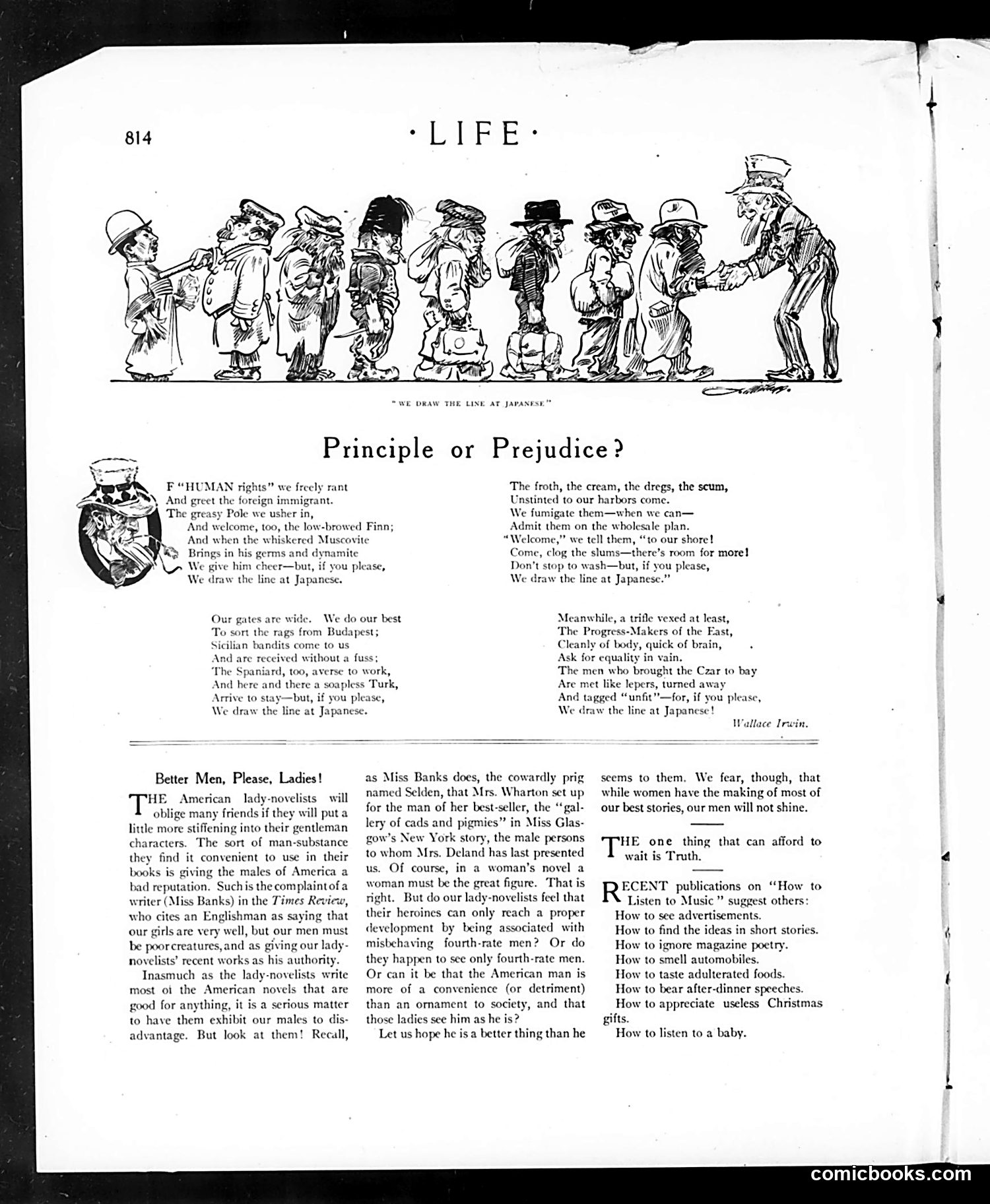
**The Cartoon:** The top illustration shows Uncle Sam (right, in stars-and-stripes hat) refusing entry to a line of immigrants of various ethnicities—representing "the froth, the cream, the dregs, the scum" mentioned in the accompanying poem. The caption "We Draw the Line at Japanese" indicates this specifically targets Japanese immigration exclusion. **The Point:** The satirical poem "Principle or Prejudice?" critiques American immigration hypocrisy. While America claims to welcome all races and nationalities, it selectively excludes Japanese immigrants despite professing "human rights." The cartoon mocks this contradiction—Uncle Sam welcomes Europeans (Finns, Muscovites, Turks, Spaniards) but rejects Japanese applicants, exposing that American "principles" mask racial prejudice.
📄 Transcribed text from this page (OCR, searchable)
Machine-transcribed from the original scan — historical spelling and the odd misread are preserved.
\, And greet the foreign immigrant. The greasy Pole we usher in, welcom iy ) We give him ch We draw the line at Japanese. ‘The Spaniard, too, And here and ther Arrive to stay—but, F “HUMAN rights” we freely rant too, the low-browed Finn; And when the whiskered Muscovite KY Brings in his germs and dynamite oC —but, if you please, Our gates are wide. We do our best To sort the rags from Budapest; Sicilian bandits come to us And are received without a fuss; ii Verse to soapless you p We draw the line at Japanes "WE DRAW THE LINE AT JAPANE Principle or Prejudice? The froth, the cream, the dregs, the scum, Unstinted to our harbors come. We fumigate them—when we can— “Welcome, Admit them on the wholesale plan. we tell the Come, clog the slum: Don't stop to wash m, “to our shore! —there’s room for more! but, if you please, We draw the line at Japanese.” Meanwhile, a trifle vexed at ‘The Progress-Makers of the Cleanly of bod Ask for equal quick of brain, in vain, The men who brought the Czar to bay Purk, Are met like lepers, turned away ase, And tagged “unfit""—for, if you please, We Better Men, Please, Ladies! HE American lady-novelists _ will oblige many friends if they will put a little more stiffening into their gentleman characters. The sort of man-substance they find it convenient to use in their books is giving the males of America a bad reputation. Suchis the complaintof a writer (Miss Banks) in the Times Review, who cites an Englishman as saying that our girls are very well, but our men must be poorcreatures,and as giving our lady- novelists’ recent works as his authority. Inasmuch as the lady-novelists write most oi the American novels that are good for anything, it is a serious matter to have them exhibit our males to dis- advantage. But look at them! Recall, as Miss Banks does, the cowardly prig named Selden, that Mrs. Wharton set up for the man of her best-seller, the “gal- lery of cads and pigmies” in Miss Glas- gow’s New York story, the male persons to whom Mrs. Deland has last presented us. Of course, in a woman's novel a woman must be the great figure. That is right. But do our lady-novelists feel that their heroines can only reach a proper development by being associated with misbehaving fourth-rate men? Or do they happen to see only fourth-rate men. Or can it be that the American man is more of a convenience (or detriment) than an ornament to society, and that those ladies see him as he is? Let us hope he is a better thing than he fraw the line at Japanese! Wallace Irwin. seems to them, We fear, though, that while women have the making of most of our best stories, our men will not shine. HE one thing that can afford to wait is Truth, ECENT publications on “How to Listen to Music ” suggest others: How to see advertisements. How to find the ideas in short stories. How to ignore magazine poetry. How to smell automobiles. How to taste adulterated foods. How to bear after-dinner speeches. How to appreciate useless Christmas gifts. How to listen to a baby. comicbooks.com